https://www.nytimes.com/2026/02/02/us/supreme-court-nondisclosure-agreements.html
Feb 02, 2026
Is John Roberts a Neo-Faschist?
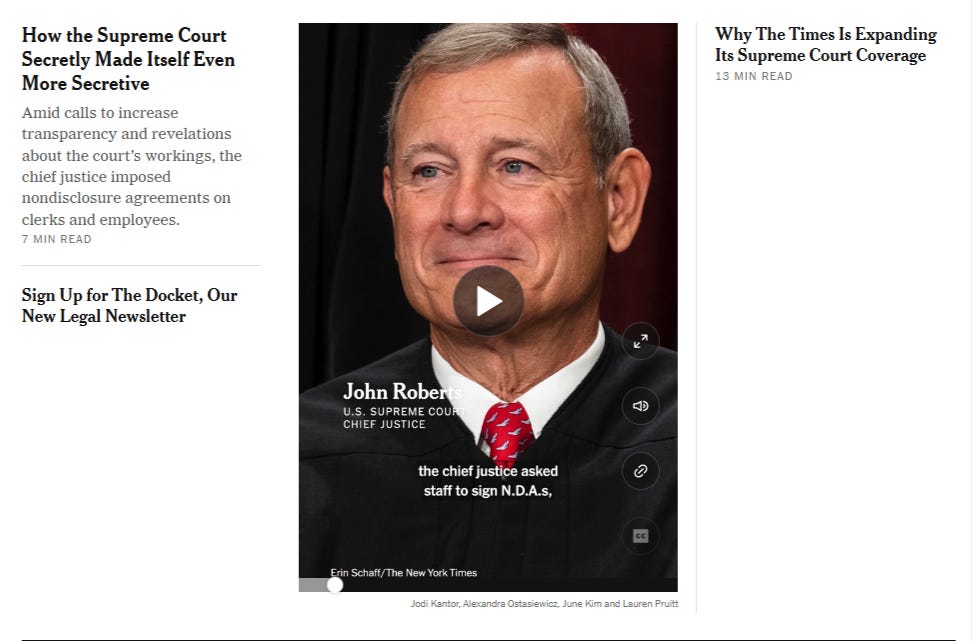
Feb 02, 2026
Is John Roberts a Neo-Faschist?
Feb 01, 2026
David Remnick
Editor, The New Yorker
Is Gavin Newsom running for President? “I’m not thinking about running, but it’s a path that I could see unfold,” he has said, offering a new twist on the tradition of pre-announcement coyness. Many political kibitzers consider Newsom to be the front-runner for the Democratic nomination—“an odd claim,” the New Yorker staff writer Nathan Heller points out in this week’s issue, “about a race in which nobody is yet running.”
Newsom, who leads the nation’s most populous and powerful state, continues to position himself in direct opposition to Donald Trump. To do so, he sometimes seems to borrow from Trump’s noisy tactics of self-presentation. Newsom is brash, confrontational, unrelenting. He gleefully baits the President on social media, weaponizing Trump’s own tactics against him. He recently helped lead California to pass Proposition 50, a sort of tit-for-tat legislative response to gerrymandering in Texas, a moment that galvanized Democrats nationally (and, conveniently, allowed Newsom to flex his coalition-building skills). His hope is to extend his appeal well beyond states as reliably blue as California. As the veteran Democratic Party operative James Carville told Heller, “Part of his selling will have to be, I can play in the middle of the country—I can play fresh water and I can play salt water.”
In this Profile, Heller provides a definitive portrait of Gavin Newsom. He explores Newsom’s upbringing (perhaps less humble than Newsom cares to admit) in the Bay Area and his dramatic rise in California politics. Heller charts how Newsom’s early battles with dyslexia still influence his working style today. (The Governor memorizes speeches rather than reading them, because he sees lines on a teleprompter “as a single image, like a Chinese character.”) His report is filled with fascinating details about Newsom’s character, his thinking, and his flaws. We learn a great deal about how he operates. The Governor reads a compendium of right-wing blogs every morning. He has nine thousand twenty-two contacts in his phone, “and is in touch with a startling number of them,” Heller writes. (“It’s like his focus group,” one former adviser said.) Newsom does not suffer from blandness. Reported over many months, Heller’s piece makes it plain that Newsom’s life and career is filled with personal drama, political confrontation, and raw ambition. He can, “at times,” Heller notes, “seem more like the Tom Cruise of politics, more successful than beloved.” But he is studying the recent past with care to make sure he optimizes his chances in 2028. As Heller writes, Newsom “dutifully records every explanation he hears for the Democrats’ losses in 2024 on a list that now runs to twenty-seven pages.”
Heller, who had deep access to Newsom and the people in his personal and political worlds, pulls off a difficult feat: he offers a fresh and useful perspective on a politician who has been around for a long time. At a moment when the nation’s focus is, rightfully, on the chaos sown by the current Administration, it’s a look at what might come next. Depending, of course, on whom you ask. Some in California are a little less coy about Newsom’s future. Willie Brown, a former mayor of San Francisco said, matter-of-factly, of Newsom’s Presidential aspirations, “I think he’s had that in mind from Day One.”
Newsom, for his part, likes to play it cool. “He tells people that, if his political career ended tomorrow, he would return to life in business, and what a mercy that would be,” Heller writes. “But the feint convinces almost no one.”
…
The New Democrats of a retooled and medatious Reaganism, whose betrayel of FDR & Ferdinand Pecora of Glass-Steagall Banking Act of 1933, is about the utter bankruptcy of a Political Party, that has become the toxic and self-aggrandizing twin of The Republicans!
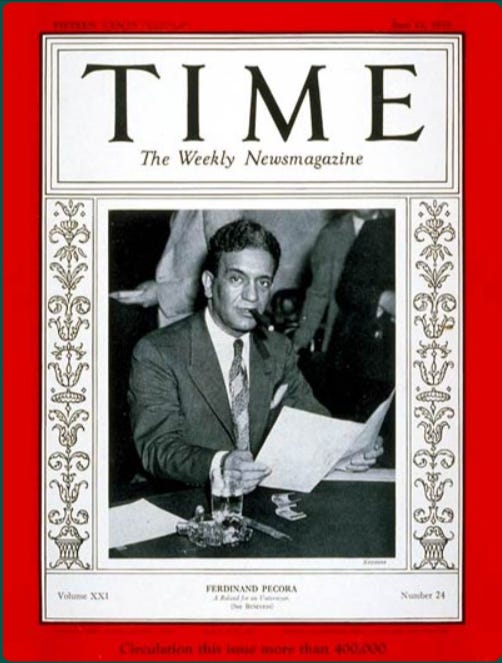
Editor: In the face of Trump and Trumpism, in its various expressions of internal political moral/civic/intitutional collapse: what David Remnick offers what is not quite an introduction, that he manages to construct a kind of political melodrama, that he mines from Nathan Heller’s reportage!
Newspaper Reader.
Jan 31, 2026
Editor: the opening paragraphs of this diatribe the Econonist fellow traverls provide a sketch of what is to follow. The miscreants are named and shamed. In italics below, and the virtious in bold font! The Economist writer is attached to her self-regard, while ignoring the powerful figure of Adam Smith! And his The Theory of Moral Sentiments (1759) and his An Inquiry into the Nature and Causes of the Wealth of Nations (1776) that are equal in importance, to a possible intellectual rapprochement, that eludes the The Economists self-serving reductivist Intelectual History !
Liberalism is a broad church. In this series we have ranged from libertarians such as Robert Nozick to interventionists such as John Maynard Keynes. Small-government fundamentalists like Friedrich Hayek have rubbed shoulders with pragmatists such as John Stuart Mill.
But there are limits. Our last brief seeks to sharpen the definition of liberalism by setting it in opposition to a particular aspect of the thought of three anti-liberals: Jean-Jacques Rousseau, a superstar of the French Enlightenment; Karl Marx, a 19th-century German revolutionary communist; and Friedrich Nietzsche, 30 years Marx’s junior and one of philosophy’s great dissidents. Each has a vast and distinct universe of ideas. But all of them dismiss the liberal view of progress.
In this primer
Liberals believe that things tend to get better. Wealth grows, science deepens understanding, wisdom spreads and society improves. But liberals are not Pollyannas. They saw how the Enlightenment led to the upheaval of the French revolution and the murderous Terror that consumed it. Progress is always under threat.
And so liberals set out to define the conditions for progress to come about. They believe that argument and free speech establish good ideas and propagate them. They reject concentrations of power because dominant groups tend to abuse their privileges, oppressing others and subverting the common good. And they affirm individual dignity, which means that nobody, however certain they are, can force others to give up their beliefs.
In their different ways Rousseau, Marx and Nietzsche rejected all these ideas. Rousseau doubted that progress takes place at all. Marx thought progress is ordained, but that it is generated by class struggle and revolution. Nietzsche feared that society was descending into nihilism, but appealed to the heroic übermensch in each person as its saviour. Those coming after them did terrible things in their name.
…
Editor: In the final paragraphs of this essay, Nietzsche and his epigones take center stage. Name it political histeria mongering for the Economist reader to chew on! Via Sue Prideaux!
The will to power
Nietzsche sets out his view of progress in “On the Genealogy of Morality”, written in 1887, two years before he was struck down by insanity. In writing of extraordinary vitality, he describes how there was a time in human history when noble and powerful values, such as courage, pride and honour, had prevailed. But they had been supplanted during a “slave revolt in morality”, begun by the Jews and inherited by the Christians under the yoke of the Babylonians and later the Romans. Naturally, the slaves elevated everything low in themselves that contrasted with their masters’ nobility: “The miserable alone are the good…the suffering, deprived, sick, ugly are also the only pious, the only blessed…”.
The search for truth remained. But this has led ineluctably to atheism, “the awe-inspiring catastrophe of a 2,000-year discipline in truth, which in the end forbids itself the lie involved in belief in God.” “God is dead…” Nietzsche had written earlier. “And we have killed him.”
It takes courage to stare into the abyss but, in a life of pain and loneliness, courage was something Nietzsche never lacked. Sue Prideaux, in a new biography, explains how he tried desperately to warn the rationalists who had embraced atheism that the world could not sustain the Christian slave morality without its theology. Unable to comprehend suffering in terms of religious virtue or the carapace of virtue vacated by religion, humanity was doomed to sink into nihilism, in a bleak and meaningless existence.
Nietzsche’s solution is deeply subjective. Individuals must look within themselves to rediscover noble morality by becoming the übermensch prophesied in “Thus Spake Zarathustra”, Nietzsche’s most famous work. Characteristically, he is vague about who exactly an übermensch is. Napoleon counted as one; so did Johann Wolfgang von Goethe, the German writer and statesman. In his lucid survey of Nietzsche’s thought, Michael Tanner writes that the übermensch is the heroic soul eager to say Yes to anything, joy and sorrow alike.
Nietzsche is not susceptible to conventional criticism—because ideas pour out of him in a torrent of constantly evolving thought. But both left and right have found inspiration in his subjectivity; in linguistic game-playing as a philosophical method; and in how he merges truth, power and morality so that might is right and speech is itself an assertion of strength. He is father to the notion that you cannot divorce what is being said from who is saying it.
The illiberal view of progress has a terrible record. Maximilien Robespierre, architect of the Terror, invoked Rousseau; Joseph Stalin and Mao Zedong invoked Marx; and Adolf Hitler invoked Nietzsche.
Newspaper Reader.
Jan 30, 2026
David Brooks and Reinhold Niebuhr: A selection of my comments on Niebuhr, under various guises!
Posted on January 18, 2026 by stephenkmacksd
Jan 10, 2026
David Brooks infatuation with Reinhold Niebuhr is equal to Brooks impersination of the very tallented Mario Buatta the Princed Chintz? With apologies to the very talented Mr. Buatta. Mr. Brooks does not write political commentary, but resorts to a feckless impersonation, of what actual political commetary might resemble, a pastisch of Walter Lippmann? Here are a selection of my comments on Neibuhr over time.
On The Theopolitics of Reinhold Niebuhr by Political Observer
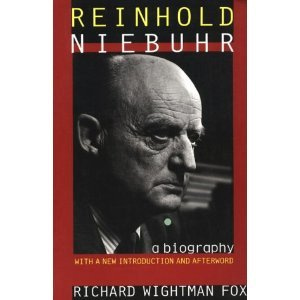
I’ve just finished a Reinhold Niebuhr biography by Richard Fox published in 1985. That I find Mr. Niebuhr repugnant as person and Christian Moralist is a statement of my prejudice, without apology. I felt that I wanted to understand who the man was and where he came from. Those questions are answered in some detail in Mr. Fox’s biography, although Mr. Fox seems to be satisfied with hagiography rather that critical engagement with Mr. Niebuhr as theopolitician. Niebuhr appears to be a religious and political conformist swept along from Socialism to Cold War Liberalism: always a little too anxious to prove his patriotism, his Americaness. Niebuhr has become the object of a cult headed by President Obama, perhaps because of the tough minded moralizing represented by Christian Realism: which could be more accurately named Christian Imperialism. It has something in common with the Protestant Christian Politics of Woodrow Wilson, with an emphasis on the necessary use of violence, to reach political ends deemed important enough to warrant it. In the name of the greater political good, even as necessary to emancipate, if only temporarily, man from his natural sinful and irredeemable self-hood. This cliché of the Christian Tradition reeks of the self-hating Augustine, and his successors, who institutionalized the persistent, morally destructive Christian anti-humanism. Imperial Politics with a thin veneer of carefully cultivated piety is an American tradition. I would call Niebuhr hopelessly Middlebrow: more about the care and maintenance of bourgeois political respectability and the self-exculpatory, as key to ex post facto rationalizations identified as ‘Philosophy’ . I was impressed, and moved by one person’s character in Mr. Fox’s biography of Reinhold, and that was the love, devotion and steadfastness of his brother Richard. Engaging with the ‘Philosophy’ of Mr. Niebuhr using the valuable historical frame provided by Mr. Fox will enrich my further reading.
Political Observer
May 24, 2012
Posted on August 2, 2017 by stephenkmacksd
Niebuhr’s reputation as a primary American Philosopher demonstrates with stunning clarity the paucity of intellectual standards in America. He was no Sartre, Heidegger nor was even comparable to William James. He was, in fact, a tent preacher with intellectual and moral pretension. As Richard Fox’s near worshipful biography points out, time after time, Niebuhr was a craven political and moral conformist: in his days in Chicago he opined that the working class shouldn’t give up violence as a methodology and that he was Marxient thinker. Those pronouncements came back to haunt him when J. Edgar Hoover was stalking him. The political result was Niebuhr’s letter denouncing ‘The Left’, not to speak of formation the ADA, with ‘Vital Center’ author Arthur Schlesinger, Jr. Protecting ‘Liberal Free Speech’ but throwing ‘The Left’ to the McCarthy/Nixon wolves and their political capo J.Edgar Hoover. Please read Schlesinger’s diary entries from the early 50’s, where he makes noises like ‘Big Jim McLain‘, the use of the word ‘commies’ is indicative of the political myopia demonstrated by sons, who edited his diaries for publication. Accurate history is more important than covering your old man’s ass! Those entries, read in the political present express both the comedy and menace of Schlesinger’s obsequious political conformity.
Niebuhr shared something in common with ‘friendly witness’ Elia Kazan: the rationalization that bound their separate careers was that they both thought that their ‘radical pasts’ should not interfere with their very important, indeed vital life mission. Kazan’s was making movies and Niebuhr’s was winning converts to ‘Christian Realism’ ,which was in sum a riff on ‘render unto Caesar’ and the central belief in ‘Inherent Evil’ of the human person. Institutional Christian Self-Hatred is Augustine’s self-loathing for being human writ large, and his later epigones.
The reader can see the why of President Obama’s admiration for this ersatz ‘American Philosopher’, both share a belief in, not just the imperfectability of the human person, but its inherent ‘Evil’, allied with a political/moral rhetoric that appeals to the aspirations of their respective audiences. Christian Realism advocates/embraces not just the idea of the saved and dammed in eschatological terms, but in terms of the Cold War ethos. That ethos has now been applied, by Obama, to the Age of The War on Terror, and the utterly catastrophic Neo-Liberal Theology, that has been operative since the Reagan era. Note that Obama never praised FDR, but was fulsome in his praise for Reagan.
Almost Marx
Here is an excerpt from Alice Bamford’s review of Amanda Anderson’s ‘Bleak Liberalism’ in the New Left Review of May/June 2017. Which places ‘Liberalism’ and its primary thinkers like Schlesinger and Niebuhr, among others, to an examination of their political mendacity: which looks like a utter betrayal of what that ‘Liberalism’ could have been. If only its thinkers/defenders had exercised something like dissent as a singular moral/political imperative of that very ‘Liberalism’. Is the Liberal thinker/actor even capable of such an act of moral imagination?
Yet while ostensibly offering a defence of ‘political liberalism’, Anderson’s case rests on a near total abstraction from politics as such. Despite the pivotal role played by their thought in her narrative, the record of Anderson’s chosen Cold War liberals is never examined. Clergyman Niebuhr approved the atomic obliteration of Hiroshima and Nagasaki, applauded the development of the H-bomb, and advocated the ethnic cleansing of Palestine. Schlesinger colluded with (and lied about) the us invasion of Cuba, backed Kennedy’s wars in Indochina and counselled Americans under Johnson that ‘we must hold the line in Vietnam’, even telling Defense Secretary Robert McNamara, architect of escalation under both presidents: ‘You have been one of the greatest public servants in American history, and your departure from the government is an incalculable loss to this nation.’ Aron never spoke out against the French occupation of Indochina, or torture in Algeria; Camus not only refused to condemn France’s Algerian war, but backed the Suez expedition against Egypt. Berlin witch-hunted Isaac Deutscher out of a job in the British academy. Such particulars of the past, however, are too mundane for reference on the nebulous plane at which the history of ideas enters Bleak Liberalism.
https://newleftreview.org/II/105/alice-bamford-in-the-wake-of-trilling
A.M.
(Added August 3, 2017 7:33 AM PDT)
On The Cult of Niebuhr by Political Observer
Posted on October 18, 2011 by stephenkmacksd
How can one dismiss the Christian Realism of Reinhold Niebuhr? Because his special brand of intellectually inflected political conformism fits so handily in this modern age of outright attacks on citizens, by their own government? Of drone attacks on civilian populations, argued by government agencies to be the locus of terrorist activities? Of preemptive war against states possessing weapons of mass destruction? That he is a Christian Theologian add luster to his varied career as political apologist for the Cold War and the National Security State. While some might even argue that he is the thinking man’s Billy Graham, with a more persuasive intellectual resume. With his ally Mr. Schlesinger singing his praises, as an intellectual leader, and with their creation of what was to be the ADA, a refuge of Liberals anxious to establish their credentials as anti-communists: freedom of political expression for right and left wing social democrats only! One need only read Mr. Schlesinger’s tedious and self-congratulatory diary entries of the period; with his penchant for the use of the word ‘commie’, to identify political dissidents of that benighted age in America.
As for Mr. Niebuhr’s status as political philosopher, he has an intellectual breadth and a seemly ever changing, evolving set of ideas tending toward conservatism as he aged. The addition of the fallen nature of ‘man’, the sine qua non of the Christian mythology, appealed to the deep stain of Puritanism still active in the American consciousness: the world historical battle between good and evil as background. He was a public intellectual with something to offer Liberal and Conservative thinkers, a kind of Cold War Pragmatist, perfect for our age of suspicion, our age of terror, peopled by intellectual pretenders of all stripes.
Political Observer
Andrew Sullivan,Reinhold Niebuhr,’Christian Realism’ and President Obama by Political Observer
Posted on May 27, 2013 by stephenkmacksd
I find the public career of Mr. Andrew Sullivan puzzling, disappointing even infuriating. I started reading him when he was writing for The New York Observer and subsequently as he and Christopher Hitchens kept the debate of 9/11 within the bounds that they thought as reasonable, intellectually and politically acceptable, two stern enforcers of their continually evolving master ideas.
The two rhetorical policeman dismissing the charlatans who dared to express an opinion outside the the ken of these two intellectual capos. Vicious, dismissive and utterly ruthless to those they identified as unfit to comment on the most recent American Wound. Part of the collection of jingos and war mongers in the American intelligentsia that announced themselves in the subsequent day and weeks after the attacks on the World Trade Center.
Both became enthusiasts, celebrants of the Iraq War and just as quickly became disenchanted of their momentary celebration of the martial spirit, in the name of the honored dead and the need for retribution, even though their was no connection between the 9/11 perpetrators and Iraq, none.
That sorry, dismal, murderous folly is almost behind us or so Mr. Sullivan instructs us in his latest essay titled An End in Sight. He congratulates President Obama and, of course, himself in the process. But let me point to one telling paragraph:
“My view entirely. I’m struck too by his Niebuhrian grasp of the inherent tragedy of wielding power in an age of terror – a perspective his more jejune and purist critics simply fail to understand. This seems like a heart-felt expression of Christian realism to me:”
It is totally appropriate that Mr. Sullivan should frame his argument using the name of Niebuhr and his intellectual child ‘Christian Realism’ to add a certain theological/political gloss to his argument, that bit of cosmic melodrama that so appeals to his inflated sense of himself as a modern seer, prophet.
In that regard Mr. Niebuhr and Mr. Sullivan are kindred spirits in the celebration of God and the political realism, the Christian Realism that recognizes the importance of the state, as the indispensable political actor that can bring their respective religiously inflected politics into the realm of the actionable, the real. In a way, Mr. Sullivan and Mr. Niebuhr, in their respective personal and historical contexts, are acolytes of the dyad of state power/masculine power.
Political Observer.
Jan 29, 2026
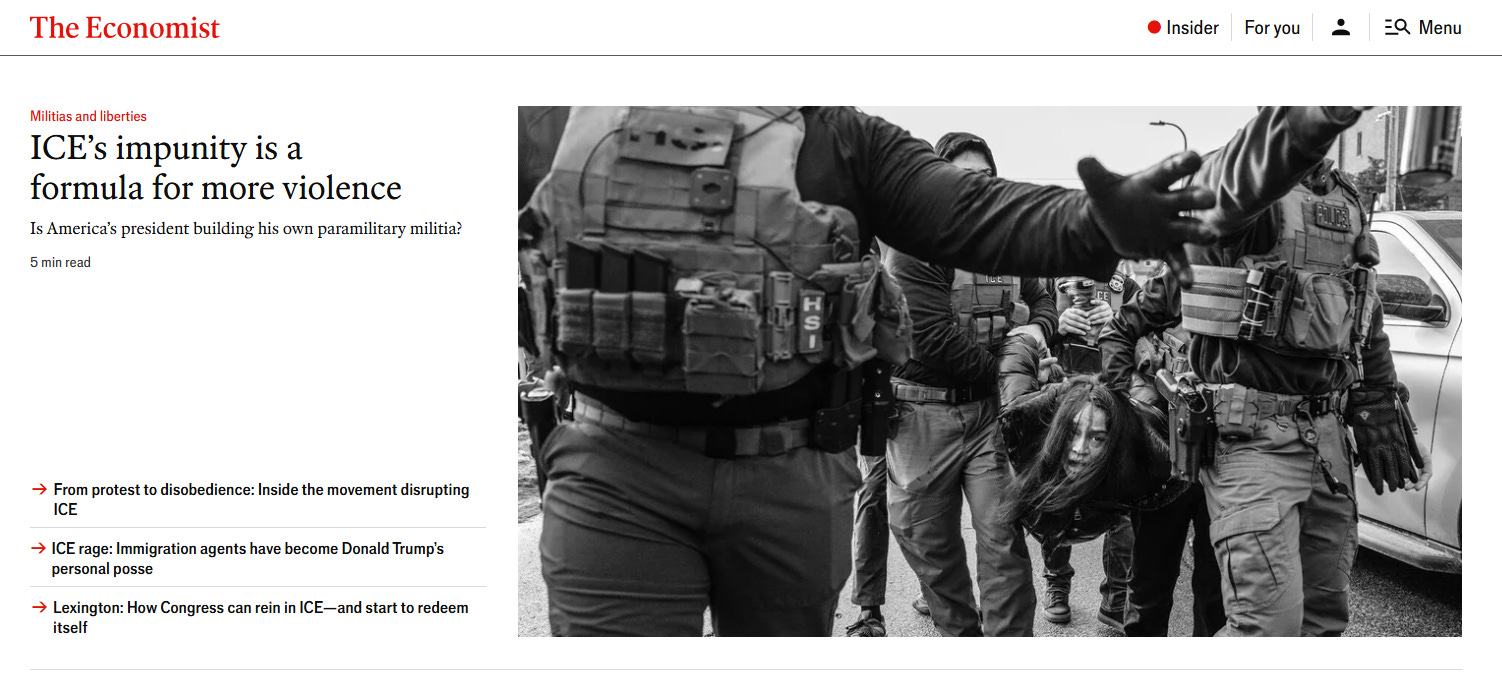
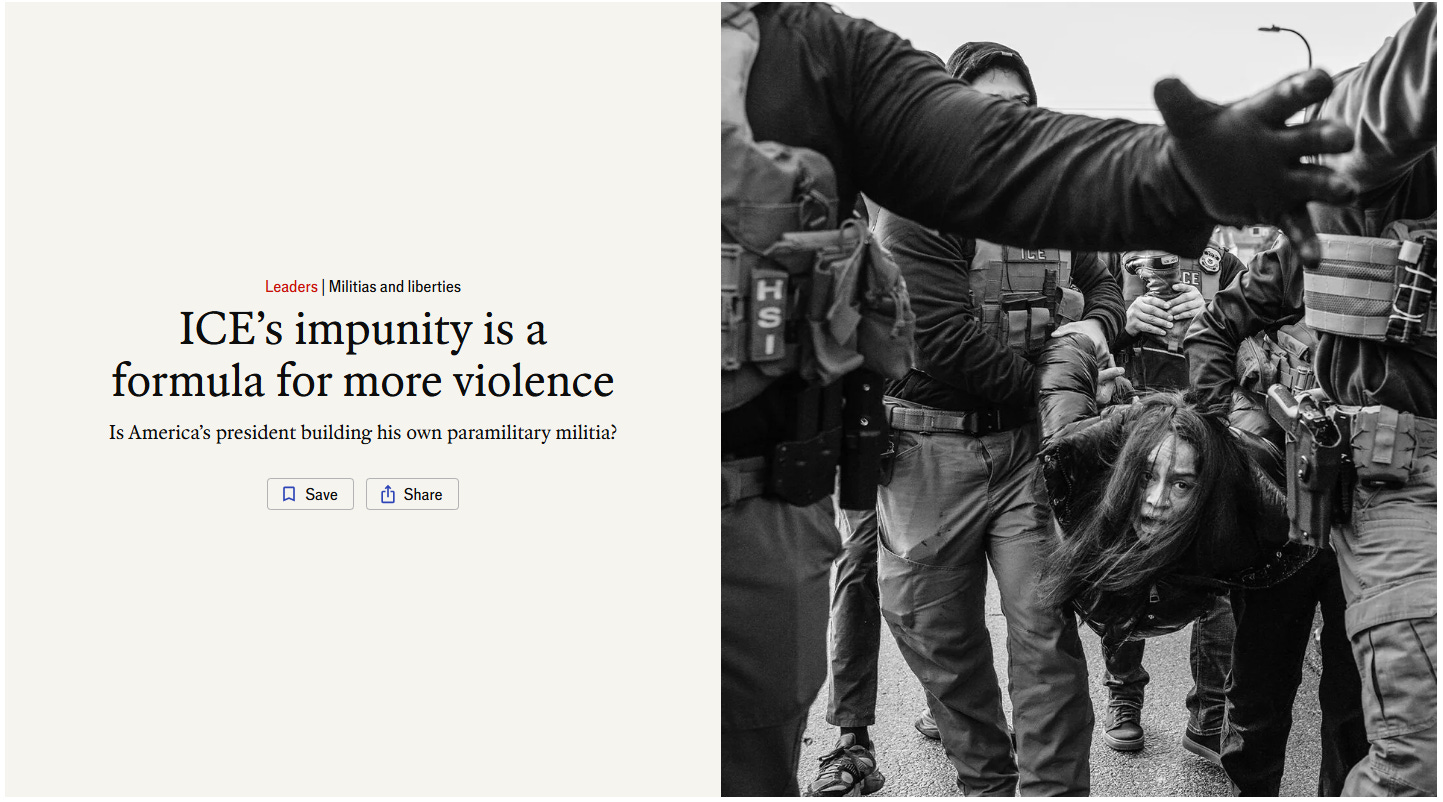
https://www.economist.com/leaders/2026/01/29/ices-impunity-is-a-formula-for-more-violence
Jan 29, 2026
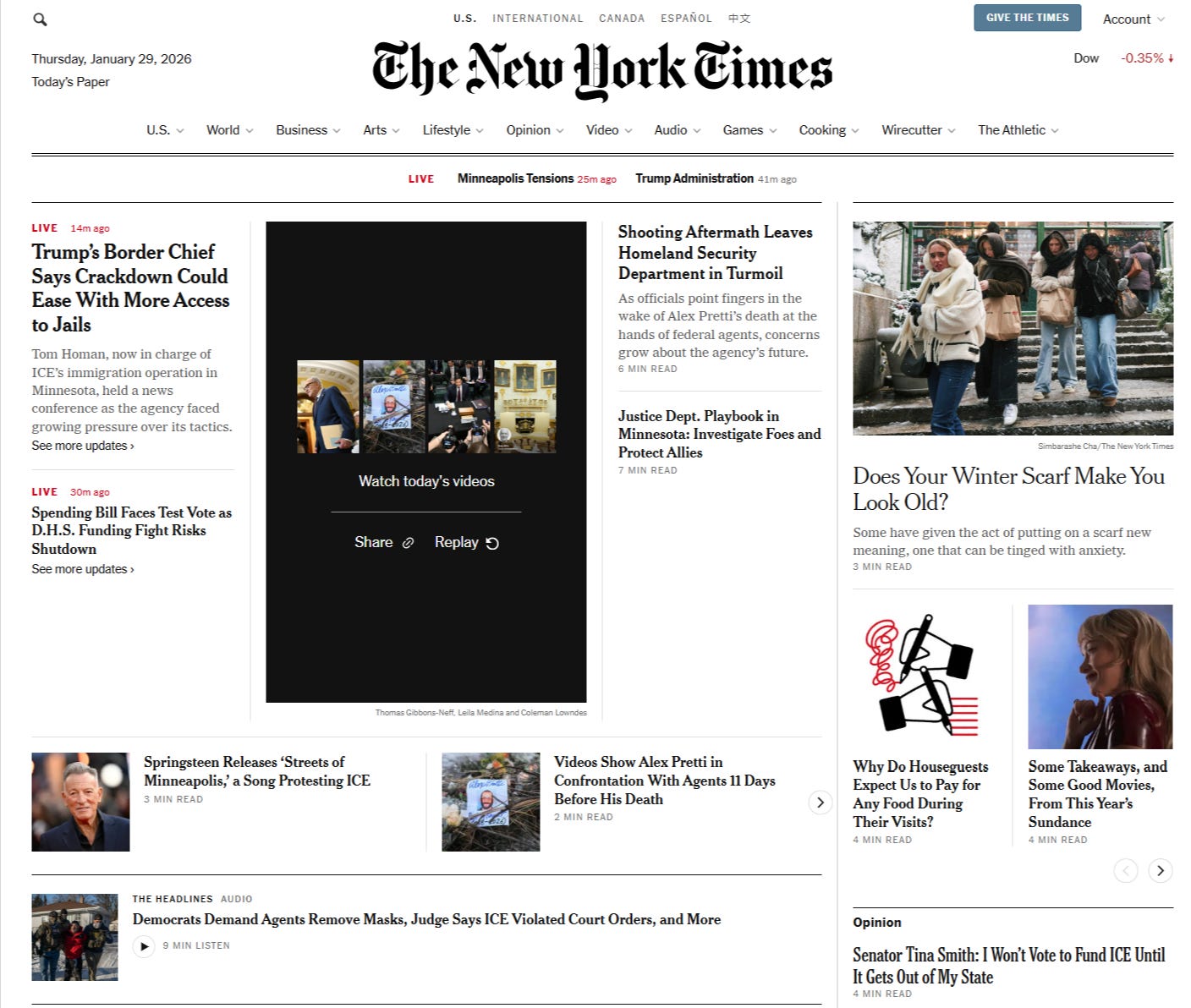
Thursday, January 29, 2026
Dow
-0.35%
Jan 28, 2026
Publius on Elizabeth Drew’s latest essay
Posted on February 2, 2012 by stephenkmacksd
http://www.nybooks.com/articles/archives/2012/feb/23/can-we-have-democratic-e…
Here is Elizabeth Drew’s latest essay in the New York Review of Books, Can We Have a Democratic Election? In which she raises many important questions that escape the ‘pundits’ who are covering the campaign as a ‘horse race’. She asks some basic questions that escape the handicapping mentality of her competitors, in the forth estate. That is what gives this essay it’s political resonance: her arguments are powerful, her reasoning hard to refute. She also describes a Republican Party, in the states, as engaging in a concerted campaign of ‘voter suppression’, and the devastating effects of the Citizens United Supreme Court decision.
The Republican Party in desperation after the defeat of 2008 has progressively descended into political nihilism, using the idea of ‘voter fraud’ as rationale for restrictive laws that demand state issued ID’s, in order to cast a vote. No voter fraud has been demonstrated, but the laws were passed in the name of protecting the electorate, from a pernicious problem that does not exist. The young,the poor,black folk and students generally vote Democratic, so that restrictive election laws aimed at these groups make perfect sense, in the domain of Rovian politics.
On the Citizens United decision, one must just recall John Roberts thrilling encomium to stare decisis before the Senate Judiciary Committee, as not just a tribute to his intellectual brass,and mendacity but as simply a eulogy to that legal workhorse, when political motive rules the day. Have I gone too far in the arena of respectable bourgeois political commentary?
If the Republican Party is at the end of it’s political rationality, and Barack Obama asserts the right to execute American citizens by presidential fiat, to attack ‘terrorists’ by the use of drones, wherever they may seek refuge, and NDAA has been passed by Congress and signed into law by the president, which weakens habeas corpus protections: where are we as citizens?
Publius.
Editor: A revelatory quotation from the final paragraphs of Elizabeth Drew’s essay:
…
Citizens are now faced with evidence of the growing power of organized moneyed interests in the electoral system at the same time that the nation is more aware than ever that the inequality among income groups has grown dramatically and economic difficulties are persistent. This is a dangerous brew. Political power is shifting to the very moneyed interests that four decades of reform effort have tried to contain. The election system is being reshaped by the Super PACs and the greatly increased power of those who contribute to them to choose the candidates who best suit their purposes. But little attention is being paid to the fact that our system of electing a president is under siege. While the political press is excitedly telling us how the polls on Friday compare with the ones on Tuesday, little notice is taken of the danger to the democratic system itself.
Much of the citizenry has become more restive—less accepting of the way things are. Can an election that’s being subjected to such seriously self-interested contortions be accepted by the public as having been arrived at in a fair manner? And what will happen if it can’t?
Editor here are more of Elizabeth Drew’s commentaries:
Dividing to Rule: Trump’s Midterm MayhemNovember 2, 2018
November 2, 2018
How Obamacare SurvivedJuly 28, 2017
July 28, 2017
Trump: The Presidency in Peril June 22, 2017 issue
The president’s troubles will continue to grow as the investigators keep on investigating and leakers keep on leaking.
June 22, 2017 issue
Publius.
Jan 28, 2026
Editor: I will focus my attentions on the final paragraphs of Stephens diatribe!
…
Iran’s traumatized protesters might have been energized by a U.S. attack when they were still in the street; they would probably be unwilling to risk their necks again. The regime has surely learned the lesson of Israel’s successful strikes last June against its top commanders and is hiding its leaders much more effectively. Last year’s Israeli strikes on Iran’s ballistic missile sites did not keep Iran from restarting production lines once the war had ended. And a U.S. attack, even one that carefully spares civilians, will also reinforce the regime’s propaganda about perfidious Uncle Sam.
Weighed against all this is a different set of risks: of the example of a U.S. president who urged protesters to go in the streets and said help was on the way only to betray them through inaction; of missing the opportunity to cripple an enemy when it is vulnerable, uncertain and — despite its show of force — internally divided; of giving it time to recover its strength, knowing that when it does it will again pose a clear and present danger to the United States and our allies.
And something else: Do we really want to live in a world in which people like Mohseni-Ejei, the judicial leader, can terrorize people with utter impunity? Have decades of vowing “Never again” — this Tuesday marks the anniversary of the liberation of Auschwitz — taught us nothing more than to offer pro forma condemnations when thousands of protesters are gunned down by modern-day Einsatzgruppen?
I know that, for now, thoughtful Americans are much more alarmed by the thuggish killing in Minneapolis on Saturday of Alex Pretti and by the smears to which he’s been posthumously subjected by senior members of the administration. I also know that the president who is so grotesquely at fault for inflaming the situation in Minnesota makes an unlikely champion of protesters in Iran.
But if Pretti’s death is a tragedy, what do we say or do in the face of the murder of thousands of Iranians? Are they, as Stalin might have said, just another statistic?
Editor: The Reader doesn’t need to wonder about the crass moral reductionism, of the the final paragraphs of Stephen’s attempt, at what to mame it? The Reader need only look too the Western amimus to the birth of the Iranian Revolution. Keeping in mind the murder of Iranian Scientests by Mossad, and the fact that Western Powers nurture the internal dissident’s that Stephens presents as heroic figures. ‘Pretti’s death’ is reduced to mere background to the heroism of Iranian Dissidents!
Iranian Revolution, popular uprising in Iran in 1978–79 that resulted in the toppling of the monarchy on February 11, 1979, and led to the establishment of an Islamic republic. It involved the participation of a wide range of Iranians—from the secular left to the religious right—who sought an end to the shah’s autocracy and Western interference in the country’s policies. The revolution found expression in the form of Shiʿi Islam, which many supporters considered to be a unifying element of Iranian identity and culture, and ultimately in the guidance of Ruhollah Khomeini, an accomplished religious scholar critical of the shah who had articulated, as an alternative, a populist form of government overseen by a spiritual authority.
…
https://www.britannica.com/event/Iranian-Revolution
Editor: Not forgetting the natural animus of a Zionist hysteric, and his political alligence to the Zionist State, and his time at Jerusalem Post!
Jan 27, 2026

We’re offering Stephen Graham’s powerful exposé of how political violence operates through the spaces of urban life, Cities Under Siege, as a free download. Discount applies in-cart.
Cities are the new battleground of our increasingly urban world. From the slums of the global South to the wealthy financial centers of the West, Cities Under Siege traces the spread of political v…
Ebook
Add to cartRegular price$9.99Sale price$0.00
Jan 25, 2026
Editor: Reading, or in reality reciting to myself ‘Kants Late Philosophy of Nature’ in the Cambridge Elements series.
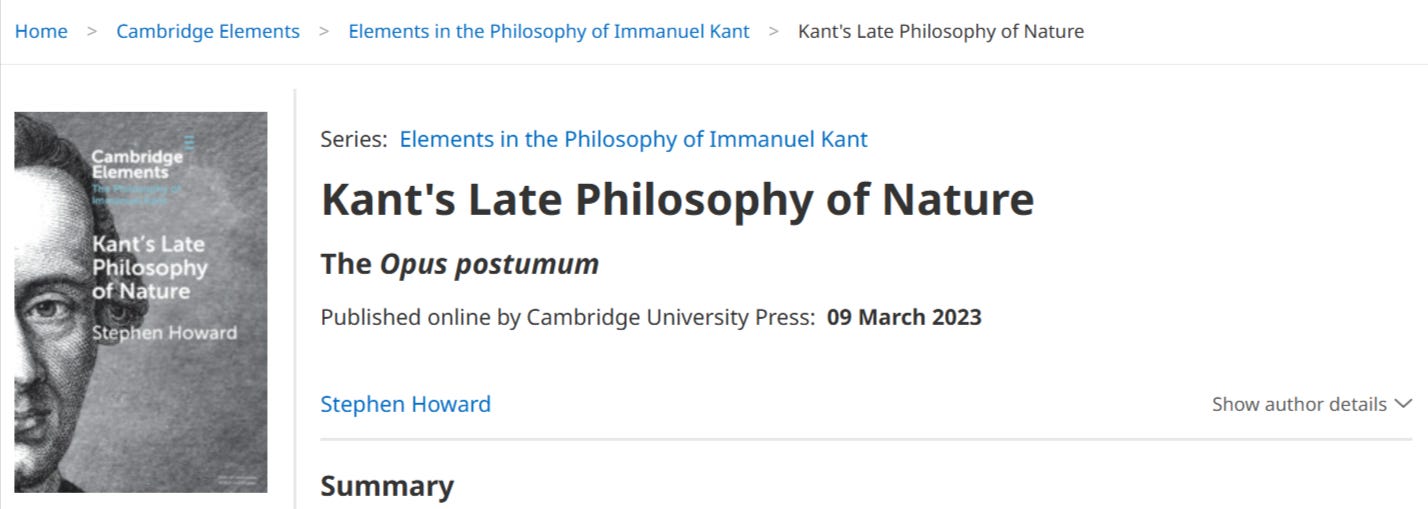
Kant’s final drafts, known as his Opus postumum, attempt to make what he calls a ‘transition from the metaphysical foundations of natural science to physics.’ Interpreters broadly agree that in this project Kant seeks to connect the general a priori principles of natural science, as set out in the major critical works, to the specific results of empirical physics. Beyond this, however, basic interpretative issues remain controversial. This Element outlines a framework that aims to combine the systematic ambition of early twentieth-century readings with the rigor of more recent studies. The author argues that a question that has animated much recent scholarship – which ‘gap’ in Kant’s previous philosophy does the Opus postumum seek to fill? – can be profitably set aside. In its place, renewed attention should be given to a crucial part of the manuscript, fascicles X/XI, and to the problematic ‘arrival point’ of the transition, namely, Kant’s question: What is physics?
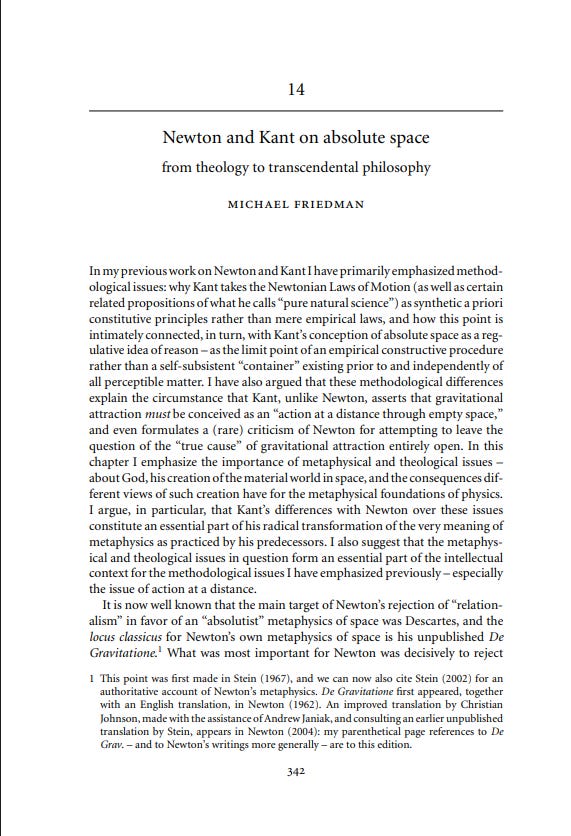
Editor: On page 49 footnote 74, Howard mentions Newton’s Principia book 3 ‘OnThe System of the World’ which led me here :
https://philosophy.duke.edu/books/interpreting-newton-critical-essays
And here:
Philosopical Apprentice.
September 4, 2025
Michael Friedman Faculty Profile
“On Looking for—and Finding—Epistemology in the Aufbau. An Homage to Michael Friedman (1947-2025)” Webinar delivered by Alan Richardson (University of British Columbia) on June 11, 2025.
A Celebration of Life was held for Michael and Graciela at the Frances Arrillaga Alumni Center on June 10. Please enjoy a video recording of the event.
Read a tribute to Michael on the Stanford H&S site.
The Stanford Philosophy Department mourns the passing of our colleague, the prominent philosopher Michael L. Friedman, who died at Stanford Hospital on March 24, 2025 after a long illness. He was 77. Friedman was the Suppes Professor of Philosophy of Science at Stanford until his retirement in 2024.
Friedman (Ph.D. Princeton, 1973) had been our colleague in Stanford Philosophy since 2000. He taught previously at Harvard (1972-75), the University of Pennsylvania (1975-82), the University of Illinois at Chicago (1982-94), and Indiana University (1994-2000), where he served as Chair of History and Philosophy of Science. He also held visiting positions at Harvard, UC Berkeley, Western Ontario, Konstanz, Oxford, and the Max Planck Institute for the History of Science in Berlin. He was made Fellow of the American Academy of Arts and Sciences in 2001, and was President of the Philosophy of Science Association in 2000. He was awarded the 1987 Lakatos Prize (for Foundations of Space-Time Theories), the 1985 Matchette Prize (for the same work), and the 2015 Fernando Gil International Prize in Philosophy of Science (for Kant’s Construction of Nature).
Michael Friedman was among the most incisive philosophical intelligences of our era, and his work left an indelible mark on the philosophy of science, on Kant studies, and on philosophy more broadly. His early work on space-time theories and on unification-based theories of scientific explanation was broadly influential. Noteworthy highlights include the Lakatos prize-winning Foundations of Space-Time Theories (1983) and the widely cited paper “Explanation and Scientific Understanding” (J Phil, 1974). Over time, his interests and his contributions steadily moved in the direction of greater historical depth. “Kant’s Theory of Geometry” (Phil Rev, 1985) initiated Friedman’s field-shaping intervention into Kant scholarship, and sparked a series of penetrating studies that found an early culmination in the landmark book Kant and the Exact Sciences (1992), which decisively reoriented Kant studies by restoring the systematic Kantian account of the foundations of exact scientific knowledge to its rightful central place in our understanding of the overall Kantian philosophy.
That project kicked off three decades of probing scholarship on Kant and Newton, which included a new translation of Kant’s Metaphysical Foundations of Natural Science (2004) and literally dozens of influential papers. The culmination of this historical work was Friedman’s monumentally detailed, Gil-prize-winning Kant’s Construction of Nature (2013), which probes the deepest and most technical details of Kant’s reconstruction of Newtonian science.
Through this research trajectory, Friedman remade himself into a scholarly historian of philosophy and science, with sensitivity to the historical actors’ own categories and the full strangeness of the past. But he never relinquished the aim of also deploying that historical depth in the service of his own novel explanations of scientific knowledge. Indeed, his historical work fed directly into his distinctive, neo-Kantian theory of the progress of science, which combined Kuhnian insights into the nature of revolutionary scientific change with Kantian ones about how a priori constitutive principles permit the formulation of well-framed scientific questions that can stand in exact relation to evidence. These ideas received initial expression in Dynamics of Reason (2001), work which began life as the 1999 Kant Lectures here at Stanford. The ideas continued to preoccupy Friedman, and a fuller and more detailed working out of the Friedman neo-Kantian conception of science was the subject of his 2012 Spinoza Lectures and his 2015 Isaiah Berlin Lectures at Oxford, as well as late papers and manuscripts on which he continued to work until his health gave out.
Friedman was also one of our major scholarly interpreters of the development of analytic philosophy and its connections to philosophy of science, with particular expertise on Carnap and logical positivism (Reconsidering Logical Positivism, 1999). In addition, he was a leading voice on the emergence of the split between “analytic” and “continental” philosophy. A Parting of the Ways (2000) shed decisive light on the previously under- or even unappreciated role played in that split by differing reactions to certain difficulties that arose in the research program of orthodox neo-Kantianism generally, and within Ernst Cassirer’s work, in particular.
Friedman’s major lecture series on the material about Cassirer, Carnap, and Heidegger, like the ones on the Dynamics of Reason material, were experiences of impressive rigor, remarkable erudition, and unforgettable intellectual excitement for those who were able to attend.
Friedman’s training touched literally dozens of students and postdocs, decisively shaping the intellectual trajectories of an exceptional group of younger scholars across the history of philosophy, the history and philosophy of the exact sciences, and contemporary philosophy of science alike. Many others of us who were never his students likewise benefitted as colleagues from his penetrating pressure and critique, and from studying his careful work. Readers can gain a sense of the depth and power of these intellectual connections from the remarkable 850 pp. volume Discourse on a New Method (2010), which brought together an impressive collection of students and colleagues to engage with themes from Friedman’s work. His own response to the contributors runs to over 200 pp., and should be considered another Friedman book in its own right.
Michael was preceded in death by his beloved wife and philosophical collaborator, our colleague Graciela de Pierris (1950-2024). He is survived by his mother, his sister, her two children, and his three grand nieces, as well as a wide circle of students, colleagues, and admirers worldwide.
Michael was a philosopher’s philosopher. He was immensely serious about our subject, and he was relentlessly demanding—both in the excellence he expected from his interlocutors (and himself), and in his recognition that knowledge and philosophical understanding are a never ending journey demanding continual improvement. As Kant rightly saw, the sort of systematic knowledge to which philosophy aspires is a regulative ideal, not an achieved fact. When one talked with Michael, philosophy was never far from the surface, whatever the ostensible topic.
His death is an enormous loss for our intellectual community here at Stanford, and for the world of philosophy.
https://philosophy.stanford.edu/news/loving-memory-michael-l-friedman-1947-2025
Philosopical Apprentice.

 StephenKMackSD's Blog