Subheadline: A 33-year-old American woman is the discreet CEO of the social media platform that, following the American presidential election, is seen as a promising alternative to the controversies surrounding X.
Officially launched in February 2023, the microblogging platform Bluesky, with 33-year-old Jay Graber as its CEO, got off to a timid start. Initially limited to a number of selected subscribers, a year later it opened up to the public and today appears as a safe haven for those who are fleeing X. Developed starting in 2019 within Twitter, Bluesky is now a public benefit corporation that has hybrid articles of association making it both a for-profit company as well as having a mission to make a positive impact on society. Unlike its competitors, it is an open-protocol operation, where the technology is accessible to all and is improved as users add to it. In an interview in March with technology news site The Verge, Graber said that the company’s mission is “to build something that’s actually a better social ecosystem for people.”
…
A woman in a man’s world
Graber is a rarity in the male-dominated world of Silicon Valley. None of the five Gafams (Google, Apple, Facebook, Amazon and Microsoft) has ever been headed by a woman, and 89% of positions of power in the tech sector are held by men. On November 13, The Guardian newspaper announced the closure of its X account and, for the past two weeks, a million new subscribers have been flocking to Bluesky every day, taking the number of subscribers to over 20 million. a far cry from the 400 million daily users claimed by X, which nevertheless, puts Graber and her management team firmly in the spotlight.
Clémentine Goldszal can hardly control her ersatz feminism for the clone of twitter/X!
One of the advantiges of being almost eighty years of age, at least in my case, is that you can recall from memory, the political controversies as they unforded on the Evenining News. The “The Negro Family: The Case for National Action.” of March 1965 is one of those memories. And that Bret Stephens resurrects the ghost of Mr. Moynihan, as some kind of arbeter of public/political morality, raised the hackles of a person alive, and sentient, at the inauspicious rise of Moynihan! The Reader might not need to wonder at the propinquity between Bret Stephens and Mr. Moynihan: Opportunism!
Editor: Mr. Stephens might have been inspired by this National Affaires essay number 61 • Fall 2016 ? At a brisk 4922 words this is political hagiography, read the final paragraphs
What, then, shall we make of Moynihan’s pungent critiques of liberals, critiques accompanied by his frequent praise of conservative thinkers ranging from Burke to Oakeshott, Kristol to Strauss?
This, after all, is someone who said that after the Great Society he “had considerably scaled down my expectations of what government could do about most things — in the early 1960s in Washington we thought we could do anything, and we found out different — and had acquired the discipline of not being too much impressed by clever-seeming people.” Liberalism in that era, he complained, “lost a sense of limits.” He lectured Democrats in 1968 — in a volume edited by a Republican congressman, and, to add insult, entitled Republican Papers — that “somehow liberals have been unable to acquire from life what conservatives seem to be endowed with at birth, namely, a healthy skepticism of the powers of government to do good.”
Citations to conservatives, meanwhile, pepper his writings. Moynihan studied at the London School of Economics around the time Michael Oakeshott arrived there, and he appears to have attended at least some of the latter’s lectures. Significantly, he deployed Oakeshott against both parties, such as when he accused each of excessive scientism in the formation of social policy: “A larger possibility is that we are seeing at work in both ‘liberal’ Democratic and ‘conservative’ Republican administrations the demon that Michael Oakeshott has identified as Rationalism — the great heresy of modern times.” (Again the quotation marks framing “liberal” and “conservative” are suggestive.) He quoted Burke at least two dozen times in his writings. He invoked Podhoretz against liberal doomsaying.
Part of the explanation for all this is that he believed liberalism needed to be nourished by an internal critique from which, especially amid the moralism of the 1960s, it had insulated itself. About his 1976 run for Senate, he said, “I ran as a liberal willing to be critical of what liberals had done. If we did not do this, I contended, our liberalism would go soft.” Moreover, some conservatives have mistaken Moynihan’s capacious intellectual curiosity, which spanned not only a diversity of topics but also a diversity of perspectives, for political compatibility. Instead, his particular proclivity for associating with, reading, and quoting conservative thinkers arose from a suppleness and habit of mind that actively sought disagreement — an aptitude largely, and sadly, lost not merely among statesmen but among scholars, a similarly insular profession.
In assessing Moynihan’s relationship to neoconservatism, the issue of party is inescapable as well. Whether because the movement has shifted, because the major political parties have realigned, or both, neoconservatism is more monolithically Republican today than when Kristol wrote in 1976. There is also no question that the second generation of neoconservatives is less Burkean and more Wilsonian than the first.
But the explanation, ultimately, distills to this: Moynihan was neither a neoconservative nor a paleoliberal. Moynihan was Moynihan. He believed in government as an agent of good, but also in limitation as a condition of life. As he wrote in 1973: “Increasingly, it is what is known about life that makes it problematical….The unexpected, the unforeseen: the public life of our age seems dominated by events of this cast.” He believed in a politics rooted in empirical circumstance rather than theoretical abstraction. He championed the subsidiary units of society — family, ethnic group, neighborhood. He respected society’s complexity, but also believed some problems required political and national solutions.
I have called this “Burkean liberalism.” But if the issue of Moynihan and the neoconservatives comes down to labels, perhaps a time may come when individuals of a certain bent, with a certain combination of beliefs, will describe themselves as “Moynihan liberals.” This would be as good a time as any.
Pundits far and wide portray Daniel Patrick Moynihan as a prophet without honor, whose unpopular message carried great potential but went sadly unheeded. Nothing could be further from the truth.
The culmination of this shift came in 1970, when Moynihan—then a member of the Nixon administration—wrote a memo that called for “a period of benign neglect” in national discussions of race. While acknowledging that “the seeds of neoconservatism” existed in the original report, Geary nonetheless identifies a shift in Moynihan’s perspective. By arguing that “the main problem was not African American inequality, but intemperate discussions of race,” Moynihan left little room for his earlier call to “national action.” Geary portrays Moynihan’s turn to the right as the result of his desire for professional advancement and his thin-skinned attitude toward his critics, not as a sign of the affinity between his ideas and those of his more thoroughly conservative fans. This is, perhaps, wishful thinking. Further, while Geary bemoans the exhaustion of 1960s liberal reform—encapsulated in miniature in Moynihan’s own exasperation with his feminist and left-wing critics—he lays too much of the blame on the doorsteps of some of Moynihan’s most incisive and unforgiving critics.
Advocates of Black Power were some of the earliest and most forceful critics of Moynihan’s “pathological” view of black family life. Stokely Carmichael’s insistence that “the reason we’re in the bag we’re in isn’t because of my mama, it’s because of what they did to my mama” cut to the heart of the Moynihan Report’s failings. Geary suggests that the Black Power movement, with its focus on reclaiming black cultural power and self-determination, not only undersold the report’s progressive call to address black unemployment but also abandoned the radical economic proposals of the civil rights movement. He laments the “unfortunate and largely unintended consequence of the Moynihan Report controversy” that “Moynihan and many of his critics shifted debate about inequality away from political economy,” identifying Black Power as one of the principal culprits of this turn away from economic issues and toward questions of identity, self-representation, and cultural worth.
This widely held idea, echoed by Geary, is a misrepresentation; in fact, he shortchanges Black Power’s own economic message. Carmichael and his collaborator, the political scientist Charles V. Hamilton, devoted most of their 1967 book Black Power to the economic and political obstacles to black mobilization and empowerment in the South and North. Carmichael and Hamilton emphasized that at the core of the problem of “institutional racism”—a term they coined—was the lack of “decent housing, decent jobs, and adequate education.” Furthermore, activists regularly invoked the signs and language of Black Power in a variety of local struggles, whether organizing against discriminatory union leadership in Detroit’s Chrysler plants or fighting for tenants’ rights on Baltimore’s housing board.
Like many writers on today’s left who are disappointed with modes of organizing based in marginalized groups’ demands for recognition, Geary disregards the power of collective consciousness to spark broad-based political action. One of the legacies of the sixties—captured by slogans like “Black Power” and “the personal is political”—is that the arenas of political economy and culture cannot be so easily disaggregated. Degrading representations are social facts, imbricated in the political economy of their day. By treating Black Power primarily as a shift from economics toward culture in the national debate on inequality, Geary unfortunately ignores its invocation in campaigns for fair housing, equal employment, and welfare rights.
The controversy surrounding the Moynihan Report is certainly a tangle of threads, and Geary skillfully unravels it, eloquently tracing each strand of debate. The report’s central legacy, unfortunately, seems all too clear. The Moynihan Report, by identifying the culture and family structure of poor black people as the cause of their poverty, has given ammunition to opponents of anti-poverty programs for decades. More broadly, it has contributed to the sadly common view that racism is a thing of the past—that we need to look elsewhere for the causes of contemporary inequality. Activism undertaken beneath the sign of Black Lives Matter has unsettled this willful blindness to the ongoing violence, discrimination, and economic deprivation directed at African Americans. If, as Geary argues, we still need “national action to ensure social and economic equality for African Americans,” we must acknowledge and support the independent black political action that has been, and remains, so crucial to realizing that goal.
Editor: the final paragraphs of Stephen’s ersatz Morality Play, with a telling fragment of Dostoyevsky…
…
There’s a guiding logic here — and it isn’t to “own the libs,” in the sense of driving Trump’s opponents to fits of moralistic rage (even if, from the president-elect’s perspective, that’s an ancillary benefit). It’s to perpetuate the spirit of cynicism, which is the core of Trumpism. If truth has no currency, you cannot use it. If power is the only coin of the realm, you’d better be on the side of it. If the government is run by cads and lackeys, you’ll need to make your peace with them.
“Man gets used to everything, the beast!” Dostoyevsky has Raskolnikov observe in “Crime and Punishment.” That’s Trump’s insight, too — the method by which he seems intent to govern.
There’s a hopeful coda to Moynihan’s warning. In the years after he published his essay, Americans collectively decided that there were forms of deviancy — particularly violent crime — that they were not, in fact, prepared to accept as an unalterable fact of life. A powerful crime bill was passed in Congress, the police adopted innovative methods to deter violence, urban leaders enforced rules against low-level lawbreakers, bad guys were locked away, and cities became civilized and livable again.
Part of that achievement has been undone in recent years, but it’s a reminder that it’s also possible to define deviancy up. In politics, we can’t start soon enough.
Old Socialist
November 21, 2024:
Editor: Reader you will notice that both Stephens and Moynihan are/were tough on crime, the closing paragraph of the Moynihan essay is instructive about ‘the decline of the American civic order’!
Editor: the final paragraph is instructive about American Politics, since the end of the Civil Rights, era and the rise of The New Nixon and his epigones across party lines!
Mr. Stephens offer a link to the Moynihan essay here, its final paragraph
THE HOPE–if there be such–of this essay has been twofold. It is, first, to suggest that the Durkheim constant, as I put it, is maintained by a dynamic process which adjusts upwards and downwards. Liberals have traditionally been alert for upward redefining that does injustice to individuals. Conservatives have been correspondingly sensitive to downward redefining thatweakens societal standards. Might it not help if we could all agree that there is a dynamic at work here? It is not revealed truth, nor yet a scientifically derived formula. It is simply a pattern we observe in ourselves. Nor is it rigid. There may once have been an unchanging supply of jail cells which more or less determined the number of prisoners. No longer. We are building new prisons at a prodigious rate. Similarly, the executioner is back. There is something of a competition in Congress to think up new offenses for which the death penalty is seemed the only available deterrent. Possibly also modes of execution, as in “fry the kingpins.” Even so, we are getting used to a lot of behavior that is not good for us. As noted earlier, Durkheim states that there is “nothing desirable” about pain. Surely what he meant was that there is nothing pleasurable. Pain, even so, is an indispensable warning signal. But societies under stress, much like individuals, will turn to pain killers of various kinds that end up concealing real damage. There is surely nothing desirable about this. If our analysis wins general acceptance, if, for example, more of us came to share Judge Torres’s genuine alarm at “the trivialization of the lunatic crime rate” in his city (and mine), we might surprise ourselves how well we respond to the manifest decline of the American civic order. Might.
Editor: The Reader might judge that the final sentence of the essay is reminiscent of Joe Biden and Hillary Clinton’s hysterical predetors speaches!
Joe Biden:
User Clip: Joe Biden Senate remarks on “predators”
Note also the final florish of the Mr. Moynihan essay ‘…to the manifest decline of the American civic order’ which expresses the Neo-Conservate ethos of Bret Stephens, and The New Democrats in the Age of Trump!
Asked what he thinks farmers’ next steps will be, following Tuesday’s demonstration, Tom Bradshaw said: “I think you’ll have all seen the media reports about what farmers across the United Kingdom think they should be doing next.”
It comes as farmers have threatened the government with “militant action” over the policy, which they argue will cause food shortages and the breakup of family farms.
“The ball is in the government’s court. They have to be the ones that now decide how they react to this”, Mr Bradshaw told journalists at the NFU’s mass lobby event, which saw union members engage with around 150 members of parliament in an event held alongside the demonstration on Whitehall.
But Oliver Atkinson, a farmer from Hampshire who took part in the protest, suggested that even Mr Bradshaw would not go far enough to force the government’s hand on the issue.
He told The Independent there is a feeling among the agricultural community that the NFU chief needs to take a tougher approach in his talks with ministers, and be more supportive of protests and demonstrations.
Mr Atkinson said he expects further local action to be taken following on from today’s protest if the government doesn’t backtrack.
Tuesday’s protest saw TV personality Jeremy Clarkson urge the government to back down over the policy, saying it is a “hammer blow to the back of the head” for the agricultural industry.
…
Editor: even the stogy Jeremy Clarkson, who usually writes for The Times, is a partisan of the Farmers, as he plays one on television?
Marc Santora reported from Kyiv, Ukraine, and Eric Schmitt from Washington.
Nov. 19, 2024Updated 10:59 a.m. ET
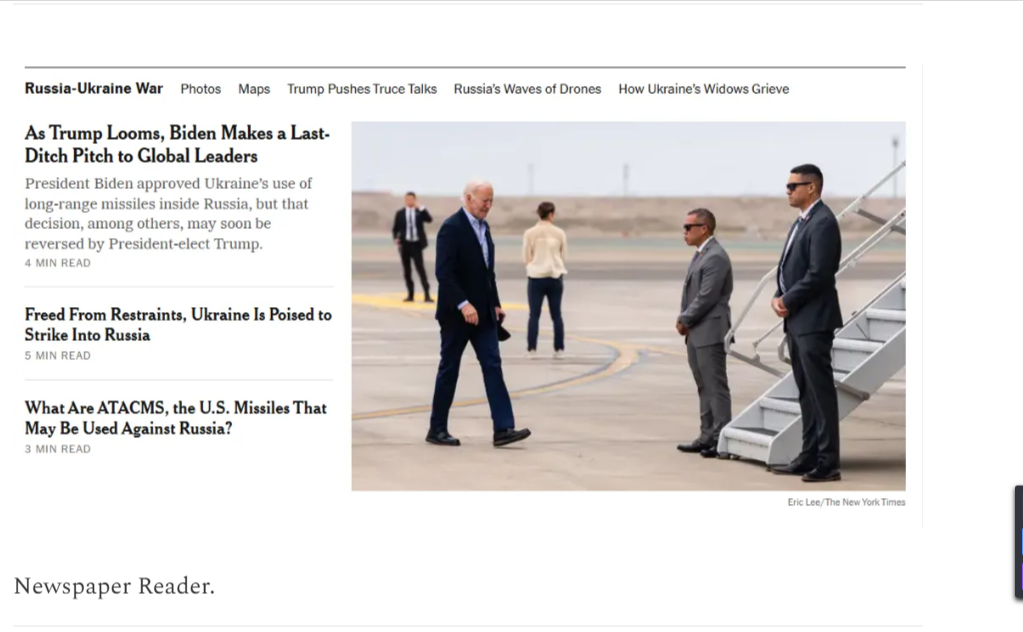
Ukraine’s military used American-made ballistic missiles on Tuesday to strike into Russia for the first time, according to senior U.S. and Ukrainian officials, just days after President Biden gave permission to do so in what amounted to a major shift of American policy.
The pre-dawn attack struck an ammunition depot in the Bryansk region of southwestern Russia, Ukrainian officials said. Russia’s Ministry of Defense said in a statement that Kyiv used six ballistic missiles known as the Army Tactical Missile System, or ATACMS. A senior American official and a senior Ukrainian official, who spoke on the condition of anonymity to discuss ongoing operations, confirmed that ATACMS were used.
The strike represented a demonstration of force for Ukraine as it tries to show Western allies that providing more powerful and sophisticated weapons will pay off — by degrading Russia’s forces and bolstering Ukraine’s prospects in the war.
Officials in Kyiv had pleaded for months for permission to use ATACMS to strike military targets deeper inside Russia before the Biden administration relented and gave its assent. The authorization came just months before the return to office of President-elect Donald J. Trump, who has said he will seek a quick end to the war in Ukraine.
This is the stuff of T.V. Guide of the 1950’s : consider Julius La Rosa being fired by Arthur Godfrey on Air! Or is that stretcing the point?
Editor: let me quote at lenkth this Hollywood Reporter ‘scoop’?
Seven years after they last spoke to him, MSNBCMorning Joe hosts Joe Scarborough and Mika Brzezinski traveled to Mar-a-Lago over the weekend to meet with President-elect Donald Trump.
The duo, who used to be friends with Trump, turned into fierce critics during his first term in office, and he returned the favor, occasionally ripping into them in posts on X (formerly Twitter). At the top of Monday’s program, they disclosed their trip, acknowledging that his decisive win influenced their decision.
“Joe and I realized it’s time to do something different and that starts with not only talking about Donald Trump, but also talking with him,” Brzezinski said. “For those asking why we would go speak to the president-elect during such fraught times, especially between us, I guess I would ask back, why wouldn’t we? Five years of political warfare has deeply divided Washington and the country.”
“What we did agree on was to restart communications,” Brzezinski added. “My father [former Jimmy Carter national security adviser Zbigniew Brzezinski] often spoke with world leaders with whom he and the United States profoundly disagreed. That is a task shared by reporters and commentators alike.”
“I will tell you a lot of Democratic leaders we have talked to this past week since the election have told Mika and me, it’s time for a new approach,” Scarborough added.
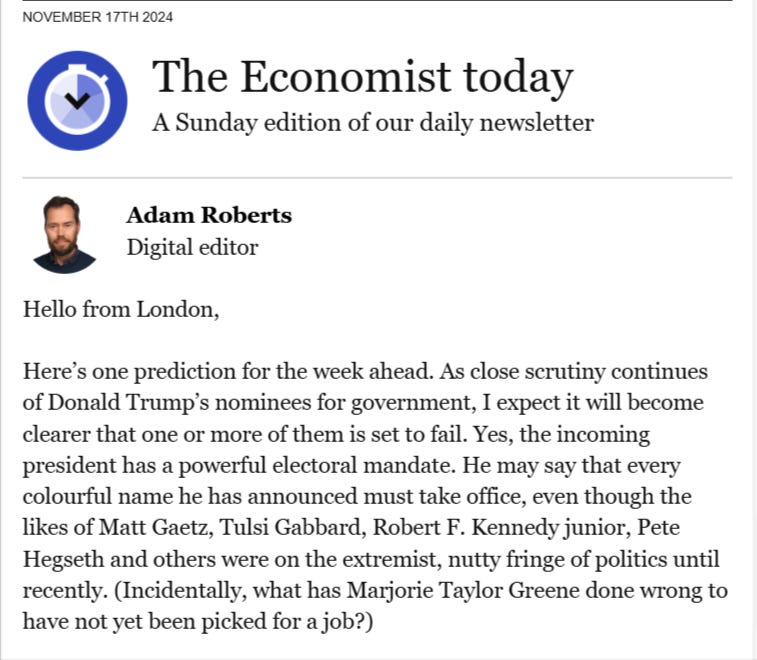
Editor: here is an email from The Economist of November 17, 2024 by Adam Roberts : Digital Editor
I suspect, instead, that Mr Trump is being more Machiavellian. He probably also foresees, and may even welcome, that one or more of his chosen figures will fall away. Perhaps the Senate will block an appointment. Maybe, as details of police inquiries become public in one or more cases, a preferred candidate will be obliged to withdraw. Most of his chosen candidates will get through, but when one or more are blocked Mr Trump can have his cake and eat it: he will bewail the deep state, telling supporters that his opponents want to block the radical changes that he would supposedly bring.
And here’s my second prediction, for the slightly longer term. Elon Musk and Mr Trump will have an almighty falling out. I can’t see either man being willing to submit for long to the discipline or constraints that come from working closely with (or for) the other. Each expects to be the top dog. We suggest today how the Department of Government Efficiency, the joke-named institution that Mr Musk is set to run, might make the budget cuts it is set up to achieve. But stripping away a lot of public spending is bound to upset the lives of a lot of ordinary Americans—the ones who just voted for Mr Trump—by slashing funds for welfare, infrastructure, defence or by failing to pay off debt.
For all the drama in American politics, meanwhile, the most powerful effects of Mr Trump’s pending arrival as president are already being felt in foreign affairs—most obviously in Ukraine and Russia. Volodymyr Zelensky is putting on a brave face, saying that the war in his country will end sooner than had been expected, perhaps in 2025. With Russian forces continuing to gain territory, and Vladimir Putin bringing in extra fighters from North Korea, an early ceasefire is not the same as a good outcome for Ukraine. As our columnist on geopolitics writes in our new column, The Telegram, this might mean acquiescing, more or less, to Russian terms. In places such as Crimea and the eastern Donbas region, Russia will keep direct control of the territory it stole. In the rest of Ukraine, Russian influence will be indirect but still real, just as the Soviet Union held a veto over Finland’s political alignment during the cold war.
Dateline (our history quiz) and our test of whether you’ve kept up with the week’s news, the pint-sized news quiz, are both live. Can you get high scores in both?
Here’s my final prediction for the week: you will hear a lot more forecasts about 2025 from my colleagues. We are poised to publish the new edition of “The World Ahead”, setting out our political, economic, technological, cultural and other judgments for the coming year. (You can re-read last year’s edition, meanwhile, and check how we did last time around.) Our correspondents around the world, along with editors in London and some guest writers, will provide the best possible guide to the trends and events in 2025. It’s going to be a lively year. And if you’re a subscriber, you can join a live event on November 21st with Tom Standage, who edits “The World Ahead”. Sign up here.
A postscript to the various predictions for the American presidential election. I had vowed to namecheck everyone who correctly foresaw the number of electoral college votes that each candidate would get. Somehow, last week, I forgot to include mention of Nikos Kotalakidis, who correctly predicted that Mr Trump would take 312 votes to 226 for Ms Harris. Congratulations Nikos.
Editor : Can The Reader imagine those unrepentent Oxbridgers John Micklethwait and Adrian Wooldridge of that long list of books : The Company: A Short History of a Revolutionary Idea (Modern Library Chronicles Series Book 12) ,The Right Nation: Conservative Power in America,The Fourth Revolution: The Global Race to Reinvent the State, God Is Back: How the Global Revival of Faith Is Changing the World, The Wake-Up Call: Why the Pandemic Has Exposed the Weakness of the West, and How to Fix It, A Future Perfect: The Challenge and Promise of Globalization, ever writing something like the quoted paragraph below?
Finally, I want to hear your views about Ukraine and Russia. What outcome do you expect for the conflict there, in 2025? Will Mr Putin soon be in a position to boast about defeating his neighbour, even after Ukraine received billions in military support from the West? Or is some other result possible? Might Mr Trump, anxious for a quick end to the fighting but also not to lose face, achieve a compromise that brings peace with Ukrainian (and Western) honour? Email me at economisttoday@economist.com with your thoughts.
After Mr. Colvile’s defence of ‘Free Schools’ in the Times of last week and his advocacy as Director of :
Robert Colvile, Director of the Centre for Policy Studies, said:
“It is now clear that free schools have been a success, improving the lives of their pupils – disproportionately in disadvantaged areas – and spurring innovation and competition within the wider education system.
“However, following the departure of Michael Gove as Education Secretary, the programme has steadily been stripped of its originality and distinctiveness. We urge the new Government to build on success by turbocharging the free schools agenda and improving the lives and prospects of children across the country.”
When they were plotting Labour’s election victory, Keir Starmer and Rachel Reeves had a clear diagnosis. Labour had lost the last few elections, an aide told The Times, “because we’ve gone into them being seen as against opportunity and aspiration”.
Opportunity and aspiration are powerful words. Historically, they’ve been at the heart of some of the Conservatives’ most successful policies, such as the opportunity to buy your own council house, or the aspiration to ensure the best education for your child, if necessary by setting up a new and better school to deliver it.
So how are those signature aspirational policies — the right-to-buy and free schools — doing under Labour?
Since 2010, more than 650 free schools have opened in England. Another 44 had been approved. But now they’ve been un-approved. In a ministerial statement, the education secretary, Bridget Phillipson, announced that funding would be snatched away pending review. The statement argued that where free schools create damaging competition with existing schools, or surplus capacity, they should not be allowed to open. The priority, in terms of value for money, has to be rebuilding Britain’s crumbling classrooms.
This was strange, for two reasons. First, there is little evidence — despite the best efforts of their critics to find some — that free schools lower standards in nearby schools. If anything, competition pushes others to up their game. Second, Phillipson boasted last week that Reeves had provided extra cash both for rebuilding schools and for the wider education budget. So why the spiteful decision to pause (and very probably cancel) funding for schools that were already on the slipway?
Michael Gove’s free schools programme increased social segregation, according to an analysis of the flagship scheme that also suggests it reduced student intakes at neighbouring schools.
The creation of free schools has been touted as a major success of the 14 years of Conservative-led government. They were intended to offer high-quality institutions and improve parental choice. Part of their stated aim was to pressure nearby schools to improve and create a “galvanising effect on the whole school system”.
However, new research shared with the Observer suggests that free-school enrolment was associated with increased segregation of primary pupils, particularly in terms of their ethnicity. The study, by academics at University College London, also found that the presence of a free school was not associated with any significant change in student attainment in nearby primary schools.
…
While nearby secondary schools did show a modest increase in student attainment in English and maths after a free school opened, there was also evidence to suggest this was linked to attracting more advantaged students. Secondaries admitting a substantially more disadvantaged intake did not tend to improve after a free school opened nearby.
The UCL study of free schools found that despite claims of setting high standards, this was not the case. Primary free schools performed worse than a matched sample of similar schools, while secondary free schools performed no better or worse.
Leaders in nearby schools reported feeling they were in competition, but this appeared to drive them to work harder on their advertising and external appeal, rather than enhancing the quality of their teaching. The highest levels of perceived competition were where free schools appealed to aspirational or middle-class families who had a “quasi-private school ethos”.
“Our findings show the introduction of free schools has often created new competition,” said Rob Higham, associate professor at UCL’s Institute of Education and the lead author of the study. “When subjected to these new market pressures, neighbouring schools rarely prioritised change or innovation in classroom practices.
“Not all free schools create such choice and competition, but where they do, this has the potential to increase social divisions in the school system, including the social segregation of students.”
Mr. Colvile is a Thatcerite ideologue, with an Institutional Veneer: yet with a 14 year record of Tory mendacity, wedded to a cadre of apoligists like Colevile: what was that Biblical Injunction against False Phrophets of Matthew 7:15 ?
What has happened to the once ascendent Oxbridgers at The Economist? The first paragraph of these book recomendations/reviews read as if it were in The Telegraph!
Editor: The opening parqagraphs of this essay:
They may not have the cachet of the Pulitzer or the Booker, but the Sidewise Awards for Alternate History deserve respect. The what-if genre of fiction is growing fast, with work of startling quality and originality. Take the last Sidewise long-form winner, “Cahokia Jazz” by Francis Spufford. A noir thriller that takes place in the 1920s, it imagines an America in which the native population had not been nearly wiped out by smallpox. Other winners of the 29-year-old prize include Laurent Binet’s “Civilizations”, which imagines that the Incas invaded Europe in 1531, 39 years after Christopher Columbus did not discover the Americas. Tweaking history is surely as much fun as a novelist can have: losers become winners, and not quite everything changes. What if General Lee had won at Gettysburg? What if Napoleon had seen off Wellington and Blücher at Waterloo? The Nazis are overrepresented on alternate-history bookshelves as they are in other sections of most libraries.
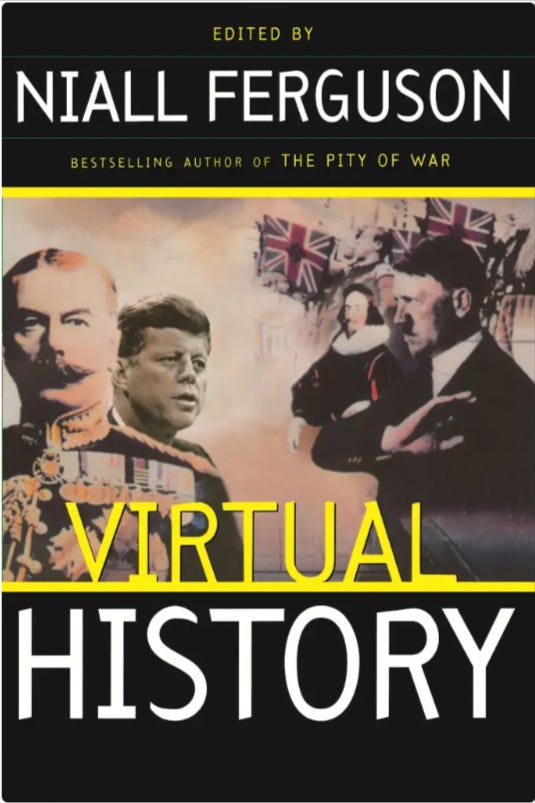
Perhaps the inspiration for this review/essay and the Sidewise Awards had their beginnings with Niall Ferguson’s book, of 1997?
Editor: The carefully re- written ‘Plot’ by televisions writers David Simon and Ed Burns, captures the Oxbridger attention for ‘a moment’!
The Plot Against America”byPhilip Roth, for example, places Charles Lindbergh, a suspected Nazi sympathiser, in the White House. Not far behind is John F. Kennedy, who skipped that visit to Dallas, or perhaps fell victim to the mafia/Cubans/Russians/Lyndon Johnson. As this selection of the best alternate-history novels demonstrates, the world of imagined pasts is rich and potentially endless.
Editor: Roth’s ‘Plot’ is awash in political hysteria, wedded to Roth’s idealised younger self: narcissism rules! : That evetually became a 2020 Television Melodrama, by David Simon and Ed Burns. They collaboreated with Roth and engaged in a re-write for television!
…
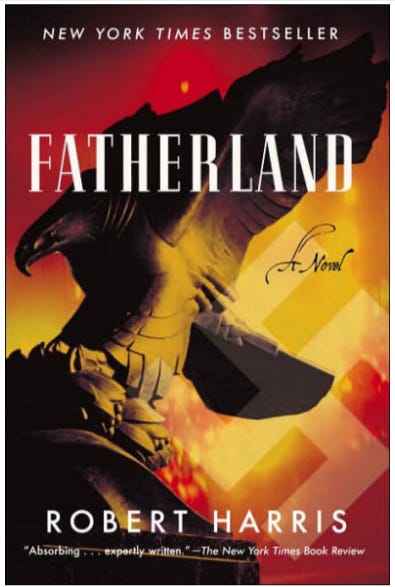
Robert Harris’s “Fatherland”, set in 1964 in Nazi Berlin, would have been another entry.
Editor: I read ‘Fatherland’ and found it compelling reading from start to finish. Harris’s literary debut was auspicious. This novel transcendes the territory of Ferguson’s book, it is the work of a novelist that posses a vital, powerful Historical Imagination!
…
Rodham
Curtis Sittenfeld imagines what might have happened to Hillary Rodham Clinton (pictured), and to American politics, if Hillary and Bill Clinton had broken up in 1975. Hillary becomes a politician and Bill leaves politics and becomes a rich tech entrepreneur. Their paths cross again in startling fashion in 2016, when Donald Trump also makes an appearance. Ms Sittenfeld finds a way to include the Clintons’ famous “60 Minutes” interview in 1992, in which Hillary declared herself to be no Tammy Wynette “standing by my man”. The glamour, the rough and tumble and the sheer grind of American politics are well captured. Above all, Ms Sittenfeld convincingly transports us into Hillary’s inner world. The book’s surprising denouement seems entirely plausible.
Reader here is a link: BOOKS
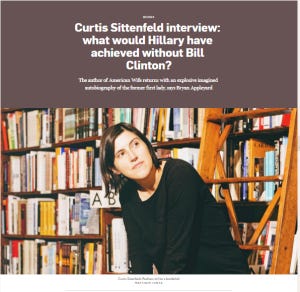
Curtis Sittenfeld interview: what would Hillary have achieved without Bill Clinton?
The author of American Wife returns with an explosive imagined autobiography of the former first lady, says Bryan Appleyard
How opportune! As Senile Old Joe marinates in his cognitive decline , sequestered from public view. His campaign, such as it is, carefully managed ‘interviews’ with friendly media, and short videos. Curtis Sittenfeld’s ‘Counter Factual Biography’ of Hillary Clinton, to be published under the title ‘Rodham’ adds what to the American political conversation? Here is her picture provided by The Sunday Times:
Here is a quote from Bryan Appleyard about the ‘why’ of the book:
Sittenfeld writes women better than anybody else, and women read her in huge numbers with the joy of recognition. If anybody can turn Hillary into a fictional heroine, she can.
And she really is the heroine. This book is a counterfactual — a “what if?” way of studying the past. The big “what if” here is what if Hillary hadn’t married Bill? Her answer, thanks to the deft way she combines fact and fiction, is wholly convincing. This is clearly how she wanted Hillary to be. And, crucially, about how much she wanted her to become president.
The book, and the timing of its publication are suspicious, to say the least, so it is important that Sittenfeld establish her distance from Hillary Clinton:
She has not met Hillary, although was once “in the same space with her” at Stanford University. But she springs to utterly convincing life in these pages.
“I do feel it’s important for me to emphasise that I’ve never spoken to her. It’s not as if I have any inside scoop. Any research I did was publicly available. I never interviewed someone behind the scenes. But there is a lot of information that’s out there.”
Appleyard probes a bit :
If she did meet her, what would she want to ask? She emails her question: “If you hadn’t become a lawyer and politician, what do you think you’d have done instead?” My question would have been: do you think marrying Bill Clinton held you back? That’s the one that looms behind the book. However, I can tell Sittenfeld doesn’t like that. She’s a detail person, and if that is the looming question, it’s up to the reader to ask it, not her.
Should the reader of this interview come to the conclusion that Sittenfeld has written counter factual fan fiction?
Did she like Hillary more than when she started this book more than three years ago? “Yes, more, more! You know, for a lot of the last three years I’ve put on a pant suit and blond wig, metaphorically. I would never write a book from the point of view of a character I was unable to sympathise with. I feel very emotional about her. There’s this reflexively negative way of talking about her. Yet she’s such a hero and role model to so many people, especially many women, which doesn’t get acknowledged as much as it should.”
She says she ended up loving her. But she had also fallen for Bill during her research. She had read his big, swaggering autobiography, My Life.
“I mean, this is the thing; while reading it, I felt like I fell in love with him. And it was very surprising to me. But I think a writer needs to be able to feel the emotions her characters feel.”
This is voice of the true believer, or to be pointed, an apologist/propagandist that has produced an ‘imagined’ Hillary Clinton, rendered more palatable by Sittenfeld’s adolescent ‘crush’.
Even Appleyard provides a bit of gush about ‘Bill’ , and Sittenfeld confirms :
I tell Sittenfeld about meeting the real Bill at a party. He charmed me in about three seconds, and there was some weird visual effect that made everybody else blur into insignificance.
“Exactly, I’ve heard he has this very particular kind of magnetism that most mortals do not have.”
Not interested in the remainder of the interview focused on Sittenfeld life and literary career. One final comment, neither Appleyard nor Sittenfeld have any relation to the tradition of Graham Greene or even Eric Ambler !
American Writer
Editor: The final comment from The Economist: steeped in prescience and self-congratulation! Being an Oxbridger is a moral/political responsibility, that weighs on the whole cadre!
In 2017 we warned that the what-if-the-Nazis-had-won genre may distract from more credible threats to democracy. Our series “The World If” has speculated about the future and invented history
NYT latest Zionist Propganda, with a cameo by Thomas Friedman & Russia expert Leon Aron, from the American Enterprise Institute: The Marriage of Zionist Propaganda & perennial Neo-Conservartive bellicosity, hardly a surprise!
Editor: Leon Aron from the American Enterprise Institute, quoted and paraphased at lenkth:
Putin, Aron added, cannot afford to come back to the Russian people after some 600,000 of their compatriots have been killed and wounded in Ukraine, and say, “Oops, sorry, we are not going to control Ukraine after all.” Putin cannot let this war end in defeat. But Trump cannot accept a peace that looks like a defeat for the West. Then he would look like a loser.
If there is any chance of a mutually acceptable deal on Ukraine — a long-term cease-fire roughly on existing battle lines in return for some lifting of sanctions on Russia and accelerated membership for Ukraine in the European Union along with security guarantees but not formal NATO membership — it will most likely happen only after Putin suffers more defeats there and Trump makes clear that he would arm Ukraine even more heavily if Putin would not relent.
The fact that Putin had to effectively hire 10,000 North Korean forces to help fight his reckless war in Ukraine shows two things: how afraid he is to stop without a visible victory “and how afraid he is of a societal backlash if he is forced to send into the trenches raw 18-year-old ethnic-Russian conscripts, especially from Moscow and St. Petersburg where the Russian elite lives,” said Aron, author of “Riding the Tiger: Vladimir Putin’s Russia and the Uses of War.”
“Putin is not in a position to have a forever war,” concluded Aron. “He is running out of people.” All of which is to say that if Trump is capable of sustaining Ukraine in its current battlefield position for 12 more months, he might get the deal to end the Ukraine war in a year that he promised in the campaign to deliver in a day.
…
Editor: here is Friedman’s final paragraph:
That’s the thing about the world — it is always so much more complicated than it sounds on the campaign trail, and today more than ever. Or as the boxer Mike Tyson is said to have observed: “Everyone has a plan until they get punched in the face.”
ALEXANDRIA, Virginia — A U.S. jury on Tuesday awarded $42 million to three former detainees of Iraq’s notorious Abu Ghraib prison, holding a Virginia-based military contractor responsible for contributing to their torture and mistreatment two decades ago.
The decision from the eight-person jury came after a different jury earlier this year couldn’t agree on whether Reston, Virginia-based CACI should be held liable for the work of its civilian interrogators who worked alongside the U.S. Army at Abu Ghraib in 2003 and 2004.
The jury awarded plaintiffs Suhail Al Shimari, Salah Al-Ejaili and Asa’ad Al-Zubae $3 million each in compensatory damages and $11 million each in punitive damages.
The three testified that they were subjected to beatings, sexual abuse, forced nudity and other cruel treatment at the prison.
They did not allege that CACI’s interrogators explicitly inflicted the abuse themselves, but argued CACI was complicit because its interrogators conspired with military police to “soften up” detainees for questioning with harsh treatment.
CACI’s lawyer, John O’Connor, did not comment after Tuesday’s verdict on whether the company would appeal.
Baher Azmy, a lawyer for the Center for Constitutional Rights, which filed the lawsuit on the plaintiffs’ behalf, called the verdict “an important measure of Justice and accountability” and praised the three plaintiffs for their resilience, “especially in the face of all the obstacles CACI threw their way.”
The $42 million fully matches the amount sought by the plaintiffs, Azmy said.
“Today is a big day for me and for justice,” said Al-Ejaili, a journalist, in a written statement. “I’ve waited a long time for this day. This victory isn’t only for the three plaintiffs in this case against a corporation. This victory is a shining light for everyone who has been oppressed and a strong warning to any company or contractor practicing different forms of torture and abuse.”
Al-Ejaili traveled to the U.S. for both trials to testify in person. The other two plaintiffs testified by video from Iraq.
The trial and subsequent retrial were the first time a U.S. jury heard claims brought by Abu Ghraib survivors in the 20 years since photos of detainee mistreatment — accompanied by smiling U.S. soldiers inflicting the abuse — shocked the world during the U.S. occupation of Iraq.
None of the three plaintiffs were in any of the notorious photos shown in news reports around the world, but they described treatment very similar to what was depicted.
Al Shimari described sexual assaults and beatings during his two months at the prison. He also said he was electrically shocked and dragged around the prison by a rope tied around his neck. Al-Ejaili said he was subjected to stress positions that caused him to vomit black liquid. He was also deprived of sleep, forced to wear women’s underwear and threatened with dogs.
CACI had argued it wasn’t complicit in the detainees’ abuse. It said its employees had minimal interaction with the three plaintiffs in the case, and CACI questioned parts of the plaintiffs’ stories, saying that military records contradict some of their claims and suggesting they shaded their stories to support a case against the contractor. Fundamentally, though, CACI argued that any liability for their mistreatment belonged to the government.
As in the first trial, the jury struggled to decide whether CACI or the Army should be held responsible for any misconduct by CACI interrogators. The jury asked questions in its deliberations about whether the contractor or the Army bore liability.
CACI, as one of its defenses, argued it shouldn’t be liable for any misdeeds by its employees if they were under the control and direction of the Army. under a legal principle known as the “borrowed servants” doctrine.
Lawyers for the plaintiffs argued that CACI was responsible for its own employees’ misdeeds. They said provisions in CACI’s contract with the Army, as well as the Army Field Manual, make clear that CACI is responsible for overseeing its own workers.
The lawsuit was first filed in 2008 but was delayed by 15 years of legal wrangling and multiple attempts by CACI to have the case dismissed.
Lawyers for the three plaintiffs argued that CACI was liable for their mistreatment even if they couldn’t prove that CACI’s interrogators were the ones who directly inflicted the abuse.
The evidence included reports from two retired Army generals, who documented the abuse and concluded that multiple CACI interrogators were complicit in the abuse.
Those reports concluded that one of the interrogators, Steven Stefanowicz, lied to investigators about his conduct and that he likely instructed soldiers to mistreat detainees and used dogs to intimidate detainees during interrogations.
Stefanowicz testified for CACI at trial through a recorded video deposition and denied mistreating detainees.





 StephenKMackSD's Blog