The almost mordant wit of janan.ganesh@ft.com.

Newspaper Reader can almost embrace his practice?

Opinion: Geopolitics

Europe’s leaders have woken up to hard power

It isn’t clear that their electorates have done the same

https://www.ft.com/content/42a4531a-d50a-46f0-9a23-076c03b0da31

Mr. Ganesh as boulevardier loves to tease his readership! The first two paragraphs of Ganesh’ s essay are an evocative crowd scene:

Not enough is said about the other Donald T. Having led Poland between 2007 and 2014, Donald Tusk can take some credit as his nation approaches western European standards of living. Now in his second stint, Ukraine has no more vociferous friend in the world. Talk of Poland as the eventual heir to Britain — a pro-market, pro-American and martial voice in the EU — seems rash. It has around half the population and less diplomatic clout. But Tusk’s ease in those institutions as a former Brussels grandee narrows the gap.

Whatever Europe lacks as it tries to become a hard power, it isn’t leadership. Even aside from Tusk, Ursula von der Leyen has been a strong wartime president of the European Commission. With the zeal of a convert, Emmanuel Macron now sees the Kremlin is implacable. Rishi Sunak and Sir Keir Starmer are so as one on Ukraine that the subject never arises in British politics. As an Italian populist, Giorgia Meloni could be a Russia apologist. She isn’t. Even Olaf Scholz, the alleged ditherer, has seen Germany become easily Europe’s largest donor of military aid to Ukraine on his watch.

Then Ganesh actually begins his essay, after his baroque crowd scene, amounts to this:

The high politics aren’t perfect. There are always grounds for a tired metaphor about the Franco-German engine sputtering and so on. But these schisms add up to a rounding error next to the real problem, which is, I’m afraid, us.

Their are no ‘high politics’ except the one imagined by Ganesh. Who is the ‘us’ that he offers? Another 266 words and The Reader thinks she has arrived, with this sentence :

“Leaders must lead, not follow,” you will say, but that is always a dreamy view of politics.

The next paragraphs offers this:

This is the most overused word in politics. The extent to which the public are ever “led” against their preferences is overstated by romantics.

The penultimate paragraph this:

There is good news to be had. Europe is well-led (compare its main figures with America’s).

The final paragraph offers this:

The bad news is that leaders can only ever do so much against public sentiment. Scholz’s “historic turning point” took place in chancelleries. We don’t know if it took place in households. I can’t shake from my mind a quote attributed to another European leader, in another era, in another context. “We all know what to do. But we don’t know how to get re-elected once we have done it.”

Newspaper Reader
Posted in Uncategorized | Leave a comment

gideon.rachman@ft.com Stillbirth’s ‘Identity Geopolitics’.

Newspaper Reader & Political Cynic

Headline: Ukraine, Gaza and the rise of identity geopolitics

Sub-headline: The global conscience moves in mysterious ways

https://www.ft.com/content/c9173148-22d9-444b-8a8c-b14585a7db26

Rachman sets the stage:


Early in the Gaza conflict, a TikTok video of John Kirby went viral. In the first frames, the White House spokesman is composed as he describes civilian casualties in Gaza as part of the “brutal, ugly” reality of war.


For the Biden administration’s critics, that video summed up America’s double standards.


The threat of a famine in Gaza is currently making global headlines every day.


Like Gaza, Sudan borders Egypt. But the Sudanese conflict — and last week’s warning — has been largely ignored by the wider world.


Efforts to free the Israeli hostages held in Gaza have become a centrepiece of international diplomacy.


Go a little further back and the world’s capacity to ignore mass killing and suffering — particularly in Africa — is stark.


The slogan “Black Lives Matter” that began in the US was resonating globally in 2020.


Here after the bourgeoise political chatter gideon.rachman@ft.com arrives at his point:

What is it that causes some tragedies and conflicts to command the world’s attention and others to pass almost unnoticed? 

The answer seems to be something that can be called identity geopolitics. A conflict is much more likely to spark international concern and outrage if large numbers of people identify with those who are fighting or suffering. Europeans look at fleeing Ukrainians and imagine their own cities under bombardment. Many Muslims and Jews identify with the warring sides in Gaza.

‘Identity Politics’ can only be defined as a politics that is dismissed out of hand, as prima facie without merit, by its critics, who set an imaginary standard as a singularity? In sum a politics that is out of step with the Technocratic Babblers/ Political Conformists. Rachman simply widens it’s parameters into ‘identity geopolitics’. Six more dazzling paragraphs of Rachman’s political/moral acrobatics and The Reader arrives here:

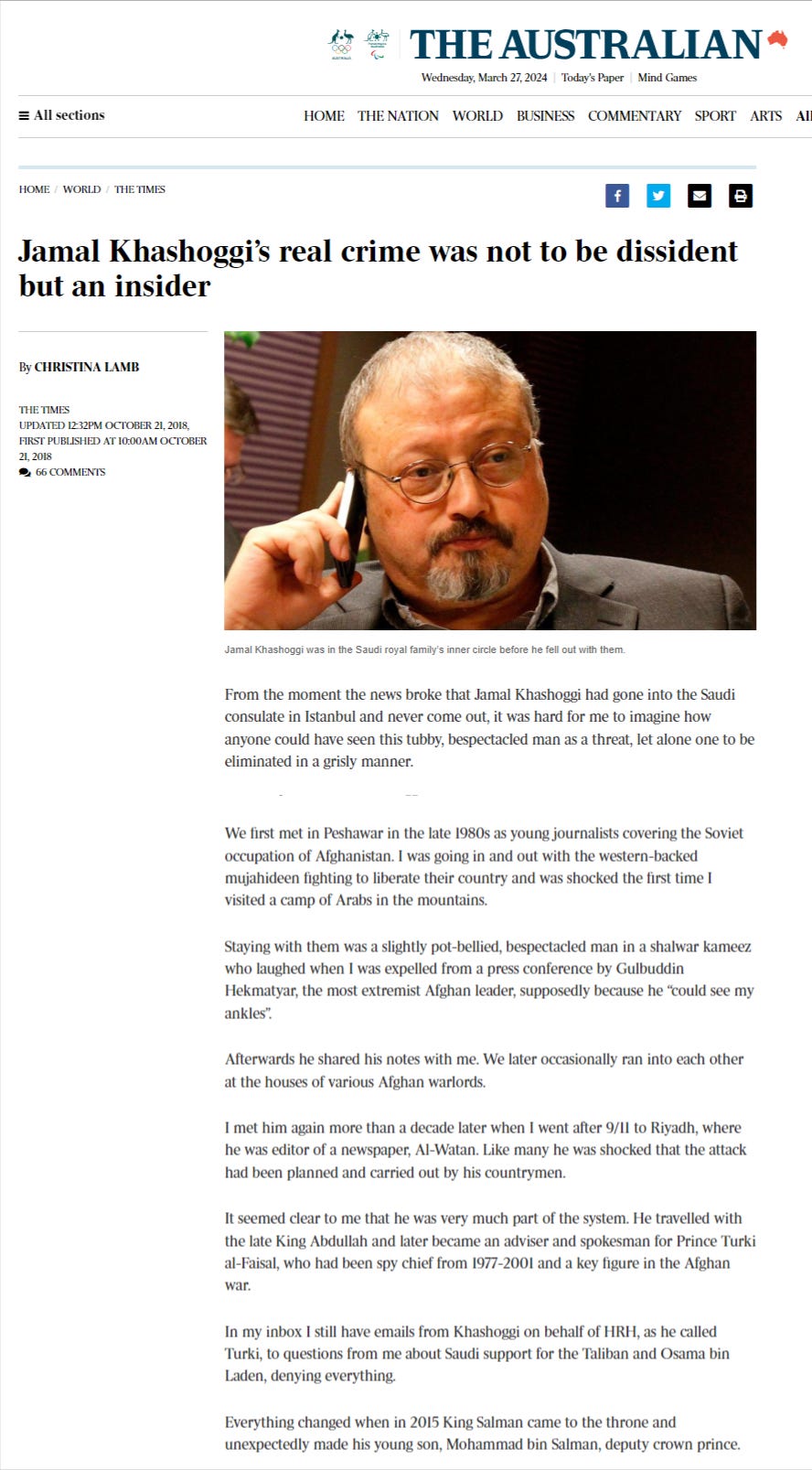
The issue that caused a real crisis in US-Saudi relations was the murder of a single prominent journalist, Jamal Khashoggi. His horrific story had the power to move emotions and shift international politics — unlike the deaths of thousands of other victims, who were destined to remain anonymous. 

World politics still seems to live by the infamous phrase, often attributed to Stalin: “A single death is a tragedy, a million deaths is a statistic.”

This report from The Australian of 2024 paints Khashoggi as an ‘Insider’ rather that as a ‘Dissident’ :

Newspaper Reader & Political Cynic

Posted in Uncategorized | Leave a comment

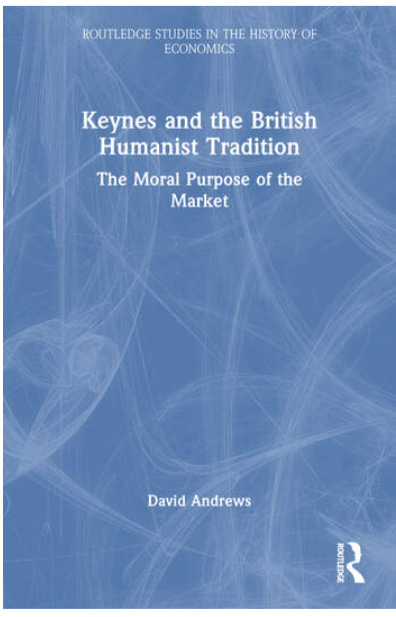
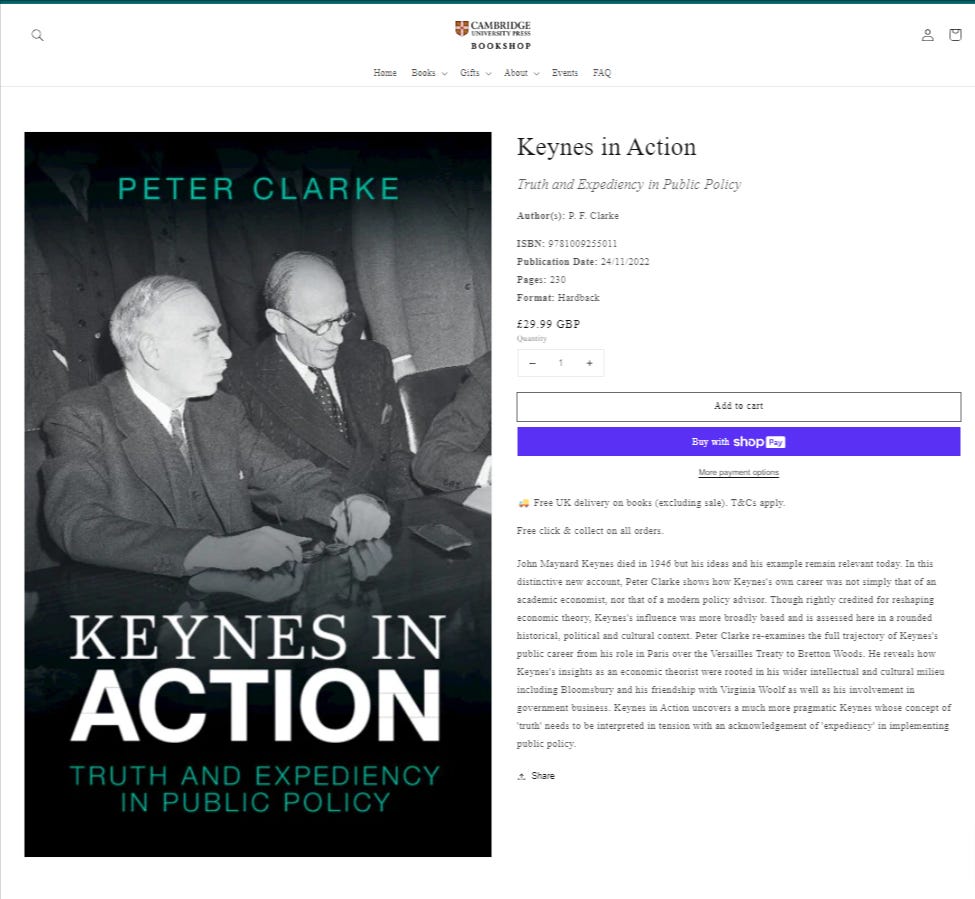
Two valuable books on Keynes & his ‘Essays in Persuasion’ (Thank you to Brad Delong!)

Political Observer.

MAR 26, 2024

Well-connected in academia, business and government, John Maynard Keynes was one of the most influential economic theorists of the twentieth century. It appears that his theories will be just as important for the twenty-first. As Keynes himself explained, his ideas throughout his life were influenced by the moral philosophy he learned as an undergraduate. Nevertheless, the meaning and significance for Keynes of this early philosophy have remained largely unexplored.

Keynes and the British Humanist Tradition offers an interpretation of Keynes’s early philosophy and its implications for his later thought. It approaches that philosophy from the perspective of the nineteenth century intellectual context out of which it emerged. The book argues that roots of Keynes’s early beliefs are to be found in the traditions of the Apostles, the very famous secret society to which he and most of his teachers belonged. The principles of Keynes’s philosophy can be seen in such writers as John Stuart Mill and Henry Sidgwick, but the underlying ideas have been obscured by changing fashions in philosophy and thus require excavation and reconstruction.

This book will be of interest to students and researchers in the history of economics, in particular the thought of John Maynard Keynes, especially his ethics, politics and economics.

https://www.routledge.com/Keynes-and-the-British-Humanist-Tradition-The-Moral-Purpose-of-the-Market/Andrews/p/book/9780415746519


John Maynard Keynes died in 1946 but his ideas and his example remain relevant today. In this distinctive new account, Peter Clarke shows how Keynes’s own career was not simply that of an academic economist, nor that of a modern policy advisor. Though rightly credited for reshaping economic theory, Keynes’s influence was more broadly based and is assessed here in a rounded historical, political and cultural context. Peter Clarke re-examines the full trajectory of Keynes’s public career from his role in Paris over the Versailles Treaty to Bretton Woods. He reveals how Keynes’s insights as an economic theorist were rooted in his wider intellectual and cultural milieu including Bloomsbury and his friendship with Virginia Woolf as well as his involvement in government business. Keynes in Action uncovers a much more pragmatic Keynes whose concept of ‘truth’ needs to be interpreted in tension with an acknowledgement of ‘expediency’ in implementing public policy.


Thank you, to Brad Delong!

Political Observer

Posted in Uncategorized | Leave a comment

In my in box: March 24, 2024

Newspaper Reader

Adam Roberts
Digital editor

Hello from London,

What consequences might flow from Friday’s terrorist attack on Crocus City Hall in Moscow? Even—or especially—for an autocrat who just won a sham election, there is a risk of looking weak or wrong-footed after such a horrific event. Vladimir Putin, a spy by training, tends to stay out of the public eye when confronted by unexpected crises. Last year, for example, he was nowhere to be seen as Yevgeny Prigozhin, the leader of the Wagner mercenary group, led a column of fighters towards Moscow. The Russian president took his revenge later.

This time, as our new article explains, Mr Putin hopes to pin the blame for the Moscow attack on his foes in Ukraine. I suspect he will struggle to do so. An affiliate of Islamic State claimed responsibility for the attack, and it bore the group’s hallmarks. Russia has suffered from Islamist attacks on civilian targets before. Indeed, just a few weeks ago American intelligence warned of an imminent assault by such actors in Russia. Mr Putin dismissed their claims as blackmail. 

Nonetheless, Mr Putin will surely try to take advantage of the uncertainty. He might, for example, say that the terrorist threat requires more resources to be given to the security services. Perhaps he will try to mobilise another wave of conscripts to fill the ranks of his army ahead of an anticipated spring offensive for his needless war in Ukraine. Large numbers of young Russian conscripts are slaughtered there each week. Last month we published a grim article assessing how many Russian soldiers have been killed in Ukraine since the invasion two years ago.

Beyond Russia, we have published a new article on the American election: not the presidential race, but the contest for control of Congress. Republicans are within a whisker of losing control of the House of Representatives, just as Democrats may be forced to give up their grip on the Senate. After November, both chambers could see a change of control.

Last week I promised a slightly less fiendish set of questions for our weekly history quiz, Dateline. I believe we have delivered, but let me know how you get on with the new batch.

Spare a thought for the disjointed opposition in India as the election campaign gets under way in the world’s biggest democracy. Late last week the chief minister of Delhi, Arvind Kejriwal, was arrested. I’m not one for conspiracy theories, but it’s a bad look when opposition politicians are dragged off to jail and the bank accounts of their parties frozen, whereas figures in the ruling coalition are left alone. I knew Mr Kejriwal a bit, when I was a correspondent in Delhi a decade or so ago. His newish political party is finding ways to win over voters beyond the capital. Perhaps he is seen as a threat.

Here in Britain I expect to see more stories in the coming days about the royal family, after the Princess of Wales said she was being treated for cancer. Almost every family, including my own, knows how cancer can upend lives. This should be a moment for discussing how to reduce its prevalence and promote better treatment for everyone.

Finally, we have a new story on the boom in equities. The strength of America’s stockmarkets is remarkable, but some analysts are beginning to brace for a crash. Should investors hunting for value look further afield? 

Our inbox is crammed with your responses from last week on Israel and Gaza. Thank you for your comments—we read them all and enjoy most of them. This week I’d like you to tell me how you expect Mr Putin to respond to the Moscow terror attack—and what, if anything, it might mean for the war in Ukraine. You can reach us at economisttoday@economist.com.

Newspaper Reader

Posted in Uncategorized | Leave a comment

@nytdavidbrooks is both a Zionist Apologist & American political conformist, in sum the ultimate New York Times over-paid babbler!

Newspaper Reader comments.

Mr. Brook’s 3,248 word apologetic for Israel, and its American sponsor does not include the word Genocide. Neo-Conservatives as followers of Leo Strauss, engage in the habit of drowning the reader in words and paragraphs, steeped in verbosity , that seek to obfuscate meaning, from what rhetoric is meant to accomplish, informing the reader, in sum presenting viable arguments.

A sampling of the ‘actors’ in Mr. Brooks’ political melodrama:

the Democratic Party, the war in Gaza, Israel has the right to defend itself, defeat Hamas, The vast numbers of dead and starving children are gut wrenching, it’s hard not to see it all as indiscriminate, If the current Israeli military approach is inhumane, what’s the alternative?, use to defeat Hamas without a civilian blood bath, I’ve been talking with security and urban warfare experts, The thorniest reality that comes up,

Hamas’s strategy is pure evil, but it is based on an understanding of how the events on the ground will play out in the political world.

So we’re back to the original question: Is there a way to defeat Hamas with far fewer civilian deaths?

Another alternative strategy is targeted assassinations.

Furthermore, Hamas’s fighters are hard to find, even the most notorious leaders.

The political costs of this kind of strategy might be even worse than the political costs of the current effort.

A third alternative is a counterinsurgency strategy, of the kind that the United States used during the surge in Iraq.

A fourth alternative is that Israel should just stop.

The national security adviser, Jake Sullivan, has argued that Israel can destroy Hamas in Gaza without a large invasion but “by other means”…

Benny Gantz, reportedly told U.S. officials, “Finishing the war without demilitarizing Rafah is like sending in firefighters to put out 80 percent of a fire.”

Reader just 1109 words left of this not very carefully managed Zionist apologetics! Aided by the recycled comments of his selection of Technocrats/Experts!

The concluding paragraphs that features David Petraeus as one of his featured political/moral actors with a quote ‘“Over time, hearts and minds still matter.” Call it what it is a maladroit non sequitur, and or just an inept attempt to express etiolated profundity!

For her book “How Terrorism Ends,” the Carnegie Mellon scholar Audrey Kurth Cronin looked at about 460 terrorist groups to investigate how they were defeated. Trying to beat them with military force alone rarely works. The root causes have to be addressed. As the retired general David Petraeus reminded his audience recently at the New Orleans Book Festival, “Over time, hearts and minds still matter.”

Israel also has to offer the world a vision for Gaza’s recovery, and it has to do it right now. Ross argues that after the war is over, the core logic of the peace has to be demilitarization in exchange for reconstruction. In an essay in Foreign Affairs, he sketches out a comprehensive rebuilding effort, bringing in nations and agencies from all over the world, so Gaza doesn’t become a failed state or remain under Hamas control.

Is any of this realistic given the vicious enmity now ripping through the region? Well, many peace breakthroughs of the past decades happened after one side suffered a crushing defeat. Egypt established ties with Israel after it was thoroughly defeated in the Yom Kippur War. When Israel attacked Hezbollah in southern Lebanon in 2006, the world was outraged. But after the fighting stopped, some Lebanese concluded that Hezbollah had dragged them into a bloody, unnecessary conflict. The Hezbollah leader, Hassan Nasrallah, was forced to acknowledge his error, saying he didn’t know Israel would react so violently. The Lebanese border stabilized. Israel’s over-the-top responses have sometimes served as effective deterrents and prevented further bloodshed.

Israel and the Palestinians have both just suffered shattering defeats. Maybe in the next few years they will do some difficult rethinking, and a new vision of the future will come into view. But that can happen only after Hamas is fully defeated as a military and governing force.

Newspaper Reader

Posted in Uncategorized | Leave a comment

@TheEconomist on the Russian City Hall attack.

Political Observer comments.

Europe | Carnage at Crocus City Hall

Headline: Who was behind the massacre in Moscow?

Sub-headline: Islamic State claims responsibility, but Vladimir Putin tries to implicate Ukraine

The Economist offers ‘the most likely culprit’ & ‘But there is no shortage of other potential suspects’ framed in the final three paragraphs of it’s ‘news story’.

Who might have been behind the attack? The claim, and American officials’ apparent agreement with it, does make Islamic State the most likely culprit. But there is no shortage of other potential suspects. The Kremlin’s brutal two-year war in Ukraine has created new enemies and increased the amount of arms in open circulation among returnee soldiers. There is a strong nationalist and vigilante movement at home. The Kremlin’s involvement in bloody conflicts internally in Chechnya and Dagestan have also long made Russia a target for Islamist terrorist groups of various stripes. But its intervention in Syria, where Russian soldiers have supported the Assad regime against Islamic State and other rebels, does support that group’s claim of responsibility.

Ukraine immediately denied any involvement in the attack. A high-level intelligence source told The Economist that the Ukrainian government had been worried that the Kremlin might try to weaponise a terror event of this sort, especially as Mr Putin weighs up whether to risk a new wave of mobilisation. The source said it was necessary to wait to see how Russia would officially classify the event: “Whether they will say it is Chechnya, or Dagestan, perhaps that we are involved somehow, or just simply blame us directly.” The reality is that it would be an act of pure insanity for Ukraine to attempt anything of the sort. Killing civilians would be a sure way to alienate the Western supporters on whom Ukraine so heavily depends.

Still, the Kremlin is trying to implicate Ukraine, even if, in an address to the nation on the afternoon of March 23rd Mr Putin stopped short of directly accusing it of mounting the attack. Instead, he claimed that Ukraine had provided a “window” of escape for the terrorists, who had fled towards that country before supposedly being captured, without saying where they had actually come from.

Should the object lesson of Seymour Hersh’s expose, offer room for doubt on the Economist Questions/Answers?

Headline: How America Took Out The Nord Stream Pipeline

Sub-headline: The New York Times called it a “mystery,” but the United States executed a covert sea operation that was kept secret—until now

Seymour Hersh

How America Took Out The Nord Stream Pipeline

The U.S. Navy’s Diving and Salvage Center can be found in a location as obscure as its name—down what was once a country lane in rural Panama City, a now-booming resort city in the southwestern panhandle of Florida, 70 miles south of the Alabama border. The center’s complex is as nondescript as its location—a drab concrete post-World War II structure th…

Read more

a year ago · 13251 likes · Seymour Hersh

The Editor of The Economist Zanny Minton Beddoes was former employee of the notorious Jeffrey Sachs.

Dr. Jeffrey Sachs, Shock Therapist

Sachs’s message of urgency is not universally accepted. Plenty of Western as well as Russian economists contend that a more gradual approach is not only possible but necessary. “Economic reform is a political process,” says Padma Desai at the Harriman Institute at Columbia University. “First, you must build consensus.”

And even his sympathizers acknowledge that Sachs’s high profile and world-class impatience could generate a backlash in a nation still adjusting to the reality that it is no longer a superpower. “There’s a real dilemma here,” says Stanley Fischer, an international economist at the Massachusetts Institute of Technology. “You have to make a lot of noise to get the attention of the West. But the more noise you make, the more you make it seem that the reform program is a Western program. And that could be the kiss of death.”

Still, Sachs’s brand of “shock therapy” has worked elsewhere. And there is good reason to believe that Russia’s future will turn on how well its leaders learn the catechism of change that he has worked so hard to promulgate.

Here is Beddoes on The Daily Show reciting the Neo-Conservative Catechism of this historical moment.

Political Observer

Posted in Uncategorized | Leave a comment

@FT on declining fertility rates in ‘The West’, while The Global South’s will ‘nearly double to 35 per cent by 2100’

Political Observer comments.

Demographics and population

Headline: Declining fertility rates will transform global economy, report says

Sub-headline: The proportion of births in low-income countries projected to nearly double to 35 per cent by 2100


Falling fertility rates in most countries over the next quarter century will drive a global demographic shift that will have a far-reaching social and economic impact, according to a new study.

Three-quarters of nations are projected to fall below population replacement birth rates by 2050, leaving growth concentrated in a minority of low-income states in sub-Saharan Africa and Asia that face acute threats from resource shortages and climate change.

The research published in The Lancet medical journal on Wednesday highlights the ever-sharper divide between the countries still powering population growth and those where birth numbers are dwindling.

https://www.ft.com/content/318ff981-d189-4bd6-b608-a9709097eedc

What @FT is really telling its privileged white readership, is that the Deluge of Immigrants from America’s ‘War on Terror’ was just the beginning of the end of ‘The Myth of the West’, as the sine qua non of Anglo-European Humanity! Oswald Spengler, Leo Strauss and the Neo-Liberal trinity of Mises/Hayek/Friedman are/were the grave diggers of this toxic Mythology?

Supported by revelatory Maps and Charts, and further paragraphs of the unwelcome news offered by two Technocrats:

“We are facing staggering social change through the 21st century,” said Stein Emil Vollset, the paper’s senior author and a professor at the Institute for Health Metrics and Evaluation. “The world will be simultaneously tackling a ‘baby boom’ in some countries and a ‘baby bust’ in others.”

The study of 204 countries and territories forecasts 76 per cent will dip below population replacement rates by 2050 — a number that will rise to 97 per cent by 2100. The proportion of live births in low-income countries is projected to all but double from 18 per cent in 2021 to 35 per cent by the end of the century. Sub-Saharan African countries are forecast to account for half of global births by 2100.

“The implications are immense,” said Natalia Bhattacharjee, co-lead author of the study and lead research scientist at IHME. “These future trends in fertility rates and live births will completely reconfigure the global economy and the international balance of power — and will necessitate reorganising societies.”

The Reader might wonder, and ask the vexing question who will be in charge of ‘the necessary reorganization of societies’ ? The indispensable Technocrats featured in this essay would be the obvious choice? The Reader need only look to the sub-headline to come to terms with the future. The Global South’s birth rate is set to double by 2100.

The proportion of births in low-income countries projected to nearly double to 35 per cent by 2100

Political Observer

Posted in Uncategorized | Leave a comment

@TheEconomist opines on ‘The Battle of the Sexes 2024 style’. Offered as ‘Of Mars and Venus’…

Myra Breckenridge says pardon my brass!

International | Of Mars and Venus

Why young men and women are drifting apart

Diverging worldviews could affect politics, families and more

Should it surprise that the once male dominated World View of ‘The Economist’ has ‘evolved’ under the female editor @zannymb, a rather notorious Neo-Conservative/Neo-Liberal, in line with the older generation of male editors. In the political present, as presented in this Economist essay, young women seem to be better educated and more ‘liberal’ that their less educated ‘conservative’ potential male partners?

This 3004 word essay is Pop Sociology with Subtitles, and evocative graphs, aimed a young female demographic. Although it is not Helen Gurley Brown, but in fact not many steps away!

Young and cranky

Making America virile again

The solution is offered by Richard Reeves, a liberal scholar, in “Of Boys and Men” and advocated by The Economist.

What neither side has done well is to tackle the underlying problems that are driving young men and women apart. Most important, policymakers could think harder about making schools work for underperforming boys. Mr Reeves suggests hiring more male teachers, and having boys start school a year later, by default, since they mature more slowly than girls do. Also, since “the desegregation of the labour market has been almost entirely one-way”, the state could beef up vocational training to prepare young men for occupations they currently shun, such as those involving health, education or administrative tasks. If such reforms help more boys and men adjust to a changing world, that would benefit both men and women.

It appears that men and women have different rates of reaching ‘maturity’ hardly a new concept. Vocational Training is advocated. I find this puzzling at best. In the latter part of my working life , I was was involved in Home Heath Care as a Service Representative. The staff was both men and women, of almost equal number. My last employment was for a vendor who serviced Surgical Equipment, in which I called upon Hospitals, Surgery Centers to arrange for repairs of various surgical equipment. Is the world of work so different than it was in 2010? I was not looking for a life partner. But I was made highly aware, of the way the highly credential fellow workers, treated me and the other support staff, with a kind of measured tolerance, and in times of high pressure, with near contempt, and gender did not matter!

Yours,

Myra Breckenridge

Posted in Uncategorized | Leave a comment

janan.ganesh@ft.com on ‘The era of the unfixable problem’.

Political Observer on the jaunty cynicism, and self-congratulation of that boulevardier.

Headline: The era of the unfixable problem

Sub-headline: Refugee flows, low birth rates and left-behind regions persist because there is no answer, not because politicians are useless

https://www.ft.com/content/2095fc43-abf7-4397-827c-0520d8977954

Confronting Ganesh in this essay ‘on the unfixable problem’ is not the end of his boulevardier phase, but something like the birth of a political impressionism and at some points an even more abstract version of that ‘impressionism’, as the simulacrum of actual thought, as a fog dispersing in the sunlight. A bit too highfalutin for his regular readers who treat his essays as revelation.

I’ll collect/select various parts of his essay that might be revelatory as to his methodology?

empire of high-powered quangos, to lead the mission- London and its halo of commuter counties -How does this lie about the political class manage to live on? -the problem of left-behind regions might have no solution- technological automation and the other global forces-Ask the American Midwest- the UK regions is going to flop, again-This is the era of the insoluble problem, the baby bust, too low to maintain populations at their current level- Nordic nations would be ultra-fertile- huge upfront fiscal cost, and the pique of non-parents- Moral exhortation?, a byproduct of affluence and secularisation- the ultimate case of an insoluble problem in the modern world- to accept all, or most, or even a large percentage of the people- in catastrophic climates or in bandit-ravaged failed states- the purest example of an intractable situation in the world today-There are such things as intractable problems- There is such a thing as rational despair- we arrive at a cynical and acrimonious atmosphere- I am well-located to understand that sometimes there is no good move- it can’t raise taxes to improve public services without compromising incentives and animal spirits in business- but there is little stomach for the national rancour involved in trying to undo it anytime soon…

The above collection presents the strangled music of the long abandoned aperçus, that once made Mr. Ganesh a stylist worth reading, for the real music he could offer once to the Reader!

Mr. Ganesh’s final paragraph, that resembles the jaunty cynicism and self-congratulation of that boulevardier.

Is there a high-income country on Earth that is so exquisitely checkmated? I can’t think of one. But this does make Britain a good place from which to observe a fact of world relevance. Some problems can’t be solved, just mitigated at the edges. Pretending otherwise isn’t “optimistic” or enlightened, it is poisonous to a nation’s civic health. Oh, for more of the can’t-do spirit.

Political Observer

Posted in Uncategorized | Leave a comment

@MichaelRStrain is my favorite AEI Capo!

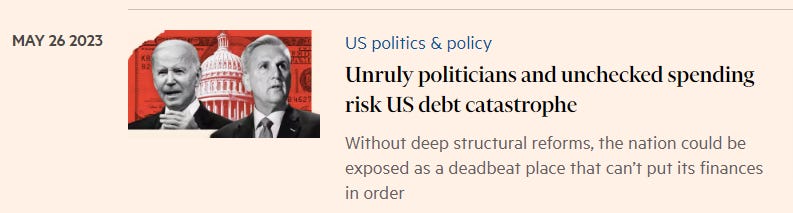
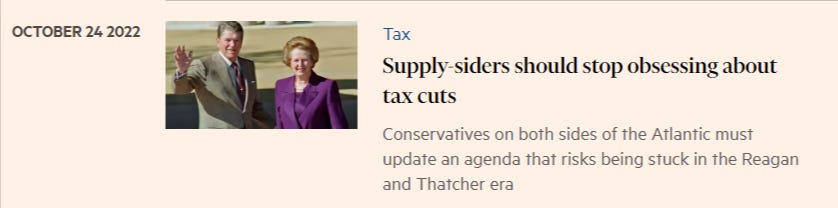
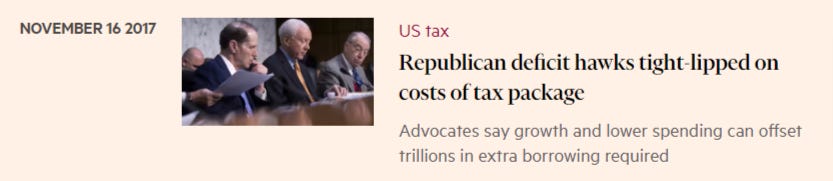
Old Socialist provide some @FT essays.

https://www.ft.com/stream/f0a1fc4b-f0c8-38b3-9737-9747de4c773d

Old Socialist

Posted in Uncategorized | Leave a comment