Recall that Haidt used a riff on Bloom’s ‘The Closing of the American Mind’ to sell his ‘The Coddling of the American Mind’. Note his title as ‘A professor of ethical leadership at New York University’ call this being ‘ kicked uptairs’ equal toavaucious honerific. It should not surprise that he is a staunch New Democrat: He’s Hillary Clinton wet dream: maufaturing crisies on order, for the New Democrats/Republicals/Neo-Consertatives, to screech on command, about the various, and myraid threats to the Natural Political Order of a toxic Centrism. The first paragraph is riddled with unintentional comedy, name it vulgerised political kitsch, which I will highlight!
A professor of ethical leadership at New York University, Haidt made his name with The Righteous Mind, a 2012 book that explained the deep psychological impulses that lie behind our political choices. His 2018 book with Greg Lukianoff, The Coddling of the American Mind, drew a link between the rise of hyper-woke “snowflakes” on university campuses and the mental health crisis caused by safety-first childhoods that have been swamped by technology.
The Anxious Generation is in many ways a sequel. In it he traces the abyss into which our children have sunk since 2010. Last year, a report from NHS England found that one in five children and young people aged 8 to 25 had a “probable mental disorder”— where poor mental health has affected their daily lives — including problems with hyperactivity, concentration, emotions and behaviour.
Caroline Scott’s 2207 word essay/propganda featuring Haidt as would-be expert , on the vexing question of phones, and the possible/probable dangers to children, and other political actors, like parents. The question is where are the Parents of children who are, after all the guardians of their own children? Mr. Haidt is simply a self-promoting ‘expert’ with something to sell, his self-ascribed ‘expertise’ is about politics by other means!
Haidt rejects this criticism, saying he has collected “dozens of correlational and longitudinal studies” that “reveal a fairly consistent relationship in which heavy users of social media are at much higher risk of mental illness or poor mental health than everyone else”.
For many parents, the academic debate is just that: academic. They have the irrefutable evidence of their own eyes. Since my son started using an app called Opal, which limits his YouTube habit, his screen time has reduced from four hours a day to one and a half. He’s joined the debating society at university and a gym. And he’s definitely happier.
Editor:The Reader of Mr. Ganesh’s latest essay is a bit puzzled by his story telling methodology. The cast of characters keeps evolving, let me attempt to demonstarte the ‘how’ of it, as a kind of wayward political meander.
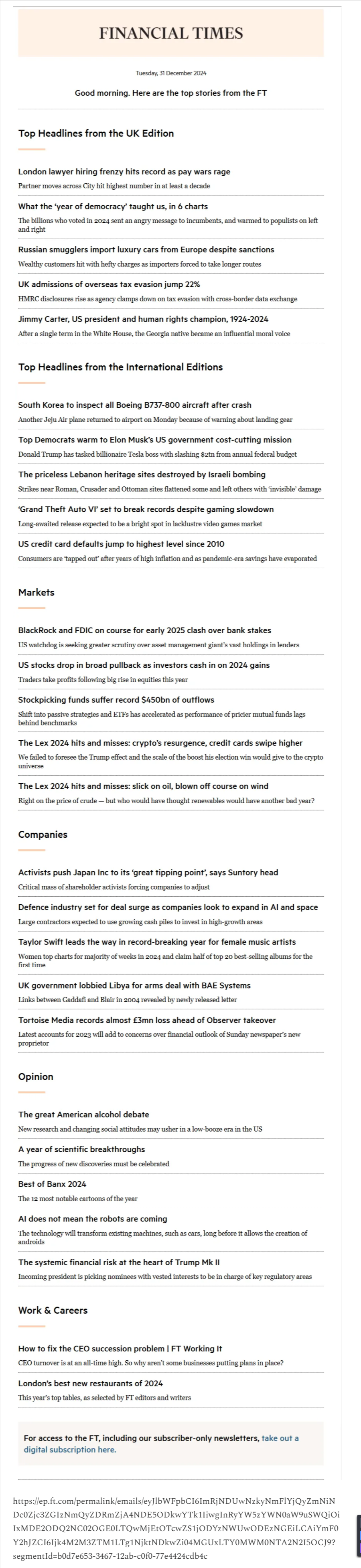
I once met a sweet old couple in west Texas who still felt sore at Jimmy Carter.
…
Bashing the 39th US president, who died on Sunday, was never just a conservative sport, though.
…
He was a recurring punchline in The Simpsons too.
…
On the other hand, without that anger, that historic snapping of public patience at the end of the 1970s, there wouldn’t have been the corresponding appetite for new ideas. No rage, no Reagan.
…
I am increasingly convinced of something that we might call the Carter Rule: rich democracies need a crisis in order to change. It is almost impossible to sell voters on drastic reforms until their nation is in acute trouble.
…
But the electorate wasn’t fed up enough at that stage to entertain a total rupture with the postwar Keynesian consensus. There had to be more pain.
…
Things had to get worse to get better.
…
Editor: Here Ganesh’s political story telling attempts to takes flight, in a report on the Neo-Liberal Capture of The West, that began with Mrs. Thatcher Hayekian Revolution, carefully laundered by Ganesh’s etolted chatter, about worse/better as a kind of convient story telling device.
But doesn’t this describe Emmanuel Macron in recent years? And look at his ordeal. If the president of France had tried to pass his controversial budget in response to a sovereign debt crunch, rather than to avoid one, it would have commanded more of a hearing. Had he raised the state pension age amid a crisis, not to stave one off, the protests would not have been so intense. There are no votes in preventive action. Few of us mean it when we urge governments to think long-term, to fix roofs while the sun is shining, and so on.
Editor: The uttery corrupt Macron then becomes the subject of Ganesh’s apologetic: he describes Macron’s ‘ordeal’, this The Financial Times! , but leaves his Anti-constitutional political methodology untouched, garnished via well worn platiudes.
Editor: The Will To Believe fully graps our would be Shahrazad.
Once you see the Carter Rule in one place, you start to see it everywhere.
…
It is now plain that Europe could have weaned itself off Russian energy long ago. But it took a war to force the issue.
…
(Including the sublime one of Manmohan Singh, the finance minister and later prime minister who died three days before Carter.)
…
The problem with this argument is that it is next of kin to a sort of strategic defeatism: an active desire for things to get worse, that they might improve.
…
Otherwise, Argentina would have put its economic house in order decades ago.
…
This is even truer of high-income countries, where enough voters have enough to lose that even small tweaks to the status quo are provocative.
…
And so to Britain. If any leader today should pore over Carter’s life and times, it is Sir Keir Starmer. The prime minister has useful ideas, as Carter did. As with the “malaise” speech, his bleakness about the state of things at least shows that he understands how much needs to change.
…
Like Carter, he is stuck in one of those pockets of history when the national stomach for change is growing, but not in time for his administration.
…
Those who think Starmer is too cautious might overrate the role of individual agency. It is the public that decides when it is ready to make difficult trade-offs.
…
In politics, as in marriage, there is a world of difference between dissatisfaction and breaking point.
…
Not long after, it lined up exquisitely with the public mood. The tragedy of Carter was one of timing, not talent.
…
Newspaper Reader offer a link to Michael K Smith’s
Having run as a Washington “outsider,” he immediately filled his administration with Trilateral Commission members, hoping that a coterie of Rockefeller internationalists could resurrect the confidence of American leaders and enrich business relations between Japan and the United States.
His Secretary of State was Cyrus Vance, a Wall Street lawyer and former planner of the Vietnam slaughter. Secretary of Defense Harold Brown was Lyndon Johnson’s Air Force Secretary and a leading proponent of saturation bombing in Vietnam. Secretary of the Treasury Michael Blumenthal was the standard rich corporation president. Attorney General Griffen Bell was a segregationist judge who disclosed that he would request “inactive” status as a member of Atlanta clubs closed to blacks and Jews [Carter himself stated that housing should be segregated]. Energy coordinator James Schlesinger was a proponent of winnable nuclear war. Transportation Secretary Brock Adams was a staunch proponent of Lockheed’s supersonic transport. National security adviser Zbigniew Brzezinski was an anti-Soviet fanatic who said in an interview with the New Yorker that it was “egocentric” to worry that a nuclear war between the U.S. and U.S.S.R. would entail “the end of the human race.” Since it was unlikely that every last human being would perish in such event, Brzezinski recommended that critics of U.S. nuclear policy abstain from narcissistic concern for the mere hundreds of millions of people who would.
…
Headline: Things have to get worse to get better
Sub-headline : Voters can’t be sold on change until their nation is in acute trouble
Editor:The Reader of Mr. Ganesh’s latest essay is a bit puzzled by his story telling methodology. The cast of characters keeps evolving, let me attempt to demonstarte the ‘how’ of it, as a kind of wayward political meander.
I once met a sweet old couple in west Texas who still felt sore at Jimmy Carter.
…
Bashing the 39th US president, who died on Sunday, was never just a conservative sport, though.
…
He was a recurring punchline in The Simpsons too.
…
On the other hand, without that anger, that historic snapping of public patience at the end of the 1970s, there wouldn’t have been the corresponding appetite for new ideas. No rage, no Reagan.
…
I am increasingly convinced of something that we might call the Carter Rule: rich democracies need a crisis in order to change. It is almost impossible to sell voters on drastic reforms until their nation is in acute trouble.
…
But the electorate wasn’t fed up enough at that stage to entertain a total rupture with the postwar Keynesian consensus. There had to be more pain.
…
Things had to get worse to get better.
…
Editor: Here Ganesh’s political story telling attempts to takes flight, in a report on the Neo-Liberal Capture of The West, that began with Mrs. Thatcher Hayekian Revolution, carefully laundered by Ganesh’s etolted chatter, about worse/better as a kind of convient story telling device.
But doesn’t this describe Emmanuel Macron in recent years? And look at his ordeal. If the president of France had tried to pass his controversial budget in response to a sovereign debt crunch, rather than to avoid one, it would have commanded more of a hearing. Had he raised the state pension age amid a crisis, not to stave one off, the protests would not have been so intense. There are no votes in preventive action. Few of us mean it when we urge governments to think long-term, to fix roofs while the sun is shining, and so on.
Editor: The uttery corrupt Macron then becomes the subject of Ganesh’s apologetic: he describes Macron’s ‘ordeal’, this The Financial Times! , but leaves his Anti-constitutional political methodology untouched, garnished via well worn platiudes.
Editor: The Will To Believe fully graps our would be Shahrazad.
Once you see the Carter Rule in one place, you start to see it everywhere.
…
It is now plain that Europe could have weaned itself off Russian energy long ago. But it took a war to force the issue.
…
(Including the sublime one of Manmohan Singh, the finance minister and later prime minister who died three days before Carter.)
…
The problem with this argument is that it is next of kin to a sort of strategic defeatism: an active desire for things to get worse, that they might improve.
…
Otherwise, Argentina would have put its economic house in order decades ago.
…
This is even truer of high-income countries, where enough voters have enough to lose that even small tweaks to the status quo are provocative.
…
And so to Britain. If any leader today should pore over Carter’s life and times, it is Sir Keir Starmer. The prime minister has useful ideas, as Carter did. As with the “malaise” speech, his bleakness about the state of things at least shows that he understands how much needs to change.
…
Like Carter, he is stuck in one of those pockets of history when the national stomach for change is growing, but not in time for his administration.
…
Those who think Starmer is too cautious might overrate the role of individual agency. It is the public that decides when it is ready to make difficult trade-offs.
…
In politics, as in marriage, there is a world of difference between dissatisfaction and breaking point.
…
Not long after, it lined up exquisitely with the public mood. The tragedy of Carter was one of timing, not talent.
…
Newspaper Reader offer a link to Michael K Smith’s
Having run as a Washington “outsider,” he immediately filled his administration with Trilateral Commission members, hoping that a coterie of Rockefeller internationalists could resurrect the confidence of American leaders and enrich business relations between Japan and the United States.
His Secretary of State was Cyrus Vance, a Wall Street lawyer and former planner of the Vietnam slaughter. Secretary of Defense Harold Brown was Lyndon Johnson’s Air Force Secretary and a leading proponent of saturation bombing in Vietnam. Secretary of the Treasury Michael Blumenthal was the standard rich corporation president. Attorney General Griffen Bell was a segregationist judge who disclosed that he would request “inactive” status as a member of Atlanta clubs closed to blacks and Jews [Carter himself stated that housing should be segregated]. Energy coordinator James Schlesinger was a proponent of winnable nuclear war. Transportation Secretary Brock Adams was a staunch proponent of Lockheed’s supersonic transport. National security adviser Zbigniew Brzezinski was an anti-Soviet fanatic who said in an interview with the New Yorker that it was “egocentric” to worry that a nuclear war between the U.S. and U.S.S.R. would entail “the end of the human race.” Since it was unlikely that every last human being would perish in such event, Brzezinski recommended that critics of U.S. nuclear policy abstain from narcissistic concern for the mere hundreds of millions of people who would.
Editor : Mitch McConnell is a Historian of Note, a small selection from his History Made To Measure:
When he begins his second term as president, Donald Trump will inherit a world far more hostile to U.S. interests than the one he left behind four years ago. China has intensified its efforts to expand its military, political, and economic influence worldwide. Russia is fighting a brutal and unjustified war in Ukraine. Iran remains undeterred in its campaign to destroy Israel, dominate the Middle East, and develop a nuclear weapons capability. And these three U.S. adversaries, along with North Korea, are now working together more closely than ever to undermine the U.S.-led order that has underpinned Western peace and prosperity for nearly a century.
The Biden administration sought to manage these threats through engagement and accommodation. But today’s revanchist powers do not seek deeper integration with the existing international order; they reject its very basis. They draw strength from American weakness, and their appetite for hegemony has only grown with the eating.
Many in Washington acknowledge the threat but use it to justify existing domestic policy priorities that have little to do with the systemic competition underway. They pay lip service to the reality of great-power competition but shirk from investing in the hard power on which such competition is actually based. The costs of these mistaken assumptions have become evident. But the response to four years of weakness must not be four years of isolation.
Even though the competition with China and Russia is a global challenge, Trump will no doubt hear from some that he should prioritize a single theater and downgrade U.S. interests and commitments elsewhere. Most of these voices will argue for focusing on Asia at the expense of interests in Europe or the Middle East. Such thinking is commonplace among both isolationist conservatives who indulge the fantasy of “Fortress America” and progressive liberals who mistake internationalism for an end in itself. The right has retrenched in the face of Russian aggression in Europe, while the left has demonstrated a chronic allergy to deterring Iran and supporting Israel. Neither camp has committed to maintaining the military superiority or sustaining the alliances needed to contest revisionist powers. If the United States continues to retreat, its enemies will be only too happy to fill the void.
…
In January 1934, William Borah, a Republican senator from Idaho and an outspoken isolationist, addressed a meeting of the Council on Foreign Relations in New York. Because peace had prevailed for 15 years following the end of World War I, Borah argued, global military spending was excessive. Tensions between European powers, he insisted, could not be solved by outsiders: “It will be a long time, I venture to believe, before there will be any necessity or any justification for the United States engaging in a foreign war.”
Of course, by the end of the 1930s, the Nazi conquest of Europe had driven a dramatic swing in U.S. public opinion away from Borah’s isolationist daydream. By May 1940, as German forces invaded France, 94 percent of Americans supported any and all necessary investments in national defense. By June, more than 70 percent favored the draft.
The United States saw the light during World War II. But must it take another conquest of a close ally before the country turns its belated attention to the requirements of national defense? Isolation is no better a strategy today than it was on the eve of World War II. Today, in fact, in the face of linked threats even more potent than the Axis powers, a failure to uphold U.S. primacy would be even more catastrophically absurd than was the refusal to assume that responsibility 85 years ago. The last time around, the naive abdication of the requirements of national defense made reviving the arsenal of democracy on a short timeline unnecessarily difficult. As Admiral Harold Stark, then the chief of naval operations, observed in 1940, “Dollars cannot buy yesterday.”
…
Editor : Senator Mitch McConnell does not sound the notes of a Walter Lippmann nor a George Kennan, but of the long forgotten voice of Joseph Alsop!
Political Observer can’t get enough of the careless packaging of ‘News’, in its de-evolution into National Security State Propganda & the triumph of John H. Kellogg’s Breakfast Cereal ?
Editor: Under the rubric of ‘THE SUNDAY TIMES VIEW’
Headline: The age of uncertainty is here to stay — so let’s embrace it
When Labour last won a landslide victory, in 1997 under Tony Blair, it took a long time for voters to become disenchanted. Mori had Labour with a 29-point lead over the Tories in December 1997, seven months after the election. That was the platform on which Blair built three strong election victories.
Today under Sir Keir Starmer things could hardly be more different. As we report today, a large-scale, seat-by-seat polling analysis by More in Common shows that if there were to be an election now, Labour would lose nearly 200 seats and its majority, finishing only slightly ahead of the Tories, with Reform UK, the Liberal Democrats and the Scottish Nationalists winning dozens of seats. At first blush the analysis merely tells you Labour has shot itself in the foot repeatedly since the election, making enemies and few friends. The real cause, though, arguably goes far deeper. It is down to political fragmentation, which increasingly describes the world that we are in.
The clues were there at the time of the July general election. Turnout was a paltry 59.7 per cent, and of that the combined vote share of the two main parties, Labour and the Tories, was only 57 per cent. Only 20 per cent of those entitled to vote backed Labour, 14 per cent the Tories.
If the analysis we are reporting today provides anything like a glimpse into the future, the fragmentation we saw in July 2024 is a mere taster. No workable coalitions could be established. It would be like importing the present French or German instability into the UK, something that first-past-the-post is meant to prevent.
Editor: Reader recall the dismal record of this newspaper for ‘truth telling’? This just a sample of the defamation that Corbyn suffered from all British Corporate Media !
Headline: Biography
Review: Dangerous Hero: Corbyn’s Ruthless Plot for Power by Tom Bower — portrait of a monomaniac
If Jeremy Corbyn became prime minister, he would easily be the most dangerous, most indolent and least intelligent holder of the office in history
Sunday February 24 2019, 12.01am GMT, The Sunday Times
Editor: given this reprehesable record of lies, how might the Reader treat this wan apologetic for Tony Blairs political catamite Kier Starmer ? The diagnosis of the present is thin, and carelessly refracted through a politically self-serving characature of a past!
This fragmentation has not happened in a vacuum. People are probably more cynical about politicians than they have ever been. Years of slow growth, high immigration and squeezed living standards, and of high taxes alongside crumbling public services, have created permanent disquiet and turbocharged Reform UK. The world is also increasingly splintered — worryingly so. It is not that long since post-Soviet Russia, even under Vladimir Putin, was being embraced. For a while, the G7 was the G8. Less than ten years ago, too, under David Cameron’s “golden era” of relations with China, the then prime minister posed with a pint in a pub with Xi Jinping.
Editor : ‘Growth’is the very linch-pin of Neo-Liberalism , no matter how they self-present , in the guises adapted for the self-serving present! The final paragraph of the essay is just reiteration, in political costume!
Otherwise the future looks painful: a slow march to an election in which “none of the above” is the favoured choice. UK elections are by tradition won in the centre ground. But it would be a mistake to rely on this. The age of uncertainty is here to stay. The challenge for Starmer, and other western leaders, is to embrace it
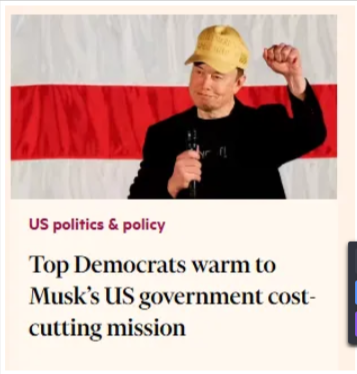
Pressing question: how long will the Trump/Musk allience last?
(Under the rubric of Self-congatulation) According to popular legend, after his abjuration Galileo allegedly muttered the rebellious phrase “and yet it moves” (Eppur si muove)
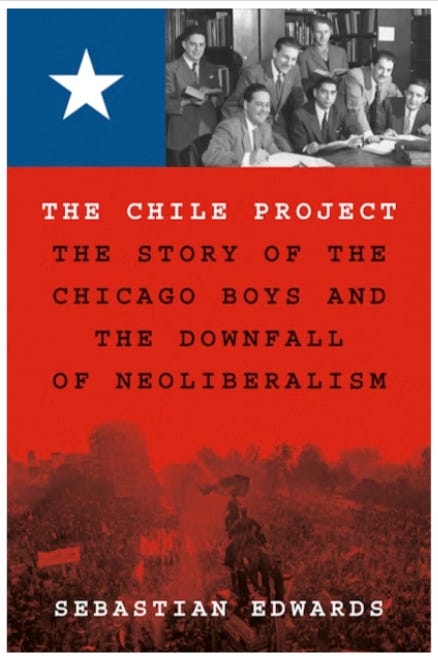
Editor : The Reader has to wonder at Andrews enthusiasm for Milei, after the Economic Catastprohie 2006-2008, that brought The West into Economic Crisis, and destroyed both the working class and the middle class, in Western Democrasies. Yet The Reader of this interview is confronted by Andrews enthusiasm, for a politics that didn’t just fail, but utterly collapsed and emisertated millions across The West for decades! Such is the the political fact of the Hayek/Mises/Friedman Swindle!
Editor: here are the final paragraps of this would-be hagiography freighted with the necessary Neo-Liberal political ballaist:
…
In speeches and interviews, Milei effortlessly pulls out quotations and themes from great free-market works, such as Friedrich von Hayek’s The Fatal Conceit or Ludwig von Mises’s Socialism. He talks about the ideas and philosophers that shaped his libertarian thinking. But what attracted him to those ideas in the first place?
‘I am a true libertarian,’ he says. ‘I see the state, government, as an oppressive machine which destroys rights, which destroys liberty. I see taxes as theft, I see the state as an organised criminal gang.
…
I ask Milei if Trump is a conundrum for libertarians. On the one hand, he offers domestic tax cuts and a commitment to free speech. On the other, he proposes tariffs and economic protectionism. Does Milei think the positive case outweighs the negative case, or does he think Trump – who says that ‘tariffs’ is his favourite word apart from ‘love’ and ‘religion’ – is bluffing to secure trade deals?
‘First of all, what I do commend and welcome about Trump is that he understands who the enemy is. He understands that woke-ism is the enemy, he understands that the enemy is socialism, that the enemy is the state… on the second thing, I believe all the accusations levelled against him about the tariffs vis-a-vis China are wrong, they’re incorrect, so I don’t really take that point. I think one should try to understand how the system works.’
Milei’s free-market radicalism is tempered, then, by his realism when it comes to politics and the way the world operates. He calls himself an anarcho-capitalist in ‘philosophical terms’, but in ‘real life’ he says he hovers ‘between a classical liberal or libertarian and a minarchist’. He is critical of the purists, the ‘liberal libertarians who strongly criticise me for not having lifted the currency controls on day one’ – a major move towards liberalisation that still has not happened. ‘If I had done that on the very first day, it would have caused hyperinflation and by January I would have been thrown out.’
Milei is also a fan of Boris Johnson, and the two met in Buenos Aires in October. ‘We had a wonderful conversation,’ he says. ‘[Johnson] brought me his book, and we talked about economics and we discussed the philosophical approach. Naturally, he is closer to being a more classical liberal… I really enjoy having the opportunity to talk to other leaders and I try to internalise the restrictions they face.’
Johnson is not the only former prime minister to have made an impression on Milei. He describes David Cameron as a ‘brilliant individual’ – and he’s spoken to both Johnson and Cameron about his hopes of meeting Mick Jagger when he comes to the UK. ‘I would also like to meet Keith Richards. I have the full collection not only of the Rolling Stones but also of the Beatles.’ Milei often speaks about his love for the Rolling Stones, but his Anglophilia runs much deeper than that.
‘One thing that also brought me very close to British culture was Lord Byron, especially when I read “Don Juan”. I thought it was amazing. In fact, when I bought the book, I had it in English and in Spanish, and when I read it in English I really enjoyed it much better than in Spanish.
‘Of course, Shakespeare also brought me close to British culture. There are many things I find very appealing about the UK, apart from the fact that you invented football but of course we are the best ones.’ Fighting words, I say. We won’t fight about it, he tells me reassuringly, ‘but we are better!’.
Given his enthusiasm for Britain, and presumably his classical liberal belief in the right to self-determination, I wonder how Milei defends Argentina’s position on the Falkland Islands – or what the Argentinians call Islas Malvinas. In a referendum in 2013, 99 per cent of Falklands residents voted to remain British. ‘We have a sovereignty claim,’ he says. ‘We believe that our foundations, in support of the claim, that the Malvinas are Argentine, so we will seek through diplomatic channels to recover them.
‘The people of Argentina elected me as President. In that context I recognise the Malvinas Islands as Argentine, and I will make every diplomatic effort to recover them and that’s part of my policy… you may like my proposals or not, but you won’t say that I’m not consistent.’
On trade, Milei is certainly consistent: the more, the better. He wants to ramp up relations with Beijing, for instance, just as Trump’s America seems to be decoupling from China. He had a sideline meeting with President Xi Jinping at the G20 to discuss further opportunities. How does a libertarian president deal with an authoritarian communist world leader?
‘What is my job today? President of Argentina. And I need to take care of defending the interests of the people of Argentina and improving the quality of life of the Argentine people,’ he says. ‘China is a natural partner for us. And let me tell you something, I was pleasantly surprised by the way that China works with other countries, in that it’s a very friendly partner… it is a trading partner that does not interfere, that causes no nuisance.’
It’s a glowing description of the world’s second-largest economy. ‘Honestly,’ he says, ‘I am very much surprised by the respectful way they have treated us.’ He then remembers the largest economy, and smiles. ‘And at the same time, I am really filled with joy by the way the Republican party in the United States treats us.’ There might come a point, soon, when he has to choose between the two.
Editor: What does the Buenos Aires Herald of December 15, 2024 have to say:
Tuesday marked one year since President Javier Milei took office, and he took to the airwaves to deliver a national address in which he promised to eliminate 90% of taxes, get rid of currency controls, and allow Argentines to spend dollars alongside pesos. Alongside promises of a near prosperous future thanks to policies for the “common man” was the usual “anti-caste” rhetoric. Warnings against opposing government reforms peppered the speech: “You can either get on the train or be run over by it.”
A common refrain among Milei’s supporters is that he is not a far-right government. He’s simply trying to implement policies in Argentina that are common among pro-market governments all over the world, and he values liberty above all things. Sure, he says some wild things, but that’s his personal style, and we shouldn’t take it literally. What’s far-right about all that?
It’s true that many of Milei’s economic policies are relatively common elsewhere. But some mark a throwback to the 1990s in their singular belief that a free market and a small state cure all ills, despite a deluge of subsequent studies that found that these policies tend to increase inequality and concentrate wealth at the top.
In Argentina, the litmus test for whether a political figure was far right, as opposed to simply conservative, has mostly been their support — either outspoken or veiled — for the military dictatorship’s narrative about political violence in 1970s Argentina.
As democracy advanced, the Argentine political and judicial system progressively reached a popular consensus that what the military called the “Dirty War” was actually a ploy to disguise the horrific truth: that the dictatorship had run a systematic plan to disappear and murder a portion of the population that opposed the imposition of their political order. This scheme also included an ultra-liberal economic program that increased foreign debt, hindered industrialization, and left an accumulated inflation rate of more than 8,000%.
In the 1990s and early 2000s, calls for “a complete memory” were only marginal. Included in this group, essentially proponents of the denialist “Two Demons Theory” that equated state terrorism with the armed resistance groups, were a few former dictatorship officials, as well as the relatives of military officers — current VP Victoria Villarruel being one of them — who were finally being tried and sentenced for crimes against humanity.
By 2015, the consensus was so well-grounded that PRO leader Mauricio Macri, who had previously echoed some of the dictatorship’s ultra-right rhetoric, notably had to tone it down when becoming president. It was actually during his administration that the ESMA Museum and Site of Memory officially opened, following years of work under the Kirchners’ presidencies. In 2016, during Barack Obama’s official visit to Argentina, Macri even joined the former US president in honoring dictatorship victims at the Parque de la Memoria for the 40th anniversary of the coup.
But now, Milei has vindicated the sectors of the Argentine far-right that deny the dictatorship’s crimes and demonize human rights groups like Mothers and Grandmothers of Plaza de Mayo. This has come in the form of rhetoric describing state terror as a “war,” disputing the number of the dictatorship’s victims, and calling human rights organizations’ work a “con” ( curro ). He has also followed the strategies of other far-right world leaders, who have turned “culture wars” into the rallying cry of their base.
The issues within this category range from reproductive rights and protection of LGBTQIA+ people to attacks on immigrants and Indigenous people. Milei has also included targets of his own, bashing groups that have historically been at the center of Argentina’s civil society and are a source of pride for the country, like public universities, film institute INCAA, and the top publicly-funded research institute CONICET.
The president has consistently sought to include these actors within the “caste” by accusing them of being privileged sectors that use public resources that do not yield any benefits for the population. By beating this drum, Milei has managed to tune in to one of the most effective strategies of the global far-right: the battle of elites versus commoners.
In Milei’s unique Argentina-centered vision of this conflict, the dilemma is between sectors or individuals that depend on the state for financing, no matter their mission, importance, or success, and the rest who have to cover it out in the wilderness of the “free market.” The president thanked such Argentines specifically for their sacrifice at the top of his December 10 speech.
His security policy has swung towards punitivism, with Security Minister Patricia Bullrich explicitly looking to Salvadoran strongman Nayib Bukele’s system of mega prisons. The government also lowered the minimum age to carry firearms legally and will also seek to reduce the age of criminal responsibility, according to Milei’s speech on December 10.
Policies have so far been regressive, in the sense that poverty exploded by 11 points and inequality, as measured by GINI coefficient, spiked. And although formal salaries may be starting to gain ground against inflation, workers in this sector have lost 6% of purchasing power since Milei came into office. It should also be noted that informal workers have lost even more.
His supporters might argue that such economic hardship is a necessary price to pay to wrestle the country into shape after what they see as years of aberrant and ruinous policies: better to rip off the band-aid than incur more suffering because nothing changes.
Relying heavily on free market principles without considering their potential social impacts can lead to negative consequences, such as increasing poverty. It’s essential to strike a balance between economic growth and the well-being of all citizens to ensure that progress doesn’t come at the expense of the most vulnerable.
These costs have moved in lockstep with deliberate attacks on the rights of women, minorities, and Argentina’s national memory about state terror. To argue that such positions are merely conservative or right-of-center rather than far-right implies normalizing that which can never be normal.
Argentina completes one year under the extreme right
Milei’s defenders dispute this category, but rejecting it implies normalizing aberrations
Tuesday marked one year since President Javier Milei took office and delivered an inaugural address in which he promised to eliminate 90% of taxes, lift the currency controls and allow Argentines to spend dollars alongside pesos. Along with promises of a prosperous future thanks to policies for the “common man” was the usual “anti-caste” rhetoric. The speech was peppered with warnings against those who oppose government reforms: “Either you get on the train or it runs you over.”
A common refrain among Milei’s supporters is that his is not a far-right government. He is simply trying to implement policies in Argentina that are common among pro-market governments around the world, and he values freedom above all else. True, he says some crazy things, but that is his personal style, and we should not take him literally. What is far-right about all this?
It is true that many of Milei’s economic policies are relatively common elsewhere. But some of them date back to the 1990s, with his singular belief that a free market and a small state cure all ills, despite the avalanche of subsequent studies that found that these policies tend to increase inequality and concentrate wealth in the hands of a few.
In Argentina, the litmus test for determining whether a political figure was far-right, rather than simply conservative, has largely been his or her support, overt or veiled, for the military dictatorship’s narrative about political violence in 1970s Argentina.
As democracy advanced, the Argentine political and judicial system gradually reached a general consensus that what the military called the “dirty war” was in fact a ploy to disguise the horrible truth: that the dictatorship had carried out a systematic plan to disappear and murder a part of the population that opposed the imposition of its political order. This plan also included an ultra-liberal economic program that increased the foreign debt, slowed industrialization and left an accumulated inflation rate of more than 8,000%.
In the 1990s and early 2000s, calls for a “complete memorial” were marginal. This group, essentially supporters of the denialist “two demons theory,” which equated state terrorism with armed resistance groups, included some former officials of the dictatorship, as well as relatives of repressors (among them the current vice president Victoria Villarruel) who were finally being tried and convicted for crimes against humanity.
By 2015, that consensus was already so well cemented that PRO leader Mauricio Macri, who had previously echoed some of the dictatorship’s far-right rhetoric, had to moderate noticeably upon becoming president. Indeed, it was during his administration that the ESMA Museum and Site of Memory was officially inaugurated, after years of work during the Kirchner presidencies. In 2016, during Barack Obama’s official visit to Argentina, Macri even joined the former US president in honouring victims of the dictatorship at the Parque de la Memoria on the occasion of the 40th anniversary of the coup.
But now, Milei has vindicated sectors of the Argentine far right that deny the crimes of the dictatorship and demonize human rights organizations such as the Mothers and Grandmothers of Plaza de Mayo. This has happened in the form of rhetoric that describes state terrorism as a “war,” questions the number of victims of the dictatorship, and calls the work of human rights organizations “a job.” She has also followed the strategies of other far-right world leaders, who have turned “culture wars” into the rallying cry of their base.
Topics within this category range from reproductive rights and the protection of LGBTQIA+ people to attacks on immigrants and indigenous peoples. Milei has also added her own targets, attacking groups that have historically been at the center of Argentine civil society and are a source of pride for the country, such as public universities, the national film institute (INCAA) and the main publicly funded research institute (CONICET).
The president has constantly sought to include these actors within the “caste,” accusing them of being privileged sectors that use public resources and do not provide any benefit to the population. With this song, Milei has managed to tune in to one of the most effective strategies of the global extreme right: the battle of the elites against ordinary people.
In Milei’s particular view of this conflict, which is focused on Argentina, the dilemma is between the sectors or individuals that depend on the State for their financing, regardless of their mission, importance or success, and the rest who have to make do in the desert of the “free market.” The president specifically thanked those Argentines for their sacrifice in the first part of his speech on December 10.
Its security policy has veered toward punitivism, with Security Minister Patricia Bullrich explicitly resorting to Salvadoran dictator Nayib Bukele’s mega-prison system. The government has also lowered the minimum age for legally carrying firearms and will seek to lower the age of criminal responsibility.
Policies so far have been regressive, in the sense that poverty has grown by 11 points and inequality, as measured by the GINI coefficient, has soared. And while formal wages may be starting to gain ground against inflation, workers in this sector have lost 6% of their purchasing power since Milei came to power. It should also be noted that informal workers have lost even more.
Milei’s supporters might argue that such economic hardships are a necessary price to pay to get the country moving again after what they see as years of aberrant and ruinous policies: it is better to rip off the band-aid than to continue suffering because nothing changes.
Over-reliance on free market principles without considering their potential social impacts can lead to negative consequences, such as increased poverty. It is essential to strike a balance between economic growth and the well-being of all citizens to ensure that progress does not come at the expense of the most vulnerable.
These costs have come in tandem with deliberate attacks on women’s rights, minorities, and Argentina’s national memory of state terrorism. To argue that such positions are merely conservative or center-right rather than far-right is to normalize something that should never be normal.
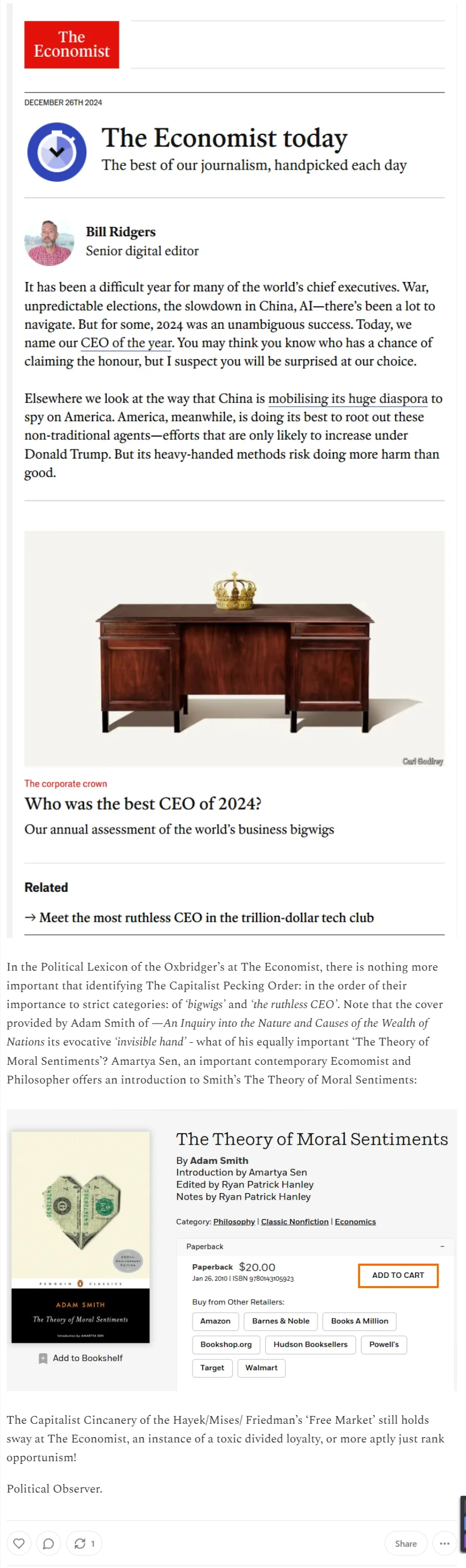
Bill Ridgers ‘Senior digital editor’ sends me a personal note from The Economist’s ‘Best CEO of 2024’ and ‘the most ruthless CEO in the trillion-dollar tech club’ !





 StephenKMackSD's Blog