@BerkowitzPeter on ‘Philip Howard Aims To Enhance Freedom by Restoring Authority’.

Old Socialist comments.

I am not a subscriber to ‘Real Clear Politics’ , but somehow I am on their mailing list. Today I explored the web site, and one of the essays caught my interest:

‘Philip Howard Aims To Enhance Freedom by Restoring Authority’ by Peter Berkowitz.

https://www.realclearpolitics.com/articles/2024/04/21/philip_howard_aims_to_enhance_freedom_by_restoring_authority_150829.html

The first sentence of Berkowitz’s essay offers both ‘The New Right’ & ‘the progressive left’ : Reader first note, the upper case of ‘The New Right’ and the lower case reserved for ‘the progressive left’, as a way to minimize, to place in shadow, as opposed to the revelation of ‘The New Right’ ! ‘Largely unbeknownst to themselves’ places both ‘Right’ and ‘Left’ in the category of unconscious political actors, is more Berkowitz rhetorical chicanery?

Largely unbeknownst to themselves, influential segments of the New Right and the progressive left share a deep-seated – and delusive – belief. Both suppose that freedom – in the form of the equal individual rights promised by America’s founding principles – on the one hand, and traditional virtues and tight-knit local communities, on the other, are implacably opposed. The more you have of one, prominent figures on the right and on the left surmise, the less you have of the other.

They draw, however, opposite conclusions from their common conviction. Prizing virtue and community, national conservatives and postliberals on the right blame individual freedom for hollowing out the public good and diverting attention from citizens’ character, and they would wield government to uphold their religious convictions and the moral judgments that flow from them. Valuing autonomy, ideologues and activists of the progressive left seek to emancipate individuals from the constraints of venerable duties and inherited ways of life.

One can take too far the observation about the partisans’ strange convergence. After all, the New Right affirms the right of national self-determination and that public policy should reflect that human beings are equally created in God’s image. Meanwhile, the progressive left employs government authority to curtail free speech in the name of inclusiveness. But on the whole, both believe that one must choose: freedom and individual rights or virtue and community.

I’ve placed in italics of some of the Berkowitz’s arcane, or just dubious political vocabulary e.g. national conservatives postliberals , as co much techo-chatter, for want of a better descriptor ! Peter Berkowitz is a ‘senior fellow at the Hoover Institution’ who understands the value of propaganda, in the guise of book review, that acts the part of literary criticism, wedded to verifiable good of the restoration of ‘Authority’! In his next paragraph Mr. Berkowitz mentions both John Locke and Aristotle as part of ‘our political/moral inheritance’, I will offer the caveat that both of these Philosophers need careful laundering.

From the perspective of America’s founding principles, that is a false choice. The founders generally shared John Locke’s view – which reflects The author of several books dealing with institutions, laws, and practices that have distorted society, eroded freedom, and misshaped morals, Howard is also a lawyer and chair of Common Good, a nonpartisan organization that endeavors to replace bureaucracy with human responsibility .and Aristotle’s understanding – that freedom, the virtues, and community are mutually dependent: freedom makes possible the exercise of virtue and the preservation of communities while individuals acquire in communities the virtues that enable them to maintain and improve free institutions.


Locke:

Abstract:

Locke owned stock in slave trading companies and was secretary of the Lords Proprietors of the Carolinas, where slavery was constitutionally permitted. He had two notions of slavery: legitimate slavery was captivity with forced labor imposed by the just winning side in a war; illegitimate slavery was an authoritarian deprivation of natural rights. Locke did not try to justify either black slavery or the oppression of Amerindians. In The Two Treatises of Government, Locke argued against the advocates of absolute monarchy. The arguments for absolute monarchy and colonial slavery turn out to be the same. So in arguing against the one, Locke could not help but argue against the other. Examining the natural rights tradition to which Locke’s work belongs confirms this. Locke could have defended colonial slavery by building on popular ideas of his colleagues and predecessors, but there is no textual evidence that he did that or that he advocated seizing Indian agricultural land.

https://academic.oup.com/edited-volume/28299/chapter-abstract/214977811?redirectedFrom=fulltext

April 24, 2024: ‘Locke could have defended colonial slavery…?


Aristotle

Abstract

Aristotle’s claim that natural slaves do not possess autonomous rationality (Pol. 1.5, 1254b20-23) cannot plausibly be interpreted in an unrestricted sense, since this would conflict with what Aristotle knew about non-Greek societies. Aristotle’s argument requires only a lack of autonomous practical rationality. An impairment of the capacity for integrated practical deliberation, resulting from an environmentally induced excess or deficiency in thumos (Pol. 7.7, 1327b18-31), would be sufficient to make natural slaves incapable of eudaimonia without being obtrusively implausible relative to what Aristotle is likely to have believed about non-Greeks. Since Aristotle seems to have believed that the existence of people who can be enslaved without injustice is a hypothetical necessity, if those capable of eudaimonia are to achieve it, the existence of natural slaves has implications for our understanding of Aristotle’s natural teleology.

https://www.researchgate.net/publication/33039745_Aristotle_on_Natural_Slavery


Christian teaching

This speaks for itself!


Mr. Berkowitz’s 1478 word essay, has been reduced to 836 words remaining. Mr. Berkowitz is a Neo-Conservative, or its cognate, whose political/moral imperative is to the muddy the rhetorical waters, just enough to make his arguments seem plausible! The Ideas, Philosophies of these paradigmatic Thinkers/Writers are tainted, as my sources make clear: if The Reader attaches herself to something like Truth or even mere plausibility. I’ll pick through the arguments remaining, and without apology, it will be self-serving, but I think revelatory of Mr. Berkowitz’s defence of a needed re-invigoration of ‘Authority’.

…fruitful expression in cooperation is central to Philip K. Howard’s succinct new book. In “Everyday Freedom: Designing the Framework for a Flourishing Society,” Howard maintains that throughout contemporary public life, “Americans have lost the authority to do what they think is sensible.” Restoring that authority, he argues, will enhance individual freedom.

The author of several books dealing with institutions, laws, and practices that have distorted society, eroded freedom, and misshaped morals, Howard is also a lawyer and chair of Common Good, a nonpartisan organization that endeavors to replace bureaucracy with human responsibility.

Howard focuses on the corrosion of the culture of freedom in post-1960s America. This may sound odd since that decade is famously associated with rebellion against traditional norms and practices.

The post-1960s assault on freedom flowed from good intentions, he asserts.

But, Howard maintains, the technocratic mindset overreached.

Howard identifies “three new legal mechanisms” that government and business have implemented since the 1960s to protect the American people from abusive authority.

The purpose of comprehensively regulating conduct through elaborate rules, extensive procedures, and a vast array of rights – you could call it the juridification of public life – reflected the high-minded aspiration “to enhance freedom by reducing any wiggle room for bias, unfairness, or error.”

The long-term consequences of the juridification of public life, argues Howard, have been pernicious. The expansion of law and regulation – notwithstanding the aspiration to fairness – suppresses spontaneity, constricts intuition and common sense, fosters conformity, promotes indiscriminate distrust of authority, discourages people from taking ownership of their actions, and erodes appreciation of the common good.

“The cure is not mainly new policies, but new legal operating structures that re-empower Americans in their everyday choices,” Howard contends.

Howard proposes an alternative framework. To preserve and enlarge “everyday freedom,” this new legal architecture would establish “boundaries safeguarding against unreasonable acts.”

Since judgment on the spot is crucial to most human activities – in the family, within communities, on the job – law that empowers individuals to use their common sense would not only expand freedom but also improve outcomes.

“Everyday freedom requires not only a zone of protected autonomy, but also trust that other people will abide by the reasonable values of society.”

Although it cuts against the grain of contemporary legal sensibilities, argues Howard, “people with responsibility must be empowered to assert norms of what’s right and reasonable, and they must be free to make judgments about the people they work with.”

This freedom to exercise authority allowed supervisors and workers to use their discretion, find creative solutions, and work unimpeded by bureaucratic meddling and endless demands for permits and licenses.

The last paragraphs of Mr. Berkowitz’s essay are platitudinous at best, yet he still can’t let go of the bad actors, in this dubious Political Melodrama : ‘The New Right’ , in upper case & ‘the progressive left’ in lower case, that exemplifies his political/rhetorical bad faith!

To deserve, in the name of the protection of everyday freedom, the greater authority and discretion that Howard would entrust to them, public officials and ordinary citizens must acquire a range of virtues: the imagination to put themselves in other people’s shoes; the diligence to do their homework and devise feasible undertakings, measures, and reforms; the courage to stand by correct but unpopular decisions; and the grace to admit when they are wrong and correct course.

The American political tradition teaches that the cultivation of these virtues, which are essential to the responsible exercise of everyday freedom, depends on strong families, vibrant communities, and schools dedicated to education rather than indoctrination.

Contrary, then, to influential elements within both the New Right and the progressive left, reconciling freedom, on the one hand, and virtue and community, on the other, does not call for squaring a circle but rather embracing a package deal.

Political Observer
Posted in Uncategorized | Leave a comment

Melanie Phillips: ‘How Conservatism’s Chickens Came Home to Roost in Gaza’

Political Observer comments.

Melanie Phillips opens her diatribe with these markers, this hysterical collection of ‘charges’ against a people subject to 75 years of subjugation, oppression, dispossession, incarceration, kidnap, murder. And in the present to Geocide and Famine, charges that Phillips vehemently denies, based on denial, alone!

The Enemy of Civilization

The malign malignant attack

Genocide of the Jews

The War against The West

War against Israel

The War against Civilization

Phillips is, along with other Jews, are given the role of Victim, as in the six charges above! Phillips also attacks an amorphous, ill defined ‘Left’, the Tories and some of the attendees at the Conference she is addressing. A 25 minute speech consisting of repetitions, reframed as need be, to fit the evolving rhetorical imperatives of propaganda!

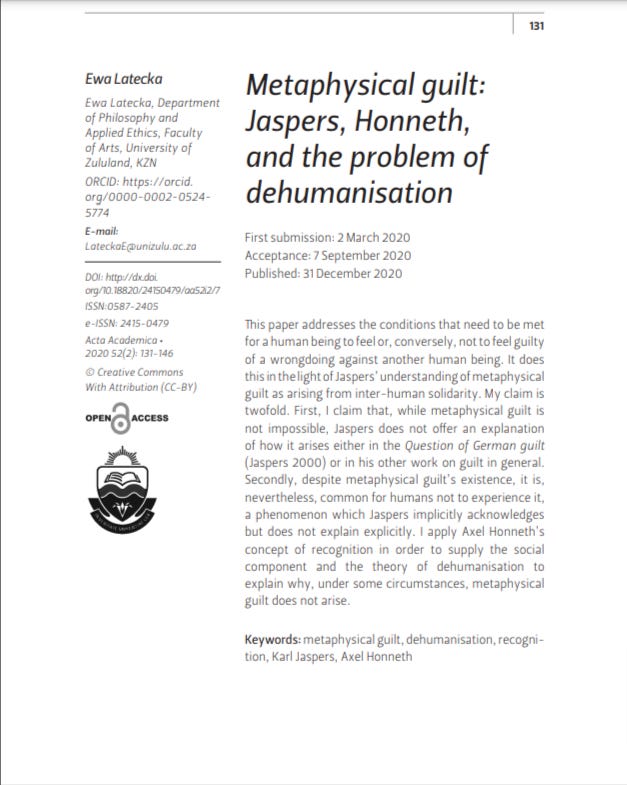
Here is a valuable paper by Ewa Latecka, Department of Philosophy and Applied Ethics, Faculty of Arts, University of Zululand, KZN

Political Observer

Posted in Uncategorized | Leave a comment

The Would-Be Poetry of @rcolvile is irresistible?

Political Observer wonders at this short lived ‘evolution’!

The first paragraphs demonstrate a remarkable ‘evolution’, that reminds this American Reader of Rod McKuen’s ‘Listen to the Warm’ of 1967! He was reported to be Elizbeth Taylor’s favorite Poet! Mr. Colvile poetic reach, not to speak of his blend of ‘The Eclipse’ , the political with popular entertainment of the moment, lends a certain elan !

For medieval peasants a solar eclipse was a certain sign of the apocalypse. A 14th-century text, “The Fifteen Signs before Doomsday”, explained that the sun “will give no light and will be cast down to Earth — while you now see it as pleasing and bright, it will become as black as coal”.

For Tory MPs there is no need to watch the heavens to predict the end: they just have to look at the polls. The Conservative rating of 19 per cent in Ipsos’s Political Monitor is the lowest since the survey started in 1978. Rishi Sunak’s personal favourability has hit a historic low, too — yet the same polls suggest that changing leader would do little to help.

Indeed, a better parallel than the Middle Ages may be Fallout, the big new show on Amazon Prime, in which a mismatched group of characters have to navigate a derelict, post-nuclear hellscape.

Admittedly, those Conservative MPs that do make it back into parliament may not have to grapple with flesh-eating ghouls, mutated fish monsters and murderous robots. But on present polling it’s looking like about as much fun.

Yet in politics, as in Fallout’s wasteland, life always goes on. Which is why thoughts are already turning to what comes next.

Unfortunately, Mr. Colvile then touches the ground of reality, in the political present, I’ll attempt a foreshortened collection of the ‘highlights’ :

With the signal exception of Suella Braverman, the main contenders for the Tory leadership after the election are still supportive of Sunak,…

….

…Conservative Home’s survey of Tory members, vindicated by the Cass review on transgender care for under-18s, giving a punchy speech on regulation and growth and using the free vote on the smoking ban to express principled opposition to creating two categories of legal adults.

Yet the more I think about the Conservative Party’s plight, the more questions of personality feel almost irrelevant.

We don’t need to rehearse all the reasons for the Tories’ spectacular — and historically unprecedented — slide in the polls.

The Conservatives have lost voters to both left and right,…

The Tory party, as one of its senior members told me the other day, is made up of three tribes.

Editor: The Three Tribes:

the soft centre

“the wets”

There are those (like me) who prioritize free markets and economic opportunity.

…Conservatism is cultural, inspired by faith, family and flag.

Editor : Perhaps I don’t understand British Counting, it looks like 4 to me!

Of course, these tendencies mix and mingle, often within the same individuals.

Editor: Liz Truss is entitled to her own section!

…Liz Truss complains that during the Brexit referendum, in which she campaigned for Remain, “Vote Leave’s main campaign message … was simply a pledge to increase public spending on the NHS. This seemed an odd rallying cry for free-market conservatives.”

The brutal truth — much as Truss and I would both wish it otherwise — is that messaging tailored to free-market conservatives barely wins you a majority among Tory MPs these days, let alone the wider electorate.

Assuming that the polls do narrow (as I still suspect they will), there will be enough of a core for the Tories to rebuild after their likely loss.

I mentioned Fallout earlier. It’s a hit show. But the audience for even the biggest hits today is a fraction of what it was in the four-channel days. We’re a multiculture, not a monoculture. So why should political parties be an exception?

But that majority also relied on the electoral steroids provided by Corbyn and Brexit. Even without the stream of shocks and scandals that followed, it would have been hellishly difficult to keep that coalition together.

There is, of course, one consolation: the same probably applies to Labour. That may seem a strange claim, given Keir Starmer’s position in the polls. But that lead is built on dislike of the Tories, not enthusiasm for the other lot.

Owen Jones, the leftie’s leftie, has already departed in high dudgeon, because a Labour Party that moves far enough right to win a majority has gone beyond the ideological pale for the Corbyn lot.

I’ve always been a strong supporter of first past the post. I still am.

Fixing them will take serious reforms, as it did under Thatcher — a topic I’ve been reading about in depth, given that I run the Centre for Policy Studies, the think tank she and her allies founded to do that job 50 years ago.

How, for example, do you persuade an electorate that is increasingly dependent on the state that there are limits to not just what it can do, but what it should do?

If rebuilding a majority Conservatism is a hard task, building one that also addresses Britain’s core challenges feels even harder. Yet it’s a job that absolutely needs to be done.


@rcolvile self-presents as a modern day Sisyphus?

Political Observer

Posted in Uncategorized | Leave a comment

@nytdavidbrooks on ‘Transgender Care’ .

Queer Atheist offers a selective commentary.

The first paragraphs of the Brooks’ essay don’t quite give the game away :

Hilary Cass is the kind of hero the world needs today. She has entered one of the most toxic debates in our culture: how the medical community should respond to the growing numbers of young people who seek gender transition through medical treatments, including puberty blockers and hormone therapies. This month, after more than three years of research, Cass, a pediatrician, produced a report, commissioned by the National Health Service in England, that is remarkable for its empathy for people on all sides of this issue, for its humility in the face of complex social trends we don’t understand and for its intellectual integrity as we try to figure out which treatments actually work to serve those patients who are in distress. With incredible courage, she shows that careful scholarship can cut through debates that have been marked by vituperation and intimidation and possibly reset them on more rational grounds.

Cass, a past president of Britain’s Royal College of Pediatrics and Child Health, is clear about the mission of her report: “This review is not about defining what it means to be trans, nor is it about undermining the validity of trans identities, challenging the right of people to express themselves or rolling back on people’s rights to health care. It is about what the health care approach should be, and how best to help the growing number of children and young people who are looking for support from the N.H.S. in relation to their gender identity.”

Should this surprise The Reader? Brooks is smitten by evocatively presented ‘Credentials’ ! I’ve placed in bold font the Brooks anti-left hysteria. Brooks was trained by Wm. F. Buckley Jr. , in sum the ‘left’ is mendacious by nature. Yet ‘Some activists and medical practitioners on the left’ : this defamation defended by a ‘2022 Reuters investigation , prefaced by the modifier ‘some’ !

Some activists and medical practitioners on the left have come to see the surge in requests for medical transitioning as a piece of the new civil rights issue of our time — offering recognition to people of all gender identities.

But a 2022 Reuters investigation found that some American clinics were quite aggressive with treatment: None of the 18 U.S. clinics that Reuters looked at performed long assessments on their patients, and some prescribed puberty blockers on the first visit.

Where might The Reader look for another perspective ?

Headline: What the Cass Review Means for Trans Kids in Britain—and Beyond

Sub-headline: A new review of gender-affirming healthcare in England could change the way gender-questioning children and young everywhere people receive care. .

By Natasha Hakimi Zapata

Astronomical waiting times are just one of the failures the Cass Review identifies, highlighting that during these limbo periods, children are not offered any sort of support, including mental health services. This is especially egregious considering the NHS’s own Healthcare Safety Investigation Branch told Reuters in 2022 that the “‘incredibly distressing’ wait for gender care ‘created a significant patient safety risk for young people.’” There have been a number of suicides linked to waiting times, including Alice Litman, a 20-year-old who’d first sought gender-affirming care at age 15, and was still on a waiting list for more than 1,000 days when she died.

The review’s publication also comes as the country grapples with a stark rise in anti-trans hate crimes amid what Cass herself labeled the “exceptional” “toxicity of the debate” on trans youth healthcare. While some, like Kamran Abbasi, editor in chief of the The BMJ (formerly the British Medical Journal), see the Cass Review as “an opportunity to pause, recalibrate, and place evidence-informed care at the heart of gender medicine,” Amnesty International has warned that it is already being “weaponised by people who revel in spreading disinformation and myths about healthcare for trans young people”. The Scottish author J.K. Rowling has already taken a victory lap on Twitter/X. In an election year, the independent review is also being misused by beleaguered Tories who, like the US right, have resorted to stoking culture wars to distract from dire conditions caused by their policy decisions over nearly 15 years.

It’s not just British anti-trans groups that could “weaponize” it, either. American LBGTQ+ activist and civil rights attorney Alejandra Caraballo has been paying close attention to the Cass Review from across the Atlantic, because the legal expert has identified a disturbing trend in recent years.

“Prominent anti-trans cases in Finland, Sweden, and especially the UK have been cited in US courts,” Caraballo told The Nation. It’s only a matter of time, she believes, before the Cass Review is used in American legal cases looking to further restrict trans rights.

Meanwhile, back in the UK, after years of mounting letdowns, the Cass Review has already transformed the country’s approach to gender dysphoria. It remains to be seen however, when it comes to the well-being of trans children and teens, whether those changes will be for better or for worse.

What is happening is that the Acolytes of The Abrahamic Tradition ,and their Hetero- Traditionalists allies, are in a panic: that the continuing evolution of Human Kind, can now exercise 1it’s freedom to choose who and what 2‘it’ aspires to be, outside those hallowed ‘Norms’ ,equal to un-reflective conformity!

1

‘It’s to lapse into Hegelian pastiche

2

‘It’s to lapse into Hegelian pastiche

Posted in Uncategorized | Leave a comment

Martin Wolf’s hand-wringing: ‘The shadow of war darkens on the global economy’ …

Political Observer offers a ‘selective reading’.

The first paragraphs of Mr. Wolf’s essay that presents the players in this Political Melodrama: Iran is guilty of ‘escalation’ and Benjamin Netanyahu is an embattled prime minister, no matter how crudely introduced, the protagonists sets the parameters of this essay:

The decision by Iran to escalate its conflict with Israel by launching a barrage of armed drones and missiles brings the risks of open war between the two countries, possibly involving the US, yet closer. It is no secret, after all, that Benjamin Netanyahu, Israel’s embattled prime minister, has long wished to destroy Iran’s nuclear programme. Some in the US feel similarly. Is this not the hawks’ chance?

In a column published in October 2023, I argued that such an escalation was the principal danger to the world economy posed by the murderous attack on Israel by Hamas. Even though the oil-intensity of the world economy has more than halved over the past 50 years, oil remains an essential source of energy. Severe disruption to supply would have large adverse economic effects.

The alarm is sounded : ‘the principal danger to the world economy’ is the central concern to Mr. Wolf. The commentary is held aloft via a collection of evocative full color Charts and Graphs:

Economic performance in 2022 and 2023 tended to be better than forecast in October 2022


Global energy prices have been substantially lower than forecast in October 2022


Shares of fixed-rate mortgages have reached high level in many countries


High-income economies are losing their post pandemic savings buffer


The growth of total factor productivity since the global financial crisis has fallen sharply across the world


The ratio of world trade to output has stabilized rather than fallen


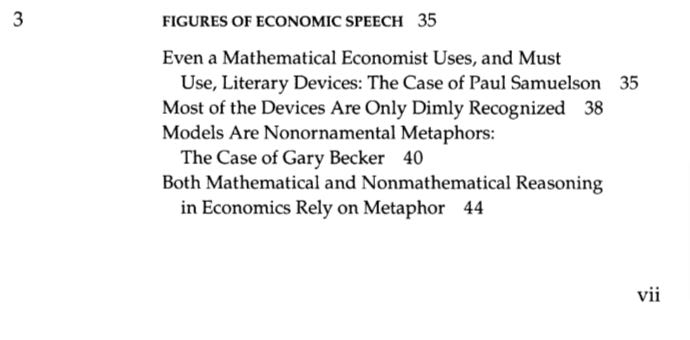
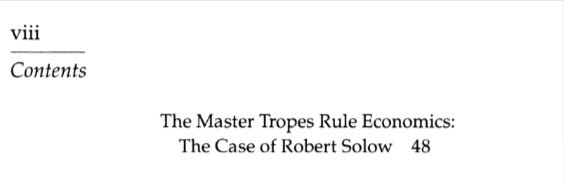
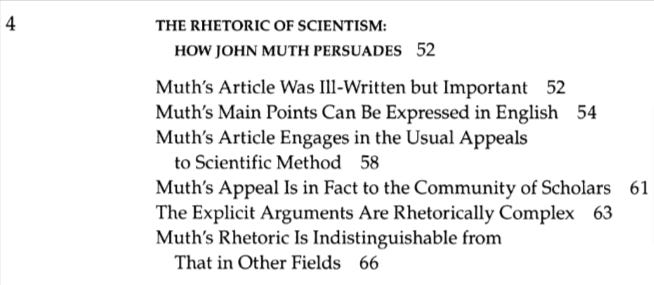
For the confused Reader, let me offer these chapter from Deirdre N. McCloskey book ‘The Rhetoric Of Economics’:


The final paragraphs of Mr. Wolf’s essay: call it a parade of well worn cliches!

On the upside, we might see a short-term surge in election-related fiscal loosening. Positive surprises, notably in labour supply, might further accelerate the decline in inflation. Artificial intelligence might deliver a positive surprise shock to the generally poor productivity growth. Successful reform might also accelerate the growth in potential output. Yet, on the downside, China’s growth might fall sharply. There are also all too evident risks to global financial, fiscal, political and geopolitical stability. World trade might be battered by protectionism. War between Israel, the US and Iran could blow up the Middle East, with huge consequences for energy and commodity prices. The biggest victims of such mayhem would, as usual, be the poorest.

We may have managed shocks better than expected. But we are walking on eggshells and must tread carefully.

Political Observer

Posted in Uncategorized | Leave a comment

@tomfriedman & Bret Stephens offer ‘The New York Times Point of View’ on the Iranian- what to name it ‘reprisal’, ‘comeuppance’, ‘justice’ ?

Political Observer edits the chatter!

Thomas Friedman offers this:

It would be easy to be dazzled by the way Israeli, American and other allied militaries shot down virtually every Iranian drone, cruise missile and ballistic missile launched at Israel on Saturday and conclude that Iran had made its point — retaliating for Israel’s allegedly killing a top Iranian commander operating against Israel from Syria — and now we can call it a day.

That would be a dangerous misreading of what just happened and a huge geopolitical mistake by the West and the world at large.

There now needs to be a massive, sustained, global initiative to isolate Iran — not only to deter it from trying such an adventure again but also to give reason to Israel not to automatically retaliate militarily. That would be a grievous error, too. Iran has a regional network, and Israel needs a regional alliance, along with the U.S., to deter it over the long run.

So there must be major diplomatic and economic consequences for Iran, with countries like China finally stepping up: When Tehran fired all those drones and missiles, it could not know that virtually all of them would be intercepted. Some were shot down over Jerusalem. A missile could have hit al-Aqsa Mosque, one of Islam’s holiest shrines. (You can see pictures online of Iranian rockets being intercepted in the skies right over the mosque.) Another could have hit the Israeli Parliament or a high-rise apartment house, causing massive casualties.

No one should think Iran is just a paper tiger. Tehran can still unleash thousands of shorter-range rockets against Israel through Hezbollah — and because some of these rockets have precision guidance, they could do significant damage to Israel’s infrastructure. Iran has bigger missiles in its arsenal, as well.

Still, what happened Saturday is ultimately a significant boost for what I call the Inclusion Network in the Middle East (more open, connected countries like Jordan, Saudi Arabia, Bahrain, the United Arab Emirates, Egypt and Israel and the NATO allies) and a real setback for the Resistance Network (the closed and autocratic systems represented by Iran, Hamas, Hezbollah, the Houthis and Iran’s Shiite militias in Iraq) and Russia. The sound within Iran and the Resistance Network on Sunday morning is that sound you hear from your car’s GPS after a wrong turn: “Recalculating, recalculating, recalculating.”

Mr. Friedman is writer given to Zionist Apologetics/Propaganda, and the manufacture of puerile Catch-Phrases: ‘The Inclusion Network’ ‘The Resistance Network’ a reductivist pastiche of actual thought!

Bret Stephens offers this:

After several days during which Supreme Leader Ali Khamenei repeatedly vowed that “the evil Zionist regime” would be punished for its April 1 attack on Iran’s embassy complex in Damascus that killed seven Iranian military advisers, including three top commanders, the Islamic Republic struck. More than 300 drones and missiles launched from Iranian soil took aim at Israel on Saturday. Nearly all of them were intercepted, mainly by Israeli or American defenses, with a report of just one Israeli casualty, a girl from a Bedouin community wounded by shrapnel.

Will that be the end of it?

It’s no secret that Israel and Iran have fought a shadow war for decades. The weekend attack is notable for two reasons: its directness and its ineffectuality. Iranian military commanders undoubtedly understood that most of their slow-moving drones, about 170 in all, would be shot down before reaching their targets. They were a diversion. Those commanders were probably more surprised that their 30 cruise missiles and 120 ballistic missiles also did negligible damage.

That should drive home a clear lesson to Iran’s leaders: They are no technological match for the Jewish state, especially when the United States is lending a hand. If Israel decides to respond to the attack with direct strikes on Iran — perhaps against oil installations, nuclear sites or military infrastructure — it isn’t likely to miss its targets.

The reader/viewer might look to an actual expert Scott Ritter, being interviewed by George Galloway, that explores the questions raised by the Iranian attack on Israel?

Mr Stephens is a notorious Zionist partisan/apologist. Ritter an expert in Warfare. Stephens is a New York Times opinion writer. Expertise vs. Opinion?

The final two paragraphs of The Stephens Melodrama. The Neo-Conservative wallows in war mongering brio, without the actual experience of battle, that Ernst Jünger’s ‘Storm of Steele’ offers the reader!

Nor is it to say that Israel doesn’t deserve President Biden’s full support if it chooses to retaliate for Saturday’s attack. The Ayatollah Khamenei surely noted the friction between Israel and the West over Gaza when he ordered the strike; daylight between Israel and the United States is often an invitation to mischief by the common enemies of both. The president has political reasons to avoid another full-scale regional war in an election year. But the best way to avert such a war is to leave Tehran with no illusions that it could separate Israel from the United States by starting one.

The key decisions of the past half-century that have driven the Middle East to the place it is in today have a common origin: Iran’s Islamic Revolution of 1979, which brought to power a theocratic despotism intent on sowing fanaticism, brutalizing its own people, destroying Israel and causing misery across the region for the sake of its ideological aims. Saturday’s missile attack is the latest example of a long and ugly record. But as Israelis decide how to react, they would serve their interests best by recalling the useful adage that revenge is a dish best served cold.

Political Observer

Posted in Uncategorized | Leave a comment

Is it possible that boulevardier Janan Ganesh offering a ‘Mulligan Stew’, instead of his usual… his readership might miss his proffered rhetorical ‘Caviar and Blinis’ ?

Political Cynic comments

Opinion Populism

Headline: The west is suffering from its own success

Sub-headline: Smartphone addiction, culture wars and low birth rates are byproducts of wealth

https://www.ft.com/content/74918df2-6911-4087-8add-c11df2811129

A sampler of this ‘Mulligan Stew’ that Ganesh prepares for his readers is helpful:

Jonathan Haidt’s The Anxious Generation, smartphone panic exists, smartphone panic exists,

so insulated from life-and-death issues that sad teenagers are what pass for news

it is a parable for the west, where life can be too good for our own good.

Where did the “woke” movement take hold?

the 2008 financial crash and the 2020 pandemic.

If woke is the howl of the dispossessed,

Problems of success are harder to fix because,

answer to the culture war is, after all, “induce an economic depression”.

the most effective answer to low birth rates is “undo modernity”.

Parents no longer need to have three children to ensure that one survives.

hey needn’t even have one as a source of income support in old age. State pensions have seen to that.

From something precious (the Enlightenment), something bleak (demographic decline).

the baby bust, No, that is populism,

the last time that electing a demagogue led to total societal ruin

the last crash starts to take risks with its balance sheet.

economist Hyman Minsky said of financial crises, that stability breeds instability,

The challenge is to persuade western intellectuals of this.

It is a hopeless account of the past decade.

The Brexit campaign won most of England’s affluent home counties.

it liberates people to be cavalier with their vote,

Faced with problems of failure — disease, illiteracy, mass unemployment — western elites are supremely capable.

(What if all the jobs disappear?)

(What will people do with all that leisure?)

Modernity — a world in which most people live in cities, have freedom from clerics and communicate across great distances at low cost — came along about five minutes ago in the history of civilisation.

The story isn’t phone-induced stress or even low birth rates. The story is that we haven’t experienced much worse.


Mr. Ganesh riffs on the themes of the Neo-Cons, who drown The Reader in chatter, that begats confusion and exploitable in-attention, or just utter despair: think of a novice attempting to read Hagel or Heidegger, without preliminary research!

Political Cynic

Posted in Uncategorized | 1 Comment

janan.ganesh@ft.com exhumes the political ghosts of 14 years of Tory rule, via A History Made to Measure.

Political Cynic comments.

It’s always a revelation, of a kind, to read Mr. Ganesh History Made to Measure that places the 14 year Tory Rule as preferable, to the New Labour of ‘Corbyn Slayer’, and Labour Friends of Israel apologist Kier Starmer, as somehow not a bad copy of the Tories? After all Mrs. Thatcher proclaimed Tony Blair , the actual Leader of New Labour, as her greatest accomplishment!

The rhetorical prestidigitations, of the Ganesh of remembrance, is now long gone. These almost gems deserve to be quoted, apart for the the rest of the rhetorical dross:

For all Starmer’s underrated toughness, this is still a party that twice offered Jeremy Corbyn as prime minister.


If not — if progressives, with their Marxian weakness for narrative, have read a big dialectical shift into the messiness of real life — expect a very unpopular Labour government, very soon

Yet The Reader confronts this dubious declaration about ‘middle age’ as the end point of Mr. Ganesh’s endorsement of Tory incompetence, wedded to its mendacity!


Among the consolations of middle age is seeing things from one’s prime years come around again. After the financial crash in 2008, Labour was confident that the hour of the state had arrived. It entertained talk of a post-liberal world. It elected leaders in that image. It hasn’t governed since.

Political Cynic


Reader recall this essay from 2019?

Jeremy Corbyn’s Labour cannot be trusted to govern

This week’s conference showcased a divided and paranoid party

https://www.ft.com/content/f605e55c-df7e-11e9-b112-9624ec9edc59

Jeremy Corbyn, a leader who fails to inspire the confidence of many of his own MPs, is behind many of the problems. His attitude to foreign affairs and a visceral anti-American stance are a threat to national security. Whether it is the EU or Nato, he has made clear his mistrust of and opposition to organisations involving Britain’s closest allies that have underpinned peace and prosperity in Europe for decades.

Yet much of the party remains in thrall to Mr Corbyn. Many delegates feared his refusal to embrace a Remain stance could cost the party dearly in a coming election. Even so, Corbyn loyalists treated a vote on Mr Corbyn’s Brexit policy as an issue of confidence in the leader, urging delegates to back him to avoid a defeat that could be exploited by a hostile media and a disloyal parliamentary party.

Devoted Corbynites support an approach to the economy that sees a powerful interventionist state as the solution to every problem. The party this week escalated its attacks on the foundations of British prosperity. Not only does Mr Corbyn see the free market economy as a conspiracy to exploit workers, he has singled out two sectors in which the UK excels — finance and life sciences — for special attention. In addition to his existing plans for the City of London, he announced new plans for compulsory licenses for pharma patents for a new state-owned generic drugmaker. Such policies could have a chilling effect on Britain’s status as a research and development hub. 

Here is political hysteric Jonathan Freedland in The New York Review of Books, of November 2020, reciting the crimes of Jeremy Corbyn:

To Labour’s Anti-Semitism Saga, a Bitter Denouement

Jonathan Freedland

Jeremy Corbyn’s suspension after defying a report’s damning conclusions about his leadership was the last twist in a shameful chapter of the party’s history.

Corbyn didn’t see it that way. Thirty-five minutes after publication, before Starmer had even delivered Labour’s official response to the report, Corbyn issued his own statement on Facebook making it clear that he did not accept all of the EHRC’s findings; indeed, he believed that the problem of anti-Semitism in the Labour Party had been “dramatically overstated.” That clashed with Starmer’s insistence that anyone who sought to minimize Labour’s anti-Semitism problem belonged “nowhere near the Labour Party.” (Indeed, I’m reliably informed that Corbyn knew in advance that this was precisely where Starmer would draw the line, but he chose to cross it anyway.) By lunchtime that day, Labour officials had suspended Corbyn’s party membership. He remains a member of Parliament, but will no longer count as part of the Labour group in the House of Commons. Considering that Corbyn was the leader of the Labour Party as recently as April, it’s a remarkably swift fall.

Al Jazeera provides the antidote to both The Financial Times and Freedland’s defamation of Corbyn!

The Labour Files – Episode 1 – The Purge I Al Jazeera Investigations

The Labour Files – Episode 2 – The Crisis I Al Jazeera Investigations

Political Cynic

Posted in Uncategorized | Leave a comment

Cass R. Sunstein, a partitioner of ‘The Kahneman Methodology’?

Newspaper Reader engages is some revelatory Political Archelogy.

Mr. Sunstein latest political intervention on behalf of another Academic/Technocrat should not surprise. Daniel Kahneman represents the virtue of seeking ‘a consensus’ of a kind, with his critics in an Academic World, consonant with the adversarial, is presented as a virtue?

I’ll offer a selection of Sunstein’s 1093 word argument.

Our all-American belief that money really does buy happiness is roughly correct for about 85 percent of us. We know this thanks to the latest and perhaps final work of Daniel Kahneman, the Nobel Prize winner who insisted on the value of working with those with whom we disagree.

Professor Kahneman, who died last week at the age of 90, is best known for his pathbreaking explorations of human judgment and decision making and of how people deviate from perfect rationality. He should also be remembered for a living and working philosophy that has never been more relevant: his enthusiasm for collaborating with his intellectual adversaries. This enthusiasm was deeply personal. He experienced real joy working with others to discover the truth, even if he learned that he was wrong (something that often delighted him).

Back to that finding, published last year, that for a strong majority of us, more is better when it comes to money. In 2010, Professor Kahneman and the Princeton economist Angus Deaton (also a Nobel Prize winner) published a highly influential essay that found that, on average, higher-income groups show higher levels of happiness — but only to a point. Beyond a threshold at or below $90,000, Professor Kahneman and Professor Deaton found, there is no further progress in average happiness as income increases.

Sunstein offers this as an object lesson of the ‘Kahneman Methodology’:

Eleven years later, Matthew Killingsworth, a senior fellow at the Wharton School of the University of Pennsylvania, found exactly the opposite: People with higher income reported higher levels of average happiness. Period. The more money people have, the happier they are likely to be.

What gives? You could imagine some furious exchange in which Professor Kahneman and Professor Deaton made sharp objections to Dr. Killingsworth’s paper, to which Dr. Killingsworth answered equally sharply, leaving readers confused and exhausted.

Professor Kahneman saw such a dynamic as “angry science,” which he described as a “nasty world of critiques, replies and rejoinders” and “as a contest, where the aim is to embarrass.” As Professor Kahneman put it, those who live in that nasty world offer “a summary caricature of the target position, refute the weakest argument in that caricature and declare the total destruction of the adversary’s position.” In his account, angry science is “a demeaning experience.” That dynamic might sound familiar, particularly in our politics.

Instead, Professor Kahneman favored an alternative that he termed “adversarial collaboration.” When people who disagree work together to test a hypothesis, they are involved in a common endeavor. They are trying not to win but to figure out what’s true. They might even become friends.

Jeremy Waldron in The New York Review of Books offered a review of October 9, 2014 of two books by Cass Sunstein:

Why Nudge? The Politics of Libertarian Paternalism

by Cass R. Sunstein

Yale University Press, 195 pp., $25.00

Conspiracy Theories and Other Dangerous Ideas

by Cass R. Sunstein

Simon and Schuster, 267 pp., $26.00

I’ve made some choices for The Reader, that she may not agree with, so feel free to comment! But Waldron seems to be right on target in his criticisms of these books!

Employers sometimes try to educate people to make better choices, offering them retirement-planning seminars, for example. But the lessons of these seminars are soon forgotten: “Employees often leave educational seminars excited about saving more but then fail to follow through on their plans.” And so Sunstein and Thaler suggested a different strategy. Instead of teaching people to overcome their inertia, we might take advantage of their inertia to solve the problem. Suppose we arrange things so that enrollment at some appropriate level of contribution is the default position—the position that obtains if the employee does nothing. Something has to be the default position; why not make it the position that accrues most to the employee’s benefit, “using inertia to increase savings rather than prevent savings”?

Resetting the default position this way is what Thaler and Sunstein call a “nudge.” It exploits the structure of the choice to encourage a more desirable option. The decision is not taken entirely out of the employee’s hands. She can still change it and revert to a strategy of no contributions or diminished contributions to her retirement funds. But in that case she has to make an effort; this is where she has to overcome her inertia.

Nudging is an attractive strategy. People are faced with choices all the time, from products to pensions, from vacations to voting, from requests for charity to ordering meals in a restaurant, and many of these choices have to be made quickly or life would be overwhelming. For most cases the sensible thing is not to agonize but to use a rule of thumb—a heuristic is the technical term—to make the decision quickly. “If it ain’t broke don’t fix it,” “Choose a round number,” “Always order the special,” and “Vote the party line” are all heuristics. But the ones people use are good for some decisions and not others, and they have evolved over a series of past situations that may or may not resemble the important choices people currently face.

Here begins Waldron’s critical analysis:

Nudging is about the self-conscious design of choice architecture. Put a certain choice architecture together with a certain heuristic and you will get a certain outcome. That’s the basic equation. So, if you want a person to reach a desirable outcome and you can’t change the heuristic she’s following, then you have to meddle with the choice architecture, setting up one that when matched with the given heuristic delivers the desirable outcome. That’s what we do when we nudge.

All of this sounds like a marketer’s dream, and I will say something about its abusive possibilities later. But Sunstein and Thaler have in mind that governments might do this in a way that promotes the interests of their citizens. Governments might also encourage businesses and employers to use it in the interests of their customers and employees. The result would be a sort of soft paternalism: paternalism without the constraint; a nudge rather than a shove; doing for people what they would do for themselves if they had more time or greater ability to pick out the better choice

Mr. Waldron ends his review here:

There’s a sense underlying such thinking that my capacities for thought and for figuring things out are not really being taken seriously for what they are: a part of my self. What matters above all for the use of these nudges is appropriate behavior, and the authorities should try to elicit it by whatever informational nudge is effective. We manipulate things so that we get what would be the rational response to true information by presenting information that strictly speaking is not relevant to the decision.

I am not attributing informational nudging to Sunstein. But it helps us see that any nudging can have a slightly demeaning or manipulative character. Would the concern be mitigated if we insisted that nudgees must always be told what’s going on? Perhaps. As long as all the facts are in principle available, as long as it is possible to find out what the nudger’s strategies are, maybe there is less of an affront to self-respect. Sunstein says he is committed to transparency, but he does acknowledge that some nudges have to operate “behind the back” of the chooser.

It may seem a bit much to saddle Cass Sunstein with all this. The objections about dignity and manipulation that I’ve been considering can sound hysterical. It is perfectly reasonable for him to ask: “Is there anything insulting or demeaning about automatic enrollment in savings and health care plans, accompanied by unconstrained opt-out rights?” The strategies he advocates, when used wisely and well, seem like a sensible advance in public regulation, particularly when we consider them nudge by nudge.

Still, it is another matter whether we should be so happy with what I have called “nudge-world.” In that world almost every decision is manipulated in this way. Choice architects nudge almost everything I choose and do, and this is complemented by the independent activity of marketers and salesmen, who nudge away furiously for their own benefit. I’m not sure I want to live in nudge-world, though—as a notoriously poor chooser—I appreciate the good-hearted and intelligent efforts of choice architects such as Sunstein to make my autonomous life a little bit better. I wish, though, that I could be made a better chooser rather than having someone on high take advantage (even for my own benefit) of my current thoughtlessness and my shabby intuitions.

Here is Sunstein’s reply to Waldron’s critical analysis and Waldron’s reply:

In response to:

It’s All for Your Own Good from the October 9, 2014 issue

To the Editors:

I am most grateful to Jeremy Waldron for his generous and clear-headed review of my books Why Nudge? The Politics of Libertarian Paternalism and Conspiracy Theories and Other Dangerous Ideas [NYR, October 9]. Waldron worries that nudging poses a risk to autonomy and dignity, but it is important to see that nudges are meant to promote both of those values. Disclosure of relevant information (about the terms of a school loan or a mortgage, for example) is hardly a threat to human dignity. When people are asked what they would like to choose, their autonomy is enhanced, not undermined. (Active choosing is a prime nudge.) A GPS certainly nudges, but it does not compromise what Waldron favors, which is “a steadfast commitment to self-respect.” Waldron is right to worry about the risk of manipulation, but the whole idea of nudging is designed to preserve freedom of choice, and in that sense both autonomy and dignity.

Cass R. Sunstein
Robert Walmsley University Professor
Harvard University
Cambridge, Massachusetts

Jeremy Waldron replies:

I appreciate this clarification. Many nudges simply involve an improvement of the decision-making environment and of the information available to choosers. Professor Sunstein is right that there can be no objection to that. But in his book, the term “nudge” also comprises attempts to manipulate people behind their backs, using their own defective decision-making to privilege outcomes that we think they ought to value. I think both of us should be concerned about that and about a world in which that more sinister sense of nudging becomes a widespread instrument of public policy.

This Issue

October 23, 2014

The Reader might think to herself, that Sunstein has ‘evolved’ in light of his praise of for the ‘Kahneman Methodology’?

Final thought: ‘Conspiracy Theories’ is/was a mask to hide the role that The American National Security State played in the assassination John Kennedy. The test of fealty to this lie, was professing a belief that only ‘crackpots’ believed in these ‘theories’. Arlen Spector was its apologist till the end!

Newspaper Reader

Posted in Uncategorized | Leave a comment

The Problem with the imagined ‘American Left’ : Technocrats quoting other Technocrats!

Political Cynic on a revelatory portion of Jonathan Guyer’s political encyclical.

In a Box With Biden

Unless President Biden is willing to kick down the sides of the box—checking his own assumptions about Israel, facing down the realities of the electorate, turning to new advisers with a broader perspective, and seeing the Middle East as it is—he will remain constrained.

Many policies to ensure human rights and accountability are already enshrined in law. They are lying in wait, unused. “If we’re going to keep arming Israel then there’s not that much to talk about,” Yager told me.

On most topics in any presidential administration, credit or blame can be broadly distributed. But in this case, the pro-Israel directives are coming from the president himself, with his instincts from another era. “Biden has a multi-decade career where he has proudly stood with Israel at every turn,” Zaha Hassan of the Carnegie Endowment for International Peace told me. “The idea that now, in his later years, he is going to want to distract from that legacy is unlikely.”

The most powerful foreign-policy officials in the Biden administration are negotiating with Israel about getting more flour into Gaza, tweaking rhetoric in press conferences, urging their boss to adjust small policies on the margin, like holding Israeli settlers to account, while failing to make the bigger adjustments needed to deal with the gravity of the crisis at hand. The story is not really one of foreign policy, but of the ideology and psychology of President Biden.


Jonathan Guyer is a foreign-policy reporter and editor based in New York. He worked as managing editor of the Prospect from 2019 to 2021.

Political Cynic

Posted in Uncategorized | Leave a comment