Mr. Ganesh’s ‘politicking’ reaches into the the most unlikely places, and chooses unlikely persons to make his arguments! Wedded to self-congratulation about his imagined victory about ‘low birth rates’ and the underserving retirees: ‘old people will have to remain productive a bit longer’ ! In its way it echoes Mitt Romney 47 % of 2012, that cost him the election. The perpetual Boulevardier now steps into the quicksand of a variety of exhausted Neo-Liberal cliches, without the rhetorical curlicues, that once set apart his pronouncements.
Now that the world agrees with me about children, birth rates are low. This means too few workers for too many pensioners. To keep the state solvent, old people will have to remain productive a bit longer. Expect, therefore, ever more eulogies from politicians and bosses about the advantages of age in the workplace. Prudence, caution, restraint. The moderating hand. All will be cited.
And all will miss the point. The most dramatic mental change that comes with age is a loss of interest in what others think. And that allows for more, not less, risk-taking.
This weekend, Carlo Ancelotti, 64, grandfather, stands to win his fifth Champions League title as a coach. Even if Real Madrid lose, his late-career success stands out in an ever-younger profession. (The coach of the German national team is 36.) What explains the resurgence of a man who was sputtering out at Everton in 2021?
Over the past decade or so, football became regimented. A modern coach micromanages the passing sequences, the distances between teammates, the number of seconds a “press” goes on for. Even a casual watcher of the sport might have noticed the extinction of the Number 10, the glamour role, in which a team’s most gifted individual is licensed to roam and improvise. In place of Zidane and Özil: “machine football”.
Now that the world agrees with me about children, birth rates are low. This means too few workers for too many pensioners. To keep the state solvent, old people will have to remain productive a bit longer. Expect, therefore, ever more eulogies from politicians and bosses about the advantages of age in the workplace. Prudence, caution, restraint. The moderating hand. All will be cited.
And all will miss the point. The most dramatic mental change that comes with age is a loss of interest in what others think. And that allows for more, not less, risk-taking.
This weekend, Carlo Ancelotti, 64, grandfather, stands to win his fifth Champions League title as a coach. Even if Real Madrid lose, his late-career success stands out in an ever-younger profession. (The coach of the German national team is 36.) What explains the resurgence of a man who was sputtering out at Everton in 2021?
Over the past decade or so, football became regimented. A modern coach micromanages the passing sequences, the distances between teammates, the number of seconds a “press” goes on for. Even a casual watcher of the sport might have noticed the extinction of the Number 10, the glamour role, in which a team’s most gifted individual is licensed to roam and improvise. In place of Zidane and Özil: “machine football”.
Establishing with The Reader that he is ‘one of the fellas’ buy way of this enthusiasm for the game, and choosing ‘Carlo Ancelotti, 64, grandfather’ as paradigmatic of those ‘old people will have to remain productive a bit longer’ ?
Editor: But Ganesh can’t seem to self-emancipate from evocative references:
… And now look. I don’t know if another Champions League title with this loose and expressive Madrid team will bring, in some kind of Hegelian antithesis, a turn in the tide against over-coaching.
…
The value of Ancelotti’s age isn’t prudence, then. It is almost the opposite: a defiance of convention, born of being long past caring about one’s reputation. Some of that insouciance was innate, no doubt. But it would have grown, not waned, with time.
…
With his tariffs and subsidies, Joe Biden, 81, building on the work of Donald Trump, 77, has changed the world. (For the worse, I think.)
…
Editor: Ganesh political reach at high velocity:
America’s pro-trade consensus was paper-thin to begin with. The 2008 financial crash then enhanced the prestige of the state. The speed with which protectionism has become the new common sense in Washington suggests the two men were pushing at an open door.
…
Editor: the pejorative ‘old people’ : in sum its reduced to a trans-generational conflict ?
Sometimes, in old people, it manifests as rudeness. But it has a constructive upside in this appetite for heresy.
…
It is hard to know the active ingredient that makes people carefree with age. It might be that near-term unpopularity seems trivial next to death.
…
Either way, the equation of youth with risk-taking, and age with conformism, needs adjustment.
Editor: In the final paragraphs Ganesh reverts to Cultural Critique, steeped in disingenuousness garnished with the fatuous!
… There is an exhibition at the British Museum now on Michelangelo’s last decades. The drawings show the artist in furious argument with himself. Here he changes the head of a figure beside the crucified Jesus. There he has several goes at an airborne angel on the one page. It is like looking at the scribbled marginalia of Shakespeare.
Well, we are going to need late-life restlessness from more and more citizens. Reducing their potential contribution to that of temperance and caution isn’t just a cliché. It ignores a world that is being turned upside down by those who aren’t long for it.
Pamela Paul closing paragraphs is awash in the ‘scolding’ of dissenting students. Hardly a surprise. History might offer something of value, on the vexing question of ‘student protests’ ? Some of her readership might recall vividly Mario Savio of of 1964:
To put it bluntly Pamela Paul is a Careerist who has found a safe position at The New York Times: examining ‘on the hazards of shifting norms’ where her political conformity is of value: to a newspaper attached to the most toxic expressions of what the New York Times most values, political conformity. The Reader need only look at it’s triad of commentators : Friedman, Brooks, Stephens as evidence of that fact!
…
For decades, employers used elite colleges as a kind of human resources proxy to vet potential candidates and make their jobs easier by doing a first cut. Given that those elite schools were hotbeds of activism this year, that calculus may no longer prove as reliable. Forbes reported thatemployers are beginning to sour on the Ivy League. “The perception of what those graduates bring has changed. And I think it’s more related to what they’re actually teaching and what they walk away with,” an architectural firm told Forbes.
The American university has long been seen as a refuge from the real world, a sealed community unto its own. The outsize protests this past year showed that in a social media-infused, cable-news-covered world, the barrier has become more porous. What flies on campus doesn’t necessarily pass in the real world.
The toughest lesson for young people of this generation may be that while they’ve been raised to believe in their right to change the world, the rest of the world may neither share nor be ready to indulge their particular vision.
…
As a newspaper reader since 1960, Pamela Paul represents what used to be called ‘hard-hitting’, when men were ascendent in newspaper business. Though Paul engages in the ‘shaming’ of students with a certain gusto, once reserved for that cadre of entitled males. In sum, its the same old grift!
Political Observer
P. S. Pamela Paul on Journalistic Ethics
Coming from a decade in the newsroom and two decades as a freelance writer, I apply those same standards and rigor to my work as an Opinion columnist. I always write what I believe to be accurate and true, even if it means presenting facts and opinions that challenge readers rather than reaffirm their preconceptions or preferences. I strive to write about complicated issues with clarity, nuance and sensitivity. I never blurb books. I avoid or disclose potential conflicts. I prefer to express my opinions on platforms other than social media. You can read this to learn more about our ethical guidelines.
Editor: Self-congratulation is no stranger to Pamela Paul!
The Reader confronts the latest of Mr. Ganesh’s essays, with his ability to view the 14 years of Tory rule, that has been shortsighted, across a range of issues. To express it in the blandest terms: which just might be the raison d’etre of this Ganesh intervention? The trivialization serves as the backdrop, for an apologetic that simply muddies the waters, of what an actual critical evaluation of those 14 years might be argued!
Boris Johnson, 2017: “We hear that we’re first in line to do a great trade deal with the US.” Liz Truss, 2019: “My main priority now will be agreeing a free trade deal with the US.” Dominic Raab, a cabinet eminence at around the same time: “President Trump has made clear again that he wants an ambitious trade agreement with the UK.”
Then Rishi Sunak on the same subject last summer. “For a while now, that has not been a priority for either the US or UK.” Oh.
This government’s single greatest disservice to the UK has been to misunderstand the US.
…
Mr. Ganesh’s political myopia eventuates, realizes itself , into an expression of a self-serving political refraction, that might capture the The Reader’s attention, in the moment. But on reflection is judged as disingenuous? And or leads The Reader to treat this as propaganda?
Editor: Brexit in the next paragraph becomes the ‘Paradise Lost’ in this narrative. A a huge bet on the economic openness of America is then argued as Derrida might have argued it, as an aporia ?
Brexit was, from the start, a huge bet on the economic openness of America. A bilateral trade deal with Washington was meant to offset the loss of unfettered access to the EU market. That no such deal emerged was bad enough (though as predictable as sunrise). But then Donald Trump and later Joe Biden embraced a wider protectionism. World trade is fragmenting as a result. So for Britain, double jeopardy: no agreement with America, but also less and less prospect of agreements with third countries.
Editor: I’ll select some quotes from the remainder of the essay.
…
In essence, the nation staked its future on trade at the exact historical moment that it fell out of favour as an idea. It is the geostrategic equivalent of investing one’s life savings in a DVD manufacturer circa 2009.
…
Anyone with a passing knowledge of Washington could have warned them not to confuse the place for a free-market bastion.
In 1992, the trade sceptic Ross Perot won 19 per cent of the national vote as an independent presidential candidate.
…
Editor: Potted American History:
Look at the dates here. This was the high summer of “neoliberalism”. Imagine how much stronger the protectionist impulse was in normal times. Or rather than imagine, check the record. It shows the tariff walls of the 1800s. It shows the statism of Alexander Hamilton and Abraham Lincoln. Smoot-Hawley wasn’t an interwar aberration.
…
But protectionist sentiment is a force in American life to an extent that it can’t be in a mid-sized, resource-poor archipelago. It is then transformed into policy via sectoral lobby groups of a scale and sophistication that must be seen up close to be believed.
…
If I lived in a continental-scale market with superabundant resources, I’d need a lot of persuading from David Ricardo and The Economist that I am still better off trading. But that is the point. The Tories think the crucial fact about America is that it is made up of Britain’s “cousins”. (It isn’t, unless we are consulting the census of 1810.)
…
After that, the next most important fact is its status. America is defending a position as the world’s number one power.
… Editor: Mr. Ganesh must realize that the Hegemon does as it pleases. The very history of Britain is defined by that practice, that claim!
One needn’t admire this about the US. One can suspect it of hysteria, in fact. But the job of a British government is to fathom these things before betting the nation’s entire future on a hunch that America will forever uphold world trade.
…
Editor: the final paragraphs of this churlish meandering philippic come to an end!
This mistake came from “Atlanticist” Tories, remember — the ones who read Andrew Roberts and track the exact co-ordinates of the Churchill bust in the White House. (Barack Obama was hated for moving it.) Well, after giving it all that, these people failed on their own terms. They failed to understand US politics. Britain will foot the bill of their error for decades.
“Trade”: even the moral connotation of the word is distinct in each nation. It has had a high-minded ring to it in Britain ever since the abolition of the Corn Laws helped to feed the working poor. In America, where the cotton-exporting Confederates were free-traders, history isn’t quite so clear-cut. It is almost as if these are different countries.
It’s quite surprising that the Newspapers like The Financial Time and The New Statesman sends me daily updates of their latest commentaries on politics. The Financial Times accepts my money, but blocks me from commenting on any of the news reports, or the commentaries of their writers.
Today, May 29, 2024 Stephen Bush Columnist & Associate Editor sent me this:
Title: Lead the way
Are the polls exaggerating Labour’s lead? Matt Singh, the pollster who called the 2015 poll miss, ponders this question in his newsletter. He concludes that there are no “red flags” similar to that in 1992 or 2015, and that at most the Labour lead is only in the lower end of what pollsters are predicting. Still, this points to a landslide defeat, and as James Kanagasooriam explains over on FocalData’s blog, Labour doesn’t need that large a lead to win comfortably, as its coalition is now pretty electorally efficient.
I agree with James and Matt, and have little to add on this topic, other than that if we look at what Rishi Sunak and Keir Starmer are doing, it is pretty clear that they don’t think the polls are wrong.
Starmer is campaigning like a man who has a large opinion poll lead and whose focus is on reassuring voters and not doing anything to mess it up.
Sunak, meanwhile, is campaigning like someone who doesn’t really believe that he can win the election but just needs to get enough Reform voters back into the Tory fold to avoid a disaster. See, for instance, his latest set of proposals. First, a commitment to keep raising the threshold on which pensioners start paying tax so they will never pay tax on the state pension, a so-called quadruple lock. This will keep the tax base narrower than it needs to be, but the commitment is made safe in the knowledge Sunak won’t actually have to keep it. His policy of bringing back national service is similarly riddled with holes. And today the Tories have pledged that funding towards the degrees that are “not performing well” would be diverted towards apprenticeships (under the promise, about one in eight undergraduate degrees would be shut down, the Tories estimate).
What these all have in common is that they are squarely focused on people who voted Tory in 2019, but are currently saying they will vote Reform, or not at all.
Our polling toy will gradually update to include more assumptions about tactical voting — which we can assume will increase the Liberal Democrat seat total. But for now, it is a good way of gauging the Conservative-Labour battle and a reminder that as it stands, both parties are assuming that the polls suggesting Labour are on course to win are about right.
….
Under the rubric of Top stories today:
Whip restored to Diane Abbott | Veteran MP Diane Abbott was readmitted to the Parliamentary Labour party yesterday following her suspension for remarks about Jewish people. Abbott confirmed today that she has been banned from standing for Labour in July’s election.
Battle pavilions | For Keir Starmer to win a House of Commons Labour majority of just one, he must gain about 125 seats on July 4. Given the party’s record postwar defeat in 2019, that would be a big achievement. In Scotland, Labour is locked in a fight with the Scottish National party, in what will be a pivotal election north of the border. Here are the places where the election will be fought and won.
Neutral tones | Some of the UK’s biggest companies are refusing to back either of the main parties ahead of the country’s general election, as businesses attempt to avoid being drawn into partisan politics.
Below is the Financial Times’ live-updating UK poll-of-polls, which combines voting intention surveys published by major British pollsters. Visit the FT poll-tracker page to discover our methodology and explore polling data by demographic including age, gender, region and more.
This followed with an evocative, full color graph! Yet there are certain lacuna, empty spaces, within the whole of of Mr. Bush’s political commentary e.g. : George Galloway’s win in Rochdale, Jeremy Corbin’s running as an independent, with Diane Abbott to do the same? Mr. Galloway and his The Workers Party of Britain are running other alternative candidates to the Tory/New Labour Political Monochrome! Perhaps that Political Monochrome, and its well paid Propogandists/Technocrats, will confront another kind of Politics , not rooted in Corporatist Imperatives?
The Readers must love Freddie’s Political Chatter? Though this ‘revolt’ by Corbyn shouldn’t surprise an experienced political commentator. The victory of George Galloway might be another missed clue, that escaped Freddie ? Or the fact of Dianne Abbott’s purge. A coy Freddy isn’t convincing!
I’ll just highlight, or more honestly, pick randomly through his ‘chatter’ at 872 words, or so :
…
But what of Labour? Keir Starmer has his own problems: Jeremy Corbyn is standing as an independent in Islington North — a few thoughts below.
…
Is Starmer’s left flank vulnerable? Jeremy Corbyn has been in exile from Labour since 2021 after he refused to apologise for saying reports of anti-Semitism inside the party were exaggerated.
Editor: What might constitute ‘Starmer’s left flank’ ? The Left has been purged from the Party , all that remain are the New Labour hacks!
…
Corbyn’s expulsion from the party he represented in parliament for 40 years was not inevitable. In October 2020 a deal between himself and the leadership was close. Accounts vary, but negotiations were reportedly scuppered because Corbyn was on holiday on the Isle of Wight. The party later reinstated Corbyn’s Labour membership but Starmer refused to restore the parliamentary whip until the former leader apologised, hence he sat as an independent.
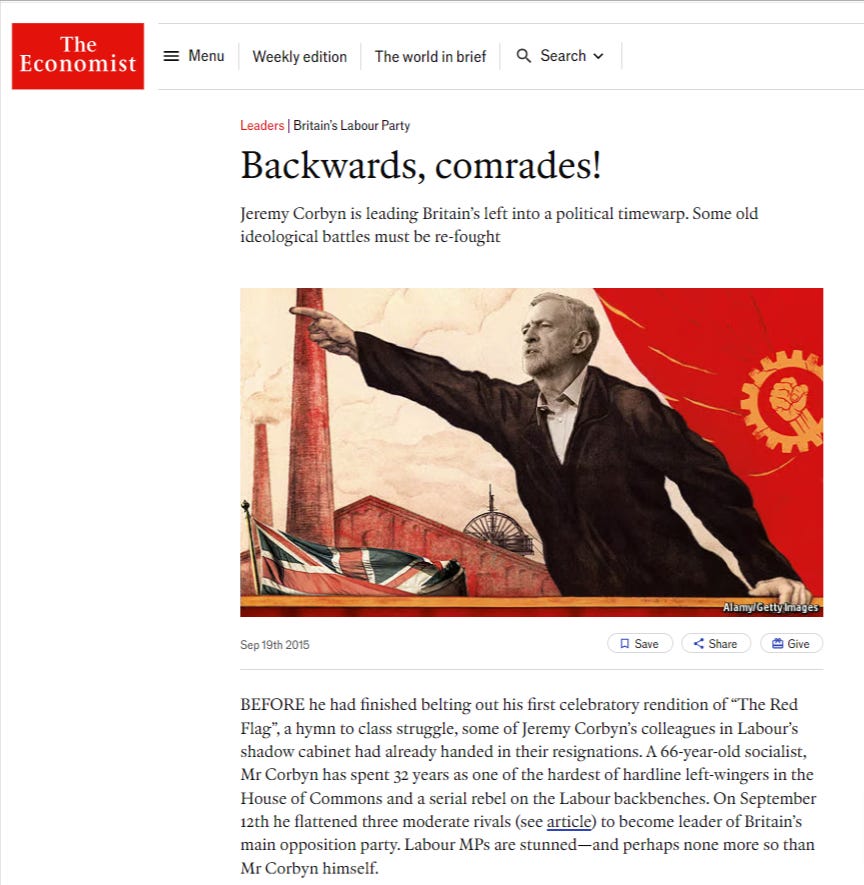
Editor: Freddy follows The Party Line on Corbyn, any surprise? The Newspapers like The Guardian and its Johnathan Freedland defamed Corbyn. Even @TheEconomist proclaimed Corbyn as a toxic expression of another time and place!
Editor: Freddy moves on in the same vein as The Economist
Since then, Corbyn has let rumours that he may stand in Islington North or for London mayor as Ken Livingstone did rumble on. The former was always the likely option because Corbyn has a relationship with his constituents that he doesn’t have with London in general. While he ruminated on his next move, Corbyn launched a vehicle to promote his politics: the Peace & Justice Project. While its branding is oddly reminiscent of the Tony Blair Institute’s, its patrons include former Unite general secretary Len McCluskey, the filmmaker Ken Loach and former Bolivian president Evo Morales.
Editor: Freddy recites the New Labour Corbyn Party Line :
Corbyn is a member of a political grouping of candidates called the Collective who support the Peace & Justice Project’s five priorities:
…
Editor: Freddy deviates from The Party Line via ‘source on the party’s left pointed out’ : again that phantom Left appears.
As one Labour source on the party’s left pointed out, Corbyn has the three qualities that any successful independent candidate needs: local pedigree; high name recognition; and a compelling story. Corbyn is famous for being a “good constituency MP”. He has 40 years of relationships and name recognition to draw on. (One key problem will be that any Labour members that openly support him will face expulsion.)
…
Corbyn’s trajectory – going from party leader to independent candidate in one parliament – is unique. The threat, therefore, is contained. And yet, there are signs that Labour could face problems from the left, charged with anger at Labour’s position on Gaza and Starmer’s abandonment or dilution of many of his original 10 leadership pledges.
Editor: The Reader has to wonder at Freddy’s cultivated ignorance of Corbyn and George Galloway’s political alliance, that is running candidates in the coming elections!
…
While Starmer’s party has a notional majority of around 17,000 in the new seat, the Greens won every ward in the constituency in the recent local elections.
…
After Corbyn’s announcement, Starmer said: “Jeremy Corbyn’s days of influencing Labour Party policy are well and truly over. Jeremy Corbyn’s decision is his decision. What I’m intent on doing is putting first-class Labour candidates in Islington North, which we have now done.”
Editor: Starmer’s whistling in the dark!
…
The result in five weeks’ time will depend on whether Corbyn’s 26,188 majority is, in reality, his majority or Labour’s. It will signal whether the threat to Labour from the left is latent or non-existent.
With the party leading so comfortably in the polls, challenges from the left can appear obscure. For now, the priority for Labour’s strategists will be to limit the damage Corbyn can inflict on their campaign for No 10. And at the same time, win Islington North.
Political Cynic’s attempt at ‘Rhetorical Mapping’.
Headline: Historians will look back on 14 years of lost opportunities. Since 2010, five Conservative prime ministers have notched up some modest successes. But measured against four other periods of one-party dominance, the record is distinctly underwhelming, argues Anthony Seldon
Editor : the final paragraphs of this Times assessment of 14 years of Tory rule offer:
…
Furious Tories turned their sights on the blob, as it was termed, to blame for the poor performance. Never have the Conservatives attacked in such a consistent way the civil service, the judiciary, the Bank of England, the BBC and universities. Denunciation without reform generates poor morale and confusion, which is what happened. The centre of government was in need of dramatic reform for sure, and grievously missed the departure of cabinet secretary Jeremy Heywood who died in 2018, aged 56. The office of the prime minister, and its relations with the Treasury, need attention, and the centre of government needs slimming down and strengthening, as the Institute for Government report Power with Purpose argued this year. It didn’t deserve aimless trashing.
External shocks did not help any of the five prime ministers, including the legacy of the global financial crisis, Covid and the invasion of Ukraine with its devastating impact on fuel prices. But the earlier governments had shocks too, including the Suez crisis of 1956, adroitly calmed by the incoming prime minister Harold Macmillan. Thatcher’s handling of the Falklands conflict and end of the Cold War and Major’s resetting of economic policy with the chancellor Norman Lamont after Black Wednesday in 1992, when Britain was ejected from the European exchange rate mechanism, were confidently handled. The biggest shock of all in 2010-24 was entirely self-imposed: Brexit. The criticism of historians is likely to focus less on the decisions that led to it than on the lack of leadership that followed and the failure to capitalise on the opportunities that Brexit presented. Every disruption, as every great leader knows, creates unprecedented opportunities. The Conservatives had not only Brexit but also Covid, but such moments have to be channelled, and they conspicuously were not.
The 14 years of Conservative rule have not been altogether wasted. There were plenty of examples of effective and high-quality leadership, rarely more so than at the Queen’s funeral, masterminded indicatively not by the nation’s politicians but by its much-criticised civil servants. But with the long lens of history, these 14 years will be seen as a time when opportunities for national renewal, cohesion and purpose were lost. So not wasted, but prodigal. Whether Labour, if they win, will be able to provide the quality of leadership demanded is the question. The country still has not found a settled place domestically or in the world at large this century. Starmer will need to emulate the ambition and achievement of Attlee — or of Wilson, Blair and Brown at their best — if he is to provide the strategic leadership needed.
Editor: The Reader might look to The Financial Times’ Janan Ganesh’s last two essays, that seem to be dislocated from the imperatives of the Times’ hired political experts, Anthony Seldon and Tom Egerton!
After this May 17, 2024 opening paragraph:
When I was two or three, I went walkabout and wasn’t found until some time later at a local mall. What a close brush with disaster, readers will think. What a potential loss to English letters and the Clerkenwell restaurant trade. Relax. This happened in one of the safest countries on Earth. I got my infant meanderings out of the way in Singapore.
And it’s successors:
A point gets lost in all the coverage of the island state as it changes leadership this month. Economic enrichment is Singapore’s other achievement. It comes below, and wouldn’t have happened without, the creation of order and cohesion where there had been communal strife. To quote its per capita income, which now tops that of the US, is to understate what has happened in a once-fractious Chinese-Malay-Indian society.
…
The press is full of “Whither Singapore?” articles this month, and fair enough. The country has to navigate the US-China rift without the helpful scale of other Asean nations. It flourished in a world order that is decomposing. (LKY’s all-too-prescient speech to Congress urged America to uphold free trade.) But the island’s ultimate advantage, and example to the world, was always inside the head. That rational incoherence isn’t so easily lost.
In Europe, the three signs of spring have arrived: the bright flora, the endless days and the ambient sound of American voices. All are welcome. But the last is also an annual reminder of the spending power of US tourists. That their economy has outperformed the continent’s this past decade or two can be felt, not just measured.
The material success of the US is discussed in all quarters. What isn’t said enough is that it has happened amid political bedlam. America has roared ahead in the era of the Tea Party, Donald Trump, “forever wars” abroad and culture wars at home. There have been more presidential impeachments in the past generation than in the previous two centuries of the republic. At the turn of the millennium, 44 per cent of Americans trusted the federal government. Now 16 per cent do. The US failed to achieve even a peaceful transfer of power at its last election. (Unlike, say, Senegal.) The civic rot is so deep that well-adjusted citizens find themselves taking an interest in the health of Supreme Court justices, lest one die under a president of the opposing side.
So much political turmoil, so little economic consequence. Why?
…
In liberal thought, stable political institutions are held to be a precondition for affluence, which in turn increases public support for those institutions, until the circle of logic is closed. In America we are seeing, if not the first ever challenge to this notion, then perhaps the one on the largest historical scale. It is hard to know what to feel: relief at the resilience of America’s wealth creators, or dread that its voters lack a material incentive to fix politics.
Editor: Ganesh favorite guise is that of the boulevardier! How might the regular Reader of Ganesh interpret these essays, and their function illuminating the looming British Election? If at all?
Political Observer comments/reports on Brook’s propaganda essentials.
Mr Brooks cultivates the political fiction that he is a ‘Centrist’ in a Political World populated by the dread Populists, in sum Trump! The last paragraphs of his presented political rationalism, is provided by the Hoover Institution scholar Larry Diamond. The ‘as if’ here is that The Hoover Institution and Mr. Diamond exemplify that rationalism. The Brooks strategy never grows old, in his own mind, yet is bleakly realized in these paragraphs. I have selected for The Reader what I thing is revelatory, perhaps that reader may think me a disingenuous critic? If so, please comment in the space below!
What Reader can forget this Brooks Political Intervention of April 28, 2003?
This pretentious dull-witted dreck won him a job at The York Times!
…
Of course, the main difference between those years and 2024 is that during those earlier pivotal moments the world experienced an expansion of freedom, the spread of democracy, the advance of liberal values. This year we’re likely to see all those widely in retreat
Is there a way to fight back against the populist tide? Of course there is, but it begins with the humble recognition that the attitudes that undergird populism emerged over decades and now span the globe. If social trust is to be rebuilt, it probably has to be rebuilt on the ground, from the bottom up. As for what mainstream candidates should do this election year, I can’t improve on the advice offered by the Hoover Institution scholar Larry Diamond in The American Interest magazine in 2020:
Don’t try to out-polarize the polarizer. If you stridently denounce the populist, you only mobilize his base and make yourself look like part of the hated establishment.
Reach out to the doubting elements of his supporters. Don’t question the character of his backers or condescend; appeal to their interests and positive dreams.
Avoid tit-for-tat name calling. You’ll be playing his game, and you’ll look smaller.
Craft an issue-packed campaign. The Ipsos survey shows that even people who hate the system are eager for programs that create jobs, improve education, health care and public safety. As Diamond puts it, “Offer substantive, practical, nonideological policy proposals.”
Don’t let the populists own patriotism. Offer a liberal version of national pride that gives people a sense of belonging across difference.
Don’t be boring. The battle for attention is remorseless. Don’t let advisers make their candidates predictable, hidden and safe.
It’s looking like this year’s elections will be won by whichever side stands for change. Populists promise to tear down systems. Liberals need to make the case for changing them in a comprehensive and constructive way
Note the framing of the last two sentences: ‘Populists promise to tear down systems” ‘Liberals need to make the case for changing them in a comprehensive and constructive way’
Voters, as of this moment, face a contest between the corrupt Senile Old Joe, a Netanyahu lackey, and Donald Trump another Zionist lackey, whose indictments and trials have become the mainstay of Network News channels, as their audiences evaporate like smoke!
When I was two or three, I went walkabout and wasn’t found until some time later at a local mall. What a close brush with disaster, readers will think. What a potential loss to English letters and the Clerkenwell restaurant trade. Relax. This happened in one of the safest countries on Earth. I got my infant meanderings out of the way in Singapore.
And it’s successor:
A point gets lost in all the coverage of the island state as it changes leadership this month. Economic enrichment is Singapore’s other achievement. It comes below, and wouldn’t have happened without, the creation of order and cohesion where there had been communal strife. To quote its per capita income, which now tops that of the US, is to understate what has happened in a once-fractious Chinese-Malay-Indian society.
Reader, that was just the amuse bouche: Let me segue to Ganesh’s May 21, 2024 essay:
In Europe, the three signs of spring have arrived: the bright flora, the endless days and the ambient sound of American voices. All are welcome. But the last is also an annual reminder of the spending power of US tourists. That their economy has outperformed the continent’s this past decade or two can be felt, not just measured.
The material success of the US is discussed in all quarters. What isn’t said enough is that it has happened amid political bedlam. America has roared ahead in the era of the Tea Party, Donald Trump, “forever wars” abroad and culture wars at home. There have been more presidential impeachments in the past generation than in the previous two centuries of the republic. At the turn of the millennium, 44 per cent of Americans trusted the federal government. Now 16 per cent do. The US failed to achieve even a peaceful transfer of power at its last election. (Unlike, say, Senegal.) The civic rot is so deep that well-adjusted citizens find themselves taking an interest in the health of Supreme Court justices, lest one die under a president of the opposing side.
So much political turmoil, so little economic consequence. Why?
Now Ganesh favorite guise is that of the boulevardier! Yet what is the poverty and homeless rate in America?
As of January 2024, the US Census Bureau reported a national poverty rate of 11.5%. The federal poverty level (FPL) for 2024 is $15,060 for a person living in the mainland US, $17,310 in Hawaii, and $18,810 in Alaska. The FPL is used to determine eligibility for certain programs and benefits, including: Medicaid, CHIP coverage, and Savings on Marketplace health insurance.
And it’s not a small problem. A December 2023 report by the U.S. Department of Housing and Urban Development said 653,104 Americans experienced homelessness, tallied on a single night in January last year. That figure was the highest since HUD began reporting on the issue to Congress in 2007.
This final paragraph of Ganesh’s ‘essay’
In liberal thought, stable political institutions are held to be a precondition for affluence, which in turn increases public support for those institutions, until the circle of logic is closed. In America we are seeing, if not the first ever challenge to this notion, then perhaps the one on the largest historical scale. It is hard to know what to feel: relief at the resilience of America’s wealth creators, or dread that its voters lack a material incentive to fix politics.
Mr. Ganesh is a Neo-Liberal, in the mold of the Hayek/Mises/Friedman Trinity!
The regular reader of Mr. Niall Ferguson’s cumbersome , bloated historical panoramas, the word count in this instance is 2596 -The Straussian method is to drown the reader in verbiage, ideas, actors, as a strategy to make a possible reply so onerous a rhetorical task as to render critique mute? This is the descriptor of the Historical/Political project of Ferguson’s Neo-Conservatism!
The opening paragraph is revelatory:
Suppose They Gave a War and Nobody Came? was the title of cheesy 1970 film that captured the anti-Vietnam Zeitgeist. But suppose they gave a cold war and you couldn’t afford it? Half a century later, that is the question the US needs to ask itself.
Mr. Ferguson is usually a bit more practiced in his refences to books, rather than cinema. As Mr. Ferguson was born in 1964, and the film he references was ‘Suppose They Gave a War and Nobody Came?’ was released in 1970, Mr. Ferguson was six, perhaps his search of the Internet for an Anti-War movie that fits his paradigm landed him here?
This is followed by this self-advertisement for he and his political cronies:
The debate on Cold War II is heating up. On Tuesday I chaired a fascinating symposium on “Cold Wars” — plural — at the Hoover Institution in California. We gathered together, in person or over Zoom, a pretty good proportion of the leading historians in the field. After a day of debate, three different schools of thought had emerged.
Editor: note that Ferguson engages in a bit of self-serving prestidigitation! It appears to The Reader, that some of these were active participants, and were present in this symposium, while others are just subject to mention or simply quotation?
Those siding with me in believing that we are already in a second cold war included George Takach, the author of Cold War 2.0, for whom the contest between the US and China is primarily technological; Dmitri Alperovitch, co-founder of the cybersecurity firm CrowdStrike and author of World on the Brink, who shares my view that we are approaching a Taiwan Crisis as dangerous as the Cuban Missile Crisis of 1962; and the Soviet-born historian Sergey Radchenko, whose meticulously researched To Run the World has just been published by Cambridge and argues that the USSR leadership was motivated more by historically rooted psychological insecurities than by Marxist-Leninist ideology. It doesn’t take a huge leap to see similar insecurities at work in the minds of China’s Xi Jinping and Russia’s Vladimir Putin today.
There are two distinct counterarguments. One — which I’ll call the Aspen Strategy Group/Harvard University view — is that the US-China relationship is not as bad as the US-Soviet relationship. That’s the line taken by Joe Nye and his Harvard Kennedy School colleague, Graham Allison, who met with Xi and Foreign Minister Wang Yi on a recent visit to China. “We’re serious about cooperating where we can, but at the same time competing vigorously in almost every dimension,” was how Allison characterized the relationship between Washington and Beijing in a recent interview.
“I am in you, and you are in me,” Xi told Allison, which must have given the translator a nasty moment. “What did I mean?” the Chinese leader went on. “The answer is ‘engagement.’ Through communication and cooperation, the US and China can become closely linked.” It is this aspiration that lies behind the increasingly frequent use in Beijing of the old Soviet phrase, “peaceful coexistence.”
Mr Ferguson’s essay is held afloat buy that prestidigitation that is expressive of bad faith?
Editor: In this section of his essay, is obvious quotation:
Then there is the Yale University/Hoover Institution view. According to Odd Arne Westad, professor of history at the former, and Philip Zelikow, a colleague of mine at the latter, the global situation today more closely resembles the world on the eve of one or the other of the world wars. In an excellent new piece, Zelikow argues that it is a comforting delusion — indeed, “wishful thinking” — to believe we are in a cold war with China. Rather, we confront a new Axis — China, Russia, Iran and North Korea — that in many ways poses a bigger threat than the Germany-Japan-Italy Axis of the late 1930s and early 1940s, or the early Cold War combination of the Soviet Union, China and the other communist-controlled states.
“The worst case, in a major crisis,” writes Zelikow, “will be if the United States and its allies commit to victory, animated by their own rhetoric and dutiful but ill-considered military plans, and then are outmaneuvered and defeated. It would be the ‘Suez moment’ for the United States, or perhaps much worse.” Regular readers of this column will know that I sometimes share this fear. For me, Cold War II is the good outcome. An American version of the Suez Crisis of 1956 — the abortive occupation of the Suez Canal by Britain, France and Israel — would be worse, in that such a humiliation over, say, Taiwan would signal the end of American primacy, just as Suez sounded the death knell of Britain’s Empire. Losing World War III would of course be the worst.
Editor: Here Mr. Ferguson reports on ‘interesting arguments I heard’. Neo Conservative Jake Sullivan is quoted. Note the wan invention of ‘The Diet Cold War’: is this akin to that dull-witted ‘Chimerica’. Mr. Ferguson in a ‘Madison Ave’ mode! What also catches The Readers attention, is that Mr. Ferguson is utterly absent of Perry Anderson’s American Foreign Policy and Its Thinkers. Yet he is a prominent Neo-Conservative voice, though not an American.
Editor: The next paragraphs are a cobbled together ‘History’. With another appearance of Jake Sullivan
One of the most interesting arguments I heard was that there may have been more than two cold wars. What if the period before July 1914 was another cold war — one between Britain and Germany that ultimately turned hot because of miscalculations on both sides? That, it was cleverly suggested, would justify the designation “Cold War Zero.”
Well, if there’s even the possibility of Cold War Zero, should there also be Diet Cold War? Letting other people do the fighting is, after all, one of the four pillars of National Security Adviser Jake Sullivan’s grand strategy: “Help [fill in the blank] defend itself without sending US troops to war.”
In practice, that means channeling money and arms to key countries — Ukraine, Israel, Taiwan — and hoping they can hold off the new Axis powers without the need for American “boots on the ground.”
Unlike in Cold War I and the global war on terrorism, in other words, this time the US is seeking to avoid sending its own soldiers into battle. And this makes sense. If your debt burden is dauntingly high and set to keep growing even if you cut defense spending relative to GDP, you need Diet Cold War, in just the same way that overweight people opt for Diet Coke (and Ozempic).
This approach has plenty of precedents in European history — for example, in the 18th and 19th centuries, when Britain paid substantial subsidies to its allies in its wars against France, encouraging them to do the fighting. The disadvantage is that the “paymaster power” has less control over military events than if the armies were directly under its command. It’s also very problematic if the paymaster succumbs to Ferguson’s Law — which states that any great power that spends more on interest payments than on defense is not going to be great for very long.
The Reader might wonder what Ferguson’s Law might be, beside an expression of his toxic egoism ? Andrew Stuttaford (https://x.com/AStuttaford) in The National Review offers this:
And speaking of reckoning, there’s the small matter of America’s debt, something that prompts Ferguson to remind his readers about “Ferguson’s law”:
Any great power that spends more on debt service (interest payments on the national debt) than on defense will not stay great for very long. True of Hapsburg Spain, true of ancien régime France, true of the Ottoman Empire, true of the British Empire, this law is about to be put to the test by the US beginning this very year, when (according to the CBO) net interest outlays will be 3.1% of GDP, defense spending 3.0%.
On our current trajectory, this gap will only widen, until it can’t.
Editor: The next question that occurs to The Reader: where are ‘we’ in relation to the whole essay? The Reader is at word 957 with 1689 to go. The How and why of a critical procedure, that might be serviceable does not immediately present itself ! Yet the instance of Leo Strauss’ attempt to re-write The History of Philosophy, a Neo-Conservative’s touchstone, reveals the utterly mendaciousness of the Straussian Project, and its acolytes!
From this Sentence :The British imperial precedent is highly relevant to US policymakers, if they but knew.
To This Sentence: It wasn’t Hessians, but Britons (as well as Dutchmen and Hanoverians) the Duke of Wellington commanded at Waterloo.
Editor: Mr. Ferguson provides a Potted History: Reader, this adds 466 words! : I will quote the most interesting, to me, of the remans of this Political/Historical Monstrosity.
…
As a result, the federal debt in public hands is already at 99% of GDP — in what may be the first inning of Cold War II — and projected by the Congressional Budget Office to reach 166% in 30 years’ time.
…
“I’m also concerned about the softening demand to meet supply, particularly from international buyers worried about the US debt picture and possible sanctions.” Me too, Ray. Not many people were saying this kind of thing about Britain in 1789.
…
The perfect illustration is the complete inability of President Joe Biden’s administration to get the government of Israel to do what it wants, namely stop killing Palestinian civilians caught in the crossfire of its efforts to eliminate Hamas in Gaza.
…
“The supply of artillery shells and powerful bombs for offensive operations can no longer be taken for granted,” he wrote last week, “Israel cannot stand alone and [Prime Minister Benjamin] Netanyahu knows it.”
…
It was not so much that the US fell out of love with Israel: The rapid growth of the Israeli economy drastically reduced the relative importance of American aid.
…
Nevertheless, the US lets Israel negotiate large defense contracts under the assumption that the money will keep on coming, which allows Israel to negotiate better terms than might otherwise be the case.
…
Perhaps it will suffice to head off a second Israeli war against Hezbollah in Lebanon — clearly a much bigger undertaking than the war against Hamas. But even that is far from certain.
…
According to the latest Ukraine Support Tracker published by the Kiel Institute for the World Economy, between the beginning of the war and this March, the European Union plus its individual members together allocated a total of €89.9 billion in military, humanitarian and financial aid to Ukraine.
…
…operations that cannot possibly have been approved by Team Biden, which it seems will (to quote John F. Kennedy) “pay any price, bear any burden, meet any hardship … to assure the survival and success of liberty” — except for higher gasoline prices in an election year.
…
Turning off aid to Ukraine has unquestionably encouraged Putin to believe that victory can be achieved in a relatively short time frame. Thanks to Samuel Charap and Sergey Radchenko, we know now that, when their invasion was going badly in early 2022, the Russians were ready to negotiate a peace deal with Ukraine.
…
After meeting in Istanbul on March 29, a month after the invasion, the two sides announced that they had agreed to a joint communiqué with the title “Key Provisions of the Treaty on Ukraine’s Security Guarantees.” Why it all fell through in May is still a matter for conjecture.
…
One thing is already certain, however: Any chance of a negotiated peace is vanishingly small so long as Putin believes he can win this war because the US has no staying power.
…
Finally, a question: Who gets fat on Diet Cold War? The Latin term tertius gaudens is a useful one in this context — the third party who benefits.
…
Today, as Gita Gopinath and colleagues at the International Monetary Fund point out, “a set of nonaligned ‘connector’ countries are rapidly gaining importance and serving as a bridge between [the American and Chinese] blocs.”.
…
Like Diet Coke, Diet Cold War could leave a bitter aftertaste.
Political Cynic takes the measure of Mises/Hayek/Friedman’s successor?
I’ve been a reader of The Economist from the early 1990’s and on and off since then. The stogey old white men, represented by those once stalwarts Adrian Wooldridge and John Micklethwait, Oxbridgers both, and their best sellers like The Right Nation: Conservative Power in America compendiums of their various essay subjected to studious re-writes. When the comments section was closed, that was marked my canceling of my subscription, though I later returned. Beddoes was not a member of that club, so that high-flown rhetoric must patiently wait for paragraphs like these? In this essay Amazon is the arbiter of Popular Taste, with Mr Seabright’s off and on appearances, aided by some ‘Big Names’. This is propaganda!
God gets mixed reviews on Amazon. This is perhaps surprising. His marketing campaign (now in its third millennium) has been strong. His slogans (“God is Great!”) are positive. And indeed many shoppers effuse. “Wonderful!” reads one five-star review beneath His best-known work, the Bible. “Beautiful,” says another. “Amen,” adds another satisfied customer.
Other reviewers are critical. One, after giving the Bible just a single star, observes bluntly, if rather blasphemously, that it is a “boring read”. Another review complains: “the plot is not cohesive”. A third disgruntled reader argues that there are “Too many characters” and that the main protagonist is a bit full of himself.
The patient reader need just wait as Mr Seabright describes himself:
…
My research lies in the areas of microeonomic theory, industrial and competition policy, intellectual property and the digital society, development economics, economics and human evolution, the economics of gender, the economics of religion. A common theme to these apparently chaotically diverse topics is the foundations of human cooperation and social trust: I examine the way in which our prehistorically evolved psychology interacts with modern institutions to make social cooperation possible.
The Reader might just wonder, indeed ponder the reach of ‘Economic Science’, in the thought of Mr Seabright! He seems to bypass the Neo-Liberal Chatter of that Toxic Trio of Mises/Hayek/Friedman!
The Reader might wonder at what Economist might offer the The Believer, The Atheist , and or the completely disinterested?
If it feels surprising that God is reviewed on Amazon, it should not. God may have made heaven and earth, but he also makes an awful lot of money, as Paul Seabright, a British economist and professor at the University of Toulouse in France, points out in a new book.
The utter boredom of God Talk: The Economist.
…
Secularists may smirk at religion as silly, but it deserves proper analysis. “The Divine Economy” looks at how religions attract followers, money and power and argues that they are businesses—and should be analysed as such. Professor Seabright calls religions “platforms”, businesses that “facilitate relationships”. (Other economists refer to religions as “clubs” or “glue”.) He then takes a quick canter through the history, sociology and economics of religions to illustrate this. The best parts of this book deal with economics, which the general reader will find enlightening.
Economists were slow to study religion. Some 250 years ago Adam Smith observed in “The Wealth of Nations” that the wealth of churches was considerable.He used secular language to describe how such wealth arose, observing that churches’ “revenue” (donations) flowed in and benefited priests, who he argued were sometimes animated less by love of God than by “the powerful motive of self-interest”. He also argued that if there were a better functioning market in religious providers, this would lead to increased religious harmony. According to Laurence Iannaccone, a professor of economics at Chapman University in California, Smith’s analysis was “brilliant”—and for a long time largely ignored.
…
The Religious Hucksters, what ever their guise, trade in Sacred Texts like the Bible, the Koran, The Talmud. Mr. Sebright uses Economics as the ‘Key’ . It’s like the etiolated Neo-Liberal Trinity of Hayek/Mises/Friedman in a new key! Economics is the central driver in human existence: The Wisdom of the Market is the singular imperative of human striving?
Some selective quotation: The Economist: Two descriptors apply: ‘Potted History’ or ‘History Made To Measure’!
Divinity departments are staffed by theologians rather than economists; the idea of mixing the dismal science with the divine strikes many people at the very least “as odd and at worst strikes them as blasphemous”, says Mr Iannaccone. People associate God with angels, not with Excel.
Yet religions lend themselves to economic analysis nicely. They offer a product (such as salvation); have networks of providers (priests, imams and so on) and benefit from good distribution networks. It is not just trade that travels on trade routes: ideas, diseases and religions do, too. Roman roads allowed the plague of Justinian to spread across Europe with a rapidity never seen before. They also allowed Christianity to.
Starting in the 1970s, some economists have been approaching religion with more academic devotion, analysing, for example, the economics of extremism and obtaining a place in the afterlife. This mode of thinking can help to clarify complicated religious history. When historians talk about the Reformation they tend to do so using thorny theological terms such as “transubstantiation”. Economists would describe it more simply as the moment when a monopoly provider (the Catholic church) was broken up, leading to an increase in consumer choice (Protestantism) and the price of services declining (indulgences were out).
A greater variety of suppliers started to offer road-maps to heaven. Henry VIII swapped his old service provider, Catholicism, for the new one—which was not only cheaper, but also allowed him to divorce a troublesome wife. There were, admittedly, some bumps: the pope was not pleased, and the habit of burning picky customers at the stake dented consumer confidence. But overall, the Reformation enabled people and their rulers to “get a better bargain”, says Davide Cantoni, a professor at Ludwig Maximilian University of Munich.
Seabright returns briefly, then some Brand Names, Nations, then it becomes a muddle of Economist chatter!
(Christianity and Islam), Walmart, Lidl and Tesco, the Catholic church, like McDonald’s, Vatican or Venezuela, Baal , the Bible, Tom Lehrer, Catholics, The Vatican Rag, “The Divine Economy”, ‘ a rational Bayesian framework, God, as Friedrich Nietzsche stated, Jordan Peterson, a Canadian academic.
The final salvo: The Economist
God might wish he were dead when He hears such things. He is not.
( Call this the profession of Faith of ‘The Economist’?)

 StephenKMackSD's Blog