A YEAR after his headline-grabbing speech in Berlin, in which he called for German leadership of Europe, Poland’s foreign minister Radosław (Radek) Sikorski has launched another bold initiative. In a speech (pdf) near Oxford, he has blasted British Euroscepticism; a condensed version ($) was published in the Times a few days later. The intervention follows the publication of a report jointly written with the foreign ministers of Austria, Belgium, Denmark, France, Italy, Germany, Luxembourg, the Netherlands, Portugal and Spain, which demanded “more Europe” as a response to the crisis. Recommendations included European oversight over the national budgets, bank-supervisory powers for the European Central Bank, a European Monetary Fund for bail-outs and more powers for the European Parliament. (It was also published in the New York Times as an op-ed)
Mr Sikorski comes from a background of hawkish British Atlanticism. As a refugee from Communist Poland, he was a notable figure in Oxford in the early 1980s, belonging to the Bullingdon Club of hard-drinking aristocrats (other members included Boris Johnson, George Osborne and David Cameron). Most people from that milieu are more or less euro-sceptic. But many fear that Britain’s position on the sidelines of Europe is becoming unsustainable. Ian Traynor wrote in the Guardian recently:
Berlin for months has been demanding to reopen the EU treaties to facilitate a big pooling or surrender of – depending on your point of view – national sovereignty to facilitate a federalised eurozone, with what amounts to a core European government of an expanding 17 countries that would take on prerogatives over tax-and-spend powers. Britain is well out of that.Last week the European commission signed up to the German blueprint, while unveiling problematic EU legislation making the European Central Bank the policeman of the eurozone banking sector. Britain will have no part of that, either.On Tuesday the German foreign ministry extended the federalising economic policy-making to foreign and defence, along with 10 other EU foreign ministries carefully chosen to reflect the non-UK EU mainstream – small countries, big countries, single currency members and those outside the euro, core western states and newer east European countries. The likelihood is that the 11-country consensus will swell into a majority among the EU’s 27. Britain also stands apart from this. The 11 include Germany and France, the big ones, plus Italy, Spain and Poland – after Britain the biggest EU countries.In short, Britain’s isolation becomes more fixed, while the cross-Channel gap widens to become less than bridgeable. More in sorrow than in anger.
It is in this troubling context that Mr Sikorski (disclosure: a friend of the author of this blog post) made his speech. Poland wants Britain in Europe as a counterweight to the EU’s dirigiste, heavy-regulating countries and to balance German weight and Russian proximity. Despite the betrayals of the past (Yalta, Katyń) it cherishes Britain’s support for Poland’s freedom in recent years. But if Britain marginalises itself, Poland will have to make the best of Europe as it is, and as it is shaping up to be. I was once at dinner with Mr Sikorski and a leading British Tory who chided him over Poland’s impending membership of the EU (it was 2001). “Why is Poland of all countries selling out to Brussels?” said the Tory. “Do you think we should rely on Britain, like we did in 1939?” came the crisp response.
Though his Tory friends try not to hear it, Mr Sikorski’s message is consistently and unashamedly pro-European. He uses words and sentiments that are rarely heard in Britain now (only the Lib Dems are unabashedly europhile, and even they tend to keep quiet about it). He told his audience at Blenheim Palace. “I believe in the logic and justice of the modern European project. And my country, Poland, will do its utmost to help it succeed.”
MORE illegal recordings are destabilising the Polish government this week. The juiciest revelation so far is that the foreign minister, Radek Sikorski (pictured), said in January that he viewed Poland’s alliance with America as “worthless”.
Mr Sikorski’s comments were made in a dinner conversation with the former finance minister, Jacek Rostowski, which was illegally recorded and printed in Wprost, a Polish news weekly. During the often vulgar conversation, Mr Sikorski said the alliance with Washington “is complete bullshit. We’ll get into a conflict with the Germans and the Russians and we’ll think that everything is super because we gave the Americans a blowjob. Losers. Complete losers.”
The conversation took place before Russia’s annexation of Crimea and its support for an armed rebellion in eastern Ukraine, which has prompted a noticeable warming in Poland-American security ties. Warsaw has also become more critical of Germany, as the German government has been reluctant to impose tough sanctions on Russia and is lukewarm about shifting NATO troops to central European states worried about the perceived Russian threat.
American officials stated in public that ties with Poland were not affected. “I’m not going to comment on alleged content of private conversations. As for our alliance, I think it’s strong,” tweeted Stephen Mull, the American ambassador in Warsaw. Mr Sikorski said the “government has been attacked by an organised group of criminals. We still don’t know who is behind this.” Polish law forbids the recording of a conversation without the knowledge of the participants.
Wprost did not say much about who made the recordings, writing only that they had been supplied by a “businessman” who dubbed himself “Patriot” when sending along an e-mail with a link to four recordings. Gazeta Wyborcza, a newspaper, reported that waiters at several exclusive Warsaw restaurants frequented by senior officials and businessmen may have been making recordings for about a year and then selling them back to those who had been bugged. The paper said the political recordings had been taken over by someone else.
The scandal is hitting the government of Donald Tusk at a time when Poland has been playing its strongest diplomatic hand in centuries. Warsaw has been a leading advocate of a tough EU response to Russia’s behaviour in Ukraine.
In their conversation, Mr Sikorski and Mr Rostowski also worried that Britain could end up being pushed out of the EU. They talked in cutting terms about fellow politicians and opined that Mr Tusk would make an able replacement for Herman Van Rompuy, the president of the European Council.
Editor: Paragraph 1: The highlighted sentence fragment is pure speculation!
Judged by the din of Russian propaganda and the despair among some Europeans, Vladimir Putin has never been closer to winning his war on Ukraine. Yet three years after his invasion, it is not clear what “win” means. His goals are elusive. His “special military operation” was planned in secret. His government was kept in the dark, as were the Russian people. Mr Putin talks of defending Russian sovereignty, but what happens next depends in part on factors outside his control: politics in Ukraine, Europe’s re-armament effort, and above all Donald Trump. Negotiations with the Trump administration began formally on February 18th in Saudi Arabia.
Editor: Paragraph 2: the highlighted paragraphs are more speculation. The absence of verifiable data is indivative of more speculation.
Mr Trump has no clear plan, and his options range from cutting off Ukraine to ramping up military aid and sanctions. The dance between the American president and Mr Putin took another step in Riyadh, in the first direct meeting between American and Russian officials for three years. They agreed to a nebulous series of negotiations on Ukraine and “mutual geopolitical interests”. Preparations will begin for a Trump-Putin summit, although no date was fixed.
Editor: Paragraph 3: Abundent Speculation wedded the anonimious: says an American official.
These open-ended talks suit Mr Putin just fine. Whereas Mr Trump views them as a way to end a “ridiculous” war, Mr Putin sees them as a stage in a larger conflict, says an American official. The Russian leader calculates he has more staying power than Ukraine or NATO, the creaking Western alliance. Like a poker player, Mr Putin excels in projecting confidence and strength. In reality, though, his cards are not as strong as he would like his opponents to believe, while an end to the war could create complications for him at home.
Editor: : Paragraph 4: the first two sentences are about opinion, not fact. Rekon British sources and A Western official says are neblious blind items!
Any assessment of Russia’s negotiating position should start with the military situation. Its army has performed dismally. The pace of advance is excruciatingly slow: since last July it has struggled to take the town of Pokrovsk, where current losses are staggering. Most of its gains were in the first weeks of the war. In April 2022, following Russia’s retreat from the north of Ukraine, it controlled 19.6% of Ukrainian territory, and its casualties (dead and wounded) were perhaps 20,000. Today Russia occupies 19.2% and its casualties are 800,000, reckon British sources.A Western official says “the two armies are fighting each other because they can’t stop, not because they are really hoping to achieve a decisive victory.”
Editor: Paragraph 5: the first five sentences are unattached to actual data, but are offered, as the standin for that data? Although the final sentences reports on the Russian dissatisfaction with the war?
The attrition of equipment is jawdropping. Consider Russia’s stock of Soviet-era armour, built up over decades. More than half of the 7,300 tanks it had in storage are gone. Of those that remain, only 500 can be reconditioned quickly. By April Russia may run out of its T-80 tanks. Last year it lost twice as many artillery systems as in the preceding two years. Recruiting contract soldiers is getting more expensive. A general mobilisation would be politically risky. Public-opinion surveys clearly show that Russians want the war to end.
Editor: Paragraph 6: three sources: ‘leaked to Reuters’ ‘According to Mikhail Zadornov, a former finance minister’, ‘Kirill Rogov of Re: Russia, a think-tank,’
Russia’s economy has withstood the blow of sanctions thanks to the professionalism of its central bank, high commodity prices and fiscal stimulus. Yet the reallocation of resources from productive sectors to the military complex has fuelled double-digit inflation. Interest rates are 21%, the highest level in two decades. A shortage of labour is chronic. Figures on the economy may not be reliable: the statistics authority constantly revises growth estimates, for example. But a report by the Central Bank and the Ministry of Economy, leaked to Reuters, warns a recession may come before inflation slows. Oleg Vyugin, a former deputy head of the central bank, says the government must soon choose between cutting military spending or galloping inflation. The sovereign wealth fund is being drained. According to Mikhail Zadornov, a former finance minister, its liquid assets have shrunk from 7.4% of GDP to below 2%. Exports, which were $417bn last year, are under pressure from sanctions and lower commodity
Editor: Paragraph 7 Mr. Rogov again and an un-named American Official.
Such vulnerabilities mean some in the West believe this is the worst possible time for America to be floating rapid concessions to the Kremlin. Even if the West cannot grant Ukraine ironclad security guarantees it could maintain sanctions in order to hold Russia at bay, Mr Rogov argues. Yet Mr Trump is focused on delivering on his promise to end the war quickly, not on constraining and deterring Russia for years. “We are finally getting Putin into the position where we wanted him to be for three years. It would be a terrible shame if we allow him to snatch victory from the teeth of defeat,” an American official says.
Editor: Paragraph 8: The Economist as mind readers of Putin? This garnished with carefully selected quotation from Putin!
Mr Putin believes Mr Trump is not just impatient, but manipulable. He has courted the American president with flattery and instant gratification: on February 11th he released Marc Fogel, an American citizen whom Russia arrested in 2021. Mr Putin’s underlying demands are unchanged. These include a non-aligned Ukraine, whose forces are limited in size and in terms of equipment, and which does not host Western troops. He wants recognition that Crimea and four other annexed Ukrainian provinces are part of Russia. Most importantly, as Mr Putin laid out in June 2024, “the essence of our proposal is not a temporary truce or ceasefire” that would leave sanctions in place and allow Ukraine to rearm. Instead Mr Putin wants a “definitive resolution” that would lift the Western embargo on Russia and allow it to reconstitute its army.
Editor: Paragraph 9 : The Post-War American/NATO Party line is recapitulated: ‘American-led post-1945 order’, ‘according to Steve Covington, an advisor to NATO’s Supreme Allied Commander Europe’, ‘“the entire system of Euro-Atlantic security is crumbling before our eyes.” , ‘“is being marginalised in global economic development, plunged into chaos…and losing international agency and cultural identity” , ‘The Kremlin no doubt hopes that pro-Russian right-wing parties, whom Mr Vance admires, will gain in European elections’ Trump’s familiar JD Vance as political scold to the recalcitrant European’s
Even if the hot war ends, Mr Putin will continue to try to cripple Europe and re-establish Russia’s sphere of influence. His goal is to break Ukraine and to dismantle the American-led post-1945 order, according to Steve Covington, an advisor to NATO’s Supreme Allied Commander Europe. As Mr Putin told his diplomats last year, “the entire system of Euro-Atlantic security is crumbling before our eyes.” Europe “is being marginalised in global economic development, plunged into chaos…and losing international agency and cultural identity”. He was doubtless pleased to hear J.D. Vance, America’s vice-president, echo this claim on February 15th at the Munich Security Conference. At that event in 2007 Mr Putin first declared his determination to fight the West. The Kremlin no doubt hopes that pro-Russian right-wing parties, whom Mr Vance admires, will gain in European elections.
Editor: Paragraph 10: Under the jejune rubric of ‘Gremlins for the Kremlin’ :The Economist Public Moralists are unable to staunce the flow of their indignation at the beast that is Putin, he the ghost of, or merely the current and very usable iteration of Joseph Stalin: if only their readership knew who he was!
Mr Putin’s highest priority is to stay in power. Getting out of war entails its own risks, including the return of hundreds of thousands of soldiers and a fight among different clans. Mr Trump’s diplomacy has given oxygen to moderates who had silently opposed the war. They lack political power, but these “beneficiaries of peace”—private businessmen, economists and some technocrats–hope Mr Trump and his team can change Russia’s trajectory. Unable to confront Mr Putin, they want to persuade him that cooling the confrontation with the West would not endanger, but enhance his security
On the other side are the “beneficiaries of war”. If confrontation is the foundation of the Putin regime, violence and corruption are its glue. Oligarchic clans benefit from quotas for exporting oil and other commodities in grey markets created by sanctions. (One tycoon likens them to the smuggling schemes run by Iran’s Revolutionary Guards.) They will not part with their lucrative franchises lightly. The security services will be searching both for “fifth columnists” who support peace and ultra-nationalists who will see any deal as a betrayal.
Mr Trump is right to want to “stop the killing”. If a ceasefire allows Ukraine to re-build, triggers higher European defence spending and maintains some sanctions on Russia’s creaking economy it could also see Mr Putin’s ambitions fail. Mr Putin, however, is betting that he can fight for longer than Ukraine can, or that he can manoeuvre Mr Trump into a deal that allows Russia to reintegrate into the world economy, renders Ukraine a divided and semi-failing state, and leaves Europe too stunned to defend itself.
My Friend’s at The New Statesman keep me informed about their desertion of the Left, of Sidney and Beatrice Webb, George Bernard Shaw and other prominent members of the Fabian Society! But the current Management tells their story in several iterations, yet their act of betrayal of The Founders ‘Left’ status looks like a toxic riff on New Labour, under the self-serving rubric of New Times, New Thinking!
Editor: The Self-Report :
History
Foundation
The New Statesman was created in 1913 with the aim of permeating the educated and influential classes with progressive ideas. Its founders were Sidney and Beatrice Webb (later Lord and Lady Passfield), along with Bernard Shaw, and a small but influential group of Fabians. The Webbs’ previous publication, The Crusade, had existed to gain support for the Minority Report of the Royal Commission on the Poor Law, and for Beatrice Webb’s National Committee for the Prevention of Destitution. However, it had died after less than two years, when it became obvious that no government would swallow the Minority Report whole, with all its socialist implications. The New Statesman was created to fill the gap.
The Webbs talked, argued, wrote letters and discussed the project with their friends incessantly. They eventually raised £5,000: £1,000 each from Bernard Shaw, Edward Whitley, Henry Harben and Ernest Simon, the balance in smaller sums. Clifford Sharp, who had edited The Crusade, was appointed Editor. The name Statesman was proposed, but this was already the name of India’s largest English language newspaper; as an alternative, the Tory ex-Prime Minister Arthur Balfour suggested the New Statesman, and the magazine was first published on 12 April 1913, with a pre-publication subscription list of 2,300 – and all the auguries against it.
From the first issue, the magazine’s tone of didactic and brisk common sense was set. Whether in pointing out that the weak are not always and automatically the virtuous in international politics, or advocating the advance booking of all theatre seats, the note was one of brass-tacks and no nonsense – in contrast with the high moral tone of the rival Nation. Sharp himself wrote:
Sixteen months after the magazine’s first issue, Archduke Ferdinand was assassinated and Europe plunged into war. A year later, with sales of 3,000 copies a week, the magazine was second in circulation only to theSpectator among the sixpenny weeklies and, in spite of continually upsetting everyone in turn throughout the war years, it emerged with a circulation of 6,000 and its influence immeasurably enhanced.
The Nation and Athenaeum and the Weekend Review
By 1931, with the appointment of a new Editor, Kingsley Martin, the New Statesman was in a position to take over one of its main competitors among the political and literary weeklies: Nation and Athenaeum. The history of the Athenaeum went back as far as 1828. It had a tradition of attracting the very best writers of the age; in the early twentieth century, the Athenaeum could boast such ‘star’ writers as Max Beerbohm, Katherine Mansfield, Virginia Woolf, Thomas Hardy, Robert Graves, Edith Sitwell, T S Eliot, Edmund Blunden and Julian Huxley.
However, in 1921, with falling circulation, the Athenaeum was incorporated into the Nation. The younger magazine was also attracting writers of great renown: H N Brailsford, J A Hobson, Harold Laski, Leonard Woolf, David Garnett, G D H Cole and almost all the Bloomsbury Set. For fourteen years, the Nation’s brand of Liberal radicalism flourished. It soon became obvious, however, that it could not continue as an independent competitor to the more left-wing New Statesman, whose growth was contributing to the other publication’s demise. Thus, on 28 February 1931, the first number of New Statesman and Nation (incorporating Athenaeum) was published.
A further title was acquired two years later. The Weekend Review had been established in March 1930 – not a propitious time for founding any enterprise – financed by Samuel Courtauld and edited by Gerald Barry. By 1933, the going was getting increasingly tough for weekly reviews, and its sales of were insufficient to achieve financial viability. After some cliff-hanging negotiations, the New Statesman acquired another title for its masthead – and the famous “This England” and “Weekend Competition” features. The New Statesman and Nation (incorporating The Weekend Review) first appeared on 6 January 1934. It was during this period that, under Martin’s editorship, the magazine is generally felt to have had its first golden age, with its circulation peaking at almost 100,000 around 1959.
Recent History
The Nation suffix was dropped on 6 July 1957, and The Weekend Review on 6 November 1964. Apart from one or two still popular features, the only remaining trace of the New Statesman’s tributaries was in the imprint on the contents page where their names are listed; this note has since been moved to the classified pages at the back of the magazine.
Editors since Martin’s departure have included: John Freeman, one time Labour minister and television presenter and later a British Ambassador to Washington; Richard Crossman, who had been Secretary of State for Social Services in the first Wilson cabinet; and Bruce Page, an Australian born farmer and Sunday Times journalist who tried to make the magazine a leader in hard-nosed investigative reporting.
On 10 June 1988, as the magazine celebrated its 75th anniversary, New Statesman merged with New Society, a magazine covering the field of the social sciences, to form the New Statesman and Society. (The suffix was dropped in 1996). However, despite the merger generally being seen as a takeover by the New Statesman, the first two editors of the combined magazine, Stuart Weir and Steve Platt, both came from the editorial team of the New Society. Another title, Marxism Today, was acquired in December 1991. In April 2013, the New Statesman celebrated its centenary by publishing an 186-page edition, the largest single issue in its history.
New Statesman
Online Newstatesman.com first went live in November 1998, with vote and comment facilities that allowed people across the globe to discuss the issues considered in the magazine. It subsequently introduced a subscriber only service and an exact electronic edition of the magazine available to download hot-off-the-press anywhere in the world.
Relaunched in 2006, newstatesman.com has forged its own identity carrying a raft of original content including blogs, articles and columns – as well as everything we publish in the magazine. The website has facilitated not just a new generation of readers, but a readership that stretches around the world.
Relaunched again in January 2011, traffic to the site more than trebled between 2009 and 2011 and it is increasingly recognised as a must-visit part of the web.
This updated version of a book that first appeared during the 2017 French presidential election—in which Emmanuel Macron prevailed—argues that France has become ungovernable. In the authors’ view, all the major parties in France have given up on the traditional postwar “social-liberal” compromise that combined moves toward fluid labor markets, external openness, and EU cooperation with continued redistribution, social solidarity, and upward mobility. Instead, both left-wing and center-right parties have sacrificed the latter for the former. A center-right “bourgeois bloc” is now pushing this process further, triggering rising inequality and the marginalization of low-wage labor and stoking intense disillusionment and opposition on the traditional left and the far right. Although it is certainly true that in recent decades France has moved toward more free-market policies in some areas, one cannot help sensing that these authors often miss the forest for the trees. Inequality in France today is roughly equal that in Sweden. Its levels of taxation and social spending top the European charts. Its public services—not to mention the five weeks of paid vacation guaranteed for all full-time workers—are the envy of most of its neighbors. If France’s welfare-state model is collapsing, then bring on the collapse!
President Javier Milei’s backing of the crypto token $Libra that collapsed in hours is a story that the administration is hastily trying to rewrite amid calls for impeachment and international media attention.
On Friday night, the president took to X announcing the “Viva la Libertad Project” and promoting a token called $Libra, claiming it would bolster Argentina’s economy. The token’s value soared and promptly plummeted within hours in what is known as a “rug pull,” with eight users making away with most of the US$4.5 billion market cap.
The backlash was immediate and multipartisan, with many pointing to the endeavor’s red flags and the fact that it is illegal for elected officials to advertise private ventures. There was initial speculation that the president’s account had been hacked, which was later debunked. After five hours, Milei removed the post, saying he had since “become more familiar” with the scheme and lashed out at political opponents for wanting to ‘take advantage of this situation.”
The story plastered Argentina’s front pages over the weekend, and international media outlets, including the New York Times, Bloomberg, and El País wrote about what’s nationally being coined as the $Libra scandal.
Political firestorm:
Online discussions quickly turned to whether Milei’s actions were illegal and whether he could be held liable for the losses incurred by those who invested in the meme coin. Constitutional lawyer Andrés Gil Dominguez claimed that the president’s incursion into $Libra violated “several criminal laws, Argentina’s Public Ethics Law (based on Article 36 of the Constitution” among others.
“With the post, President Milei induced the purchase of a hitherto non-existent cryptocurrency by linking it to the country’s economic growth. He linked the cryptocurrency’s smart contract (the place where the money should be sent) because, as a new currency, it was not listed anywhere. Without such a publication on X, no one would have invested in $LIBRA the way it happened,” he wrote in an X post on Sunday afternoon.
He highlighted Article 265 of the Penal Code — establishing a maximum six-year prison sentence for public officials who use their position for financial benefit — and the widely-reported meeting between the president and Julian Peh, the co-founder of KIP Protocol, the company which hosted $Libra.
Socialist deputy Esteban Paulón was the first to announce that he would litigate the president’s actions, saying he would demand Chief of Staff Guillermo Francos appear before the Lower House and give explanations. He later added that on Monday, he would file a petition requesting that impeachment proceedings be launched.
It should be noted that the Impeachment Commission does not currently have a presiding deputy and is thus not operational.
“You promoted a private cryptocurrency from your official X account, created by who knows who. You inflated its value taking advantage of your presidential investiture,” said former president and head of the Justicialist Party, Cristina Fernández de Kirchner, in an X post interspersed with capital and lowercase letters. “And, to top it all off, you say that you were ‘unfamiliar’! Weren’t you “the best president in history”? Weren’t you “the genius of the economy”? From self-proclaimed ‘global leader’ to CRYPTO SCAMMER.”
In a bid to address the growing political firestorm, the government announced on X that Argentina’s Anti-Corruption Organization would be audited “to determine whether there was improper conduct on the part of any member of the national government, including the president himself.”
“Milei has to explain to the country and to justice who the swindlers are and who he benefited. It has to be made clear if he and his entourage are among the swindlers,” said Buenos Aires Governor Axel Kicillof. “The president of Argentina was part of a worldwide con. It is a scandal and a disgrace. But, above all, it is a crime.”
Open questions remain as to how markets will react on Monday morning.
The opening paragraphs of JD Vance speech should not surprise! It is the usual Trump strategy of causing intentional disequlibian, in sum putting American Allies on the defensive. It’s the Trump Political Speciality: Greenland, Panama Canal, Canada, the Gulf of America! But note that JD Vance iteration of that strategy, is a more modulated than Trump’s, but still manages to cause upset/consternation in European Officialdom!
JD Vance has said Europe’s “threat from within” is graver than that posed by Russia and China in a confrontational speech that hit out at alleged infringements of democracy and provoked a furious response from the continent’s officials.
In an address to the Munich Security Conference, the US vice-president criticised the cancellation of a recent election in Romania, the prosecution of an anti-abortion protester in the UK and the exclusion of far-right and far-left German politicians from the event itself.
“The threat that I worry the most about vis-à-vis Europe is not Russia, it’s not China, it’s not any other external actor,” Vance said. “And what I worry about is the threat from within, the retreat of Europe from some of its most fundamental values.”
Editor: Does JD Vance manage to convince The Reader that his performance as moderate scold, in lieu of Trump has patency? Or that Vance has suceeeded in any way with his auidence? These quotations will supply possible answer?
European officials were alarmed by what they saw as Vance’s attempts to link US security backing for the continent to his comments about freedom of speech and democracy.
Speaking after Vance in the same forum, Germany’s defence minister Boris Pistorius labelled the criticism as “unacceptable”, adding he had no choice but to respond.
“I had a speech I prepared today,” Pistorius said. “It was supposed to be about security in Europe. But I cannot start in the way I originally intended . . . This democracy was called into question by the US vice-president.”
The German defence minister added: “He compares the condition of Europe with what is happening in autocracies. This is not acceptable.”
Kaja Kallas, the EU’s chief diplomat, said she was surprised by Vance’s “lecturing”. “I think we can deal with our own domestic issues,” Kallas told the FT.
Friedrich Merz, Christian Democrat leader and favourite to be the next German chancellor, accused the Trump administration of “interfering quite openly in an election”.
He told broadcaster Deutsche Welle he was irritated by Vance’s remarks, adding: “It is not the job of the American government to explain to us here in Germany how to protect our democratic institutions.”
As dozens of European leaders, corporate executives and senior diplomats watched on grimly, Vance painted a picture of a continent where democracy was under threat from a disconnected elite.
“If you are running in fear of your own voters, there is nothing America can do for you,” he said.
Editor: Further revelitory Vance Speak:
…the US vice-president said there should be “no room for firewalls” in European politics.
Editor: Vance and AfD:
Though he did not explicitly refer to Alternative for Germany, his comments were hailed by the far-right party, which polls suggest will claim second place in the February 23 election. “Excellent speech!” Alice Weidel, AfD co-leader, wrote on X.
Parts of the AfD have been designated as rightwing extremists by Germany’s domestic intelligence agency and the group has been blacklisted from this week’s Munich conference, as has a populist leftwing party.
Vance met with Weidel on Friday, a big step in normalising a party seen as toxic by mainstream German parties and most of their western allies.
…European leaders were blindsided by the Trump administration’s announcement that it would begin bilateral talks with Russia about ending the war in Ukraine.
Vance said European allies planned to brief him on how they would increase their commitments to the continent’s collective defence. However, he said security would only come through addressing the array of social challenges he described.
“I believe deeply that there is no security if you are afraid of the voices, the opinions and the conscience that guide your very own people.”
European officials in Munich were horrified at what they saw as Vance’s unfair and untrue claims, and his linking of US support to the allegations.
“It was mad, totally mad,” said one senior European diplomat. “And very dangerous.”
Some officials compared the speech with Vladimir Putin’s address at the same event in 2007, where the Russian president warned that Nato expansion risked conflict with Moscow.
“He lectured us, he humiliated us,” said a senior EU diplomat. “The mood in the room was exactly like the Putin 2007 speech . . . it was outrageous.”
A 24-year-old failed Afghan asylum seeker pleaded guilty to carrying out the attack, authorities said on Friday, as they suggested a likely Islamist motive.
Editor: The Vance diatribe continued as reported in The Financial Times:
Vance said: “More and more all over Europe, they are voting for people who promise to put to an end uncontrolled migration.”
He added: “Dismissing their concerns . . . shutting people out of the political process, protects nothing. In fact, it is the most sure-fire way of destroying democracy.”
The US vice-president attacked “EU Commission commissars” for warning “citizens that they intend to shut down social media . . . the moment they spot what they’ve judged to be ‘hateful content’,” and, “perhaps most concerningly . . . our very dear friends, the United Kingdom”.
Vance criticised the UK’s handling of a case in which a man was convicted last year after praying near an abortion clinic. The man was within a buffer zone around such centres in which abortion-related campaigning is banned.
Note that Vance’s literary debut ‘Hillbilly Elegy: A Memoir of a Family and Culture in Crisis’ reviewed here by Nancy Isenberg :
J.D. Vance’s Hillbilly Elegy borrows from the traditional formula of the American Dream, celebrating grit and self-actualization. Looking in the rearview mirror as he moves ahead, Vance—who was raised in a middle- and working-class community in southern Ohio, served in the Marines, went to Yale Law School, and became a venture capitalist—revels in the proven possibility of individual uplift. He simultaneously tells two stories: those of outsider and insider. He is at once a fugitive from his dysfunctional family and the anointed prophet tasked with translating rural Appalachia into words that the American media can process with knowing satisfaction. He is a believer in the “corny” American Dream and feels that he lives in the “greatest country on earth.” (Yeah, he actually writes that.)
Vance writes about a troubled childhood with an abusive mother who is battling alcohol and drug addiction. He endures a long list of stepfathers and a remarried father whose religious extremism he eventually finds empty because it “required so little” of him except hating gays, evolutionary theory, Clintonian liberalism, and extramarital sex. Vance’s childhood trauma centers around one very dramatic event, in which his mother threatens to kill them both in a car crash; but we never really see it from his perspective as a child. He survives the ordeal, and is forced to lie in court so that his mother, who is tried for a domestic violence misdemeanor, can retain custody and avoid jail time. He had made a pact with his grandmother, Mamaw: he could stay with her whenever he wanted, and “if Mom had a problem with the arrangement, she could talk to the barrel of Mamaw’s gun.”
…
Mr. Vance’s ‘Elegy’ was re-written and edited by many hands, as Vance was/is ambitious, and had powerful friends, mentors and other canny self-publicists.
Editor: The Self-Made Man had help on The Way Up, from another Self-Made Man!
Editor: The American Mythology of The Selfmade Man :
27 Facts About J.D. Vance, Trump’s Pick for V.P.
Mr. Vance spilled scores of details about his life in his coming-of-age memoir. We’ve collected the highlights.
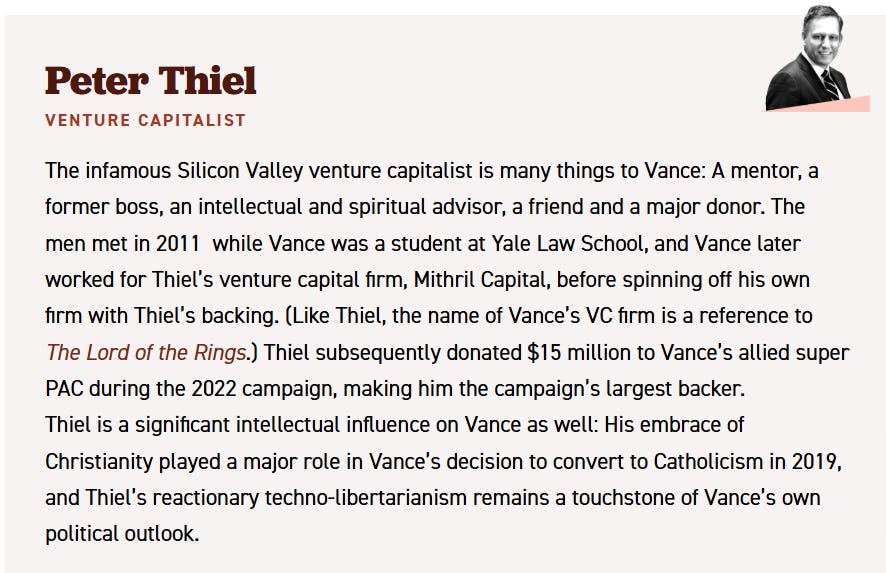
Editor: Consider number 6 and how handily it fits Peter Thiel. ‘A mentor, a former boss, an intellectual and spiritual advisor, a friend and a major donor.’!
6. He was taught to accept gay people. Mr. Vance wrote that he would “never forget the time I convinced myself I was gay.” Not yet old enough to feel attracted to the opposite sex, he worried something was wrong. “You’re not gay,” his mamaw told him, and even if he were, she reassured him, “that would be OK. God would still love you.” As he wrote, “Now that I’m older, I recognize the profundity of her sentiment: Gay people, though unfamiliar, threatened nothing about mamaw’s being. There were more important things for a Christian to worry about.”
I’m trying to imagine the left’s reaction if it emerged that a leading politician had once lavished praise on a century-old book that not only trotted out racist stereotypes about, say, black people and their supposed characteristics, but whose central thesis rested on an ancient, hostile assumption about that group. Would good, progressive folk be rushing to defend that politician by saying the author of the book in question had also written lots of important, non-offensive things, and that other people had quoted that author too, so this was a fuss about nothing – or would they be appalled and even sickened that a contemporary politician could praise such a text without so much as mentioning the racism within it?
It turns out that the answer is: it depends which side the politician is on, and also perhaps which ethnic minority is involved. If the politician is the current leader of the Labour party and the minority involved are Jews, well, then it seems the usual progressive reflexes don’t always kick in.
In today’s Times, the columnist Daniel Finkelstein has dug out a 2011 reissue of JA Hobson’s 1902 work, Imperialism: A Study. The foreword was written by Jeremy Corbyn in 2011. Across eight pages, the then Labour backbencher lavishes praise on the book. His very first sentence describes it as a “great tome”. Among other things, he calls it “very powerful,” “brilliant”, as well as “correct and prescient”. The trouble is, Hobson was not just an accomplished analyst of international politics – for the Manchester Guardian, as it happens – but an egregious anti-Jewish racist.
….
Editor: don’t miss the final paragraph
We all know that it’s painful to admit flaws in those we admire. Corbyn should have done it about Hobson, but did not. Now that task falls to Labour MPs, members, supporters and voters. The Labour leader may tell himself that he is the victim here, a serially unlucky anti-racist who means well, but keeps overlooking racism against Jews even when it’s right in front of him, whether on the platforms he shares or the books he praises. Now the rest of the Labour family have to decide how much longer they are willing to indulge that delusion.
Editor: Don’t forget The Economist contribution to the Defamation of Corbyn ?
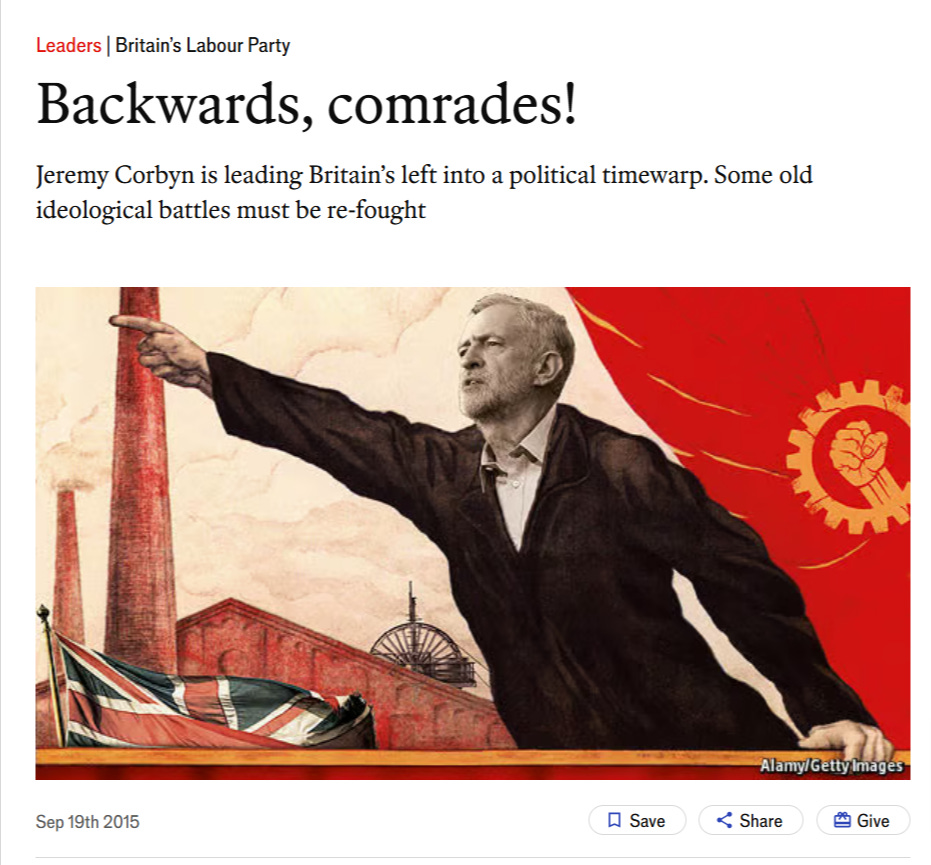
BEFORE he had finished belting out his first celebratory rendition of “The Red Flag”, a hymn to class struggle, some of Jeremy Corbyn’s colleagues in Labour’s shadow cabinet had already handed in their resignations. A 66-year-old socialist, Mr Corbyn has spent 32 years as one of the hardest of hardline left-wingers in the House of Commons and a serial rebel on the Labour backbenches. On September 12th he flattened three moderate rivals (see article) to become leader of Britain’s main opposition party. Labour MPs are stunned—and perhaps none more so than Mr Corbyn himself.
Two views are emerging of Labour’s new leader. The more sympathetic is that, whatever you think of his ideology, Mr Corbyn will at least enrich Britain by injecting fresh ideas into a stale debate. Voters who previously felt uninspired by the say-anything, spin-everything candidates who dominate modern politics have been energised by Mr Corbyn’s willingness to speak his mind and condemn the sterile compromises of the centre left. The other is that Mr Corbyn does not matter because he is unelectable and he cannot last. His significance will be to usher in a second successive Conservative government in the election of 2020—and perhaps a third in 2025.
Both these views are complacent and wrong. Mr Corbyn’s election is bad for the Labour Party and bad for Britain, too.
Cowards flinch and traitors sneer
Start with the ideas. In recent decades the left has had the better of the social arguments—on gay rights, say, or the role of women and the status of the church—but the right has won most of the economic ones. Just as the Tory party has become more socially liberal, so, under Neil Kinnock and then Tony Blair, Labour dropped its old commitment to public ownership and accepted that markets had a role in providing public services. Mr Blair’s government put monetary policy in the hands of an independent Bank of England and embraced the free movement of people and goods within Europe.
The argument today has moved on—to the growing inequality that is a side-effect of new technology and globalisation; to the nature of employment, pensions and benefits in an Uberising labour market of self-employed workers (see article); and to the need for efficient government and welfare systems. Fresh thinking on all this would be welcome—indeed it should be natural territory for the progressive left. But Mr Corbyn is stuck in the past. His “new politics” has nothing to offer but the exhausted, hollow formulas which his predecessors abandoned for the very good reason that they failed.
In his latest political/moral iteration Freedland plumbs the depths of the Zionist Psyche, while avoiding the Genocide, that is the actual Watershed of Theodor Herzl’s European Zionism. Not to willfully forget that Freedland is a Tribalits to his marrow! Reader brace your-self for the turged melodrama!
In Israel, dread and rage haunt the streets. Netanyahu is exploiting that
When I visited Israel this week, it seemed time had stood still since 7 October. I saw pain and grief, but little sign of hope
Journalists cannot enter Gaza, but I was in Israel this week and saw for myself at least the latter half of the equation. When I reported from there a few weeks after the 7 October attacks, I was struck by how time seemed suspended, how frozen the country was in the terror of that day, when at least 1,200 Israelis, mostly civilians, were killed and more than 250 taken hostage. That remains true today. For Israelis, it’s still 7 October.
What has kept so many of them stuck is the wait for the hostages’ return. It might be the Tel Aviv skyscraper lit up with the number of days of captivity – it will be 500 on Monday – and the message “All of us are waiting for you”, or the stickers and posters of their faces plastered on street corners and bus shelters. Either way, anxiety for their plight hangs heavy in the air.
It gained a new urgency after the release last Saturday of three male hostages, each one visibly emaciated. The sight immediately struck a nerve that lies close to the surface of Israeli society: I heard the three referred to as Muselmänner, the name Auschwitz prisoners gave to the walking skeletons among them.
Editor: I will offer a selection of the Melodrama, as narrated by Freedland:
…
That has left the hostage families in the no man’s land between hope and dread: hope that their father or son will come out, dread at the state they’ll be in.
…
“It’s like an open wound that you cannot treat until this is over.” She cannot move on till he is back, and in that she is like much of her country.
But beyond dread, there is rage.
…
What Sharabi did not know, but his captors surely did, was that his wife and daughters were murdered on 7 October.
…
Israeli media rarely show the devastation Israeli bombardment has wreaked on the strip; most Israelis don’t see what the rest of the world sees. They know that thousands have been killed, but they put the blame squarely on Hamas, which surely knew what it was unleashing on 7 October.
…
He wants the war to resume, and for cynical reasons: because if the war continues, his far-right coalition members stay onboard, keeping him in the prime minister’s chair and out of jail. (His trial on corruption charges is ongoing.)
…
…Netanyahu would embark on a “very aggressive”, two-month operation that would, Harel writes, culminate in “the forced expulsion of Palestinians”.
…
This week, I met Yair Golan, the new leader of what was the Israeli Labor party, now rebadged as the Democrats. A former general, Golan is hailed as one of the heroes of 7 October.
…
Equally important is to provide an alternative to Hamas.” Only when “a young Palestinian” can see the path to a better future that does not involve violence will Hamas be truly defeated.
…
And much of the Israeli public struggles to see through the anger, pain and grief that descended on 7 October and which has barely lifted.
Those who want change have to hope that Netanyahu has erred by tying himself to an erratic, if not unstable, US president abroad and to extremist allies at home, and that is too combustible a mixture to last. I badly want that to be right. But I also know there’s a reason why hope has always been the Middle East’s scarcest commodity.
Editor: Max Seddon in Berlin and Christopher Miller in Kyiv write on the Putin Victory that is almost certain?
Vladimir Putin’s initial plan to capture Ukraine in a few days ended in disaster. But after Donald Trump set up direct peace talks with Moscow, bypassing Kyiv and European allies, the Russian president is now closer than ever to getting what he wanted from his three-year-long invasion.
Putin’s main ambition, said people who have spoken to him during the war, is to establish a new security architecture that gives Russia a sphere of influence in Europe — much as the Yalta conference did for the Soviet Union at the end of the second world war.
Now, the US may be open to letting him have it. Defence secretary Pete Hegseth has dismissed Ukraine’s aspirations to join Nato and reclaim its territory from Russia. Putin and Trump discussed “bilateral economic co-operation”, suggesting that the US was prepared to roll back its sanctions against Moscow.
And Trump appears intent on rolling back the US’s commitment to Nato and leaving to European countries the job of sustaining a peace.
“The situation looks much more favourable for Putin than at any point during the entire war over the last three years,” said Alexander Gabuev, director of the Carnegie Russia Eurasia Center in Berlin. “If the US just unilaterally ends its military and diplomatic support, as well as intelligence sharing, then Ukraine will be in a very tough position. And it’ll be hard to get out of it even if the Europeans get more involved.”
In Moscow, there was palpable joy following Wednesday’s call between Trump and Putin.
“A single call can change the course of history — today, the leaders of the US and Russia have possibly opened a door to a future shaped by co-operation, not confrontation,” said Kirill Dmitriev, a Russian sovereign wealth fund chief involved in back-channel talks with the US over prisoner exchanges.
Editor: Note the source in the above paragraph : said Kirill Dmitriev, a Russian sovereign wealth fund chief involved in back-channel talks !The Reader must wonder at the insertion of the photograph of Churchill, Stalin and FDR at Yalta… as a mispaced mood setter, toward what purpose? Reader save yourself from the agony of this propganda and procede to the the final paragraphs of this 1,290 word diatribe!
… Zelenskyy told reporters on Thursday that it was “not very pleasant” to know that Trump spoke to Ukraine’s adversary first. He insisted he “will not accept . . . any bilateral negotiations about Ukraine without us”.
What was imperative, Zelenskyy added, was to “not allow everything to go according to Putin’s plan”.
Kyiv had hoped it could convince Trump to work out a common position on bringing Russia to the table, and had offered access to its reserves of rare earth metals in return for US support.
For now, Kyiv and its European allies are looking on, aghast, from the outside, fearful the US will strike an unfavourable deal with Putin to end the war — and stick them with the bill.
“Trump is proving to be as bad as we feared. He is willing to make a deal with Putin at the expense of Ukraine, and still wants Ukraine to pay him in mineral resources,” said Volodymyr Kulyk, a professor of political science at the Kyiv School of Economics. “The question is what Ukraine and Europe will do.”
Editor: Recall that Victoria Nuland and United States Ambassador Geoffrey R. Pyatt along with NATO, the EU, George Soros , The Foundation for Defense of Democracies, a Neo-Consevetive front group, while Obama remained at a safe distance? On The Foundation for Defense of Democracies, Muhammad Sahimi has written a revelatory essay at Lobe Log:
Behind the Foundation for Defense of Democracies’ Embrace of Authoritarianism


 StephenKMackSD's Blog