American Provincial quotes just enough of Michel Hazanavicius ennui inducing essay…
Why do so many young, pink-assed, Nike-wearing French people want to be revolutionaries and fierce defenders of the weakest with a one-dimensional reading of the issue? And why do we want to make Muslims my antagonists here in France, when in fact they’re not? Why did I spend my youth with Arabs, without it being an issue, and now we want it to be more complicated than that?
How can we fail to see that words form ideas, and that after ideas come acts? Why is it so complicated to hate no one and hope that no one hates us? At least to an acceptable extent? Without things getting out of hand?
…
And why do I get the feeling that more and more people have a problem with even talking about the Jewish genocide?
…
Why do I get the feeling that a dull force is trying to break the last dam that imposed a ban?
…
And why is it that Jews are too often asked to talk about anti-Jewish hatred, when we’re probably not the most representative in the field?
…
Why do I so often wish I weren’t Jewish so that I could defend them without my word being automatically nullified? And why are we all so silent? Are we really sure that our silence will be louder than their screams?
Editor: Michel Hazanavicius is not François Truffaut!
Here is a portion of Tett’s essay from January 16, 2015, the whole essay is more than worthy of your attention!
Headline: A debt to history?
Sub-headline: To some, Germany faces a moral duty to help Greece, given the aid that it has previously enjoyed
…
Last summer I found myself in that spot for a conference, having dinner with a collection of central bank governors. It was a gracious, majestic affair, peppered with high-minded conversation. And as coffee was served, in bone-china crockery (of course), Benjamin Friedman, the esteemed economic historian, stood up to give an after-dinner address.
The mandarins settled comfortably into their chairs, expecting a soothing intellectual discourse on esoteric monetary policy. But Friedman lobbed a grenade.
“We meet at an unsettled time in the economic and political trajectory of many parts of the world, Europe certainly included,” he began in a strikingly flat monotone (I quote from the version of his speech that is now posted online, since I wasn’t allowed to take notes then.) Carefully, he explained that he intended to read his speech from a script, verbatim, to ensure that he got every single word correct. Uneasily, the audience sat up.
There are two lessons here. The first is that not even ultra-well-paid financiers — be they hedgies, private equity players or bankers — can really forecast the precise moments of market meltdowns. Yes, fundamental strains and cracks can be identified. But judging when these will cause a market earthquake is as hard as real geology; humility is required. And doubly so given that the rise of algorithmic trading is creating dramatically more price volatility and feedback loops.
Second, this week’s market rout was driven not so much by panic around the “real” economy as by financial dynamics. Or, as Bridgewater wrote in a client letter: “We view the widespread deleveraging firmly as a market event and not an economic one,” since “periods of structurally low volatility have always been fertile ground for the accumulation of outsize positioning” — and eventually they unwind.
…
Editor: Tett broaches the telling subject of Quantitative Easing :
Or, to put it another way, these events can be viewed as (yet another) aftershock from the unwinding of that extraordinary monetary policy experiment known as quantitative easing and zero interest rates. For while investors have normalised cheap money in recent years — and to such a degree that they barely notice the distortions this has caused — they are now belatedly realising how odd it was. In that sense, then, the dramas have been thoroughly beneficial — even if electronic trading has made that lesson more dramatic than it might have been.
…
The immediate display of this is the yen carry trade — the practice of borrowing short in cheap yen to buy higher-yielding assets such as US tech stocks. Cheap yen loans have fuelled global finance ever since the Bank of Japan embarked on QE in the late 1990s, albeit to a degree that has fluctuated, depending on US and European rates. But the carry trade appears to have exploded after late 2021, when the US moved away from QE and zero rates. Then, when the BoJ (finally) also started to tighten earlier this year, the rationale waned.
…
Editor : Instead of completely scavenging her insights, let me offer some selective quotations that might better evoke portions of her essay.
…
UBS and JPMorgan also think that about half of these have been unwound.
…
Either way, the key point is that insofar as free(ish) money was fuelling asset inflation in America and Japan, this is coming to an end.
…
Unsurprisingly, this leaves some investors hunting for other long-ignored QE distortions that could also unwind.
…
Unsurprisingly, this leaves some investors hunting for other long-ignored QE distortions that could also unwind.
…
My answer is “not now”. Although these holdings look odd by historical standards, the BoJ insists it will not sell soon. But what is most interesting is that non-Japanese investors are waking up to this issue, after ignoring — that is to say, normalising — it for years.
…
But this confidence — or complacency — has been reinforced by the Federal Reserve acting as a buyer of last resort for bonds during QE.
…
Editor: The final paragraphs:
A cynic might retort that all this mental readjustment may yet turn out to be unnecessary: if markets truly swoon, central banks will be pressured into propping up them up — yet again. Thus on Wednesday, the BoJ deputy governor pledged to “maintain current levels of monetary easing”, contradicting hints from the BoJ governor last week that more rises loom.
But the key point is this: bountiful free money is not a “normal” state of affairs, and the sooner investors realise this the better — whether they are mom’n’pop savers, private equity luminaries, hedge funders or those central bankers.
Julian Tett manifests integrity in both these essays!
…the American left…, …Defund the Police…,…White Fragility…, Politics being downstream of culture,…, Dave Chappelle making sport of them…,
Editor: Paragraph 2: Ganesh switches tracks & provides what passes for diagnosis, but still enmeshed in disarray.
How Republicans have allowed this state of affairs to flip since then should be the subject of an inquest. And it might start in Palo Alto. If Donald Trump loses the presidential election, his courting of the tech world, or its embrace of him, won’t seem the masterstroke that it did at the time. However lavish the campaign donations from that quarter, much of the Republicans’ perceived abnormality stems from the same place.
Editor: Paragraph 3: Ganesh resorts to jitter-bug cadences: a not so subtle attack on ‘tech bros’? Is Ganesh an Oxbridger?
Tech weirdness tends to consist of two things. One is intellectual obsession. The favoured issues of tech bros are often good ones — demographic decline is serious, free speech is threatened — but get much too much prominence for the median voter’s tastes. The other component is tonal. Rife in tech is an almost teenage eagerness to provoke that jars outside of podcasts and internet chat rooms.
Editor: Paragraph 4: Enter JD Vance & Peter Thiel and Mike Pence, offered in the highlighted comic sentience. Ganesh attempt to construct a viable argument by way of Pence reads like the non sequitur it is!
Both glitches come together in the person of JD Vance, the Peter Thiel mentee who it is hard to imagine as running mate before the tech-Trump entente. What the GOP ticket needed was another Mike Pence, another reassuring emissary to suburban moderates. What emerged was someone on whom Trump is the restraining influence. If this unnerves enough voters in enough states, no donation was worth it.
Editor: Paragraph 5 : Ganesh compares The Palo Alto cast of mind, with that of the Wall Street cast of mind: they are not actually explored, but mentioned, alluded to, this is, at best riffing on already established themes of Ganesh. The ‘as if’ is just that, it has no rhetorical weight … it is almost Straussian in its potted history of investors ,financial hubs and the casual dishonesty of political conformists of all stripes?
It might be useful to compare the Palo Alto cast of mind with that of Wall Street, that other funder and shaper of US politics. If only because financial markets are sensitive to events — an oil shock, a foreign coup, a crop blight — those who work in them have to be at least somewhat tethered to practical reality. There is little profit in abstract thought, and not much time for it either. (Hedge funds being a partial exception.) Reinforcing this hard-headedness is the fact that financial hubs are situated in big cities, where human contact is constant and the messiness of life part of the furniture.
Editor: I’ll just quote portions from the remaining paragraphs in order. Ganesh’s chatter loses its ability to charm the reader, after a barrage of self-congratulation, masquerading as political insight, that reveals itself as wan propaganda aided by his myopic view from afar !
Editor: Paragraph 6:
…
Pour in thousands of first-class mathematicians and engineers, and it would be strange if a sort of brilliant unworldliness didn’t take root. As a generator of wealth, US tech is phenomenal. As an actor in politics, it can be maladroit.
Editor: Paragraph 7:
…
No, the problem is absolutism: the taking of ideas, left or right, to the nth degree. Riots in the UK? “Civil war is inevitable”, judges Elon Musk, of a nation that didn’t have a civil war over the Corn Laws, the Somme or the loss of empire. This very Northern Californian millenarianism is weird, not to say wrong and often unfalsifiable.
Editor : Paragraph 8:
…
To judge by some tweeted reactions from tech moguls to the Vance appointment (“WE HAVE A FORMER TECH VC IN THE WHITE HOUSE. GREATEST COUNTRY ON EARTH BABY”) the right is now the self-high-fiving in-group with no clue how it comes across to uncommitted voters.
Editor: Paragraph 9:
…
You can be weird and win, of course. The Democrats strike me as about as overconfident as the Republicans of a month ago. The question is whether Trump’s chances are better or worse as a result of his much-celebrated support from the Valley. On balance, worse, I think. The Apprentice started airing in the pre-streaming Arcadia we call 2004. A man who owes his political breakthrough to linear television never needed his pioneering but odd new friends.
Myra Breckenridge comments upon ‘“Elizabeth Taylor: The Lost Tapes”’ by Alissa Wilkinson, in The New York Times.
As the creature of Gore Vidal’s vivid, and at times perverse sexual imagination, I’m probably not the right semi-plagiarist, and pretender, to rifle through Alissa Wilkinson review of ‘Elizabeth Taylor: The Last Tapes’ in the New York Times? Like any pretender, I can’t resist the lure of a possible audience! (Recall Charles Pierce as ‘Drag Queen’ ?) The last three paragraphs of her ‘review’ reek of ‘Hollywood Vomit’ , as Raymond Chandler once called it!
…
“Elizabeth Taylor: The Lost Tapes” also documents, with a harrowing frankness, the precise moment when the public’s interest in celebrities tipped over from worshiping their glittering lives to feeding on their scandals. As the film frames it, Taylor’s split from her fourth husband, Eddie Fisher, after she fell in love with her “Cleopatra” co-star Richard Burton, prompted the birth of the paparazzi: photographers who would chase stars tirelessly to get a juicy shot they could sell. One commentator in the film says they weren’t coming for glamour anymore — they were coming for the destruction of glamour.
Taylor, in her own retelling, says that she decided at some point that it was fruitless to try to “fix” her public image. “People have a set image they want to believe, either the good or the bad,” she says. “If you try to explain, then you lose yourself along the way.” Of course, a series of high-profile fallouts with Burton, substance-abuse issues and her aging appearance were all reliable tabloid fodder. And it pained her, until she found a third act as an AIDS activist.
But “Elizabeth Taylor: The Lost Tapes” suggests that in her own way, Taylor, who died in 2011, paved the path for future generations of stars who would have to deal with celebrity. So it’s not just a fascinating glimpse into a woman who spent her whole life in the spotlight. It’s a chronicle of a moment when everything changed, and a sobering reminder that we often think we know who public figures are, but we rarely really understand.
Political Observer comments & supplies ‘a selective reading’ of Conradi’s polemic!
Mr. Conradi’s feature story begin as just that:
When Holly-Rose Clegg was beginning her acting career in Paris, a job at Starbucks helped pay her bills. Almost a decade later, she has a successful career on stage and screen and in adverts — but it is now the French state, rather than serving coffee, that keeps her going in the inevitable gap between engagements.
Every month, Clegg logs onto an official website to input the jobs she has done and how much she has earned and is paid for the days on which she has not been working — in her case, typically €1,600 (£1,350) a month.
“It’s amazing because France is the only country that pays us like a salary every month,” said Clegg, 33, who was born in London to British parents and moved to France when she was eight. “They give it to actors, singers, dancers, musicians, even technical people who work on movie sets or do the sound. Even if you’re a foreigner, you can still have it if you work here, which is really cool. It’s not just for French people.”
Clegg is among more than 300,000intermittents du spectacle— people employed on a casual basis in the French entertainment industry — who are entitled to receive money from the state provided they satisfy certain criteria, including a minimum number of performances or hours a year.
Editor:But Conradi can’t resist the temptation that these introductory paragraphs offer, to become what be might be named a Thatcherite Scold, in a bespoke suit- this is The Times, with a history of not just Conservatism, but an Anglicized Neo-Liberalism, via that Iron Lady!
The scheme, estimated to cost more than €1 billion a year, is typical of a unique economic model that has made the French state one of the largest and most generous in the world.
Such largesse comes at a cost, however: now at close to 57 per cent of GDP, government spending in France has long been way higher than in any of its G7 rivals; the equivalent figure for Britain is 44.2 per cent and for America 37.5 per cent. At the same time, tax rates are high, while social charges — the French equivalent of national insurance — are vast.
Yet, in recent years, successive governments have been finding it increasingly difficult to balance the books: the budget deficit is running at 5.5 per cent of GDP, which has helped push up French government debt to 110.8 per cent of GDP, third only to the figures for Greece (159.8 per cent) and Italy (137.7 per cent).
Editor:Mr. Conradi’s evidence as the above presents it, is well ‘alarming’? I’ll choose some telling fragments, of the remaining 969 words of the Conradi’s verbose polemic, that left the experience of Holly-Rose Clegg’s story as mere window dressing!
…
the markets are getting nervous, the ratings agencies have downgraded French debt and the European Commission is demanding action.
…
To further complicate matters, the country is still without a government almost a month after an inconclusive election in which the largest number of seats was won by the New Popular Front…
…
“We are the world champions for public spending and the European champion for taxes, plus growth is mediocre at little more than 1 per cent,” said Benoît Perrin, director of Contribuables Associés, a campaigning group that is the French equivalent of Britain’s TaxPayers’ Alliance.
…
The only way to balance the books is to cut public spending, but for 50 years, our governments have drugged the French with public money, and it is very difficult to wean them off it.”
…
The situation is compounded, Perrin argues, by multiple levels of bureaucracy and an army of fonctionnaires (public sector workers), whose numbers have been growing year on year.
…
Editor: The fact is that the Neo-Liberal Marcon has been a dismal failure, across the board : the non-vote on the retirement age was a demonstration of Macron’s cowardice!
…
Paradoxically, France’s budgetary woes come despite a concerted drive by President Emmanuel Macron to open up the economy since he first came to power in 2017: labour laws have been made more flexible, taxes for business lowered and unemployment cut considerably.
Foreign investors have taken note and, for the fifth year running, put more money into France than they have into Germany or Britain…
…
… and, when it comes to crises, Macron’s response, like that of his predecessors, has been to spend more public money, putting his country increasingly at odds with its neighbours and competitors.
…
Bruno Le Maire, the outgoing finance minister, announced plans last month for €25 billion in budget cuts this year, with the aim of bringing the deficit down towards the level demanded by the EU: 3 per cent of GDP.
This was not enough to appease the Cour des comptes, the independent body that scrutinises France’s public spending. In a damning report, the auditors accused the government of failing to deliver sufficient cuts and described its debt-reduction promises for the future as “unrealistic”.
…
The Council of Economic Analysis (CAE), an organisation attached to the French prime minister’s office, argued in a recent note that the government would have to cut spending by €112 billion over the next 7 to 12 years to generate a 1 per cent primary budget surplus necessary to bring down the debt.
…
:spending by the French presidency last year was €125.5 million, a budget overshoot of €8.3 million, it was revealed last week. This included €474,851 for a lavish reception for King Charles at the Palace of Versailles during his state visit.
…
Like Gabriel Attal, the prime minister, and other members of the government, he tendered his resignation following the election. It remains to be seen who will replace them.
…
… the New Popular Front has staked its claim to the premiership, alarming financial markets with policies that include raising public sector wages, linking salaries to inflation, and cutting income tax and social security contributions for lower earners.
Notably, it has pledged to reverse a controversial law pushed through parliament last year by Macron to raise the retirement age from 62 to 64, credited with saving the state an estimated €17 billion a year — and reduce it even further to just 60.
…
…Lucie Castets, 37, a left-wing economist and senior civil servant, called for €150 billion more in taxes between now and 2027, largely levied on the better off and on companies, and said keeping to the EU’s 3 per cent limit would not be her “primary objective”.
…
Unwilling to destabilise the country in the middle of the Olympics, he has said he will not do so until after the Games end next weekend. In the meantime, France’s debt looks set to continue ticking up.
The first three paragraphs of this essay wallows in a retelling of a History, that is still unfolding. But the very canny Mr. Friedman lets his ‘reader’ know that he is aware of the various political actors in this Real Life Melodrama, and that he has not been beguiled by the machinations of those toxic actors? Yet Friedman is a Zionist! How might a Zionist approach such fraught political/moral territory ?
One of my ironclad rules of reporting in the Middle East is that sometimes you need to rereport a story to see things even more clearly than you did earlier. I’m having that experience with the Iran-Israel-Hamas-Hezbollah war, which could soon draw in the United States. It could not be more clear now that, while Hamas’s surprise attack on Israel on Oct. 7 was triggered in part by reckless Israeli settlement expansions, brutal treatment of Palestinian prisoners and encroachments on Muslim religious sites in Jerusalem, the terrorist assault was also part of a broader Iranian campaign to drive America out of the Middle East and America’s Arab and Israeli allies into a corner — before they could corner Iran.
Which is why if the current tit-for-tat conflict between Israel and Iran and Iran’s proxies (Hamas, Hezbollah and the Houthis) escalates into a full-scale war — one that Israel could not fight for very long alone — President Biden could face the most fateful decision of his presidency: whether to go to war with Iran, alongside Israel, and take out Tehran’s nuclear program, which is the keystone of Iran’s strategic network in the region. Iran has been building that network to supplant America as the most powerful force in the Middle East and to bleed Israel to death by a thousand cuts inflicted by its proxies.
But America must always be wary about what Israeli Prime Minister Benjamin Netanyahu is up to. As a former Israeli diplomat, Alon Pinkas, observed in Haaretz on Thursday, one has to wonder why Netanyahu chose now to assassinate the Hamas leader Ismail Haniyeh in Tehran — in the middle of delicate hostage talks.
The Reader finds herself in the uncomfortable position, of confronting 1,205 more of Friedman’s words: that should cement in her mind, his mastery of the vexing complications of Netanyahu’s Political/Moral Universe, and the real possibility of nuclear war, as a possible outcome?
Editor: I’ll sample some of Freidman’s self-serving chatter , that in his mind demonstrates ‘mastery’. Poor Mr. Friedman is not Walter Lippmann!
…
In Netanyahu’s nearly 17 years in power, Bibi has both aided and undermined American interests in the region.
…
But honesty also requires me to acknowledge that some things are true even if Netanyahu believes them.
…
No leader in any of these Arab states today can make decisions hostile to Iran’s interests without fear of being killed.
…
Lebanon and Syria had to observe three days of mourning after Iran’s president died in a helicopter crash. Yup, three days of mourning for another country’s president. There is a name for that: Iranian imperialism.
…
IMEC was designed to foster tighter trade and energy supply links between the European Union and India — via U.S. allies on the Persian Gulf.
…
The founding IMEC partners are the U.S., the E.U., Saudi Arabia, India, the U.A.E., France, Germany and Italy.
…
Iran knew it had to prevent this Saudi-U.S.-Israel deal or be strategically isolated.
…
Iranian supreme leader Ali Khamenei said that Muslim countries that are normalizing with Israel are “betting on a losing horse,” state-run media reported Tuesday, as regional rival Saudi Arabia moves toward establishing ties with Jerusalem. Khamenei also predicted Israel would soon be eradicated, in an address to government officials and ambassadors from Muslim countries. …
…
How, though, will it end?
…
“In a network, everyone is No. 2.” Successors always emerge, often worse than their predecessors.
…
With that one chess move — embracing the Palestinian Authority — Netanyahu could cement the U.S.-Israeli-Arab alliance, put in place a Palestinian governing structure in Gaza that would not threaten Israel and isolate Iran and its proxies militarily and politically, making their bet on Hamas’s war an utter waste of lives and money. But Bibi would have to risk his governing coalition to do it, because his extremist far-right messianic partners oppose any deal with any credible Palestinians.
…
What is not at all clear is what Bibi will do. Whose interests will he serve? His, Israel’s, America’s or Iran’s?
…
Iran has long been happy to let Palestinians, Lebanese, Yemenis, Iraqis and Syrians die “for Palestine” but never risk Iranians if it could avoid that. The crocodile tears shed by Iran’s clerical leaders for Palestinians are all a fraud — all just a cover for Tehran’s regional imperialist adventure.
Netanyahu can now pull back the curtain on the whole cynical play. But that would require him to put Israel’s interests ahead of his own political survival. Will he?
Don’t turn off your critical thinking skills just because you have been told Venezuela is “socialist” your whole life. The Venezuelan opposition have claimed fraud and contested virtually every election that they have lost since Chávez came to power. Yet they can never provide evidence, and that is because Venezuela’s electoral process is far more secure than what we have in the United States. I describe the voting process in the country, which I have observed firsthand, in my book, Corporate Coup:
“In Venezuela, voting machines were activated through a two-step verification process consisting of a physical check of the voter’s national identity card and a digital scan of their fingerprint. After casting their vote, the voter received a physical receipt of their ballot which they then personally dropped in a secure box on site. The voter then signed their name and stamped their thumbprint on a physical electoral registry to certify their participation. When polls closed, authorities assuaged fears of digital vote tampering by checking their final electronic tally against a random sampling of 54 percent of the physical ballot receipts submitted by voters at polling stations.”
Citizen and international observers are present throughout this process. Do not fall for claims of fraud unless hard evidence is produced. Especially because further escalation in Venezuela will only result in civil conflict and perhaps even regional war in the Western hemisphere. You think our border looks bad now? Wait until Washington turns up the heat on Caracas. Oh—and the Russian military has strong military ties with Venezuela and a presence within the country. We are not only talking about regional war here, but an expansion of the World War currently raging against Russia and its allied rising powers. Are you ready for that war to hit “Washington’s backyard”?
One more point: the vast majority of Venezuela’s economy—hotels, restaurants, stores—are privately owned and operated. Venezuela’s “socialism” is largely defined by the fact its industries, including its oil sector and precious mineral reserves, are nationally operated. This makes Venezuela comparable to Russia and many other modern states that consider the natural resources stored within the nation to be the property of the Republic rather than a few at the top. Venezuela is an obsession in Washington because before Chávez, US and European companies practically owned the country and the IMF set its domestic economic agenda. Venezuela is home to the largest oil and untapped gold reserves in the world. This is why Americans have been inundated with propaganda about Venezuela since it began the process of asserting sovereign ownership over that natural wealth. That is what their “socialism” is primarily about.
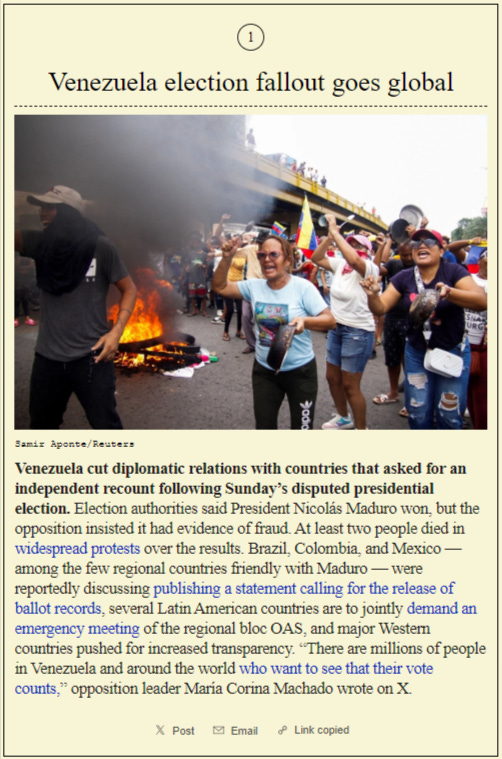
The reader need only compare the ‘Semafor Flagship’ to the Time Magazine approach of Henry Luce’s political methodology, of another time and place! Reportage in it’s carefully reduced state of a collection of political villains aligned with Maduro’s ‘Leftism’, as a continuing threat to American Hegemony! The Venezuelan Oligarchs allied with Uncle Sam covet the abundant Oil Reserves that Maduro controls.
The Reader can only wonder at Anya Parampil fact based reporting on the election! Never to have a place in American Corporate Media, nor the subject of any debate, on Political Talk Shows: that wallow self-congratulation, as their audiences continue to decline at high speed. Anya Parampil, in the tradition of I.F. Stone, provide fact based dissent, on the teetering and totally corrupt Technocrats, who continue to produce American National Security State propaganda!
The title @rcolvile’s latest of attack on Keir Starmer political motives leaves The Reader in the dark confronting ‘The problem with a tax regime built on golden geese is that they can fly away’ the burning question is, who are these Golden Geese? Could this be what Colevile is attempting to describe?
9 Jul 202410.15 EDT
Closing summary
The vacuum cleaner and air-filter maker Dyson is cutting about 1,000 jobs in the UK as part of a global restructure, reducing its British workforce by more than a quarter.
Staff were told on Tuesday morning about the cuts as part of moves to reduce the business’s 15,000-strong workforce around the world amid a wider cost-cutting drive.
Dyson, which is known for its bagless vacuum cleaner as well as hand-dryers and bladeless fans, has 3,500 UK employees, with offices in Wiltshire, Bristol and London. The review that led to the decision began some time before the general election was announced in May.
Or could the culprit be Mariana Mazzucato : Professor in the Economics of Innovation and Public Value at University College London where she is the founding director of the UCL Institute for Innovation and Public Purpose.
Her work challenges orthodox thinking about the role of the state and the private sector in driving innovation; how economic value is created, measured and shared; and how market-shaping policy can be designed in a ‘mission oriented way’ to solve the grand challenges facing humanity. She is winner of international prizes including the 2020 John von Neumann Award and the 2018 Leontief Prize for Advancing the Frontiers of Economic Thought.
History tells us that innovation is an outcome of a massive collective effort – not just from a narrow group of young white men in California. If we want to solve the world’s biggest problems, we better understand that.
Mariana Mazzucato, Wired interview
In these paragraphs Colvile riffs on themes of @Jacob_Rees_Mogg , in sum of Rich Men as the perpetual victims of political opportunists!
In the face of Tory harassment during the campaign, Labour ruled out increasing all manner of taxes on “working people” — although its definition of “working people” turned out to exclude quite a large chunk of the population, not least those who pay for their own children’s education. And if you rule out “working people”, that just leaves “the rich”.
But that’s a problem, because our tax system rests on an incredibly narrow base. The latest statistics, published a few days before the election, show that the top 1 per cent of earners pay an astonishing 28 per cent of income tax. That comes to £85 billion, or roughly three times the amount paid by the entire bottom half of the workforce. Indeed, for all the stereotypes about the Tories, in their 14 years they steadily took more of high earners’ salaries, and less from that bottom half, than Labour ever did.
The problem with a tax regime built around golden geese, however, is that they can always fly away. And pretty much all of the rumoured tax rises are ones that might prompt them to do so. Capital gains. Inheritance tax. High-earners’ pensions. Making it harder to pass companies to the next generation.
Reader there are still 339 words left ! I hope my summery offers some insights, that will make the remainder of your inquiry rewarding! I’ll provide a sampler of the remaining Covile’s examples of what Starmer’s misbegotten Economics presages for ‘British Economic Growth’ the great mirage of Neo-Liberalism and Thatcherism’s utter failure to connect to the singular idea of ‘Development’ of Manfred Max-Neef !
There is a paradox here. Labour’s economic strategy is built on attracting private investment, to deliver the state’s objectives on decarbonisation, housing and so on. But its taxes will fall on private investors.
…
Indeed, there is widespread consensus in the City that the abolition of non-dom status amounts to a titanic act of self-harm. On the latest figures, the 37,800 non-doms paying on a “remittance” basis (ie, being taxed only on their UK income and assets) contributed £6.5 billion in taxes — to say nothing of the companies they ran or goods they bought. Yet significant numbers of the highest earners are already taking that cash elsewhere, to the point where you could go through The Sunday Times Rich List with a marker pen.
…
The core problem for most is not the level of tax — many would be happy to stump up much more to stay in Britain — but Labour’s likely insistence that they pay inheritance tax on all their assets and investments, whether or not they have anything to do with the UK. As one put it to me: “We can afford to live here. We just can’t afford to die here.”
…
They are the inevitable consequence of low growth, high inflation, excess borrowing, a global pandemic and an ageing population — in other words, a toxic combination of long-term pressures and temporary emergencies.
…
As the new chancellor recognises, the only sustainable way to get us out of this mess is to drive up the rate of growth. The danger is that by targeting the wealthy as a short-term fix, she will make that even harder.
Mr. Colvile is a Thatcherite Political Romantic and Propagandist, and has no interest in the Economic Utopianism of Manfred Max-Neef , nor of Jeremy Corbyn’s Left-Wing Social Democracy. Thatcherism was, is, and remains about the Primacy of The Market, as the singularity that defines the human endeavor.
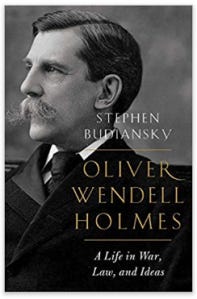
I saw a copy of this latest biography of Oliver Wendell Holmes by Stephen Budiansky, today, at my local library. I searched, out of curiosity, for the Buck vs. Bell case. This being a valid test of an actual biography of Holmes, warts and all, or just more of the same apologetics, for this misogynist and misanthrope, and one of the decisions that establishes without fail this American jurist’s reputation.
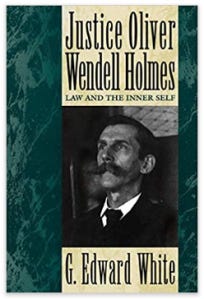
Here, from G. Edward White’s Oliver Wendell Holmes : Law and The Inner Self:
From pages 407 and 408 some telling information that has escaped Mr. Budiansky’s attention ? That I recalled this portion of Prof. White’s biography can be attributed to the fact that Holmes was a very particular kind of American Monster!
…
The second feature of Buck v. Bell is that it concerned a legislative “reform” about which Holmes did not have his customary skepticism. On the contrary, he was an enthusiast for population control devices, particularly those that promised to reduce “incompetence” in the population. He had no reason to doubt many of the assumptions of the eugenic reformers: that mental disabilities were inherited; that mental disability was linked to crime; that the very persons who were candidates for sterilization were the least likely to control their sexual impulses. He had written Pollock in 1920 that “I should be glad . . . if it could be arranged that death should precede life by provisions for a selected race,” because “every society rests on the death of men,”(130) and that “[y]our remark that the men fit for military service on the whole are the better type . . . is precisely the reflection that makes me believe that it would be possible to breed a race.”(131)
He had written Laski in 1923 that “I do not regard the great multiplication of the species as a benefit.”(132) and in 1925 that “I don’t believe in millennia and still less in the possibility of attaining one . . . while propagation is free and we do all we can to keep the products, however bad, alive.”(133) He wrote Lewis Einstein in 1927, after the Buck decision, that “establishing the constitutionality of a law permitting the sterilization of imbeciles . . . gave me pleasure.”(134) And he wrote Laski that when he wrote the opinion in the Buck case he “felt that I was getting near to the first principle of real reform.”(135)
It therefore proves too much to associate Holmes’ opinion in Buck v. Bell with a skeptical tolerance for “social legislation” of all sorts, which does not capture his attitude toward Virginia’s sterilization statute. The notoriety of Buck v. Bell has increasingly cut into Holmes’ image as a civil libertarian; it played an important part in the first major revision of that image by critics in the 1960s.(136) The question remains, however, how that image first surfaced, given Holmes’ repeated skepticism about the efficacy of “progressive” legislation, indifference toward civil rights claims, disinclination to grant aliens any rights against the state, and ultrapositivist theories of sovereignty.
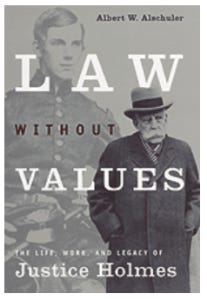
Also see Law without Values : The Life, Work, And Legacy Of Justice Holmes by Albert W. Alschuler : Chapter Five , Holmes’s Opinions pages 65, 66 and 67 that reiterates the historical evidence that White presents.
The Cult of Oliver Wendell Holmes is politically and civically toxic! Mr. Budiansky is another Holmes acolyte.



 StephenKMackSD's Blog