On the burning question of the Post-Macron Era, in Le Monde!

Can Macron’s Anti-democratic ‘retirement age’ be revoked, expunged, etc.? Political Observer speculates!

On paper, the proposal looks simple, but the conditions for its implementation are the subject of intense debate. A few minutes after the initial estimates of the outcome of the legislative elections were released, leader Jean-Luc Mélenchon forcefully reaffirmed on Sunday, July 7, that the statutory retirement age, which was introduced in 2023, will be abolished by decree “as early as this summer” if the left-wing Nouveau Front Populaire (NFP) alliance governs the country. However, the statement by the leader of the radical-left La France Insoumise (LFI) party is open to scrutiny, with many experts believing that a law is needed to abolish the provision which is as emblematic as it is unpopular.

This is one of the actes de rupture (“acts of separation”) that the NFP pledges to carry out in the “first fortnight” to “respond to the social emergency” if it takes power. It wants to cancel the “implementation decrees of Emmanuel Macron’s reform” which raised the retirement age from 62 to 64. The left-wing parties’ program focuses on Article 10 of the April 14, 2023 law, which made significant changes to France’s system. It’s worth noting that the article in question also includes a provision for extending the length of employment time required to obtain a full-rate pension for certain generations. Strangely, the NFP has not said whether it also intends to put an end to this provision which could mean additional efforts for the age groups concerned.

https://www.lemonde.fr/en/politics/article/2024/07/11/french-elections-can-the-left-repeal-the-pension-reform-if-it-comes-to-power_6681110_5.html

Editor: On the question of ‘Legality’

Michel Borgetto, a professor emeritus at the University of Paris-II Panthéon-Assas, shared this view, stating that, “A decree cannot go back on the provision of the law gradually raising the legal retirement age to 64, as such a modification or repeal can only come from the law.”

Editor: Legal avenues

However, other experts have a different view. Laure Camaji, a lecturer in labor law at Lyon-II University, argued that “a decree can immediately freeze the increase in the retirement age.” Emilien Quinart, a lecturer in public law at the University of Paris-I Panthéon-Sorbonne, went even further, observing that from 1985 to 2010, the retirement age appeared in the regulatory part of the Social Security Code, before being inserted in the legislative component following a reform enacted under former conservative president Nicolas Sarkozy.

The prime minister could then ask the Constitutional Council, which rules on the constitutionality of laws, to “delegalize” the retirement age, in other words, to downgrade it and restore its regulatory status, as it was before 2010.

The option of referring the matter to Parliament remains. Socialist leader Olivier Faure mentioned it on Franceinfo broadcaster on Monday. He suggested that “a bill is needed, which we will table in the Assemblée” and that “the Assemblée will have to make a decision.”

Editor: Reader pay attention to where Bertrand Bissuel ends his speculations, about possible means to an end, the repeal of the retirement age, that appears to be the strategy adopted by Macon, turned against it-self ? Or should it be named the political nihilism of the long discarded ‘Jupertarian Politics’, as Neo-Liberal chicanery collapsing upon itself ?

In this context, Faure explained that it would be possible to resort to Article 49.3 of the Constitution, an article that allows the government to pass laws without a vote. “Everyone [would] understand,” he argued, pointing out that “80% of the French” were opposed to the 2023 reform, which was passed with the use of Article 49.3.

There is yet another way: the far-right Rassemblement National (RN), which is also against retirement at 64, could add its votes to those of the NFP. RN lawmaker Laure Lavalette told BFM-TV on Monday that her party would “vote for the repeal.”

Political Observer

Posted in Uncategorized | Leave a comment

janan.ganesh@ft.com mines the periphery of Nato: Ireland!

Political Observer comments.

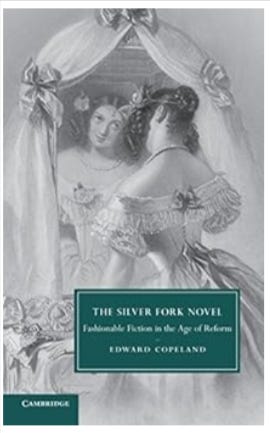
The first three paragraphs of the Ganesh essay are carefully assembled with Ireland as the key state, in fact, the paradigmatic case for NATO. His talent as a Story Teller is not quite the same as his sometime, once, talent as author of beguiling aperçus! The periphery of NATO becomes in the ‘thought’ of Ganesh its very virtue, in propaganda terms! These three paragraphs reminds this reader of his literary Hero Tom Wolfe Silver Fork fictions.

To Dublin, where “triple lock” has an altogether different meaning. In Britain, it is a rule that protects the real value of the public pension. In Ireland, it is a set of tests the government must pass to send armed forces abroad. If unpicking the British lock is too provocative for politicians to consider, imagine fiddling with the Irish one, bound up as it is with the republic’s non-belligerent self-image.

Yet the government proposes change. Allies have long nudged Ireland to do more, noting that democratic Europe has enemies who might not exempt a “neutral” state from their menaces. (Subsea cables near the Irish coast are candidates for sabotage.) And while Nato membership isn’t even a remote prospect, Ireland has signed up to a new co-operation scheme with the alliance.

In fact, Ireland, where support for EU membership amounts to a near consensus, is a good spot from which to observe one of the under-told stories in the world: the resilience of the west’s two most important institutions. Having been diagnosed “brain-dead” in 2019 by no less an eminence than the president of France, Nato is now wider, in that Sweden and Finland have joined, and deeper, in that member states are spending more on defence. Some are even mulling the revival of conscription. Whatever is missing from the alliance that convenes in Washington this week — a vigorous US president, for example — it isn’t a raison d’être. The Kremlin has seen to that.

Editor: The cast of characters from Irish seedlings, to The Kremlin ( Putin The Terrible), follows in its meandering way of Western Corporate Press hysteria! Ganesh produces a very particular kind of political confection! I’ll proved some selective quotation, of the remainder of this obvious propaganda:

And Nato might be the second most resilient Brussels-headquartered entity.

The EU is popular. And has become more so in recent times. Readers who find this implausible should take it up with various polling companies.


Editor: Ganesh offers irreputable polling data? Yet the Polling Data, is bought and paid for by Political Operatives, of many Parties, that use this ‘data’ to secure by the publication of such ‘information’ to ‘massage’ political outcomes. This seems to this writer to be axiomatic!

According to YouGov last month, a referendum on membership would result in a crushing Remain win in each of the large EU democracies. German support for Leave is 18 per cent. In Spain, it is in the single digits. Eurobarometer, a pan-continental pulse check, finds that 74 per cent of respondents now “feel” like citizens of the EU, against 25 per cent who don’t. Those numbers were 59 and 40 around a decade ago. The Pew Research Center reports that supermajorities think well of the EU throughout Europe (save Greece) and as far afield as South Korea, having not always done so.

Survey after confounding survey reveals the same trend: a reputational slump for the EU in the mid-2010s, amid the sovereign debt crises, then a recovery to remarkable highs ever since. It explains some odd twists of events in national politics. To get as far as she has, which isn’t far enough to govern France, Marine Le Pen had to soften her line on Europe. The Italian premier, Giorgia Meloni, has been constructive with an EU that some expected her to fight. The return of Donald Tusk as Poland’s leader happened, in part, because his predecessors’ tiffs with Brussels sat ill with a pro-EU electorate. Across the continent, lots of voters with ultraconservative instincts on immigration, crime, net zero and, yes, Brussels, balk at EU exit, or anything close to it.

Editor: The spot diagnosis’s of the problem:

None of this assures the EU a serene future, or even a future. While populists didn’t sweep the European parliament elections last month, they did well enough to intensify their spoiling role.


And the idea of an existential crisis for the EU on that front is much harder to stand up now than it was circa 2015, whatever the surge of anti-establishment politics since then. Because, in Britain, someone who is nationalist in general will be anti-EU in particular, the Anglo-American intelligentsia tends to assume the same of Europeans. In fact, millions are able to decouple the two things.

Apart from its co-authorship of the single market in the 1980s, Brexit stands out as the UK’s kindest service to the European project. (Both happened under the Tories, which will gall that party to a degree that no landslide election defeat ever could.) What a parting gift. And how true, on such different levels, when Brussels says: “You shouldn’t have.”

Editor: How might The Reader look to Jeremy Corbyn’s victory in Britain or :

https://www.lemonde.fr/en/politics/article/2024/07/08/the-two-frances-of-july-7-the-relief-of-the-left-the-disillusionment-of-rn-supporters_6677295_5.html

Political Observer

Posted in Uncategorized | Leave a comment

Old Socialist on ‘PUCK’: The Magazine that does the ‘thinking for you’ !

Old Socialist comments

JUL 06, 2024

Share

Though not a subscriber to PUCK I keep getting this in my email. Now Puck must be the latest copy, on the once ascendent Vanity Fair, under perennial ass kisser Graydon Carter, now at AirMail, call it a dusty antique!

Though, Julia Ioffe is the strong clear voice of Neo-Conservatism, in its most hysterical  registers. No need to read the New York Times trio of @nytdavidbrooks, Bret Stephens or @tomfriedman, she is the most valuable commodity Zionism thrives upon:  the Zionist Fellow Traveler!

……………………………………………………………..

Good morning,

Thanks for reading The Backstory, a composite of the best new work at Puck.

It was another extraordinary, truly historic week here at Puck: Peter Hamby unearthed a ground-shifting Biden poll; John Heilemann captured the subterranean politics of the president’s darkest hour; Abby Livingston revealed Biden’s emerging horror on Capitol Hill; Julia Ioffe explained how this is all playing out among the G20 crowd; Rachel Strugatz reported on a $1 billion valuation trap; Lauren Sherman sorted through a Pinault re-org; Eriq Gardner and John Ourand parsed the NFL’s $15 billion nightmare; Marion Maneker discovered a Picasso surprise; and Dylan Byers got to the bottom of the latest Washington media scandal.

Check out these stories, and others, via the links below. And stick around for the backstory on how it all came together.

Programming note: Next week, on July 10 in D.C., Peter Hamby will host an exclusive panel conversation focused on shifting voter dynamics ahead of the ’24 election—based on data revealed through Puck’s polling partnership with Echelon Insights—with a special emphasis on the outsize impact of women voters over the age of 50. Peter will be joined by Kristen Soltis Anderson from Echelon Insights, Margie Omero from GBAO, and Nancy LeaMond from AARP. To attend, click here to sign up for Puck, and email Fritz@puck.news for registration information.

……..

Yours, 

Old Socialist 

Posted in Uncategorized | Leave a comment

Posted on February 26, 2022 by stephenkmacksd

Posted in Uncategorized | Leave a comment

Jonathan Freedland never disappoints, except in the matter truth, facts or valid argument! It’s his habit of being!

Political Observer engages in some Political Archaeology.

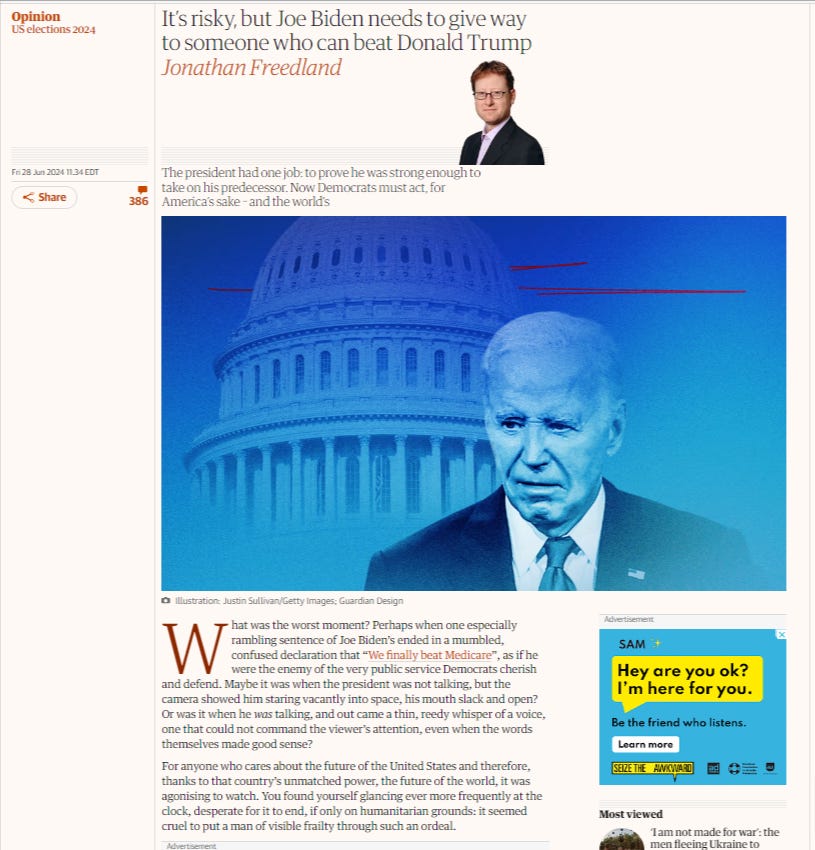
Headline: It’s risky, but Joe Biden needs to give way to someone who can beat Donald Trump

Sub-headline: The president had one job: to prove he was strong enough to take on his predecessor. Now Democrats must act, for America’s sake – and the world’s

https://www.theguardian.com/commentisfree/article/2024/jun/28/joe-biden-democrats-donald-trump

Mr. Freedland almost makes political noises reminiscent of ‘Morning Joe’ on the burning ‘Biden Question’ : beginning with 3:50 is the maudlin chatter about Joe’s ‘love of Biden, Jill and his family’: Norman Rockwell was better at producing American Kitsch! But this is also about the utter failure of American Broadcast News, as America abandons ‘Morning Joe’ for ‘Joe Rogan’ !

Freeland’s approach is the bloated ‘World Historical’ , as expressed the ‘The Fate of West’ in the sub-headline. But nothing quite matches Freedland’ s particular brand of panic steeped in hysterics:

What was the worst moment? Perhaps when one especially rambling sentence of Joe Biden’s ended in a mumbled, confused declaration that “We finally beat Medicare”, as if he were the enemy of the very public service Democrats cherish and defend. Maybe it was when the president was not talking, but the camera showed him staring vacantly into space, his mouth slack and open? Or was it when he was talking, and out came a thin, reedy whisper of a voice, one that could not command the viewer’s attention, even when the words themselves made good sense?

For anyone who cares about the future of the United States and therefore, thanks to that country’s unmatched power, the future of the world, it was agonising to watch. You found yourself glancing ever more frequently at the clock, desperate for it to end, if only on humanitarian grounds: it seemed cruel to put a man of visible frailty through such an ordeal.

In that sense, the first – and, given what happened, probably last – TV debate between the current and former president confirmed the worst fears many Biden supporters have long harboured over his capacity to take on and defeat Donald Trump. For more than 90 excruciating minutes, every late-night gag about Biden’s age, every unkindly cut TikTok video depicting him as doddery and semi-senile, became real. There was no spinning it, despite White House efforts to blame a cold. Joe Biden delivered the worst presidential debate performance ever.

Is this Freedland’s Gethsemane moment?

Editor: The Reader is left with 963 words of ‘analysis’ I’ll engage in ‘sampling’ from this bloated text:

Expectations were rock bottom:

For one thing, Trump’s entire framing of this race is strong v weak: he offers himself as a strongman, against an opponent too feeble to lead and protect the US in an increasingly dangerous world.

But, no less important, Biden’s inability to deliver clear, intelligible statements meant Donald Trump’s lies went unchallenged.

There were dozens more in that vein, an unceasing firehose of lies.

As the former Obama administration official Van Jones put it after the debate, this is a contest of “an old man against a conman” – but the weakness of the former is allowing the latter to prevail.

Editor: on Trump:

He is a failed coup leader, nationalist-populist menace and racist who would suck up to the world’s autocrats and throw Ukraine to Vladimir Putin’s wolves: he should be allowed nowhere near power.

Editor: on ‘expectations’:

Indeed, that is why the White House opted to have the debate so unusually early: to allay fears about the president’s age and to reframe the race not as a referendum on Biden, but as a choice.

Editor: On Biden as a ‘proud and stubborn man’:

Some imagine the likes of Hillary Clinton and Barack Obama having a quiet word, but Biden is a proud and stubborn man who feels he was passed over too long, including by those two.

Editor: Jill Biden provides a kind of solace as antidote to the glaring reality:

Some say the only person who could ever persuade him to do that is his wife, Jill. But after the debate, she loudly congratulated her husband, albeit in a manner that reinforced the sense of a man well past his prime. “Joe, you did such a great job!” she said. “You answered every question! You knew all the facts!”

Editor: on the possibility of a Biden replacement:

The party could throw it open to a contest fought out at its convention in August among the deep bench of next-generation Democratic talent – the Michigan governor, Gretchen Whitmer, her California counterpart, Gavin Newsom, and others – but that could be messy, bitter and rushed.

Editor: Freedland in his final paragraph repeats the current political wisdom of the Biden as ‘a good and decent man’ : ‘Morning Joe’s maudlin chatter seems to have infected , emboldened other apologists? Yet this reader recalls the Joe Biden of another political time:

CNN — 

Joe Biden in a 1993 speech warned of “predators on our streets” who were “beyond the pale” and said they must be cordoned off from the rest of society because the justice system did not know how to rehabilitate them.

Biden, then chair of the Senate Judiciary Committee, made the comments on the Senate floor a day before a vote was scheduled on the Senate’s version of the Violent Crime Control and Law Enforcement Act.

His central role in shaping and shepherding the tough-on-crime bill will likely face scrutiny in a Democratic primary should he run for president in 2020. His 1993 comments, which were in line with the broad political consensus to tackling crime at the time, are at odds with a new bipartisan coalition of activists and lawmakers who are trying to undo what they say is a legacy of mass incarceration fostered by that era.

Biden’s word choice could also pose a problem with a new generation of Democrats who view the rhetoric at the time as perpetuating harmful myths about the black community.

CNN’s KFile came across the 1993 speech during a review of the former vice president’s record.

President Bill Clinton in 1994 signed the crime bill into law with broad bipartisan support as violent crime rates peaked in the US in the early 1990s. Included in the law was the federal “three strikes” provision, mandating life sentences for criminals convicted of a violent felony after two or more prior convictions, including drug crimes.

“We have predators on our streets that society has in fact, in part because of its neglect, created,” said Biden, then a fourth-term senator from Delaware so committed to the bill that he has referred to it over the years as “the Biden bill.”

“They are beyond the pale many of those people, beyond the pale,” Biden continued. “And it’s a sad commentary on society. We have no choice but to take them out of society.”

In the speech, Biden described a “cadre of young people, tens of thousands of them, born out of wedlock, without parents, without supervision, without any structure, without any conscience developing because they literally … because they literally have not been socialized, they literally have not had an opportunity.” He said, “we should focus on them now” because “if we don’t, they will, or a portion of them, will become the predators 15 years from now.”

https://www.cnn.com/2019/03/07/politics/biden-1993-speech-predators/index.html

Political Observer

Posted in Uncategorized | Leave a comment

Claire Gatinois (@gatinois4) & Nathalie Segaunes (@NSegaunes) of Le Monde, provide a breathtaking panorama of the Macron debacle/melodrama.

Old Socialist’s selective quotation introduces the English Reader to this French nonpareil.

Headline: ‘People hate you’: The French are increasingly rejecting Macron

Sub-headline: The French president is omnipresent, despite having pledged to let his prime minister lead the campaign for the upcoming elections. Yet he has never been so unpopular, even within his own camp.

https://www.lemonde.fr/en/politics/article/2024/06/26/people-hate-you-the-french-are-increasingly-rejecting-macron_6675755_5.html

Editor: Even the first paragraph is alive with political melodrama, of the most breathless variety?

This Sunday, June 23, Emmanuel Macron was toying with a new idea, locked away almost every weekend in the Lanterne residence in Versailles. Those who had seen him recently described him as a lion in a cage. Outside the gates of the former hunting lodge, the rejection of the French president was palpable. In a bid to win re-election in the parliamentary elections on June 30 and July 7, MPs from the presidential camp no longer display his face on their campaign posters. “People hate you,” former Renaissance MP Patrick Vignal told him on June 11, when the president called him to find out how his decision, taken two days earlier, to dissolve the Assemblée Nationale, was perceived on the ground. “Emmanuel Macron is like an artist who has gone out of fashion,” said the elected official. Vignal believed the fall from grace was excessive, even if, like most MPs, the former Socialist himself did not understand the president’s action.

Editor: Macron is in fact a dismal failure … the gilets jaunes were the first to realize that Macron, was a Neo-Liberal, bent on turning ‘coddled workers’ into the silent dependents of Capital’s hatred of the lower orders! Macron a graduate of ENA:

Headline: Macron Closes Elite French School in Bid to Diversify Public Service

Sub-headline : The institution had become a symbol of privilege in a society where social mobility has broken down.

Mr. Macron announced on Thursday the closure of ENA, and its replacement by a new Institute of Public Service, or ISP, as part of what he called a “deep revolution in recruitment for public service.”

The decision, one year ahead of a presidential election, is intended to signal Mr. Macron’s determination to democratize opportunity and create a public service that is more transparent and efficient. Earlier this year, he deplored the fact that France’s “social elevator” had broken down and worked “less well than 50 years ago.”

Mr. Macron announced on Thursday the closure of ENA, and its replacement by a new Institute of Public Service, or ISP, as part of what he called a “deep revolution in recruitment for public service.”

The decision, one year ahead of a presidential election, is intended to signal Mr. Macron’s determination to democratize opportunity and create a public service that is more transparent and efficient. Earlier this year, he deplored the fact that France’s “social elevator” had broken down and worked “less well than 50 years ago.”

Macron is/was but a pretender, that longed for that World Stage, without the necessary – even the unsophisticated vision of a Thatcher or a Reagan longing for the Revolutionary Moment, that eventuated in the 2008 Catastrophe!

Macron knows he’s misunderstood. On June 21, he recorded a podcast for an entrepreneurs’ website, “Génération Do it Yourself,” defending the rationality of his action for an hour and 45 minutes. The president castigated the political programs of his opponents, “the extremes,” as he labeled them, targeting both the far-right Rassemblement National (RN), on the brink of power, and the left-wing alliance Nouveau Front Populaire (NFP). In his eyes, they will lead “to civil war.” A strong phrase, perhaps too strong? “No comment,” sighed someone at Macron’s Renaissance party campaign HQ, where the president’s public appearances are deemed to be increasingly clumsy.

Macron had pledged to let his prime minister, Gabriel Attal, lead the legislative campaign. But, since June 9, the president has been speaking out every other day. “He’s a man who never loses hope of trying to convince people,” said an Elysée spokesperson. Last Sunday, he wanted to make his voice heard again. But how? According to the Elysée, in a phone conversation with the majority leaders, Macron had been contemplating the idea of writing a “Letter to the French.”

Editor: Reader follow the Subtitles, I’ll assist you by quoting the most flagrant, informative, or even the most melodramatic of these paragraphs. Please post your comments!

When you have nothing to say, should you make it known

The president’s advisers knew that he was devastated, and they did not try to talk him out of expressing himself, speaking of “impressionistic interventions” which, in their eyes, fit into to the role of a president. It was perhaps a mistake. “The role of a spin doctor is to say things frankly, like a doctor talks to a patient. Communication is a soft science with hard rules,” professed Stéphane Fouks, vice-president of public relations company Havas, recalling the conversation which, according to him, happened in 1988 between communications adviser Jacques Pilhan and former president François Mitterrand. At the time, Mitterrand confided his desire to speak on television. “Yes, but to say what?” asked his adviser. “The French need to hear me,” he replied. “When you have nothing to say, should you make it known?” Pilhan asked. Mitterrand decided against his TV intervention.

Page has turned between Macron and his majority

On June 20, Finance Minister Bruno Le Maire, who has so often been mistreated by the Elysée insiders, who have spread rumors against him, accused the president’s advisers of having pushed him into a corner. “The parquet floors of the ministries and the palaces of the Republic are full of woodlice (…) they are in the parquet floors, the grooves of the parquet floor, it’s very difficult to get rid of them,” he said on TV5Monde, targeting the architects of the dissolution, in particular Bruno Roger-Petit, the president’s adviser on historical issues. Le Maire had warned Macron on the evening of June 9 that “a dissolution of convenience would lead to a regime crisis.” His warning went unheeded.

He hates us all

Philippe Bolo, elected and re-elected in Maine-et-Loire since 2017, almost threw in the towel, despite his chances of victory. “I can’t take it anymore, I’ve lost all faith,” he said. “I’m being asked to get back on the train, but I don’t know who’s driving it,” worried MP Elodie Jacquier-Laforge. After a two-and-a-half-hour meeting, Bayrou sat down on a banquette at the Poule au Pot bistro in Paris with a handful of loyal followers, “groggy,” in the words of one of the guests.

Some psychologists and psychiatrists are witnessing increased stress and anxiety among their patients since the dissolution was announced. But the president’s advisers are explaining that thanks to this electroshock, the country is rediscovering “the essence of democracy.” The Elysée insisted that Macron is following in the footsteps of Charles de Gaulle, who decided to dissolve the Assemblée Nationale after the student revolts of May ’68. “Commentators were already criticizing him for having plunged the country into deep disarray,” but this did not prevent de Gaulle from winning a large majority in the Assemblée, the same advisers pointed out, conveniently forgetting that he resigned a year later.

The Hardest part is the beginning

His near-disappearance in the weeks that followed was intriguing. Macron did not take part in the legislative elections, which ended in failure. The machine was beginning to jam. The leader of a relative majority, then prime minister Elisabeth Borne, who claimed to be left-wing, was tasked with passing, with the support of the conservatives, bills considered right-wing: the pension reform and the immigration law. She succeeded, but the governing coalition was fractured. Historical political figures are choking on these texts, which break with the progressive ideal of the original Macronist vision.

Macron planned to regain favor by appointing Attal, the youngest prime minister of the Fifth Republic, in January. The Elysée boasted that this was new-found Macron audacity. Borne was abruptly dismissed as the new year began, as were several other ministers, without anyone knowing exactly where the president wanted to go. By text message, an MP warned the president that his troops needed “cuddle therapy.” “I can’t do everything,” Macron snapped.

Five months later, the European elections were a fiasco, leading to the thunderbolt dissolution of the Assemblée Nationale. Did Macron make a mistake, on June 9, by calling the people to the polls again? Not necessarily, said his former classmate at the ENA school for top civil servants, Gaspard Gantzer. “He’s right. The French want a new gathering for democracy,” said Gantzer, a press relations advisor. “But their problem isn’t the Assemblée Nationale, it’s the president.”

Old Socialist

Posted in Uncategorized | Leave a comment

Freddy Hubbard of @NewStatesman keeps sending me notes on British Politics.

Political Observer comments on the Institute for Fiscal Studies link.

Freddy is probably not a reporter, nor a stringer, but a person who complies and edits the work of other, the less important contributors – he is the Oxbridger buffer that filters that ‘raw data’ into usable propaganda!

Of the many links that he offered was this:

Headline: Election 2024

Sub-HeadlineGeneral Election 2024: IFS manifesto analysis

IFS researchers and Director Paul Johnson will deliver their analysis of the parties’ manifestos at a live-streamed press briefing.

Editor: Some telling quotations:

These raw facts are largely ignored by the two main parties in their manifestos. That huge decisions over the size and shape of the state will need to be taken, that those decisions will, in all likelihood, mean either higher taxes or worse public services, you would not guess from reading their prospectuses or listening to their promises. They have singularly failed even to acknowledge some of the most important issues and choices to have faced us for a very long time. As the population ages these choices will become harder, not easier. We cannot wish them away.

Low growth, high debt and high interest payments mean we need to do something quite rare just to stop debt spiralling ever upwards: we need to run primary surpluses. That means the government collecting more in tax and other revenues than it spends on everything apart from debt interest. Not necessarily a recipe for a happy electorate.

Editor: Low Growth remains the fly in the ointment of the Free Marketeers!

Editor: Mr. Paul Johnson profession of Faith:

I am an optimist about the capacity of good policy to drive growth. The UK needs effective public investment, more private investment, planning reform, tax reform, removal of barriers to trade – notably non-tariff barriers with our nearest and richest neighbour, the European Union – and education and training policies to deliver a workforce with the right skills.

Editor: An uninspired conclusion steeped in well worn clichés !

We need more efficient and effective public services. We need a government laser-focused on improving our economic performance. It’s good to see those facts acknowledged. But on the big issues over which governments have direct control – on how they will change tax, welfare, public spending – the manifestos of the main parties provide thin gruel indeed. On 4 July we will be voting in a knowledge vacuum.

If – as is likely – growth forecasts are not revised up this autumn, we do not know whether the new government would stick roughly to the day-to-day and investment spending totals set out in the March Budget, or whether they would borrow more or tax more to top them up. If they were to stick to spending plans we do not know what would be cut. If taxes are to go up, we do not know which ones. We certainly don’t know how they would respond if things were to get worse.

The choices in front of us are hard. High taxes, high debt, struggling public services, make them so. Pressures from health, defence, welfare, ageing will not make them easier. That is not a reason to hide the choices or to duck them. Quite the reverse. Yet hidden and ducked they have been.

Editor: John Weeks offer this from 2019, on Open Democracy:

Headline: We need to talk about the Institute for Fiscal Studies

Sub-headline: The IFS prides itself on being independent and objective. But its analysis often resembles ideology masquerading as science.

https://www.opendemocracy.net/en/oureconomy/we-need-talk-about-institute-fiscal-studies/

In recent weeks political parties have started to announce their policy platforms for the forthcoming general election. Numerous organisations, including the Progressive Economy Forum (PEF), will be offering expert assessments of these policies and manifestos.

The Institute for Fiscal Studies (IFS) is perhaps the most well-known of these organisations. Its analysis frequently crowds out that of other institutions, such as the Institute for Public Policy Research (IPPR) and the Women’s’ Budget Group.

On its donations page, the IFS describes its purpose as follows:

“During an election campaign, objective analysis of economic policy is more important than ever…Our commentary on party manifestos and campaign promises leads the public debate, providing individuals with the tools to understand and evaluate complex decisions. What’s more, the IFS is entirely independent of political parties, companies and pressure groups, allowing us to hold politicians of all stripes to account when their numbers don’t add up or their policies are poorly designed.”

The key components here are 1) a commitment to “objective analysis”, 2) providing “the tools to understand and evaluate complex decisions”, and 3) independence from political parties that allows the IFS to hold politicians to account. Its guiding purpose is to show when “numbers don’t add up” and when policies are “poorly designed”.

The meaning of words is quite important here. One can claim “objective analysis” by applying the same assessment criterion to each proposal and still be biased. It is possible for a policy to be “well designed”, with numbers that “add up”, while also imposing devastating social costs. The IFS’s narrow criteria implicitly (or in some cases explicitly) ignores these social costs. This judgment reflects a clear bias in favour of accounting balance over social outcome.

Similarly, the claim of “independence” explicitly refers to no links to political groups. Crucially, however, this does not prevent political bias.

Editor: this essay is worth the time and attention of The Reader! Let me quote the final paragraphs of John Weeks revelatory essay!

Independence and bias

The IFS is regularly called a “watchdog” for politicians’ policy proposals. But it would be more accurate to describe it as an expert in the bean-counter approach to policy assessment.

The basic problem lies not in the political bias or orientation of the IFS. I directed a small research organization for 20 years, which was, as the IFS claims, objective, independent and unaffiliated to political parties or interest groups. Our analytical orientation was clear and well-known. Our studies tended to be critical of mainstream analysis, and organisations came to us with that outcome in mind.

The issue is not that the conclusions of the IFS’s studies are predictable and easily anticipated; it is that its studies are not always as objective as they claim. They often apply the wrong tools, and treat macroeconomic issues as if they were microeconomic. As Robert Chote, the former director of the IFS admitted: “they don’t do macro”.

By ignoring social, political and macroeconomic effects, IFS studies do not tell us whether a policy is a good idea, only whether “the numbers add up”.

At this election, we deserve better.

https://www.opendemocracy.net/en/oureconomy/we-need-talk-about-institute-fiscal-studies/

Political Observer

Posted in Uncategorized | Leave a comment

@zannymb and her @TheEconomist cadre scold Nigel Farage!

Political Reporter comments.

Headline: Nigel Farage’s claim that NATO provoked Russia is naive and dangerous

Sub-headline: It is also a wilful misreading of history

Editor: the first two paragraphs set the stage for this act of political shaming of Farage: for his lack of conformity to the received wisdom that Putin is the ‘author’ of the War in Ukraine. Its ‘as if’ 2014 and the machinations of Victoria Nuland, Jeffery Pyatt, NATO, The EU, the Azov Battalion, Right Sector and Svoboda in its later political iterations, has been subject to a convenient erasure. And the fact that Zanny Minton Beddoes is a Neo-Con. Her appearance on The Daily Show of Feb 12, 2024 cements her status on the Neo-Con spectrum! Also the fact that ‘Comedy’ of the Jon Stewart variety, is wedded to a political conformity within a very narrow range of respectable political chatter!

Zanny Minton Beddoes was also a member of Jeffrey Sachs team in 1993. Her animosity toward Russia is of a perennial variety. The Reader need only look:

Dr. Jeffrey Sachs, Shock Therapist

By Peter Passell

June 27, 1993

Sachs’s message of urgency is not universally accepted. Plenty of Western as well as Russian economists contend that a more gradual approach is not only possible but necessary. “Economic reform is a political process,” says Padma Desai at the Harriman Institute at Columbia University. “First, you must build consensus.”

And even his sympathizers acknowledge that Sachs’s high profile and world-class impatience could generate a backlash in a nation still adjusting to the reality that it is no longer a superpower. “There’s a real dilemma here,” says Stanley Fischer, an international economist at the Massachusetts Institute of Technology. “You have to make a lot of noise to get the attention of the West. But the more noise you make, the more you make it seem that the reform program is a Western program. And that could be the kiss of death.”

Still, Sachs’s brand of “shock therapy” has worked elsewhere. And there is good reason to believe that Russia’s future will turn on how well its leaders learn the catechism of change that he has worked so hard to promulgate.

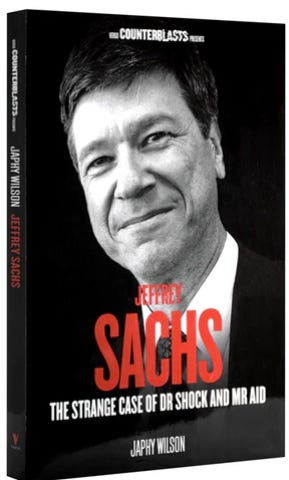
Editor: Mr. Sachs has tried to re-invent himself in the political present, I’ll call it unconvincing! Japhy Wilson’s book provides a necessary history :

When The Reader considers the framing I offer, as revelatory to the public chastising of Farage, by a powerful news magazine: stepped in a self-proclaimed ‘Liberalism’, ‘Free Markets’, and the other adaptations, tinctured in Hayekian faith in The Wisdom Of The Market , as political/moral singularity. Yet Reader look to the Economic Collapse of 2006-2008, that was the direct result of that ‘Liberalism’ and misplaced faith in ‘Free Market’ nostrums!

Mr. Farage crime is in not reiterating The Party Line on Putin. Farage is the leader of Reform UK since June 2024, his statement reveals that both New Labour and the Tories are dismal failures

Our country has so much potential, but both Labour and the Conservatives have broken promise after promise for the last 30 years.

You are worse off, both financially and culturally. Wages are stagnant, we have a housing crisis, our young people struggle to get on the property ladder, we have rising crime, energy bills are some of the highest in Europe, the NHS isn’t working, both legal and illegal immigration are at record levels and woke ideology has captured our public institutions and schools.

The Conservatives have failed and Labour will fail too. A vote for either is a vote for more incompetence, dishonesty and failure.

We are ruled by an out of touch political class who have turned their backs on our country.

Reform is the alternative.

Only Reform will stand up for British culture, identity and values. We will freeze immigration and stop the boats. Restore law and order. Repair our broken public services. Cut taxes to make work pay. End government waste. Slash energy bills. Unlock real economic growth.

Only Reform will take back control over our borders, our money and our laws. Only Reform will secure Britain’s future as a free, proud and rich nation.

https://www.reformparty.uk/

On june 21st Nigel Farage acknowledged that the war in Ukraine was the fault of Vladimir Putin, but told the bbc that Russia’s president had been “provoked” by nato and the European Union. The leader of Reform uk, the populist party snapping at the heels of the governing Conservatives in pre-election polling and threatening to push them into third place, was echoing Mr Putin’s own arguments. The Russian leader is focused mostly on nato, which provides the hard security that makes the eu safe. He complains that the alliance’s expansion into central and eastern Europe after the cold war made Russia’s position intolerable. Some Western scholars concur.

Mr Farage and Mr Putin have the argument upside down. Countries join nato not to antagonise Russia, but because they are threatened by it. To understand how the arguments have shifted, you need to look back to the unstable politics of Europe in the 1990s, after the collapse of the Soviet Union.

Editor: The Critical Reader might ask what % of the voting population does Farage represent? Politico provides an oblique answer:

Headline: The Nigel Farage effect is real

Sub-headline: Conservatives lose out while Farage’s Reform UK is projected to win 5 seats in latest in-depth model.

https://www.politico.eu/article/nigel-farage-effect-uk-election-reform-party-mrp-projection-yougov/

Nigel Farage’s entry into the U.K. election race seems to have finally put his Reform party on the map.

Pollster YouGov released its latest in-depth seat projections Wednesday as the July 4 vote looms. It’s the company’s first MRP model projection since Farage, now at the helm of Reform UK, announced he would be running in the election after all in early June.

Things have gone from bad to worse for the Conservatives, with the model projecting the party’s lowest seat total in its history. Coming in at just 108 of the total 650 up for grabs, the party is 257 seats down on its triumph under Boris Johnson in 2019.

Nigel Farage’s entry into the U.K. election race seems to have finally put his Reform party on the map.

Pollster YouGov released its latest in-depth seat projections Wednesday as the July 4 vote looms. It’s the company’s first MRP model projection since Farage, now at the helm of Reform UK, announced he would be running in the election after all in early June.

Things have gone from bad to worse for the Conservatives, with the model projecting the party’s lowest seat total in its history. Coming in at just 108 of the total 650 up for grabs, the party is 257 seats down on its triumph under Boris Johnson in 2019.

With at least 5 seats hanging in the balance, The Economist is making political war on Farage. The Reader might wonder, if any of the potential voters in this election will read this diatribe? Upper-Crust Tories and New Labour voters, might but Farage’s constancy is working-class, or those on the political margins!

I’ve presented what I think is relevant to the questions that animates this political polemic, without creating too much boredom?

Political Reporter

Posted in Uncategorized | Leave a comment

On the ‘Magic of Freud’: in the TLS

Former Analysand offers a selective commentary!

What is the Magic of Freud that sends his apologists, explicators, defenders and even his cadre of worshipers, to such dross? Here is George Prochnik in the TLS:

The first time Sigmund Freud wrote of destroying his papers he was twenty-one years old. He was writing to Eduard Silberstein, an intimate friend of his youth and the sole other member of the Academia Castellana, a make-believe Spanish literary society anchored in Cervantes trivia, which served them as a secret forum for airing playful fantasies and precocious world-weariness. Freud invited Silberstein to help expunge the record of their relations by conjuring up a pleasant winter evening in which they could come together to burn their archives “in a solemn auto-da-fé”. The next occasion was eight years later, in a letter to his then fiancée Martha Bernays, during what he described as a “bad, barren month”, waiting for money from a chemist to finance further research into cocaine, doing almost nothing except browsing through Russian history and toying with two rabbits who continually nibbled turnips and messed up his floor. His only real accomplishment, he told Martha then, was to have nearly completed his intention of doing something that would dismay various unborn, unfortunate people – namely his future biographers. He’d destroyed all his notes from the past fourteen years, along with correspondence and the original manuscripts of his scientific papers. In 1907, he once again burned a huge trove of private documents. Finally, in 1938, just before escaping Nazified Vienna, he delegated to his daughter Anna the task of overseeing another bonfire of his letters, which she undertook together with his disciple Marie Bonaparte.

The Reader is put directly within the early Freudian milieu, as recreated in Prochnik’s vivid evocation, across a lifetime? It’s like a bad movie, or a thriller, though not like Graham Greens ‘entertainments’, or even like Eric Ambler’s beautifully realized novels!

But Prochnik can’t quite emancipated himself from his status of acolyte/apologist, in a minor key, tending to the imperative of the care and the maintenance, of his would be Historical Sketch, as a kind of apologetic? Think of each paragraph as a entry in a loose-leaf notebook.

Freud has often been approached by biographers not only as a subject whose life merits fresh exposition owing to evolving perspectives on psychoanalysis, but also as someone who masked and elided key parts of his story. His distaste for the very premiss of the biographical project is on record. When his friend the novelist Arnold Zweig told Freud that he wanted to write his life story, Freud retorted that he felt far too affectionately toward Zweig to permit such a misstep. “Anyone who writes a biography is committed to lies, concealments, hypocrisy, flattery and even to hiding his own lack of understanding, for biographical truth does not exist, and if it did we could not use it.” Topping off the critique he announced, “Truth is unobtainable, mankind does not deserve it, and in any case is not our Prince Hamlet right when he asks who would escape whipping were he used after his desert”. In light of all Freud’s suppressive tactics and declarations, it seems fair to wonder what he was trying to keep under wraps.

In the last sentence Prochnik wonders of Freud’s motives. He offers this :

Freud’s standard biographers have typically fallen into two categories: those who believe his obfuscations are meant to cover up the fraudulence of his entire undertaking, and those who view Freud’s cloaked actions and emotions as either irrelevant or misunderstood features of his transcendent genius. Into this vexed arena comes Mortal Secrets, an accessible, fluent introduction to Freud’s life and work by the clinical psychologist and prolific author Frank Tallis. Tallis’s book moves crisply between biographical scenes, snapshots of Vienna’s golden age, retellings of Freud’s significant case histories, and well-crafted summaries of Freud’s principal theories. Interspersed throughout are brief discursions into Freud’s relevance to contemporary psychologists and neurologists, along with efforts to show how Freud’s ideas continue to reverberate through popular culture

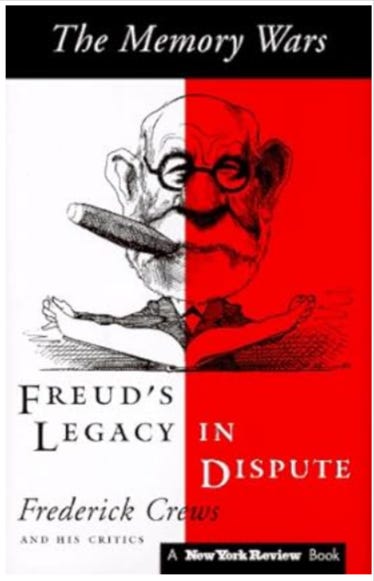
But just rhetorical moments away lurks… I’ll place in italics the various attacks on the ‘Science of Psychoanalysis’ because Freud was its ‘inventor/practitioner’ over time. Yet a regular reader of its current partitioners, notices that they have completely eliminated that arcane Freudian vocabulary. ‘Freud bashers”, like Frederick Crews’ Crews laid waste to the cult of Freud in the pages of the New York Review Of Books.

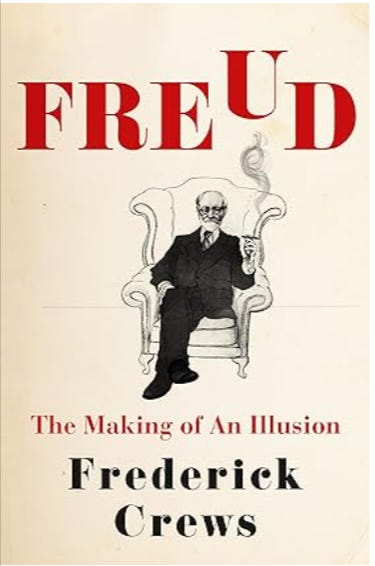
And in his Freud biography

George Prochnik next paragraph features more … I’ll put in italics this collection with the comparison of Freud with Isaac Newton. In sum for Prochnik there is an enlightened position on Freud, balanced by a collection of acolytes, hero’s and scoundrels!

In contrast to both the “Freud bashers”, like Frederick Crews, and the dwindling tribe of dazzled, truculent hagiographers, Tallis aims for an even-handed portrait of his subject, and in large measure succeeds. The heat of the attacks on Freud’s legacy has cooled with the fading of his iconic status and the sheer passage of time. Tallis is thus able to acknowledge the justice of many specific critiques of Freud’s record – especially with respect to his problematic treatment of particular patients – without needing to suggest that these failures require us to jettison the entire Freudian project. “Dismissing Freud because of his shortcomings is like dismissing Sir Isaac Newton because he was a disagreeable misanthrope whose personal papers reveal a gullible fascination with alchemy and esotericism”, Tallis writes. Newton may not be the optimal analogue, since the scientific legitimacy of his core project is almost universally accepted, whereas the stature of psychoanalysis as an empirically verifiable scientific endeavour has been continually contested, but the general message is clear: when it comes to Freud’s contributions, our gains dramatically outweigh the deficiencies.

Reader there are 2377 more words: I offer this synopsis:

Editor: On ‘The Psychopathology of Everyday Life : 113 words.

Editor: On the utterly preposterous  the Oedipus complex: 504 words

Editor : On ‘Civilization and Its Discontents’ : 34 words

Editor: On The Interpretation of Dreams’ : 363 words

Editor : Autobiographical Study: 178 words

The Reader confronts more of George Prochnik unimpressive attempt, at the marriage of Literary Pretention, and the moldering remains of Psychoanalyses!

Throughout his life, Freud famously suffered from acute anxiety about growing old and infirm, even going so far as to suggest that after the age of fifty psychoanalysis might no longer work since by then “the elasticity of the mental processes, on which treatment depends, is as a rule lacking”. Was that the secret he most longed to bury? Not some sensational personal escapade like the rumoured affair with his sister-in-law Minna, nor a shocking misrepresentation of a patient’s biography, but the skull hidden behind the defiant countenance in his photographs? This would mark the point at which what Freud describes as the psychologically determinative “instinct for knowledge” breaks down.

Whatever else, it appears that along with his Oedipal situation, Freud had a colossal Sphinx complex, and this remains unresolved.

Former Analysand

Posted in Uncategorized | Leave a comment

Perry Anderson eviscerates ‘International Law’, in Sept/Oct 2023!

Political Observer offer a selection of quotations.

There can be no doubt that Perry Anderson is the formidable Public Intellectual writing today! No one can match his body of work, he has no equal! Forget cadre of political sycophants, who write for the respectable newspapers, and other publications, Corporate Media and Think Tank Chatterers, the issue of the utterly toxic Herman Kahn, and Walter Lippmann’s deeply anti-democratic worship of the ‘Expert’, the fore-rummer of the whole of the Technocratic Class: that now supplies that endless stream of respectable political commentary, steeped in the current political wisdom.

This long essay is formidable in every way, again Anderson is without peer! Let me focus this collection of long quotations, on the revelatory bad actors, who trade on the the currency of ‘International Law’, and its utter mailability in the hands of political opportunists:

The principle of hierarchy

At the end of the War, the victor powers England, France, Italy and the United States called the Versailles Conference to dictate terms of peace to Germany, redraw the map of Eastern Europe, divide up the Ottoman empire and—not least—create a new international body devoted to ‘collective security’, to ensure establishment of durable peace and justice between states, in the shape of the League of Nations. At Versailles, the United States not only made sure that Rui Barbosa was excluded from the Brazilian delegation, but that the Monroe doctrine—Washington’s open presumption of dominion over Latin America—was actually incorporated into the Covenant of the League as an instrument of peace. A Permanent Court of International Justice was set up in the Hague, its Article 38 continuing to invoke ‘the general principles of law recognized by civilized nations’. Among those who drafted its Statutes was the author of a 600-page defence of the admirable record of Belgian administration in the Congo.

The us Senate eventually declined American entry into the League, but the design of the new organization faithfully reflected the requirements of the victor powers, since its Executive Council—the predecessor of today’s un Security Council—was controlled by the other four great powers on the winning side of the War, Britain, France, Italy and Japan, who were given exclusive permanent membership of it, on the model of the American scheme at the 1907 Hague Conference. In the face of this blatant imposition of a hierarchical order on the League, Argentina refused to take part in it from the start, and a few years later Brazil—when its demand that a Latin American country be given a permanent seat in the council was rejected—withdrew. By the end of the thirties, no less than eight other Latin American countries, large and small, had pulled out of it. Undeterred, the leading textbook of the period on international law, still widely used today, credited to Lassa Oppenheim and Hersch Lauterpacht, noted with satisfaction that ‘the Great Powers are the leaders of the Family of Nations and every advance of the Law of Nations during the past has been the result of their political hegemony’, which had now finally received, for the first time, in the Council of the League a formal ‘legal basis and expression’.footnote13

Words and swords

Such was the position in the inter-war period. Out of the Second World War came a new dispensation. With much of the continent in ruins, or in debt, the primacy of Europe was gone. When the United Nations was founded at San Francisco in 1945, the principle of hierarchy inherited from the League was preserved in the new Security Council, whose permanent members were given still greater powers than their predecessors in the Executive Council of old, since they now possessed rights of veto. But Western monopoly of this privilege was broken: the ussr and China were now permanent members, alongside the United States and a diminished Britain and France, and as decolonization accelerated over the next two decades, the General Assembly became a forum for resolutions and demands increasingly uncomfortable to the hegemon and its allies.

Surveying the scene in 1950, in his commanding retrospect The Nomos of the Earth in the International Law of the Jus Publicum Europaeum, Carl Schmitt observed that in the 19th century: ‘The concept of international law was a specifically European international law. This was self-evident on the European continent, especially in Germany. This was also true of such worldwide, universal concepts as humanity, civilization and progress, which determined the general concepts and theory and vocabulary of diplomats. The whole picture remained Eurocentric to the core, since by “humanity” was understood, above all, European humanity, civilization was self-evidently only European civilization, and progress was the linear development of this civilization’. But, Schmitt went on, after 1945 ‘Europe was no longer the sacred centre of the earth’ and belief in ‘civilization and progress had sunk to a mere ideological façade’. ‘Today’, he announced, ‘the former Eurocentric order of international law is perishing. With it the old nomos of the earth, born of the fairytale-like, unexpected discovery of a New World, an unrepeatable historical event, is vanishing.’footnote17 International law had never been truly international. What had claimed to be universal was merely particular. What spoke in the name of humanity was empire.

After 1945, as Schmitt saw, international law ceased to be a creature of Europe. But Europe, of course, did not disappear. It simply became subsumed in another of its own overseas extensions, the United States, leaving open the question: how far has international law since 1945 remained a creature, no longer of Europe, but of the West, with at its head the American superpower? Any answer to this question refers back to another. Setting aside its historical origins, what is the juridical nature of international law as such? For its first theorists in 16th and 17th century Europe, the answer was clear. The law of nations was grounded in natural law, that is a set of decrees ordained by God, not to be questioned by any mortal. In other words, the Christian deity was the guarantee of the objectivity of their legal propositions.

By the 19th century, the increasing secularization of European culture gradually undermined the credibility of this religious basis for international law. In its place emerged the claim that natural law still held good, but no longer as divine commandments, rather as the expressions of a universal human nature, which all rational human beings could and should acknowledge. This idea, however, was soon made vulnerable in its turn by the development of anthropology and comparative sociology as disciplines, which demonstrated the enormous variety of human customs and beliefs across history and the world, contradicting any such easy universality. But if neither the deity nor human nature could offer any secure basis for international law, how should it then be conceived?

An answer to this question could only be sought in a prior one: what was the nature of law itself? There, the greatest political thinker of the 17th—or perhaps any—century, Thomas Hobbes, had given a clear-cut answer in the Latin version of his masterpiece Leviathan, which appeared in 1668: sed auctoritas non veritas facit legem—not truth, but authority makes the law, or as he put it elsewhere: ‘Covenants, without the Sword, are but Words’.footnote18 This would over time become known as the ‘command theory of law’. That theory was the work, two centuries later, of John Austin, a clear-minded friend and follower of Bentham, who admired Hobbes above all other thinkers, and in concurring that ‘every law is a command’ saw what this meant for international law. His conclusion was: ‘The so-called law of nations consists of opinions or sentiments current among nations generally. It therefore is not law properly so called . . . [for] a law set by general opinion imports the following consequences—that the party who will enforce it against any future transgressor is never determinate and assignable.’footnote19

Practice

Crucial words: never determinate and assignable. Why was that so? Austin went on: ‘It follows that the law obtaining between nations is not positive law; for every positive law is set by a given sovereign to a person or persons in a state of subjection to the author’—but since in a world of sovereign states ‘no supreme government is in a state of subjection to another’, it followed that the law of nations ‘is not armed with a sanction, and does not impose a duty, in the proper acceptation of these expressions. For a sanction properly so called is an evil annexed to a command’.footnote20 In other words, in the absence of any determinable authority capable of either adjudicating or enforcing it, international law ceases to be law and becomes no more than opinion.

This was, and is, a conclusion deeply shocking to the liberal outlook of the overwhelming majority of today’s international jurists and lawyers. What is often forgotten is that it was shared by the greatest liberal philosopher of the 19th century, John Stuart Mill himself, who reviewed and approved Austin’s lectures on jurisprudence twice. Answering attacks on the foreign policy of the short-lived French Republic in 1849, which had offered assistance to an insurgent Poland, he wrote: ‘What is the law of nations? Something, which to call a law at all, is a misapplication of the term. The law of nations is simply the custom of nations’. Were these, Mill asked, ‘the only kind of customs which, in an age of progress, are to be subject to no improvement? Are they alone to continue fixed, while all around them is changeable?’ On the contrary, he concluded robustly, in a spirit of which Marx would have approved: ‘A legislature can repeal laws, but there is no Congress of nations to set aside international customs, and no common force by which to make the decisions of such a Congress binding. The improvement of international morality can only take place by a series of violations of existing rules . . . [where] there is only a custom, the sole way of altering that is to act in opposition to it.’footnote21

A few examples will suffice. At the very foundation of the highest official embodiment of international law, namely the United Nations, whose Charter enshrines the sovereignty and integrity of its members, the United States was engaged in their systematic violation. In an Army base in the old Spanish fort a few miles from the inaugural conference that created the United Nations in San Francisco in 1945, a special team of us military intelligence was intercepting all cable traffic by delegates to their home countries; the decoded messages landed on the breakfast table of American Secretary of State Stettinius the next morning. The officer in charge of this round-the-clock operation of surveillance reported that ‘the feeling in the Branch is that the success of the Conference may owe a great deal to its contribution’.footnote26 What did success mean here? The American historian who describes this systematic espionage exults that ‘Stettinius was presiding over an enterprise his nation was already dominating and moulding’—for the un was ‘from the beginning a project of the United States, devised by the State Department, expertly guided by two hands-on Presidents, and propelled by us power . . . For a nation rightly proud of its innumerable accomplishments’—the most recent, the dropping of atomic bombs on Japan—‘this unique achievement should always be at the top of its illustrious roster’.footnote27

Matters were no different sixty years later. The 1946 un Convention states that ‘The premises of the un shall be inviolable. The property and assets of the United Nations, wherever located and by whomsoever held, shall be immune from search, requisition, confiscation, expropriation and any other form of interference, whether by executive, administrative, judicial or legislative action.’ In 2010 it was revealed that Clinton’s wife, then Secretary of State, had directed the cia, fbi and Secret Service to break the communication systems, appropriating passwords and encryption keys, of the Secretary-General of the un, together with the ambassadors of all four other permanent members of the Security Council, and to secure the biometric data, credit-card numbers, email addresses and even frequent-flyer numbers of ‘key un officials, to include undersecretaries, heads of specialized agencies and chief advisers, top secretary-general aides, heads of peace operations and political field missions’.footnote28 Naturally, neither Mrs Clinton nor the American state paid any price for their brazen violation of an international law supposedly protecting the un itself, the official seat of such law.

What of the international justice that international law purports to uphold? The Tokyo Tribunal of 1946–48, organized by the United States to try military leaders of Japan for war crimes, excluded the Showa Emperor from the trial in order to lubricate American occupation of the country, and treated evidence with such disregard for due process that the Indian judge on the Tribunal, in a blistering 1,000-page condemnation of it, observed that the Tokyo trials amounted to little more than ‘an opportunity for the victors to retaliate’, declaring ‘only a lost war is a crime’.footnote29 The Dutch judge on the Tribunal admitted candidly: ‘Of course, in Japan we were all aware of the bombings and the burnings of Tokyo and Yokohama and other big cities. It was horrible that we went there for the purpose of vindicating the laws of war, and yet saw every day how the Allies had violated them dreadfully’footnote30—Schmitt’s discriminatory conception of law to the letter. The successive American wars that followed in East Asia, first in Korea and then in Vietnam, were then littered, as American historians have shown, with atrocities of every kind. Naturally, no tribunal has ever held them to account.

Has anything much changed since then? In 1993 the un Security Council set up an International Criminal Tribunal on Yugoslavia, to prosecute those guilty of war crimes in the break-up of the country. Working closely with nato, the Canadian Chief Prosecutor made sure successful indictments for ethnic cleansing fell on Serbs, the target for us and eu hostility, but not on Croats, armed and trained by the us for their own operations of ethnic cleansing; and when nato launched its war on Serbia in 1999, excluded any of its actions—the bombing of the Chinese Embassy in Belgrade and the rest—from her investigation of war crimes. This was perfectly logical, since as the press officer for nato explained at the time: ‘It was the nato countries who established the Tribunal, who fund and support it on a daily basis.’footnote31 In short, once again, the us and its allies used trials to criminalize their defeated opponents, while their own conduct remained above judicial scrutiny.

Discriminations

As for the un Security Council, the nominal guardian of international law, its record speaks for itself. Iraqi occupation of Kuwait in 1990 brought immediate sanctions, and a million-strong counter-invasion of Iraq. Israeli occupation of the West Bank has lasted half a century without the Security Council lifting a finger. When the us and its allies could not secure a resolution authorizing them to attack Yugoslavia in 1998–99, they used nato instead, in patent violation of the un Charter forbidding wars of aggression, whereupon the un Secretary-General Kofi Annan, appointed by Washington, calmly told the world that though nato’s action might not be legal, it was legitimate—as if Schmitt had scripted his words to illustrate what he meant by the constitutive indeterminacy of international law. When, four years later, the United States and Britain launched their attack on Iraq, having had to bypass the un Security Council under threat of a veto from France, the same Secretary-General once again blessed the operation ex post facto, making sure that by a unanimous vote the Security Council gave back-dated cover to Bush and Blair by voting un assistance to their occupation of Iraq with Resolution 1483. International law may be dispensed with in launching a war; but it can always come in handy to ratify such a war after the event.

Weapons of mass destruction? The Nuclear Non-Proliferation Treaty is the starkest of all illustrations of the discriminatory character of the world order that has taken shape since the Cold War, reserving for just five powers the right to possess and deploy hydrogen bombs, and forbidding their possession to all others, who might need them more for their defence. Formally, the Treaty is not a binding rule of international law, but a voluntary agreement from which any signatory is free to withdraw. Factually, not only is a perfectly legal withdrawal from the Treaty treated as if it were a breach of international law, to be punished with the utmost severity, as in the case of North Korea, but even observance of the Treaty is open to restrictive interpretation, and if insufficiently monitored, subject to retribution, as in the case of draconian sanctions against Iran—indeterminacy and discrimination elegantly combined. That Israel has ignored the Treaty and has long possessed abundant nuclear weapons cannot be so much as mentioned. The powers punishing North Korea and Iran pretend the massive Israeli nuclear arsenal does not exist—perhaps the best commentary of all on the alchemies of international law.

The force of opinion

Modern international law is thus, as Koskenniemi observes, intrinsically threaded with contestation, and as its contemporary instrumentation for the will of today’s hegemon and its satellites has grown ever more brazen, so the number of critical legal minds not only questioning but seeking to reverse its imperial use has grown too. The most lucid do so without attributing more strength to its claims than they can bear. In the mot of a distinguished French jurist, international law is ‘performative’. That is, such pronouncements in its name seek to bring into being what they invoke, rather than refer to any existent reality, however laudable.footnote43

The same dialectic, of course, has more famously been true of municipal law, invoked in Europe at least since the 17th century in defence of the weak against the strong, who created it. But there Austin’s axiom makes the difference. Within the nation-states, as they became, of Europe, there was always a determinable sovereign authorized to enforce the law, and as this authority passed from crowns to peoples, not coincidentally came also the legitimate power to change it. In relations between states, unlike relations among citizens, neither condition holds. So while hegemony functions in both national and international arenas, and by definition always combines coercion and consent, on the international plane coercion is for the most part legibus solutus and what consent is secured inevitably weaker and more precarious. International law operates to hide that gap. Koskenniemi began his career with a brilliant demonstration of the two poles between which the structure of international legal argument had historically moved, entitled From Apology to Utopia: either international law supplied servile pretexts for whatever actions states wished to take, or it purveyed a lofty moral vision of itself as, in Hooker’s words, ‘her voice the harmony of the world’, with no relation to any empirical reality. What Koskenniemi failed to see was the interlocking of the two: not utopia or apology, but utopia as apology: responsibility to protect as charter for the destruction of Libya, preservation of peace for the strangulation of Iran, and the rest.

Still, defenders of international law can argue that its existence, however often it is abused by states in practice, is at least better than would be its absence, invoking in their aid La Rochefoucauld’s well-known maxim: L’hypocrisie est un hommage que le vice rend à la vertu. Yet critics can equally reply that here it should be reversed. Ought it not rather to read: hypocrisy is the counterfeit of virtue by vice, the better to conceal vicious ends: the arbitrary exercise of power by the strong over the weak, the ruthless prosecution or provocation of war in the philanthropic name of peace?

https://newleftreview.org/issues/ii143/articles/perry-anderson-the-standard-of-civilization


I have offered a collections of quotations from Perry Anderson’s invaluable essay, that places History in the forefront, that identifies the toxic actors, by name and by their actions in Historical Time. We live in the Age of the ‘Public Relations’, the book Propaganda, written by Edward Bernays in 1928 is an invaluable tool. As is Anderson’s invaluable, revelatory History!

Political Observer

Posted in Uncategorized | Leave a comment