Trumpian chicanery renders any attempt at finding motive and reasons, for self-serving political and economic manipultion, are moot? Exploitable Chaos is The Trumpian métier !
Editor: The Financial Times reports on the Trumpian Chaos, and the massive sighes of relief, and the fears of an uncertain future, that cannot be assuaged!
Donald Trump stunned global investors on Wednesday when he announced a 90-day pause in additional tariffs on countries that were willing to negotiate with the US, sending stocks surging as the president backed down from a full-blown trade war.
Wall Street equities surged immediately after Trump’s announcement, with the blue-chip S&P 500 closing up 9.5 per cent and the Nasdaq Composite surging more than 12 per cent. It was the best day for the S&P 500 since 2008 and the strongest for the Nasdaq since 2001.
The massive rally in stocks added about $4.3tn to the market value of the S&P 500, according to Financial Times calculations based on FactSet data. The gains reversed some of the heavy losses for US stocks since Trump announced his wide-ranging tariffs a week ago.
However, the president also singled out China for further tariffs, increasing his additional levies on the world’s second-largest economy to 125 per cent, deepening his trade stand-off with the Asian nation.
Trump said in a Truth Social post: “Based on the fact that more than 75 Countries have called . . . to negotiate a solution . . . and that these Countries have not, at my strong suggestion, retaliated in any way, shape, or form against the United States, I have authorized a 90 day PAUSE, and a substantially lowered Reciprocal Tariff during this period, of 10%, also effective immediately.”
But China had showed a “lack of respect” by retaliating against US tariffs, Trump added. “I am hereby raising the Tariff charged to China by the United States of America to 125%, effective immediately.”
The stunning climbdown from the US leader came after a week of turmoil in global markets, with trillions of dollars shed in equity prices around the world, a sharp sell-off in US bonds, and a plunge in oil prices to levels last seen during the coronavirus pandemic.
“This is Trump’s capitulation to markets,” said Andy Brenner at NatAlliance Securities. “He has saved face by keeping tariffs on China.”
A heavy sell-off in US government debt, a bedrock of the global financial system, eased following Trump’s U-turn and a Treasury auction that signalled robust international demand. The 10-year yield, which had been up as much as 0.24 percentage points on Wednesday, ended the New York day up 0.08 percentage points at 4.35 per cent.
Companies that had been beaten down in recent days also posted huge gains on Wednesday. Apple, Nvidia, Microsoft, Amazon, Meta and Tesla all jumped at least 10 per cent following Trump’s announcement.
Commerce secretary Howard Lutnick said the “world is ready” to work with Trump to “fix global trade” but dismissed China as having “chosen the opposite direction”.
Lutnick added on X that he and Treasury secretary Scott Bessent “sat with the President while he wrote one of the most extraordinary Truth posts of his Presidency”.
Later on Wednesday, Trump appeared to acknowledge some of the fear in the markets sparked by his trade war.
“Well, I thought that people were jumping a little bit out of line. They were getting yippie, you know, they were getting . . . a little bit afraid,” he told reporters.
Headline: There’s Nothing Real About Trump’s ‘Real America’
…
I’ve been thinking about this case as an emblem of everything that makes Donald Trump’s presidency so vile and destructive, even when I’ve bentoverbackward to give him the benefit of the doubt, and even when I’ve agreed with him on this or that pointofpolicy.
…
I have, to borrow a line from Peggy Noonan, a “certain idea of America.” He ain’t it.
…
It’s Sojourner Truth asking the suffragists at the 1851 Woman’s Rights Convention in Akron, Ohio, “Ain’t I a woman?
…
It’s Lou Gehrig, stricken with A.L.S. in his 30s, calling himself “the luckiest man on the face of the earth.”
…
It’s Gail Halvorsen, the candy bomber of the Berlin Airlift, parachuting chocolates and gum to the hungry children of the besieged city.
…
It’s John McCain refusing an offer to be released before other American P.O.W.s in North Vietnamese captivity — and, 40 years later, publicly rebuking a supporter for calling Barack Obama, his opponent in the 2008 presidential race, “an Arab.”
…
It’s Robert F. Kennedy after Martin Luther King Jr.’s assassination: “What we need in the United States is not division; what we need in the United States is not hatred; what we need in the United States is not violence and lawlessness; but is love and wisdom, and compassion toward one another.”
Democratic nobility is also found on a page I keep in my desk drawer, a passenger manifest of the ship that brought my 10-year-old mother to the United States, thanks to the Displaced Persons Act of 1948. Right below my mother’s name and nationality — “Stateless” — there is Jamil Issa Hasan, 26, Jordanian; Bruna Klar, 27, Italian; Martha Kohlhaupt, 41, German; and Gerda Nesselroth, 45, also stateless.
Soon to be Americans all.
…
understatement and confidence, decency and expectation, the America of Huck and Jim, Bogart and Hepburn, Shepard and Glenn.
…
But I struggle to understand what’s real in JD Vance’s shape-shifting political beliefs or Trump’s meme coins.
…
Editor: this selective collection of quotations, in sum these lifeless tableau vivant , are the sighposts of a decorus chatter, that is an attempt to mitigate, excuse the Genocide being perptrated against the Palestinian’s, by the Zionist Faschist State. Onley in high dudgeon can Mr Stephens manage to command, what almost resembles the moral/political high ground!
The United States is a vast and diverse country and an old and resilient democracy that won’t quickly fold into authoritarianism and illiberalism the way Russia or Hungary did. The habits of freedom, 250 years old, still run deep in our bones — deeper than anything this president can ruin over the next few years. But that certain idea of America that once typified us, and for which we were once so admired, is evaporating.
A fresh, research-driven playbook for how successful leaders can maximize the potential of others
When we think of leaders, we often imagine lone, inspirational figures lauded for their behaviors, attributes, and personal decisions—a perception that is reinforced by many leadership books. However, this approach ignores the expectations of modern work cultures centered on equity and inclusion, where a leader’s true mission is to empower others. Applying decades of behavioral science research, Don A. Moore and Max H. Bazerman offer a passionate corrective to this view, casting today’s organizations as decision factories in which effective leaders are decision architects, enabling those around them to make wise, ethical choices consistent with their own interests and the organization’s highest values. As a result, a leader’s impact grows because it ripples out instead of relying on one individual to play the part of heroic figure.
Filled with real-life stories and examples of the structures, incentives, and systems that successful leaders have used, this playbook equips each of us to facilitate wise decisions.
yup.email.news@yale.edu
Editor: Recall ‘The Man in the Gray Flannel Suit’ in the 1955 novel by Sloan Wilson and the Movie of 1956 ?
Political Observer
I recall reading ‘The Man in the Gray Flannel Suit’ sometime in the 1990’s. I had to stop reading this book – I felt a growing sence of creeping claustrophobia, as Wilson’s book described the ethos of that time and place in post-war America. In the near political present ‘Mad Men’ captured, although awash in retograde nostalgia, and in evocative color resolution, what that time was like…
Anderson is too intelligent and honest to deny the intellectual and political triumph of the right in the past decade, and yet he has never formally renounced his revolutionary convictions. They have just sunk quietly into the background, becoming a kind of coda to what is now his main occupation – the exposition of other people’s ideas. In this he is masterly. Yet intellect and political loyalties still occasionally conflict, producing confusion. A good example of this is his essay on Francis Fukayama’s The End of History. Fukayama’s grand narrative of historical progress – even though it culminates in the triumph of bourgeois liberal democracy – is of precisely the kind to win Anderson’s admiration. Anderson defends it against its detractors, claiming, on impeccably Marxist grounds, that their various refutations of Fukayama’s hypothesis amount to nothing more than local difficulties, and do not constitute a genuine contradiction. But then – as if suddenly realising what he has admitted – he amasses a whole set of difficulties of his own, ranging from environmental problems to feminism. But these are no more a fundamental contradiction than the difficulties he has previously dismissed. All are manageable within the confines of the present world-system. Fukayama has beaten Anderson at his own game.
Editor: Reader consider these portions of Commentary – Endgame by Joseph McCarney: Radical Philosophy 62, Autumn 1992
…
In sharp contrast Perry Anderson hails it in A Zone of Engagement as a work of ‘conviction and elegance’ ,of’ graceful fluency’ and’ original argument’ , a ‘remarkable feat of composition’ in which ‘for the first time, the philosophical discourse of the end of history has found a commanding political expression’. ‘It is safe to say,’ he adds, ‘that no one has ever attempted a comparable synthesis – at once so deep in ontological premise and so close to the surface of global politics.’ These generous words may also be taken as illustrating a larger tendency. Clearly, the reception of Fukuyama ‘s book offers a rich field of inquiry.
…
Perry Anderson gives the principle of them in remarking that the Right’s charge of ‘inverted Marxism’ is grounds for tribute on the Left. His own tribute is delivered in A Zone of Engagement with an intellectual force and authority that risks incongruously overshadowing its subject.
…
Fred Halliday’s report in New Left Review 193 on ‘An Encounter with Fukuyama’ is the product of one of those unsatisfactory confrontations. This was a television discussion which was, as Halliday says, ‘somewhat deviated by the interventions of a bibulous Labour dignitary’ . Hence, it did not even begin to get the measure of Fukuyama’ s ideas and Halliday now seeks to make amends on his own account. He does this by graphically outlining some of the ‘many questions of interest and challenge to historical materialism’ raised by Fukuyama’s work. For present purposes, however, it may be enough to note his conclusion in which, echoing the ‘inverted Marxism’ theme, he suggests thatthe ‘problem with Fukuyama’s theory’ might be solved by doing to him ‘what Feuerbach did to Hegel, namely turn him on his head’. Halliday takes it to be a measure of Fukuyama’s breadth of reading and tolerance of his critics that he did not seem ‘too perturbed’ by the suggestion. Such equanimity deserves to be probed further. But first one should take account of the record of a meeting with a representative of historical materialism that is even warmer in tone and undeviated in its significance. This is Andrew Chitty’S interview in the second issue of Analysis, by far the most revealing document for Fukuyama’s thinking to have emerged from his British visit. In it Chitty refers to the vitriolic tone of much right-wing and establishment comment on the book, contrasting it with his own view as a Marxist that it is ‘one of the most developed expressions’ of bourgeois thought in the last twenty or thirty years. For the most striking vignette of Fukuyama’ s encounter with the British Left one has, however, to look to the occasion of his debate with Terry Eagleton. It came at question time when a speaker from the floor asked whether Fukuyama realised that the only friends he had in the world were orthodox Marxists like himself. Once again Fukuyama did not seem too perturbed. He seemed rather to endorse the suggestion in a complex reaction which united insight, resignation and humour. In the interview with Chitty he had declared himself proud to be an exemplar of bourgeois thought. Yet the responses to Halliday and to his anonymous questioner hint at levels of self-consciousness not adequately captured in that description, at a sensibility less flatly bourgeois than he likes to profess to the world.
…
Indeed Fukuyama’s book can plausibly be read as the record of a struggle for his soul between Kojeve and Strauss. This unacknowledged and unresolved drama may go some way to account for the impression of generalised ambiguity the work has made on many readers
…
This is so because the esoteric message of Fukuyama’s book is not at all personally congenial to him as a patriotic American liberal. His problem is that he lacks the theoretical resources to put up any serious resistance to it. Yet such resources are available in the tradition from which he claims indirect descent. For Hegel history is emphatically not to be characterised as essentially a struggle for recognition. It is rather ‘the progress of the consciousness of freedom’. A proper articulation of this view would surely enable one to see why the end of history is not, in principle, on offer from any kind of collectivist authoritarianism. That this is not clear to Fukuyama should be put down to the fact that, as various commentators have noted, the idea of freedom has no significant role in his theoretical scheme. The occasional references to it are the merest lip-service without any sense of intellectual or normative pressure behind them. This is perhaps not too surprising in view of the immediate provenance of his work, as outlined here. A living concern with freedom is scarcely to be acquired from a· conservative elitist such as Strauss. On the other hand, an interest in it as an ideal is, notoriously, not to be found in Kojeve either, ‘un Stalinien de stricte observance’, as he described himself. Nothing could better illustrate Fukuyama’s own distinctive brand of irony than his deadpan attempt to explain the problems in seeing Kojeve ‘as a liberal’. For Fukuyama to escape from his dilemma here he would need direct access to Hegel, unmediated by such an interpreter. An important lesson of his book is that his critics and admirers on the Left need this access too, now more than ever. As Kojeve’ s pupil, Lacan, remarked, it is just when we think we may be moving further away from Hegel that he may be sneaking up behind us. His understanding of how individual freedom may be concretely realised in a rationally-ordered community is still an indispensable starting point, indeed an as yet untranscended horizon of thought. The case for a welcome for Fukuyama from the Left rests on the assumption that his project and some of his methodology can be adapted in the service of quite other conclusions. From this standpoint it appears that the Right shows a sound instinct in being suspicious of him. The philosophy of history is our subject, and, now that Fukuyama has helped to put it back on the agenda, we have to take it over and revivify it. Our entire intellectual tradition rests on the belief that the truth of Hegel’s dialectic is socialism. This truth urgently needs to be demonstrated once again in the accents of our time.
Defeated on the political plane, Anderson has at last succumbed to the “siren voices of idealism”. His latest essay, The Origins of Postmodernity, is a work of cultural criticism in the classic tradition of Benjamin and Adorno. It is essentially a defence and an elaboration of Frederic Jameson’s thesis that postmodernism constitutes “the cultural logic of late capitalism”.
Postmodernism is a natural target of attack for a Marxist. What it signifies is the final disappearance of any critical perspective on the capitalist order. The Soviet Union, for all its imperfections, provided such a perspective, and its existence sustained the avant-garde throughout Europe and America. Now there is nothing but capitalism. Any revolt is immediately assimilated and commodified. Art, realising this, has abandoned its haughty intransigence and entered into alliance with the market. The tone of the essay is one of sorrowful resignation. Anderson can diagnose the malady, but he has no cure.
There is something strangely conservative about Anderson’s denunciation of a world in which, to quote Jameson, “we are henceforth so far removed from the realities of production and work that we inhabit a dream world of artificial stimuli and televised experience”. All that remains of Marxism, now that the political illusions have been shattered, is nostalgia for a lost seriousness. It can hardly be a coincidence that the fiercest critics of postmodernism, the most intransigent defenders of the eternal verities, have all been Marxists: Alex Callinicos, David Harvey and Terry Eagleton. At first glance this appears an ironic reversal, but on reflection it could hardly have been otherwise. Marxism cannot be other than conservative, because the one truly revolutionary ideology of the modern world – under whose sign “everything solid melts into air” – is capitalism.
The core of Gould’s essay is a close reading of PI par. 112-138, elucidating an oft-quoted bit: “A picture held us captive. And we could not get outside it, for it lay in our language and language seemed to repeat it to us inexorably” (par. 115). Oversimplifying, Gould’s point is that the vatic, aphoristic quality of the line tempts readers into an ‘isolationist’ reading, when what is needed is an understanding of therapeutic function in context. That Wittgenstein is attempting ‘therapy’ is of course the least original of theses, but Gould is painstaking and plausible in his tracing of a narrative of restless oscillation — but it must be! but it can’t be! — leading to fixation on linguistic forms, which turn out to be delusive rudders, leading to attention to ordinary use. To get the details, read Gould. But the complex irony he is exploring can be appreciated in the abstract. A typical effect of par. 115 is almost a parody of its purpose. ‘A picture of pictures as things in language held us captive. And we could not get outside it, for it lay in Wittgenstein’s language and his language seemed to repeat it to us inexorably.’ Here we get some hint as to why Gould thinks Wittgenstein’s compulsion to show what he is saying is problematic — when it seems it ought to be helpfully reinforcing. At the very moment he wants to send us ‘back to the rough ground’, he gives us some artfully epigrammatic frame — which we then trace around and around until its contours seem necessarily isomorphic with wisdom. By exemplifying the target pathology too potently, Wittgenstein’s rhetoric infects rather than inoculates.
But I have not explained how Gould makes the connection between his close reading and Wittgenstein’s allegedly fraught post-Romanticism. Eldridge helps here. Let me first quote one bit without context, because the subject could be almost any page of The Literary Wittgenstein:
“But now the worry arises that such a working through and dramatic display could not be philosophically significant. No theses seem to be quite established. Arguments appear at best as moves within an ongoing self-interrogation, not as routes to definite results. It seems too ‘optional’ whether anyone responds to the protagonist’s worries and to the drama of the text. Is philosophy here, within this reading, being vaporized into bad literature, as some of my colleagues sometimes ask?” (p. 212).
A drop of philosophy vaporized into a cloud of grammar. Indeed, all the contributions to The Literary Wittgenstein risk accumulating into a nebulous reversal of Wittgenstein’s therapeutic intentions; especially when half orbit around an inevitable few — tantalizing, ambiguous, vague — drops from Culture and Value, e.g. “I think I summed up my position on philosophy when I said: philosophy ought really to be written only as a form of poetry” (CV 24). This sentence appears as a blurb on the back of the book.
American Reader comments on Le Monde’s ‘Political Centrism’ as ‘Neo-Liberal Apologetics’ !
Editor: A brief preamble:
The Reader needs to approach with caution Nathalie Segaunes essay! With the Trump/Vance meeting with Zelensky, that signaled the not quite end of American and NATO hegemony! And the allience of Macron and Starmer, and a cadre of the un-ethusiastic: where might The Reader place Segaunes celebratory praise of Alexis Kohler, at the most impropitious moment of his planned departure? In a brief 1102 words?
The Eurocrats, in the person of Ursula von der Leyen, President of the European Commission, enthuse over the possibility that Europe can rise to the political moment, and save the remanes of the 2014 American coup d’état? The Reader can only imagine Macron of the Jupiterian presidencyand other over-blown political mendcities, with out the help of Tecnocrat Supreme Alexis Kohler: Yet Macron as his attack on the Gilets Jaunes made utterly clear, that even Kohler couldn’t manage Macron’s authoritarianism.
………………………………………………………………
Editor: Give Nathalie Segaunes her due, she embraces the duty of a political cog in the political machinery of this newspaper! Note the “vice president,” …
The end of the reign is in sight. With two years to go before the end of President Emmanuel Macron’s second term in office, Alexis Kohler, his chief of staff since 2017, will step down on April 14, the Elysée Palace announced on Thursday, March 27.
The news did not come as a major suprise. The day after Macron’s re-election in 2022, the “vice president,” as he has sometimes been nicknamed, said he would not stay at the Elysée Palace for the full 10 years. His statement had been met with doubt, as his close relations with the president and his hard work had established him as an essential cog in keeping the state running.
Editor: Some informative quotations follow. This weak melodrama moves this political chatter along:
…
In the fall of 2024, the news quietly spread that Kohler had approached the High Authority for Transparency in Public Life to inquire about possible conflicts of interest should he take up a job in the private sector. Macron’s “twin” was, indeed, looking for a way out.
…
The two men, who had no political experience at the time, together devised the platform that led to Macron’s victory in the 2017 presidential election, and led the country for eight years with a rare close ideological bond.
…
Pragmatic and even-tempered, Kohler, who is older than the president by five years, was also the man who would translate Macron’s sometimes risky “political impulses” into public policy.
…
“He has served our country in an exemplary way these years. I know how much our collective action owes to him, and I know that he will continue his commitment to the nation in other forms,” he added.
…
Deeply affected by this accusation, the senior civil servant believes that the legal proceedings would never have existed if he hadn’t been the president’s chief of staff.
…
Editor : On the pressing Question of who Alexis Kohler is :
February 19. In a press release on Friday morning, the bank Société Générale said Kohler, 52, would become its second-in-command and head its investment banking services, confirming initial reports by Le Monde.
…
Moulin served as chief of staff to Bruno Le Maire at the Finance Ministry (from 2017-2020), and then to Gabriel Attal at the prime minister’s office (January-September 2024).
As expansive and frank as Kohler is secretive and rigid, Moulin is no stranger to crisis management
…
Editor: Under the tired rubric of Inside Information!
Moulin would have preferred to head the French government’s investment arm, the Caisse des Dépôts et Consignations (CDC). The position has been vacant since Eric Lombard joined the government as finance minister on December 23, 2024. However, getting Parliament to approve him promised to be tricky, especially as he was the head of the Treasury at the time when France’s public accounts began to deteriorate, in 2023. He will instead help Macron complete the last stretch of his term in office
Editor: The Reader can’t be surprised by this would-be hagiography of Starmer, by Mr. Marr. Yet the pestioners with out heat, and the claim of 28 Million Buget hole from Rachel Reeves demonstrates what?
Rachel ReevesBritain’s Labour Government Says It Inherited a $28 Billion Budget Hole
Rachel Reeves, the chancellor of the Exchequer, cut some infrastructure funding and pensions benefits, adding that more “difficult decisions” would come later this year.
To put those figure into context, in the Spring Budget it was expected that total public spending this year would be £1,226bn. Either £9.5bn or £22bn would be a small proportion of that.
Spending was much higher than expected due to Covid in 2020 and 2021 and also almost £10bn higher than expected in 2023 because of inflation caused by Russia’s invasion of Ukraine.
Outside those years there have not been overspends close to £9.5bn.
This piece was originally published on 3 September 2024 and has been updated following the OBR report that accompanied the 30 October Budget
Editor : What is The Reader to think ? Yet here is Reeves latest excuse making:
Editor: The Patient Reader finally emerges from the fog of would-be hagiography, to what resembles critical evaluation, of a kind !
…
At this point a hefty dose of scepticism is appropriate. Leaders of right and left have said similar things throughout the past century, while government has grown ever bigger and slower to respond. This week’s new Planning and Infrastructure Bill, read carefully, actually increases regulatory safeguards.
And Starmer, the former public prosecutor, is not ready to confront the problem of judicial review, which makes it harder for ministers to take decisions and has had a chilling effect across Whitehall. He will get there, but not yet. He believes that he has the tenacity others have lacked; that when he gets his teeth into something he tends not to let go. We will see.
But meanwhile, his argument deserves a hearing. We live in a political culture which thinks of politics as fundamentally about visions and values whereas he sees it as about levers and pulleys – what people say vs how to build a more effective machine.
Toolmaking, his late father’s trade, is not simply a working-class job. It is a highly skilled and difficult art – turning out precisely crafted implements for the real, material world. Perhaps it isn’t so hard to see where the Prime Minister’s obsession with “what actually works” and his contempt for the easier answers of populism, comes from.
At any rate, here is Starmerism. And if, grinding remorselessly through Whitehall, it can yet produce a more effective state – a big “if” – it may turn out to be what demoralised, divided Britain needs.
Editor : Final consideration: Starmer was the polical product of the the purge of Jeremy Corbyn from the New Labour of Tony Blair, and the Toxic Political Mythologist like @Freedland at The Guardian!
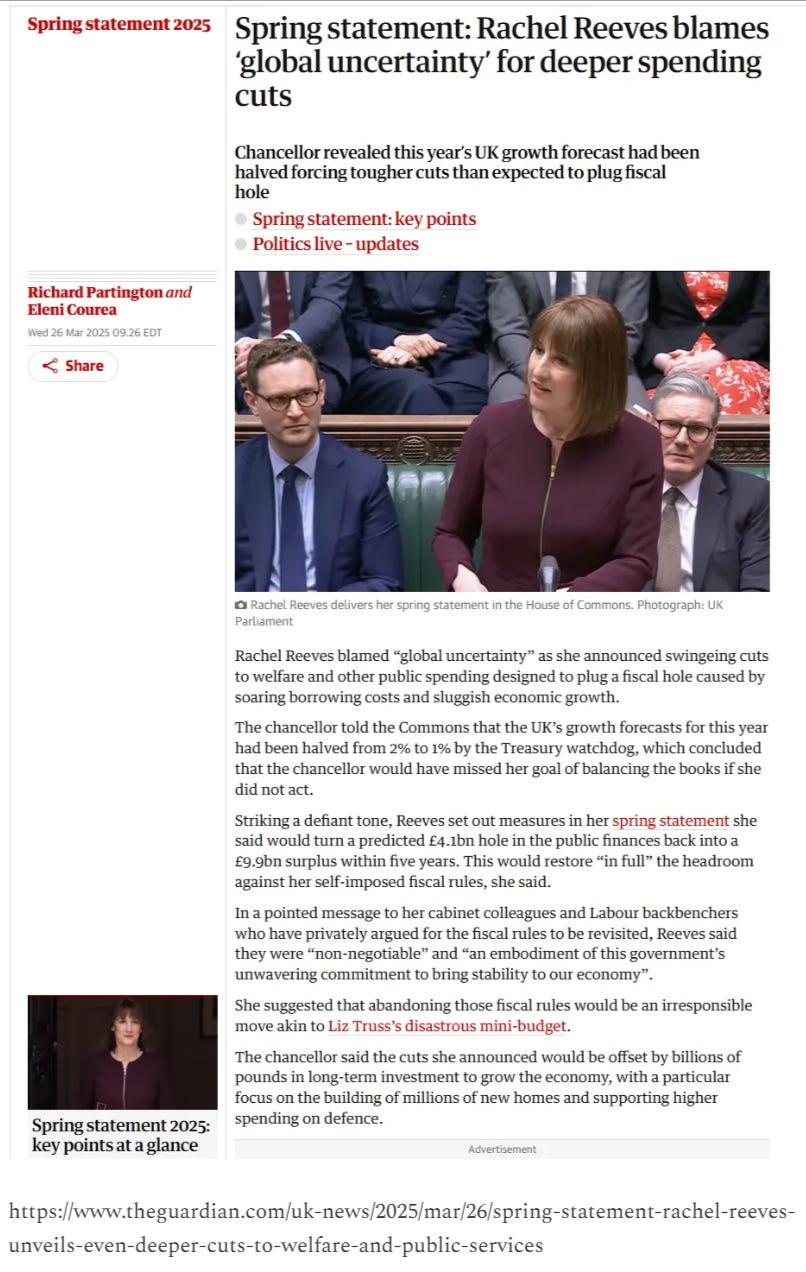
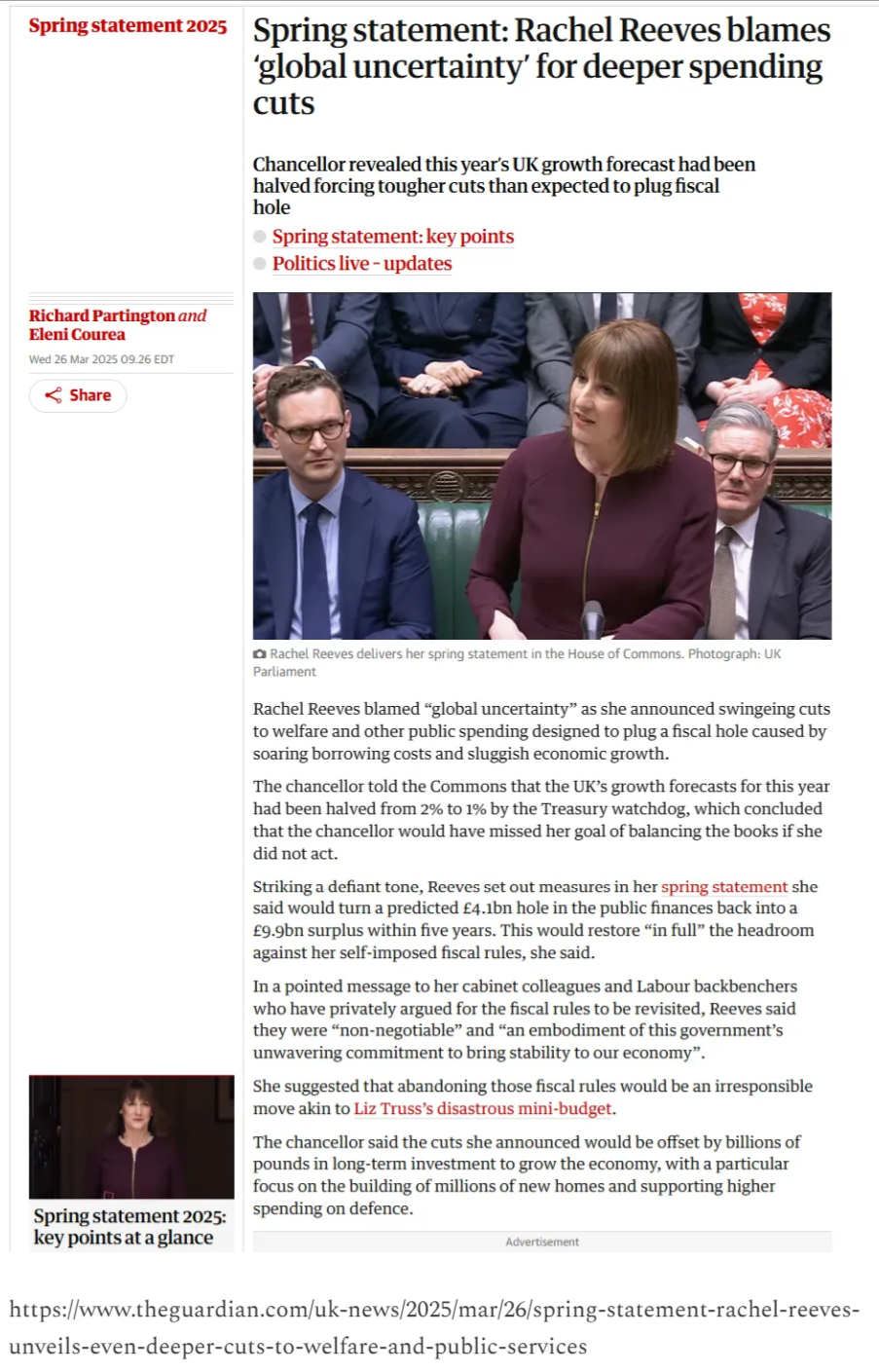
Pensioners without heat are not the only problem that Kier Starmer and Rachel Reeves face, besides that utterky anemic 1% growth rate! And the argued 22 billion over-spend that is left beind, and in its place is ‘global uncertainty’. ?
To put those figure into context, in the Spring Budget it was expected that total public spending this year would be £1,226bn. Either £9.5bn or £22bn would be a small proportion of that.
Spending was much higher than expected due to Covid in 2020 and 2021 and also almost £10bn higher than expected in 2023 because of inflation caused by Russia’s invasion of Ukraine.
Outside those years there have not been overspends close to £9.5bn.
This piece was originally published on 3 September 2024 and has been updated following the OBR report that accompanied the 30 October Budget
Headline: Michael Lind: Trump represents a nationalist tradition that goes back to Nixon’
Sub-headline: Despite his inconsistencies, the American president has always criticized free trade and the American military umbrella. For four decades, he has described the United States’ allies as parasites, highlights the Texan writer and academic.
The Nixon-Connally strain of American economic nationalism was carried on in the 1990s by Connally’s fellow Texan Perot, like Trump a billionaire businessman who ran for the presidency twice, in 1992 and 1996. Perot denounced the North American Free Trade Agreement for allowing US automobile companies to transfer production from well-paid, unionized workers in the US to low-wage labor in Mexico. Perot complained that the Japanese and other allies had “picked our pockets” and declared that as president he would charge both Japan and Germany $50 billion [$114 billion in today’s dollars] to repay the US for the cost of defending them
In the 1992 presidential campaign, Perot received nearly 20% of the popular vote – more than any third-party party since former Republican president Theodore Roosevelt ran as the Progressive candidate in 1912. Nevertheless, following Perot’s defeats in 1992 and again in 1996, the US foreign policy establishment treated neo-Nixonian economic nationalism as a discredited doctrine favored only by marginal figures on the far right like the pundit and failed presidential candidate Patrick J. Buchanan – who had been a Nixon aide.
….
Editor: As an Amrican I’m familier with Michael Lind ‘He is a fellow of the center-left think tank New America’ ! And its CEO Anne-Marie Slaughter a Clinton Fellow Traveler. Here is Lily Geismer on the evolution of The Neo-Liberal Democrats, while not a complete History, it offers enough valuable insights, that renders the Clinton Betrayel of the New Deal Tradition about politcal opportunism!
Democrats and Neoliberalism
Lily Geismer
The fallout from the 2016 election has created many surreal moments for historians of American politics and parties, but surely one of the oddest has been the introduction of the term neoliberal44 into the popular discourse. Even stranger still is that it has become a pejorative largely lobbed by the left less at Republicans and more at Democrats.45 As neoliberal has come to describe a wide range of figures, from Bill and Hillary Clinton46 to Ezra Klein47 and Ta-Nehisi Coates,48 its meaning has become stretched thin and caused fuzziness and disagreement. This muddle of meanings creates an opportunity to seek a more precise understanding of what I call “Democratic neoliberalism.”
It is actually not the first time Democrats have been called neoliberal. In the early 1980s, the term emerged to describe a group of figures also called the Watergate Babies, Atari Democrats, and New Democrats, many of whom eventually became affiliated with the Democratic Leadership Council(DLC). In this iteration, the term neoliberal was embraced not as opprobrium. Rather, it used a form of self-description and differentiation to imply that they were “new Democrats.” In 1982, Washington Monthly Editor Charles Peters published “A Neo-Liberal’s Manifesto,”49 which aimed to lay out the core principles of this group; two years later, journalist Randall Rothenberg wrote a book called The Neoliberals50 that sought to codify and celebrate this cohort’s ascendency.
…
In The Neoliberals, Rothenberg observed that “neoliberals are trying to change the ideas that underlie Democratic politics.” Taking his claim seriously provides a means to think about how this group of figures achieved that goal and came to permanently transform the agenda and ideas of the Democratic Party.
…
The group of policymakers and politicians that circulated around the DLC suggests that the roots of many aspects of neoliberalism emerged less from free market conservatism than from the ideology, institutions, and social commitments of liberalism. This group updated and extended many of the core tenets of post-New Deal liberalism, especially the emphasis on technocratic expertise, individualist solutions to structural problems, growth over redistribution, and development of strong partnerships between public and private sectors, particularly nonprofits, businesses, and foundations. The efforts to portray the DLC as indicative of the rightward shift of the party, therefore, fail to acknowledge the ways in which they advocated retaining key aspects of liberalism.
…
Figures like Michael Dukakis, Paul Tsongas, Bill Bradley, Tim Wirth, and Al Gore abided by the maxim “the solutions of the thirties will not solve the problems of the eighties.”
…
This group was heavily influenced by the work of figures like Lester Thurow, whose 1980 book The Zero-Sum Society53 essentially became something of a guidebook. Thurow argued that the solution to the multifaceted problems of the 1970s lay in “accelerating the growth of productivity,” which he believed could happen by investing public and private resources in sunrise rather than sunset industries.
…
David Osborne, an early fellow at PPI, was especially influential in helping achieve and shape this mission. Osborne’s research centered largely on the rise of public-private partnerships and “third sector institutions”58 such as nonprofits and other community organizations, which he argued offered a more effective means of providing social services and economic development than traditional government bureaucracies. Osborne reduced the argument of his 1988 book, Laboratories of Democracies, to a slogan: “if the thesis was government as solution and the antithesis was government as problem, the synthesis is government as partner.”
&
Along with co-author Ted Gaebler, Osborne expanded on this argument in Reinventing Government: How the Entrepreneurial Spirit Is Reinventing the Public Sector,59 published in 1992. The book’s model of “entrepreneurial government” advocated both efficiency techniques to make government more results-oriented and less costly as well as ways to decentralize authority and to shift more responsibility and control onto the community. It also suggested that the government should serve not as a service provider but as a “catalyst” in connecting the public and private sectors. Clinton, who served as the head of the DLC in the early 1990s, emerged as the most influential advocate of the ideas in Reinventing Government, praising it as a “blueprint” to “revitalize government.
Editor: The reader is here watching the birth of The Neo-Liberal New Democrats Bill And Hillery Clinton, and their Thatcherite Vision :
Crime Bill Signed Enacted the Clinton-Gore Administration’s tough and smart crime fighting strategy. The Bill contained tougher penalties, including “three strikes and you’re out” legislation, helped states build more prisons and increased prevention and victims rights. As a result, the overall crime rate has dropped for 8 years in a row — the longest continuous drop on record — and is now at a 26 year low. (PL 103-322, signed 9/13/94)
Welfare Reform Enacted President Clinton kept his promise to end welfare as we know it by requiring welfare recipients to work, limiting the time they can stay on welfare, and providing child care and health care to help them make the move from welfare to work. The landmark bipartisan welfare reform law signed by the President also enacted tough new child support enforcement measures proposed by the President. Since January 1993, the number of people on welfare has fallen by nearly 60 percent, from 14.1 million to 5.8 million, the smallest welfare rolls in 32 years, and millions of parents have joined the workforce. (PL 104-193, signed 8/22/96)
Created the Welfare to Work Partnership The Welfare to Work Partnership was launched at the President’s urging to lead the national business effort to hire people from the welfare rolls. Now 20,000 businesses strong, the Partnership has helped an estimated 1.1 million welfare recipients move to employment. Under Vice President Gore’s leadership, the Administration has also done its fair share, hiring 50,000 welfare recipients, and has fostered partnerships between employers and community and faith-based organizations that help families move from welfare to work.
Welfare-to-Work Grants Due to President Clinton’s leadership, the Balanced Budget Act included $3 billion over two years for Welfare-to-Work grants to help states and local communities move long-term welfare recipients and certain non-custodial parent in lasting, unsubsidized jobs. This funding, used for job creation, placement and retention efforts, has helped the hardest-to-serve welfare recipients and promotes parental responsibility among non-custodial parents who need to find work to honor their responsibilities to their children.
Achieving Victory in Kosovo President Clinton led the NATO Alliance in a 79-day air war that expelled Serb forces from Kosovo and restored self-government to the province, ending a decade of repression and reversing Slobodan Milosevic’s brutal campaign of ethnic cleansing. In the face of Allied unity, American military superiority, and strong Presidential leadership, Milosevic withdrew his troops and permitted international peacekeepers to begin returning refugees. (3/24-6/20/99)
Financial Modernization Legislation Enacted President Clinton signed the Financial Modernization Act into law, finally revamping a banking system that had been in place since the Great Depression. The new law will increase innovation and competition in the financial services industry, including traditional banking, insurance and securities industries, giving consumers greater choice and lower prices. The President insisted that the new regulatory structure permit banking institutions to expand into these newly authorized lines of business only if they satisfactorily serve the credit needs of their communities, and that the law include many of the consumer privacy provisions he proposed. (PL 106-102, signed 11/12/99)
Headline: Abundance is the new buzzword on the US left. Now it’s coming here
Sub-headline : The US left’s focus on redistribution is failing. A new approach, emphasising economic growth, is gaining traction — but faces big hurdles
Editor: Colvive can hardley contain his glee via the use of the US Left in his headline and sub-headline! The Reader need only read Bari Weisse’s column of March 18, 2025 in the The Free Press to find the source of Colevile US Left fixsation.
Headline: Can Ezra Klein and Derek Thompson Save the Left From Itself?
Sub-headline : The Democrats desperately need a new vision. Two prominent liberal journalists are offering one.
Editor: To put it bluntly Bari Weisse is the very bottom of the Neo-Conservative Intellegencia! Neither Ezra Klien nor Dereck Thompson are Liberals:Klien is at The New York Times andDerek at The Atlantic, a Neo Conservative publication. And Bairi Weisse lives in an Imagined World!
Ezra Klein and Derek Thompson are the two most important liberal journalists working in the legacy press today—Ezra at The New York Times, and Derek at The Atlantic.
Although they insist they’ll never go into politics themselves, they are offering Democrats a path back to power.
To get out of the political wilderness, they say the Democrats need a new vision—one that goes beyond resistance to Trump. A vision that can bring back the disaffected Democrats who stayed home or voted red for the first time this past November.
While other progressives are doubling down on zombie ideas, afraid to confront a country that has moved decisively to the right, Ezra and Derek are willing to face reality. They see that blue states are functioning similarly to the DMV—and, as a result, losing people to states like Texas and Florida.
In their new book, Abundance, they offer a blueprint for winning them back—to cities like San Francisco and New York, but also to the Democratic Party.
The thesis is simple: To have the future we want, we need to build and invent more of what we need.
While conservatives and libertarians might say, Yes, exactly, let the free market do its thing, Ezra and Derek insist that the government can play a crucial role—if liberals will let it. They want to rein in the laws, regulations, and bureaucratic thinking that have made it nearly impossible to do anything in this country.
….
Editor: Colvile as a Thatcherite attacking the Left is a civic, political duty!
The US elections were brutal for the Democrats. But here’s the most brutal fact: the places that swung hardest against them were those where they’d been in power for longest — New York, Chicago, Detroit, Los Angeles. And the people there aren’t just voting against left-wing rule but increasingly leaving it behind: one of America’s great demographic trends has been migration from blue states to red.
What’s the problem? In their new book Abundance, Ezra Klein and Derek Thompson make a simple argument: the left has been awful at governing. In particular, it has prioritised keeping its coalition of interest groups happy over getting stuff done — and brought in a raft of rules, not least on environmental protection, that make it too hard to build or invent things that might give those voters a better life, whether that be homes, high-speed railways, solar farms or life-saving medicines.
When this approach has, inevitably, produced a gap between supply and demand, the solution has been to throw subsidies at the problem — for affordable housing or childcare, say — rather than to actually tackle the blockages.
Klein and Thompson’s book is filled with chilling examples: the ghastly failure of cities like New York to build housing; the California high-speed rail project that makes HS2 look like a model of prudent procurement; the steady decline of risk-taking in science. But it is also filled with inspirational stories: the reforms that enabled the construction of cheap housing for the homeless in San Francisco; the Pennsylvania governor who repaired a bridge half melted by a crashed oil tanker in days rather than weeks; the warp-speed development and deployment of Covid vaccines.
Why does this matter? Partly because the authors are pretty influential — celebrated writers at The New York Times and The Atlantic respectively. But mostly because it represents one of the first serious attempts to chart a course for the Democrats that doesn’t involve doubling down on progressivism or shouting about the nasty orange man.
…
Editor: The final paragraph compares Abundence with Foundations written by three of his friends? Or just three of his employees?
But there is one final problem, which is that many voters, particularly on the right, do not want abundance at all. They are the people who decry the desecration of the green belt, who want new power cables buried underground (at billion-pound expense), who complain about tower blocks being built on car parks. And Labour’s planning reforms — which I largely support — will give them more ammunition, in particular via the hugely contentious plans to expand compulsory purchase of private land.
Indeed, the whole reason the Tories did not take up the abundance agenda while in power — despite my and others’ best efforts — was that they had become almost exclusively focused on protecting the privileges of pensioners, including the delightful views from their windows. Because, as I’ve pointed out before, it is OAPs that hold the electoral whip hand.
Abundance is one of those books that matter. Like the UK-focused essay Foundations — written by three of my friends — it explains that the scarcities that afflict our economies are scarcities we have actively chosen. Making it easier to build, making better choices, will enable us to build a better future. But it is a future that needs to be not just argued for, but fought for.



 StephenKMackSD's Blog