Editor: Its always important when reading the troka of Friedman/Brooks/Stephens that each of these writers is a committed Zionist. So Mr. Friedman’s latest 1465 word ‘essay’ follows in that self-alpogelic tradition! In the body of Friedman’s imagined letter to Trump, there are these paragraphs!
I have zero sympathy for Hamas. I think it is a sick organization that has done enormous damage to the Palestinian cause. It is hugely responsible for the human tragedy that is Gaza today. Hamas’s leadership should have released its hostages and left Gaza a long time ago, removing any excuse for Israel to resume the fighting. But Netanyahu’s plan to reinvade Gaza is not to stand up a moderate alternative to Hamas, led by the Palestinian Authority. It is for a permanent Israeli military occupation, whose unstated goal will be to pressure all Palestinians to leave. That is a prescription for a permanent insurgency — Vietnam on the Mediterranean.
Addressing a conference on May 5 sponsored by the religious Zionist newspaper B’Sheva, Bezalel Smotrich, Israel’s far right finance minister, spoke like a man who couldn’t care less what you think: “We’re occupying Gaza to stay,” he said. “There will be no more entering and leaving.” The local population will be squeezed into a less than a quarter of the Gaza Strip.
As the Haaretz military expert Amos Harel noted: “Since the army will try to minimize casualties, analysts expect it to use particularly aggressive force that will lead to extensive damage to Gaza’s remaining civilian infrastructure. The displacement of the population to the areas of the humanitarian camps, combined with the ongoing shortage of food and medicine, could lead to further mass deaths of civilians. … More Israeli leaders and officers could face personal legal proceedings against them.”
Indeed, this strategy, if executed, may not only trigger more war crime accusations against Israel, but will also inevitably threaten the stability of Jordan and the stability of Egypt. Those two pillars of America’s Middle East alliance structure both fear that Netanyahu aims to drive Palestinians from Gaza and the West Bank into their countries, which would surely foment instability that would spill over their borders even if Palestinians themselves did not.
…
Editor: In this context where does Friedman stand ?
…
On the Middle East, you have some good independent instincts, Mr. President. Follow them. Otherwise you need to prepare yourself for this looming reality: Your Jewish grandchildren will be the first generation of Jewish children who will grow up in a world where the Jewish state is a pariah state.
“On Tuesday, the Israel Air Force killed nine children, between the ages of 3 and 14. …The Israeli military said that the target was a ‘Hamas command and control center’ and that ‘steps were taken to mitigate the risk of harming uninvolved civilians.’… We can continue to ignore the number of Palestinians in the Strip who have been killed — more than 52,000, including around 18,000 children; to question the credibility of the figures, to use all of the mechanisms of repression, denial, apathy, distancing, normalization and justification. None of this will change the bitter fact: Israel killed them. Our hands did this. We must not avert our eyes. We must wake up and cry out loudly: Stop the war.”
Political Cynic.
Further thoughts/considerations:
May 10, 2025
Mr. Friedman’s final comment lacks honesty and veracity, yet the Haaretz editorial displayes what Mr. Friedman cannot muster! What does that demonstraight about @NYT and Mr. Friedman?
Published today at 10:29 am (Paris), updated at 11:45 am
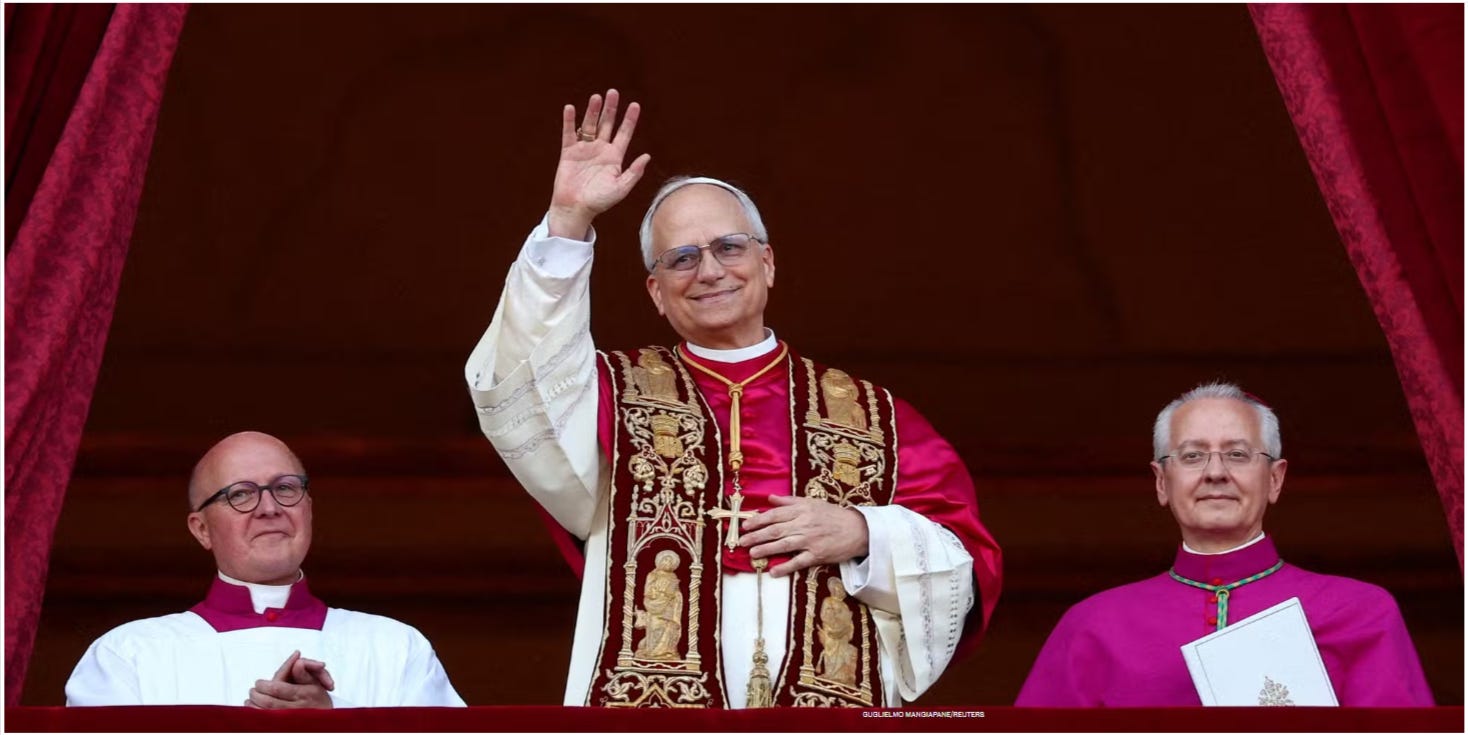
ProfileThe American Robert Francis Prevost’s affiliation with the mendicant order of the Augustinians, known for their commitment to tradition and charity, and his understanding of the Curia contribute to a reassuring image. Grounded in modernity and mindful of the marginalized, his pontificate promises ‘unity’ and collegiality.
When his name was announced, there was a murmur of confusion among the crowd gathered in Saint Peter’s Square, Rome. “Prevost? Who is he?” In the election for the Throne of St. Peter, observers saw him as a serious candidate due to his ability to unite and bring peace to the Church. However, to the general public, Robert Francis Prevost, the 267th pope of the Catholic Church and the first to come from the United States, is unknown.
When white smoke appeared from the chimney of the Sistine Chapel on Thursday, May 8, shortly after 6 pm, onlookers were still betting on the victory of Pietro Parolin, former second in command to Francis and the anticipated favorite for the papacy. “It will be him, Parolin, with the papal name Paul VII,” predicted two French priests. The speed with which the election was concluded – four rounds of voting, totaling 24 hours of conclave – seemed to support this hypothesis.
But it was Robert Prevost, from the Order of Saint Augustine, who was elected. He took the papal name Leo XIV. This choice places the new pontiff in the continuity of Leo XIII, the pope who forged the Church’s social doctrine, notably through the encyclical Rerum Novarum (“Of New Things”), published in 1891. In short, the promise of a pontificate rooted in modernity and concerned for the poor, the marginalized, the excluded – the “peripheries,” as Francis would have said, to whom Leo XIV paid a heartfelt tribute in his first speech.
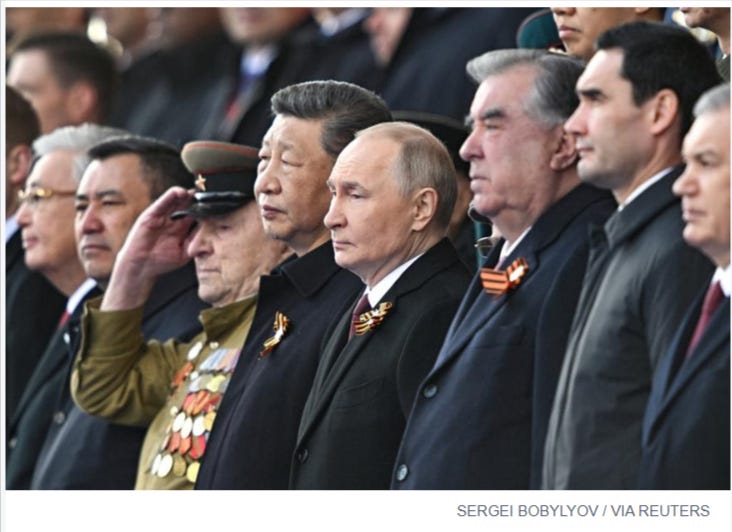
Interview: The Russian journalist, in an interview with Le Monde, analyzes the militaristic propaganda created by the Kremlin around the end of World War II, celebrated in Russia on May 9, which led to the invasion of Ukraine in 2022.
Sergey Parkhomenko, 61, founder of the Russian news magazine Itogi – created in 1996 in cooperation with the American weekly Newsweek – has not only had a rich career as a journalist He is also behind several civic initiatives, such as Dissernet, a platform that tracks plagiarism in Russian science, and Last Address, which places hundreds of commemorative plaques for victims of Stalinism on buildings in Moscow, Saint Petersburg and Yekaterinburg.
Close to the non-governmental organization Memorial, Parkhomenko has lived in exile since 2021, the year when the renowned human rights group, dedicated to the preservation of the memory of victims of Soviet power, was dissolved. Today, he leads the project Redkollegia (“editorial board”), funded by philanthropist businessman Boris Zimin, which rewards Russian journalists unaffiliated with the government for the quality of their work.
What do the 1945 victory commemorations represent in today’s Russia, currently involved in a war it initiated?
Since Vladimir Putin, the change has been dramatic. I remember that before, at my grandparents’ house, there was a set table and friends were invited, but it was above all a celebration of pain, of remembrance. And then, the celebrations of the Great Patriotic War [as World War II is called in Russia] became an instrument of militaristic propaganda, a celebration of aggression against everyone under the theme of “We can do it again.”
Political Cynic grows weary of Political/Ethical Mendacity. Think of political crime of David Brooks’ ‘The Collapse of the Dream Palaces’ as the possible/aguable political beach-head?
The war in Gaza has reached a predictable and deadly impasse.
In response to the Hamas terrorist attack on Oct. 7, 2023, the Israeli government has publicly pursued two primary war aims. First, Israel wanted to secure the return of every hostage Hamas seized. Second, Israel wanted to destroy Hamas.
At the same time, however, Israel also indicated that it did not want to reoccupy Gaza. There are good reasons for this. The international community is opposed to occupation, Israeli society is deeply divided by the idea, and the previous occupation ended poorly — with Hamas coming to power after Israel withdrew from the strip in 2005.
But the brutal military fact is that rejecting occupation not only rendered Israel’s vow to destroy Hamas incalculably more difficult, it made the war far more inhumane and deadly.
Editor : Mr. French in the following sentences seeks to cover his ass with his readership!
I want to emphasize that this newsletter primarily offers a military analysis. It is not focused on politics. That’s not because the politics of the situation are unimportant, but rather because we often pay too little attention to military realities, and the success or failure of military operations can completely transform the politics of an international crisis.
Editor: What follows is a 1701 word diatribe, framed as somehow a valid rationale of Israel’s Genocide? Mr. French provodes a provisional cast of chacacters, for the Reader to consider as actors in his Political Melodrama, aided by his inept phrase-making!
Hamas, lesson the United States learned, “commuting to war,”. Even if a military follows the law of war (and that is a matter of debate in Gaza), emphasizing destruction can lead to a mentality that treats body counts as an independent objective, Israel has inflicted significant losses on Hamas, the Iraq war surge, the Israeli security cabinet has approved a plan to enter Gaza and stay — at least temporarily — to end Hamas’s control, President Trump floated in February, This is the approach of the worst hard-liners in the Israeli government, and it’s not just illegal. It’s a recipe for endless war. , …Pete Hegseth, the secretary of defense, is fond of calling military lawyers “jagoffs” — see the obligations of the laws of war as inhibiting war fighters and diminishing their effectiveness….
Editor: Reader there are but 1064 words remaining to this ‘essay’: yet for all the politically maicured chatter, these paragraphs signal the point of arrival has been reached ?
Also, it’s important to remember that the long and deadly history of conflict between Israelis and Palestinians has rendered the Gazan population far more hostile to the I.D.F. than most Iraqis were to American forces. Israel has a more difficult challenge than we faced in Gaza — though the emergence of (unimaginably courageous) demonstrators against Hamas in Gaza indicates that there is an appetite for change.
Israel is facing a terrible choice. If it wants to remove Hamas from power, it almost certainly has to pursue an occupation that would divide the nation and further enrage the international community. If it wants to secure the release of the hostages, it will almost certainly have to agree to a cease-fire that leaves Hamas in place and sets the stage for future conflicts.
It remains to be seen whether Israel’s new approach is anything more than bluster. Perhaps Israel’s threats are little more than negotiation tactics. Perhaps Israel will ultimately prioritize releasing the remaining hostages over ending Hamas’s despotic rule. But one thing is crystal clear.
Traditionally, secretaries of state have played a role of great prominence in U.S. administrations. Although they are only fourth in the presidential order of succession, these officials often outshine vice presidents. One need only think of examples such as Henry Kissinger, James A. Baker, Hillary Clinton, or John Kerry to recall how influential and vocal public servants in this office can be.
Against this backdrop, current Secretary of State Marco Rubio cuts a particularly disappointing figure. As President Donald Trump’s second term takes on a clear authoritarian bent and disrupts long-standing U.S. relationships, one might have expected Rubio—who has a record of criticizing Trump and his foreign-policy stances—to be one of the rare “adults in the room,” as experienced officials such as John Kelly and James Mattis were called during Trump’s first term. Analysts sometimes credited these figures with slowing the president down through deliberate debate and reining in his impulsive extremes.
….
Editor: This was all I could manage to salvage, of this Howard French’s essay, without a payment. Reader consult this issue of Cold War Studies for what the posibilities of what actual thought might offer, instead of Lukewarm Theology!
Headline: The ‘Wall Street Journal’ calls on Trump to take the path of former French Socialist president François Mitterrand
Sub-headline: The financial daily, which closely reflects the views of the business community, hopes that the US president will abandon a misguided policy a few months after its implementation, like Mitterrand did in the 1980s.
Editor : Arnaud Leparmentier opening salvo ends in paraphrasing the Neo-Faschist rag The Wall Street Journal!
Has the worst passed? This is the faint hope that economic circles are clinging to after Donald Trump’s first 100 days in office, which have triggered distrust and indescribable chaos due to his trade war and caused a nearly 10% drop in the dollar against the euro. The Wall Street Journal is so stunned that it has invoked the spirit of a Frenchman, a Socialist no less – François Mitterrand.
Editor: I recall reading a biography of François Mitterrand by a women whose name escapes my memory, and I can’t find on the internet. Note that Arnaud Leparmentier of Le Monde quotes ‘The Wall Street Journal’ and its Kimberley Strassel, after a long involved, and at best of a comic notion, of selling the idea/notion of a ‘François Mitterrand Moment’ to the Trump Neo-Faschist cadre, and his Fellow Travelers at this ‘newspaper’ ?
Editor: Arnaud Leparmentier quotes Kimberley Strassel, she plays the role of Madame Defarge in the Trump World Toxic Melodrama. When will Sydney Carton make his appearnce?
The Wall Street Journal is an excellent indicator of the dismay among American economic circles, which thought that Trump’s second term would be a repeat of his first – chaotic, boasting about trade and migrants, yet fundamentally pro-business. Where business leaders made an opportunistic but futile allegiance, the daily maintained its editorial stance. Editorialist Kimberley Strassel expressed hope that “the president has lost control of the narrative, but he has a chance to retake it.” She urged the president to “use the 100-day mark to double-down on Trump 1.0 – and never look back.”
Editor: Kimberley Strassel is one of Rupert Murdoch trained and reliable cadre of underlings, with an appetite for retorical blood-letting!
Editor: The two political frauds, of the utterly bankrupt New Democrats : Senator Bernie Sanders (Vermont) and Representative Alexandria Ocasio-Cortez (New York) make their apperance as champions of what: Not the long abandoned New Deal Tradition of Franklin D. Roosevelt and Ferdinand Pecora of the Glass–Steagall Act?
The second is up to Congress and the daily saw red when some Republicans close to Vice President JD Vance or the populist MAGA (“Make America Great Again”) movement, including Steve Bannon, proposed raising taxes on the wealthiest (from 37% to 39.6% maximum marginal rate, as under Barack Obama) to counter left-wing Democrats: specifically, Senator Bernie Sanders (Vermont) and Representative Alexandria Ocasio-Cortez (New York) who are touring the country to denounce the takeover by Trump’s “oligarchy.”
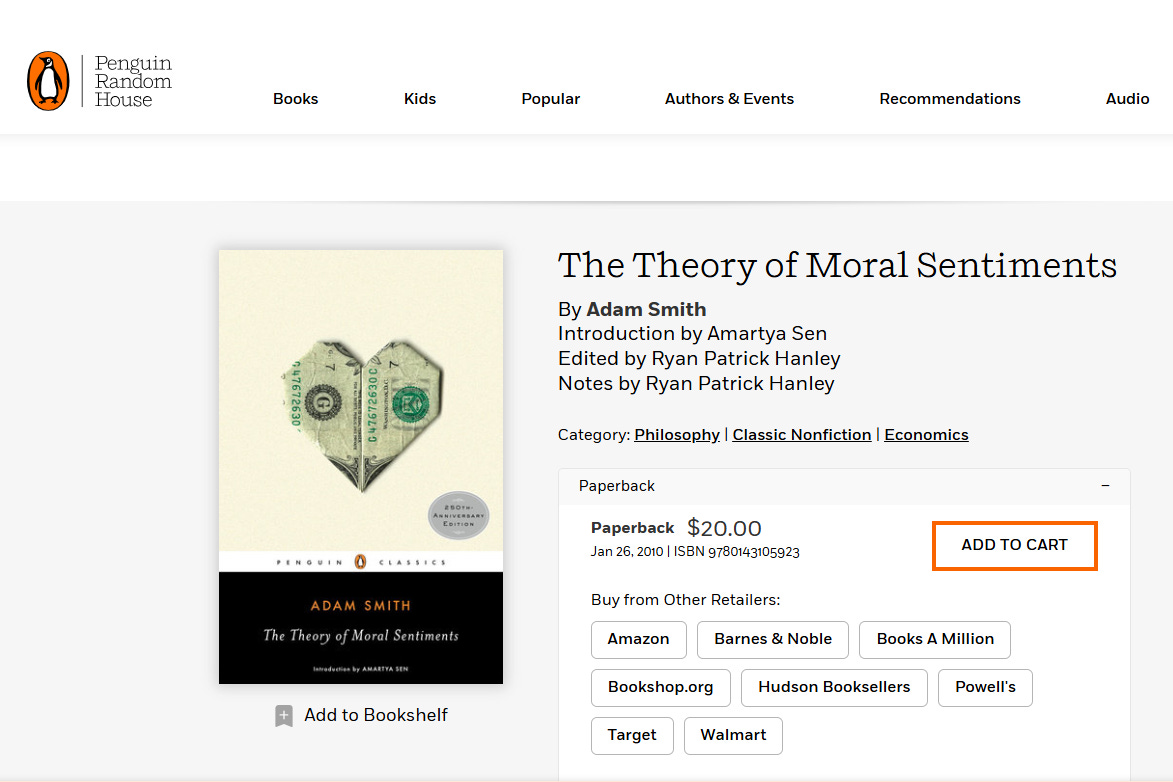
Editor: Arnaud Leparmentier last and unimpressive paragraph! On Adam Smith recall the economist Amartya Sen’s introduction to Smith’s ‘The Theory of Moral Sentiments’ ?
Editor: The final paragraph and the final sentence…
Investors are divided over the issue: according to a Wall Street Journal survey, hedge funds have sold $1 trillion in stocks since the beginning of 2025, while 97% of American Vanguard clients did not touch their retirement funds in early April, hoping for better days ahead. Who is right, the Wall Street elites or those who are saving up money? Evidently, Adam Smith’s invisible hand is trembling.
Mr. Colevile is attched to catch-phrases as manuctured place holders, like his latest ‘Reformageddon’, that hints at an imagined ‘something’ about to occure in the political now, or politicak moment! Think of ‘The Red Shoes’ and that wayword advertisement that is animated as partner, to the enchanted dancer? Too highpalutin? 1167 words makes the Critics role mired in speculatons, refracted though more speculations!
Nigel Farage has had some good days in politics. But it’s hard to imagine anything as purely satisfying as standing on stage in Durham to proclaim “a truly historic landmark” — a set of local elections that marked, among a string of other Reform successes, “the beginning of the end of the Conservative Party”, which was being “wiped out in the shires of England”.
For Keir Starmer, the news was … less good. Losing the by-election in Runcorn & Helsby, one of the safest seats in the country, will hardly calm the jitters in his party about its dire poll ratings. On the other flank, we also saw the Greens and Islamic independents continue to eat into Labour’s vote share.
Editor: Its hard to imagine two more mis-begotten candiates, yet view their percursors: David Cameron, Theresa May, Boris Johnson, Liz Truss, and Mr Sunak!
Editor: some very selective quotation, mined from this well of chatter:
…
There, even though the combined vote share for Conservatives and Reform massively outweighed Labour, a divided right helped Labour come through the middle.
…
Now, he argued, it is supporting Kemi Badenoch that is a wasted vote: “If you vote Conservative, you stop our chances of winning. If you vote Conservative, you get Labour.”
…
But there’s also a case — even if only a tentative and provisional one — that the divisions on the centre right may not be as damaging, for either party, as the consensus has it.
Let’s start with the results from Thursday. It is clear that Farage has forged a remarkable coalition. Any party that can win both Kent and Durham needs to be taken very seriously indeed.
In fact, Reform did not just win votes where the Tories won in 2019 and 2021, but also where they could never dream of doing so — in particular, some of the working-class Labour strongholds where even Boris Johnson, in his post-Brexit pomp, could not triumph.
…
Editor: Reader delay your bout of ennui, and read the last three paragraphs of this essay!
Of course, the parallels aren’t exact — not least because of the difference between a referendum and a five-way first-past-the-post grudge match. And trying to carve out an electoral foothold in an environment transformed by Reform may be a historic comedown for a Conservative Party that has long had a comfortable monopoly on the centre-right vote. But that’s what you get when you screw up as badly as the Tories have in recent years.
As for Farage, he has long dreamt of supplanting the Tories as the country’s second party. That dream is closer than ever to being fulfilled. Yet even if Reform eclipses the Conservatives, it is still hard to see either having the strength to win on its own.
A single right-wing ticket, in whatever form, would prevent Labour from coming through the middle. But it could also taint both Tories and Reform with the negatives of the other. Better for each movement to focus ruthlessly on the voters it is best placed to attract. Buttressed by voters’ impeccable ability to self-sort, such an approach might just mean, as in 2016, that a divided right ends up being more than the sum of its parts.
Jonathan Freedland never disappoints, except in the matter truth, facts or valid argument! It’s his habit of being!
Political Observer engages in some Political Archaeology.
Headline: It’s risky, but Joe Biden needs to give way to someone who can beat Donald Trump
Sub-headline: The president had one job: to prove he was strong enough to take on his predecessor. Now Democrats must act, for America’s sake – and the world’s
Mr. Freedland almost makes political noises reminiscent of ‘Morning Joe’ on the burning ‘Biden Question’ : beginning with 3:50 is the maudlin chatter about Joe’s ‘love of Biden, Jill and his family’: Norman Rockwell was better at producing American Kitsch! But this is also about the utter failure of American Broadcast News, as America abandons ‘Morning Joe’ for ‘Joe Rogan’ !
Freeland’s approach is the bloated ‘World Historical’ , as expressed the ‘The Fate of West’ in the sub-headline. But nothing quite matches Freedland’ s particular brand of panic steeped in hysterics:
What was the worst moment? Perhaps when one especially rambling sentence of Joe Biden’s ended in a mumbled, confused declaration that “
Is this Freedland’s Gethsemane moment?
Editor: The Reader is left with 963 words of ‘analysis’ I’ll engage in ‘sampling’ from this bloated text:
…
Expectations were rock bottom:
…
For one thing, Trump’s entire framing of this race is strong v weak: he offers himself as a strongman, against an opponent too feeble to lead and protect the US in an increasingly dangerous world.
…
But, no less important, Biden’s inability to deliver clear, intelligible statements meant Donald Trump’s lies went unchallenged.
As the former Obama administration official Van Jones put it after the debate, this is a contest of “an old man against a conman” – but the weakness of the former is allowing the latter to prevail.
…
Editor: on Trump:
He is a failed coup leader, nationalist-populist menace and racist who would suck up to the world’s autocrats and throw Ukraine to Vladimir Putin’s wolves: he should be allowed nowhere near power.
…
Editor: on ‘expectations’:
Indeed, that is why the White House opted to have the debate so unusually early: to allay fears about the president’s age and to reframe the race not as a referendum on Biden, but as a choice.
…
Editor: On Biden as a ‘proud and stubborn man’:
…
Some imagine the likes of Hillary Clinton and Barack Obama having a quiet word, but Biden is a proud and stubborn man who feels he was passed over too long, including by those two.
…
Editor: Jill Biden provides a kind of solace as antidote to the glaring reality:
Some say the only person who could ever persuade him to do that is his wife, Jill. But after the debate, she loudly congratulated her husband, albeit in a manner that reinforced the sense of a man well past his prime. “Joe, you did such a great job!” she said. “You answered every question! You knew all the facts!”
Editor: on the possibility of a Biden replacement:
The party could throw it open to a contest fought out at its convention in Augustamong the deep bench of next-generation Democratic talent – the Michigan governor, Gretchen Whitmer, her California counterpart, Gavin Newsom, and others – but that could be messy, bitter and rushed.
…
Editor: Freedland in his final paragraph repeats the current political wisdom of the Biden as ‘a good and decent man’ : ‘Morning Joe’s maudlin chatter seems to have infected , emboldened other apologists? Yet this reader recalls the Joe Biden of another political time:
CNN —
Joe Biden in a 1993 speech warned of “predators on our streets” who were “beyond the pale” and said they must be cordoned off from the rest of society because the justice system did not know how to rehabilitate them.
Biden, then chair of the Senate Judiciary Committee, made the comments on the Senate floor a day before a vote was scheduled on the Senate’s version of the Violent Crime Control and Law Enforcement Act.
His central role in shaping and shepherding the tough-on-crime bill will likely face scrutiny in a Democratic primary should he run for president in 2020. His 1993 comments, which were in line with the broad political consensus to tackling crime at the time, are at odds with a new bipartisan coalition of activists and lawmakers who are trying to undo what they say is a legacy of mass incarceration fostered by that era.
Biden’s word choice could also pose a problem with a new generation of Democrats who view the rhetoric at the time as perpetuating harmful myths about the black community.
CNN’s KFile came across the 1993 speech during a review of the former vice president’s record.
President Bill Clinton in 1994 signed the crime bill into law with broad bipartisan support as violent crime rates peaked in the US in the early 1990s. Included in the law was the federal “three strikes” provision, mandating life sentences for criminals convicted of a violent felony after two or more prior convictions, including drug crimes.
“We have predators on our streets that society has in fact, in part because of its neglect, created,” said Biden, then a fourth-term senator from Delaware so committed to the bill that he has referred to it over the years as “the Biden bill.”
“They are beyond the pale many of those people, beyond the pale,” Biden continued. “And it’s a sad commentary on society. We have no choice but to take them out of society.”
In the speech, Biden described a “cadre of young people, tens of thousands of them, born out of wedlock, without parents, without supervision, without any structure, without any conscience developing because they literally … because they literally have not been socialized, they literally have not had an opportunity.” He said, “we should focus on them now” because “if we don’t, they will, or a portion of them, will become the predators 15 years from now.”
Labour knew it and Corbyn knew it. Those appalling numbers were not state secrets. His admirers always describe him as a selfless, almost saintly man, devoid of ego. So why didn’t he take one look at his own ratings and say, “I am clearly a drag on this party’s prospects. Those who need a Labour government have a better chance of getting one if I step aside.” Not a chance.
Corbyn’s own vanity was too great for him even to consider such an act of self-sacrifice. Instead he was encouraged by his own devoted legions of supporters, for whom the idea of a change of leader was heresy. In their mind, it was better to lose under Corbyn than to have a shot at winning with someone – anyone – else.
…
Of course, this relates not just to Corbyn but Corbynism. For the last four years, Labour has been in thrall to the notion that it’s better to have a manifesto you can feel proud of, a programme that calls itself radical, than to devise one that might have a chance of winning. Some even argued that, “win or lose”, Corbyn achieved much simply by offering a genuinely socialist plan – in contrast with Labour’s 1997 offer, which was so boringly modest and incremental.
Well, guess what. Labour’s “radical” manifesto of 2019 achieved precisely nothing. Not one proposal in it will be implemented, not one pound in it will be spent. It is worthless. And if judged not by the academic standard of “expanding the discourse”, but by the hard, practical measure of improving actual people’s actual lives, those hate figures of Corbynism – Tony Blair and Gordon Brown – achieved more in four hours than Corbyn achieved in four years. Why? Because they did what it took to win power.
…
Editor: Mr. Freedland provides a severable diganosis of the Corbyn political mentality ?
Wed 5 Sep 2018 08.53 EDT
Headline : Jewish concern over Corbyn is not all about Israel. It’s about antisemitism
Sub-headline: The IHRA row focused on the Middle East conflict. But that’s not the heart of the matter
….
The IHRA controversy has also distorted and obscured what the tension over Labour and antisemitism is really about. Because of the focus on the four IHRA examples that Labour dropped back in July, it’s often looked as if the disagreement is entirely about Israel/Palestine – as if, when you get right down to it, the Jewish community cannot tolerate criticism of Israel and that its problem with Corbyn is that he is just too passionate a campaigner for Palestinian rights.
Of course that might be true for some. But for many Jews, especially within Labour, the picture is very different. Witness Sunday’s conference in London of the Jewish Labour Movement, many of whose members have been most vocal in criticising Labour over antisemitism. A curious thing happened when Gordon Brown addressed the conference. At one point, he called for the establishment of a Palestinian state, the sharing of Jerusalem and the withdrawal of settlements – going on to denounce Donald Trump for cutting off funding of Palestinian refugees. He was interrupted by loud applause.
Later Margaret Hodge, the same Margaret Hodge who called Corbyn an antisemitic racist to his face, condemned Benjamin Netanyahu’s recent nation state law as “despicable and abhorrent”. The room erupted in a thunderous ovation. To state the obvious: these are not the reactions of people who cannot stomach criticism of Israel.
Where, then, lies the grievance with Corbyn? At that meeting on Sunday, Jewish Labourites were not opposing the party leader for championing the Palestinians. They were opposing him for, to take one example, his 2013 attack on a group of “Zionists” he’d encountered, where he tackled them not on their arguments but on ethnic grounds, noting that despite “having lived in this country for a very long time, they don’t understand English irony”.
The implication of that remark is clear – and it has nothing to do with defending Palestinians. It’s that Corbyn sees Jews as fundamentally alien, foreigners who might live here a long time, might even be born here, but are still essentially other. People who will never be truly English.
…
Editor: Friedland offers Corbyn in the guise of : ‘Corbyn sees Jews as fundamentally alien, foreigners…’ This viewed from the political present of the ongoing Gaza Genocide, renders Mr. Freedland’s ‘fundamentally alien’ claim, refracted in the lens of the political present, of unabated Zionist Mass Murder reads like prescience of a very high order?
………………………………………………………………………………
Fri 2 May 2025 11.39 EDT
Headline: One hundred days in, Donald Trump faces a problem: he can rage, but he can’t govern
Sub-headline: Americans are beginning to worry about their future amid a shrinking economy, warnings of empty shelves – and the president’s failed promises
Mr. Friedland’s commentary is awash in ‘Liberal Distaine’ of Trump and Trumpism: yet the Political History of Britain, is marked by notorious political incompetence: David Cameron, Theresa May, Boris Johnson, Liz Truss, Rishi Sunak , Keir Starmer!
Editor : The final paragraphs of Freedland’s diatribe offers…..
…
So it’s fair to say the 100 days have not gone as Trump would have wished. And thanks to those serial failures, you can see the first, small signs that his power to terrify is fading. Witness the handful of senate Republicans who voted with Democrats against his tariff policy. And note how the reliably rightwing editorial page of the Wall Street Journal is now a fierce critic, slamming Trump as a “bully” and denouncing tariffs as “the biggest economic policy mistake in decades”. For a few short hours, even Jeff Bezos seemed ready to take a stand, amid reports that Amazon was about to itemise the cost of tariffs to US customers, before the company backed down.
Of course, none of this should be a surprise. Trump’s conman promises and delusional dreams of turning the clock back were always bound to fail. This is the nature of nationalist populism, whether it wears a red cap in Michigan or a turquoise rosette in Runcorn. It is expert at turning grievance, division and nostalgia into votes. But when it comes to governing, it will always fail. It offers an outlet for complaint – and has no answers at all.
Editor : Mr. Brooks has become a more adroit propagandist since the ‘The Collapse’ but not by much!
I had forgotten how exhausting it is to live in Donald Trump’s world. He’s not only a political figure. He creates a psychological and social atmosphere that suffuses the whole culture — the airwaves, our conversations, our moods.
If there is one word to define Trump’s atmosphere, it is “pagan.” The pagan values of ancient Rome celebrated power, manliness, conquest, ego, fame, competitiveness and prowess, and it is those values that have always been at the core of Trump’s being — from his real estate grandiosity to his love of pro wrestling to his king-of-the-jungle version of American greatness.
The pagan ethos has always appealed to grandiose male narcissists because it gives them permission to grab whatever they want. This ethos encourages egotists to puff themselves up and boast in a way they find urgently satisfying; self-love is the only form of love they know.
The pagan culture is seductive because it lures you with images of heroism, might and glory. Think of Achilles slaughtering his enemies before the walls of Troy. For a certain sort of perpetual boy, what could be cooler than that? But there is little compassion in this worldview, no concept that humility might be a virtue. There is a callous tolerance of cruelty.
…
Editor : If the discussion of ‘paganism’is just to be‘imagined’ by Brooks in the most self-serving way: what can a series of novels offer, to the reader, who might consider Mary Renault’s Trilogy?
Editor: Mr. Brooks offers his reader:
Tom Holland is a historian who wrote several fine books of classical history, like “Persian Fire.” Gradually he became more and more appalled by many of those ancient pagans — those Caesars who could slaughter innocent human beings by the hundreds of thousands while everyone thought this was totally fine.
“This is a really terrifyingly alien world, and the more you look at it, the more you realize that it is built on systematic exploitation,” Holland told the writer Justin Brierley. “In almost every way, this is a world that is unspeakably cruel to our way of thinking. And this worried me more and more.”
….
The callous tolerance of cruelty is a river that runs through human history. It was dammed up, somewhat, only by millenniums of hard civilizational work. The pagan ethos — ancient or modern — always threatens to unleash brutality once again. The pagan ethos does not believe that every human was made in the image of God, does not believe in human equality, is not concerned about preserving the dignity of the poor. It does not care much about the universal feelings of benevolence, empathy and faithfulness toward one another, which, it turns out, are absolutely required for a democracy to function.
…
If paganism is a grand but dehumanizing value system, I’ve found it necessary, in this increasingly pagan age, to root myself in anything that feels rehumanizing, whether it’s art or literature or learning. I’ve found it incredibly replenishing to be spending time around selfless, humble people who are still doing the work of serving the homeless, mentoring a lost kid who’s joined a gang. These days I need these moral antidotes to feel healthy, resilient and inspired.
…
If paganism is a grand but dehumanizing value system, I’ve found it necessary, in this increasingly pagan age, to root myself in anything that feels rehumanizing, whether it’s art or literature or learning. I’ve found it incredibly replenishing to be spending time around selfless, humble people who are still doing the work of serving the homeless, mentoring a lost kid who’s joined a gang. These days I need these moral antidotes to feel healthy, resilient and inspired.
…
Judaism and Christianity confront paganism with rival visions of the good. The contrast could not be starker. Paganism says: Make yourself the center of the universe. Serve yourself and force others to serve you. The biblical metaphysic says: Serve others, and you will find joy. Serve God, and you will delight in his love.
Editor: Where might The Reader look to explaine/rationalize the Genocide in Gaza, perpitrated by Israel, with munitions supplied by its allies in The West? That Brooks so malidriotely elides, from his self-serving politcal moralizing = New York Times merde!
Editor: Mr. Colevile’s voice is very distinctive: The Reader cannot compare him in any way to @JohnJCrace of The Guardian, as political satirist and commentator. Mr. Colevile cannot match his talent in either of these fields: of commentary and political satire, with a welcome bite! Also consider Colevil’e political propinquity with arch conservative, and the utterly notorious @Jacob_Rees_Mogg! This just a quick sketch of ‘The Worlds’ that Colevile inhabits, touches, and attemps to explaine to The Reader.
………………………………………………………………………
Headline: The prize on Thursday: who do voters hate the least?
Sub-headline: In these anxious times, all our politicians are more or less equally unpopular, all at once
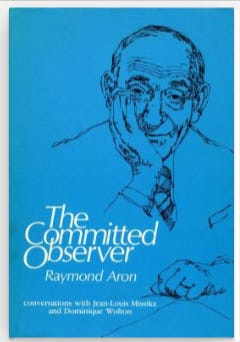
Editor: It can’t be a surprise, that Colevile political essay is a brief 1095 words? The question might occour, as to how The Reader might approach this bloated political itinerary? Reader consider the possibilities of naming all the political actors? Or might The Reader opt for the naming of the political operatives, that marked the 14 years of Tory Rule :David Cameron, Theresa May, Boris Johnson, Liz Truss, Rishi Sunak? Colevile’s strategy is to place himself outside the political action. Which in a way is servisable, that reminds me or just echos the book of The Committed Observer that I read in 1983.
The Committed Observer
Interviews With Jean-Louis Missika and Dominique Wolton = Le Spectateur Engage





 StephenKMackSD's Blog