Headline: Our £1.5 trillion state will mean nothing without innovation
Sub-headline: Kemi Badenoch beware, there is no guarantee that voters will return to the blue team after being brutalised by Labour
Sunday November 03 2024, 12.01am GMT, The Sunday Times
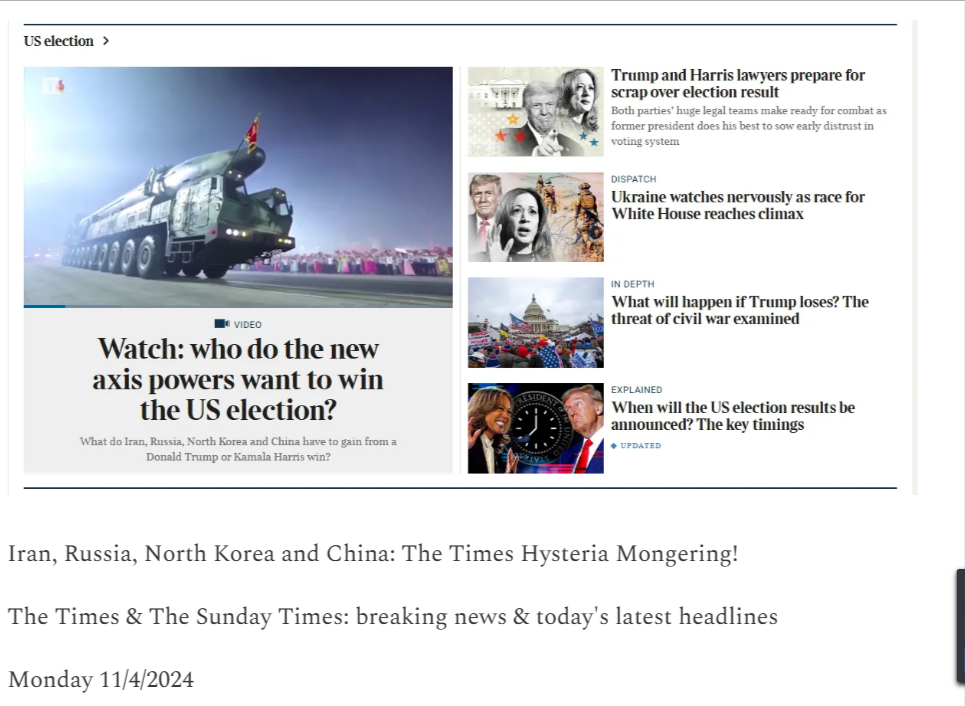
What might The Reader make of this report from The Times of November 3, 2024
Headline: Rachel Reeves: It was wrong to promise I wouldn’t raise taxes
Sub-headline: The chancellor defends her budget and denies it was motivated by class or ideology
Sunday November 03 2024, 12.25pm GMT, The Times
Reeves was asked whether her decision to raise taxes on private schools, users of private jets and multi-million pound farming estates was motivated by class.
“It wasn’t an ideological budget,” she told the BBC’s Sunday With Laura Kuenssberg. “It was a budget where we had to raise £40 billion to put our public finances on a firm footing and also to ensure our state schools, our NHS are properly funded and that we can build the homes and indeed invest in those long-term investment opportunities … to grow our economy and bring good jobs paying decent wages.”
Following a backlash from farmers, Reeves defended her changes to inheritance tax on agricultural estates and said they would only affect the wealthiest landowners.
Notwithstanding Mr. Colvile’s lack of knowledge of Rachiel Reeves statement:
Labour thinks budget is a success — yet concerns mount over what’s next
The chancellor told an admiring Labour Party that they had ‘made our choices’, but the public reception to her far-reaching reforms remains highly uncertain
Friday November 01 2024, 10.10pm GMT, The Times
November 03, 2024, 12.25pm GMT, The Times
A few years ago my colleagues at the Centre for Policy Studies think tank noticed something extraordinary. Boris Johnson’s government was poised to become the first in British history to spend a trillion pounds — not just on Covid firefighting, but every single year.
Last week they noticed something else. Thanks to Rachel Reeves’s budget, that figure has risen. Substantially. In fact, by the end of this decade “total managed expenditure” will top £1.5 trillion.
It is hard to get a handle on how large this number is. By my estimate, if you gave away a £10 note every second, spending £1.5 trillion would take you more than 4,750 years. Lay those tenners end to end and you’d get to the moon and back, 25 times over.
Now, I may have got those calculations slightly wrong. There were a lot of zeroes. But by any metric, this is an absolutely staggering amount of spending — whose growth rate is completely unsupported by the economy that is paying for it.
And this is the underlying truth of the budget — what is behind the record-breaking tax rises, and the extra borrowing too. We are entering the age not so much of the big state but the super-state, the mega-state. As a result of Labour’s decisions, both taxes and spending will hit levels — as a percentage of our GDP — that have never been reached in peacetime, or, in the case of the tax take, in wartime either.
Editor: Mr. Colevile’s above paragraphs, uses the vehicle of Boris Johnson, to act as a rhetorical bridge to a critique of Rachel Reeves’ budget. And the appearance of the rhetorical phantoms of the not just the big state but the super-state, the mega-state. The Regular reader of Mr. Colvile confronts his panic about The State as anathema to the Thatcherite Hayekian civic/political romance!
Reader there are 887 words left of Colevle’s essay yet nowhere to be found is the actual fact, evidence of Tory financial profligacy, incompetence:
Headline: The lost decade: The Tories spent all the money
Sub-headline: The party’s programm of austerity has choked the economy, harmed public services and doubled the national debt.
Since the Tories came into power in 2010, the national debt has more than doubled. It now stands at more than £2 trillion. They have increased the national debt more than every Labour Government combined.
At the last Conservative Party Conference, Boris Johnson applauded the Tories for having “tackled the debt and the deficit” left by the last Labour Government. But, the truth is that the Conservatives have created a huge national debt. The Tories are the real culprits of ‘spending all the money’ rather than the disingenuous phrase of “Labour spent all the money” – which is one of the biggest myths in UK politics. What is also conveniently forgotten is that the Labour Government ran a surplus between 1998-2002 – an achievement almost unparalleled in modern history in the UK.
In 1997-1998, public sector debt as a percentage of GDP was 40.4 per cent; in 2007-2008 it was 36.4 per cent; in 2010-2011 it was 60.0 per cent; and in December 2019 it was 82.9 per cent.
…
Colvile ends his essay here, yet The Reader finds these paragraphs maladroitly comic, tinged with mendacity!
Politically, the great challenge for the government is to show that all this spending actually works — that this great swollen state can actually deliver. For its opponents, the scenario is manna from heaven. If you were trying to come up with the perfect recipe to reconcile the Tories with their electoral base, it would involve stripping benefits from the elderly, a massive tax raid on business, rising gilt yields, hikes in inheritance tax, furious farmers and a general sense that Labour promised the earth to get elected and then instantly reverted to type.
Yet the Tories’ new leader should not be complacent. There is no guarantee that voters brutalised by Labour will return to the blue team, especially given its record in office.
More to the point, even if Kemi Badenoch can pull the Conservatives back into contention, any future Tory prime minister will face the same awful situation. A state for which that £1.5 trillion figure is just a starting point; which despite those huge inputs is still failing to deliver the services its citizens expect, or the growth; which is taxing and spending at rates never before seen.
In short, the challenge for the Tories over the coming decades will be the same as for all Britain’s politicians: wrestling with Leviathan.
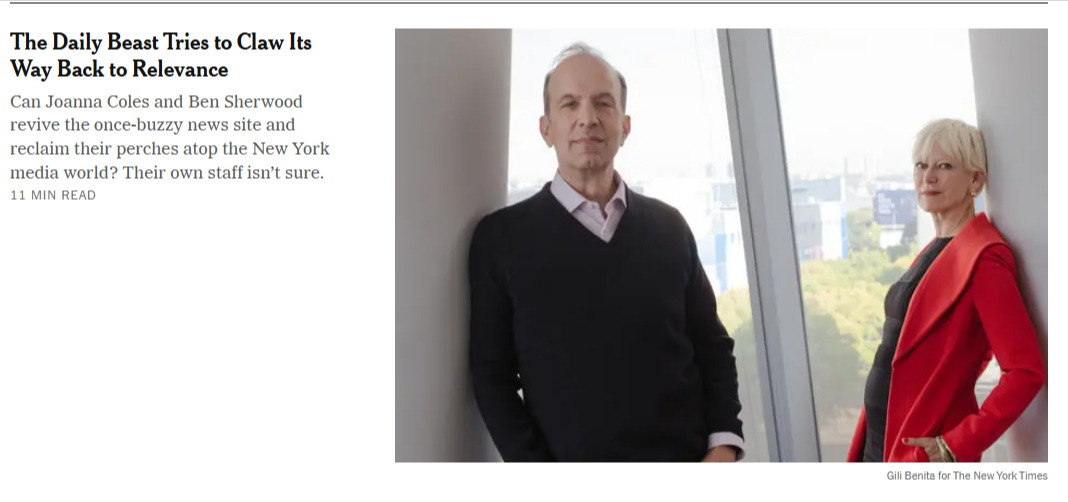
Can Joanna Coles and Ben Sherwood revive the once-buzzy news site and reclaim their perches atop the New York media world? Their own staff isn’t sure.
Ben Sherwood and Joanna Coles took over leadership of The Daily Beast in April with the task of turning the money-losing site around. Credit…Gili Benita for The New York Times
On a sunny morning in early October, Joanna Coles, clad in a stylish tomato-red coat, and Ben Sherwood, dressed more demurely in a corduroy jacket, convened at their regular breakfast spot, the no-frills Star on 18 diner on Manhattan’s Far West Side.
The two veteran media executives were talking about their ambitious plans for The Daily Beast, the 16-year-old money-losing news website, in which they jointly acquired a minority stake in April.
But along with the predictable optimism about the mission they are taking on and enthusiasm about early signs of audience uptick and subscriber growth, Ms. Coles, a former chief content officer of Hearst Magazines, and Mr. Sherwood, a onetime president of ABC News and Disney TV chief, also conveyed a sense of frustration.
Frustration that they weren’t greeted by the staff they inherited as warmly as they expected. Frustration that the site’s tech problems meant they’ve had to buy multiple subscriptions just to log in. Frustration that convincing the newsroom of their editorial vision has been an uphill climb.
Less than three weeks after the pair’s takeover, New York magazine published a detailed report on the friction between reporters and Ms. Coles over story suggestions that they deemed ridiculous, including an investigation into whether former President Donald J. Trump was having stress-induced flatulence during his criminal trial and a list of the most obese members of Congress. (Neither article ran.)
It was clear that many of the sources for the report were inside the organization, with one unnamed staff member bluntly criticizing the new owners’ “warped vision” of the news site.
“This thing came within a day of being sold to the private equity knacker’s yard, where it would have been stripped,” Ms. Coles said later in an interview at The Beast’s offices in Chelsea, using a British term for a slaughterhouse. “In what way is it helpful to tape our conversations and to proudly boast that you are not going to even attempt to look at the stories that your new bosses are asking you to look at?”
“To me, that’s just, like, ‘No wonder the place is going out of business,’” she added.
For his part, Mr. Sherwood was aghast that Beast journalists had anonymously complained about a Daily Beast article on plans by Barron Trump, Mr. Trump’s youngest son, to attend New York University. The article relied on a source of Ms. Coles and was published without a byline.
“That happens to be something that she knew stone cold — her source was solid,” Mr. Sherwood said. “The organization went into a convulsion over this because Joanna did not reveal her source and no one could stand this up with any of their sources.”
Myra: while WWIII simmers, under the hand of The Netanyahu, backed by senile Old Joe, a bought and paid for House and Senate, and a complicit Corporate Media, Katie Robertson provides an amuse-bouche, for those Sunday morning readers of The Paper of Record!
Editor: Mr. Ganesh begins his essay with this ‘The paragraph that follows is the most reluctantly written of my career.’: what might The Reader make of this ‘confession’ of a sort? Could it be hyperbolic? Or just a feint?
Donald Trump qualifies as a titanic success in politics. And not because he got himself elected to the world’s highest office. Someone does that every leap year. It is because he achieved the hardest thing in government, which is to bind one’s successors. He moved the consensus on a big issue — trade — until the next president couldn’t go back, or didn’t want to. Hence the tariffs and subsidies of Bidenomics. Hence the spread of protectionism elsewhere in the world. Most leaders who change the “common sense of the age” need consecutive terms (Reagan) or a crisis (Thatcher) or both (FDR). Trump needed neither to turn an apostasy into an orthodoxy.
Whatever happens next week, we will be living in Trumpland for decades. Yes, I’ll manage, thanks. Besides some marginal trimming of restaurant wine lists, it is odd how little an era of global economic fragmentation incommodes a man. But “we” also encompasses the unknown millions who won’t now be elevated out of low income through trade, as so many Chinese were in the decades either side of the millennium. It includes the political class of Europe, too, which must decide whether to match the American fence. Trump could lose on Tuesday and still untie the west over time via his protectionist successors.
Editor: The Reader might wonder at focus on trade? Is its very remoteness from the usual Anti-Trump propaganda, that makes Ganesh’s essay so appealing? Ganesh just doesn’t shift his argument but expands it both exponentially, and prescriptively in the following.
Rather than mope, wonder how he did it. How does profound and lasting change happen? How does one leave a mark?
On YouTube, videos abound of Trump from the 1980s. He is measured, even soft-spoken, until the subject of trade comes up On YouTube, videos abound of Trump from the 1980s. He is measured, even soft-spoken, until the subject of trade comes up. At that point, a new edge enters the voice and a hint of a snarl contorts the face. Japan is the main target (“They come over here, they sell their cars, their VCRs”) but Kuwait gets some too. And this is on things like Oprah. In temporal terms, we are almost as far from this footage as it was from D-Day. But he still says the same things now about the same subject with the same vehemence.
Editor: Ganesh fails to see that Trump by nature, by design is rabble-rouser: he baits his audience with reports of bad actors.
Editor: Some Ganesh Snapshots:
This is almost all he cares about. (Immigration is a distant second.)
We can mock the primitivity of the economics.
The secret to leaving a legacy is monomania.
Editor: Bill Clinton, a sublime generalist: ornate Oxbridger dreck.
If there is a counter-Trump, it is Bill Clinton, a sublime generalist, his own wonk on most issues, an intelligent tinkerer of tax credits here and diplomatic relations there, but also one of the more forgettable two-term presidents.
Editor: Ganesh ignores the Clintons political romance with The Neo-Liberal Swindle that collapsed in 2007-2008!
In the end, Clinton just didn’t have a paramount obsession.
Editor: Ganesh uses Isaiah Berlin for almost a full paragraph. Although not mentioning the very elastic standards demonstrated by Berlin’s academic politicking!
‘Isaac and Isaiah: The Covert Punishment of a Cold War Heretic
by David Caute
Two high-voltage scholars engage in a bitter conflict in this irresistible tale of principle and politics in the Cold War years
Rancorous and highly public disagreements between Isaiah Berlin and Isaac Deutscher escalated to the point of cruel betrayal in the mid-1960s, yet surprisingly the details of the episode have escaped historians’ scrutiny. In this gripping account of the ideological clash between two of the most influential scholars of Cold War politics, David Caute uncovers a hidden story of passionate beliefs, unresolved antagonism, and the high cost of reprisal to both victim and perpetrator.
Though Deutscher (1907–1967) and Berlin (1909–1997) had much in common—each arrived in England in flight from totalitarian violence, quickly mastered English, and found entry into the Anglo-American intellectual world of the 1950s—Berlin became one of the presiding voices of Anglo-American liberalism, while Deutscher remained faithful to his Leninist heritage, resolutely defending Soviet conduct despite his rejection of Stalin’s tyranny. Caute combines vivid biographical detail with an acute analysis of the issues that divided these two icons of Cold War politics, and brings to light for the first time the full severity of Berlin’s action against Deutscher.
Editor: The final Ganesh paragraph is unsurprising, yet the very nature of Trump, since his Apprentice Circus, is his wayward attention span and volatility. Mr. Ganesh fails to even consider what role Elon Musk might play in the next Trump Administration!
Well, for a reason. It clarifies a lot. *Leaders glamorized as “change-makers” are often bores who grind away at one groove: rolling back the state, or joining the European project (Ted Heath was an immense hedgehog) or leaving it. Watch Trump fulminate about trade in the 1980s, and again 40 years later. The narrowness of his concerns would invite a chuckle, if they hadn’t prevailed.
Rachel Reeves will today deliver the first Labour Budget for 14 years and the first-ever by a female chancellor. It’s a major moment in the UK’s history – even before Reeves has uttered a word. Below I explore what will define her statement.
During the general election campaign, Rachel Reeves appeared trapped in a straitjacket of her own making. By pledging not to raise income tax, National Insurance, VAT and corporation tax, she had ruled out deploying the taxes that account for more than two-thirds of government revenue.
Reeves had also bound herself to fiscal rules that radically limited the scope for investment. In order to meet her promise to reduce government debt as a share of GDP, Labour’s manifesto offered just £4.7bn of extra capital spending. Economists scoffed at its fiscal modesty: call this a growth plan?
But today, in an act of political escapology, Reeves will break free of these constraints. First, she will increase employers’ National Insurance as part of what some predict will be the biggest tax-raising Budget in history (the current record was set by Norman Lamont in 1993). Mindful that this may be her moment of maximum political leverage, Reeves has moved swiftly. Call it the Macbeth Budget: “If it were done when ’tis done, then ’twere well it were done quickly” (as is said of the murder of King Duncan).
The charge that Reeves faces is that she has killed one of Labour’s manifesto pledges. Party aides reject this claim, recalling that the Tories challenged them during the election to rule out an increase in employers’ NI (they didn’t). But what Reeves can’t deny is that this is a tax on business and, indirectly, “working people” – the criticism that she made of Rishi Sunak’s NI increase back in 2022. Expect the Chancellor to argue that the Conservatives’ profligacy left her with no choice. The facts have changed, so she has changed her mind.
Reeves’s second escape act is over borrowing. As first trailed a month ago in her Labour conference speech, the Chancellor will revise her debt rule to create more room for investment. Reeves is set to adopt a measure known as public sector net financial liabilities (PSNFL), which takes into account government assets – such as the student loan book and company shares. This would free up £50bn for investment, but Reeves is expected to settle for around £20bn to reassure the markets. She will also vow not to borrow for day-to-day spending (something that could necessitate future tax rises).
The Chancellor hopes that her extensive pitch-rolling will prevent anything resembling a Truss-style backlash. But more than Sunak’s Budget response – his last major act as leader of the opposition – eyes will be fixed on UK gilt yields (already at a post-election high).
Reeves’s wager is that the short-term pain of tax rises will be offset by the long-term gain of improved public services. This, polls suggest, is what voters expect from a Labour government. The nightmare for Reeves will come if the Conservatives can credibly argue that voters are “paying more for less”. That’s one reason the debate over public sector spending – and reform – is only just beginning.
Good morning, George here. Rachel Reeves’ tax-and-spend Budget represents an unambiguous break with the Conservative years. But while there are a lot of big numbers in the Red Book, they don’t appear in the growth column. That’s the problem I explore below.
This Budget was the one that Labour always promised to deliver – if you listened closely enough. As I wrote before the election, Keir Starmer and Rachel Reeves’ pledge to “prevent austerity” was only achievable through larger tax rises. These, I suggested, would be imposed after Reeves discovered “the books are worse than thought”. That’s exactly what has happened.
The £41.5bn of tax rises announced by Reeves put the UK within touching distance of the western European norm (a tax take of 38.2 per cent of GDP will leave us level with the Netherlands and not far off Germany). Combine this with a new industrial strategy, stronger workers’ rights and the highest public investment since Harold Wilson and a distinctively social-democratic model emerges.
Economic growth is critical to this approach – improved public services and higher living standards for workers depend on it. The problem for Labour is how little of it is predicted. GDP growth is forecast by the Office for Budget Responsibility to average just 1.66 per cent across the five-year period (after a temporary rise to 2 per cent next year). And remember, despite its gloomy reputation, the OBR has generally been overly optimistic in the past.
The outlook for living standards is even grimmer: they are projected to rise by just 0.5 per cent a year on average across the parliament, only slightly higher than growth during the previous Conservative term (0.3 per cent). This, the Resolution Foundation notes, would be the worst performance under a Labour government, lower than the 0.8 per cent growth recorded in the 2005-10 parliament.
Are there any glimmers of hope for Reeves? Labour aides point out that the OBR hasn’t accounted for the potential boost to growth from the government’s planning reforms (as they have yet to be finalised). But these alone won’t have the transformative effect that the Chancellor seeks.
Reeves insists that she doesn’t want a return to either austerity or ever-higher taxes – yet that is the unpalatable choice she faces. Spending on unprotected government departments is currently due to fall by 1.1 per cent a year in real terms after 2025-26. In common with her Conservative predecessors, Reeves has deferred rather than cancelled cuts.
Higher economic growth would help ease her dilemma. That’s one reason we can expect an increasingly animated debate about how to achieve it. Looming over the Budget was Brexit – a word mentioned just once by Reeves (“their Brexit deal harmed British businesses”, she noted of the Conservatives). The OBR’s judgement is as unambiguous as ever: it expects Brexit to “reduce the overall trade intensity of the UK economy by 15 per cent in the long term”.
I’ve long noted the irony that, far from becoming “Singapore-on-Thames”, Britain has embraced a more European model since Brexit: higher taxes, higher spending, more regulation. That is more the case than ever under Labour.
But what still separates the UK from its European peers? It isn’t a member of the single market. As the debate over Labour’s next manifesto begins, this inconsistency will become increasingly apparent.
The New Statesman proclaimes itself to represent:
New Times, New Thinking.
The once Sidney and Beatrice Webb, George Bernard Shaw, John Maynard Keynes magazine is no more. Jonathan Rutherford represents that ‘New Times, New Thinking’?
Headline : How the Corbynite left hit self-destruct
Sub-headline: Andy Beckett’s The Searchers charts the rise and fall of Tony Benn’s heirs, but fails to confront the obstinacy and intolerance that undid them.
This is a story about four left-wing Labour politicians – John McDonnell, Jeremy Corbyn, Ken Livingstone and Diane Abbott – and how they carried forward the cultural revolution of 1968. Inspired and guided by the older Tony Benn, the fifth “searcher” of the title, they single-mindedly enlivened a moribund London Labour politics and transformed the political culture of the capital as it emerged from its postwar decline. In their comradely, disputatious and occasionally angry relationships with one another they shared a political heritage in Benn’s democratic socialism.
In 1981 his bid for the deputy leadership had bitterly divided the Labour Party. He narrowly lost and, unforgiven, suffered the political death of internal exile. A similar fate of banishment awaited three of those he inspired. In 2015, when Corbyn won the leadership of the Labour Party, they took their London politics of economic radicalism and social liberalism on to the national stage. Like all stories of hope and human desire, it ended in tragedy.
Andy Beckett has written a sympathetic and absorbing political history of the main actors of the hard-left Socialist Campaign Group. McDonnell is the intense and thoughtful one, the strategist whom Beckett describes as influenced by the Italian communist theorist Antonio Gramsci. McDonnell will prove to be the most adept in the tactical pursuit of power. Corbyn is the believer who likes people. He wants them to like him, and generally when they meet him they do. Some will come to revere him. Livingstone is the great political talent, and like Corbyn a political obsessive. His cheeky-chappy patter disguises his dark political arts. Abbott stands a little apart and slightly aloof, more guarded in public. She has had to force a trail through racism, insults and ignorance to become the first black female Labour MP. They have all had a tough fight to make their way in Labour politics, but Abbott has had the hardest. It never got easier.
The 1960s was a brief period of social change and upward social mobility. These four individuals – the working-class Abbott, McDonnell and Livingstone, and the middle-class Corbyn – were able to establish themselves as activist leaders of a new metropolitan middle class that eventually came to dominate Labour politics. They pursued their ideal of socialism with tenacity and no little courage, earning themselves both love and hate – the latter at sometimes shocking intensity. And as Beckett makes plain in his title they won “many enemies”.
Of whom I was probably one. There is a brief mention of my role in Labour Together, the organisation that set itself the task of “winning the philosophical, intellectual and policy arguments within Labour”. The purpose was to “build the organisational capacity and political leadership to carry out this project”. That was the idea. Not unlike the project of these four politicians, then. Like them, the 1968 cultural revolution inspired my teenage years. Like them, although I was younger, my politics was formed in the late 1970s and 1980s with the rise of a humanist brand of Marxism and identity politics. But in the end I opposed their political ascendancy in the party.
…
By 2015 Tony Benn had died – the year before, aged 88 – and Livingstone was no longer mayor. McDonnell, Corbyn and Abbott, all now in their sixties, were marginal if troublesome figures in the Labour Party. As Beckett writes, it felt like the Labour left “was passing into history”. But the cooling embers were about to burst into flame. Labour lost the May general election, Ed Miliband resigned, and there was a contest for a new leader.
Should Corbyn carry the torch of the left into the leadership contest? As the deadline for nominations approached he ummed and ahhed. Finally, he agreed. Abbott immediately tweeted out the news before he could change his mind. A short while later McDonnell and his wife were at the Globe Theatre on the South Bank. McDonnell got a call from Seb Corbyn, Corbyn’s middle son, who was working on his father’s campaign. He said: “Dad’s worried about running. He’s worried that he might win”.
He did. In an astonishing populist revivalism, Corbyn united a coalition of the “defeated idealists of the 1970s and 1980s” and the “discontented of the early 21st century”. His election in September 2015 stupefied the political class. And then, a year later, it was knocked sideways by Brexit. The old rules of the game had been torn up. The polarising politics of friends and enemies was back in force.
The centrists and moderates who dominated the Parliamentary Labour Party had no conception of how to respond to the Corbyn leadership. He had attracted a huge influx of new members and created a plebiscite that underwrote his leadership. MPs opposed to Corbyn found themselves under increasing pressure in their constituency Labour parties. In an attempt to unseat him, 20 shadow ministers resigned. They tried a second time to remove him in a leadership contest in 2016. The problem was they had no political alternative to offer. Corbyn increased his vote. They bided their time until the next general election. With Corbyn as leader Labour would suffer a catastrophic defeat.
The 2017 election confounded them again. Labour, after an energetic campaign that was picking up support, lost but increased its vote. A few more weeks of campaigning would have seen it victorious. This was the high point for the four remaining searchers, a “victory” that was actually a defeat. And then the past and their allegiances began to catch up with them. Corbyn’s dramatic elevation into national politics brutally exposed his shortcomings. His naivety in dealing with foreign relations culminated in his questioning Moscow’s involvement in the Novichok poisoning of the former Russian spy Sergei Skripal in March 2018. His support, along with Livingstone and McDonnell, for Irish republicanism and anti-Zionism provided the right-wing press with a rich supply of stories about his meetings with extremists, conspiracy theorists and anti-Semites. Did Corbyn like the country he wanted to lead? His sympathies lay with the historical victims of British imperialism. Its enemies were his friends.
His desire to please everyone and to avoid difficult decisions created a leaderless party. Without political authority, intolerance, intimidation, mob persecutions on Twitter and the booing of journalists became regular features of Labour’s politics. A sanctimonious, cult-like politics grew up around him that identified his enemies and mobilised against them. Beckett makes elaborate efforts to distance Corbyn from the anti-Semitism that took hold and grew in this environment. In doing so, he more or less denies its existence, and cannot admit the paradox that the left too can be a source of evil as well as good.
Livingstone was the first to fall. In 2016 he was suspended for suggesting Hitler supported Zionism. He formally resigned in 2018. The following year Labour suffered a fourth, crushing election defeat. In 2020, under the new leader, Keir Starmer, Corbyn was suspended for stubbornly refusing to accept the scale of anti-Semitism in the party following the investigation by the Equalities and Human Rights Commission. The banishment was completed in March 2023 when the National Executive Committee (NEC), Labour’s ruling body, vetoed Corbyn standing as a Labour MP. The final act came a month later in April 2023 when the Observer published a letter from Abbott in which she argued that Jews, Irish people and traveller communities experience prejudice but not racism. It was sufficient excuse to suspend her from the party. Only McDonnell remained, leading a diminishing and marginalised hard-left faction. The influx of new members under Corbyn went into reverse. By summer 2023, the NEC reported a fall of nearly 170,000 from the peak of 564,000.
Each of Beckett’s five politicians confirmed Enoch Powell’s observation that all political lives end in failure because that is the nature of politics and of human affairs. What were they searching for? They came to represent a politics in search of redemption. The dogmatism and attacks on those perceived to be its enemies did not come from a searching, so much as the belief in a true path from which there can be no deviation. Politics came to stand for a religious quest for the puritan ideal of the city on the hill. That way lies the road to hell, paved with good intentions.
Beckett ends his book in 2023 with a visit to a talk by Bernie Sanders at the Royal Festival Hall. Looking around at the packed audience, Beckett recognises its similarity to Corbyn’s mass meetings. He reflects that it does not look like a Britain whose political time had gone for good. This may be true, but for the searchers of this book and their particular brand of London socialist politics, it has.
The Searchers: ‘, Their Dream of a Different Britain, and Their Many Enemies Andy Beckett Allen Lane, 560pp, £30
Editor: Should The Reader give any creedence to a publication that trades in Anti-Left propaganda, that could have been published in The Telegraph? There can be no doubt that the ghosts of the ‘Fives Rebels’ still haunt the Blairite New Labour, a pastisch, if that’s the right descriptor, of Mrs. Thatcher, but none the less toxic!
Editor: A portion of The Spetator’s Kate Andrews offers what George Eaton cannot!
Part of the problem will be the massive increase in spending on services like the NHS. With more than £22 billion worth of additional day-to-day spending going to the health service (without any reform attached), already public policy circles are doubting that tax and borrowing will stick at the levels announced in yesterday’s Budget. Paul Johnson at the Institute for Fiscal Studies notes how ‘incredibly front loaded’ the borrowing and spending is; ‘day-to-day public service spending, after inflation and the additional cost to public sector employers of rising NI, is set to rise by 4.3 per cent this year and 2.6 per cent next year, but then by just 1.3 per cent each year thereafter.’ Similar to the Tories’ pledge to cut spending dramatically in the years to come, it’s hard to believe Labour really intends to reduce its spending plans so substantially, especially in the run-up to an election. This suggests yesterday’s announcements are the start of what’s to come. Far from giving markets confidence, it’s uncertainty that has come to characterise the government’s borrowing strategy.
It should be said that Reeves is still far off breaking her own borrowing rules. And unlike the aftermath of the mini-Budget, the story of borrowing costs is being told over days, not hours. But costs are still moving in a more expensive direction, which will cause the Treasury plenty of problems, even if no policy undergoes a U-turn. The OBR forecasts that both interest rates and government borrowing costs will be roughly a quarter of a percentage point higher due to Reeves’s plans – but if headline figures settle higher than expected, that will add billions of pounds on to the government’s bills.
Winning over the markets was one of the biggest challenges in Reeves’s first Budget – and borrowing more was always going to be tricky, with the era of low interest rates long gone. So far they don’t seem convinced that this is an agenda for growth, which is why investors want a bigger pay-off for the risk they’re taking. Don’t be surprised if the goalposts shift: the hope for the government now is not that markets celebrate this Budget, but that they come to tolerate it.
Israel’s strikes on Iran are intended to reset deterrence between the countries, preventing a wider war while, somehow, allowing both sides to save face.
If that sounds like mission impossible, it is because the past year shows evidence of a steady climb up the ladder of escalation, resulting in Saturday’s large-scale military action.
The hope that this might mark an end to the trading of missiles can be seen in the announcement by Rear Admiral Daniel Hagari that: “The Israel Defence Forces has fulfilled its mission.” The IDF spokesman added: “If the regime in Iran were to make the mistake of beginning a new round of escalation, we will be obligated to respond.”
Iran’s attack at the start of this month, when about 200 medium-range ballistic missiles were fired at Israel, could not be left unanswered: in the jargon of Israeli securocrats a “re-establishment of deterrence” was needed.
Calibrating that response was difficult. America quickly made clear that it would not support attacks on Iran’s nuclear facilities or oil infrastructure, and during the 25 days of consultations that followed the Iranian missile blitz it was apparent that Israel was working closely with the Pentagon.
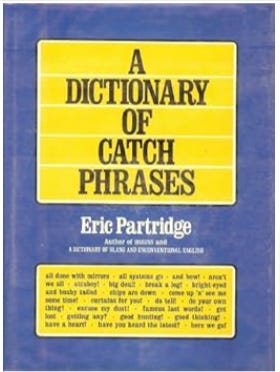
Editor: Mr. Urban ads a new descriptor to the vocabulary of reporters : securocrats. It will not enter Eric Partridge’s book, but reflects the use of language in propaganda: that imitates actual thought, the end of which are political manipulation.
The first sentence of Mr. Urban’s essay is an apologetic framed as ‘allowing both sides to save face’ and other examples of language used for the ends of propaganda.
Israel’s strikes on Iran are intended to reset deterrence between the countries, preventing a wider war while, somehow, allowing both sides to save face.
Editor: Mr. Urban has framed his commentary. Yet let me offer a selection of the reimaging 1106 word of Mr. Urban’s Neo-Jingoism, its not quite Ernst Jünger but wallows in a kind of pastiche of Jünger !
…
Thus, the weapons of choice were F-15, F-16, and F-35 jets carrying long-range missiles — allowing the initial attacks to be launched far from Iranian air defences — and unmanned stealth aircraft.
A leak of US intelligence documents several days ago described Israel’s preparations in detail. American satellites had detected drills in mid-October to fit two types of missile to these jets: one called Golden Horizon, also known as Blue Sparrow, that has a range of up to 2,000km; another, the Rocks, which can be used at a range of up to 300km
…
In April, following an earlier wave of Iranian strikes on Israel, one or more of these missiles was used to attack a radar site. Its role is to suppress such air defences while the aircraft that released it remains far away — for example, over Syria.
…
Iranian media reported that four soldiers in its air defence forces had been killed. As for phase two, Iranian social media feeds showed damage to two factories making missiles and drone parts, south of Tehran, with reports of other sites being hit in two west Iranian provinces.
…
Editor: There is a kind of resignation here, as if the blood-thirsty Netanyahu has not signaled the approach of WWIII!
So is it over now? The White House hopes so, briefing reporters that Israel’s strikes were “targeted and proportionate”, and expressing the hope that this would mark the end of the “direct military exchange” between the two nations. If Iran chooses to hit back, officials said, America would come to Israel’s assistance.
…
By sending extra defensive missiles to Israel, warships to the region and promising to deliver more advanced weapons, the White House gained a significant role in shaping the strikes.
…
Iran’s air defence force issued a statement saying: “Despite prior warnings to the criminal Zionist regime, its provocative actions led to slight damage, which is currently under assessment.”
…
By striking factories on the outskirts of Tehran — at night, to spare large casualties among the workers — the Israelis have demonstrated their ability to brush aside air defences to hit pinpoint targets in the Iranian capital. In subjecting the inhabitants to a night of explosions and uncertainty, they also demonstrated to Iranians the regime’s vulnerability.
…
Editor: It’s exhausting to read Mr. Urban’s long explication of the Crimes of Netanyahu, and his gutless American Allies, in a continuing War that can lead to WWIII. There is no comfort in War, nor in the propaganda that nurtures it, yet the once advocates of political rationalism, have become enmeshed in and willfully blind to a not too distant History !
Editor: The first paragraphs of David Brooks’ lamentations about the approaching America Elections:
I had hoped this election would be a moment of national renewal. I had hoped that the Democrats could decisively defeat MAGA populism and send us down a new national path.
That’s clearly not going to happen. No matter who wins this election, it will be close, and this is still going to be an evenly and bitterly divided nation.
In retrospect, I think I was expecting too much of politics. When certain sociological and cultural realities are locked in, there is not much politicians can do to redirect events. The two parties and their associated political committees have spent billions this year, and nothing has altered the race. The polls are just where they were at the start. If you had fallen asleep a year ago and woke up today, you would have missed little of consequence, except that it’s Kamala Harris leading the blue 50 percent of the country now and not Joe Biden.
It’s clearer to me now that most of the time politicians are not master navigators leading us toward a new future. They are more like surfers who ride the waves created by people further down in the core society.
…
Editor: The Reader need only look to Brook’s ‘The Collapse of the Dream Palaces’ as paradigmatic, of the propaganda produced since. Here is a link to my July 10, 2019 commentary on that political intervention:
Editor: What follows this lamentation, is a 990 word Potted History, made to measure: in the name invoking a kind of clarity, let me choose just ten quotations from this Historical Pastiche:
…
Waves of immigration swept across the country, transforming urban America. Political corruption was rampant in cities, and political incompetence was the norm in Washington, D.C.
…
But other movements did indeed produce rebirth. First there was a cultural shift. The cutthroat social Darwinist philosophy was replaced by the social gospel movement, which emphasized communal solidarity and service to the poor.
…
At the top of society, moguls like J.P. Morgan imposed order on the corporate world to reduce boom and bust. Philanthropists like Andrew Carnegie and John Rockefeller built libraries, museums and universities.
…
Today we face another great civilizational question: How can we create a morally cohesive and politically functional democracy amid radical pluralism and diversity?
…
Our nation still lacks the sense of social and psychic safety that would allow us to have productive conversations across partisan difference. We still lack a national creed or a national narrative that would give us common ground among competing belief systems.
…
Groups like Occupy Wall Street and Black Lives Matter burst to the fore. Racial equity programs were sweeping across corporations and campuses.
…
The country is moving rightward on issues like immigration and economics, and Kamala Harris is moving with it.
…
It’s simply unfair to ask Harris, who has been a presidential candidate for all of three months, to lay out a vision for comprehensive national renewal under these conditions.
…
Even today we are enjoying a period of economic renewal that makes America, as The Economist put it, the “envy of the world.” It’s our social and political relationships that have turned poisonous, producing exhaustion.
…
Editor: The final paragraphs Brooks historico-political intervention:
In 1902, the psychologist William James wrote a book about conversion experiences called “The Varieties of Religious Experience.” Occasionally, he wrote, some belief or vision touches people at “the hot place in a man’s consciousness,” the “habitual center of his personal energy.” These visions arouse great fervor, shake loose existing assumptions and lead, often enough, to heroic action.
Damn Great Empires! provides a new perspective on the works of William James by placing his encounter with American imperialism at the center of his philosophical vision. This book reconstructs his overlooked political thought by treating James’s anti-imperialist Nachlass—his speeches, essays, notes, and correspondence on the United States’ annexation of the Philippines—as the key to the political significance of his celebrated writings on psychology, religion, and philosophy. It shows how James located a craving for authority at the heart of empire as a way of life, a craving he diagnosed and unsettled through his insistence on a modern world without ultimate foundations. Livingston explores the persistence of political questions in James’s major works, from his writings on the self in The Principles of Psychology to the method of Pragmatism, the study of faith and conversion in The Varieties of Religious Experience, and the metaphysical inquiries in A Pluralistic Universe. Against the common view of James as a thinker unconcerned with questions of politics, this book places his writings in dialogue with champions and critics of American imperialism, from Theodore Roosevelt to W. E. B. Du Bois, as well as a transatlantic discourse of modernity, in order to excavate James’s anarchistic political vision. Bringing the history of political thought into conversation with contemporary debates in political theory, Damn Great Empires! offers a fresh and original reexamination of the political consequences of pragmatism as a public philosophy.
For a whole society to change, the people in the society have to want to change themselves. A smug, self-satisfied, “I am right” nation is going to be perennially stuck in place.
King Charles has acknowledged the “pains of the past” in an attempt to smooth over the ongoing row about reparations for Britain’s role in the slave trade.
Speaking on the first full day of the Commonwealth Heads of Government Meeting (Chogm) in Samoa, the King called for “ways to right enduring inequalities” but avoided taking sides in the diplomatic dispute between Sir Keir Starmer and Caribbean leaders calling for compensation.
He said: “I understand from listening to people across the Commonwealth how the most painful aspects of our past continue to resonate. It is vital therefore that we understand our history to guide us to make the right choices in the future … None of us can change the past, but we can commit with all our hearts to learning its lessons and to finding creative ways to right inequalities that endure.”
…
Editor: the responses to the Kings comments should not surprise!
As a series of Labour MPs called on the government to discuss reparations, chancellor Rachel Reeves was asked on a trip to Washington if Britain could afford to pay them. She replied: “No”.
Sir Keir is expected to be pressed on the issue personally while in Samoa, after the prime minister of the Bahamas Philip Davis said he wanted a “frank talk” with the PM on the issue, while Fred Mitchell, his country’s foreign affairs minister, said it was “only a matter of time” before the Labour leader changed his position.
At the summit, Sir Keir said that this generation should have a conversation about the history of slavery but said that the UK should be “forward looking” in its stance on reparations.
He told the BBC: “We should look at what are today’s challenges in this group of countries represented here today.
Asked if he thinks this generation can be held responsible for the actions of their forebears, Sir Keir told the BBC: “I think our generation can say the slave trade and practice was abhorrent, and we should, you know, we talk about our history. We can’t change our history, but we should certainly talk about our history.”
…
And ex-shadow chancellor John McDonnell, currently suspended from the party after he voted against the government to scrap the two-child benefit cap, told The Independent: “The argument Keir Starmer is putting forward is that the Commonwealth should focus on the present and future fails to understand that addressing the past is not a distraction but is essential to dealing with the future.“
“To have a Labour prime minister and foreign secretary simply repeating the policy of the Conservatives virtually word for word is extremely disappointing.”
…
Editor: there is no difference between the Tories and New Labour except for Corbyn wing of the Party, long since purged, yet it’s ghost still hold sway on issues like reparations, as John McDonnell’s wan quote demonstrates?



 StephenKMackSD's Blog