Newspaper Reader fights the crowds…

Dec 30, 2024
Editor: In the small print :

Newspaper Reader.
Dec 30, 2024
Editor: In the small print :
Newspaper Reader.
Dec 29, 2024
Editor: Under the rubric of ‘THE SUNDAY TIMES VIEW’
Headline: The age of uncertainty is here to stay — so let’s embrace it
When Labour last won a landslide victory, in 1997 under Tony Blair, it took a long time for voters to become disenchanted. Mori had Labour with a 29-point lead over the Tories in December 1997, seven months after the election. That was the platform on which Blair built three strong election victories.
Today under Sir Keir Starmer things could hardly be more different. As we report today, a large-scale, seat-by-seat polling analysis by More in Common shows that if there were to be an election now, Labour would lose nearly 200 seats and its majority, finishing only slightly ahead of the Tories, with Reform UK, the Liberal Democrats and the Scottish Nationalists winning dozens of seats. At first blush the analysis merely tells you Labour has shot itself in the foot repeatedly since the election, making enemies and few friends. The real cause, though, arguably goes far deeper. It is down to political fragmentation, which increasingly describes the world that we are in.
The clues were there at the time of the July general election. Turnout was a paltry 59.7 per cent, and of that the combined vote share of the two main parties, Labour and the Tories, was only 57 per cent. Only 20 per cent of those entitled to vote backed Labour, 14 per cent the Tories.
If the analysis we are reporting today provides anything like a glimpse into the future, the fragmentation we saw in July 2024 is a mere taster. No workable coalitions could be established. It would be like importing the present French or German instability into the UK, something that first-past-the-post is meant to prevent.
….
Editor: Reader recall the dismal record of this newspaper for ‘truth telling’? This just a sample of the defamation that Corbyn suffered from all British Corporate Media !
Headline: Biography
Review: Dangerous Hero: Corbyn’s Ruthless Plot for Power by Tom Bower — portrait of a monomaniac
If Jeremy Corbyn became prime minister, he would easily be the most dangerous, most indolent and least intelligent holder of the office in history
Review by Dominic Sandbrook
Sunday February 24 2019, 12.01am GMT, The Sunday Times
Editor: given this reprehesable record of lies, how might the Reader treat this wan apologetic for Tony Blairs political catamite Kier Starmer ? The diagnosis of the present is thin, and carelessly refracted through a politically self-serving characature of a past!
This fragmentation has not happened in a vacuum. People are probably more cynical about politicians than they have ever been. Years of slow growth, high immigration and squeezed living standards, and of high taxes alongside crumbling public services, have created permanent disquiet and turbocharged Reform UK. The world is also increasingly splintered — worryingly so. It is not that long since post-Soviet Russia, even under Vladimir Putin, was being embraced. For a while, the G7 was the G8. Less than ten years ago, too, under David Cameron’s “golden era” of relations with China, the then prime minister posed with a pint in a pub with Xi Jinping.
Editor : ‘Growth’ is the very linch-pin of Neo-Liberalism , no matter how they self-present , in the guises adapted for the self-serving present! The final paragraph of the essay is just reiteration, in political costume!
Otherwise the future looks painful: a slow march to an election in which “none of the above” is the favoured choice. UK elections are by tradition won in the centre ground. But it would be a mistake to rely on this. The age of uncertainty is here to stay. The challenge for Starmer, and other western leaders, is to embrace it
Newspaper Reader.
Dec 28, 2024

Pressing question: how long will the Trump/Musk allience last?
(Under the rubric of Self-congatulation) According to popular legend, after his abjuration Galileo allegedly muttered the rebellious phrase “and yet it moves” (Eppur si muove)
Dec 28, 2024
Editor : The Reader has to wonder at Andrews enthusiasm for Milei, after the Economic Catastprohie 2006-2008, that brought The West into Economic Crisis, and destroyed both the working class and the middle class, in Western Democrasies. Yet The Reader of this interview is confronted by Andrews enthusiasm, for a politics that didn’t just fail, but utterly collapsed and emisertated millions across The West for decades! Such is the the political fact of the Hayek/Mises/Friedman Swindle!
Editor: here are the final paragraps of this would-be hagiography freighted with the necessary Neo-Liberal political ballaist:
…
In speeches and interviews, Milei effortlessly pulls out quotations and themes from great free-market works, such as Friedrich von Hayek’s The Fatal Conceit or Ludwig von Mises’s Socialism. He talks about the ideas and philosophers that shaped his libertarian thinking. But what attracted him to those ideas in the first place?
‘I am a true libertarian,’ he says. ‘I see the state, government, as an oppressive machine which destroys rights, which destroys liberty. I see taxes as theft, I see the state as an organised criminal gang.
…
I ask Milei if Trump is a conundrum for libertarians. On the one hand, he offers domestic tax cuts and a commitment to free speech. On the other, he proposes tariffs and economic protectionism. Does Milei think the positive case outweighs the negative case, or does he think Trump – who says that ‘tariffs’ is his favourite word apart from ‘love’ and ‘religion’ – is bluffing to secure trade deals?
‘First of all, what I do commend and welcome about Trump is that he understands who the enemy is. He understands that woke-ism is the enemy, he understands that the enemy is socialism, that the enemy is the state… on the second thing, I believe all the accusations levelled against him about the tariffs vis-a-vis China are wrong, they’re incorrect, so I don’t really take that point. I think one should try to understand how the system works.’
Milei’s free-market radicalism is tempered, then, by his realism when it comes to politics and the way the world operates. He calls himself an anarcho-capitalist in ‘philosophical terms’, but in ‘real life’ he says he hovers ‘between a classical liberal or libertarian and a minarchist’. He is critical of the purists, the ‘liberal libertarians who strongly criticise me for not having lifted the currency controls on day one’ – a major move towards liberalisation that still has not happened. ‘If I had done that on the very first day, it would have caused hyperinflation and by January I would have been thrown out.’
Milei is also a fan of Boris Johnson, and the two met in Buenos Aires in October. ‘We had a wonderful conversation,’ he says. ‘[Johnson] brought me his book, and we talked about economics and we discussed the philosophical approach. Naturally, he is closer to being a more classical liberal… I really enjoy having the opportunity to talk to other leaders and I try to internalise the restrictions they face.’
Johnson is not the only former prime minister to have made an impression on Milei. He describes David Cameron as a ‘brilliant individual’ – and he’s spoken to both Johnson and Cameron about his hopes of meeting Mick Jagger when he comes to the UK. ‘I would also like to meet Keith Richards. I have the full collection not only of the Rolling Stones but also of the Beatles.’ Milei often speaks about his love for the Rolling Stones, but his Anglophilia runs much deeper than that.
‘One thing that also brought me very close to British culture was Lord Byron, especially when I read “Don Juan”. I thought it was amazing. In fact, when I bought the book, I had it in English and in Spanish, and when I read it in English I really enjoyed it much better than in Spanish.
‘Of course, Shakespeare also brought me close to British culture. There are many things I find very appealing about the UK, apart from the fact that you invented football but of course we are the best ones.’ Fighting words, I say. We won’t fight about it, he tells me reassuringly, ‘but we are better!’.
Given his enthusiasm for Britain, and presumably his classical liberal belief in the right to self-determination, I wonder how Milei defends Argentina’s position on the Falkland Islands – or what the Argentinians call Islas Malvinas. In a referendum in 2013, 99 per cent of Falklands residents voted to remain British. ‘We have a sovereignty claim,’ he says. ‘We believe that our foundations, in support of the claim, that the Malvinas are Argentine, so we will seek through diplomatic channels to recover them.
‘The people of Argentina elected me as President. In that context I recognise the Malvinas Islands as Argentine, and I will make every diplomatic effort to recover them and that’s part of my policy… you may like my proposals or not, but you won’t say that I’m not consistent.’
On trade, Milei is certainly consistent: the more, the better. He wants to ramp up relations with Beijing, for instance, just as Trump’s America seems to be decoupling from China. He had a sideline meeting with President Xi Jinping at the G20 to discuss further opportunities. How does a libertarian president deal with an authoritarian communist world leader?
‘What is my job today? President of Argentina. And I need to take care of defending the interests of the people of Argentina and improving the quality of life of the Argentine people,’ he says. ‘China is a natural partner for us. And let me tell you something, I was pleasantly surprised by the way that China works with other countries, in that it’s a very friendly partner… it is a trading partner that does not interfere, that causes no nuisance.’
It’s a glowing description of the world’s second-largest economy. ‘Honestly,’ he says, ‘I am very much surprised by the respectful way they have treated us.’ He then remembers the largest economy, and smiles. ‘And at the same time, I am really filled with joy by the way the Republican party in the United States treats us.’ There might come a point, soon, when he has to choose between the two.
Editor: What does the Buenos Aires Herald of December 15, 2024 have to say:
Tuesday marked one year since President Javier Milei took office, and he took to the airwaves to deliver a national address in which he promised to eliminate 90% of taxes, get rid of currency controls, and allow Argentines to spend dollars alongside pesos. Alongside promises of a near prosperous future thanks to policies for the “common man” was the usual “anti-caste” rhetoric. Warnings against opposing government reforms peppered the speech: “You can either get on the train or be run over by it.”
A common refrain among Milei’s supporters is that he is not a far-right government. He’s simply trying to implement policies in Argentina that are common among pro-market governments all over the world, and he values liberty above all things. Sure, he says some wild things, but that’s his personal style, and we shouldn’t take it literally. What’s far-right about all that?
It’s true that many of Milei’s economic policies are relatively common elsewhere. But some mark a throwback to the 1990s in their singular belief that a free market and a small state cure all ills, despite a deluge of subsequent studies that found that these policies tend to increase inequality and concentrate wealth at the top.
In Argentina, the litmus test for whether a political figure was far right, as opposed to simply conservative, has mostly been their support — either outspoken or veiled — for the military dictatorship’s narrative about political violence in 1970s Argentina.
As democracy advanced, the Argentine political and judicial system progressively reached a popular consensus that what the military called the “Dirty War” was actually a ploy to disguise the horrific truth: that the dictatorship had run a systematic plan to disappear and murder a portion of the population that opposed the imposition of their political order. This scheme also included an ultra-liberal economic program that increased foreign debt, hindered industrialization, and left an accumulated inflation rate of more than 8,000%.
In the 1990s and early 2000s, calls for “a complete memory” were only marginal. Included in this group, essentially proponents of the denialist “Two Demons Theory” that equated state terrorism with the armed resistance groups, were a few former dictatorship officials, as well as the relatives of military officers — current VP Victoria Villarruel being one of them — who were finally being tried and sentenced for crimes against humanity.
By 2015, the consensus was so well-grounded that PRO leader Mauricio Macri, who had previously echoed some of the dictatorship’s ultra-right rhetoric, notably had to tone it down when becoming president. It was actually during his administration that the ESMA Museum and Site of Memory officially opened, following years of work under the Kirchners’ presidencies. In 2016, during Barack Obama’s official visit to Argentina, Macri even joined the former US president in honoring dictatorship victims at the Parque de la Memoria for the 40th anniversary of the coup.
But now, Milei has vindicated the sectors of the Argentine far-right that deny the dictatorship’s crimes and demonize human rights groups like Mothers and Grandmothers of Plaza de Mayo. This has come in the form of rhetoric describing state terror as a “war,” disputing the number of the dictatorship’s victims, and calling human rights organizations’ work a “con” ( curro ). He has also followed the strategies of other far-right world leaders, who have turned “culture wars” into the rallying cry of their base.
The issues within this category range from reproductive rights and protection of LGBTQIA+ people to attacks on immigrants and Indigenous people. Milei has also included targets of his own, bashing groups that have historically been at the center of Argentina’s civil society and are a source of pride for the country, like public universities, film institute INCAA, and the top publicly-funded research institute CONICET.
The president has consistently sought to include these actors within the “caste” by accusing them of being privileged sectors that use public resources that do not yield any benefits for the population. By beating this drum, Milei has managed to tune in to one of the most effective strategies of the global far-right: the battle of elites versus commoners.
In Milei’s unique Argentina-centered vision of this conflict, the dilemma is between sectors or individuals that depend on the state for financing, no matter their mission, importance, or success, and the rest who have to cover it out in the wilderness of the “free market.” The president thanked such Argentines specifically for their sacrifice at the top of his December 10 speech.
His security policy has swung towards punitivism, with Security Minister Patricia Bullrich explicitly looking to Salvadoran strongman Nayib Bukele’s system of mega prisons. The government also lowered the minimum age to carry firearms legally and will also seek to reduce the age of criminal responsibility, according to Milei’s speech on December 10.
Policies have so far been regressive, in the sense that poverty exploded by 11 points and inequality, as measured by GINI coefficient, spiked. And although formal salaries may be starting to gain ground against inflation, workers in this sector have lost 6% of purchasing power since Milei came into office. It should also be noted that informal workers have lost even more.
His supporters might argue that such economic hardship is a necessary price to pay to wrestle the country into shape after what they see as years of aberrant and ruinous policies: better to rip off the band-aid than incur more suffering because nothing changes.
Relying heavily on free market principles without considering their potential social impacts can lead to negative consequences, such as increasing poverty. It’s essential to strike a balance between economic growth and the well-being of all citizens to ensure that progress doesn’t come at the expense of the most vulnerable.
These costs have moved in lockstep with deliberate attacks on the rights of women, minorities, and Argentina’s national memory about state terror. To argue that such positions are merely conservative or right-of-center rather than far-right implies normalizing that which can never be normal.
Argentina completes one year under the extreme right
Milei’s defenders dispute this category, but rejecting it implies normalizing aberrations
Tuesday marked one year since President Javier Milei took office and delivered an inaugural address in which he promised to eliminate 90% of taxes, lift the currency controls and allow Argentines to spend dollars alongside pesos. Along with promises of a prosperous future thanks to policies for the “common man” was the usual “anti-caste” rhetoric. The speech was peppered with warnings against those who oppose government reforms: “Either you get on the train or it runs you over.”
A common refrain among Milei’s supporters is that his is not a far-right government. He is simply trying to implement policies in Argentina that are common among pro-market governments around the world, and he values freedom above all else. True, he says some crazy things, but that is his personal style, and we should not take him literally. What is far-right about all this?
It is true that many of Milei’s economic policies are relatively common elsewhere. But some of them date back to the 1990s, with his singular belief that a free market and a small state cure all ills, despite the avalanche of subsequent studies that found that these policies tend to increase inequality and concentrate wealth in the hands of a few.
In Argentina, the litmus test for determining whether a political figure was far-right, rather than simply conservative, has largely been his or her support, overt or veiled, for the military dictatorship’s narrative about political violence in 1970s Argentina.
As democracy advanced, the Argentine political and judicial system gradually reached a general consensus that what the military called the “dirty war” was in fact a ploy to disguise the horrible truth: that the dictatorship had carried out a systematic plan to disappear and murder a part of the population that opposed the imposition of its political order. This plan also included an ultra-liberal economic program that increased the foreign debt, slowed industrialization and left an accumulated inflation rate of more than 8,000%.
In the 1990s and early 2000s, calls for a “complete memorial” were marginal. This group, essentially supporters of the denialist “two demons theory,” which equated state terrorism with armed resistance groups, included some former officials of the dictatorship, as well as relatives of repressors (among them the current vice president Victoria Villarruel) who were finally being tried and convicted for crimes against humanity.
By 2015, that consensus was already so well cemented that PRO leader Mauricio Macri, who had previously echoed some of the dictatorship’s far-right rhetoric, had to moderate noticeably upon becoming president. Indeed, it was during his administration that the ESMA Museum and Site of Memory was officially inaugurated, after years of work during the Kirchner presidencies. In 2016, during Barack Obama’s official visit to Argentina, Macri even joined the former US president in honouring victims of the dictatorship at the Parque de la Memoria on the occasion of the 40th anniversary of the coup.
But now, Milei has vindicated sectors of the Argentine far right that deny the crimes of the dictatorship and demonize human rights organizations such as the Mothers and Grandmothers of Plaza de Mayo. This has happened in the form of rhetoric that describes state terrorism as a “war,” questions the number of victims of the dictatorship, and calls the work of human rights organizations “a job.” She has also followed the strategies of other far-right world leaders, who have turned “culture wars” into the rallying cry of their base.
Topics within this category range from reproductive rights and the protection of LGBTQIA+ people to attacks on immigrants and indigenous peoples. Milei has also added her own targets, attacking groups that have historically been at the center of Argentine civil society and are a source of pride for the country, such as public universities, the national film institute (INCAA) and the main publicly funded research institute (CONICET).
The president has constantly sought to include these actors within the “caste,” accusing them of being privileged sectors that use public resources and do not provide any benefit to the population. With this song, Milei has managed to tune in to one of the most effective strategies of the global extreme right: the battle of the elites against ordinary people.
In Milei’s particular view of this conflict, which is focused on Argentina, the dilemma is between the sectors or individuals that depend on the State for their financing, regardless of their mission, importance or success, and the rest who have to make do in the desert of the “free market.” The president specifically thanked those Argentines for their sacrifice in the first part of his speech on December 10.
Its security policy has veered toward punitivism, with Security Minister Patricia Bullrich explicitly resorting to Salvadoran dictator Nayib Bukele’s mega-prison system. The government has also lowered the minimum age for legally carrying firearms and will seek to lower the age of criminal responsibility.
Policies so far have been regressive, in the sense that poverty has grown by 11 points and inequality, as measured by the GINI coefficient, has soared. And while formal wages may be starting to gain ground against inflation, workers in this sector have lost 6% of their purchasing power since Milei came to power. It should also be noted that informal workers have lost even more.
Milei’s supporters might argue that such economic hardships are a necessary price to pay to get the country moving again after what they see as years of aberrant and ruinous policies: it is better to rip off the band-aid than to continue suffering because nothing changes.
Over-reliance on free market principles without considering their potential social impacts can lead to negative consequences, such as increased poverty. It is essential to strike a balance between economic growth and the well-being of all citizens to ensure that progress does not come at the expense of the most vulnerable.
These costs have come in tandem with deliberate attacks on women’s rights, minorities, and Argentina’s national memory of state terrorism. To argue that such positions are merely conservative or center-right rather than far-right is to normalize something that should never be normal.
https://buenosairesherald.com/op-ed/editorial/argentinas-first-year-under-the-far-right
Newspaper Reader.
Dec 27, 2024
Bill Ridgers ‘Senior digital editor’ sends me a personal note from The Economist’s ‘Best CEO of 2024’ and ‘the most ruthless CEO in the trillion-dollar tech club’ !
Dec 22, 2024
Opinion: Populism
Headline: Economics can’t explain all the anger of voters
Sub-headline: If it did, the US should have much healthier politics than Europe
Janan Ganesh
Editor: Mr. Ganesh specialises in ‘Pop History’ that acts the part of the actual thing itself , without its reilization. Its fluidity of application to various iterations is the key to the ‘Ganesh Methodology’. Reader I’ll begin here:
Except for the most tiresome pedants, who celebrated the millennium on January 1 2001 rather than 2000, we are nearing the quarter-point of our century. What are the surprises so far? What would people have found hard to believe 25 years ago?
…
Here’s another. The US would outclass Europe in economic growth, and be no happier for it. If people ultimately vote on their material experience — a common sense thing to suppose —
…
How odd. Perhaps what voters do is compare their economic experience with that of their own forebears, not with that of contemporaries in other countries. The data that matters is longitudinal, then, not latitudinal.
…
In the 1980s, Sinn Féin won 1 or 2 per cent of the vote in Irish general elections. In the noughties, this went up to around 6. Though it didn’t break through, the party scored 19 per cent in last month’s election.
….
It has to reckon with the fact that Ireland, despite a savage crash in 2008, is richer than it was a couple of generations ago, and to little obvious glory for the established political order that oversaw most of that success.
…
Greece, which had a scarring economic experience in the last decade, and an excuse to turn to the fringes, has a prime minister who is the toast of international moderates. Italy, which underwent less structural reform, has a populist. Not only is there no faithful correlation between economic circumstances and political choices, there isn’t even a useful line of best fit.
…
If not just economics, then, what is bugging voters? Immigration, in large part. But even this isn’t a clincher.
…
Another explanation for what is going on is “hedonic adjustment”. As incomes rise, so do expectations. Voters become quicker to revolt. In other words, economics is decisive, but not how you’d imagine.
…
This was Joe Biden-ism. In fact, it is much of western liberalism. There is impeccable common sense to it, but also an intellectual ponderousness. Conservatives have been quicker to intuit that stranger forces than material interest are at work in the world, and to master them.
…
Just to stipulate, then, I’m a growth zealot. I want 20mn Londoners, not 10mn. But the case for growth must be that it is good in and of itself, that more stuff for more people is intrinsically worthwhile, that romanticising the pre-industrial world is imbecilic tweeness.
…
Editor: Ganesh flirts with the evocative fragment as I present it, as an itegral part of my self-seving critique! Yet his final paragraph ends in another collection of more of the same: I’ll repeat: ‘Mr. Ganesh specialises in ‘Pop History’ that acts the part of the actual thing itself , without its actual reilization. Its fluidity of application to various iterations, is the key to the ‘Ganesh Methodology’. In the end it resembles a riff on kitsch !
In fact, the causal link between economic performance and political outcomes has broken down in both directions. Not only can a nation have a thriving economy to no obvious benefit to its politics, it can sustain awful politics without incurring economic damage. At this time of year, we are asked to reflect on all the things in life that money can’t buy. To “love” and “class”, add civic sanity.
Newspaper Reader
Dec 22, 2024
Headline: It seems everyone but Justin Trudeau knows it’s time for him to go. Why is it so hard to quit?
Sub-headline: The prime minister is in the fight for his political life. But deciding to back out is harder than it may seem.
This reader must first recognise Mark Colley exceptional reporting on Justin Trudeau! He quotes :
“It was very hard,” said Kathleen Wynne of her experience in the 2018 Ontario election, when as premier she suffered a stunning loss that reduced her Liberal party to seven seats before she resigned as party leader. “The whole thing was brutal because it did feel like, as the leader, I was letting people down and that’s a horrible feeling.”
….
Knowing when to quit is part of the dilemma.
There are signs. According to Raymond Blake, a professor at the University of Regina who specializes in 20th century Canadian politics, two of the biggest are public and party discontent. A lapse of judgment is another. Failure to meet expectations, too.
But even with the signs, it can be hard to quit. History is littered with examples of those who have hung on past their expiration date.
“It’s really, really tough for anyone who’s at the top of their game to give it up,” Blake said. “Walking away is tough.”
…
Psychologically speaking, our careers become deeply ingrained in who we are, according to Marie-Hélène Budworth, the director of York University’s school of human resource management who has a PhD in organizational behaviour. At a dinner party, the answer to the question “Who are you?” is often occupation.
Quitting leaves the quitter searching for a new answer.
“It can be a real struggle to make the decision to leave it behind,” Budworth said, “because you’re leaving part of your identity.”
This dilemma, of course, is only exaggerated for a role as public-facing as the prime minister of Canada.
Budworth also suggests social circle could play a role in Trudeau’s decision. Often, the people around us agree with our views. It can create the notion of a false consensus — that most people are on my side because this small group is.
And there’s also the public consequences of quitting.
“We live in a world where quitting is often seen as failure,” Budworth explained. “Someone who quits couldn’t hack it. They couldn’t make it work.”
It doesn’t help people aren’t good at remembering accomplishments, Budworth said. Instead, our nature is to simply remember how something ends. Thus, leaving in a cloud of controversy “does leave a lasting scar,” Blake said.
It impacts legacy. Rehabilitating public opinion is a natural process for any public leader once they’ve left office. Trudeau’s legacy will be damaged if he leaves now, but it will suffer even more if he sticks around and is crushed in the next election, Blake predicted.
…
Compare this above selection from Mark Colley insightful reporting, though he does miss the the disturbing fact of Freedlands Ukranian connection as reported in his own newspaper :
The controversy over Chrystia Freeland and the red Ukrainian scarf, explained
Deputy Prime Minister Chrystia Freeland has been caught in a controversy over a red and black scarf.
March 2, 2022
Editor : Matthew Kaminski at Politico:
Headline: Trudeau’s Top Lieutenant Resigns With a Bang
Sub-headline: Chrystia Freeland is a serious woman. She spent a decade at the right hand of an unserious man, Justin Trudeau. Her resignation on Monday was shocking in its bluntness — and in its impact on politics north of the border.
https://www.politico.com/news/magazine/2024/12/17/canada-trudeau-freeland-resignation-00194785
What a crazy month for geopolitical bingo. Who had a successful Syrian revolution on their card? Or martial law in South Korea? Or, a world-class-worthy-of-Shakespeare political drama in Ottawa?
The day up north began with a resignation letter from Canadian Deputy Prime Minister and Finance Minister Chrystia Freeland. Before anyone dares to suppress a yawn — and I am well aware that New York Times columnist Flora Lewis’s “Worthwhile Canadian Initiative” won the New Republic’s prize in 1986 for most boring headline ever written — this was no ordinary letter. Chrystia Freeland is no ordinary politician.
Freeland is, first of all, a journalist. She can write. She has also, going back to 2013 when Justin Trudeau recruited her from the ink-stained world, been steadfastly loyal to him. In her various cabinet posts after Trudeau and the Liberals won power two years later, Freeland kept the rapier always sheathed. In words spoken and written, she was measured. A team player, always. Old friends from the Financial Times, her professional home for many years (where for three years in the mid-1990s she was my boss), were amazed/annoyed by how disciplined she was when they had to cover her. Chrystia was no Boris, as in former British Prime Minister Johnson, another hack-turned-pol, who was desperate to charm and entertain his old pals in the trade. Then Monday came her letter, published on X.
…
As for the letter itself, you don’t have to know anything about Canadian politics to appreciate the sight of a rhetorical rapier plunged straight in in the bright light of day. You tried to demote me, she writes, so I quit. She didn’t need to say it but it was noticed that Trudeau did the same to other prominent women in his cabinet, and Freeland wasn’t going to let him do it to her. She was building up her steam. “You and I have found ourselves at odds,” she writes. I see President-elect Donald Trump’s “aggressive economic nationalism,” in the form of tariffs, as “a grave challenge,” she writes. You, Dear Justin, are into “costly political gimmicks” — the details here are boring but basically involve fiscal giveaways over the holidays — “which we can ill afford.” You are unserious, she implies. Then she lays out what it “means” to be “serious.” To act in “good faith and humility,” to face “the threat” from Trump, to be a nation “strong, smart and united.” You, Pretty Boy, are not able to lead this kind of Canada. I am. I’ll be running for my seat in the next election, she writes. And as everyone can read between the lines, I’ll be running to lead the party.
…
Editor: Matthew Kaminski wallows in it! It’s almost like reading Puck! He then expolores on it periphery Freedland Ukraine connection in its carfully scrubbed version:
On the world stage, Freeland was a particularly prominent voice on behalf of Ukraine, the birthplace of her mother Halyna, where both of them worked in the early days of its independence. She was taken very seriously in G7 finance and foreign policy councils, even though Freeland was speaking on behalf of a country that — unwilling to spend on defense, falling well short of the NATO minimum guidelines of 2 percent of GDP — was itself not taken seriously.
Editor: Here is the un-laundered version
Headline: Chrystia Freeland’s ties to Ukrainian nationalists reveal a double standard
Sub-headline: The deputy prime minister was photographed with a scarf associated with the Ukrainian far-right at a demonstration in Toronto
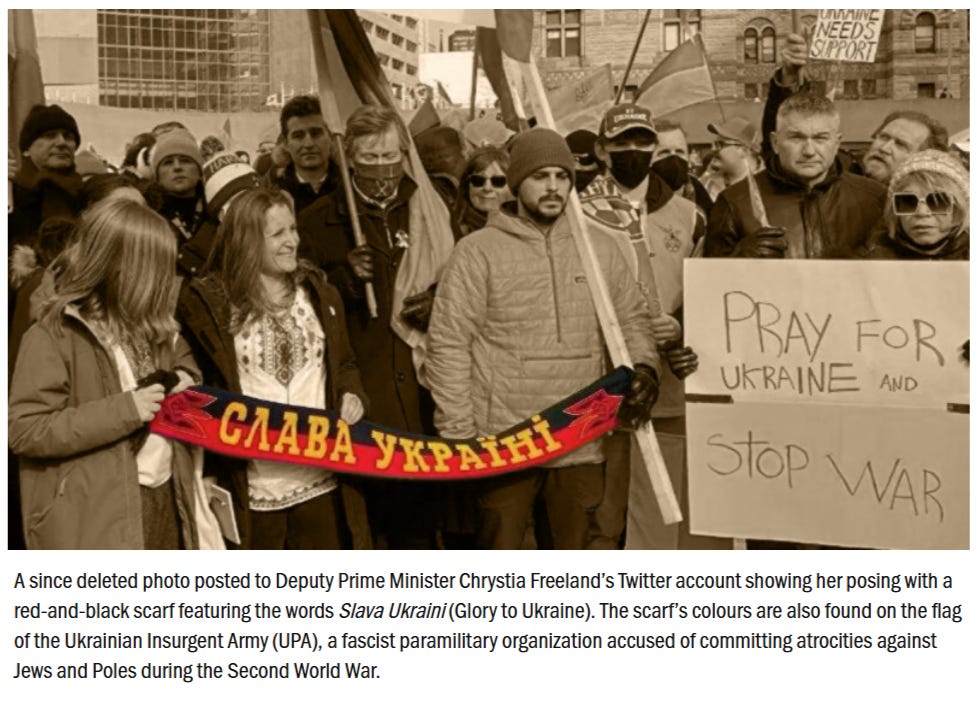
Canadian Deputy Prime Minister Chrystia Freeland spoke at a rally against Russia’s invasion of Ukraine on February 27, in which she was photographed holding up a scarf associated with a Ukrainian paramilitary organization that massacred thousands of Jews and Poles during the Second World War.
Freeland, who has made her Ukrainian heritage a major focus of her political brand, tweeted out the photo of her holding up a black and red scarf that had “Slava Ukraini,” or “Glory to Ukraine” written on it, with the relatively innocuous caption, “We stand united. We stand with Ukraine.”
The scarf’s colour scheme, as well as the slogan on it, were adopted by the Ukrainian Insurgent Army (UPA), an offshoot of the more radical wing of the Organization of Ukrainian Nationalists led by Stepan Bandera.
The UPA collaborated with the Nazis to ethnically cleanse Volhynia and Eastern Galicia of Poles and Jews in an attempt to establish an ethnically-pure Ukrainian state, which culminated in the murder of 100,000 Poles by 1943, according to historian Terry Martin.
“Red and black are the colours of the Bandera Wing of the Organization of Ukrainian Nationalists. The flag symbolizes blood and soil, and was adopted by that organization in 1941, along with an explicitly totalitarian program. The black-and-red banner is a symbol intimately connected with the most radical Ukrainian right-wing tradition,” Per Anders Rudling, a historian of nationalism, explained to the Toronto Star.
Natalia Khanenko-Friesen, director of the Canadian Institute of Ukrainian Studies, confirmed to the National Post that the colours represent blood and soil, but reassures the reader that it’s not the fascist kind. “Blood as life, as blossom, and not as blood lost in battles,” she declared. Freeland deleted the tweet and then posted an image of her at the rally without the scarf. But as many pointed out, the replacement photo still has a UPA flag in the distant background—a testament to the prominence of UPA symbology at the rally.
At Passage, Davide Mastracci notes UPA flags were also seen at Ukraine solidarity rallies in Montreal, Winnipeg, Vancouver, Prince George, BC, Edmonton and London, Ontario.
While Toronto Mayor John Tory rushed to condemn the use of swastikas by fringe cranks at a pro-Palestine rally in Toronto last year, he stood right behind Freeland while she held up the UPA scarf at the pro-Ukraine protest.
…
Editor: It is easy to see that Freedland’s letter come at an auspisious momet , as Joe Biden leaves office and Trump assumes office in America. The Ukraine War is reaching its denouement with a fated Russian victory? A politically weakned Trudeau and Freedland acting as an unofficial voice for Ukraine offers…
Political Observer
Dec 21, 2024
Headline: Opinion | Chris Wray’s Resignation Is a Terrifying Sign of What’s to Come Under Trump
Sub-headline :The FBI director’s preemptive resignation is a terrifying sign of what’s to come under Trump 2.0.
https://www.politico.com/news/magazine/2024/12/12/chris-wrays-abdication-of-leadership-00194002
Editor: Garrett Graff recites the propganda that has infected generations of apologist for J.Edgar Hoover corrupt personal feifdom!
When Donald Trump said over Thanksgiving that he was nominating Kash Patel to be FBI director, the announcement sent shudders through official Washington — Patel, besides being simply unqualified for such a big role, has explicitly laid out a retaliatory agenda that would weaponize the FBI against Trump’s foes. But there was one important wrinkle in Trump’s move: The simplest argument against Patel taking over the FBI was that there was no vacancy atop the FBI.
Current FBI Director Christopher Wray had years left on his term. Wednesday, in a jaw-dropping announcement underneath the FBI seal at an employee town hall, Wray said he would serve out the rest of the Biden administration and then step down.
Wray’s surprise decision is, simply put, a damning decision, an abdication of leadership, and a terrifying indication of how unready Washington remains for a second Trump term.
Wray’s decision undermined decades of hard work — by Congress, presidents, the Justice Department and the FBI itself — to move it out of a partisan, political framework. The FBI’s highest guiding principle is supposed to be the rule of law — and federal law is clear: The FBI director serves a 10-year-term, a length meant to isolate the role from political winds. Similarly, in federal law, there is a mechanism for removing an FBI director who errs — they can be fired, but only for cause. The role is not meant to be like the CIA director, attorney general or Defense secretary and turn over at noon on Jan. 20 for a new administration; it is, in fact, explicitly designed to NOT do so. Ronald Reagan spent almost all of his presidency with Jimmy Carter’s FBI director; George W. Bush inherited Bill Clinton’s FBI director; Barack Obama, in turn, inherited Bush’s, and Joe Biden will have spent his entire presidency with Wray, Trump’s choice to head the bureau.
Those safeguards and traditions exist because the FBI, in the wrong hands, is incredibly dangerous to American democracy.
The FBI is the most powerful, best resourced, and far-reaching law enforcement agency, not just in the United States, but anywhere in the world. Nothing compares to the sweeping breadth of its investigative powers; the intelligence and information it collects, wittingly and unwittingly, on all manner of Americans, powerful and not, guilty and innocent alike; and the resources and technologies it can bring to bear against anyone in its investigative sights. Even its routine investigations can paralyze and bankrupt businesses, upend lives, careers and families, and destroy reputations — and even do so when it doesn’t bring federal charges at the end. Under J. Edgar Hoover’s half-century reign, he deployed those resources to ruin the lives of civil rights activists and antiwar protesters, harass literary figures such as James Baldwin, blackmail gay people and persecute anyone he didn’t feel was sufficiently patriotic. We’ve spent a half-century as a nation trying to make sure that never happens again — and now Trump is explicitly saying he wants to restart that darkest chapter of the FBI’s history.
Editor: What resemembled praise, turned to ‘that darkest chapter of the FBI’s history’ : Yet it isn’t long before Garrett Graff is featuring Christopher Wray as the once Heroic Face of the FBI , who morphes now ino its betrayer of ‘the bureau’s core values’ : a record of self-serving lies, mendacity, corution and invented political paranoia! In sum, in Garrett Graff Political Melodrama, Christopher Wray plays the part of a Political Opportunist!
The reality is that Wray’s action repudiates all of the bureau’s core values and principles and the hard work of scores of FBI leaders across a half-century. It is a decision that seems to help only one person: Wray, easing his way back into polite legal society and a top-shelf corporate or legal role with a minimum of awkward fuss and Trump vitriol. It certainly sends a terrible message to the workforce, public servants who we as a nation will desperately want to stand up for the rule of law in the years to come: Cave to Trump or just get out of the way.
Political Observer


 StephenKMackSD's Blog