Editor: Here is Friedman’s latest essay of a mere & compact 1,509 words, respectfully addressing President Trump.
Headline: President Trump, You Can Remake the Middle East if You Dare
Dear President Trump:
You may not be interested in Jewish or Arab history, but they are both very interested in you today. This is one of those rare moments — like after World War I, World War II and the Cold War — when everything in the Middle East is in play and everything is possible. And right now, everyone is waiting for you.
No exaggeration: You have a chance to reshape this region in ways that could fundamentally enhance the peace and prosperity of Israelis, Palestinians and all the region’s people, as well as the national security interests of America.
Be advised, though, while the wages of success will be enormous, the consequences of failure will be utterly hellish. It’s the Nobel Prize or the booby prize. Yet there is no escaping this mission. The Middle East is either going to be reborn as a strong region where normalized relations, trade and cooperation are defining objectives or disintegrate into a few solid nation-states surrounded by vast zones of disorder, warlordism and terrorists who are chillingly expert at using drones.
On every train schedule there is something known as the last train. Well, when it comes to peacemaking between Israelis and Palestinians, before Israeli West Bank settlements totally choke off any possibility of a two-state deal; to ending Lebanon’s 50-year civil war, while there is still a shred of hope; to giving Syria a chance to reintegrate after 14 years of strife; and to neutralizing Iran before it gets a nuclear bomb, this really feels like a last train.
…
Editor: The Reader might just recall another Friedman execise in political prescience?
A Biden Doctrine for the Middle East Is Forming. And It’s Big.
Jan. 31, 2024
There are two things I believe about the widening crisis in the Middle East.
We are about to see a new Biden administration strategy unfold to address this multifront war involving Gaza, Iran, Israel and the region — what I hope will be a “Biden Doctrine” that meets the seriousness and complexity of this dangerous moment.
And if we don’t see such a big, bold doctrine, the crisis in the region is going to metastasize in ways that will strengthen Iran, isolate Israel and leave America’s ability to influence events there for the better in tatters.
A Biden Doctrine — as I’m terming the convergence of strategic thinking and planning that my reporting has picked up — would have three tracks.
…
Editor: Reader note the final paragraphs of Friedman’s latest essay; ‘otherwise, it needs to be done kinetically’ is the place holder for War!
Finally, on Iran, Israel has done the world a huge favor in stripping this awful, corrupt, repressive regime of much of its ability to project power around the region through failing states and proxy militias in Lebanon, Syria, Iraq and Yemen while hiding behind Tehran’s nuclear program.
That nuclear program and Iran’s malign regional strategy need to be eliminated. I hope you can do it through peaceful negotiations; otherwise, it needs to be done kinetically. The more credibly we threaten the second, the more likely we will get the first.
Good luck, Mr. Trump. History has its eyes on you.
On January 13 2025, spreads between yields on 10-year gilts and German Bunds reached 230 basis points. This was four basis points higher than the peak reached on September 27 2022, when Liz Truss was prime minister. The UK is probably not heading for a borrowing crisis. But its position is fragile. The government must reinforce confidence in the soundness of the UK and its own good sense.
Interest rates have risen across the G7. Even in Germany, the yield on the ultra-long 30-year Bund rose by 290 basis points between January 15 2021 and January 15 2025. In the US, the rise was 300 basis points, and in France 350 points. Alas, the rise in UK yields was the highest in the G7, at 440 basis points. UK yields on 30-year gilts reached 5.2 per cent in mid-January. This was the highest level in the G7, while German yields were only 2.8 per cent and French ones still only 3.9 per cent. But US yields were not so far behind UK levels, at 4.9 per cent, probably because of the huge structural fiscal deficits in the global economic superpower.
In sum, UK yields on long-term debt have risen by more and reached higher levels than in peer countries. Yields on 30-year gilts were even 56 basis points higher than Italy’s on January 15. Moreover, while UK yields had risen 78 basis points in the previous year, Italy’s did not rise at all. That is embarrassing. A crucial question is why rates have risen. The big change has been in the real rate of interest, not inflation expectations. In the UK case, we have reasonably robust measures of both, from yields on index-linked and conventional gilts. The difference between the two indicates inflation expectations and perceptions of inflation risk.
…
Editor: The Reader just might look at 14 years of Tory Economic incompetence, succeded by Kier Starmer’s ‘Tribute Band’s’ version: Tony Blairs wayward pupil, in the political present, has met the Liz Truss’ bench mark?
Editor: Mr. Wolf maintaines his composure, as this whole essay remaines in the very high-flown register of ‘Economics’ , enuciated by a master of the genre!
In brief, the UK’s situation is fragile. The government needs to retain the confidence of its creditors. It is crucial not to adopt policies that raise doubts about its good sense. How taxes were raised in the Budget did just that. So, too, do regulatory developments, notably in the labour market. The government will have to toughen its stance on current spending in its coming review or consider higher taxes.
The UK must focus on resilience and growth. Panic is unnecessary, but the era of cheap borrowing is over. Policy has to respond.
Editor: The Reader of The Financial Times needn’t wonder about the political strategy of this Neo-Liberal/Neo-Conservative Hybrid! 1,248 words later The Reader realizes that this essay, shorn of its Techno-Chatter, allied to some scolding of Senile Old Joe: another Hybred composed of Sullivan, Blinken & the toxic Hillary Clinton, behind the curtain! Tej Parikh and Keith Fray essay eventually realises itself in the jejune!
Joe Biden has won plaudits internationally for presiding over an economy that has achieved stellar growth. But as he prepares to step down on Monday, many Americans feel they are worse off than when the president took office.
Biden’s four-year term spanned a period of global economic upheaval, from the coronavirus pandemic and the worst inflation shock in a generation to rising tensions with China. Yet data compiled by analysts at BCG shows that Donald Trump will take office with one of the strongest economic backdrops of any president since Jimmy Carter. “Biden inherited a Covid-battered economy and he is bequeathing an exceptionally strong one,” said Mark Zandi, chief economist at Moody’s Analytics.
The US unemployment rate is near historical lows, and inflation is falling, albeit slowly. The S&P 500 has also risen more than 50 per cent since Biden’s term began.
US economic policy, meanwhile, has moved further from free-market orthodoxy towards a bigger role for the state. “Bidenomics”, in the president’s own words, was about “growing the economy from the middle out and the bottom up”.
But many American voters — including those towards the bottom of the income scale — believe the country’s economic resilience failed to benefit them.
Editor: A comic iterlude, featuring Ronald Reagan.
His policies, including the $369bn Inflation Reduction Act, did not cut through to the general public, failing what political analysts refer to as the “Reagan test”.
In the final debate of the 1980 presidential race, Republican nominee Ronald Reagan asked the public: “Are you better off now than you were four years ago?” A survey from the University of Michigan shows that Americans of all income bands feel the answer to that question under Biden is a resounding “no”.
In the run-up to the election, Americans consistently thought Trump would be better at handling the economy than the president, according to the Financial Times-Michigan Ross polls.
Inflation, which surged to a multi-decade high during Biden’s term, ranked as voters’ number-one concern.
While many economists blamed the surge in prices on global factors such as supply chain snags, others say his $1.9tn American Rescue Plan in 2021 — which provided direct stimulus payments to households — played a critical role in raising the cost of everyday essentials such as eggs, bread and rent.
Though the budget deficit as a share of GDP has fallen, it remains uncomfortably high, at an estimated 6.4 per cent. The federal debt is also on an upward trajectory, the scale of which the independent Congressional Budget Office has described as “unprecedented”.
Loose monetary policy when Biden became president also contributed to the post-pandemic increase in prices. That left the Federal Reserve playing catch-up, using bumper interest rate rises of up to 75 basis points at a time to quell price pressures.
While inflation is now closer to rate-setters’ 2 per cent goal, the interest rate increases damped the economic mood by leaving borrowing costs at their highest level for more than two decades.
Consumer prices, meanwhile, remain more than 20 per cent higher than in January 2021.
“What did the Democrats in was inflation,” said Stephen Moore, a former senior economic adviser to Trump.
Other economists point out that the administration made some advances for working families, such as temporarily expanding the child tax credit and providing more support for healthcare insurance
Low-wage workers also experienced the fastest real wage growth of any income group under Biden, according to the Economic Policy Institute. More Americans are also in work than when he started his term.
But much of the Covid-era support was temporary and poorly targeted, according to analysts.
The child poverty rate rebounded after initially falling by half, while plans to permanently enlarge social welfare programmes failed.
“The administration couldn’t overcome legislative opposition to labour law reform or to raising the federal minimum wage,” said Josh Bivens, chief economist at EPI, adding that the administration’s gamble that its progressive policies would become too popular to remove backfired. “Progressives need to not bank on programmes creating their own constituency.”
Despite a sturdy jobs market and stimulus cheques, many of the poorest Americans still feel worse off than when Biden entered the White House.
Low-income households spend more of their income on essentials, which jumped the most in price, according to research by Oxford Economics.
“The irony of Biden’s presidency was that lower- and middle-income households suffered the most,” said Moore.
With savings built up during the pandemic now largely spent, the share of loan balances in serious debt delinquency — defined as late payments of 90 days or more — on credit cards and auto loans are near their highest since the aftermath of the 2008 financial crisis.
Despite the Biden administration’s focus on “middle-class Americans”, it has been corporate America that has really boomed, particularly as enthusiasm over artificial intelligence pushed equity prices higher.
Though under its chief Lina Khan, the Federal Trade Commission was aggressive in bringing antitrust cases to Big Tech, Trump’s new team — with its ties to tech billionaires such as Elon Musk — is expected to give the sector a freer hand.
Economists believe that over time Biden’s industrial strategy — pursued not only through the IRA but also the Chips Act and protectionist policies placed on Chinese competitors — will leave a bigger mark on the American economy.
“The balance will shift in favour of Biden as the memory of the inflation shock fades,” said Ian Shepherdson, editor-in-chief at Pantheon Macroeconomics. “The transformations wrought by his investment programmes continue to deliver broad benefits across the whole economy.”
The White House estimates that private companies have committed $1tn in investment as part of Biden’s packages — just under half of that has been in electronics and chips.
New factories and battery plants have sprouted across the country. Taiwan Semiconductor Manufacturing Co recently started producing advanced four-nanometer chips for US customers in Arizona.
“There is now emerging bipartisan consensus on the government’s role in re-industrialisation,” said Daniel Correa, chief executive of the Federation of American Scientists. “Whether we call it industrial strategy or not.”
But both the IRA and Chips act have faced setbacks.
An FT investigation in August found that 40 per cent of projects of at least $100mn announced within the first year of the laws had been paused or delayed. Labour shortages, permitting problems and local sourcing requirements were cited as obstacles
A promised boom in manufacturing jobs has also been absent so far. Job creation under Biden has been driven by the public sector, services, and health and social care.
The effort to recreate global industrial supply chains at home more broadly has been criticised by economists for being wasteful and undermining free trade.
Recent research by the Peterson Institute for International Economics estimates the average subsidy per job created under the Chips Act could be about twice the average annual salary of US semiconductor employees.
The packages are also expected to be trimmed by Trump’s administration, though the prevalence of new investments in Republican states could keep them alive in some form.
Many believe Biden leaves behind a strong, but highly indebted economy.
“Just as Trump inherited a strong economy in 2017, the same is happening in 2025,” said Maurice Obstfeld, senior fellow at the Peterson Institute think-tank. “[But] Biden’s legacy is mixed. His achievements came with collateral damage such as raising inflation, the deficit and protectionist barriers.
“His policies either had long lag times, were temporary, or simply did not cut through to voters . . . For now, the winners are in a position to try to write history,” Obstfeld added.
Editor: This cadre of dullards, can’t face the Political Monster they, and the NBC Television Network, nurtured/created!
Patrick Healy: We’re at a historical moment that Americans have experienced only once before — the inauguration of a president who previously held the office and was turned out, only to win election again four years later. None of us were alive in 1893, so I want to explore how you’re making sense of it now. First, what do you remember thinking or feeling about Trump when his presidency began eight years ago?
Ross Douthat: What was the supposed George W. Bush line, upon hearing Trump’s Inaugural Address? “That was some weird [expletive]”? I think the weirdness was important, the fundamental surrealism, the sense that this was just not how normal American politics worked — something that was felt quite widely. And with it, the sense that if you just pulled the right political lever or legal maneuver, you could get back to the normal world and leave Trump world behind.
Michelle Goldberg: I went to that rally in Columbus Circle where Bill DeBlasio and stars like Cher and Robert DeNiro spoke. I remember feeling true terror about what was coming, but also a lot of solidarity with my fellow New Yorkers.
David Brooks: I was mostly morally appalled. It was like watching Larry Flynt get elected pope.
The outgoing president’s record should be seen in two parts: the bold, bipartisan moves of his early presidency and the disappointing sluggishness of the last two years.
Editor: Here is a sample Lopez’s Presidential genuflecting, fully in tune with Bloomberg political dreck!
In the twilight of his presidency, Joe Biden has been working at a furious pace to enact policies that would burnish his legacy — apparently determined to wring every drop of potential from his remaining time in office.
Where has that sense of urgency been for the last two years?
Biden’s first two years in office were marked by bold, ambitious, often bipartisan legislation. The American Rescue Plan, with its nearly $2 trillion stimulus and extended unemployment benefits, started the task of righting the nation’s economy. That was followed by the bipartisan Infrastructure Act, the largest in history; the Inflation Reduction Act; and the CHIPS Act, which boosted domestic semiconductor manufacturing. He passed the first major gun reform in nearly 30 years and he set a record for job creation.
Editor: What is lost/evaded/covered-up in these almost cellbratory paragraphs, laced with faux regret, is Biden/Blinken/Sullivan crimes in Ukaine, and the American surrender to the political/moral toxin of the Zionist Faschist States War Mongering Netanyahu: that has metatisised accross the ‘Middle East’.
Editor: The Lopez melodrama continues, yet the contnuing revelation, of the facts of Biden’s certifiable cognitive decline, are still off-stage! As are the Biden & Sons political opportunism.
Editor: The Reader quickly graps the fact that this is political propaganda!
But at the 2022 midterms, Republicans gained narrow control of the House and Biden lost some of his ability to push legislation through. After deciding in April 2023 to run for reelection, the pressures of campaigning crowded in. When it came to governing, Biden seemed to take his foot off the gas. Immigration reform stalled. It wasn’t until June 2024 — with immigration by then an obvious political millstone — that Biden finally issued the orders that would send border crossings plummeting.
Editor: What remains is 720 words, yet Lopez ends her utterly dubious Biden apologetic, offering this political opportunist as a tragic figure!
Whatever the reason, the two months of cramming-for-the-final action show that Biden remains a complex and somewhat tragic figure — capable of greatness, yet ultimately falling short.
In his speech Wednesday night, Biden told Americans, “We must keep pushing forward, and push faster. There is no time to waste.” If only he had spent more of the last two years taking his own advice.
Can the Just-Pardoned Hunter Biden Claim Privilege Against Self-Incrimination, if Questioned About His Crimes?
Eugene Volokh | 12.2.2024 12:33 PM
A couple of people asked me this; the short answer:
[1.] Because the privilege applies only when a witness reasonably fears prosecution, and the pardon precludes prosecution for any “offenses against the United States which he has committed or may have committed or taken part in during the period from January 1, 2014 through December 1, 2024,” a pardon may indeed eliminate the privilege, and allow a court or congressional committee to order Hunter Biden to testify. “[I]f the witness has already received a pardon, he cannot longer set up his privilege.” Brown v. Walker (1896). “[A] witness may be compelled to testify concerning his involvement in a crime when he is protected from later prosecution … by the applicable statute of limitations … or by a pardon.” Pillsbury Co. v. Conboy (1983) (Marshall, J., concurring) (citing Brown).
[2.] But the privilege disappears only when there’s no realistic prospect of prosecution by any American government, federal or state. So if a witness is asked about something, and the answer might lead to state prosecution for which the state statute of limitations hasn’t run, the witness can refuse to testify because of that risk of state prosecution, even if a federal prosecution is taken off the table by the federal pardon. (Recall that a Presidential pardon only pardons for federal crimes.) This is relevant because some conduct can violate both state and federal law.
How this would play out as to any particular investigation of Hunter Biden’s behavior, I leave to others.
‘One of the great turning points in 20th-century American history was the Supreme Court’s 1954 Brown v. Board of Education decision, which overturned on constitutional grounds the 19th-century Plessy v. Ferguson case that had upheld legal segregation. This decision was the starting point for the civil rights movement, which, over the following decade, succeeded in dismantling the formal barriers to racial equality and guaranteed the rights of African Americans and other minorities. The courts had cut their teeth earlier over union organizing rights; new social rules based on those rights provided a model for subsequent social movements in the late 20th century, from environmental protection to women’s rights to consumer safety to gay marriage.
So familiar is this heroic narrative to Americans that they seldom realize how peculiar it is. The primary mover in the Brown case was the National Association for the Advancement of Colored People (NAACP), a private voluntary association. The initiative had to come from private groups, of course, because state governments in the South were controlled by pro-segregation forces. The NAACP pressed the case on appeal all the way to the Supreme Court. What was arguably one of the most important changes in American public policy thus came about not because Congress, as the representative of the American people, voted for it but because private individuals litigated through the court system to change the rules. Later developments, like the Civil Rights and Voting Rights Acts, were the result of congressional action, but even in these cases enforcement was carried out by courts at the behest of private parties.’
The genesis for Conservatism’s Myth of Usurpation of The Old Order , here presented in the abstruse rhetorical frame of ‘Institutional Decay’: the end of Segregation in public education, and it’s corollary of oppression, Jim Crow, proceeds from the unanimous Brown v Board. The Civil Rights movement in it’s most militant phase grew out of this landmark decision. It is the beginning of the politics of the present, the genesis of The Federalist Society, and the judicial careers of Rehnquist,Scalia, Thomas, Alito inextricably linked to Neo-Confederate/Originalism as legal cover, the Nixon Southern Strategy, and of the contemporary blight of Republican Nihilism. The proof is the legal restrictions placed on voting in 26 states controlled by Republican governors and legislatures ,since the election of President Obama. And the legal obscenity of the Robert’s majority decision in Shelby County v. Holder. It’s overarching but utterly disingenuous rhetorical/legal claim: ‘things have changed’. Read Justice Ginsburg’s devastating polemical dissent, it is based not on bogus claims, but on the presentation of empirical evidence.
‘No other liberal democracy proceeds in this fashion. All European countries have gone through similar changes to the legal status of racial and ethnic minorities, and women and gays in the second half of the 20th century. But in Britain, France or Germany, the same results have been achieved through a national justice ministry acting on behalf of a parliamentary majority. The legislative rule changes might well have been driven by public pressure, but they would have been carried out by the government itself, not by private parties acting in conjunction with the judiciary.’
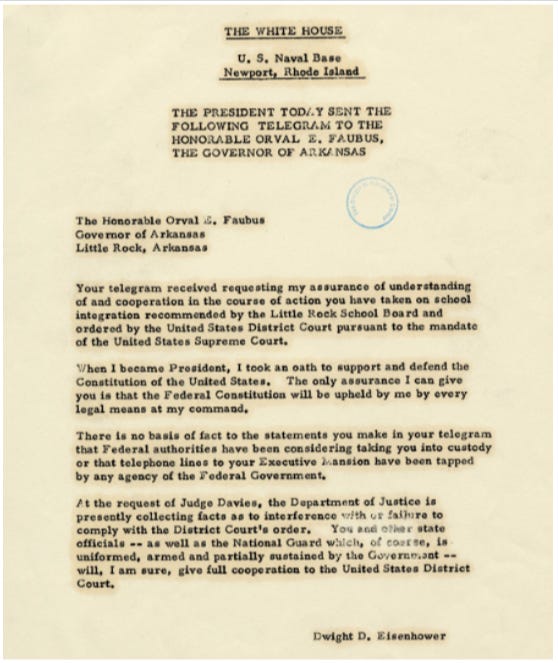
That somehow the Racial Violence and institutional racism legal Segregation was could have been ended by the legislatures of the deep South and the North is pure Conservative lie, no other name for it! There was no political will to enact such a change. The growth of Federal power was a rational legal response to segregationist intransigence. See President Eisenhower’s telegram to Governor Faubus dated September 5, 1957:
President Eisenhower’s letter may prove Mr. Fukuyama’s claims to be true, according to his presented arguments, as unconvincing as they may be. Yet the cult of the Law was once a cornerstone of ‘Conservatism’, or perhaps it was law based on an entrenched, indeed institutionalized ,racial hierarchy. In this portion of Mr. Fukuyama’s essay, an unconvincing attempt to re-frame Brown as a product of ‘institutional decay’, rather that of a civic/legal/institutional vibrancy, takes it’s place as a politically complicated set of arguments: a highly intellectualized and rationalized propaganda.
Strauss’s claims about esotericism ought to be understood within the broader trajectory of his life’s work. Such an approach is in fact in keeping with Strauss’s own recommendation for how to read philosophical texts, esoteric or otherwise. According to Strauss, an interpretation of a given text must begin “from an exact consideration of the explicit statements of an author.” However, “The context in which a statement occurs…must be perfectly understood before an interpretation of the statement can reasonably claim to be adequate or even correct” (PAW, p. 130). Turning to the context of Strauss’s claims about esotericism helps to unravel a number of other important themes in his work, including what he calls the “theologico-political predicament of modernity,” the quarrel between the ancients and the moderns, and the relation between revelation and philosophy (what Strauss also calls “Jerusalem and Athens”).
In his first published contention that Maimonides is an esoteric writer, Strauss self-consciously examines what it means to write about an esoteric text. Clearly referring to himself, Strauss writes:
No historian who has a sense of decency and therefore a sense of respect for a superior man such as Maimonides will disregard light-heartedly the latter’s emphatic entreaty not to explain the secret teaching of the Guide. It may fairly be said that an interpreter who does not feel pangs of conscience when attempting to explain that secret teaching and perhaps when perceiving for the first time its existence and bearing lacks that closeness to the subject which is indispensable for the true understanding of any book. Thus the question of adequate interpretation of the Guide is primarily a moral one. (PAW, p. 55)
Strauss maintains that before attempting to answer the question of whether a secret teaching, only hinted at in the text, can be grasped with confidence and precision, it is necessary to consider the moral implications as well as the moral impetus of a writer willing to write about such a secret. In making this claim, Strauss aligns his own dilemma with Maimonides’ dilemma and by so doing he points to the basic motivation that directs his own claims about esotericism. The question is thus twofold: why did Maimonides write the Guide in the first place and why does Strauss write about esoteric writing? In answering the first question, Strauss notes that the literary form of the Guide is a letter to Maimonides’ gifted student Joseph, who, like many Jews of Maimonides’ time, was traveling in far and distant lands: “Joseph’s departure was a consequence of his being a Jew in the Diaspora. Not a private need but only an urgent necessity of nation-wide bearing can have driven Maimonides to transgress an explicit prohibition [to write about esoteric matters]. Only the necessity of saving the law can have caused him to break the law” (PAW, p. 49).
If this is Maimonides’ reason, what is Strauss’s? Strauss is willing to make the seemingly immoral and indecent move of revealing the secrets of an esoteric text in order to save those secrets. The secret that Strauss seeks to save is insight into the political, philosophical, and theological meaning of what he calls “a forgotten type of writing.” But why does Strauss care about this forgotten type of writing? We can only answer this question by looking to Strauss’s published work as a whole and to the place of Persecution and the Art of Writing within this whole and to do so it is necessary to understand Strauss’s most basic question, which concerns what he calls the “theologico-political predicament of modernity.”
A Myth about a Myth: or free imaginative variation!
It’s been a year to the day since Javier Milei, the libertarian economist and TV pundit, became president of Argentina. His unlikely rise to the political center stage culminated in a stunning electoral upset that catapulted him to international fame.
A year ago today, he entered the national Congress and donned the presidential sash before breaking with custom to deliver his inauguration speech not to the career politicians inside but to the people waiting in the square.
In that year, the president plunged Argentina into a recession as part of a top-down process of wresting the country’s economy into line with free market orthodoxy. The process involved some of the most extreme deregulation the country has seen since the 1990s.
But Milei has also delivered plenty of surprises. Chief among them is that, despite protests that were often repressed with violence, his government has not faced the kind of massive uprising that would force them to renegotiate their fundamental proposals. Recent figures show that around half of Argentines still approve of him. Despite an abrasive stance toward his opponents and a tiny congressional minority, his pragmatism has allowed him to strike the deals he needs to govern. And, astonishingly, he has managed to cut Argentina’s inflation.
In this article, we summarize the key developments and challenges of Milei’s administration over the past year, exploring the impacts of his radical policies, the social responses they elicited, and the overall trajectory of his presidency.
Ley Bases: from failure to flagship
The Ley Bases bill was Milei’s biggest legislative win of 2024. Formally called “Law for the Bases and Starting Points for Argentines’ Freedom,” it was Milei’s flagship state deregulation proposal. But it had a rocky road, littered with hurdles that at times seemed insurmountable.
Milei filed the bill in Congress days after becoming president in December. The original version was a whopping 664-article list of aggressive economic deregulation reforms, laying the groundwork for privatizing over 40 state-owned companies.
A week earlier, he had issued a vast presidential decree that likewise sought to deregulate vast swathes of the economy. Decried as an abuse of the urgent presidential decree, it was voted down in the senate, and Argentina’s courts ruled the labor chapter unconstitutional—but the rest is in force unless the Chamber of Deputies also strikes it down.
The Ley Bases’ first round in Congress was a failure for the new government. It initially passed as a general item in early February but was sent back to commissions while the individual items were being voted on due to a rookie error by La Libertad Avanza’s lawmakers.
It finally passed at the end of June, along with a package of fiscal norms that was cut from the original bill and addressed separately. The number of articles was whittled down to 238, and the list of companies on the auction block was cut to 11, but the key points prevailed.
The final text of the Ley Bases grants Milei legislative powers over administrative, economic, financial, and energy-related issues for one year, as well as the ability to close or restructure certain public organizations. It also implemented major reforms on a plethora of issues including labor, state structure, rent, and public works.
Inflation, afuera
True to his promise, Milei started slashing public spending as soon as he got his feet under the table.
As of November, the government said, 33,000 public employees had been dismissed. The blender, as the president calls it, was also applied to pensions, which were allowed to lose value against inflation. A modest pension increase was the target of his first presidential veto.
The national administration has also clamped down on funds for Argentina’s provinces, placing Milei at a standoff with the nation’s governors in February. An olive branch he called the May Pact was, despite its name, signed in July.
In parallel, Milei vowed to halt money printing. After abruptly switching the nation’s coffers to run a fiscal surplus, Economy Minister Luis Caputo and Central Bank Chief Santiago Bausili announced in July that they would move the Central Bank’s interest-bearing liabilities to the Treasury as a measure to clear the monetary authority’s balance sheet. They argued this would allow the government to close the “second faucet” of monetary issuance, which Milei has long held is the key driver of inflation.
His economic measures culminated in inflation that, after spiking to 25.5% due to December’s devaluation, fell to a three-year low of 2.7% in October. But that achievement came at a devastating human cost: a recession in the first four months of the year contributed to poverty surging by 11 points to 53% in the first half of the year.
The government is now seeking to court investment with policies such as the RIGI large investment regime. In November, Caputo and the IMF both confirmed that they were in early talks about a potential new agreement. Meanwhile, there’s no confirmation of when Argentina’s all-important cepo currency controls will be lifted.
Presidential vetoes
Milei’s first year may be remembered as much for the legislation he nixed as that which he ultimately signed into law. On September 2, the self-styled anarchocapitalist issued his first presidential veto for a bill that would have prevented retirees’ pensions from falling behind the rising cost of living. At the time, he argued that it threatened the government’s plans to eliminate the fiscal deficit and was therefore “irrational.”
Hundreds descended on Congress to protest the body’s vote to uphold the veto, prompting a police crackdown that resulted in the pepper-spraying of several seniors.
Approximately one month later, Milei used his executive power again, this time to prevent a funding increase for public universities. The president announced his decision on the heels of a mass mobilization that saw thousands of students and faculty across the country take to the streets to defend the institution.
In the Official Gazette, the administration derided the legislation for failing to specify how it would finance its pay increases. The spending bill would have represented 0.14% of Argentina’s GDP. In 2023, the Congressional Budget Office released a report outlining tax expenditures in different sectors that amounted to 2.49%.
As with the pension veto, the public responded in kind, with students occupying administration buildings in different universities over a period of several days. Herein lies one of the lessons of Milei’s young presidency: every austerity measure will provoke an equal and opposite reaction from those affected.
Ministers: over and out
The recent dismissal of Florencia Misrahi as head of Argentina’s tax agency was the latest of 67 departures from an ever-reshuffling cabinet amid a maelstrom of changing ministries and secretariats. Many were abrupt and often surprising: the president fired the Labor Secretary in a television interview in March. That came just days after Infrastructure Minister Guillermo Ferraro stepped down after allegedly leaking information to the press. He had been under pressure to go as early as January.
2024 was also marked by consistent government infighting — from Milei publicly snubbing his own VP to blocs splitting in Congress — which contributed to the constant turnover. Milei’s Chief of Staff, Nicolás Posse, stepped down in May following a growing rift between them over the Ley Bases. Diana Mondino was suddenly fired as Foreign Minister in late October following a UN vote in favor of Cuba, but she had already lost influence within the cabinet following months of tensions. Along with former Health Minister Mario Russo leaving for “strictly personal reasons,” that makes four senior cabinet members departing within the first year.
Despite arriving at the Casa Rosada with a fiery “anti-caste” rhetoric, the ones who remain firmly behind its walls have repeat surnames. The inner sanctum of the Milei administration is his sister, Secretary of the Presidency Karina Milei, and Santiago Caputo, Economy Minister Luis Caputo’s nephew.
Visiting the free world
If we have learned anything about Milei over his first year in office, it’s that he enjoys his new position on the global stage. At the time of writing, the president had made 16 trips abroad since December 10, 2023. His favorite destination by far has been the United States, where he has traveled seven times. He has also made six trips to Europe and one to Israel, but only three to Latin American countries: Brazil, Chile, and El Salvador.
The choice of his destinations and reasons for travel have proven to be closely tied to his worldview. Milei’s dogmatic understanding of how the world works has informed a foreign policy based on labeling governments and institutions as friends or foes depending on where they land on his ideological spectrum. He has thus mostly appeared before right-wing and libertarian audiences, lauding them as staunch defenders of “freedom” while avoiding meeting with leaders he dislikes unless it is absolutely necessary. His meeting with his Brazilian counterpart Lula da Silva at the G20 summit in Brazil was so frosty that it became a meme.
The president has directed some of his harshest rhetoric against his imagined global enemies. Branding himself an enemy of what he calls “socialism” and the “woke agenda,” he has sparked conflicts with the leaders of Brazil, Colombia, and Spain — in the latter case unleashing a full-blown diplomatic conflict. Milei has also viciously attacked the United Nations and made a point of changing many of Argentina’s international positions, a stance analysts warn could eventually harm some of the country’s long-term objectives.
Freedom of hate speech
From early in the 2023 presidential campaign, concerns existed about La Libertad Avanza’s rhetoric as perpetually discriminatory and harmful. When three lesbians were killed in a brutal arson attack in May, campaigners were quick to point out that it came after months of homophobic government discourse. The administration’s dismissal of the hate crime birthed a central protest slogan regarding its vehement anti-LGBTQIA+ stances: “It’s not freedom, it’s hatred.”
The perpetuation of dictatorship apologia, also present in the campaign, continued apace, with a photo of deputies visiting convicted dictatorship torturers becoming another worrying milestone. Denialist social media posts erupted after the presidential inauguration, and a radicalized group with direct ties to the government has formed a right-wing online militia. Online threats have sauntered into the real world, from green Ford Falcons outside the Senate to LLA youth celebrating a new “armed wing” in an event with fascist trappings.
While fixated on the idea of freedom of speech, that right does not extend to the press or demonstrators. Argentina slid 26 places on the World Press Freedom Index, while Security Minister Patricia Bullrich’s draconian anti-protest protocol raised alarm bells as it enabled harsh crackdowns and arbitrary arrests by multiple security forces.
The forces of 2025
After a rollercoaster year, it’s time to look to 2025. Key questions to watch include whether Milei will secure a stronger foothold in Congress through the mid-term legislative elections, if and when currency controls will be lifted, and how a second Trump presidency will shape the political chessboard of the Americas. Whatever happens next year, the Herald will keep you updated with rigorous, high-quality reporting. Stay tuned!



 StephenKMackSD's Blog