Is the Right Choice a Good Bargain?

I began subscribing to The New York Review of Books in 1970! NYRB taught be how to be critical of my teachers!

stephenkmacksd.com/

Sep 02, 2025

Is the Right Choice a Good Bargain?

Michael Walzer

March 5, 2015 issue


5.

Despite all the arguments of Sunstein and Thaler, Sunstein and Hastie, and Sunstein solo, there is still a lot of room for partisan politics. I mean that to include deliberation—which is necessary in a democracy despite the risks of impulsive thinking, mental shortcuts, cascades, and conformity—but not to stop there. For the truth is that much of our political life is not deliberative at all, not, at least, in the sense of a deliberation aiming at a “right decision.” There is also bargaining, which may produce a compromise between two positions, one of which we think right and the other wrong, and even between positions that are, both of them, “right.” And then there is everything that comes under the heading of “political action”: organizing, campaigning, agitating, demonstrating—for all these are also central to democratic decision-making.

Political action is necessary because many people are missing from the group decision-making described in Wiser. Sunstein and Hastie report that low-status members of the research groups, and also of many real groups, commonly defer to high-status members. This assumes that the low-status members are in the room, but the truth is that very often they aren’t. One of the reasons that group decision- making goes wrong is that the people most affected by the decisions aren’t participating in the deliberations.

Wiser has a brief discussion of “asking the public”—but only to comment, not to join in the actual business of deciding. And yet the conditions of both powerlessness and inequality may be more important than the problems associated with groupthink. They are certainly a central source of “partisan divides.” Organizing, agitating, demonstrating—these are ways of bringing the powerless to the attention of the powerful. They can contribute importantly to democratic decisions, even if they seem nondeliberative, even if the shouting in the street sounds like, and probably is, the product of emotive System 1 thinking.

Sunstein himself is clearly an advocate of greater equality. Years ago he published a book praising President Roosevelt’s 1944 State of the Union address, in which FDR called for a radically redistributive “second bill of rights.”

But in the books considered here, he and his coauthors don’t recall FDR’s famous response to people who urged him actively to promote a redistributive program: “Make me.” Government agencies will make better decisions, at least on such questions as greater equality, if they feel political pressure from outside the room.

Sometimes we will want the people outside the room actually to win—to organize and agitate so successfully that they take over the small groups who dominate decision-making, with the result that they change the political conversation. We may think that their view is right, even if no one has “rigged” the choices. But in fact, all political choices are shaded by our uncertainties, our knowledge of past mistakes, and, in the best of cases, our respect for the people who disagree with us. So, yes, we need to be wiser in the ways described by Sunstein and Hastie; but we also need a radically different kind of decision-making than what they describe, involving a larger number of people inside and outside the rooms where small groups sit.

Read these books; there is much to learn from them. And then pick up Machiavelli, and then Marx.


In response to:

Is the Right Choice a Good Bargain? from the March 5, 2015 issue

To the Editors:

In “Is the Right Choice a Good Bargain?” [NYR, March 5], Michael Walzer asserts that “statistical groups do especially well in answering factual questions,” and refers to an article of Francis Galton (“Vox Populi,” Nature, March 7, 1907) to support the claim. The phrase Walzer puts in quotes—“The ox weighed 1,198 pounds; the average estimate…was 1,197 pounds, more accurate than any individual’s guess”—is nowhere to be found and completely subverts Galton’s main point.

Galton didn’t even bother to compute the average of the 787 contestants who tried to estimate the weight of the ox: he picked out the “middlemost” estimate. One week earlier (“One Vote, One Value,” Nature, February 28, 1907) he had written:

How can the right conclusion be reached…? That conclusion is clearly not the average of all the estimates, which would give a voting power to “cranks” in proportion to their crankiness…. I wish to point out that the estimate to which least objection can be raised is the middlemost estimate, the number of votes that it is too high being exactly balanced by the number of votes that it is too low.

This does not in the least deny Walzer’s assertion, but has enormous importance in determining collective decisions.

Michel Balinski
Directeur de recherche de classe
exceptionnelle (emeritus)
CNRS and École Polytechnique
Paris, France

In response to:

Is the Right Choice a Good Bargain? from the March 5, 2015 issue

To the Editors:

Michael Walzer [“Is the Right Choice a Good Bargain?,” NYR, March 5] points to a central problem with Cass Sunstein’s perspective: the assumption that what is needed is to improve procedures of group decision-making in order to increase the likelihood of making “right” choices about ends, which are conceived as givens. This is technical rationality, which holds ends to be fixed and concentrates on efficiency of means. As Walzer observes, Sunstein misses the larger, and more important, questions of real politics in which ends themselves are subject to an ongoing process of negotiation, debate, and reformulation. Yet Walzer himself also conceives of change-oriented, citizen-involving politics as targeting institutions more than transforming them. To address the problems of politics in today’s world we need more than agitation from outside institutional life, the “system world” in the language of Jürgen Habermas, long a theoretical reference point for Sunstein.

Sunstein, like Habermas and many others, sees major institutions as largely fixed and unchangeable, not subject to democratizing change. This assumption generates fatalism, which has shrunk our imaginations about decision-making, politics, and democracy itself. The challenge is to recognize that institutions of all kinds are human creations that in turn can be recreated, reconnected to questions of civic and democratic purpose. For this task we need to bring in Max Weber as well as Machiavelli and Marx. Weber described the “iron cage” that results from technical rationality. In his essay “The Profession and the Vocation of Politics,” Weber also evocatively termed the pattern “the polar night of icy darkness.” Thawing the polar night is a frontier of democracy in the twenty-first century.

Harry Boyte, Augsburg College, St. Paul, Minnesota; Albert Dzur, Bowling Green University, Bowling Green, Ohio; Peter Levine, Jonathan M. Tisch College of Citizenship and Public Service, Tufts University, Medford, Massachusetts

Michael Walzer replies:

I certainly agree, and so would Sunstein and Reid Hastie, that it’s a good idea to read Max Weber; and I also agree, and so would they, that political and economic institutions are human creations. As they were formed, so they can be reformed and transformed. Since Professors Boyte, Dzur, and Levine don’t tell us which institutions they want to transform, I can’t say whether I am ready to join them. Meanwhile, important decisions are still being made inside institutions, like the US Congress and its committees, for example, or inside the White House, and I can’t see what is wrong with trying to influence those decisions to make them more serviceable to ordinary Americans. I don’t think that will happen, or happen in significant ways, until those ordinary Americans organize themselves to bring pressure on the institutional decisions-makers. These writers want something more than that, but that much, these days, would be well worth celebrating.

StephenKMackSD
Posted in Uncategorized | Leave a comment

Politico’s Ankush Khardori’s warm embrace of Cass Sunstein: In the Age of Trump, even this etiolated New Democrat, resembles a political oasis? (Steven Poole Thu 20 May 2021 02.30 EDT)

Old Socialist comments.

stephenkmacksd.com/

Sep 02, 2025

Headline: Cass Sunstein on What Lefty College Kids Get Wrong, the Dangers of Trump and His Own Regrets

Sub-headline: In a new book, the longtime legal scholar offers a defense of liberalism from its critics on both the right and the left.

https://www.politico.com/news/magazine/2025/08/30/cass-sunstein-book-liberalism-interview-00535620

Ankush Khardori is a senior writer for POLITICO Magazine and a former federal prosecutor at the Department of Justice. His column, Rules of Law, offers an unvarnished look at national legal affairs and the political dimensions of the law at a moment when the two are inextricably linked.

Cass Sunstein, a legal scholar with a new book in defense of liberalism, served as C Here he poses for a photo near the White House on March 16, 2011. | AP

Editor: I recall when Mr. Sunstein set a letter to my address that contained two one dollar bills ! He was director of the Office of Information and Regulatory Affairs in the waining days of Obama administration, and like Bush The Elder, he lacked any acquaintanceship with the lives of ordinary citizens. Two dollars tips belong in the Depression Era, or its sucessor the Neo-Liberal collapse of 2007-2008’! I sent the two dollers back! Reader note that Cass Sunstein and Ankush Khardori share in the rerified air of a practiced political confomity!

Ankush Khardori opines:

Liberalism is under unprecedented attack in the United States. Not liberalism as in the ideology typically associated with the Democratic Party, but the broad and complex constellation of political commitments and aspirations that include respect for individual rights, pluralism and the rule of law, which have long been the foundation of American society.

The threat isn’t new, and it hasn’t just been coming from President Donald Trump or the political right. Prominent figures and thinkers on the left have tried to restrict free speech and enforce ideological conformity.

In a new book to be released on Tuesday, Cass Sunstein, a prolific legal scholar and high-level official in the Barack Obama and Joe Biden administrations, mounts a stirring intellectual defense of liberalism from its critics across the political spectrum. On Liberalism: In Defense of Freedom draws on — and ties together — the work of thinkers like John Stuart Mill and Friedrich Hayek, and it argues that they operate in a similar, broad tradition of liberalism that is in desperate need of revitalization.

In a wide-ranging interview about the book, we discussed why he wrote it and what he sees as some of the most pressing contemporary pressures on the liberal tradition both in the United States and abroad.

“There’s something about the idea of someone who’s in charge, who says ‘Fuck you’ and won’t take any shit,” he said at one point. “That resonates.”

We also touched on the Supreme Court, the state of the legal academy, his biggest regrets from his time in government, and, of course, Prince and Star Wars.

This book began with a guest essay that you wrote for the New York Times back in 2023 that provides a numbered list of propositions or claims that you associate with liberalism. You say that the response to that essay spurred you to write the book. What did you hear, and what do you want to accomplish?


Editor:

Ankush asks:

I’m going to start with a deceptively simple question. In 2025, what is liberalism to you?

Sunstein answers:

Liberalism is a set of commitments to freedom, pluralism, the rule of law, respect for individual autonomy, and security and self-government. Those are the ideals that liberalism represents.

Ankush asks:

So you view this as an intellectual project that can bring in people from across the political spectrum.

Sunstein answers:

I almost called the book Big Tent Liberalism, and I have a little bit of regret that I didn’t.


Editor: Reader spare yourself the the trouble of reading the Ankush & Sunstein self-congratulatory chatter , by going to the New York Times of Nov. 20, 2023 , which offers a predigested 34 part condensation, of this Politico Diatribe and its auteur, and fellow traveler Ankush Khardori!


Editor: Reader here from October 9, 2014 is Jeremy Waldron’s eviseration of Mr. Sunstein, and his telling reply , to Sunstein’s comment.


It’s All for Your Own Good

Jeremy Waldron

‘Why Nudge?’ by Cass Sunstein

October 9, 2014 issue

In their book Nudge, Richard Thaler and Cass Sunstein considered the choices made by ordinary people about their retirement.

Many employees have the opportunity to enroll in a 401(k) plan, in which their contributions will be sheltered from taxes and to which their employer will also contribute. But a considerable number of people do not choose to enroll in a 401(k) plan and of those who do, many select levels of contribution that are far below what would be most advantageous to them. Why? Probably because of inertia. It is easier not to make a decision than go to the trouble of calculating an optimal contribution

Employers sometimes try to educate people to make better choices, offering them retirement-planning seminars, for example. But the lessons of these seminars are soon forgotten: “Employees often leave educational seminars excited about saving more but then fail to follow through on their plans.” And so Sunstein and Thaler suggested a different strategy. Instead of teaching people to overcome their inertia, we might take advantage of their inertia to solve the problem. Suppose we arrange things so that enrollment at some appropriate level of contribution is the default position—the position that obtains if the employee does nothing. Something has to be the default position; why not make it the position that accrues most to the employee’s benefit, “using inertia to increase savings rather than prevent savings”?

Resetting the default position this way is what Thaler and Sunstein call a “nudge.” It exploits the structure of the choice to encourage a more desirable option. The decision is not taken entirely out of the employee’s hands. She can still change it and revert to a strategy of no contributions or diminished contributions to her retirement funds. But in that case she has to make an effort; this is where she has to overcome her inertia.

Nudging is an attractive strategy. People are faced with choices all the time, from products to pensions, from vacations to voting, from requests for charity to ordering meals in a restaurant, and many of these choices have to be made quickly or life would be overwhelming. For most cases the sensible thing is not to agonize but to use a rule of thumb—a heuristic is the technical term—to make the decision quickly. “If it ain’t broke don’t fix it,” “Choose a round number,” “Always order the special,” and “Vote the party line” are all heuristics. But the ones people use are good for some decisions and not others, and they have evolved over a series of past situations that may or may not resemble the important choices people currently face.

Now, every decision we face presents its own “choice architecture,” in which the possibilities we have to choose from are arrayed in a certain order. Some make themselves clamorously known; others have to be unearthed. There may be limited time to make a choice and then some possibilities expire. Or if nothing is done, something may still come to pass: there are default options (as opposed to possibilities a person has to positively choose). There is no getting away from this: choices are always going to be structured in some manner, whether it’s deliberately designed or happens at random.

Nudging is about the self-conscious design of choice architecture. Put a certain choice architecture together with a certain heuristic and you will get a certain outcome. That’s the basic equation. So, if you want a person to reach a desirable outcome and you can’t change the heuristic she’s following, then you have to meddle with the choice architecture, setting up one that when matched with the given heuristic delivers the desirable outcome. That’s what we do when we nudge.

All of this sounds like a marketer’s dream, and I will say something about its abusive possibilities later. But Sunstein and Thaler have in mind that governments might do this in a way that promotes the interests of their citizens. Governments might also encourage businesses and employers to use it in the interests of their customers and employees. The result would be a sort of soft paternalism: paternalism without the constraint; a nudge rather than a shove; doing for people what they would do for themselves if they had more time or greater ability to pick out the better choice.


Cass R. Sunstein, reply by Jeremy Waldron

On freedom of choice, autonomy, and dignity

October 23, 2014 issue

In response to:

It’s All for Your Own Good from the October 9, 2014 issue

To the Editors:

I am most grateful to Jeremy Waldron for his generous and clear-headed review of my books Why Nudge? The Politics of Libertarian Paternalism and Conspiracy Theories and Other Dangerous Ideas [NYR, October 9]. Waldron worries that nudging poses a risk to autonomy and dignity, but it is important to see that nudges are meant to promote both of those values. Disclosure of relevant information (about the terms of a school loan or a mortgage, for example) is hardly a threat to human dignity. When people are asked what they would like to choose, their autonomy is enhanced, not undermined. (Active choosing is a prime nudge.) A GPS certainly nudges, but it does not compromise what Waldron favors, which is “a steadfast commitment to self-respect.” Waldron is right to worry about the risk of manipulation, but the whole idea of nudging is designed to preserve freedom of choice, and in that sense both autonomy and dignity.

Cass R. Sunstein
Robert Walmsley University Professor
Harvard University
Cambridge, Massachusetts

Jeremy Waldron replies:

I appreciate this clarification. Many nudges simply involve an improvement of the decision-making environment and of the information available to choosers. Professor Sunstein is right that there can be no objection to that. But in his book, the term “nudge” also comprises attempts to manipulate people behind their backs, using their own defective decision-making to privilege outcomes that we think they ought to value. I think both of us should be concerned about that and about a world in which that more sinister sense of nudging becomes a widespread instrument of public policy.

Old Socialist.


Added 9/3/2025.

Editor: Here is Steven Poole, who offers a telling critique of professional Technocrat Cass Sunstein, of Thu 20 May 2021 02.30 EDT : Reader take the time to explore the full range of Mr. Poole’s evisertion of this Technocrat! I’ll just post the final paragraphs of Steven Poole’s epic eviseration of this Techno!

Headline : Liars by Cass R Sunstein review – in search of the ‘optimal chill’

Sub-headline:Who should regulate false information? A ‘nudge’ expert and former adviser to Barack Obama takes on free speech.

https://www.theguardian.com/books/2021/may/20/liars-by-cass-r-sunstein-review-in-search-of-the-optimal-chill

So if it’s to be the government’s job to regulate lies, what happens when that power rests in the hands of a lying government? Yes, it’s the old quis custodiet ipsos custodes question, which applies just as much to the social media giants whom Sunstein praises in this book for their “inventive” approach to the problem, such as tagging dubious statements with “get the facts” and so forth. But who is accountable when Twitter decides to suppress links, as it did last October, to a New York Post story about Hunter Bide ? In a recent financial statement, though not in this book, Sunstein discloses having done consulting work for Facebook and Apple, so he is perhaps inclined to take a friendly view.

The formula Sunstein arduously arrives at for his new regulatory scheme is as follows: “False statements are constitutionally protected unless the government can show that they threaten to cause serious harm that cannot be avoided through a more speech-protective route.” But this is precisely what autocrats such as Viktor Orbán and Vladimir Putin claim they are showing when they shut down dissent. We could have a law, Sunstein also suggests, “that speakers may be fined for knowingly spreading lies about candidates for public office”, as though such power could never be abused.

In Sunstein’s world, though, such powers will never be abused (perhaps because of magic democracy), and instead will regulate speech smoothly for everyone’s increased benefit. What shall we call the new government department responsible for such regulation? If only “the Ministry of Truth” didn’t have such unfortunate connotations. Don’t sweat the details, though. “The only question is whether it is possible to administer such a system,” Sunstein writes. “The best answer is that when there is a will, there is a way.”

This isn’t an answer but merely a hand-waving hope, quite apart from the general rule that when you see an American popular nonfiction writer claiming to identify “the best answer” to something, you should check your wallet again. Happily, at least, the best answer to the Covid-19 pandemic wasn’t, in fact, to lecture people about their cognitive failures to understand probability, but more along the lines of what celebrated legal scholar Sunstein told the trusting readers of Bloomberg News less than a month later: that lockdowns actually work.

https://www.theguardian.com/books/2021/may/20/liars-by-cass-r-sunstein-review-in-search-of-the-optimal-chill

Old Socialist.

Posted in Uncategorized | Leave a comment

Jonathan Freedland in ‘In high dudgeon’ over Trump: while British Citizens are arrested and jailed, without legal recourse, for marching against The Gaza Genocide!

American Observer comments.

stephenkmacksd.com/

Aug 31, 2025

Mr. Freedland is a notorious political opportunist, so the predations of Trump and his political minions, are the perfect opportunity to draw attention away form the Gaza Genocide, and the arrest of British Citizens for vocal dissents against the Zionist Faschist States crimes!


Headline: Step back and take it in: the US is entering full authoritarian mode

Sub-headline: Trump’s dictator-like behaviour is so brazen, so blatant, that paradoxically, we discount it. But now it’s time to call it what it is

https://www.theguardian.com/commentisfree/2025/aug/29/us-authoritarian-donald-trump-national-guard

Editor: Freedland wallows in the crimes of Trump, as British Dissenters are put in jail cells without legal recourse!

Of course, the greatest check on Trump would come from the opposition winning power in a democratic election, specifically Democrats taking control of the House of Representatives in November 2026. Trump is working hard to make that impossible: witness this month’s unabashed gerrymander in Texas, where at Trump’s command, Republicans redrew congressional boundaries to give themselves five more safe seats in the House. Trump wants more states to follow Texas’s lead, because a Democratic-controlled House would have powers of scrutiny that he rightly fears.

Meanwhile, apparently prompted by his meeting with Vladimir Putin, he is once again at war against postal voting, baselessly decrying it as fraudulent, while also demanding a new census that would exclude undocumented migrants – moves that will either help Republicans win in 2026 or else enable him to argue that a Democratic victory was illegitimate and should be overturned.

In that same spirit, the Trump White House now argues that, in effect, only one party should be allowed to exercise power in the US. How else to read the words of key Trump adviser Stephen Miller, who this week told Fox News that “The Democrat party is not a political party; it is a domestic extremist organisation.”

It’s the same picture on every front, whether it’s plans for a new military parade in Trump’s honour or the firing of health officials who insist on putting science ahead of political loyalty. He is bent on amassing power to himself and being seen to amass power to himself, even if that means departing from economic conservative orthodoxy to have the federal government take a stake in hitherto private companies. He wants to rule over every aspect of US life. As Trump himself said this week, “A lot of people are saying, ‘Maybe we’d like a dictator.’” The former Obama adviser David Axelrod is not alone when he says, “We have gone from zero to Hungary faster than I ever imagined.”

The trouble is, people still don’t talk about it the way they talk about Hungary, not inside the US and not outside it. That’s partly the It Can’t Happen Here mindset, partly a reluctance to accept a reality that would require, of foreign governments especially, a rethink of almost everything. If the US is on its way to autocracy, in a condition scholars might call “unconsolidated authoritarianism”, then that changes Britain’s entire strategic position, its place in the world, which for 80 years has been predicated on the notion of a west led by a stable, democratic US. The same goes for the EU. Far easier to carry on, either pretending that the transformation of the US is not, in fact, as severe as it is, or that normal service will resume shortly. But the world’s leaders, like US citizens, cannot ignore the evidence indefinitely. To adapt the title of that long-ago novel, it can happen here – and it is.


Editor: Recall Freedland’s from Fri 18 Mar 2016 16.09 EDT?

Headline: Labour and the left have an antisemitism problem.

Sub-headline: Under Jeremy Corbyn the party has attracted many activists with views hostile to Jews. Its leaders must see why this matters

https://www.theguardian.com/commentisfree/2016/mar/18/labour-antisemitism-jews-jeremy-corbyn

Editor: the final paragraphs of Freedland’s diatribe:

But Zionism, as commonly used in angry left rhetoric, is rarely that historically precise. It has blended with another meaning, used as a codeword that bridges from Israel to the wider Jewish world, hinting at the age-old, antisemitic notion of a shadowy, global power, operating behind the scenes. For clarity’s sake, if you want to attack the Israeli government, the 50-year occupation or hawkish ultra-nationalism, then use those terms: they carry much less baggage.

To state the obvious, criticism of Israel and Zionism is not necessarily anti-Jewish: that’s why there are so many Jewish critics of Israel, inside and outside the country. But it doesn’t take a professor of logic to know that just because x is not always y, it does not follow that x can never be y. Of course opposition to Israel is not always antisemitic. But that does not mean that it is never and can never be antisemitic. As Downing and Kirby have helpfully illustrated.

I hope that, as a result, many on the left will pause next time Jews raise the alarm about antisemitism. I hope they’ll remember that, while most anti-Israel activists are acting in good faith, some are motivated more darkly, while others carelessly express their opposition to Israel in language or imagery that has a melancholy history.

There’s a deeper reason to pause. Many good people on the left want to make things neat and simple by saying that Israel and Zionism have nothing to do with Jews or Judaism. That they can deplore the former even while they protect and show solidarity with the latter. But it’s not quite as easy as that.

While many Jews – especially in conversations with each other – condemn Israeli government policy going back many years, they do identify strongly with Israel and its people. A recent survey found that 93% of British Jews said Israel formed some part of their identity. Through ties of family or history, they are bound up with it. When Jews pray they face east – towards Jerusalem. And they have done that for 2,000 years.

It’s inconvenient, I know, but that needs to be remembered by those who insist that there’s no connection between Israel and Jews, that it’s perfectly possible to loathe everything about Israel – the world’s only Jewish country – without showing any hostility to Jews.

Jews themselves usually don’t see it, or experience it, that way. That doesn’t mean no one should ever criticise Israel, for fear of treading on Jewish sensitivities. Of course it doesn’t. But it does mean that many Jews worry when they see a part of the left whose hatred of Israel is so intense, unmatched by the animus directed at any other state.

They wonder why the same degree of passion – the same willingness to take to the streets, to tweet night and day – is not stirred by, say, Russia, whose bombing of Syria killed at least 1,700 civilians; or the Assad regime itself, which has taken hundreds of thousands of Arab lives. They ask themselves, what exactly is it about the world’s only Jewish country that convinces its loudest opponents it represents a malignancy greater than any other on the planet?

Which brings us to Jeremy Corbyn. No one accuses him of being an antisemite. But many Jews do worry that his past instinct, when faced with potential allies whom he deemed sound on Palestine, was to overlook whatever nastiness they might have uttered about Jews, even when that extended to Holocaust denial or the blood libel – the medieval calumny that Jews baked bread using the blood of gentile children. (To be specific: Corbyn was a long-time backer of a pro-Palestinian group founded by Paul Eisen, attending its 2013 event even after Eisen had outed himself as a Holocaust denier years earlier. Similarly, Corbyn praised Islamist leader Sheikh Raed Salah even though, as a British court confirmed, Salah had deployed the blood libel.)

Thanks to Corbyn, the Labour party is expanding, attracting many leftists who would previously have rejected it or been rejected by it. Among those are people with hostile views of Jews. Two of them have been kicked out, but only after they had first been readmitted and once their cases attracted unwelcome external scrutiny.

The question for Labour now is whether any of this matters. To those at the top, maybe it doesn’t. But it feels like a painful loss to a small community that once looked to Labour as its natural home – and which is fast reaching the glum conclusion that Labour has become a cold house for Jews.


Mr. Freedland and his cadre of Zionist Shills defamed Corbyn, and his maufactured crimes- the whole respectable British Class were united in the defamation of Corbyn. Even such Literary Luminaries, such as the foremost T.S. Eliot critic Anthony Julius whose ‘T.S. Eliot, and-Antisemitism ,and literary form’ were the fellow travelers of Freedland!

American Observer.

Posted in Uncategorized | Leave a comment

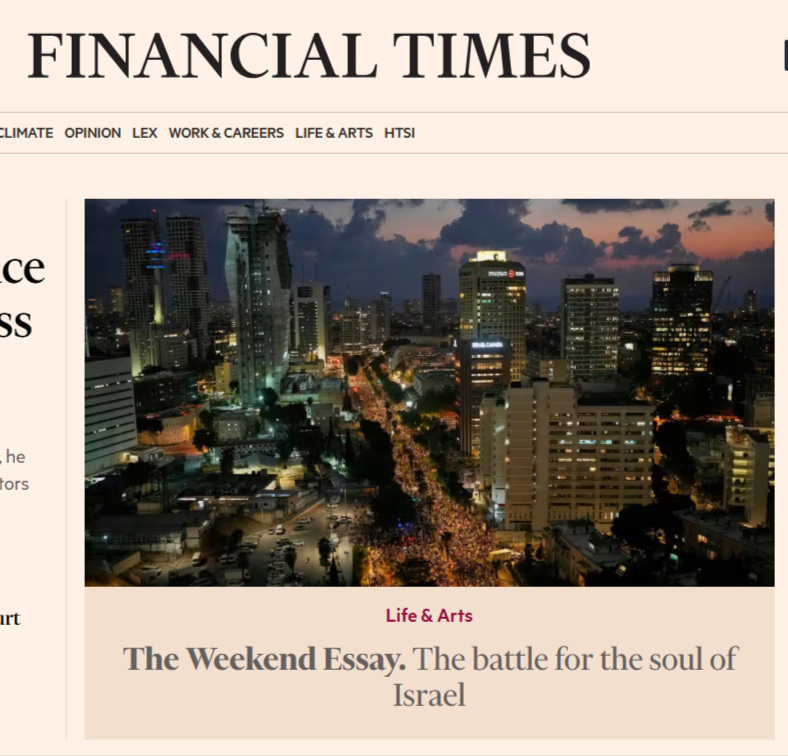
Life & Arts The Weekend Essay. ‘The battle for the soul of Israel’

Queer Atheist on Financial Times SHIT!

stephenkmacksd.com/

Aug 30, 2025

Posted in Uncategorized | 1 Comment

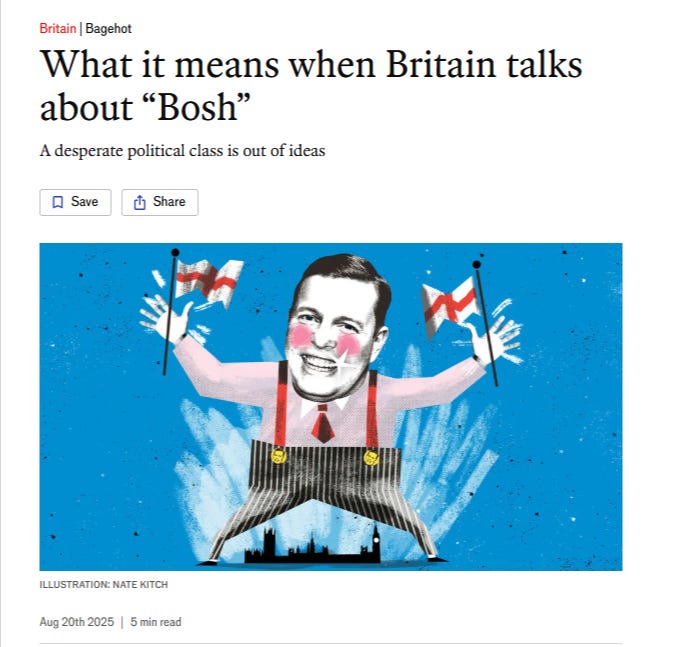
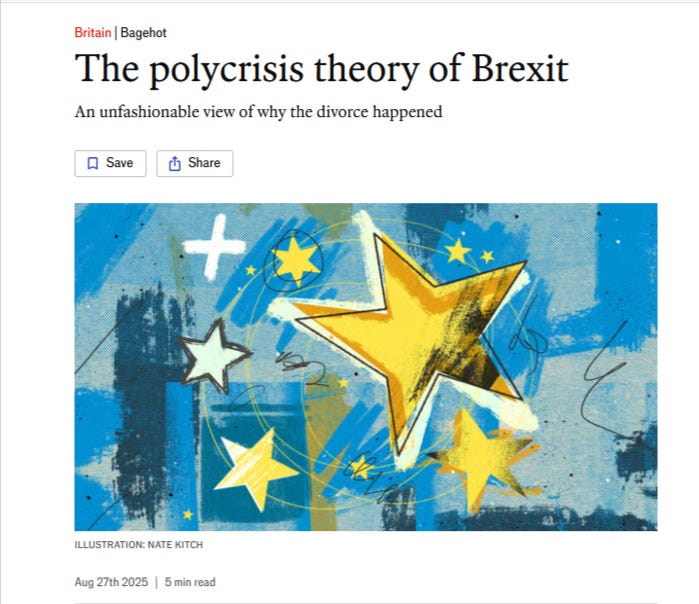
Bagehot in two iterations : Aug 20th 2025 & Aug 27th 2025!

American Reader wonders at the political elasticity of ‘The Character of Bagehot’? Over time.

stephenkmacksd.com/

Aug 30, 2025

Editor: ‘The Bagehot’ of August 20, 2025:

https://www.economist.com/britain/2025/08/20/what-it-means-when-britain-talks-about-bosh

The Reader might wonder about the books he published:

Lombard Street: A Description of the Money Market by Walter Bagehot

The English Constitution by Walter Bagehot

“Physics and Politics, or, Thoughts on the Application of the Principles of ‘Natural Selection’ and ‘Inheritance’ to Political Society”

Editor: Walter Bagehot could never be considered a satirist, yet in the hands of the present day Economist writer, Duncan Robinson mocks the Great Man!


https://www.economist.com/britain/2025/08/27/the-polycrisis-theory-of-brexit

Editor : Duncan Robinson in a ‘serious mood’, postulates ‘the polycrisis theory of brexit!’ in two short paragraphs

Parliament has lost interest, but Britons still devour books about Brexit. Those books tend to belong to one of two schools. One is the Great Man—or rather, inadequate boys—theory of history, exemplified by “All Out War”, by Tim Shipman. It argues that the divorce was propelled by the betrayals, blunders and petty feuds at the court of David Cameron, whose campaign was hopelessly focused on warning of economic disaster.

A second school takes the long view. In “Between The Waves”, a rich and incisive new history of British Euroscepticism to be published next month, Tom McTague begins the journey with Enoch Powell, a Tory imperialist, driving through the Algerian desert in 1943. From the very birth of the European project, he argues, the British dilemma between sovereignty outside the club or influence within it was acute. The break of 2016, if not inevitable, was foretold many times.

Editor: Duncan Robinson:


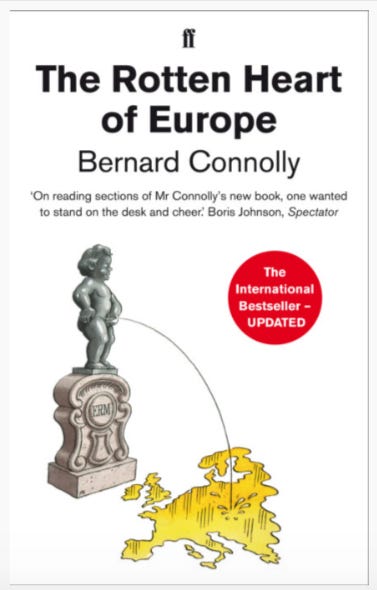
Robinson in the guise of Walter Bagehot, in his first two paragraphs fails to mention Bernard Connolly’s ‘The Rotten Heart of Europe’ in its 2012 edition:

https://www.faber.co.uk/product/9780571301744-the-rotten-heart-of-europe/?srsltid=AfmBOor7Ky2kMd4_npHslQ_BkHgQ78JhbBp_pNYl7QFbpwlGtwxkadxe

Bernard Connolly’s 400 page History is indictive of the inability of the Eurocratic clique, to let go of the tattered remaines of the legacy of Jean Monnet, and the Coal and Steel Cartel that metatisised into the Bankrupt E.U. of the current political moment! With Ukraine about to topple, and Ursula von der Leyen with her loyalists Macron, Starmer, Merz promising weapons not yet in production. What is the reader to think of Robinson as Bagehot, that offers the reader a maladroit, or just an imagined cordon sanitaire of a kind?

Editor: Just a sample of this collection of strung together Political Actors? Or just call it by another name, once favored by that long forgotten master of free association Sigmund Freud?

Revisit the continent that Lord Cameron, fresh from an election victory, toured in the summer of 2015 as he hawked his renegotiation plan.

Greece’s prime minister, Alexis Tsipras, called a referendum to defy the austere terms of a bail-out by his bankrupt country’s creditors. As cash machines ran dry, Grexit loomed—until, in an all-night summit,…

Parliament has lost interest, but Britons still devour books about Brexit. Those books tend to belong to one of two schools. One is the Great Man—or rather, inadequate boys—theory of history, exemplified by “All Out War”, by Tim Shipman. It argues that the divorce was propelled by the betrayals, blunders and petty feuds at the court of David Cameron, whose campaign was hopelessly focused on warning of economic disaster.

A second school takes the long view. In “Between The Waves”, a rich and incisive new history of British Euroscepticism to be published next month, Tom McTague begins the journey with Enoch Powell, a Tory imperialist, driving through the Algerian desert in 1943. From the very birth of the European project, he argues, the British dilemma between sovereignty outside the club or influence within it was acute. The break of 2016, if not inevitable, was foretold many times.

Both schools have merit, but Bagehot finds a third view compelling: Brexit was a matter of inept timing. Mr (now Lord) Cameron made the risky gambit of a referendum near-suicidal by asking Britons to pass judgment on the European Union after its most perilous year. Jean-Claude Juncker, then the European Commission’s president, called it the polycrisis: an era in which the prospect of Brexit combined with a euro-zone debt crisis, a migrant crisis and Islamist terrorism to threaten the foundations of Europe. With such a context, perhaps the only surprise is that Leave’s victory, with 52% of the vote, was so narrow. That crisis forms the backdrop to the last quarter of Mr McTague’s account. In the public debate, it has been largely forgotten.

Revisit the continent that Lord Cameron, fresh from an election victory, toured in the summer of 2015 as he hawked his renegotiation plan. In Brussels, the mood was leaden—like the eve of the first world war, as Donald Tusk, the Polish prime minister and an EU bigwig, later put it.

Greece’s prime minister, Alexis Tsipras, called a referendum to defy the austere terms of a bail-out by his bankrupt country’s creditors. As cash machines ran dry, Grexit loomed—until, in an all-night summit, Mr Tsipras cracked, “waterboarded” by his fellow leaders, as one diplomat put it. For the British left, the breaking of his Syriza party left a foul taste. “It’s time to reclaim the Eurosceptic cause,” wrote Owen Jones, a Guardian columnist.

….

Greece was also the entry point for many of the 1m migrants who arrived in Europe in 2015, often in dinghies over the Aegean. The largest group were Syrians displaced by war. Wir schaffen das!” said Angela Merkel in August, declaring Germany up for the challenge.

The migrant crisis fused with another fear. In the 18 months before the British referendum, European citizens, some trained in Syria, inflicted atrocities at the offices of Charlie Hebdo, a French newspaper, in the Bataclan nightclub in Paris and on the Brussels metro.

….

But European leaders resented being asked to sort out the Conservative Party’s neuroses as they battled to save their project. At summit after summit, the British question fell to the bottom of the agenda, after the coffee and petits fours.

Brexit, it claimed, was the last lifeboat to preserve the status quo; staying in a crisis-riven bloc was the real danger. That was the meaning of “Take back control”. Or as the campaign’s less-well-remembered slogan put it: “Vote Leave is the safer option.”

The reality, that running against the EU as the euro burned was playing politics on easy mode, is awkward for everyone. The Great Man theory is more flattering than dumb luck.

The polycrisis marked the end of this innocent age. It put iron in the blood: the harshness meted out to Mr Tsipras would be visited on British ministers in the Brexit years. Brussels became a lot less about farm regulations and more about flexing geopolitical muscle: a Europe of events, not rules, as Luuk van Middelaar, a Dutch historian, puts it. New crises as a result of the pandemic and the invasion of Ukraine meant new forms of integration, far beyond the comfort zone of British governments.

….

Any attempt to reverse Brexit would need to embrace this new reality. Europe’s annus horribilis made Brexit unstoppable; the changes it brought may make rejoining unthinkable.

American Reader.

Posted in Uncategorized | Leave a comment

Janan Ganesh as Madame Arcati? Political Cynic comments.

Posted on February 3, 2021 by stephenkmacksd

stephenkmacksd.com/

Aug 29, 2025

Title this ‘The Enlightenment of Tony Blair and Gordon Brown’ ? Mr. Ganesh doesn’t need to dust off his Madame Arcati shtick, he uses C-Span to demonstrate that Bill Clinton’s utter betrayal of the New Deal Tradition, in America, might just work in Britain: thus was born, the post WWII Labour Party and its Welfare State morphed into ‘Thatcherism Light’? Political opportunism, wedded to what would evolve into the myth of ‘The Third Way’ (Edward L. Bernays wrote the manuel.)that led to the economic/political catastrophe of 2008!

The archive of the US broadcaster C-Span is among the internet’s little wonders. In January 1993, an “Anthony Blair” toured Washington with another British MP named Gordon Brown. Their brief: to divine how president-elect Bill Clinton had won office and what their four-times defeated Labour party might learn. Their interview with a C-Span anchor of the just-the-facts school (“How many MPs in the House of Commons?”) is immortalised.

That ‘C-Span anchor‘ is Brian Lamb. He conducts a polite, and informative interview, aimed at an American audience. Not much more to be said. Except, of course, from Mr. Ganesh’s lofty perch.

Then the reader confronts more Ganesh mis-readings, misapprehensions, or just ideologically inflected chatter e.g. :

President Joe Biden’s centre-left peers are out of power and often out of sorts in the UK, France, Australia and the Netherlands.

A vexing question arises: how can a Neo-Liberal be ‘Center-Left’? The ‘Center’ in Western political life is now defined by the alliance between the Neo-Liberals and the Neo-Conservatives. Such is the toxicity of a collapsed Neo-Liberalism, that an actual rational political Center cannot exist. Except as a pose, a self -created mirage, a simulacrum.

If the Democrats stand out from a centre-left malaise, it is for reasons that are not much imitable outside the US.

I’ve run out of patience with Mr. Ganesh! How telling that Right-Wing Populism is the watershed of a failed Neo-Liberal Swindle? After the Crash of 2008, the fate of the Working and Middle Classes left to a rapacious Capitalism, and a politics controlled by sycophants to that Capital, and their Media allies.

On that ‘Center-Left Malaise’ in Europe see Phillip Ther’s ‘Europe since 1989: A History’ Chapters 4 & 5 that describes the toxic effects, that a fully embraced Neo-Liberalism, that left the Mitteleuropean states ripe for the Populists. That might just be first step toward an understanding of the ‘center-left malise’? Mr. Ganesh’s ‘center -left’ could be a stand-in for ‘Liberal’ or even ‘Left-Wing Social Democrats’?

With his political parameters in place, Mr. Ganesh is at full political gallop, the ‘Left’ in all its political iterations, is the enemy of choice. But the garnish is all important, the catalogue of reasons, a political symptomology is offered.

What can the reader make of the continuing rebellion, in France, against the Neo-Liberal Macron, which the Corporate Media ignores, although twitter is its life blood. And Corbyn’s ‘Project for Peace and Justice’ are the signs that the ‘Rebellion Against the Elites’ has simply reached a new stage of political development, maturation?

Mr. Ganesh final paragraph, the highfalutin notion of ‘the social contract’ dresses up his intervention with a quandry, or is it a conundrum?

What is distinctively American is the gap between the two parties on the social contract. And the subsequent indispensability of the Democratic voice. That the Biden and Republican plans for pandemic relief are $1.3tn apart could not be more eloquent of the stakes. To look at their electoral record, then the lot of the US poor, it is hard to tell if the Democrats are the most successful progressives in the rich world or the most consistently disappointing.

Political Cynic

https://www.ft.com/content/7f9e8797-a6a0-4ff8-a25d-ea2bad3e2d3c

Posted in Uncategorized | 2 Comments

Recall Henry Luce’s ‘Time Magazine’? that Gore Vidal called ‘the fictional lives of real people?’ ‘Semafor Principals’ is even more self-servingly reductive!

Political Cynic on the end of ‘reading’ replaced by ‘Evelyn Wood Reading Dynamics’ !

stephenkmacksd.com/

Aug 29, 2025

Political Cynic.

Posted in Uncategorized | Leave a comment

Benn Steil and Elisabeth Harding November 18, 2024 12:10 pm (EST)

stephenkmacksd.com/

Aug 29, 2025

https://www.cfr.org/blog/how-trump-can-control-fed

How Trump Can Control the Fed

Could President-elect Donald Trump end Fed independence on monetary policy? A legislative anomaly gives him a way.

Post by Benn Steil and Elisabeth Harding

November 18, 2024 12:10 pm (EST)

In Barron’s last Thursday, I (Benn) argued that a dusty legal anomaly could help president-elect Donald Trump—who has questioned the logic and legal basis of Fed independence—to wrest control of monetary policy away from the Federal Open Market Committee (FOMC).

The FOMC, composed of the seven Board of Governors members and five Reserve Bank presidents, has sole legal authority to conduct monetary policy. But legislation gives the power to control interest on bank reserves—the primary tool by which the Fed implements monetary policy—solely to the Board of Governors. As shown in the graphic above, all of the Board’s seven members are presidential appointments, whereas five of the twelve FOMC members are Reserve Bank presidents—not chosen by the White House. In theory, as explained in the column, the FOMC could decide to raise rates while the Board, perhaps in deference to the president, could order them cut.

More on:

Greenberg Center for Geoeconomic Studies

U.S. Economy

Federal Reserve

Here’s where the president-elect comes in.

Geo-Graphics

A graphical take on geoeconomics. Twice a month.

View all newsletters >

Though Trump cannot fire Jay Powell as chair of the FOMC, it is an open legal question as to whether he could fire him as chair of the Board. Law scholars generally say “no,” but Powell would likely have to fight a firing on his own—as the Fed lacks standing to contest it. If Trump were successfully to replace Powell as Board chair, we would effectively have two antagonist monetary “popes”—one chairing the FOMC, and the other chairing the Board.

Still, chairs are firsts-among-equals, and do not have any greater say, legally at least, than other Board or Committee members. And Trump could not, in any case, fire Powell as a Board governor, except with “cause.”

Could Trump find valid “cause” to fire Powell—or indeed other Board members? It is certainly possible. In the case of Democratic Board appointee Adriana Kugler, her term expires, in any case, at the end of January 2026, after which she will certainly be replaced by a Trump loyalist. Two other board members, Christopher Waller and Michelle Bowman, were appointed by Trump in his first term, and might, one could speculate, be induced thereby to do his bidding. We think that unlikely, particularly in the case of the academically reared Waller, but we take note of the recent praise heaped on Bowman’s speech, connecting immigration with rising housing unaffordability, by vice-president elect JD Vance. Other Board members, all Biden appointees—Michael Barr, Philip Jefferson, and Lisa Cook—could well be induced to pursue other opportunities before their terms expire, thus creating openings for Trump without the need for dismissals.

We have heard a wide range of views on the plausibility of a Trump takeover of monetary policy by way of the Board, as laid out in the Barron’s piece. These range from “it’s terrifying” to “nah.” But in any case, draft legislation (in the form of Richard Shelby’s 2015 Financial Regulatory Improvement Act) already exists to eliminate the anomaly of Board control over interest-on-reserves. We would urge Congressfolk who believe in the importance of central-bank independence to act on it.

https://www.cfr.org/blog/how-trump-can-control-fed

Posted in Uncategorized | Leave a comment

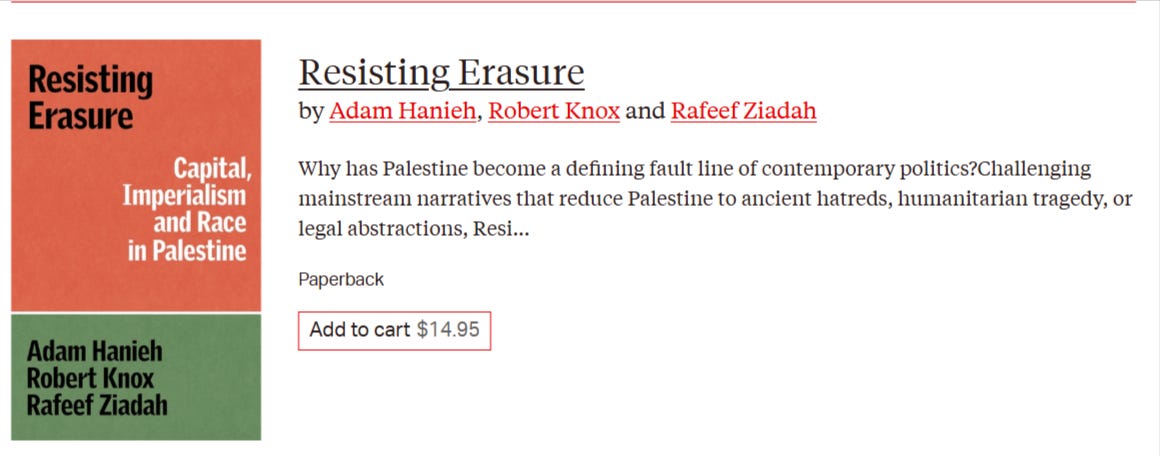
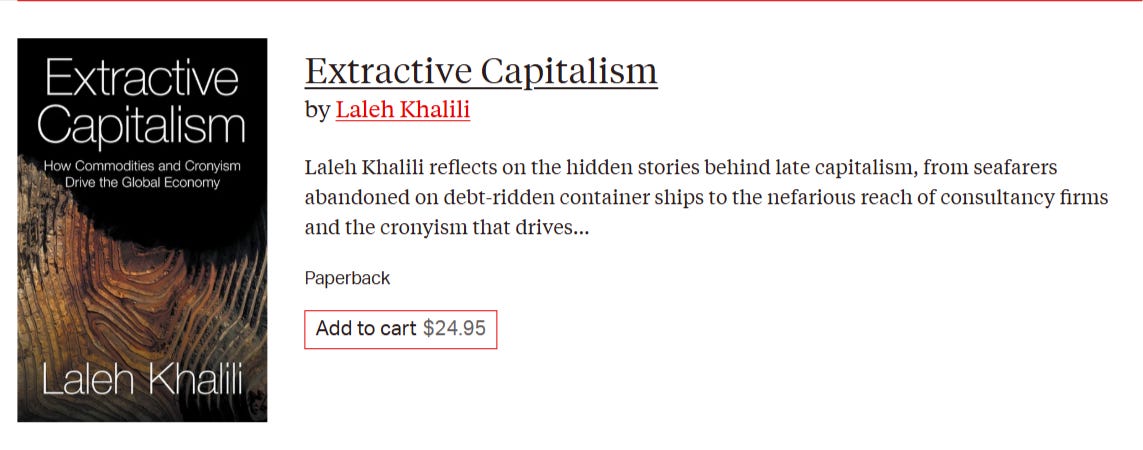
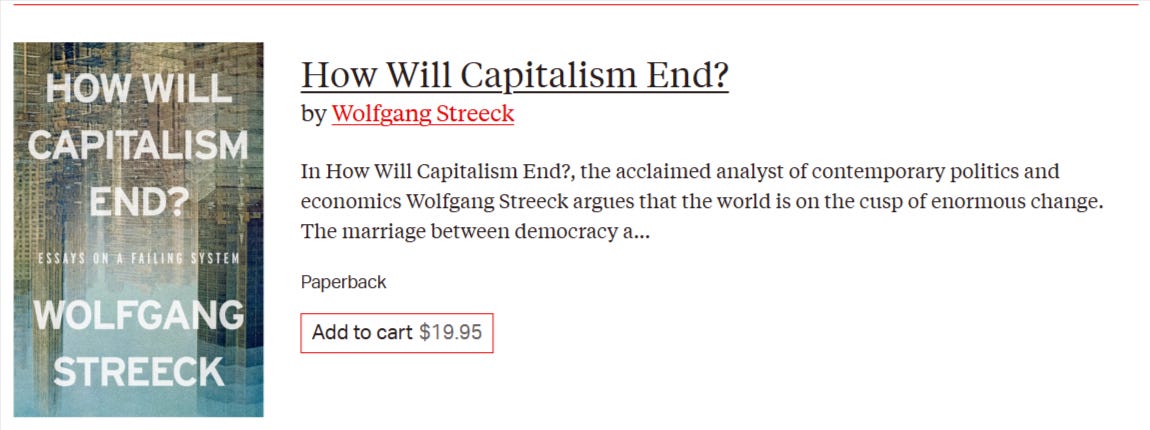
This Week’s New Titles Buy one of our new titles and save 30% on related books from our catalogue! Verso Books 26 August 2025

Political Observer !

stephenkmacksd.com/

Aug 28, 2025


Political Observer.

Posted in Uncategorized | Leave a comment

Daniel Larison is the voice of reason!

Stephen K. Mack : I have read Daniel Larison since he was writing for The American Conservative, and was eventually fired! This writer/thinker deserves your attention!

stephenkmacksd.com/

Aug 28, 2025

SKM: Here is his latest essay:

The Colossal ‘Snapback’ Error

The three European governments risk driving Iran to withdraw from the Non-Proliferation Treaty.

Daniel Larison

Aug 28

France, Britain, and Germany are about to make a colossal error:

The UK, France and Germany were preparing on Thursday to trigger a UN process to reimpose sanctions on Iran over its nuclear programme, European officials have said, in a move that would heighten tensions between the west and Tehran.

The three European governments risk driving Iran to withdraw from the Non-Proliferation Treaty (NPT). Even if Iran doesn’t quit the treaty entirely, it is practically guaranteed that their government would no longer cooperate with the International Atomic Energy Agency (IAEA). As an Iranian diplomat said this week, it will make “no sense” for Iran to cooperate with inspectors if the sanctions are put back on. It is likely that Iran would then rebuild and expand their program even more. Using the snapback mechanism is insane, and it makes a new crisis over the nuclear issue more likely rather than less.

Iranian withdrawal from the treaty is a real possibility. Iranian officials have repeatedly warned that Iran would leave the NPT if UN sanctions were reimposed. The Iranian government may conclude that it may as well quit the treaty if it is not going to be permitted to develop its nuclear program in peace as the treaty allows. If Iran is going to be put under such massive sanctions anyway, they have few incentives to remain in the treaty when they aren’t allowed to benefit from it. The Iranian leadership may also decide that withdrawing from the treaty is the only action they can take that will be significant enough to make Western governments rethink their position.

Withdrawal from the treaty doesn’t necessarily mean that Iran will pursue nuclear weapons. As Mark Fitzpatrick and Mark Goodman say in this article, “It is conceivable that Iran could withdraw from the treaty and maintain a policy of nuclear hedging, even as it reconstituted its enrichment program in secret.” Unfortunately, it is a certainty that warmongers in Israel and the U.S. will not see it that way and will likely use Iranian withdrawal as a new pretext for aggression.

Iran would be fully within its rights to withdraw from the treaty if it believes that it is necessary for its national security. The treaty states that a party to the treaty has the right to withdraw “if it decides that extraordinary events, related to the subject matter of this Treaty, have jeopardized the supreme interests of its country.” The Iranian government could point to the U.S. and Israeli attacks on their nuclear facilities and the possibility of more attacks in the future as their reasons for withdrawing. Fitzpatrick and Goodman note that Iran’s claim won’t be questioned in the same way that North Korea’s was: “In Iran’s case, such questions are unlikely to be raised, since the “extraordinary events” are obvious.”

It would be ideal if the European governments did not trigger the snapback mechanism and Iran remained in the treaty. There is no good reason to reimpose UN sanctions now, and it will just create more problems for all parties. The British, French, and German governments seem determined to make the situation worse. It was better when these governments were useless spectators. Now they suddenly want to do something on the nuclear issue, and they have landed on the stupidest possible thing to do short of war.

The Iranian government has been open to finding a diplomatic solution, and its reward has been relentless hostility, economic warfare, and bombing. Reimposing UN sanctions could very well be the last straw. The Iranian government might conclude that if it is going to be treated like North Korea no matter what it does it might as well build a deterrent to stop future attacks on their country. If that happens, the moronic hawks that brought us to this point will own the results.

StephenKMackSD

Posted in Uncategorized | Leave a comment