Books of Interest: Intellectual Curiosity and the Scientific Revolution – Academic and Professional Books – Cambridge University Press

Seventeenth-century Europe witnessed an extraordinary flowering of discoveries and innovations. This study, beginning with the Dutch-invented telescope of 1608, casts Galileo’s discoveries into a global framework. Although the telescope was soon transmitted to China, Mughal India, and the Ottoman Empire, those civilizations did not respond as Europeans did to the new instrument. In Europe, there was an extraordinary burst of innovations in microscopy, human anatomy, optics, pneumatics, electrical studies, and the science of mechanics. Nearly all of those aided the emergence of Newton’s revolutionary grand synthesis, which unified terrestrial and celestial physics under the law of universal gravitation. That achievement had immense implications for all aspects of modern science, technology, and economic development. The economic implications are set out in the concluding epilogue. All these unique developments suggest why the West experienced a singular scientific and economic ascendancy of at least four centuries.
Posted in Uncategorized | Leave a comment

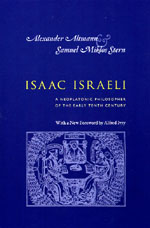
Books of Interest:Isaac Israeli: A Neoplatonic Philosopher of the Early Tenth Century, Israeli, Altmann, Stern


Recognized as one of the earliest Jewish neo-Platonist writers, Isaac ben Solomon Israeli (ca. 855–955) influenced Muslim, Jewish, and Christian scholars through the Middle Ages. A native of Egypt who wrote in Arabic, Israeli explored definitions of such terms as imagination, sense-perception, desire, love, creation, and “coming-to-be” in his writings. Continue reading

Posted in Uncategorized | Leave a comment

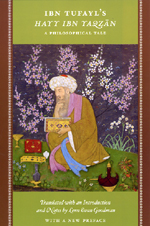
Books of Interest:Ibn Tufayl’s Hayy Ibn Yaqzan: A Philosophical Tale, Tufayl, Goodman


The Arabic philosophical fable Hayy Ibn Yaqzan is a classic of medieval Islamic philosophy. Ibn Tufayl (d. 1185), the Andalusian philosopher, tells of a child raised by a doe on an equatorial island who grows up to discover the truth about the world and his own place in it, unaided—but also unimpeded—by society, language, or tradition. Hayy’s discoveries about God, nature, and man challenge the values of the culture in which the tale was written as well as those of every contemporary society. Continue reading

Posted in Uncategorized | Leave a comment

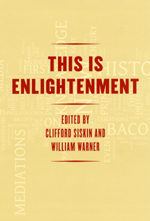
Books of Interest:This Is Enlightenment, Siskin, Warner


Edited by Clifford Siskin and William Warner

568 pages | 24 halftones, 2 line drawings | 6 x 9 | © 2010

Debates about the nature of the Enlightenment date to the eighteenth century, when Imanual Kant himself addressed the question, “What is Enlightenment?” The contributors to this ambitious book offer a paradigm-shifting answer to that now-famous query: Enlightenment is an event in the history of mediation. Enlightenment, they argue, needs to be engaged within the newly broad sense of mediation introduced here—not only oral, visual, written, and printed media, but everything that intervenes, enables, supplements, or is simply in between.  Continue reading

Posted in Uncategorized | Leave a comment

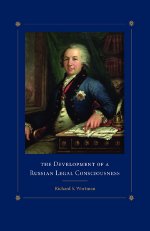
Books of Interest:The Development of a Russian Legal Consciousness, Wortman


Richard S. Wortman

360 pages | 6 x 9 | © 1976
Until the nineteenth century, the Russian legal system was subject to an administrative hierarchy headed by the tsar, and the courts were expected to enforce, not interpret the law. Richard S. Wortman here traces the first professional class of legal experts who emerged during the reign of Nicholas I (1826 – 56) and who began to view the law as a uniquely modern and independent source of authority. Discussing how new legal institutions fit into the traditional system of tsarist rule, Wortman analyzes how conflict arose from the same intellectual processes that produced legal reform. He ultimately demonstrates how the stage was set for later events, as the autocracy and judiciary pursued contradictory—and mutually destructive—goals.


Posted in Uncategorized | Leave a comment

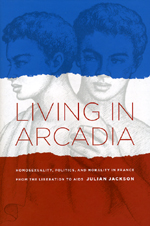
Living in Arcadia: Homosexuality, Politics, and Morality in France from the Liberation to AIDS, Jackson


In Paris in 1954, a young man named André Baudry founded Arcadie, an organization for “homophiles” that would become the largest of its kind that has ever existed in France, lasting nearly thirty years. In addition to acting as the only public voice for French gays prior to the explosion of radicalism of 1968, Arcadie—with its club and review—was a social and intellectual hub, attracting support from individuals as diverse as Jean Cocteau and Michel Foucault and offering support and solidarity to thousands of isolated individuals. Yet despite its huge importance, Arcadie has largely disappeared from the historical record. Continue reading

Posted in Uncategorized | Leave a comment

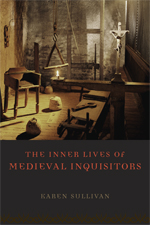
Books of Interest:The Inner Lives of Medieval Inquisitors, Sullivan


There have been numerous studies in recent decades of the medieval inquisitions, most emphasizing larger social and political circumstances and neglecting the role of the inquisitors themselves. In this volume, Karen Sullivan sheds much-needed light on these individuals and reveals that they had choices—both the choice of whether to play a part in the orthodox repression of heresy and, more frequently, the choice of whether to approach heretics with zeal or with charity. Continue reading

Posted in Uncategorized | Leave a comment

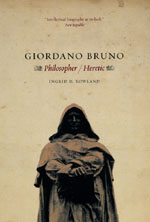
Books of Interest:Giordano Bruno: Philosopher / Heretic, Rowland

Giordano Bruno (1548–1600) is one of the great figures of early modern Europe, and one of the least understood. Ingrid D. Rowland’s biography establishes him once and for all as a peer of Erasmus, Shakespeare, and Galileo—a thinker whose vision of the world prefigures ours. Continue reading

Posted in Uncategorized | Leave a comment

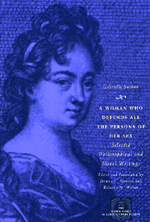
Books of Interest:A Woman Who Defends All the Persons of Her Sex: Selected Philosophical and Moral Writings, Suchon, Stanton, Wilkin


During the oppressive reign of Louis XIV, Gabrielle Suchon (1632–1703) was the most forceful female voice in France, advocating women’s freedom and self-determination, access to knowledge, and assertion of authority. This volume collects Suchon’s writing from two works—Treatise on Ethics and Politics (1693) and On the Celibate Life Freely Chosen; or, Life without Commitments (1700)—and demonstrates her to be an original philosophical and moral thinker and writer. Continue reading

Posted in Uncategorized | Leave a comment

Books of Interest: Sorcery in the Black Atlantic, Parés, Sansi


Edited by Luis Nicolau Parés and Roger Sansi

304 pages | 6 x 9 | © 2011

Most scholarship on sorcery and witchcraft has narrowly focused on specific times and places, particularly early modern Europe and twentieth-century Africa. And much of that research interprets sorcery as merely a remnant of premodern traditions. Boldly challenging these views, Sorcery in the Black Atlantic takes a longer historical and broader geographical perspective, contending that sorcery is best understood as an Atlantic phenomenon that has significant connections to modernity and globalization. Continue reading

Posted in Uncategorized | Leave a comment