http://www.nytimes.com/2011/04/05/opinion/05brooks.html?src=me&ref=homepage
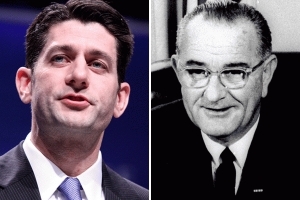
Here is Cockeyed Platonist ( CP) acting, in this episode of The American Political Melodrama, as Paul Ryan’s campaign manager . He issues this memo to the campaign staff, in preparation to the big announcement, that Mr. Ryan will run for President. Now, we must all stick to the script, is the imperative in this unapologetic encomium. The temptation is too great to pass up quoting the first short sentence of this document. ‘ It was the season of fiscal perestroika.’ Why limit yourself to a simpler word, when this beauty is waiting to be used, as the rhetorical luxury item that it is? Why, it could dress up even the most dismal essay! The title of his opinion piece is truly a nonpareil: ‘The Moment of Truth’’. Savor it’s redolence, out of the comic books of your childhood, of super-heroes and villains locked in mortal combat.
The need for Austerity is the key idea that CP and Mr. Ryan adopt: but we can look to American Capitalism as a measure of the ethical/political necessity of the practice of that puritan virtue? Let us take the case of General Electric which paid no Income Tax for the year 2010 but, in fact, claimed a 3.2 billion dollar tax credit. One might observe that G.E. didn’t even count it ‘offshore profits’ in this calculation, which is within the law, but none the less telling.
Next let us review the costs of our Colonial Wars in Iraq and Afghanistan; but where can one find, accurate, up to date information? How many trillions of dollars will be spent? We do not know exactly but we have a very good idea, given the pioneering work of Linda Bilmes and Joseph Stiglitz. Does the necessary austerity even touch these self-destructive, reckless and fiscally imprudent foreign entanglements? Let me surmise that these expenditures are sacrosanct and absolutely necessary, in the Conservative World View. As to what one of CP’s colleagues at The New York Times, Paul Krugman, has to say of Mr. Ryan and his austerity plan, I have provided a link below:
http://www.nytimes.com/2010/08/06/opinion/06krugman.html
Hardly surprising that Mr. Krugman holds a less adulatory view of Mr. Ryan’s talent as economic planner, theorist, and legislator. But his essay needs no extraneous comment, pro or con. The last two sentences of CP’s latest essay are rich in his particular variety of rhetorical gems: ‘Paul Ryan has grasped reality with both hands. He’s forcing everybody else to do the same.’ The American Political Melodrama embraces The American Political Romance.