Headline: No, Israel Is Not Committing Genocide in Gaza
It may seem harsh to say, but there is a glaring dissonance to the charge that Israel is committing genocide in Gaza. To wit: If the Israeli government’s intentions and actions are truly genocidal — if it is so malevolent that it is committed to the annihilation of Gazans — why hasn’t it been more methodical and vastly more deadly? Why not, say, hundreds of thousands of deaths, as opposed to the nearly 60,000 that Gaza’s Hamas-run Health Ministry, which does not distinguish between combatant and civilian deaths, has cited so far in nearly two years of war?
It’s not that Israel lacks the capacity to have meted vastly greater destruction than what it has inflicted so far. It is the leading military power of its region, stronger now that it has decimated Hezbollah and humbled Iran. It could have bombed without prior notice, instead of routinelywarning Gazans to evacuate areas it intended to strike. It could have bombed without putting its own soldiers, hundreds of whom have died in combat, at risk.
It isn’t that Israel has been deterred from striking harder by the presence of its hostages in Gaza. Israeli intelligence is said to have a fairly good idea of where those hostages are being held, which is one reason, with tragic exceptions, relatively few have died from Israeli fire. And it knows that, as brutal as the hostages’ captivity has been, Hamas has an interest in keeping them alive.
Nor is it that Israel lacks diplomatic cover. President Trump has openly envisaged requiring all Gazans to leave the territory, repeatedly warning that “all hell” would break out in Gaza if Hamas didn’t return the hostages. As for the threat of economic boycotts, the Tel Aviv Stock Exchange has been the world’s best-performing major stock index since Oct. 7. 2023. With due respect to the risk of Irish boycotts, Israel is not a country facing a fundamental economic threat. If anything, it’s the boycotters who stand to suffer.
In short, the first question the anti-Israel genocide chorus needs to answer is: Why isn’t the death count higher?
…
Editor: The Reader reels from the first paragraph of Bret Stephens’s political apologetic. Yet The Reader sees no mention of Francesca Albanese, Special Rapporteur on the occupied Palestinian territories? The final paragraphs of Stephen’s historically inflected propganda make way for these paragraphs:
…
Some readers may say that even if the war in Gaza isn’t genocide, it has gone on too long and needs to end. That’s a fair point of view, shared by a majority of Israelis. So why does the argument over the word “genocide” matter? Two reasons.
First, while some pundits and scholars may sincerely believe the genocide charge, it is also used by anti-Zionists and antisemites to equate modern Israel with Nazi Germany. The effect is to license a new wave of Jew hatred, stirring enmity not only for the Israeli government but also for any Jew who supports Israel as a genocide supporter. It’s a tactic Israel haters have pursued for years with inflated or bogus charges of Israeli massacres or war crimes that, on close inspection, weren’t. The genocide charge is more of the same but with deadlier effects.
Second, if genocide — a word that was coined only in the 1940s — is to retain its status as a uniquely horrific crime, then the term can’t be promiscuously applied to any military situation we don’t like. Wars are awful enough. But the abuse of the term “genocide” runs the risk of ultimately blinding us to real ones when they unfold.
The war in Gaza should be brought to an end in a way that ensures it is never repeated. To call it a genocide does nothing to advance that aim, except to dilute the meaning of a word we cannot afford to cheapen.
Editor: The Reader must confront the fact that Stephens was from 2002 to 2004, the editor-in-chief of The Jerusalem Post, a political arm of the Zionist State! He is a Zionist with deep connections to that state, and a Neo-Conservative: Leo Strauss re-wrote the ‘History Of Philosophy’, so that his political epigones, like Stephens, might acquire a fictional relationship to that mendacious re-write. Stephens operates within that benighted legacy !
As Hunter Biden continues to unleash profanity-laden attacks on Democrats, George Clooney, and others, it appears that former special counsel David Weiss is doing his own unloading. In a recent closed-door interview, Weiss said that he faced obstacles in his effort to prosecute the former President’s son, including a virtual boycott from DOJ attorneys in joining his team.
Weiss told the House Judiciary Committee staff that he struggled to staff his effort. He noted that he received no support from former Deputy Attorney General Lisa Monaco, who many viewed as the practical head of the department as opposed to former Attorney General Merrick Garland. Notably, Weiss says that he thought that Monaco might have recused herself because he received no support or even interaction with her.
Weiss’s speculation on Monaco’s staff is curious. Usually, recusals are made known to other attorneys to create a wall of separation over any potential conflicts of interest. It is bizarre if Weiss still does not know if such a recusal had occurred.
In the meantime, Weiss said that he found himself an effective persona non grata within the department as he sought staff support. When he went to the director of the Executive Office for United States Attorneys, he was told that they had received just one resume from an attorney willing to investigate the president’s son.
As opposed to investigating Trump, it appears that DOJ attorneys did not relish or support such efforts directed against the Bidens.
Weiss said, “All I know is I didn’t get a whole lot of resumes.” He also described the environment for support as “a drought” within the department.
For his testimony, the Trump DOJ gave Weiss permission in a letter to talk to Congress about Hunter Biden’s cases. The department noted, however, that it could not authorize Weiss to talk about the former first son’s confidential tax information.
Weiss was asked about his failure to charge Hunter Biden under the Foreign Agents Registration Act. Some of us wrote extensively about the strong basis for such a charge as an unregistered foreign agent given past charges brought against Trump figures and others.
Yet, as reported by Fox, Weiss “told the committee his team had no serious discussions about charging Hunter Biden under a foreign lobby law called the Foreign Agents Registration Act.”
I have previously testified on the Foreign Agents Registration Act and have previously written about the disturbing disconnect in the treatment of the President’s son as opposed to figures like Paul Manafort.
The charge was always one of the greatest fears of the White House. If Hunter Biden were a foreign agent, it would magnify the influence-peddling scandal and further link his conduct to the work of his father as vice president and later president.
What was previously known about millions received from China, Russia, and other countries made such a charge obvious. In the past, the Justice Department has frequently used the charge in high-profile cases to pressure defendants and encourage cooperation or plea agreements. During the Trump Administration, an official could not visit Epcot without incurring a FARA charge from the DOJ.
This charge has been a favorite of the DOJ before the President’s son was implicated in a massive influence peddling scheme with foreign figures.
According to reports, Weiss seemed to shrug off the FARA question.
Weiss declined to answer many questions, suggesting that he was still limited in doing so. The Trump Administration should be able to remove all such barriers. Weiss has much to answer for in his tenure as special counsel. This is an important start, but should not be the end of the inquiry.
Is it possible to treat an author as a philosophical authority and meet these requirements? I would argue that it is. This requires some combination of critical judgment and trust in the philosophical authority. Readers might treat a thinker as a philosophical authority in that they trust that what the thinker says is worthy of serious consideration, and that studying it will lead them closer to the truth. This use of authority is compatible with the first requirement; indeed, it encourages readers to reflect on what the philosopher says and to think with the text. And this use of authority is compatible with the second requirement. Although readers trust that studying the authority’s thought will lead them closer to the truth, they are free to use their critical judgment and to disagree.
The combination of trust and critical judgment makes possible an interesting structural feature in the relationship to a philosophical authority. The trust that one places in a philosophical authority can and should be confirmed or disconfirmed through the process of philosophical inquiry. If I trust that a particular thinker is a reliable source of insight, I can confirm this by reflecting critically on the thinker’s works. If these reflections bear fruit, my original trust is confirmed or even strengthened. On the other hand, a false authority can be found out in the course of philosophical investigation, if the reflections come up empty.
This trust-confirmation structure is also present for other types of authorities—in particular, the teacher. Indeed, the teacher is a particularly apt model for understanding Heidegger’s philosophical authority. Arendt notes the great fame and success that Heidegger enjoyed as a teacher,17 and so much of his thought was developed in his lecture courses. In the case of a teacher, students have to trust that what is taught is true and important to learn. Ideally, the students will be able to confirm the truth and importance of what they have learned as they continue their studies. Of course, a philosophy teacher does not teach particular philosophical positions so much as a way of thinking. As Arendt writes about Heidegger: “There is a teacher; one can perhaps learn to think.” 18 The students have to trust that this way of thinking is fruiful and leads to the truth. Its success in doing so confirms the original trust.
If the legitimate use of philosophical authority has this trust-confirmation structure, there might seem to be relatively li!le risk involved: any false authority will be found out soon enough. However, the task of interpretation sometimes requires that readers postpone critical evaluation—especially when the philosopher’s thought is demanding. In order to evaluate a philosophical position, one must first understand it. In the case of a difficult thinker like Heidegger, this requires that readers take a deep dive into the philosopher’s thought, trying out the ideas and seeing the world through the philosopher’s conceptual framework. All of this takes time and delays full critical evaluation, even if preliminary evaluations are possible along the way. In fact, there is the danger that the task of critical evaluation is postponed indefinitely—either because readers are unsure that they fully understand the philosopher’s thought, or because they are unsure by what criterion it should be judged. In the meantime, readers immersed in the philosophy trust that the effort will pay off, and that their thinking is directed toward the truth. If the philosopher is not worthy of this trust, there is certainly a risk. A false authority might shape their thinking, however subtly, in ways that distort reality and make them more open to the kind of twisted ideology expressed in the Black Notebooks. Indeed, the philosopher Karl Jaspers had this risk in mind when he recommended Heidegger be banned from teaching ater the war, claiming that his mode of thinking “would have a very damaging effect on students at the present time.”19
Editor: Of the many books cited in Mark Thomas’ essay he mentions two valuable books in his essay!
Heidegger, Philosophy, Nazism: AuthorJulian Young, University of Auckland Published: May 1997
Editor: The Table of Cotents is defines the territory!
Chapter 1 The rejection of epistemic authority 1. Authority, equality, and self-reliance in the epistemic realm 2. The epistemological case for epistemic self-reliance 2.1 Mistrust of taking beliefs from others 2.2 Self-reliance and the nature of knowledge: Plato and Locke 2.3 Self-reliance and Cartesian doubt 3. The case from ethics: self-reliance and autonomy 4. Authority and autonomy in the intellectual domain 5. The value of reflective self-consciousness
Chapter 2 Epistemic self-trust 1. The natural authority of the self 2. The natural desire for truth and the pre-reflective self 3. The desire for truth and the reflective self 4. Self-trust and the alternatives 5. The conscientious believer and the nature of reasons
Chapter 3 Epistemic trust in others 1. Epistemic egoism 2. The need for trust in others 2.1. Why epistemic egoism is unreasonable 2.2. Epistemic egocentrism 3. Trust in others and the two kinds of reasons 3.1 The distinction between deliberative and theoretical reasons 3.2 The two kinds of reasons and parity between self and others 4. Epistemic universalism and common consent arguments
Chapter 4 Trust in emotions 1. The rational inescapability of emotional self-trust 2. Trustworthy and untrustworthy emotions 3. Admiration and trust in exemplars 4. Trust in the emotions of others 5. Expanding the range of trust
Chapter 5 Trust and epistemic authority 1. Authority in the realm of belief 2. The contours of epistemic authority: the principles of Joseph Raz 3. Pre-emption and evidence 4. The value of truth vs. the value of self-reliance
Chapter 6 The authority of testimony 1. Conscientious testimony 2. Testimony and deliberative vs. theoretical reasons 3. Principles of the authority of testimony 4. Testimony as evidence and the authority of testimony 5. The parallel between epistemic and practical authority
Chapter 7 Epistemic authority in communities 1. Epistemic authority and the limits of the political model 2. Authority in small communities 2.1 Justifying authority in small communities 2.2 Justifying epistemic authority in small communities 3. Communal epistemic authority 4. The epistemology of imperfection
Chapter 8 Moral authority 1. The prima facie case for moral epistemic authority 2. Skepticism about moral authority 2.1 Skepticism about moral truth 2.2 Moral egalitarianism 2.3 Autonomy 3. Moral authority and the limits of testimony 3.1 Emotion and moral belief 3.2 Moral authority and understanding 4. Communal moral authority and conscience
Chapter 9 Religious authority 1. Religious epistemic egoism 2. Religious epistemic universalism 3. Believing divine testimony 3.1 Faith and believing persons 3.2 Models of revelation 4. Conscientious belief and religious authority
Chapter 10 Trust and disagreement 1. The antinomy of reasonable disagreement 2. Disagreement and deliberative vs. theoretical reasons 3. Self-trust and resolving disagreement 4. Communal epistemic egoism and disagreement between communities
Chapter 11 Autonomy 1. The autonomous self 1.1 The norm of conscientious self-reflection 1.2 Autonomy from the inside and the outside 2. Attacks on the possibility of autonomy: Debunking self-trust 3. Epistemic authority from the outside 4. Self-fulfillment Bibliography Index
Editor : Not relying wholly on the above table of contents, see this review by Anne Baril.
Epistemic Authority: A Theory of Trust, Authority, and Autonomy in Belief
Linda Trinkaus Zagzebski, Epistemic Authority: A Theory of Trust, Authority, and Autonomy in Belief, Oxford University Press, 2012, 279pp., $45.00 (hbk), ISBN 9780199936472.
To re-cap the main thread of the argument: 1) epistemic self-trust is both rational and inescapable, 2) consistent self-trust commits us to trust in others, 3) among those we are committed to trusting are some we ought to treat as epistemic authorities, and 4) some of these authorities can be in the moral and religious domains. (3) Zagzebski concludes that there is epistemic authority in a strong sense — an epistemic authority that “has all of the essential features of practical authority” (139) (though at times she seems to make concessions that suggest a more moderate position; see, e.g., 116-117).
Zagzebski’s argument is characteristically clear and compelling, but, like any interesting argument, controversial. In the space remaining I will note a few reservations about her understanding of rationality, and the role it plays in her argument.
Zagzebski argues that epistemic self-trust is rational because it is needed to resolve dissonance. (50) There are at least three kinds of dissonance that she proposes that rationality involves resolving: 1) dissonance among beliefs, 2) dissonance among beliefs, emotions, and actions, and 3) dissonance between, on the one hand, beliefs (and, I believe, also emotions and actions) and, on the other hand, desires (31). As accounts of rationality, I find each proposal increasingly problematic. And since her argument for epistemic authority seems to depend on her claim that epistemic self-trust is rational not only in the first sense, but also in the second and third senses, my worries about her account of rationality, if merited, threaten not only her account of rationality, but her defense of epistemic authority.
One sort of dissonance it is rational to resolve, by Zagzebski’s account, is dissonance among beliefs. We might object to even this relatively modest account of rationality, on the grounds that the most rational response to dissonance among beliefs isn’t always to resolve that dissonance.[4] But according to Zagzebski, epistemic self-trust (which itself comprises epistemic, emotional, and behavioral elements) is rational not merely in that it resolves dissonance among beliefs, but in that it resolves dissonance among mental states more generally. (43-45, 47, 190) She proposes that a person is less rational to the extent that her beliefs, actions, and emotions (especially her feelings of trust) are not in harmony. (44)
But it seems to me perfectly rational that we should continue to act as if our faculties are getting the truth, and feel trusting of them, even if upon reflection we don’t believe they are getting the truth. By way of analogy, consider what is the practically rational response when we learn surprising things about the world, such as the fact that apparently solid objects are mostly empty space. It seems to me perfectly practically rational to act as if such objects are as solid as they appear, and to feel trusting in their apparent solidity, even if, when I reflect, I don’t believe that they are solid (at least, not in the way they appear to be). Likewise, it seems perfectly rational to me for a person to continue to act as if her faculties are trustworthy, even if upon reflection she concludes that she cannot justifiably believe that they are.
This certainly seems more rational than — as Zagzebski seems to propose — changing one’s belief to ‘fit’ one’s behavior, for the sake of psychological harmony. This wouldn’t reflect the special status that epistemic considerations have in our cognitive economy. Someone who believes something for which she lacks good evidence, for the sake of psychological comfort (such as Stella, who refuses to believe Blanche’s claim that she was raped by Stella’s husband), is less rational — paradigmatically so — than one who accepts the fact and attempts to deal with it. The same, mutatis mutandis, when it comes to someone who changes her beliefs for the sake of psychological harmony.
We should also be skeptical of the proposal that a person who experiences dissonance between her beliefs and desires is thereby less rational. Is a person who believes there is a war, and hates that there is a war, really less rational than a person who resolves this dissonance by somehow managing to get rid of her belief that there is a war, or changing her feelings about war? Zagzebski says that the resolution of this kind of dissonance is less pressing than other species — that we can “get along well enough with the dissonance.” But she still claims that “nonetheless, it is better if dissonance is resolved” and that the harmony that results from unconscious resolution of conflict between desires, or between a belief and a desire “gives us a model of the kind of rationality that is desirable for the same reason we desire harmony in our beliefs: We naturally desire and attempt to achieve a harmonious self.” (31) But (granting that the alleged dissonance is best described as a dissonance between belief and desire, rather than between, say, world and mind) does this kind of dissonance really call for resolution at all?
Note that these objections do not trade on replacing the ‘broad’ rationality that Zagzebski is interested in with a ‘narrow’ understanding of rationality, where only cognitive states can be evaluated as rational or irrational. (30, 44) Even one who grants that aims, values, and emotions play an important role in forming beliefs, and ultimately in assessments of a being’s rationality,[5] may be skeptical that a person is any less rational for failing to resolve dissonance between her mental states in the way Zagzebski proposes.
Two further reservations arise from the way Zagzebski employs this understanding of rationality in her argument for epistemic authority. The first concerns her argument from self-trust to other-trust. Zagzebski bases her conclusion that we should trust ourselves on the grounds that we will experience psychic dissonance if we don’t. She concludes that since we trust ourselves, we should trust others who are similar in the relevant respects (especially with respect to their faculties): “If I have a general trust in myself and I accept the principle that I should treat like cases alike, I am rationally committed to having a general trust in them also.” (55) But when we understand the sense in which Zagzebski holds that it is rational to trust ourselves, this conclusion doesn’t seem to follow. To illustrate: imagine that you trust yourself because I’ll give you a cupcake if you do. Imagine also that Joe has faculties similar to yours. The fact that you trust yourself (for the sake of the cupcake) gives you no reason to trust Joe. If the only reason offered for trusting yourself in the first place is the attractive reward to be attained thereby, then the fact that, enticed by this incentive, you trust yourself does not give you reason to trust anyone else, no matter how similar their faculties are to yours. The only way a reason to trust yourself — whether getting a cupcake, or avoiding psychic dissonance — should extend to trusting others is if the same reward is offered for doing so.[6]
The final reservation I have concerns Zagzebski’s claim that the rationality (so understood) of self-trust commits us to belief on authority, as she claims. If rationality is understood in terms of the kind of psychological harmony attendant upon the resolution of dissonance, and this psychological harmony is cashed out in terms of success “in living a life that survives their own future conscientious self-reflection, a life of harmony within the self” (148; illustrated by her example of the monk, 146-148), it seems possible that a person may be best able to achieve this psychological harmony not by deferring to epistemic authority, but by striving towards an ideal of epistemic self-reliance (9). This possibility seems especially salient when it comes to the way a person forms beliefs in the moral and religious domains. Understanding one’s reasons for beliefs about such important matters, and coming to one’s beliefs on the basis of one’s own understanding, seems to me to be an important part of living well. If what is rational is ultimately justified by facts about what it is for us to live well, in a way that best survives our “conscientious self-reflection” (148), then it seems possible that, at least for some of us, what is rational is to work out our beliefs in important realms (paradigmatically, moral and religious realms), for ourselves, rather than taking beliefs on others’ authority.
Epistemic Authority is rich, wide-ranging, and provocative. I strongly recommend it, especially to anyone who is interested in epistemic autonomy, epistemic authority, and the rational defensibility of faith and of believing on the authority of one’s epistemic community. It will generously reward a careful and thorough read.
Below is my column in The Hill on the rise of American armchair revolutionaries, particularly among young, affluent college graduates. It is part of the “radical chic” fostered from higher education to Hollywood for citizens who have no memory of the failures of socialism and communism in the 20th Century.
Editor: Mr. Turley seems to be not just out of touch, but a purveyor of shopworn ignorance! In sum he presents Wolfe as a truth teller, rather than social critic with certain verifiable prejudices, that read like leftovers from 1970 !
Editor: some selective quotations from this essay are instructive!
…
Sometime in December, Kempton, at the suggestion of the Panthers’ lawyers, asked some well-connected and respectable friends who have a town house on the East Side whether they would arrange an evening at home to raise money for the Panthers’ defense. Not only were the defendants desperately poor, but Kempton felt it important that their situation be publicized; for, as he wrote at the time, “If they cannot be saved from being tried as strangers, they have no chance to be tried fairly at all.” Liberal New Yorkers are quick to respond to such appeals, especially where civil liberties appear to be in jeopardy. Furthermore, the Panthers had by this time gained a certain interest—not to say glamour—as the authentic voice of black misery and rage. One tended to hear in their violent language and the shallow Marxism that accompanied it not the sound of revolution but the cry of pain. What liberals found most interesting and hopeful about the Panthers were their efforts to supply dignity and political direction to black street people. Their talk of violent revolution, their identification with third world political leaders, and even the weapons they carried seemed, by contrast, largely rhetoric and theater.
To many liberals it also appeared that the Panthers were right to claim that federal and local officials were out to destroy them. Attorney General Mitchell had begun to talk of preventive detention. Fred Hampton, the Illinois Panther leader, had been shot in his bed by a posse of Chicago police, and Bobby Seale, the national chairman, had been bound and gagged by Judge Hoffman at the Chicago conspiracy trial for having repeatedly demanded no more than his constitutional right to defend himself. Moreover, evidence of the torture and murder of Alex Rackley in New Haven—a crime with which Seale had also been charged, to which two Panthers had already confessed, and for which a third was later to be found guilty—had not yet been made public; nor had any other evidence of Panther violence been produced, including whatever evidence Hogan might have had against the New York Panthers. In any case, what was on Kempton’s mind was not the guilt or innocence of the defendants but the need to raise money for their defense and to make them visible.
Thus Kempton’s friends sent out their invitations. About forty people came, including Felicia Bernstein, wife of the conductor. The Panthers who addressed these guests were articulate and calm. Their problems were obviously genuine. They talked about their breakfast program for ghetto children and said nothing to suggest that they were terrorists. They did, however, insist that they were revolutionaries, an admission that did not deter Mrs. Bernstein from agreeing to arrange a similar meeting at her own house some two weeks hence. Soon thereafter she sent elegantly engraved invitations, in her name but not in her husband’s, to perhaps a hundred people who might be interested in the case. Meanwhile, Charlotte Curtis, the society reporter for The New York Times, who had been in touch with Kempton on other matters, learned of his interest in the Panthers and said she would like to write a piece on their wives. Kempton thought this would be useful to the defendants and suggested that she come along to the Bernsteins’ party.
Tom Wolfe was another guest whom Mrs. Bernstein had not herself invited, but who came anyway. The present book is the result of his visit.
…
Editor:
God!” Bernstein interrupts Cox at one point in the evening, “most of the people in this room have had a problem being wanted.” To Wolfe this statement is laughable. Bernstein, he says, “has steered the Black Panther movement into a 1955 Jules Feiffer cartoon. Rejection, Security, Anxiety, Oedipus, Electra, Neurosis…,” etc. This misses the point. To be wanted is hardly a psychoanalytic cliché. It is an absolute spiritual necessity—for the Panthers, for the Bernsteins, and for everyone in between. The point that Wolfe misses and that Bernstein spontaneously grasped is that what we all fear is to be abandoned not simply in an indifferent and purposeless universe, but in our indifferent, purposeless, and ungoverned cities.
The prospect is not bright. According to Gibbon, when the Romans of the second century learned that their empire was waning and that their familiar gods could no longer be trusted, only a few kept their heads. Most hastened to attach their faith to whichever substitutes came their way. The result eventually was Christianity. For Americans there appears to be no such likely replacement for the faith we once had in ourselves. Some take drugs, others call the police. For most there is nothing left to do but try to pretend that things are the same, and to blame their anxiety on the failures or conspiracies of others. Such paranoia is the common refuge of a frightened people. Crises of faith are hard to bear. As therapy, delusion may seem preferable to truth. On the other hand, reality cannot be denied for long, nor does a flag on the lapel restore our lost democracy.
Yet even in such times as these, there remains a choice of action. We may blame others for our misfortunes and confront our problems with benign neglect, hoping that they will go away by themselves, or, like Felicia Bernstein and Barbara Walters, we may ask, seriously and with compassion, if anything can still be done.
Tom Wolfe’s view of things to come is darker yet. At the end of his essay he has a vision. There is a concert. Bernstein is conducting. The audience consists of
…fools, boors, philistines, Birchers, B’nai Brithees, Defense Leaguers, theatre party piranhas, UJAviators, concert hall Irishmen, Wasp ignorati, toads, newspaper readers—they were booing him—Leonard Bernstein—Boooooooooo. That harebrained story in the Times had told how he and Felicia had given a party for the Black Panthers and how he had pledged a conducting fee for their defense fund, and now stretching out before him in New York, was a great, starched, white-throated audience of secret candy store bigots, greengrocers, Moshe Dayans with patches over both eyes. Booooooo Boooooooo it was unbelievable. But it was real—he was their whipping boy and a bunch of $14.50 cretins were booing him and it was an insomniac hallucination in the loneliness of 3 AM.
Of course Wolfe can only have imagined that this was Bernstein’s dream. Though such a concert did take place soon after the editorial appeared in the Times and Bernstein was, in fact, booed, the terrible vision, with all its hatred and violence, its fear and disgust, is Wolfe’s own and in his authentic voice. The terrified conductor, the howling mob, the forgotten music may indeed be our future, as Wolfe seems to be saying. Still, we may hope that his perception in this particular is as faulty as it is generally.
Editor: Note the bad political actor in the Turley diatribe is Zohran Mamdani! The Neo-Cons and The New Democrats are in a panic over the Mamdani election. And to this the fact that Tueley was 9 in 1970, so his acquaintanceship with Wolfe’s diatribe is historical, rather that contemporaneous: I recall it vividly !
Editor: Mr. Turley refuses to acnowledge that The Rebellion Against The Elites continues!
Latte Leninist, “radical chic”, Marxism-lite, Young Democratic Socialists of America, [boycott-divestment-sanctions against Israel],
Marxism coming to America, young people for socialism and even communism, radical shifts to socialism in Great Britain and France destroyed their economies,
Notably, most of Mamdani’s proposals would violate the Constitution or bankrupt the city,
Such considerations are rarely raised, let alone resolved, in radical conferences, She added, “it’s our responsibility as people who are within the United States to go as hard as possible to decolonize this place because that will reverberate all across the world.
Lenin once mocked many in the West as idiots who would “transform themselves into men who are deaf, dumb and blind [and] toil to prepare their own suicide.” What he never imagined was how some would still be transforming themselves decades after the revolution failed.
Part of the aim of the book is to indicate what it is about the world that makes it possible for us to represent it, in thought or in language. Wittgenstein is led to a vision of crystalline purity. The world is the totality of facts. Facts are determined by states of affairs. States of affairs, each of which is independent of every other, are configurations of objects. These objects would have existed however the facts had been. If the facts had been different, it would have been because the objects had been configured differently, not because there had been different objects. Representation itself consists of facts. Thus a thought or a statement is a fact, determined by a configuration of ‘signs’. In the most elementary case the signs stand for objects, and the fact that they are configured in the way they are represents that the corresponding objects are configured in the same way. The thought or statement in question thereby serves as a ‘picture’ of the corresponding fact. It is true if the objects are configured in that way, and it is false if they are not. In a less elementary case, for example in the case of a conjunction of two statements, truth or falsity is determined by the truth or falsity of its constituents: a conjunction of two statements is true if both its constituents are true, false otherwise.
…
The whole thing has the air of a metaphysical disquisition on the fundamental character of reality and our engagement with it. The culmination, however, consists of two remarkable propositions that cast doubt on this impression: the penultimate proposition, numbered 6.54, in which Wittgenstein says that anyone who understands him will eventually recognise what he has been saying as nonsensical (by ‘nonsensical’ he does not mean absurd or foolish, but quite literally lacking in meaning); and the final proposition, numbered 7, in which, as if in explanation of the propensity to produce such nonsense, he says that we must keep silent about what we cannot speak about.
…
The book’s point is an ethical one … [It] consists of two parts: the one presented here plus all that I have not written. And it is precisely this second part that is the important one. My book draws limits to the sphere of the ethical from the inside as it were … I have managed in my book to put everything firmly into place by being silent about it.
…
The book’s point is an ethical one … [It] consists of two parts: the one presented here plus all that I have not written. And it is precisely this second part that is the important one. My book draws limits to the sphere of the ethical from the inside as it were … I have managed in my book to put everything firmly into place by being silent about it.
Editor: Friedman lectures Mamdani as if the Gaza Genocide were in a rear view mirror, of History. No surprise Friedman’s vacuous chatter is about feckless political conformity, practised over time, in The Paper Of Record!
…
First, if you are discussing a mantra — like “globalize the intifada” — that takes 15 minutes to explain why it doesn’t mean what it obviously means, I’d suggest that you distance yourself further from that mantra.
May I offer an alternative? “Two states for two peoples.” It works really well with drums — “Two states, for two peoples.”
While that solution may be a long shot, it has the virtue of being the only viable, just solution to the Israeli-Palestinian conflict — one that many Americans still support, and one, if this Gaza war ever ends, I believe many Israelis and Palestinians and Arabs and Muslims and Jews in New York City will as well. There is no other viable alternative. There is no one-state solution; there is no three-state solution. The only alternative to “two states for two peoples” is, in my opinion, no states for two peoples — just a grinding forever war between two peoples living intertwined with each other.
Second, the world does not need the mayor of New York City to be another commentator on the Israeli-Palestinian conflict. The world is awash with commentators on this issue. We don’t need any more. We need leaders ready to be conveners of those looking for the only just solution.
Tell voters more about how you will use your office to bring together Israelis, Palestinians, Arabs, Muslims and Jews who aspire to build two states for two peoples.
…
Editor: Bret Stephens essay is awash in ‘Left Bad Actors’ :
Two groups must be especially thrilled by the prospect of Zohran Mamdani becoming New York’s next mayor.
The first: young, progressive-leaning voters who gave the charismatic 33-year-old State Assembly member his come-out-of-nowhere victory in last month’s Democratic primary. They want what he wants: rent freezes, free public buses, city-owned grocery stores, tax hikes for corporations and millionaires, curbs on the police, a near doubling of the minimum wage to $30 an hour and the arrest of Benjamin Netanyahu.
The second: Republicans who want to make sure that Democrats remain the perfect opposition party — far-left, incompetent, divided, distrusted and, on a national level, unelectable. Remember when Ronald Reagan ran against the “San Francisco Democrats” in 1984 and carried 49 states? Get ready for the G.O.P. to run against “Mamdani Democrats” for several election cycles to come.
That’s a thought that ought to give moderate Democrats pause before they accept Mamdani’s mayoralty as a political fait accompli, or even think of getting behind him. Among the reasons the Democratic Party’s brand has become toxic in recent years is progressive misgovernance in places like Los Angeles; San Francisco; Oakland, Calif.; Portland, Ore.; Seattle; and Chicago. If Mamdani governs on the promises on which he’s campaigned, he’ll bring the same toxicity to America’s biggest city.
…
Editor: Stephens final quote is from Karl Marx:
Marxists often counsel: “Sharpen the contradictions.” With Mamdani as mayor, it would be Trump who’d be doing the sharpening.
Headline: Justice Ketanji Brown Jackson Makes Herself Heard, Prompting a Rebuke
Sub-headline: In solo dissents this term, the justice accused the conservative majority of lawless bias. On the term’s last day, Justice Amy Coney Barrett fired back.
Editor: The first paragraphs of Adam Liptak scolding chatter? Steeped in animus toward the newist member of the Court, is unsurprising, this is The New York Times!
Justice Ketanji Brown Jackson wrote just five majority opinions in the Supreme Court term that ended last month, the fewest of any member of the court. But her voice resonated nonetheless, in an unusually large number of concurring and dissenting opinions, more than 20 in all.
Several of them warned that the court was taking lawless shortcuts, placing a judicial thumb on the scale in favor of President Trump and putting American democracy in peril. She called the majority’s opinion in the blockbuster case involving birthright citizenship, issued on the final day of the term, “an existential threat to the rule of law.”
Justice Jackson, 54, is the court’s newest member, having just concluded her third term. Other justices have said it took them years to find their footing, but Justice Jackson, the first Black woman to serve on the court, quickly emerged as a forceful critic of her conservative colleagues and, lately, their approach to the Trump agenda.
Her opinions, sometimes joined by no other justice, have been the subject of scornful criticism from the right and have raised questions about her relationships with her fellow justices, including the other two members of its liberal wing.
Editor: In sum Justice Jackson has overstepped the bounds of deference to the senior members of the Court?
The History of the Neo-Confederate Supreme Court is well Documented, and its holdovers
On Wednesday, the five partisan Republicans on the U.S. Supreme Court showed that they wanted to do their part in devaluing the votes of blacks, Hispanics, Asian-Americans and young urban whites. So the key GOP justices indicated during oral arguments that they are looking for excuses to strike down the heart of the Voting Rights Act.
Right-wing Justice Antonin Scalia shocked the courtroom when he dismissed the Voting Rights Act as a “perpetuation of racial entitlement,” suggesting that the right of blacks to vote was some kind of government handout.
But almost as troubling was the remark from Justice Anthony Kennedy who insisted that the Voting Rights Act, which was first enacted by Congress in 1965 and was renewed overwhelmingly in 2006, was an intrusion on Alabama as an “independent sovereign,” states’ rights language reminiscent of the Old Confederacy.
Indeed, the five Republican justices also including John Roberts, Clarence Thomas and Samuel Alito seem to have absorbed a Neo-Confederate interpretation of the Constitution that is at odds with what the Framers intended.
…
Editor: Freighted with respectable bourgeois political chatter, here is the would-be ‘Bill of Attainder’ against Justice Jackson, confected by Liptak!
Justice Jackson, who did not respond to a request for comment, has also been a harsh critic of the court’s use of truncated procedures in ruling on emergency applications.
“This fly-by-night approach to the work of the Supreme Court is not only misguided,” she wrote in April, when the court said that Venezuelan men the administration was seeking to deport to El Salvador had sued in the wrong court. “It is also dangerous.”
In a dissent from an emergency ruling in June granting Elon Musk’s Department of Government Efficiency access to sensitive Social Security data, Justice Jackson accused the majority of giving Mr. Trump favored treatment. “What would be an extraordinary request for everyone else,” she wrote, “is nothing more than an ordinary day on the docket for this administration.”
When the court let Mr. Trump lift humanitarian parole protections for more than 500,000 migrants in May, Justice Jackson wrote that the majority had “plainly botched” the analysis, “rendering constraints of law irrelevant and unleashing devastation.”
Justices Jackson and Sotomayor are the only members of the court who have served as trial judges. In the last term, Justice Jackson repeatedly criticized the majority for undermining the authority of their colleagues on the front lines.
In the dissent that prompted Justice Barrett’s rebuke, she decried the majority’s “dismissive treatment of the solemn duties and responsibilities of the lower courts.”
“Officials who use their public positions for private gain threaten the integrity of our most important institutions,” she wrote. “Greed makes governments — at every level — less responsive, less efficient and less trustworthy from the perspective of the communities they serve.”
Editor: How uttery inconveient for a sitting Justice of The Supreme Court , Justice Jackson, to remind the other members of the Court, that she is capable of telling critical evaliations of their corrupt practises?
When I see someone running for mayor defending a useless, meaningless, far-left mantra that helps no one, and who prefers commenting at a distance and not convening energetically, it makes me wonder how he will deal with the really hard issues on the West Bank of the East River — not the West Bank of the Jordan — that most New York voters care most about.
Editor: Stephens is not just a Zionist like Friedman, but a former editor of the Jerusalem Post, one of the propaganda organs for the Zionist Faschist State! Stephens presents ‘The Left’ in all its various toxic hues! It’s a cartoon from the lineage of Joseph McCarthy!
The first: young, progressive-leaning voters who gave the charismatic 33-year-old State Assembly member his come-out-of-nowhere victory in last month’s Democratic primary. They want what he wants: rent freezes, free public buses, city-owned grocery stores, tax hikes for corporations and millionaires, curbs on the police, a near doubling of the minimum wage to $30 an hour and the arrest of Benjamin Netanyahu.
…
Editor: a telling bit of misplaced hyperbolie:
Marxists often counsel: “Sharpen the contradictions.” With Mamdani as mayor, it would be Trump who’d be doing the sharpening.
Editor: the quotation of the final paragraphs of Katrina Forrester’s review of Melinda Cooper book, does not even approach the value of these two invaluable Public Intellectual, to the toxin of Neo-Liberalism. And the exhaustion of the whole of America’s Political Class in the Age Of Trump, and its political precusors, offered as bearers of a kind of ersatz revelation over time?
…
Cooper’s account of the family – not only a reproductive unit or a means of pooling income, providing care and maintaining authority, but a tax shelter and vehicle for holding assets – is part of a larger story about the selective application of austerity and extravagance under neoliberalism. Today, she writes, capitalism is no longer based on returns on industrial investment, a ‘regime of accumulation organised around production and measurable in terms of growth’. Instead we have a ‘regime of asset price appreciation’ – managed largely through tax exemptions and expenditures, and based on capital gains – in which the private family wealth fund rivals the public corporation. The rentier and the debtor: this is, Cooper’s analysis suggests, the primary class division of 21st-century capitalism.
The scale of this transformation may be overstated. The family has long been a key organisational unit of capitalist social relations; the corporation persists, and public asset managers remain more powerful than private firms; and there have always been wealthy dynasties, though profitable new financial instruments have been made available to them. Public incentives to private investment were part of the logic of postwar American liberalism from the beginning, and were inscribed in earlier tax codes. Older class divisions endure, and the accumulation of capital continues through old-fashioned means of production, which coexist with the novel monetary and fiscal environments described in Counterrevolutions. Although Cooper understates these continuities, she also rejects the common diagnosis that capitalism is in a long downturn. This diagnosis is made across the ideological spectrum, from economic liberals to social democrats to the Marxist left (to which Cooper is otherwise sympathetic). Her response is that we are overlooking the boom that followed the crisis of 2008 and putting too much emphasis on long-term decline because we use outdated economic indicators that were developed to measure growth during the Fordist phase of capitalism. It is true that savings rates and industrial investment have plummeted, but new forms of investment have replaced them, and these can only be revealed by accounting for capital gains (especially those that remain unrealised).
The point of this argument is as much political as diagnostic. What Cooper wants to show is that state fiscal decisions have always been the product of antagonistic struggle – over the extent of the social wage, state debt, and the actions that capitalist actors and institutions are willing to permit. Austerity is a choice. The protection of the family at the expense of other ways of living is a choice. The transfer of public wealth to private wealth is a choice – it’s a choice to make housing a financial asset, for example. Is abundance possible for all? Cooper thinks it is, if only we can realise the possibilities afforded by control of the money supply.
While politicians have long insisted, in Theresa May’s words, that ‘there is no magic money tree’ – that we need to balance the books and live within our means – what Cooper wants us to learn from her history of the battles over the tax code in the US is that those limits are not as they are presented to us. ‘We do not lack the means,’ she writes, ‘to collectivise public debt issuance, to monetise that debt, to channel that money into collective spending on education, healthcare, welfare and the transition to renewable energy, or to redistribute the ensuing social wealth. What we lack is the political will.’ Historically, the terms and occasions on which balanced budgets can be transgressed have been set by capital, not labour. But what if we shook the magic money tree and distributed its fruits fairly: if we seized the instruments of wealth creation and socialised finance, could we finally find a way of getting everything for everyone?
The trouble, as Cooper well knows, is working out how to move towards supply-side socialism in a situation where the radical left is a long way away from power (with the democratic socialist Zohran Mamdani’s victory in the Democratic primary for mayor of what was once Trump’s New York, perhaps it is closer than one might think). But limiting the power of capital over the state isn’t just a matter of changing the ruling party, or limiting the influence of neoliberals, as Cooper sometimes seems to suggest. The relation of the state to capital runs deeper, and though there are political choices to make, they are rarely made in circumstances of our choosing. The project of using technocratic means to achieve radical abundance is beset with structural constraints. And, as Cooper’s book shows, the daily struggles of economic life under capitalism remain as much about the organisation and control of time, work and sexuality as they are about the supply and distribution of money. What her account documents is that the horrors of austerity have been the flipside of a commitment by the state to asset-owners; a commitment that could end. ‘Extravagance for everyone’ is a rallying cry that gets at the true meaning of the right to life – a demand long distorted by the anti-abortion movement. Call it the hope or the dream – too long deferred – of public luxury.
An apt analogy of Mr. Phillips book: a Studio Head, in the Golden Age of Hollywood, calling in The Wise Hack to do a re-write on a property. Such is Mr. Phillips’ role as the intellectually mendacious redeemer of the Legend of Freud. Call this intervention by its name propaganda!
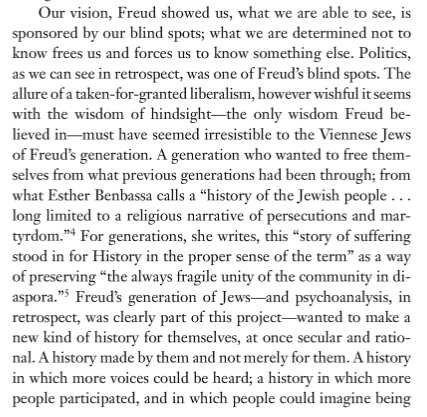
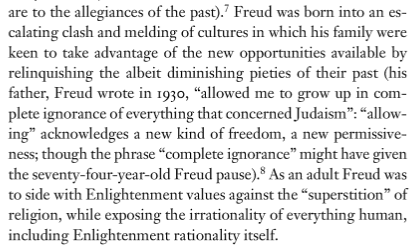
Freud always presented Psychoanalysis as a Science, not a tool for Jewish Emancipation, from European oppression in all its iterations, but as a methodology for liberation from the interaction between the Id, Ego and Super-Ego and the malign Unconscious. Freud constructs a Melodrama taking place inside the person. But this quote should put the readers mind at rest as to Freud’s commitment to Jews and Judaism:
How can a person raised in ‘complete ignorance of of everything that concerned Judaism’, a defender of Enlightenment rationality, the author of a ‘Science’ called Psychoanalysis be allied in the project of Jewish Emancipation as Mr. Phillips presents it?
That Phillips somehow thinks that part of his readership might not be former analysands, and or readers/explorers of Freud and his critics strikes this reader as the myopia of the propagandist: the evidence that leads this reader to that conclusion is the Phillips engages in the denaturing of the language of Freud, his arcane jargon, to borrow Adorno’s more that fitting description of Heidegger’s rhetorical practice, is disappeared, in favor of a set of easily understood concepts. All of this is made more palatable by Phillips’ fluid writing style, that serves him well.
To put it bluntly Phillips writes in a time in which the Freud Legend is at its nadir. The reason being, that the critical evaluation of Freud has been the undoing of his ‘Science’ and the rise of Freud as Metaphysician, Jewish Liberator or Jewish Story Teller. In Phillips re-write of Freud: he is what you desire him to be!
Mr. Phillips ‘Becoming Freud’ is the perfect candidate for an Audio Books, since the footnotes are merely superfluous scholarly garnish, to his version of Freud. Or to be blunt its like Velveeta Cheese, its ‘processed cheese food’ an ersatz version of the real thing. It is destined to end up casually placed on coffee tables, or night stands, to give the impression that its possessor is well read! I found my copy on the remainder table for $4.00
Here is a link to my essay, that contains a long list of writers who approached Freud in a critical way. I can recommend the work of Frederic Crews and John C. Ferrell :
‘Eli Zaretsky on Political Freud, a comment by Philosophical Apprentice’
…
For the surprising literary antecedent to Freud’s ‘psychoanalytic project’, Cervantes’ Quixote, see ‘Freud’s Paranoid Quest,Psychoanalysis and Modern Suspicion by John C. Farrell, Chapter 6 ‘Freud as Quixote’:
Daniel Goleman reports on psychology for The Times. Excerpts from Freud’s letters are from ”The Complete Letters of Sigmund Freud to Wilhelm Fliess, 1887-1904,” translated and edited by Jeffrey Moussaieff Masson; Cambridge, Mass., and London, England: The Belknap Press of Harvard University Press, c 1985 Sigmund Freud Copyrights Ltd. and J. M. Masson; to be published in April 1985.
WHEN SIGMUND FREUD learned in 1936 that his letters to Wilhelm Fliess, the German doctor who had been his closest friend at the turn of the century, had been purchased from a bookseller by his student, Princess Marie Bonaparte, he was aghast. Freud, by then world famous as the father of modern psychotherapy, wrote her immediately, saying: ”Our correspondence was the most intimate you can imagine. It would have been highly embarrassing to have it fall into the hands of strangers . . . I do not want any of them to become known to so-called posterity.” He later asked her to destroy them.
Almost a half-century later, the full text of that correspondence is being published. The letters have appeared, in part, before; the new edition, however, to be published next month, is the first complete and unexpurgated version. In it, passages never seen before, or quoted only in part or out of context, can be read in full, their meanings and implications presented for all to see.
Freud’s mania for controlling the narrative on his self-conception as an hero figure, is simply confirmed in the first paragraphs of this long report on the Fliess/Freud correspondence by Daniel Goleman. Freud writes to Princess Marie Bonaparte:
”Our correspondence was the most intimate you can imagine. It would have been highly embarrassing to have it fall into the hands of strangers . . . I do not want any of them to become known to so-called posterity.” He later asked her to destroy them.
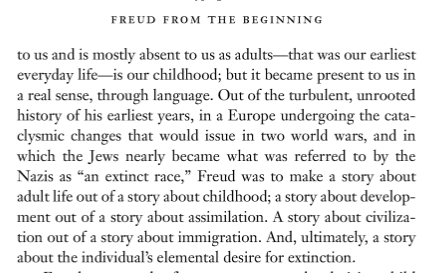
Here is more of Phillips’ breathtaking historical/personal phantasmagoria:
Begin at ‘Out of the turbulent ,uprooted history…’ . The reader can call this by its rightful name, a Freudian Melodrama aided by Lacan’s borrowings from Saussure. And ending in ‘…the individual’s desire for extinction.’ Don’t call this pessimism, but the expression of Freudian nihilism, pronounced by a revisionist’s failed attempt at his project.
Its taken some time to come to this realization: what I’ve offered as an explanation for Phillips’ style of argument, as ‘historical/personal phantasmagoria’ is that he engages in the most important tools of Psychoanalysis ‘free association’, in a biographical/historical/personal key. That appears, at first reading, as that phantasmagoria but is simply an adaptation of Freud’s methodology, to discover what the patient does not want to ‘share’ with her/his analyst.
That ‘Free Association’ reads as a meandering, evocative rhetorical style, that mimics, in a way, the aphoristic style of the seer or mystic, or even the Greek Heraclitus.




 StephenKMackSD's Blog