On The New York Times, and it’s Reporter David French, in 30 instalments!

Political Observer comments.

stephenkmacksd.com/

Aug 05, 2025

Headline: Opinion

David French

Israel Must Open Its Eyes

Aug. 3, 2025


Political Observer povides a running comentary on Mr. French’s long Zionist Apologetic


Paragraph 1

I think it’s fair to describe me as a Christian Zionist. I believe in the necessity of the Jewish people to have their own safe, secure homeland. And while I have never thought Israel was perfect (far from it), I have seen the antisemitism and genocidal intent animating its enemies in the Middle East, including Hamas, Hezbollah and Iran.

Editor Mr. Frenches self-reports

I think it’s fair to describe me as a Christian Zionist. I believe in the necessity of the Jewish people to have their own safe, secure homeland. And while I have never thought Israel was perfect (far from it), I have seen the antisemitism and genocidal intent animating its enemies in the Middle East, including Hamas, Hezbollah and Iran.

Paragraph 2

I can see the extraordinary antisemitism and bias in the larger international community. When a United Nations that includes North Korea, Syria, Russia and China condemns Israel more than any other nation in the world (by far), you know that the Jewish state is being singled out.

Editor: Antisemitism is the tool of first and last resort of the Christian Zionist?

Paragraph 3

I’m also a veteran of the Iraq war who served as judge advocate for an armored cavalry regiment during the surge in Iraq in 2007 and 2008. Before I became a journalist, I was part of a legal team that defended Israel from war crime accusations after Operation Cast Lead, the Gaza war of 2008 and 2009.

Editor Mr French offers more to the reader, more of his particular politics! ‘I was part of a legal team that defended Israel from war crime accusations after Operation Cast Lead, the Gaza war of 2008 and 2009.’

Paragraph 4

I know that Israel had the right under international law to destroy Hamas’s military and to remove Hamas from power after the massacre in southern Israel on Oct. 7. In other words, Israel had the right to respond to a terrorist force like Hamas the way the United States and its allies responded to a terrorist force like ISIS after ISIS launched its terrorist campaign across the Middle East and across Europe.

Editor: Mr French offers more of his politics, or just name it political fellow traveling. Not to speak of more carefilly managed political conformity, a recurring leitmotif !

Paragraph 5

So, yes, I consider myself a friend of Israel. But now its friends need to stage an intervention. The Israeli government has gone too far. It has engineered a staggering humanitarian crisis, and that crisis is both a moral atrocity and a long-term threat to Israel itself.

Editor: Mr. French So, yes, I consider myself a friend of Israel, with a caveat !

Paragraph 6

Civilian casualties were inevitable when Israel responded to Hamas, but the suffering of Palestinian civilians is far beyond the bounds of military necessity. The people of Gaza, already grieving the loss of thousands of children, now face a famine — and children once again will bear the brunt of the pain.

Editor:Mr. French provides more hand wringing, equivocation etc.

Paragraph 7

If you’re skeptical of this claim (and I know many supporters of Israel are), consider two factors — the numbers and the timing. As The Times documented in an article on Friday, the amount of aid flowing into Gaza has sharply diminished.

Paragraph 8

Before Israel ended its cease-fire with Hamas and blocked aid shipments in March, the amount of aid entering Gaza had soared to well over 200,000 tons per month. Then it dropped to virtually nothing, and even after Israel lifted its blockade in May, the amount of aid flowing into Gaza was a small fraction of what it had been.

Editor: Mr. French can’t quite seem to come to terms with enforced famine: Christian Zionism is elastic in its many permutations and self willed forgetting!

Paragraph 9

Compounding the problem, the method of distributing what little aid is available requires thousands of Palestinians to travel long distances, which imposes an extreme hardship on the most vulnerable people — the very old, the very sick and the very young. Palestinians also have to cross military lines, which creates its own risk of violence as thousands upon thousands of hungry civilians encounter heavily armed soldiers who are on high alert.

Editor: Mr. French never reaches the point of realizing that the Famine, was a tool of Genocide practised Netanyahu and his cadre!

Paragraph 10

In Iraq, I participated in humanitarian missions that involved far fewer people, and I can tell you that these missions can be remarkably tense. It takes extreme discipline to keep the peace. Consequently, even as the amount of aid has diminished, the number of violent incidents during aid distribution has skyrocketed. Hundreds of Palestinians in search of food have been killed, many of them by Israeli soldiers.

Editor: Mr. French seems always to be almost upon the point of realization, though carefully checked by his political conformity?

………………………………………………………………………………………….

Editor: Reader some times I lose all patience with Mr. French and will simply highlight certain portions of his commentary!

…………………………………………………………………………………………………

Paragraph 11

So there is less aid, and it’s harder and more dangerous to obtain.

Paragraph 12

The decrease in aid would be dreadful on its own, but what makes it incalculably worse is the timing. Israel’s aid blockade came after a year and a half of war, when Hamas is decimated, Gaza’s government is largely dismantled and chaos reigns.

Editor:Hand-Wringing!

Paragraph 13

The dominant power in Gaza is Israel, not Hamas, and Israel, not Hamas, is the only entity with both the power to control aid distribution and the ability to obtain and distribute aid in the Gaza Strip. There is no way for Gazans to feed themselves. They are utterly dependent on Israel, and Israel removed the United Nations from the aid distribution network without replacing it with an effective alternative.

Paragraph 14

Anyone who has spent time fighting Al Qaeda or ISIS or Hamas knows that those groups think civilian suffering advances their cause. They don’t burrow into cities and wear civilian clothes and hide behind hospitals and mosques simply to conceal themselves; they do so knowing that any military response will also kill civilians. They want the world to see images of civilian death and suffering.

Editor: Mr. French carefully follows the Party Line as this is again The New York Times: ‘Anyone who has spent time fighting Al Qaeda or ISIS or Hamas knows that those groups think civilian suffering advances their cause’ . Mr. French dons the soldiers’ garb?

Editor:

Paragraph 15

So why is Israel giving Hamas what it wants?

Paragraph: 16

Hamas should lay down its arms. It should release every hostage. But Hamas’s war crimes — including its murders, its hostage taking and its concealment among civilians and civilian buildings — do not relieve Israel of its own moral and legal obligations.

Paragraph 17

There has always been a better way to defeat Hamas, and no one knows this better than veterans of the Iraq war. We’ve watched Israel make the same mistakes we made early in the war, when we repeatedly attacked and destroyed terrorist cells but the terrorists always came back.

Paragraph 18

We played a deadly and destructive version of Whac-a-Mole, reducing neighborhoods and streets to ruin, only to bomb the rubble weeks and months later when Al Qaeda returned. The only way to stop the cycle was to seize ground, hold it and protect and secure the civilian population until we could hand control over to local authorities.

Paragraph 19

That approach has a double virtue. It’s not just kinder to civilians; it’s far more effective militarily. I’m not just saying this. Gen. David Petraeus, the commander of American forces in Iraq during the surge — when we turned the tide of the Iraq war in part by protecting the Iraqi population — has made this argument over and over and over again since Oct. 7.

Editor: Mr. French features the pussy-whipped Gen. David Petraeus!

Paragraph 20

This is a moment of short-term strength and long-term vulnerability for Israel. Its triumphs in its fights with Hamas, Hezbollah and Iran mean that its foes are militarily the weakest they’ve been in more than a generation. At the same time, however, European and American public support for Israel is in a state of collapse.

Editor: Mr. French does not qualify as competent! But like Friedman, Brooks and Stephens, as New York Times propaganda foot soldiers!

Paragraph 21

May YouGov poll found that public support for Israel in Western Europe was the lowest it had ever recorded. A July Gallup poll found that only 32 percent of Americans approved of Israel’s military actions in Gaza.

Editor: A resort to Polling as the measure of the Gaza Genocide: The New York Times knows it readerships!

Paragraph 22

But don’t take collapsing support for Israel as proof that nations support Hamas. On Tuesday all 22 members of the Arab League and all 27 members of the European Union called on Hamas to disarm, release all remaining hostages and surrender control of Gaza. This was a vitally important step — a clear indication that key nations in the world utterly reject Hamas.

Editor: Mr. French offers the soothing political bath of ‘The Middle Way’ ?

Paragraph 23

It matters when President Trump — the man who ordered U.S. strikes on Iran’s nuclear facilities — describes what’s happening in Gaza as “real starvation” and says, “I told Israel maybe they have to do it a different way.”

Editor: Mr. French offers another ‘walk-on’ for that beguiling ‘Middle Way’!

Paragraph 24

Israel’s defenders can rightfully complain that nations with far worse human rights violations receive far less scrutiny. Where are the protests, they ask, against North Korean gulags? Or against the Chinese oppression of the Uyghurs? But again, Israel has moral responsibilities, regardless of Western hypocrisy, and it still needs those Western friends.

Editor: Mr. French offers a collection of Political Culprits, in the above! In sum Israel is not so bad? The only Democracy in the region merde!

Paragraph 25

No nation — not even the United States — can thrive without allies, and Israel (despite its nuclear weapons) is far more vulnerable and dependent on international friendship than the United States or Britain or France. If Israel creates a lasting rift with its European allies and shatters the longstanding bipartisan American consensus on aiding Israel, then the long-term consequences could be grave.

Paragraph 26

It’s easy to forget that it was President Barack Obama, a Democrat, who signed the largest-ever American military aid package with Israel — a $38 billion, 10-year deal that helped supply Israel with many of the weapons it has used in this war. It’s easy to forget that President Joe Biden, a Democrat, twice deployed American forces to help defend Israel from Iranian drone and missile attacks.

Editor: Mr. French offers Barack Obama and Joe Biden as exemplars of enlightened political support for the Zionist Fascist State. The whole of America’s Political Class is Owned by AIPAC!

Paragraph 27

Is Israel better off if its alliance with America depends on whether a Republican is in the White House? Can it even count on Republican support in the long run? Putting aside for the moment the rise of antisemitism in the online right, “America First” has never been a concept hospitable to foreign aid or alliances.

Paragraph 28

One of the most frustrating aspects of our political discourse is the expectation that once you’re identified on a side, you are somehow betraying your side if you speak up when it goes terribly wrong. Partisans are used to ignoring their opponents, but there might be a chance they will listen to their friends.

Editor: Mr. French self-presents as a ‘Truth Teller’ while he ignores the World Court and:

Ms. Francesca Albanese was appointed the Special Rapporteur on the situation of human rights in the Palestinian territories occupied since 1967, by the Human Rights Council at its 49th session in March 2022 and has taken up her function as of 1 May 2022. Ms. Albanese is an Affiliate Scholar at the Institute for the Study of International Migration at Georgetown University, as well as a Senior Advisor on Migration and Forced Displacement for a think-tank, Arab Renaissance for Democracy and Development (ARDD). She has widely published on the legal situation in Israel and the State of Palestine and regularly teaches and lectures on international law and forced displacement at universities in Europe and the Arab region. Ms. Albanese has also worked as a human rights expert for the United Nations, including the Office of the UN High Commissioner for Human Rights and the UN Relief and Work Agency for Palestine Refugees.

https://www.ohchr.org/en/special-procedures/sr-palestine

Editor: Reader I’ve utterly lost patience with Mr. French and The New York Times!

Paragraph 29

Israel’s friends must speak with one voice: End the famine in Gaza. Drop any talk of annexation. Protect the civilian population.

Paragraph 30

Defeating Hamas does not require starving a single child.

Political Observer.
Posted in Uncategorized | Leave a comment

On the Political Visions of Robert Colvile?

Political Observer almost grasps the Colvile Methodology?

stephenkmacksd.com/

Aug 03, 2025

Headline: Keir Starmer’s not the issue. But nor were Johnson, May, Brown…

Sub-headline: This time last year the prime minister was at his height but he has steadily become more and more disliked. Who’s to blame for this sorry state of affairs?

https://www.thetimes.com/comment/columnists/article/of-course-keirs-not-the-problem-but-nor-were-boris-gordon-mwgkgjxnv


Editor: The Reader who attemps to come to terms with Robert Colvile latest historically inflected essay: it’s full of self-serving references of an Oxbridger, who brings to bear the very weight of that History, in near capital letters? These paragrasphs almost sings of Telegraph Myopia?

The end is Nige.” That was how The Sun’s front page reported my discovery, in 2017, that “Nigel” had fallen off the official list of baby names. At the time, it seemed not just striking but symbolic: with Ukip at 2 per cent in the polls, and its former leader out of frontline politics, Nigel’s best days really did seem to lie in the past.

Last week, the list came out again. In the register office as in public life, Nigel was firmly back, with five boys both this year and last — one of whom even joined the Reform leader on the campaign trail in Clacton. Rishi was there, and Kemi too. But poor old Keir had disappeared.

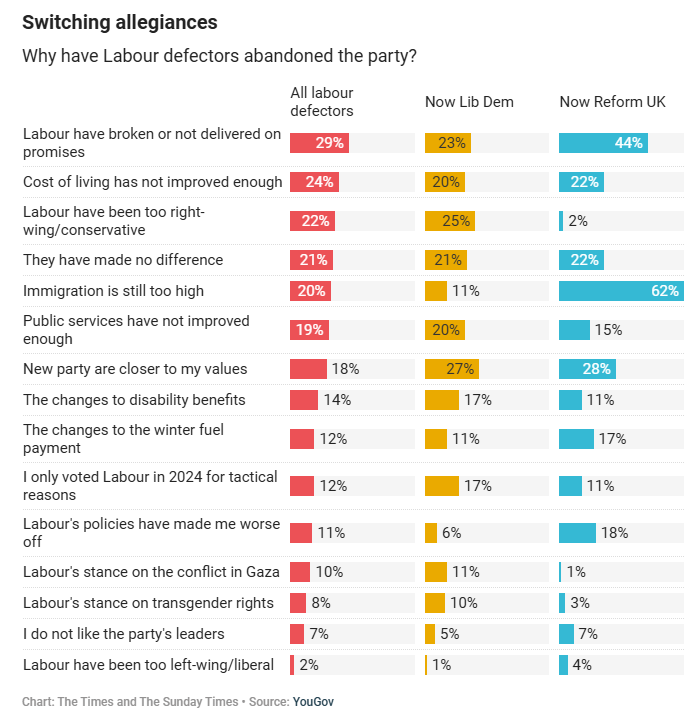
Again, the symbolism was irresistible. This time last year, Starmer was at his height as prime minister, delivering a muscular response to the riots that captured the national mood. But he has steadily become more and more disliked. Today, only 19 per cent of voters tell YouGov he is doing a good job, against 69 per cent who disagree. As of the latest polls, he is in the negatives even among Labour voters.

Editor : Mr. Colevie’s pastisch of History is meant to ensorsel the reader!

But the second tradition is far older. Indeed, it’s one of the oldest patterns in political history. In Britain, as in many other countries and cultures, it was not just treason but verging on heresy to criticise a divinely appointed king. So the discontented would always stress that their complaints were not about the wise and goodly monarch, but the evil counsellors around them. As late as the Civil War, the Roundheads blamed the outbreak of hostilities not on Charles I himself, but “an abounding malignity in those parties and Factions; who doe still labour to foment Jealosies betwixt the King and this Parliament” — godless bishops, sinister Jesuits and treacherous nobles. It took six full years of war for them to adopt the literally revolutionary position that the blame truly lay with “Charles Stuart, that man of blood”

But the problem for the government is that it’s never the advisers. It’s always the king. Just like it was for King John or Charles I or any of the others. Indeed, one of the peculiarities of the British state is that there are surprisingly few formal, institutional structures around the prime minister. Instead, Downing Street functions almost like a royal court, moulding itself around the personality of each new incumbent.

Editor: Historical Reiteration, via Mrs. Thatcher.

Ironically, for all her intractable reputation, one of the few to manage it is arguably Margaret Thatcher, who retooled her administration in 1981-2 after receiving perhaps the most wounding memo ever sent to a PM by their underlings. (“Your own management competence, like that of most of your colleagues, is almost non-existent … You break every rule of good man-management. You bully your weaker colleagues. You criticise colleagues in front of each other and in front of their officials…”).

Recently, on the train back from Kyiv, my colleague Josh Glancy asked Starmer about standing in the spotlight of history. The PM, he wrote, bristled impatiently: “I don’t do all this self-analysis bit. I thought you’d picked that up a year ago. You’re still desperately trying to get in there. Come on.”

Starmer’s position is that his job is not to construct fancy theories. It is to sit down and do the work — to make decision after decision until there are no more problems left to solve.

Editor: The Reader arrives at the final evaluation of what Starmer is, via a shopworn quote from Bismark ‘a Sphinx without a riddle’. Note the tone of self-congatulation, as somehow the point, yet what the reader confronts is an Oxbridger wallowing in political kitsch!

But all truly successful politicians tell a story about themselves. Whitehall, too, works best when everyone can buy into a single shared narrative, imposed from the centre. Starmer not only hasn’t done that, but actively resists it. The result, to steal a put-down from Bismarck, is that he ends up seeming like a Sphinx without a riddle. And the government ends up with a majority but no mission. It may be that the PM can turn things around — that by the time he leaves office, maternity wards will be packed with little Keirs, Morgans and Angelas. But I can’t help feeling that progressive Keir will soon be discarded alongside change Keir, growth Keir, and tough decisions Keir with kung-fu grip. Because if there’s one lesson from history for our leaders, it’s that the fault lies not in their advisers, but in themselves.

Political Observer

Posted in Uncategorized | Leave a comment

Recall David Brooks as writer of ‘The Collapse of the Dream Palaces’ ?

Political Observer comments.

stephenkmacksd.com/

Aug 02, 2025

Editor: Reader recall Mr. Brooks War Mongering of April 28, 2003? That led to his ascent to position at The New York Times? The War in Iraq was a lie and a crime and the stepping stone for Brooks!

The Collapse of the Dream Palaces

April 28, 2003 4:00 am


Reading ‘The Collapse of the Dream Palaces’ in July 2019: American Writer’s selective commentary

Posted on July 10, 2019 by stephenkmacksd

 Now that the war in Iraq is over, we’ll find out how many people around the world are capable of facing unpleasant facts.’

https://www.weeklystandard.com/david-brooks/the-collapse-of-the-dream-palaces

What to make of Mr. Brooks’ assertion in 2019? In the present, America is an Occupying power in Iraq, the white phosphorous attack on Falluja, Abu Ghraib and an American embassy that is 104 acres in size, are historically verifiable facts.

The embassy has extensive housing and infrastructure facilities in addition to the usual diplomatic buildings. The buildings include:[10]

Six apartment buildings for employees
Water and waste treatment facilities
A power station
Two “major diplomatic office buildings”
Recreation, including a gym, cinema, several tennis courts and an Olympic-size swimming pool
The complex is heavily fortified, even by the standards of the Green Zone. The details are largely secret, but it is likely to include a significant US Marine Security Guard detachment. Fortifications include deep security perimeters, buildings reinforced beyond the usual standard, and five highly guarded entrances.[citation needed]

https://en.wikipedia.org/wiki/Embassy_of_the_United_States,_Baghdad

Not to forget Sec. Powell’s pivotal UN speech, about non-existent Weapons of Mass Destruction, Sec. Rice’s looming ‘mushroom cloud’ and Judith Miller’s New York Times propaganda. Brooks makes up his list of heretics, whose collective abode were those ‘dream palaces‘.

There is first the dream palace of the Arabists.

Then there is the dream palace of the Europeans.

Finally, there is the dream palace of the American Bush haters.

Mr. Brooks’ literary invention of Joey Tabula-Rasa allows him to add a strategic distance between his bellicose sensibility, and that of 20 year old Joey T-B. Who is a manufactured political naif, whose uncritical acceptance of the Wise Political Elders judgement is an inept propaganda device.

Invent a representative 20-year-old, Joey Tabula-Rasa, and try to imagine how he would have perceived the events of the past month.

This essay was written for an audience of Weekly Standard readers looking for a set of political rationalizations for the ‘Iraq War’ : an endeavor of the now defunct Project for a New American Century. Its Statement of Principals and its signatories:

June 3, 1997

American foreign and defense policy is adrift. Conservatives have criticized the incoherent policies of the Clinton Administration. They have also resisted isolationist impulses from within their own ranks. But conservatives have not confidently advanced a strategic vision of America’s role in the world. They have not set forth guiding principles for American foreign policy. They have allowed differences over tactics to obscure potential agreement on strategic objectives. And they have not fought for a defense budget that would maintain American security and advance American interests in the new century.

We aim to change this. We aim to make the case and rally support for American global leadership.
As the 20th century draws to a close, the United States stands as the world’s preeminent power. Having led the West to victory in the Cold War, America faces an opportunity and a challenge: Does the United States have the vision to build upon the achievements of past decades? Does the United States have the resolve to shape a new century favorable to American principles and interests?
We are in danger of squandering the opportunity and failing the challenge. We are living off the capital — both the military investments and the foreign policy achievements — built up by past administrations. Cuts in foreign affairs and defense spending, inattention to the tools of statecraft, and inconstant leadership are making it increasingly difficult to sustain American influence around the world. And the promise of short-term commercial benefits threatens to override strategic considerations. As a consequence, we are jeopardizing the nation’s ability to meet present threats and to deal with potentially greater challenges that lie ahead.

We seem to have forgotten the essential elements of the Reagan Administration’s success: a military that is strong and ready to meet both present and future challenges; a foreign policy that boldly and purposefully promotes American principles abroad; and national leadership that accepts the United States’ global responsibilities.
Of course, the United States must be prudent in how it exercises its power. But we cannot safely avoid the responsibilities of global leadership or the costs that are associated with its exercise. America has a vital role in maintaining peace and security in Europe, Asia, and the Middle East. If we shirk our responsibilities, we invite challenges to our fundamental interests. The history of the 20th century should have taught us that it is important to shape circumstances before crises emerge, and to meet threats before they become dire. The history of this century should have taught us to embrace the cause of American leadership.

Our aim is to remind Americans of these lessons and to draw their consequences for today. Here are four consequences:

  • we need to increase defense spending significantly if we are to carry out our global
    responsibilities today and modernize our armed forces for the future;
  • we need to strengthen our ties to democratic allies and to challenge regimes hostile to our interests and values;
  • we need to promote the cause of political and economic freedom abroad;
  • we need to accept responsibility for America’s unique role in preserving and extending an international order friendly to our security, our prosperity, and our principles.

Such a Reaganite policy of military strength and moral clarity may not be fashionable today. But it is necessary if the United States is to build on the successes of this past century and to ensure our security and our greatness in the next.

Elliott Abrams, Gary Bauer, William J. Bennett , Jeb Bush, Dick Cheney, Eliot A. Cohen, Midge Decter, Paula Dobriansky,Steve Forbes Aaron Friedberg, Francis Fukuyama, Frank Gaffney, Fred C. Ikle, Donald Kagan, Zalmay Khalilzad, I. Lewis Libby, Norman Podhoretz, Dan Quayle, Peter W. Rodman, Stephen P. Rosen, Henry S. Rowen, Donald Rumsfeld, Vin Weber, George Weigel, Paul Wolfowitz

https://web.archive.org/web/20050205041635/http://www.newamericancentury.org/statementofprinciples.htm

Editor: Mr. Brooks’ evolution/de-evolution from Neo-Conservative war monger, to a self-appointed Political/Moral Prophet, with his books , riffing on the themes of an ersatz Sociology made to measure: The Social AnimalThe Road to Character and The Second Mountain places this essay, in a past that Mr. Brooks might find inconvenient? Although, like the adroit grifter, he might characterize this essay as a part of his moral/political evolution to his current point of enlightenment.

American Writer


Editor: Mr. Brooks offers his cast of chatacters:

Donald Trump

Ronald Reagan

David Frum

Simone Weil

Russell Kirk

Jon Allsop

JD Vance

Edmund Burke

Editor: Reader note the Cast of Characters in Mr. David Brooks latest pronouncement, finally reaching the point of the failure of the Democrats: Yet Trump is about the utter failure of the whole American Political Class! Mr. Brooks, in his haste, in his final paragraphs failes to look in the Political Mirror, he has construted, to place the sole blame on the Democrats!

Since the progressive era, Democrats have seen society through a government policy lens that is often oblivious to the pre-political social fabric that holds or does not hold society together from the bottom. Democrats have often been technocratic, relying excessively on social science, policy wonkery; they are prone to the kind of thinking that does not see the sinews of our common life — the stuff that cannot be quantified.

Democrats are the party of the elite managerial class, and it’s hard for us affluent, educated types in blue cities to really understand the gut-wrenching disgust, rage and alienation that envelops the less privileged as they watch their social order collapse.

I’ve read dozens of pieces from Democratic pols on how their party can turn things around. Each one — promoting this or that policy — is more pathetic than the last. These people still act and think as if it’s the 20th century and everything will be better if we can have another New Deal. They aren’t even willing to confront the core Democratic question: How does the party of the managerial elite adapt to a populist age?

The Democratic opportunity comes from the fact that, as always, Trump doesn’t try to solve the problems he addresses; he just provides a show business simulacra of a solution. If Democrats can come up with an alternative vision of how to repair the social and moral order, they might be relevant in the years ahead.

Political Observer.

Posted in Uncategorized | Leave a comment

Douglas Murray diagnoses the Gaza Problem, & mentions ‘the odd-balls Party of Jeremy Corbyn & Zarah Sultana’.

Political Observer.

stephenkmacksd.com/

Jul 31, 2025

Headline: Starmer’s spineless pandering to the Gaza vote is coming at a terrible cost

Sub-headline: Palestinianism is a creed that is entrenching divisions and transforming our culture for the worse

https://www.telegraph.co.uk/news/2025/07/30/britain-now-west-capital-sectarian-politics/

Editor: Mr. Murray point of political arrival is articulated in the these paragraphs.

Within Starmer’s own ranks similar pressures reign.

We now have a number of MPs who have been elected to Parliament purely for their ability to speak to the Palestinian issue, and they have done so because the issue is – as they know – one of the two foreign policy issues which most ignites opinion among Britain’s growing Muslim electorate (the other issue being Kashmir).

Much of the Muslim world – even those hailing from the Indian sub-continent – have imbibed anti-Israeli and indeed anti-Semitic views from birth. And they have decided that the creation of another Muslim state, and the eradication of the world’s one Jewish state, should be a priority.

As well as the “Gaza independents” in Parliament, Starmer also needs to head off the considerable number of his own MPs who share much of their sentiment or pander to the same electorate. He also has to head off the new oddballs party which is being set up by Jeremy Corbyn and Zarah Sultana – someone who is expert (as so many radical Leftists are) at playing both bully and victim at the same time.

Although Corbyn’s new movement may not be significant in the House of Commons at present, it is perfectly possible that at a future election a party like his which makes Palestinianism its first priority could hoover up dozens of seats.

Starmer’s Labour Party would then be squeezed not only by Reform that is leading them in the polls, but by this other force to his Left. Were these two forces to come at Labour simultaneously it is perfectly possible that they could push the air out of the inflated Labour majority and lead to the party losing its majority in Parliament. With the Conservatives not yet seeing any meaningful uplift in their own popularity, this messy outcome starts to look like the most likely way that Starmer’s massive majority would deflate.

Some people will think that what Starmer has done is clever politicking. It may be in the short term. But in the long term it is yet another demonstration of a dangerous trend in our country. That is the way in which religious, sectarian conflicts from abroad have been brought into the heart of our own nation, a trend which sees blocks voting along ethno-religious lines.

Starmer may have no way to lead this country to a positive future. But this week he has given us another glimpse into a future which is just as fractured and divided as some of us long warned it could be.

Editor: Mr. Murray trades on the toxin of ‘The Other’, that threatens the indigious British populations? The once British Empire, and its explotation of subjugated populatons, across the Globe, has now become the home of many, who came to Britain, in search of a better life, and opportunities unavalable to them in those former ColoniesMr. Murray is the voice of those former Colonizers.

Political Observer.

Posted in Uncategorized | Leave a comment

The Unhappy Marriage of The Economist & The Anglican Communion, as told by Charlemagne!

American Observer comments.

stephenkmacksd.com/

Jul 31, 2025

Under the rubric : Europe | Charlemagne

Headline: Cigarettes, booze and petrol bankroll Europe’s welfare empire

Sub-headline: But what if people give up their sinful ways?

https://www.economist.com/europe/2025/07/24/cigarettes-booze-and-petrol-bankroll-europes-welfare-empire

Editor: Systembolaget is equal to a state liquor store in Swedish: is the Neo-Liberal swear wordsword allied to the a riff on Puratanism, that can’t let go of its tradition of scolding the impure, and the sinfulness in British Life. That leads to a usable political pastisch of that inherent Sinfiulness via an attack on The Welfare State as a partner to that sinfullnes, rendered as satire of the bleakist kind. Notice how Systembolaget metaticises under the hand of the Economist writers/editors/curators of political content! Note the fact religious metphores and similes abound, and are continually repurposed as need be! In each of these parigraphs let me hilight the use of those metphores and similes!


Is it possible to feel the burden of sin in a continent that is all but godless, as Europe is these days? Prostitution barely generates a frisson in Belgium, a land of unionised hookers. Puffing cannabis is legal in Germany, of all places. Gambling via lotteries or mobile apps is uncontentious just about everywhere. But to feel the weight of social disapproval, try buying a bottle of wine in Sweden. Since 1955 a state-run monopoly has begrudgingly dispensed alcohol to those who insist on drinking it. The Systembolaget, as it is known, oozes disapproval. Stores are sparse and closed on Sundays. If you find one, forget posters of appealing vineyards as you browse the shelves: the decor is part Albanian government office, part pharmacy. There are no discounts to be had, nor a loyalty programme. Wine is left unchilled lest a customer be tempted to down it on a whim. As they queue to pay, shoppers are made to trudge past a “regret basket” that primly suggests they leave some of their hoard behind. The road to Swedish hell is, apparently, lined with lukewarm bottles of sauvignon blanc.

Editor: The above paragraph demonstrates that the real target, here revealed in the title is about ‘The Welfare State’, that attempts to ameliorate the bad habits of its Citizens! But note that the methology of the writer of this essay.

A dozen European countries including France and Poland impose tithes on sugary drinks. Energy taxes clobber motorists whose cars are fuelled by planet-warming petrol. Such “sin taxes” allow European politicians to indulge in their two great passions: nannying the public and filling public coffers. Alas the two are in opposition, seeing that pricey sinning makes for fewer sinners.

Europe has a special (and arguably dubious) rationale for taxing the unholy trinity that are booze, cigs and petrol: its publicly funded health-care systems ultimately pick up the tab for citizens’ bad habits, and society at large will pay the cost of adapting to global warming.

Young Europeans are on a straighter path than their parents were, including when it comes to untaxed activities like sex and illegal drugs

Though the gains made from falling sales of accessories to sin will be felt years in the future, the fiscal pain of shrinking revenue hits immediately.

Taxing sin has other issues. It often disproportionately burdens the poor, who smoke, drink and gamble more as a share of their income and drive older petrol-guzzling cars.

In 2018 a rise in fuel duties sparked the “yellow jackets” protests in France.

The EU is brimming with ideas of new sins to tax, not least as it hopes some might fund its budget directly. Levies on unrecycled plastics already flow to its coffers. On July 16th the European Commission proposed to extend excise on tobacco beyond cigarettes to vapes, as well as receiving some of the proceeds of carbon credits.

Editor: The final paragraph of this ‘essay’ is chock-a-block with Ideas for further actions that the Anti-Statest might take, when confronting the out of hand bureaucracy! Yet nowhere does their appear the realiable ‘Free Market’ that was once the answer to all questions, except the burning Question of Faith, here exercisised in its most etiolated expression? The Reader might also note that the Economist employee is given to wandering about, that is indicative of a lack of focus, she/he waxes and wanes…

Why stop there? Smoking, drinking and boiling the planet are bad, certainly. But policymakers might usefully update the list of sins to be tackled. Would any sane European oppose tripling the income taxes of people who blithely watch videos on public transport without earphones? Charlemagne would happily vote for tourism levies targeting social-media influencers who turn perfectly good Parisian cafés into Instagram backdrops. Electric scooters are a nuisance, too. The problem with taxes on addiction is it is easy for politicians to end up addicted to them.

https://www.economist.com/europe/2025/07/24/cigarettes-booze-and-petrol-bankroll-europes-welfare-empire

American Observer.

Posted in Uncategorized | Leave a comment

On the Political Rehabilitation of Zbigniew Brzezinski, in the Age Of Trump!

Political Reporter.

stephenkmacksd.com/

Jul 29, 2025

Editor: It seems that all the current political chatter about Zbigniew Brzezinski has missed this from 2015, by Charles Gati, ed. !

April 01, 2015:

Zbig: The Strategy and Statecraft of Zbigniew Brzezinski: Charles Gati, ed. Baltimore, Johns Hopkins University Press 2013

April 01 2015 in Journal of Cold War Studies (2015) 17 (2): 140–142.

https://doi.org/10.1162/JCWS_r_00535

In the years since Zbigniew Brzezinski published his first book, The Permanent Purge, nearly six decades ago, he has been in turn a prominent scholar of the Cold War, one of the leading foreign policy public intellectuals in the United States, National Security Adviser to President Jimmy Carter, and, increasingly after the turn of the century, a critic of U.S. foreign policy. Still an active presence and a strong voice in international affairs, he published his latest book, Strategic Vision: America and the Crisis of Global Power, in 2012 and continues to scrutinize U.S. engagement around the globe with a keen, skeptical eye. Brzezinski has never been afraid to speak his mind and remains for some a controversial figure.

Charles Gati has produced a valuable, informative book that examines the many facets of Brzezinski’s life and works and seeks to place the man, his era, and his writings within the broader context of the United States, along with its adversaries and partners, adapting to a changing world. The book is also a classic immigrant success story. Part personal reminiscences and part academic analysis, the volume features chapters by scholars, former officials, journalists, former students, and—at the end—a section in which Gati interviews Brzezinski about his life. This is not a conventional Festschrift, and it contains some chapters that are critical of Brzezinski’s writings and policies. But it succeeds in highlighting the unique contributions made by this scholar/practitioner.

Like his fellow Central European immigrant Henry Kissinger (with whom, the book argues, he has enjoyed a collegial, not an antagonistic, relationship over many decades), Brzezinski was able with perseverance and strong willpower to rise up in the traditional foreign policy establishment, constantly contending with suspicions that his Polish background made it impossible for him to view the Soviet Union objectively. Indeed, when Jimmy Carter appointed Brzezinski, former Defense Secretary Robert Lovett opined: “We shouldn’t have a National Security Adviser like that who’s not really an American. I can’t imagine anyone negotiating with the Russians with his loathing and suspicion” (p. 17).

Brzezinski’s record as an analyst of the Soviet system and its strengths and weaknesses has largely been vindicated by history, even though some of his ideas were contested at the time. His early writings focused on the theory of totalitarianism, which he modified to explain the post-Stalinist evolution. He understood the weaknesses of the command economy and the rigid party organization and its obsession with control, eventually predicting in his book The Grand Failure that the system had inherent weaknesses that would facilitate its collapse. Mark Kramer reminds us that Brzezinski’s analysis of Soviet-style regimes remains a “rich, provocative, stimulating source” (p. 58).

Brzezinski’s works were roundly denounced—and avidly read—in the USSR, as was clear during a unique U.S.-Soviet conference on Eastern Europe, organized by Charles Gati and Oleg Bogomolov, that took place under the auspices of the International Research and Exchange Council in the turbulent fall of 1989. I was part of the delegation with Gati and Brzezinski, who was making his first visit ever to the Soviet Union. Also in the delegation was Marin Strmecki, who vividly recounts the scene in his chapter here. Lecturing to a hushed, standing-room-only crowd at the venerable Soviet Diplomatic Academy, Brzezinski told his audience that the USSR must recognize that its East European allies had the right to self-determination, and he praised Mikhail Gorbachev’s liberalizing actions to date but said they had to go further. At the end of his speech, the auditorium erupted in thunderous applause. He went on from there to visit Katyń, the place that symbolized the massacres of Polish officers by Soviet troops at the beginning of World War II. The USSR had only just begun to admit the truth about Katyń, and he held a groundbreaking televised meeting with Soviet and Polish officials. The critic of Communism had become a player in the system’s demise.

Brzezinski’s years in the White House coincided with some of the most dramatic moments in U.S. foreign policy—the normalization of relations with China, the signing of the second Strategic Arms Limitation Treaty, the Arab-Israeli Camp David peace accords, the Iran hostage crisis, the Soviet invasion of Afghanistan, and the signing of the Panama Canal Treaty. The book argues that more was achieved in these years than in many other administrations; it also discusses the rivalry between Brzezinski and Secretary of State Cyrus Vance for the president’s ear and for control of the agenda.

The legacy of Brzezinski’s White House years remains controversial. He was the author of the policy of arming the Mujahideen in Afghanistan to fight the Soviet occupation. Although this policy undoubtedly helped accelerate the Soviet Union’s collapse, the Mujahideen were the forbearers of the Taliban and ultimately of al Qaida. Brzezinski says he has no regrets about his support of the Mujahideen. Others might disagree.

In the 21st century, Brzezinski became a harsh critic of the invasion of Iraq and many other aspects of the foreign policy of the George W. Bush administration. He also believes that the decision to stay in Afghanistan and try to modernize it was a mistake—as Soviet leaders had found out in the 1980s at great cost. Brzezinski has also been increasingly outspoken in his criticism of Israel’s policies in recent years, although he tells Gati that the only foreign country in which he feels at home—apart from Poland—is Israel. He argues for a long-term view of Russia’s evolution beyond the shadow of Putin and continues to believe that the younger generation will eventually change Russia for the better. (The Levada Center’s periodic surveys of Russian young people raise questions about this optimistic notion.)

Brzezinski’s rise and continuing influence are a testimony to the unrivaled opportunities the United States offers its immigrants, especially those with his talents, intellectual strengths, and drive. As Brzezinski himself points out at the end of the book, America is the only country in which someone called “Zbigniew Brzezinski” can make a name for himself without changing his name.

© 2015 by the President and Fellows of Harvard College and the Massachusetts Institute of Technology


Editor: From The Economist of June 19th 2025 offer shopworn hagiography: Charles Gati offering was a minimalist approach to The Great Man?

Headline: Was Zbigniew Brzezinski America’s most important foreign-policy guru?

Sub-HeadlineHe recognised—and exploited—the weakness of the Soviet Union, a new biography shows

https://www.economist.com/culture/2025/06/19/was-zbigniew-brzezinski-americas-most-important-foreign-policy-guru

Book title: Zbig By Edward Luce. Avid Reader Press; 560 pages; $35. Bloomsbury; £30

Editor: These paragraphs attempt to inflate the political reputation of Brzezinski, as the ghost like apparition as Kissinger fades from popular memory! This sentence offer clues to what Luce’s politcs are about:

Editor: Please note my placing some sentences in italics for emphasis!

Brzezinski further tightened the screws by picking up where Kissinger had left off, persuading Carter to normalise relations with China. The Soviet leadership’s feeling of isolation seemed to curb their behaviour. And after Russians invaded Afghanistan in 1979, he financed the mujahideen insurgency which, over the next decade, weakened the Kremlin.

As the sun went down on the Soviet Union, Brzezinski’s reward was to be treated in Poland as a national hero. More surprising was a visit to Moscow in 1989. Addressing the foreign service’s Diplomatic Academy, Brzezinski was his usual uncompromising self, laying out the need for a market economy, democracy and a loose federation of republics. When he finished he was met with raucous applause. To the Americans in the room, that moment marked the cold war’s end.

The question of why Brzezinski’s accomplishments are not more recognised has many answers. Kissinger was deceitful and charming; Brzezinski honest and too often rude. One was a brilliant self-publicist; the other had no time for Washington games. Nobody ever doubted who commanded Kissinger’s loyalty: himself. Brzezinski was thought by the WASP establishment to be putting Poland first. Whenever Carter was critical of Israel—and tensions were high in the lead-up to the Camp David Accords between Egypt and Israel in 1978—Brzezinski was accused of antisemitism, a charge this book refutes.

But the main reason is that Carter’s presidency was overshadowed by the mishandling of the Iranian revolution in 1979 and the hostage-taking that blighted his last year in office. Mr Luce argues that, in the run up to the revolution, Brzezinski’s advice was ignored. That does not quite wash: on other matters he was usually able to bulldoze the State Department aside. The Iranians delayed the release of the hostages until five minutes after Ronald Reagan took office. This ensured Reagan got the credit—just as he did for the collapse of the Soviet Union.

Neither Brzezinski nor Kissinger ever served in government again, but both retained a taste for power. During the presidential campaign, Kissinger had sought to ingratiate himself with Reagan by blaming the mess in Iran on Carter’s preference for human rights. When he heard of Kissinger’s muck-spreading, Brzezinski’s mordant retort was typical: “I conclude that, although power corrupts, the absence of power corrupts absolutely.”

https://www.economist.com/culture/2025/06/19/was-zbigniew-brzezinski-americas-most-important-foreign-policy-guru


Editor: This is Brzezinski after the depeat the defeat of Carter by Reagan.

The American Mission?

William Pfaff

April 8, 2004 issue

Zbigniew Brzezinski’s The Choice is superficially an election-year foreign policy tour d’horizon, more sophisticated in analysis and recommendations, and certainly more statesmanlike in temper, than current writings by the Bush administration’s supporters. It is a nuanced expression of the conventional wisdom among American foreign policy experts, and a condemnation of the self-defeating arrogance of the Bush administration’s conduct during the past two and a half years.

“‘Globalization’ in its essence means global interdependence,” Brzezinski writes. Therefore the American choice today is between attempting to create “a new global system based on shared interests,” or attempting to “use its sovereign global power primarily to entrench its own security.” The latter risks ending in “self-isolation, growing national paranoia, and increasing vulnerability to a globally spreading anti-American virus.” There would even be a risk of the United States becoming a garrison state.

One might think there are other, wider possibilities for a United States uneasily enjoying its “unilateral moment” (as the neoconservatives put it), while seeing itself as “the indispensable nation…standing taller because it sees further” (as the last Democratic secretary of state said). However, Brzezinski implicitly rejects the notion that the United States might be better off if it modified its notion of national mission and concomitant aggrandizement of national power in acknowledgment of the good sense in George Kennan’s counsel (in this journal over four years ago) that for Americans “to see ourselves as the center of political enlightenment and as teachers to a great part of the rest of the world [is] unthought-through, vainglorious, and undesirable.” Kennan added that “this planet is never going to be ruled from any single political center, whatever its military power.”

Brzezinski’s book therefore needs to be considered at two levels. The first is within the political assumptions in which it has been written, undoubtedly shared by most American foreign policy analysts and political figures today. The second would take account of the skeptical perspective articulated by Kennan and question the assumptions widely held among American officials and experts concerning the desirability or happy inevitability, and benevolent consequences, of American global hegemony.

This developed against a background of anxiety about the growing hostility of the Islamic states toward the US, coincident with Samuel Huntington’s argument that a war between civilizations was on its way. The attacks of September 2001 brought uncertainty to an end. The Bush administration launched its “War on Terror,” which despite President Bush’s explicit denial that Islam was at fault, was widely and emotionally seen as resembling a war between civilizations, with Islamic militants taken as representative of much of Islam and the United States as champion of the West (uneasily followed by its traditional allies).

Brzezinski deplores the administration’s determination to disconnect the war it had declared from its political and historical sources. He writes that The US inclination, in the spring of 2002, to embrace even the more extreme forms of Israeli suppression of the Palestinians as part of the struggle against terrorism is a case in point. The unwillingness to recognize a historical connection between the rise of anti-American terrorism and America’s involvement in the Middle East makes the formulation of an effective strategic response to terrorism that much more difficult.

Thus, he writes, an initial surge of solidarity with the United States that found expression in Europe and elsewhere just after the attacks waned as the Bush administration revealed its view of the struggle and of the appropriate response:

Culminating in the “axis of evil” formulation, the American perspective on terrorism increasingly came to be viewed as divorced from terrorism’s political context. The nearly unanimous global support for America gave way to increasing skepticism regarding the official US formulations of the shared threat.

Combined with the administration’s treatment of its supposed allies and its attacks on the United Nations and other international institutions, this skepticism was responsible for the international isolation in which the United States found itself by the time it decided to invade Iraq.

Editor: the final paragraphs of William Pfaff essay are instructive of Brzezinski’s Foreign Policy.

The ultimate criticism to be made of the position Brzezinski shares with many other foreign policy experts is that it ignores or denies the importance of what historically has been the principal force in international relations—the competitive assertion of national interests, founded on divergent values and ambitions among nations, assuredly including democratic ones.

His argument presumes that such differences will find resolution in some version of an end of history, achieved through convergence with the United States. Brzezinski and those who share his views would seem to believe in what has been called the Whig interpretation of history: that history’s purpose has been to lead up to us. The pursuit of national interest by other states produces the “global chaos” against which he warns. Condoleezza Rice made the identical argument, as in a speech last year to the International Institute for Strategic Studies in London, saying that policies based on balance of power are the road to war.

This position rejects both the classical Western view of history, which is not progressive, and the realist school of political philosophy dominant in past Western political thought, which traditionally has taken a disabused view of human nature and political possibility. The progressive view is a manifestation of hope, or of faith. It amounts to an ideology, teleological in nature. It denies the proposition that hegemony produces hubris, inviting the attention of Nemesis, ending in destitution.

The notion that the United States has an exemplary national mission has always been central to American political thought and rhetoric. In Woodrow Wilson’s view (and that of many in the US today) this mission was divine in origin. Wilson (a president respected by today’s notably secular neoconservatives) held that the hand of God “has led us in this way,” and that we are the mortal instruments of His will—a view that has repeatedly found an echo in the discourse of George W. Bush. This sense of mission lies behind the American claim to an exceptional role in international society.

Brzezinski argues that the practical consequence today of America’s global security role and its extraordinary global ubiquity [is to give the United States] the right to seek more security than other countries. It needs forces with a decisive worldwide deployment capability. It must enhance its intelligence (rather than waste resources on a huge homeland security bureaucracy) so that threats to America can be forestalled. It must maintain a comprehensive technological edge over all potential rivals…. But it should also define its security in ways that help mobilize the self-interest of others. That comprehensive task can be pursued more effectively if the world understands that the trajectory of America’s grand strategy is toward a global community of shared interest.

This belief that the United States has a unique historical mission—whether or not divinely commissioned—is not open to logical refutation. But an American policy that rests on a self-indulgent fiction must be expected to come to a bad end.

Every country has a “story” it tells itself about its place in the contemporary world. We are familiar enough with the American story, beginning with the City on a Hill and progressing through Manifest Destiny toward Woodrow Wilson’s conviction we are “to show the way to the nations of the world how they shall walk in the paths of liberty…. It was of this that we dreamed at our birth.” The current version of the story says that this exalted destiny is fatefully challenged by rogue nations with nuclear weapons, failed states, and the menace of Islamic extremists. Something close to Huntington’s war of civilizations has begun. National mobilization has already taken place. Years of struggle lie ahead.

The “isolation” of the United States today is caused by the fact that its claims about the threat of terrorism seem to others grossly exaggerated, and its reaction, as Brzezinski himself argues, dangerously disproportionate. Most advanced societies have already had, or have, their wars with “terrorism”: the British with the IRA, the Spanish with the Basque separatist ETA, the Germans, Italians, and Japanese with their Red Brigades, the French with Palestinian and Algerian terrorists, Greeks, Latin Americans, and Asians with their own varieties of extremists.

America’s principal allies no longer believe its national “story.” They have tried to believe in it, and have been courteous about it even while skepticism grew. They are alarmed about what has happened to the United States under the Bush administration, and see no good coming from it. They are struck by how impervious Americans seem to be to the notion that our September 11 was not the defining event of the age, after which “nothing could be the same.” They are inclined to think that the international condition, like the human condition, is in fact very much the same as it has always been. It is the United States that has changed. They are disturbed that American leaders seem unable to understand this.

When American officials and policy experts come to Europe saying that “everything has changed,” warning that allied governments must “do something” about the anti-Americanism displayed last year in connection with the Iraq invasion, the Western European reaction is often to marvel at the Americans’ inability to appreciate that the source of the problem lies in how the United States has conducted itself since September 2001. They find this changed United States rather menacing. An Irish international banker recently observed to me that when Europeans suggest to visiting Americans that things have changed in Europe too, as a direct result of America’s policies, “it’s as if the Americans can’t hear.” A French writer has put it this way: it has been like discovering that a respected, even beloved, uncle has slipped into schizophrenia. When you visit him, his words no longer connect with the reality around him. It seems futile to talk about it with him. The family, embarrassed, is even reluctant to talk about it among themselves.

—March 10, 2004

Political Reporter.

Posted in Uncategorized | Leave a comment

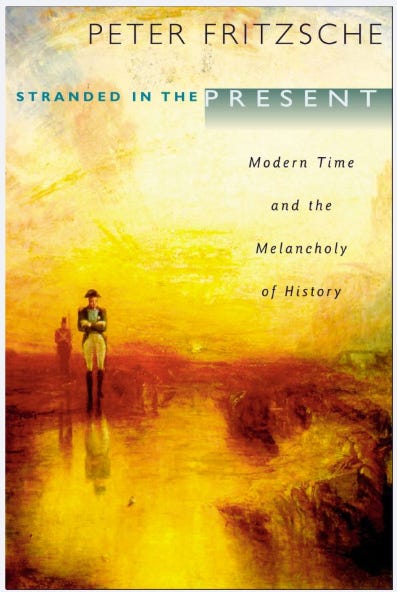
On: ‘Stranded in the Present Modern Time and the Melancholy of History’ by Peter Fritzsche

Philosophical Apprentice.

stephenkmacksd.com/

Jul 28, 2025

In this inventive book, Peter Fritzsche explores how Europeans and Americans saw themselves in the drama of history, how they took possession of a past thought to be slipping away, and how they generated countless stories about the sorrowful, eventful paths they chose to follow.

In the aftermath of the French Revolution, contemporaries saw themselves as occupants of an utterly new period. Increasingly disconnected from an irretrievable past, worried about an unknown and dangerous future, they described themselves as indisputably modern. To be cast in the new time of the nineteenth century was to recognize the weird shapes of historical change, to see landscapes scattered with ruins, and to mourn the remains of a bygone era.

Tracing the scars of history, writers and painters, revolutionaries and exiles, soldiers and widows, and ordinary home dwellers took a passionate, even flamboyant, interest in the past. They argued politics, wrote diaries, devoured memoirs, and collected antiques, all the time charting their private paths against the tremors of public life. These nostalgic histories take place on battlefields trampled by Napoleon, along bucolic English hedges, against the fairytale silhouettes of the Grimms’ beloved Germany, and in the newly constructed parlors of America’s western territories.

This eloquent book takes a surprising, completely original look at the modern age: our possessions, our heritage, and our newly considered selves.


Praise

  • Peter Fritzsche’s prose is both elegant and arresting, his insights always interesting. Stranded in the Present will attract a wide audience not only of experts but of general readers interested in how modern culture constructs its own past.—James Sheehan, Stanford University
  • An elegantly written book on an important and long neglected topic. Peter Fritzsche weaves a fascinating tale of how we came to our sense of modern time and the consequences of it. I expect this book to become a standard point of reference for the argument that the notion of modern time had an abrupt ‘beginning’ in the French revolutionary and especially Napoleonic wars. These upheavals created a kind of nostalgia about the past, that is, for what was lost in the transition to the modern. Thus melancholy and the conviction that our times are distinctly modern go hand in hand. Stranded in the Present provides an accessible, thoughtful, and even beautiful example of how to think about the category of time. It will be much discussed in many different circles.—Lynn Hunt, University of California, Los Angeles
  • In an evocatively titled work, Fritzsche conveys the disruption of time-honored social customs and intellectual assumptions in Prussia, France, Britain, and the United States caused by the French Revolution. More profound and ideological than its predecessor in the American Colonies, the French Revolution was similar to World War I in the proportion of civilian and military casualties, the collapse of old political systems, the new visibility given to the military in cultural life, and the anomie induced among writers and common folk alike. Drawing upon letters, journals, and resurgent fairy tales by the likes of the Brothers Grimm, Fritzsche reveals how many people recognized their contemporaries as fellow ‘time comrades,’ affected by a new concept of history that was no longer circular but linear.—Frederick J. Augustyn, Library Journal
  • Fritzsche argues forcefully and convincingly for the revolutionary mindsets that accompanied the events of the [French] Revolution and its seemingly endless aftershocks. The creation of a new sensibility about the place of the individual in the drama of history provides the impetus for Fritzsche’s work, which traces the dislocations experienced by individuals living through these literally unsettling times…A rich cultural history that draws upon an impressive array of sources to create a tapestry of this new historical awareness…The work is written quite well, making it accessible to a wide readership beyond specialists in modern history. Its style is evocative, eloquent, at times poetic. The author effectively captures the richness of the period under investigation, roughly 1780-1850. We meet some lesser-known figures in the history of Western Europe and the United States, as well as some more familiar names whose stories are told in intriguing ways. Fritzsche’s readings of primary sources are sound, at times quite illuminating, and his mastery of secondary literature on a wide variety of topics stands out, revealing the challenge and reward of writing this type of cultural history. In a word, Stranded in the Present is an enjoyable and informative work whose relatively short length disguises its richness and depth.—Matthew E. Brown, H-Net Reviews
  • Fritzsche’s book surveys the culture of everyday, postrevolutionary life, turning up a surprising range of provocative details about the melancholy that the rupture of the French Revolution effected, creating the sense of the past as lost. Drawing mainly from letters, memoirs, biographies, journals, fiction, and poetry, rather than “official documents” of the period, Fritzsche’s study brings us closer to the intimate effects of large-scale historical change, above all to the self-conscious “historicization of private life.”…What is most exciting about the study, however, is cumulative: The way in which Fritzsche imagines an alternative to the choice between rupture and continuity in the sense of history. The sense of rupture, Fritzsche’s study helps us to see, was the necessary predecessor to self-conscious engagement with the past, and the only creative means forward.—Emily Rohrbach, Studies in Romanticism
  • Stranded in the Present offers an insightful treatment of the modern period and the changing concept of historical time.—Bette W. Oliver, Libraries and Culture
  • [An] inspiring book…A brilliant study on the history of the making of remembrance and of our feelings toward the past.—Hasso Spode, Journal of Social History
  • Peter Fritzsche has given us a bold and ambitious book which will confirm his status as one of the leading intellectual and cultural historians of modern Europe…Fritzsche marshals a fascinating array of evidence, ranging from well-known products of the Romantic period like the writings of Francois-Rene Chateaubriand, William Cobbett, the Grimm Brothers, and Sir Walter Scott to those of more obscure but no less interesting personalities, such as the German art collector Sulpiz Boisserée and Friedrich Schlegel’s wife Dorothea, whose correspondence Fritzsche mines to good effect…Who, after finishing Fritzsche’s book, will be able to think about the early nineteenth century as other than lost, fragmented, ruptured, shipwrecked, dispossessed, melancholic, broken, nostalgic.—Robert Wohl, Modernism/modernity

https://www.hup.harvard.edu/books/9780674045873

Philosophical Apprentice.

Posted in Uncategorized | Leave a comment

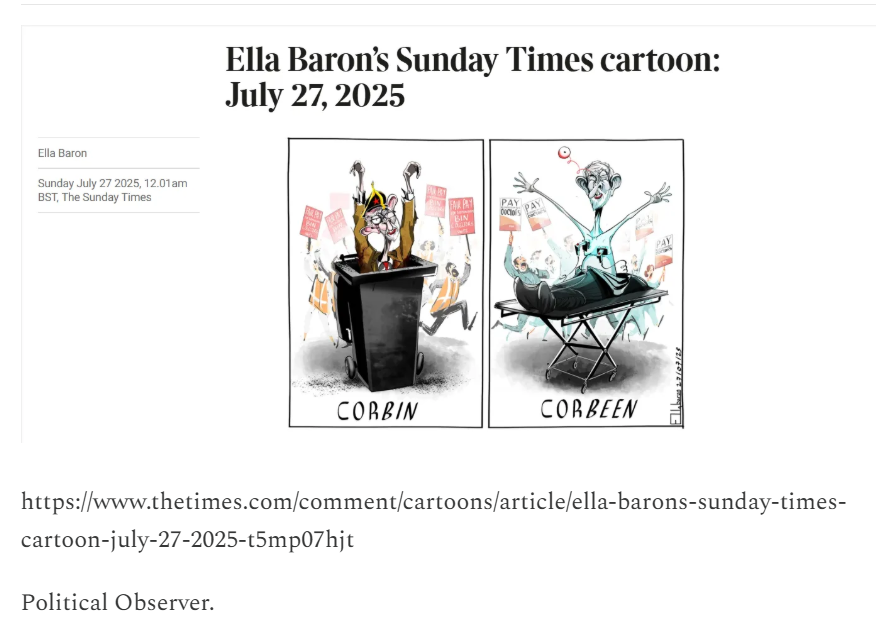
The Sunday Times deframes Jeremy Corbyn, via Ella Barons’s histerical cartoon!

Political Observer: The Times never surprises!

stephenkmacksd.com/

Jul 27, 2025

…………………………………………………………………………………………………………………….

May 16 2025

Headline: Keir Starmer’s popularity sinks to record low in poll

Sub-headline: Drop is most acute among Labour voters in a sign that PM’s attempts to woo Reform supporters may be backfiring

https://www.ft.com/content/659406e7-552c-4e10-83a0-0adebb5ad838


Sir Keir Starmer’s popularity has slumped to its lowest level on record with the fall most acute among Labour voters, according to YouGov research that will stoke concerns in Downing Street.

The proportion of Labour voters with a favourable view of the UK prime minister has plunged from 62 per cent to 45 per cent in just one month, the polling company found. It is the first time that Starmer has recorded a net negative approval rating among Labour supporters.

Some Labour MPs fear that Starmer’s shift to the right on several policy issues, in an attempt to neutralise the threat from Reform UK, has alienated many of the party’s natural supporters.

The Labour government has announced deep cuts to the international aid budget, set out tough reforms to the welfare system and this week announced new restrictions on immigration.

A speech by Starmer on Monday was criticised by some Labour MPs who suggested his reference to Britain’s risk of becoming an “island of strangers” accidentally echoed language used by Enoch Powell in his controversial 1968 “rivers of blood” address.

More than 100 Labour MPs have signed a private letter to their chief whip calling for tweaks to the welfare reforms, in a sign of jitters inside the Parliamentary Labour party.

Across all voters surveyed by YouGov in May, just 23 per cent of Britons expressed a favourable view of Starmer, marking a five-point drop from the same time in April.

That takes his popularity back to its previous nadir of July 2021 when he was opposition leader and the then Tory prime minister Boris Johnson was enjoying a “vaccine bounce” during the Covid-19 pandemic.


With the proportion of people with an unfavourable opinion of Starmer rising from 62 per cent in April to 69 per cent today, Starmer’s net favourability rating has sunk to -46, the lowest ever recorded by YouGov.

The same polling showed that the public view of Farage has ticked up from 27 per cent to 32 per cent in a month, even if 59 per cent of voters still do not like him, reflecting a net favourability rating of -27.

Farage is slightly more popular among Tory voters than the party’s leader Kemi Badenoch, YouGov suggests. Overall 16 per cent of the public have a favourable opinion of her, while 55 per cent hold an unfavourable view, giving a net score of -39.

https://www.ft.com/content/659406e7-552c-4e10-83a0-0adebb5ad838

Editor: The Reader just has to wonder at the Times attack on Corbyn, as Starmers numbers appear to be sinking, as reported in the The Financial Times of May 16 2025 !


Wednesday July 23 2025,

Headline: Keir Starmer approval rating: tracking the PM’s popularity

Sub-headline: One year into office, the Labour prime minister has seen his approval ratings collapse. Follow the latest opinion polls with our live tracker

https://www.thetimes.com/uk/politics/article/keir-starmer-approval-rating-live-tracker-bl2rj82tx

Political Observer.

Posted in Uncategorized | Leave a comment

Ketanji Brown Jackson confronts the scelrotic Supreme Court!

Political Observer offers a small contribution !

stephenkmacksd.com/

Jul 26, 2025

Editor:

The final paragraphs of Ketanji Brown Jackson dissent, offer much more than the political chatter, of the would be Guardians of bourgeois political respectability, in the organs of political conformity, passing as arbiters of what is and and is not valuable, and respectable in the life in of that Long Dead Republic!

TRUMP v. UNITED STATES JACKSON, J., dissenting

All of this leads me to ponder why, exactly, has the majority concluded that an indeterminate “core”-versus-“official”-versus-“unofficial” line-drawing exercise is the better way to address potential criminal acts of a President? Could it be that the majority believes the obviously grave dangers of shifting from the individual accountability model to the Presidential accountability model might nevertheless be offset by the great benefits of doing so? Cf. J. Bentham, A Fragment on Government and an Introduction to the Principles of Morals and Legislation 3 (W. Harrison ed. 1948) (arguing that acts can be justified by the maxim that “it is the greatest happiness of the greatest number that is the measure of right and wrong” (emphasis deleted)).

Some of the majority’s analysis suggests as much. As far as I can tell, the majority is mostly concerned that, without immunity, Presidents might “be chilled from taking the ‘bold and unhesitating action’ required of an independent Executive.” Ante, at 13. The Court’s opinion candidly laments that application of the law to Presidents might not be evenhanded, and that, as a result, Presidents might be less “‘vigorous’ and ‘energetic’” as executive officers. Ante, at 10; accord, ante, at 39. But that concern ignores (or rejects) the foundational principles upon which the traditional individual accountability paradigm is based. Worse still, promoting more vigor from Presidents in exercising their official duties—and, presumably, less deliberation— invites breathtaking risks in terms of harm to the American people that, in my view, far outweigh the benefits.

This is not to say that the majority is wrong when it perceives that it can be cumbersome for a President to have to follow the law while carrying out his duty to enforce it. It is certainly true that “[a] scheme of government like ours no doubt at times feels the lack of power to act with complete, all-embracing, swiftly moving authority.” Youngstown, 343 U. S., at 613 (Frankfurter, J., concurring). But any American who has studied history knows that “our government was designed to have such restrictions.” Ibid. (emphasis added). Our Constitution’s “separation of powers was adopted by the Convention of 1787, not to promote efficiency but to preclude the exercise of arbitrary power. The purpose was, not to avoid friction, but . . . to save the people from autocracy.” Myers v. United States, 272 U. S. 52, 293 (1926) (Brandeis, J., dissenting).

Having now cast the shadow of doubt over when—if ever—a former President will be subject to criminal liability for any criminal conduct he engages in while on duty, the majority incentivizes all future Presidents to cross the line of criminality while in office, knowing that unless they act “manifestly or palpably beyond [their] authority,” ante, at 17, they will be presumed above prosecution and punishment alike.

But the majority also tells us not to worry, because “[l]ike everyone else, the President is subject to prosecution in his unofficial capacity.” Ante, at 40 (emphasis added). This attempted reassurance is cold comfort, even setting aside the fact that the Court has neglected to lay out a standard that reliably distinguishes between a President’s official and unofficial conduct. Why? Because there is still manifest inequity: Presidents alone are now free to commit crimes when they are on the job, while all other Americans must follow the law in all aspects of their lives, whether personal or professional. The official-versus-unofficial act distinction also seems both arbitrary and irrational, for it suggests that the unofficial criminal acts of a President are the only ones worthy of prosecution. Quite to the contrary, it is when the President commits crimes using his unparalleled official powers that the risks of abuse and autocracy will be most dire. So, the fact that, “unlike anyone else, the President is” vested with “sweeping powers and duties,” ibid., actually underscores, rather than undermines, the grim stakes of setting the criminal law to the side when the President flexes those very powers.

The vision John Adams enshrined in the Massachusetts Declaration of Rights—“‘a government of laws and not of men’”—speaks directly to this concept. Mine Workers, 330 U. S., at 307 (Frankfurter, J., concurring in judgment). Adams characterized that document as an homage to the Rule of Law; it reflected both a flat “rejection in positive terms of rule by fiat” and a solemn promise that “[e]very act of government may be challenged by an appeal to law.” Id., at 308. Thanks to the majority, that vision and promise are likely to be fleeting in the future. From this day forward, Presidents of tomorrow will be free to exercise the Commander-in-Chief powers, the foreign-affairs powers, and all the vast law enforcement powers enshrined in Article II however they please—including in ways that Congress has deemed criminal and that have potentially grave consequences for the rights and liberties of Americans.

VI

To the extent that the majority’s new accountability paradigm allows Presidents to evade punishment for their criminal acts while in office, the seeds of absolute power for Presidents have been planted. And, without a doubt, absolute power corrupts absolutely. “If one man can be allowed to determine for himself what is law, every man can. That means first chaos, then tyranny.” Id., at 312. Likewise, “[i]f the Government becomes a lawbreaker, it breeds contempt for law; it invites every man to become a law unto himself; it invites anarchy.” Olmstead, 277 U. S., at 485 (Brandeis, J., dissenting). I worry that, after today’s ruling, our Nation will reap what this Court has sown.

Stated simply: The Court has now declared for the first time in history that the most powerful official in the United States can (under circumstances yet to be fully determined) become a law unto himself. As we enter this uncharted territory, the People, in their wisdom, will need to remain ever attentive, consistently fulfilling their established role in our constitutional democracy, and thus collectively serving as the ultimate safeguard against any chaos spawned by this Court’s decision. For, like our democracy, our Constitution is “the creature of their will, and lives only by their will.” Cohens v. Virginia, 6 Wheat. 264, 389 (1821).

For my part, I simply cannot abide the majority’s senseless discarding of a model of accountability for criminal acts that treats every citizen of this country as being equally subject to the law—as the Rule of Law requires. That core principle has long prevented our Nation from devolving into despotism. Yet the Court now opts to let down the guardrails of the law for one extremely powerful category of citizen: any future President who has the will to flout Congress’s established boundaries.

In short, America has traditionally relied on the law to keep its Presidents in line. Starting today, however, Americans must rely on the courts to determine when (if at all) the criminal laws that their representatives have enacted to promote individual and collective security will operate as speedbumps to Presidential action or reaction. Once selfregulating, the Rule of Law now becomes the rule of judges, with courts pronouncing which crimes committed by a President have to be let go and which can be redressed as impermissible. So, ultimately, this Court itself will decide whether the law will be any barrier to whatever course of criminality emanates from the Oval Office in the future. The potential for great harm to American institutions and Americans themselves is obvious.

The majority of my colleagues seems to have put their trust in our Court’s ability to prevent Presidents from becoming Kings through case-by-case application of the indeterminate standards of their new Presidential accountability paradigm. I fear that they are wrong. But, for all our The majority of my colleagues seems to have put their trust in our Court’s ability to prevent Presidents from becoming Kings through case-by-case application of the indeterminate standards of their new Presidential accountability paradigm. I fear that they are wrong.

But, for all our sakes, I hope that they are right. In the meantime, because the risks (and power) the Court has now assumed are intolerable, unwarranted, and plainly antithetical to bedrock constitutional norms, I dissent.

Political Observer.

Posted in Uncategorized | Leave a comment

Jeremy Corbyn & Zarah Sultana form a New Political Party

Old Socialist comments.

stephenkmacksd.com/

Jul 24, 2025

Editor : This is what the Independant offers its readership on the new party of Corbyn & Sultana!

Headline: Jeremy Corbyn confirms plan to create new political party with Zarah Sultana

Sub-headline: Ex-Labour leader said it was ‘time for a new kind of political party’ to take on Starmer – but Labour grandee warns it will only help Tories and Reform

https://www.the-independent.com/news/uk/politics/jeremy-corbyn-new-party-zarah-sultana-labour-b2795189.html


Editor: This 535 word essay ends with these paragraraphs:

Mr Corbyn led the Labour Party from 2015 to 2020 before being suspended following a row over a report into antisemitism in the party.

He was expelled in 2024 and successfully contested the summer election as an Independent candidate.

Ms Sultana had the Labour whip withdrawn after rebelling against the government to vote to scrap the two-child benefit cap. She resigned her Labour membership in 2025.


Editor: not to forget this from political fabulist, or in more telling terms, the Party Hack Jonathan Freedland, of Wed 1 May 2019.

Headline: Jeremy Corbyn is either blind to antisemitism – or he just doesn’t care

Sub-headline: Labour’s leader may claim he didn’t see the racism in JA Hobson’s book. But can the party indulge that delusion?

https://www.theguardian.com/commentisfree/2019/may/01/jeremy-corbyn-blind-antisemitism-hobson

In today’s Times, the columnist Daniel Finkelstein has dug out a 2011 reissue of JA Hobson’s 1902 work, Imperialism: A Study. The foreword was written by Jeremy Corbyn in 2011. Across eight pages, the then Labour backbencher lavishes praise on the book. His very first sentence describes it as a “great tome”. Among other things, he calls it “very powerful,” “brilliant”, as well as “correct and prescient”. The trouble is, Hobson was not just an accomplished analyst of international politics – for the Manchester Guardian, as it happens – but an egregious anti-Jewish racist.

No one is arguing that Corbyn was obliged to denounce the whole book. He could simply have nodded to the problem with a tiny caveat: something like, “Despite some passages that read uncomfortably to the modern ear …” But there is nothing like that. He might have made the move Finkelstein himself made when writing recently about Churchill, in a column headlined: “Winston Churchill was a racist but still a great man”. Corbyn could have said something similar about Hobson or his book. But he didn’t do that either. A Labour spokesman has said that: “Jeremy completely rejects the antisemitic elements of [Hobson’s] analysis.” But if that’s true, why did he not say so when he wrote about it?

Perhaps the Labour leader’s explanation will be the same one he offered for his defence of a mural depicting hook-nosed, Jewish bankers playing Monopoly on the backs of the poor: that he simply did not see the racism. But in the Hobson text, it’s there in black and white. It would be very hard to miss, especially if you’re a “lifelong anti-racist” as Corbyn always insists he is. But perhaps that will be what he’ll say: that he couldn’t see the racism even when it stared him in the face. Because the only other explanation available is that he didn’t object to this part of Hobson’s analysis – as he did to other parts, describing one element of the book as “strange” – because he didn’t see anything wrong with it.

We all know that it’s painful to admit flaws in those we admire. Corbyn should have done it about Hobson, but did not. Now that task falls to Labour MPs, members, supporters and voters. The Labour leader may tell himself that he is the victim here, a serially unlucky anti-racist who means well, but keeps overlooking racism against Jews even when it’s right in front of him, whether on the platforms he shares or the books he praises. Now the rest of the Labour family have to decide how much longer they are willing to indulge that delusion.

https://www.theguardian.com/commentisfree/2019/may/01/jeremy-corbyn-blind-antisemitism-hobson

Editor: In sum Corbyn has deviated from the acceptable definitional frame! One thinks of Isaiah Berlin, and his sub-rosa attacks on the Marxist historian Isaac Deutscher, as a telling object lesson of the how of academic politicking, Mr. Freedland pratises this in the light of day!

June 28, 2013

The Dishonesties of Isaiah Berlin

Tariq Ali


Editor: Reader look to The Economist of July 23, 2025 as to this publications willfull tone deafness, as to what is of actual political moment! The Re-animated Ghost of the long dead Bagehot, serves the political purpose of a usable political frame, by which to measure the political present through an aperition?

Britain | Bagehot

Headline : The peril of trying to please people

Sub-headline: Compromise rarely leads to contentment. But it nearly always leads to costs

https://www.economist.com/britain/2025/07/23/the-peril-of-trying-to-please-people

Under the rubric : ‘To govern is to soothe’ offers the reader

Compromise on planning speaks to a deeper crisis of confidence. The planning bill sailed through the Commons. Harsher amendments tabled by a Labour rebel (since booted out of the party) were voted down overwhelmingly. Yet now Labour’s planning reforms have been watered down before the government has even lost a vote. At times this Labour government behaves as if it is illegitimate. Elections become a mere starting point to negotiate with the actual powers in Britain, rather than a mandate to do anything. Consultations must be run; inquiries held; stakeholders engaged. If well-organised groups oppose a policy, who is His Majesty’s Government to argue otherwise?

Come autumn, if the weakened planning bill sails through the upper house without complaint from the larger environmental charities, perhaps it will have been worth it. The faster it passes Parliament, the quicker people can start building. The Office for Budget Responsibility has always priced the bill into its growth forecasts, arguing that planning changes will make the British economy about 0.2% bigger in 2029 than it would otherwise have been. It is not much, but it is much needed.

That is not the only possible path. After all, the government has been here before. Environmental ngos had initially praised the government’s plans. A month later they labelled them “cash to trash”. The same incentives are in play again. Why stop at the current concession if more can be squeezed? Less politic environmentalists are already grumbling. “The fight goes on,” declared one association of ecologists. Larger groups may join them. If they do, all that will be left is a less effective law, a public scrap and a government that will wish it had held its ground and won.


That Labour Rebel might be Jeremey Corbyn?

Old Socialist.

Posted in Uncategorized | Leave a comment