


Recent Comments
Archives
- September 2026
- August 2026
- July 2026
- June 2026
- May 2026
- April 2026
- March 2026
- February 2026
- January 2026
- December 2025
- November 2025
- October 2025
- September 2025
- August 2025
- July 2025
- June 2025
- May 2025
- April 2025
- March 2025
- February 2025
- January 2025
- December 2024
- November 2024
- October 2024
- September 2024
- August 2024
- July 2024
- June 2024
- May 2024
- April 2024
- March 2024
- February 2024
- January 2024
- December 2023
- November 2023
- October 2023
- September 2023
- August 2023
- July 2023
- June 2023
- May 2023
- April 2023
- March 2023
- February 2023
- January 2023
- December 2022
- April 2022
- March 2022
- February 2022
- January 2022
- November 2021
- October 2021
- September 2021
- August 2021
- July 2021
- June 2021
- May 2021
- April 2021
- March 2021
- February 2021
- January 2021
- December 2020
- November 2020
- October 2020
- September 2020
- August 2020
- July 2020
- June 2020
- May 2020
- April 2020
- March 2020
- February 2020
- January 2020
- December 2019
- November 2019
- October 2019
- September 2019
- August 2019
- July 2019
- June 2019
- May 2019
- April 2019
- March 2019
- February 2019
- January 2019
- December 2018
- November 2018
- October 2018
- September 2018
- August 2018
- July 2018
- June 2018
- May 2018
- April 2018
- March 2018
- February 2018
- January 2018
- December 2017
- November 2017
- October 2017
- September 2017
- August 2017
- July 2017
- June 2017
- May 2017
- April 2017
- March 2017
- February 2017
- January 2017
- December 2016
- November 2016
- October 2016
- September 2016
- August 2016
- July 2016
- June 2016
- May 2016
- April 2016
- March 2016
- February 2016
- January 2016
- December 2015
- November 2015
- October 2015
- September 2015
- August 2015
- July 2015
- June 2015
- May 2015
- April 2015
- March 2015
- February 2015
- January 2015
- December 2014
- November 2014
- October 2014
- August 2014
- July 2014
- June 2014
- May 2014
- April 2014
- March 2014
- February 2014
- January 2014
- December 2013
- November 2013
- October 2013
- September 2013
- August 2013
- July 2013
- June 2013
- May 2013
- April 2013
- March 2013
- January 2013
- December 2012
- November 2012
- October 2012
- September 2012
- August 2012
- July 2012
- June 2012
- May 2012
- April 2012
- March 2012
- February 2012
- January 2012
- December 2011
- November 2011
- October 2011
- September 2011
- August 2011
- July 2011
- June 2011
- May 2011
- April 2011
- March 2011
- February 2011
- January 2011
- December 2010
Categories
Meta
The Strange Confluence of Opposite Opinions? By Political Observer
http://www.washingtonpost.com/blogs/right-turn/post/clinton-and-obama-learned-nothing-remembered-nothing/2011/03/29/gIQA9zHVoK_blog.html#pagebreak
In her column of September 22,2011 Jennifer Rubin severely scolds President Obama and President Clinton for deviating from the AIPAC and Neo-Conservative line on Israel. Not anything like a surprise from an American Likudnik.
http://www.opendemocracy.net/opensecurity/james-renton/palestines-un-bid-lessons-from-history-of-zionism
But here is James Renton at Open Security offering some very important background information that might just put this polemical outburst into a context; as more readily understood as a holding action, to prevent the collapse of a historically untenable exceptionalism.
Political Observer
Posted in Uncategorized
Leave a comment
Books of Interest: A Sociology of Religious Emotion by Ole Riis and Linda Woodhead and The Greek Pursuit of Knowlwdge edited by Brunschwig/Lloyd
http://www.oup.com/us/catalog/general/subject/ReligionTheology/SociologyofRel…
I just received my September 16, 2011 issue of the TLS. In it is Bernice Martin’s review titled Feel the Power in which she reviews A Sociology of Religious Emotion. Ms. Martin does engage in a disagreement with Jurgen Habermas and his belief in the superiority of political secularism. She believes that it is failed and makes an almost convincing argument as to the failed nature of his faith, in that secular mythology. Although she sounds like a believer and as an atheist I find these defensive polemics a bit wearing, in this case she brings a great to deal of light to the conflict of the secular and religious, in her review. Challenging the Habermas’ view of the necessary primacy of a secularist politics by raising the rise of National Socialism as an object lesson in the failure of secularist politics/reason. One could add, in the spirit of polemic, that the American experience of the rise of our own indigenous religious fundamentalists has demonstrated a degree of intolerance toward the relativism that is the pervasive phenomenon of the secular faith, as defined by that very religious sub-set of civic actors. That might make Ms. Martin’s faith in religious tolerance sound a dissonant note in the American civic space, to this secularist. But that does not in the least take away from this review or the book under review; both are well worth respectful readerly attention.
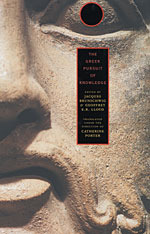
http://www.hup.harvard.edu/catalog.php?recid=27712
This morning with Ms. Martins review fresh in my mind, I read it before turning out the light, I was reading Michael Frede’s entry, The Philosopher, in this indispensible compendium of essays, originally published in a large format hardback as Greek Thought, A Guide to Classical Knowledge and then two smaller easier to handle and read paperbacks. The excerpt that caught my attention is as follows:
“We learn from Stoic physics that the world is governed by an imminent divine rational principle that arranges the world down to the smallest detail so as to be a perfect world. We also know from Stoic physics that we are constructed in such a way as to be guided by reason toward the good, and that, hence, as part of our development, we have to acquire the approximate beliefs as to what is good, bad, or neither; what it is appropriate for us to do, if we are guided by a concern for the good; and how good action consists precisely in this, doing what is appropriate out of concern for the good.”
If I am willing to imagine myself to be follower of Rorty then I might say, in the spirit of generosity that is the guiding spirit of Rorty, as the philosophical successor of James, that we could view that immanent divine rational principle as Nature. Shorn of its divinity but a potent idea none the less.
I will confess that I only become a radical atheist, when confronted with the ideological intransigence and moral/ethical, not to speak political, surety of believers; who insist that all must live by their covenants, while living under the protection of a secular state that recognizes the rights of all religious citizens, to practice their faiths, unencumbered.
Stephen
Posted in Uncategorized
Leave a comment
The End of a Political Romance: David Brooks on Obamaism by Political Observer
"I’m a sap, a specific kind of sap. I’m an Obama Sap.”
It is a rather well worn rhetorical trope to make oneself the butt of one’s criticism of another by indirection. Mr. Brooks like so many others fails to make the critical distinction between the Rhetorical Obama and the Political Obama and how this very canny and adroit pragmatist works both sides of the political street; although he has managed to alienate his base and their hunger for the fulfillment of the promise of the Rhetorical Obama. But Mr. Brooks declares his disillusionment with the reassertion of the Rhetorical Obama, as opposed to the policies of the Political Obama, which remain monuments to a rather dull conservative political/economic ethos. In all this rhetorical chaff, one can see a shining core emerge out of this debris, of the self-proclaimed reasonableness of our writer, brought to this disappointing conclusion by certain facts, like the dishonesty of the President on the matter of taxing the rich. On which Mr. Brooks provides statistical data from the IRS. Mr. Brooks does not touch on the failure of Free Market Economics to deliver on its well advertised promises, he being one of its long time advocates.Nor on the continuing economic ramifications of the collapse of 2008.That might be a kind of honesty demanded by our present crisis but wholly beyond the reach of this political moralist. One final note, a quote from the essay is illustrative of two issues.
“Being a sap, I still believe that the president’s soul would like to do something about the country’s structural problems.”
He speaks first of President Obama’s soul which is a wholly irrelevant matter and perhaps could be the subject of a more deeply argued theological discussion, if one believes in a construct called soul. But here it is used pejoratively as pure condemnation of the self-willed forgetting of one of the cornerstones of Mr. Obama’s Christian faith, as interpreted by Mr. Brooks. As for structural problems one could conjecture that that could mean the final dismantling of what is left of the New Deal as unnecessary in the 21st Century, captained by Enlightened Conservatives like Mr. Brooks and his political fellow travelers.
Political Observer
Posted in Uncategorized
Leave a comment
Books of Interest: Descartes an Intellectual Biography by Stephen Gaukroger

Just rereading pages 340 to 343 on the cogito.
‘When someone says I am thinking therefore I am, or exist, he does not deduce existence from thought by means of a syllogism, but recognizes it as something self-evident by a simple intuitus of the mind.”
Posted in Uncategorized
Leave a comment
Arianna Huffington: The Connector,gasp! by Myra Breckenridge
I know you've all been waiting for my story on Ms. Huffington, but one must admit that when it comes to insider reporting, dripping with rhetorical treacle and a certain cattiness, Elizabeth Rubin at Vogue has outdone everyone, who has attempted to describe the phenomenon of Arianna H. Let me just quote the opening sentence of this revelatory reportorial miniature:
"Everyone remembers the first time they met Arianna Huffington; everyone has a story."
And it just gets better and better. Ah,and the delicious mouth feel of the 'Arianna Huffington brand' like Poilly Fuisse on the tongue. The narration of Ms. H's rise to the top is rather breathtaking handled in two short paragraphs, designed not to excessively bore that very fastidious Vogue reader. And the word Zeitgeist never got such a working over as it gets in this article,whew! I'm dizzy just from writing it, much less reading it so many times.
Under the leadership of Tim Armstrong, AOL will promote patch.com and Arianna will use unpaid bloggers that were such a hit at the HuffPo, to work for free while giving all a chance to write for a national audience. Poor Arianna, she thinks all is forgiven from her rather nasty parting of ways of those unpaid bloggers on HuffPo, so sad. Gore Vidal did call the USA The United States of Amnesia. But after all Milton Friedman was her great,even beloved mentor. But Arianna is a force of nature or of just plain colossal ambition, to be a mogul, a taste-maker, a trendsetter and in charge of remaking the world and bringing the rest of us with her, even the unpaid ones, whether we want to go or not. Please read and enjoy this really short,chatty little pastiche. It sort of makes you long for those seemingly endless New Yorker articles brimming with authorial self-congratulation and guaranteed to put you in Dreamland.
Sincerely yours,
Myra B.
"Everyone remembers the first time they met Arianna Huffington; everyone has a story."
And it just gets better and better. Ah,and the delicious mouth feel of the 'Arianna Huffington brand' like Poilly Fuisse on the tongue. The narration of Ms. H's rise to the top is rather breathtaking handled in two short paragraphs, designed not to excessively bore that very fastidious Vogue reader. And the word Zeitgeist never got such a working over as it gets in this article,whew! I'm dizzy just from writing it, much less reading it so many times.
Under the leadership of Tim Armstrong, AOL will promote patch.com and Arianna will use unpaid bloggers that were such a hit at the HuffPo, to work for free while giving all a chance to write for a national audience. Poor Arianna, she thinks all is forgiven from her rather nasty parting of ways of those unpaid bloggers on HuffPo, so sad. Gore Vidal did call the USA The United States of Amnesia. But after all Milton Friedman was her great,even beloved mentor. But Arianna is a force of nature or of just plain colossal ambition, to be a mogul, a taste-maker, a trendsetter and in charge of remaking the world and bringing the rest of us with her, even the unpaid ones, whether we want to go or not. Please read and enjoy this really short,chatty little pastiche. It sort of makes you long for those seemingly endless New Yorker articles brimming with authorial self-congratulation and guaranteed to put you in Dreamland.
Sincerely yours,
Myra B.
Posted in Uncategorized
Leave a comment
Letter to an dear,dear friend by Myra Breckenridge
Dearest Wayne,
The vicissitudes that fate visits upon us all is rather breathtaking. A dizzy old queen dispensing advice to an audience of desperate heteros, brings the notion of irony to a rather bleak dead end! But anyone who can write a 304 page book about Jackie has got the fortitude, and just plain guts, to pontificate on problems that he is absolutely existentially ignorant of, this makes your advice column absolute must reading. And whose bight idea was it to put our Wayne in charge of advice giving? : that resident drama queen of Salon, Joan Walsh? That certainly is a tantalizing question, but probably better left for another day. And your first column certainly vindicates the faith in your abilities that the editors at Salon are vested in. Although it lacks the necessary sympathy , indeed commiseration, that would be indicative of concern for the psychological well being of your first inquirer. Or were you going for the shock therapy that Dr. Laura specialized in? Oh, and Dr. Laura is much missed, she was psychologist and moralist rolled into one. Well, best of luck on your new venture, from your old and dear, dear friend.
Sincerely yours,
Myra Breckenridge
Posted in Uncategorized
Leave a comment
Episode CCXXI of The American Political Melodrama: David Brooks bids adieu to Great Policy by Political Cynic
http://www.nytimes.com/2011/09/16/opinion/brooks-the-planning-fallacy.html?_r=1&hp
It is easy to imagine that at breakfast tables, lunch rooms , dinner tables and even at swank dinner parties in the suburbs of the capitol, the political homilies of Mr. David Brooks are the subject of many conversations, many disagreements, many small debates, that provide some mealtime diversion to the participants. They can feel a sense of partaking in the intellectual life of the Republic, of defining by their activity the actuality of citizenship. In his latest column The Planning Fallacy, Mr. Brooks exercises his dissent on the notion and practice of policy making and policy planning: in essence he says that any attempt at policy planning is essentially doomed to failure giving as his example:
“When the Nobel Prize-winning psychologist Daniel Kahneman was a young man, he led a committee to write a new part of the curriculum for Israeli high schools. The committee worked for a year, and Kahneman asked his colleagues how long they thought the rest of the project would take. Their estimates were around two years. Kahneman then asked the most experienced among them how long such work took other curriculum committees. The gentleman pointed out that roughly 40 percent of the committees never finished their work at all.But what about those that did finish? The gentleman reported that he had never seen a committee finish in less than seven years and never in more than 10.This was bad news. They might fail to finish a task that they thought would be done in three years. At best, the project might consume eight or nine years. Yet this information didn’t affect those on the team at all. They carried on, assuming that though others might fail or dally, surely they wouldn’t. As it turned out, their project took eight years to finish. By the time it was done, the Ministry of Education had lost interest, and the curriculum was never used.”
Mr. Brooks only refers to the works of well accredited experts, with impeccable intellectual pedigrees. Mr. Kahneman’s attempt to write a new curriculum was completed after eight years and never used. But what is germane is that this prolonged story of a single failed attempt to write a new curriculum is used as a long and tendentious introduction and rhetorical frame to the political stalemate between Republicans and Democrats, as presented by Mr. Brooks, hardly a disinterested observer or reporter. In essence both parties are mired in their respective narratives of economic recovery and neither can emancipate themselves from those narratives, that is, without the political wisdom of our Solomon like pundit. And his cynical conclusion is that policy can only aspire to fix small things, make small changes, that benefit some. But one could answer with the successes of the New Deal and The Great Society, although Mr. Brooks manages to describe one of these grand policy attempts as a failure.
Let me take a moment to quote some of Mr. Brooks’ irresistibly trenchant bons mots:
“The problem comes when these optimists don’t look at themselves objectively from the outside.”
“Most people overrate their own abilities and exaggerate their capacity to shape the future.”
“Optimistic people rise in this world.”
“The key to wisdom in these circumstances is to make the distinction between discrete good and systemic good.”
Political Cynic
Posted in Uncategorized
Leave a comment


