Editor: Reader here are the final paragraps of David Brooks wan public moralizing of August 21, 2025. David Brooks is a contributing writer at The Atlantic, and cites Derek Thompson essay, as a source in his essay.
Apparently, the F.B.I. now has a new category of terrorist — the “nihilistic violent extremist.” This is the person who doesn’t commit violence to advance any cause, just to destroy. Last year, Derek Thompson wrote an article for The Atlantic about online conspiracists who didn’t spread conspiracy theories only to hurt their political opponents. They spread them in all directions just to foment chaos. Thompson spoke with an expert who cited a famous line from “The Dark Knight”: “Some men just want to watch the world burn.”
This may be where history is leading. Smothering progressivism produced a populist reaction that eventually descended into a nihilist surge. Nihilism is a cultural river that leads nowhere good. Russian writers like Turgenev and Dostoyevsky wrote about rising nihilism in the 19th century, a trend that eventually contributed to the turmoil of the Russian Revolution. The scholar Erich Heller wrote a book called “The Disinherited Mind” about the rise in nihilism that plagued Germany and Central Europe after World War I. We saw what that led to.
It’s hard to turn this trend around. It’s hard enough to get people to believe something, but it’s really hard to get people to believe in belief — to persuade a nihilist that some things are true, beautiful and good.
One spot of good news is the fact that more young people, and especially young men, are returning to church. I’ve been skeptical of this trend, but the evidence is building. Among Gen Z, more young men now go to church than young women. In Britain, according to one study, only 4 percent of 18- to 24-year-olds went to church in 2018, but by 2024 it was 16 percent. ‘From the anecdotes I keep hearing, young people seem to be going to the most countercultural churches — traditionalist Catholic and Eastern Orthodox.’
Editor: I’ve highlighterd pargarph four where Brooks opines about the return to ‘countercultural churches’.Can these churches identified as ‘countercultural’ have or share a propinquity with Judaism, in the muddled chatter of Mr. Brooks ?
They don’t believe in what the establishment tells them to believe in. They live in a world in which many believe in nothing. But still, somewhere deep inside, that hunger is there. They want to have faith in something.
Editor: It never occours to Mr. Brooks that many humans live without faith of any kind or description, or simply play the game their parents played, to keep peace in the family. In sum Mr. Brooks is a political conformist, who writes dismal prose!
Mr. Ganesh demonstrates that the enemy of the political winner is the inability to conceive the possibility that the opposition can win. Call it the myopia of the winner.
Given the rise of Corbyn, or someone like him, Mr. Cameron puts his political capital behind Austerity, but an Austerity that only affects the poor. How perverse must your political judgement be, to attack the very people who can deliver political victory to the ‘un-electable’ Mr. Corbyn?
‘And David Cameron has an embarrassment of riches. Since renewing his premiership in May, he has already revised or delayed legislation to satisfy his own dissenting MPs. His plan to cut tax credits, income supplements for the low-paid, is being resisted by colleagues and newspapers, including proudly rightwing ones.’
What is relevant to the future of the Tories is to recognize that Neo-Liberalism is a spent force, and that the attack on the poor is an invitation to defeat. No amount of internal dissent can save a Party, that is still invested in Austerity exclusively aimed at the disadvantaged. Again the myopia of the winner!
‘…Conservative squabbles can deprive Labour of any relevance it has left after electing the unelectable Jeremy Corbyn as leader.’
‘There is such a thing as an optimal level of dissent: too little and the official opposition fills the vacuum, too much and things fall apart.
This last pronouncement truly demonstrates the myopia of the winners. Look at the American election of 2008 as a telling counter example!
‘People do not vote for hope and vision, but for the lesser evil.’
I can say that what appears most puzzling about Mr. Ganesh’s style of argument is that he appears to be a student of Derrida!
Editor: Bret Stephens World is just like David Brooks World? Though David somtimes forgets he’s JEW, but Stephens was trained by being the editor in chief of The Jerusalem Post, the political arm of The Zionist Faschist State! In the following paragraphs Stephens applies weak white-wash to Neo-Conservatism! Prerfectly attuned to the New York Times readers prejudices!
Although the term “neoconservative” has fallen into disuse — except as an occasional slur used by the MAGA right, the progressive left and social-media antisemites who really mean to say “Jew” — I’ve never been shy about describing myself as one. In Donald Trump’s whipsawing performances with Vladimir Putin in Alaska on Friday and Volodymyr Zelensky and his European allies in Washington on Monday, I’m reminded of why.
Neoconservatism emerged in the early 1970s as a loosely coherent movement of disenchanted liberals who were critical of the welfare state and turned off by the anti-Americanism of parts of the antiwar left. But the movement also took a dim view of the Nixon administration, particularly in its pursuit of arms control with the Soviet Union, its relative indifference to human rights issues behind the Iron Curtain, and its realpolitik approach to foreign policy in general.
I learned this the hard way 14 years ago, when Henry Kissinger nearly kicked me out of his Park Avenue office for having the ill grace to ask him about China’s brutal treatment of Liu Xiaobo, the imprisoned dissident. The former secretary of state, then 88, was still too concerned with currying influence in Beijing to say anything nice about his fellow Nobel Peace laureate.
Little wonder, then, that many of Trump’s most ardent conservative opponents in recent years are, or were, old-school neocons. Like President Richard Nixon’s, Trump’s politics are a mix of statist economic impulses, populist grievances, the conceit of being above the law and a transactional approach to foreign policy that discounts the moral force of American ideals. What Trump lacks in his predecessor’s intellectual sophistication, he makes up for with his gifts for crude showmanship.
Editor: Mr. Stephens can’t quite match Barry Gewen’s essay of 2010 in The New York Times,
Leave No War Behind
By Barry Gewen
June 11, 2010
…
This definitional question, and in particular neoconservatism’s extraordinary transformation, is the principal subject of “Neoconservatism: The Biography of a Movement,” by Justin Vaïsse, a French expert on American foreign policy who is currently a senior fellow at the Brookings Institution. It is essential reading for anyone wishing to understand the contours of our recent political past. Vaïsse is a historian of ideas. “Neoconservatism” demonstrates, among other things, that ideas really do make a difference in our lives.
Vaïsse defines neoconservatism by disassembling it. He sees three “ages” to the movement. The first began in the mid-1960s with intellectuals like Irving Kristol, Daniel Bell, Daniel Patrick Moynihan and Nathan Glazer gathering around Kristol and Bell’s new magazine, The Public Interest, and also around Commentary, under its editor Norman Podhoretz. At the time, all of these writers were sympathetic in principle to an activist government, especially when it came to the economy, but questioned the expectations of Great Society planners of antipoverty and related social programs — or, in Saul Bellow’s phrase, the Good Intentions Paving Company. Challenging what they saw as liberal overreaching and wishful thinking with hard, often crushing, empirical facts, these early neoconservatives were, in a sense, the skeptical conscience of liberalism.
But skepticism about the effectiveness of particular programs soon mutated into broader disenchantment with almost every kind of government intervention and into the conviction that the free market alone offered acceptable solutions to social problems. As neoconservative pragmatism calcified into laissez-faire dogma, some of its godfathers defected. Daniel Bell, a self-described “right-wing social democrat,” for one; Moynihan, who, Vaïsse writes, “contended that he was the modern incarnation of a Wilsonian Progressive,” for another. By the time President Ronald Reagan proclaimed “government is not the solution to our problem; government is the problem,” neoconservatism was a spent force in domestic policy, hardly distinguishable from the libertarianism of the American Enterprise Institute.
In the second and third ages, as Vaïsse describes them, neoconservatives turned their attention to foreign policy. This wasn’t surprising. The original neoconservatives were devout anti-Communists for whom opposition to Stalinism and the Soviet Union was as much a left-wing as a right-wing position. This is why the neoconservatives of the second age reacted against what Vaïsse calls “the conquest of the Democratic Party by the forces of the New Left,” begun in 1968 and completed in 1972, when George McGovern won the presidential nomination. The McGovernites, strenuously opposed to the Vietnam War and distrustful of American power, struck more hawkish Democrats as naïve about Communism, even isolationist. The neocons rallied behind Henry Jackson, known as Scoop, a Democratic senator from Washington who, though a supporter of the Great Society’s domestic programs, was the most unrepentant of cold warriors. He nurtured the careers of many young men later known as the toughest of the tough-minded — Richard Perle, Paul Wolfowitz, Elliott Abrams and Douglas Feith.
…
Editor: Stephens presents his arguments:
What would a traditional neocon say about Trump’s latest diplomatic efforts between Russia and Ukraine? A few points.
.
First, we’d note that dictators who are contemptuous of the rights of their own people tend to be equally contemptuous of the rights of other countries.
.
Second, dictators who do not abide by the rule of law at home will not honor international agreements, either.
.
Third, Putin does not see Trump’s chummy manner, his effort to forge personal ties, as an invitation to be reasonable.
.
Fourth, neocons subscribe to a “broken windows” theory of international order: If disorder goes unchecked, or if aggression is rewarded, in one part of the world, it will encourage disorder and aggression in other parts.
.
Fifth, neocons believe that American ideals do not undermine American power; rather, they march hand in hand. When the United States lent destroyers to the United Kingdom in 1940, we created the conditions that allowed us to prevail in World War II.
.
Sixth, international guarantees are mostly worthless unless backed by credible and overwhelming power.
.
Seventh, the only way to guarantee an end to this conflict is steadfast opposition to Putin through sanctions, ostracism and military and economic support for Ukraine and every other country Russia threatens.
.
Neocons may have long ago fallen out of fashion. To watch Trump in recent days is to be reminded that some old fashions deserve to be made new again.
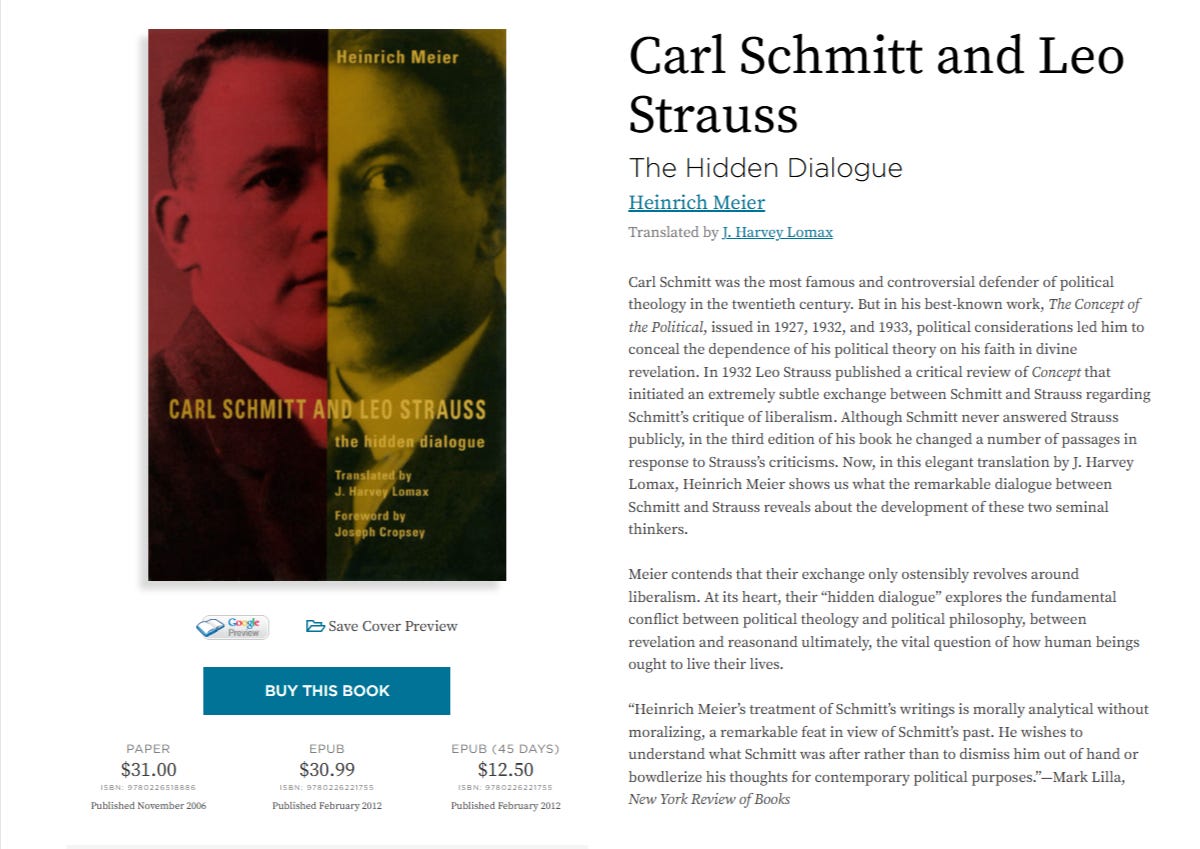
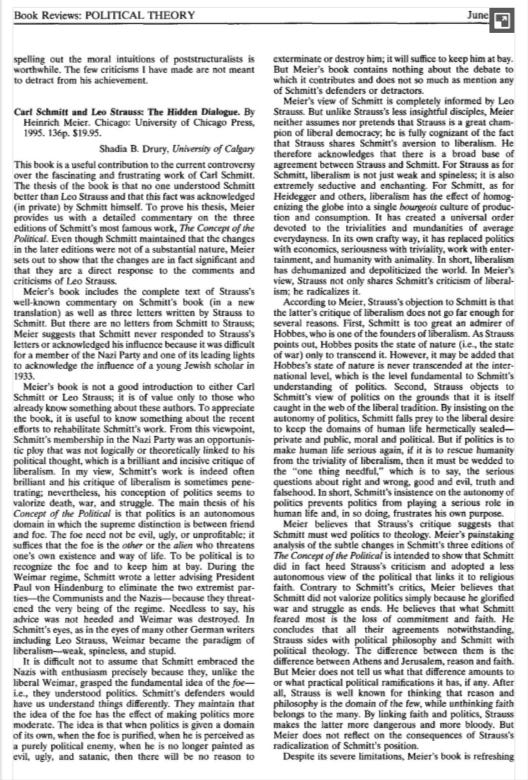
Editor: Reader see ‘Carl Schmitt and Leo Strauss The Hidden Dialogue’ by Heinrich Meier Translated by J. Harvey Lomax, to guage the political mendacity of Mr. Stephens New York Times chatter!
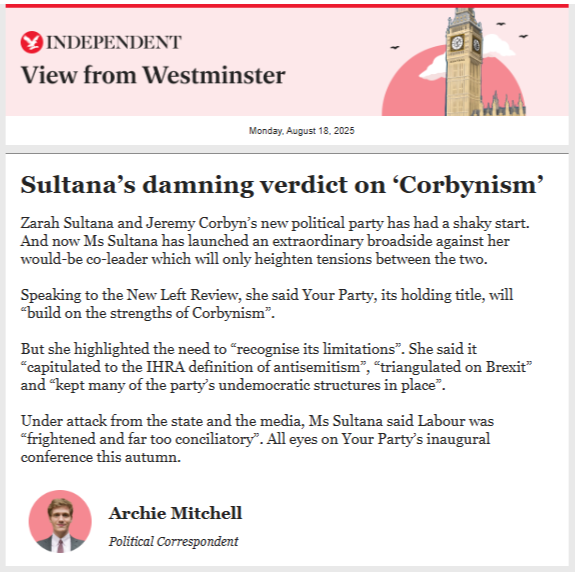
The number of people who have signed up for Britain’s new left-wing party has surpassed 650,000: a figure that dwarfs the membership of every other outfit in Westminster. Preparations are underway for its founding conference, likely to be held in November, where registrants will decide on its initial platform and develop some of its democratic structures. As part of the ongoing debate on such questions, Sidecar recently published an interview with James Schneider, the former communications director for Corbyn’s Labour, in which he set out his case for an organisation that would avoid the electoralist pitfalls of the 2010s by basing itself mostly outside Westminster and striving to construct different forms of popular power.
For our next instalment in the series, we turn to Andrew Murray. Born in 1958, Murray joined the Morning Star as a lobby journalist at the age of nineteen. He moved sidelong into the labour movement in the 1980s, playing a key role in the foundation of Unite, one of the country’s largest unions, and later serving as its Chief of Staff. During the 2000s he was appointed to the executive committee of the Communist Party of Britain and co-founded the Stop the War Coalition, set up to oppose the invasions of Iraq and Afghanistan. An early supporter of Corbyn’s leadership, Murray was seconded from Unite to assist with its 2017 general election campaign, before joining the team as a Special Political Adviser. He is also the author of numerous books on UK politics: a devastating indictment of railway privatisation, Off the Rails (2002); an account of the structural processes that produced the Corbyn project, The Fall and Rise of the British Left(2019); and an analysis of the political lessons to be drawn from that experience, Is Socialism Possible in Britain?(2022).
Murray spoke to Oliver Eagleton about the politics of the nascent party, its priorities at this early stage, the discussions about its leadership, and the attitude it should cultivate towards social movements and working-class institutions.
…
OE: How can the party provide that kind of political expression?
AM: Well, that is the main question. Debates about the organisation’s structure (federal, coalitional, central) or even its leadership (sole, joint, collective) are secondary to its political positioning. The new party needs to be absolutely, clearly anti-capitalist and anti-imperialist. It needs to see itself as creating the space for a transition to socialism. Parts of its political profile can perhaps be assumed: certainly its position on Gaza and its opposition to austerity. But it needs to go further, in my view, by generalising outward from these two urgent issues and offering a systemic alternative.
This is, broadly speaking, what the party’s supporters want. It is also what millions of people across the country are craving, including many of those who are gravitating towards Reform. In the present political landscape you have a crumbling centrism identified with Starmer and with Rishi Sunak before him, which takes a managerial approach to the colossal problems that have accumulated since 2008, and then you have a right-wing pseudo-opposition which the FT’s Martin Wolf rightly describes as ‘plutocratic populism’, which engages in all sorts of demagoguery, including posing as pro-worker, when in fact it is the project of millionaire Thatcherites. With this as the current polarisation, the left has a unique opportunity to redraw the lines of division: placing the centre and the hard right on one side, and itself on the other. The issues that it can use to do so are clear: opposition to austerity, opposition to medieval levels of social inequality, and opposition to war. Our slogan in the Stop the War Coalition is ‘Welfare not Warfare’. The government’s might as well be ‘Make the Poor Pay For War’. It is right now embarking on a major military build-up while slashing social spending – and it is doing so in lockstep with the pluto-populists, who don’t even pretend to have the same non-interventionist inclinations as Trump’s national-populists in the US.
So, undoubtedly, there is a political space to be occupied. Corbyn’s leadership filled it from 2015 to 2019, but it was tethered to the Labour Party, which already had an entrenched position in the British status quo that many of its parliamentarians and staffers were determined to defend. The new party is in a very different situation. It will be unencumbered by these problems; it will be a novel and galvanising force. But at the same time it will not have the strength that comes from being a part of the political fabric for 120 years, nor the historic roots and power bases which, although they have massively atrophied for the Labour Party, have not disappeared entirely.
America’s democracy is under threat. President Trump smashes alliances, upends norms and tramples the Constitution. So it’s normal to ask: What can one citizen do to help put America on a healthier course?
I have some hard experience with this question. Back in the early part of the first Trump term, I asked myself that question and decided to try to do more. I accepted a 50 percent pay cut from The Times and, among other things, helped start a nonprofit called Weave: The Social Fabric Project. Those of us who launched it figured that social distrust is the underlying problem ripping society apart, but that trust is being rebuilt on the local level by people serving their own communities, people we call Weavers. We wanted to support them in every way.
The work was humbling. I learned that my life as a writer did not prepare me to run an organization — I’m not good at management. I made some boneheaded decisions that led to some public humiliation. Eventually The Times sensibly decided that I couldn’t work as a journalist as well as at a nonprofit that was funded by foundations and rich donors.
So I stepped back from the day-to-day at Weave and now serve in a nonpaying role as chair. But these painful experiences did have some upsides. First, under the leadership of Fred Riley and the current team, Weave is thriving. We have plans to be operating in 75 communities within three years. Second, Weave reminded me why I went into journalism. My job there was to travel around the country, interview Weavers in Nebraska, Louisiana, North Carolina and beyond and tell their stories.
I was immersed in the life of every nook and cranny of this country, and I’ve tried to keep that going to this day. I still spend more than half the year in hotel rooms somewhere.
This experience has produced in me one central conviction about what ails America: segregation. Not just racial segregation — which at least in schools is actually getting worse — but also class segregation. I’m constantly traveling between places where college grads dominate and places where high school grads dominate, and it’s a bit like traveling between different planets.
Editor: I’ve highlighted just one sentence in the above paragraph…
…
Editor : In the final paragraphs Mr. Brooks become prescriptive, not to speak of maudlin!
In my view, those of us who oppose Trump have two jobs: to resist and reform — to resist Trump and to reform the systems that cause Trumpism. The reform part is by far the most important mission, and the reforms should have one aim: to disrupt the caste system.
That will require policy reform — directing investments, as Biden began to do, into those job categories that don’t require college degrees. It will require institutional reform. Many of us work in sectors where there is very little room for Trump supporters — in media, nonprofits, the academy, the arts world. That segregation has to end.
Mostly it will require ground-up social reform. The rest of us can do something pretty simple: join more cross-class organizations and engage in more cross-class pastimes. Even something small makes a difference. This summer I’ve been wearing a New York Mets hat. As is their wont, the Mets have been trampling all over my heart for the past few months. But over that time, in places all around America, I’ve had scores of people from all walks of life come up to me to talk about the Mets, which often leads to conversations about other things. My Mets hat has reminded me of a nice reality: We still could be one nation, despite all the ways we’ve segregated it up.
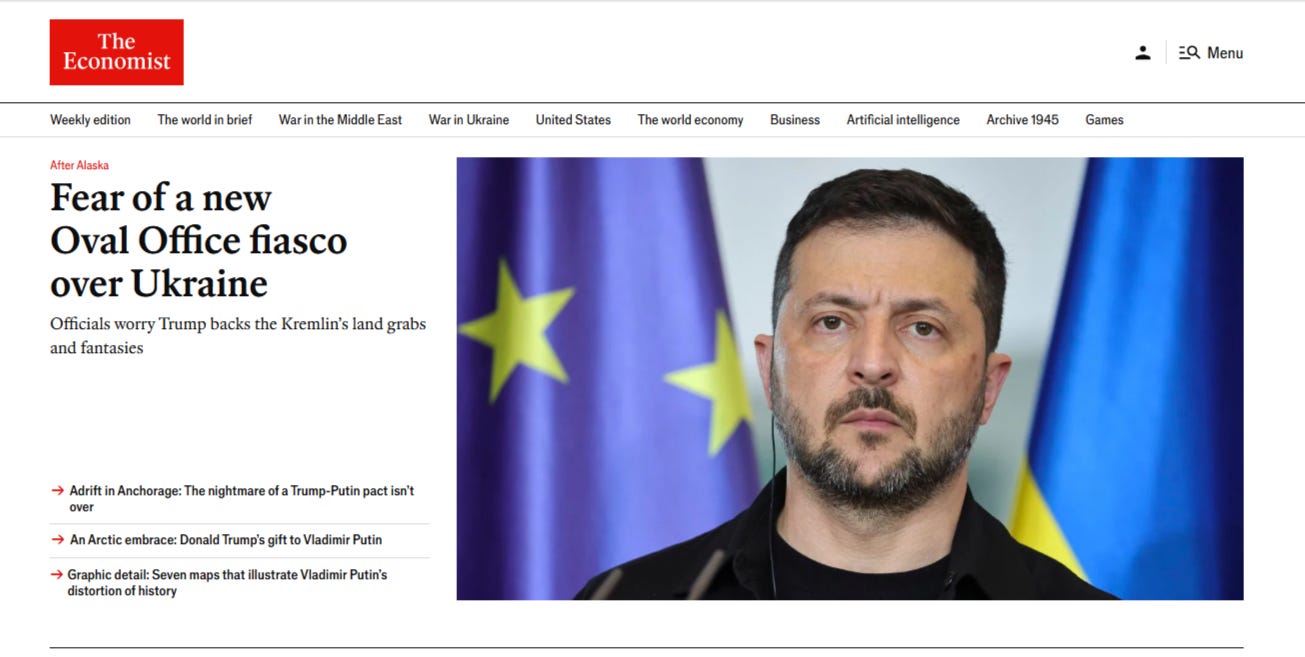
Throughout July secret contacts between Ukraine and Russia had brought the two countries closer to an understanding of how the war could be frozen. But subsequent talks between Mr Putin and Steve Witkoff, a confidant of Mr Trump from his real-estate days, created a series of impossible new territorial demands on Ukraine. At the summit on Friday Mr Putin once again demanded that Ukraine retreat from the parts of Luhansk and Donetsk provinces that it still holds, which together represent the most fortified sections of the front line. This would put Mr Putin in a far stronger position to attack again in the future, should he choose to do so. In return, the Russian president offered to give back tiny chunks of occupied territory in Sumy and Kharkiv provinces, and to freeze the current lines in Zaporizhia and Kherson.
Years of war have strained the Ukrainian people, and Russia continues to press its advantage in metal and men on the front lines. Unsurprisingly, opinion polls show a clear switch to pragmatism on concessions for peace. A majority of those asked are now in favour of acknowledging de facto occupation of the areas Russia already holds in exchange for genuine security guarantees from the West. But there are nonetheless consistent and overwhelming majorities against making any further territorial concessions to Russia. According to Anton Hrushetskyi, executive director of the Kyiv International Institute of Sociology, less than one in five would be prepared to accept the kind of land swap Mr Trump is said to be favouring.
A Ukrainian intelligence officer says the Americans are being “unbelievably aggressive” in pushing Ukraine to forfeit more land. The Russian interest is clear enough, he says. “They want to maximise the package they will get in return—from sanctions relief, to the return of seized assets, to the re-opening of energy markets.” What, he says, is far less clear is why the Trump administration was pushing so forcefully to promote Russia’s interests.
Despite the obvious headwinds, Mr Trump appears committed to his quick-fix peace. The Economist understands a three-way meeting between Mr Trump, Mr Putin and Mr Zelensky could come as early as the end of next week. Before that, on Monday, the Ukrainian leader is scheduled to arrive in Washington for his first visit since his humiliation in February. European leaders will join him in a show of support. But some of the ingredients appear ominously similar to his previous visit. Channelling the logic of Mr Putin, Mr Trump is already preparing to blame Ukraine if his plans blow up, Ukrainians fear. “Make a deal,” he advised Mr Zelensky, via Fox News. “Russia is a very big power. [You] are not.” ■
This is where Europe has a key role. After the Alaska summit Mr Trump spoke with European leaders and Mr Zelensky for one hour in a call, during which they emphasised that Ukraine must decide on territory and must get weapons supplies and security guarantees. In a statement the European leaders declared that “We will continue to strengthen sanctions and wider economic measures to put pressure on Russia’s war economy until there is a just and lasting peace. Ukraine can count on our unwavering solidarity as we work towards a peace that safeguards Ukraine’s and Europe’s vital security interests.” There is evidence that Mr Trump listens to Sir Keir Starmer, Friedrich Merz, Emmanuel Macron and Alexander Stubb, so their interventions over the next few days will carry some weight in steering him away from trying to impose a bad deal on Ukraine. There is little support in Congress or among the American public for a full rehabilitation of Russia.
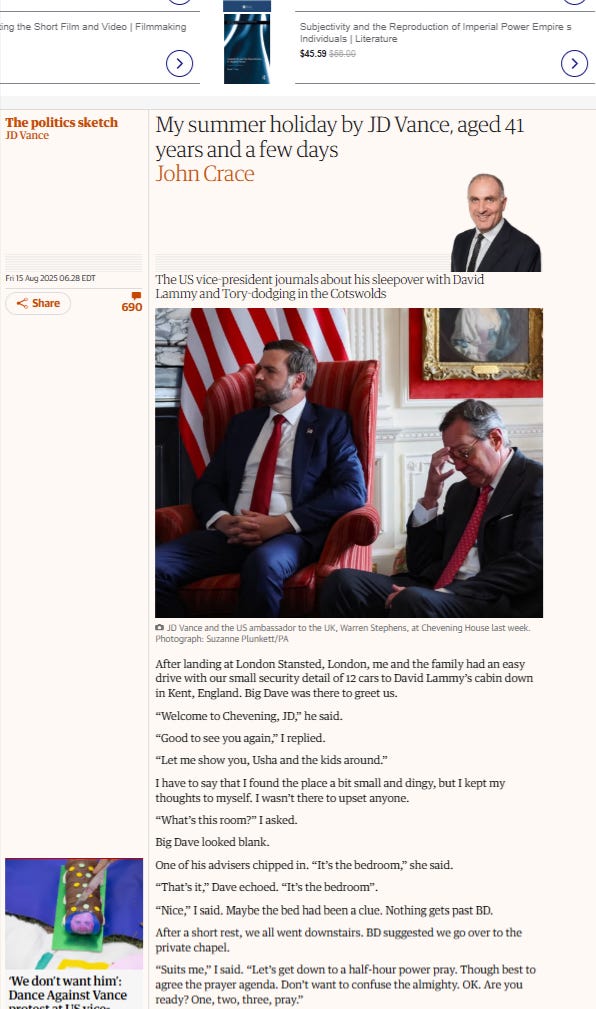
Europe would carry a lot more weight if it were doing and spending more. Mr Trump and his vice-president, J.D. Vance, both think, with some justification, that supporting Ukraine should be primarily a European responsibility. For a long time that was not the case and only in recent months has Europe’s cumulative military aid through procurement deals finally exceeded that of America, according to the Kiel Institute, a think-tank. Europe can do more by providing funds for buying weapons from America, building up its own munitions and helping Ukraine to complete the build-out of its own military-industrial complex. This is essential in any scenario. It would also signal that if Mr Zelensky and Europe ultimately reject a deal that Mr Trump and Mr Putin agree on, and America then abandons its support entirely, Ukraine is still capable of fighting on.
After Anchorage Mr Trump suggested that he wanted not a transitory ceasefire, but a final peace that would “hold up”. In fact, deal or no deal in the coming days, the conflict will continue. For Mr Putin, the war has become an instrument of political control at home, providing a pretext for the repression that keeps him in power, despite the heavy costs in lives and to Russia’s economy and increasingly rickety financial system. As well as expanding Russian territory, he hopes to divide the Western alliance and weaken Europe. The danger is that Mr Trump is blind to, or even untroubled by, the Kremlin’s agenda. The talks on Monday could produce a breakthrough. But Europe and Ukraine must prepare for the worst and make clear that they are ready for that challenge. ■
The honours for Mr Putin were in sharp contrast to the public humiliation that Mr Trump and his advisers inflicted on Mr Zelensky during his visit to the White House earlier this year. Since then relations with Ukraine have improved, but Mr Trump has often been quick to blame it for being invaded; and he has proved strangely indulgent with Mr Putin. Mr Trump told Fox you have to “weave and bob” to reach deals, but his constant shuffling in the run-up to the summit suggests indecision and frustration with a Russian leader who will not respond to his entreaties.
The Alaskan venue was rife with symbolism: the proximity of Russia and America across the Bering Strait, the sale of Alaska by Tsarist Russia to the United States in 1867; and the American lend-lease agreements that armed the Soviet Union to help it resist Nazi Germany (an important supply route ran through Alaska). Mr Putin recalled all this and recounted how, on the red carpet, he had greeted Mr Trump with “Good afternoon, dear neighbour.”
It surely makes sense for big nuclear powers, even geopolitical rivals, to talk to each other. Whether they need to roll out the honours at home for no gain is more doubtful. The only sop to Mr Trump came when the Russian leader said he was “sincerely interested in putting an end” to the war, and agreed that it would not have happened had Mr Trump been president in 2022.
Yet Mr Putin insisted that “we need to eliminate all the primary causes of that conflict”. Given that he thinks the primary cause is Ukraine’s independence and sovereignty, and its right to join European institutions including NATO, his formula is a recipe for continuing the war. Mr Trump did nothing to disabuse him. The Russian president left with a smile, and even tried a little English in public: “Next time in Moscow”, he told his host. To which Mr Trump replied, “I’ll get a little heat on that one, but I could see it possibly happening.”
Editor: Here is the final salvos of the Economist, as the perverors of a ‘History Made To Measure’! I offer a condesation, without the maps!
IN JULY 2021 Vladimir Putin published an essay with arguments he would later use to justify Russia’s invasion of Ukraine.
…
There is truth in Mr Putin’s claim that Ukraine and Russia are close kin, as the following maps demonstrate.
…
For Mr Putin the origin of Russian-Ukrainian identity is Kyivan Rus, a confederation of princedoms that lasted from the late 9th to the mid-13th century (see map 1).
…
In the mid-11th century, however, Kyivan Rus began to fragment into semi-autonomous principalities (see map 2). These included Galicia-Volhynia, which covered parts of modern Ukraine and B.
…
When the Mongol empire and its successors began to decline in the 14th century, rival polities rose to fill the vacuum.
…
In 1648 the Cossacks, settlers on the steppe who amalgamated into disciplined military units, led an uprising against the commonwealth.
…
Early Cossack warriors practised a limited form of democracy, a contrast to Muscovy’s autocratic regime.
…
But the Cossack state had a hard time. In 1654, threatened by the Poles as well as the Ottomans to the south, Cossack leaders pledged allegiance to the tsar of Muscovy.
…
By the end of the 17th century the Hetmanate’s territory had split into two: Muscovy took control of the east bank of the Dnieper river, the Polish-Lithuanian Commonwealth seized the west.
…
In the late 18th century the Russian empire broke up the Polish-Lithuanian Commonwealth, with help from Austria and Prussia.
…
On the eve of the first world war the Russian empire stretched from the Sea of Japan to the Baltic (see map 4).
…
In 1917, weakened by the war, Russia experienced two revolutions. The first overthrew the Romanov dynasty. The second was the seizure of power by Vladimir Lenin and his Bolsheviks.
…
Ukraine’s territory expanded during the Soviet period. Under the Soviet Union’s non-aggression pact with Nazi Germany, signed in 1939, the two countries carved up eastern Europe.
…
But Ukraine also experienced great suffering. In the 1930s Josef Stalin’s policy of forced collectivisation of agriculture led to a famine, known in Ukraine as the Holodomor, which killed millions of people.
…
In the 1980s Mikhail Gorbachev, the last Soviet leader, set out to reform the Soviet Union through openness and reform—glasnost and perestroika.
…
Ukraine suddenly became home to the world’s third-largest nuclear arsenal. In 1994 it agreed to denuclearise in exchange for security assurances from America, Britain and the Russian Federation.
…
In 2004-05 the “Orange revolution” highlighted Ukraine’s democratic ambitions. Thousands protested against a rigged presidential election that gave victory to a pro-Russian candidate.
…
Editor: the final paragraphs of this History Made To Measure , that is about the self -willed forgetting, of the various roles toxic political actors, played in the Political Coup against Viktor Yanukovych: Victoria Nuland, Geoffrey R. Pyatt, the Foundation for Defense of Democracies, and the toxic political meddler George Soros, and of course the subrosa political actor Barack Obama. Not forgetting Historian Timothy Snyder who benefited from the largess of Robert Silvers of The New York Review Of Books!
His response to the Maidan marked Russia’s first military incursions into independent Ukraine. In 2014 the Kremlin illegally annexed Crimea and sent troops into the Donbas, a predominantly Russian-speaking region in eastern Ukraine (see map 7). Russia’s separatist proxies—led by the Russian intelligence officers— declared “people’s republics” in Donetsk and Luhansk. By December 2021, just before Russia’s full-scale invasion in February 2022, the conflict had killed more than 14,000 people. The war continues.■
Correction (January 30th) The borders in maps 3 and 4 have been updated since this story was published. The chronology of the founding of the Ukrainian People’s Republic in 1917 has also been clarified.




 StephenKMackSD's Blog