But it doesn’t mean there isn’t a compelling case for action. Three, in fact.
Iran poses a threat to global order by way of its damaged but abiding nuclear ambitions, its deep strategic ties to Moscow and Beijing, its persistent threats to maritime commerce and its support for international terrorism.
It poses a threat to regional stability, not just through its support for anti-Israel proxies like Hamas and Hezbollah, but also by its meddling in Lebanon, Iraq, Yemen and (until the overthrow of the Bashar al-Assad regime) Syria.
And it’s a mortal threat to the life and safety of its own people, many thousands of whom it slaughtered last month. There was a time not long ago when Americans, both left and right, cared enough about human rights to believe it could, in some circumstances, justify military intervention.
…
Editor: Mr. Stephens is to say the least a Zionist Apologist/Advocate! He tries to mimic a kind of a disinterested point of view, but his regular readers are well aquainted with his tried and true methologies!
The Pentagon has set the table for major strikes against Iran. With US and Iranian officials negotiating in Geneva, President Donald Trump has threatened significant attacks to induce Tehran to accept a complete end to its nuclear program. What options are available to the president, and which would do the most to pressure Tehran?
Given the US force package in the Middle East, the administration has three “buckets” of capabilities for threatening the Islamic Republic.
The first is non-kinetic warfare, meaning nothing actually blows up. This includes cyberattacks to knock out military and civilian targets, reducing Iranian defense and response capability. There is also information warfare: more propaganda, a better flow of information to the Iranian people, and smuggling in more Starlink terminals to help them get around the regime’s internet clampdown.
Another non-kinetic option could be using radio-frequency tools to degrade microchips in key systems — the “discombobulator” weapon Trump discussed after the raid that seized the Venezuelan dictator Nicolás Maduro.
The second bucket is “limited” strikes. This is what the president seems to have settled on in much of his public commentary. The strategy could include one or two days of strategic attacks against military targets such as ballistic-missile batteries and production facilities; command-and control hubs, especially those of the Iranian Revolutionary Guard Corps; and possibly leadership targets such as Supreme Leader Ayatollah Ali Khamenei.
These strikes would use Tomahawk missiles launched from Arleigh Burke-class destroyers; drones and manned electronic-warfare aircraft; and land- and carrier-based F-35 Lightning stealth fighters. Iran’s air forces should be taken out on the ground before the fight really starts.
Finally, there is bucket three, the truly big tools. This might include several weeks of strikes to wipe out several levels of the Iranian leadership, both religious and secular; hitting what is left of Iran’s nuclear program; destruction of the electric grid; strikes against oil production and refining facilities; and assaults on Iranian naval and maintenance facilities on the Indian Ocean and Persian Gulf.
A campaign of this scale would potentially include the “Sunday punch” of both strategic bombers — likely the B-2s used to devastate Iran’s nuclear sites last summer — and far greater numbers of land-based F-35s, plus sea-based F-18 hornets.
…
Editor: What James Stavridis offer to the reader is what Bret Stephens cannot begin to match! The Military experience that Stavridis posses, even if still attched to a Idiology of Military Supremacy of Weaponry of many and varied kinds, may espress an Idiology of a kind: Yet in sum Mr. Stephens essay is about a purely idiological defence of the Zionist Faschist State manipulation of Donald Trump, via Miriam Adelson’s money, to reduce to it’s essientials!
Editor: The first two paragraphs of Stephens column
President Trump appears poised to order strikes on Iran — indeed, by the time you read this column, he may already have done so — while barely bothering to spell out his reasons. The lack of explanation is a serious moral and political mistake: At the very least, Americans deserve to know what they’re getting into, why, for how long and for what result.
But it doesn’t mean there isn’t a compelling case for action. Three, in fact.
Editor. Under the rubric ‘At the very least, Americans deserve to know what they’re getting into, why, for how long and for what result.’
…
Iran poses a threat to global order by way of its damaged but abiding nuclear ambitions, its deep strategic ties to Moscow and Beijing, its persistent threats to maritime commerce and its support for international terrorism.
…
It poses a threat to regional stability, not just through its support for anti-Israel proxies like Hamas and Hezbollah, but also by its meddling in Lebanon, Iraq, Yemen and (until the overthrow of the Bashar al-Assad regime) Syria.
…
And it’s a mortal threat to the life and safety of its own people, many thousands of whom it slaughtered last month. There was a time not long ago when Americans, both left and right, cared enough about human rights to believe it could, in some circumstances, justify military intervention.
…
Editor: This all carefully laundered via ‘a compelling case for action’ !
No wonder protests in Iran have resumed, this time among university students who are bravely undaunted by the terrifying risk. Their protests seem connected to the 40-day memorials for the victims of last month’s massacres. But it’s not a stretch to assume those protests are also a signal to Trump that his promise last month to Iranians that “help is on its way” hasn’t been forgotten, and that ordinary Iranians are prepared to join the fight for their own liberation.
If so, then there is at least a reasonable chance that a sustained military operation that not only further degrades the regime’s nuclear, missile and military capabilities — a desirable outcome in its own right — but also targets its apparatus of domestic repression could embolden the type of sustained mass protests that could finally bring the regime down. Even more so if the leaders who give the orders, including the supreme leader and his circle, are not immune from attack.
For all of its willfulness and the evil it has wreaked over 47 years, the regime does not stand 10 feet tall. It nearly fell during the 2009 Green Movement against that year’s fraudulent elections. It nearly fell again in 2022 during the Women, Life, Freedom protests.
The difference on those occasions was the absence of external military support. Donald Trump now has a unique opportunity to provide it. Despite the risk that military strikes entail, the bigger risk, in the judgment of history, would be to fail to take it.
Editor: To the Zionist Loyalist like Stephens, and his fellow travelers, the imagined future articulated in his column, presages an inevitable future?
Editor: ‘The Collapse of the Dream Palaces’was the turning point of Mr. Brooks political career! He became a New York Times opinion writer. Evan Goldstein’s fawining ‘interview’ is a monument to political confromity and obsequiousness!
For more than two decades, David Brooks has been a fixture of The New York Times opinion page — “the kind of conservative writer that wouldn’t make our readers shriek and throw the paper out the window,” as one Times editor put it when Brooks was hired. A temperamental moderate with a knack for affectionately mocking the elite, Brooks trafficked in wry bemusement rather than moral prescription. In a classic 2001 article in The Atlantic, he trained his eye on “organization kids” — the apolitical, hyperstriving careerists of the Ivy League, whom Brooks regarded as both inordinately obsessive about grabbing the next brass ring and oddly incurious about life’s deeper questions. These students prioritized the cultivation of what Brooks calls résumé virtues at the expense of eulogy virtues, the qualities you hope to be remembered for at your funeral. While he plainly felt something had gone awry, he struck a pose of cocked-eyebrow observer rather than finger-wagging scold.
In the years since, his critique of elite higher education has taken on a sharper tone. In his 2024 Atlanticcover story, “How the Ivy League Broke America,” his target isn’t the psychological malformation of elites, but the entire system that’s anointed their rise. Our method of sorting and sifting via college admissions is bad for higher education and bad for the country, Brooks argues. The architects of the American meritocracy dreamed of a world of “class-mixing and relative social comity; we ended up with a world of rigid caste lines and pervasive cultural and political war. … We ended up with President Trump.”
Now Brooks is moving to the belly of the beast. He recently announced that he would be leaving the Times to take up a new position at Yale University, where he has taught on and off for years. He was recruited to New Haven directly by Yale’s president, Maurie D. McInnis. In his new role, he will lecture, convene discussions on campus, and — what else? — start a podcast in a partnership between Yale and The Atlantic.
I called him on his last day as an employee of The New York Times. We spoke about what Trump gets right, why this is a time for reform in higher ed, and the false consciousness of progressive professors. Our conversation has been edited for length and clarity.
If you were politically aware during the buildup to the 2003 Iraq War, David Brooks’s recent column calling for America to stay in Afghanistan and take a more aggressive role overseas might feel uncomfortably familiar.
Once again, as he did when promoting the Iraq invasion, he calls for America to be the “indispensable nation” and “democracy’s champion.” Once again, there is the obliviousness to the human costs of a supposedly humanitarian U.S. intervention. That was already strange in 2003, but it’s now grotesque after the death of more than 1.3 million human beings in just the first ten years of the War on Terror that Brooks had championed.
The studied turning away from the costs of our wars to those who live in the places where they are fought turns almost surreal in the part of his column devoted to Afghanistan. Brooks cheerfully informs us that “in 1999, no Afghan girls attended secondary school…and as of 2017 the figure had climbed to nearly 40 percent,” all at the cost of “relatively few” American casualties. The cost of a quarter of a million Afghan dead, over 70,000 of them civilians, in a country with a smaller population than California gets zero mention in his column. Neither does the widespread human rights violations associated with the foreign military presence, ranging from torture and detentions to ignoring the return of institutionalized child rape by U.S.-aligned Afghan security forces, something that even the Taliban never tolerated.
After Iraq and Afghanistan, Brooks observes, America “lost faith in itself and its global role, like a pitcher who has been shelled and lost confidence in his own stuff.” Apparently the U.S. is losing its mojo in the democracy-championing business. With the upcoming 20th anniversary of 9/11 the champions of the War on Terror seem to think we are reaching some kind of statute of limitations for the relevance of our past actions. One might have more confidence in this assertion if there had been real accountability and reckoning in Washington for the individuals and ideology that drove the catastrophic decisions made after 9/11.
But this article underscores that there has been no such reckoning. What it instead illustrates is the through-line that links the ideology of global dominance that drove our decisions then, and the way we still look at the world today. The invasion of Iraq was justified by commentators like Bill Kristol using a Manichean distinction between “a world order conducive to our liberal democratic principles and our safety, or… one where brutal, well-armed tyrants are allowed to hold democracy and international security hostage.” Twenty years later, Brooks, a champion of that invasion, still depicts the world as “enmeshed in a vast contest between democracy and different forms of autocracy…a struggle between the forces of progressive modernity and reaction.” And it’s true, as Brooks claims, that this view is close to that espoused by some in the Biden administration.
…
The more subtle difference, acknowledged by Brooks in a brief statement that “we’re never going back to the Bush doctrine,” is a belief we can avoid the overreach of boots-on-the-ground invasions of foreign countries while still pursuing claims to unilateral U.S. global leadership. This recasts the Iraq and Afghanistan wars as driven not by ideological overreach but by a short-sighted failure to anticipate the practical difficulties of invasion and occupation. Calls for new hot wars are out; a sweeping, ill-defined global cold war with the forces of reaction domestically and abroad is in. But cold wars carry their own dangers — including igniting a hot war in any of the numerous simmering low-level conflicts with our ideological enemies around the world, from Ukraine to the Persian Gulf to the Taiwan Strait.
Brooks closes by saying that without aggressively fighting this new global conflict between authoritarianism and progressive values we won’t be able to “look at ourselves in the mirror without a twinge of shame.” It’s an odd moral calculus that tries to ignore shameful acts facilitated by the United States itself and instead calls on us to be ashamed of the actions of foreign governments based on the vague hypothetical claim that U.S. intervention could prevent them. But it’s at the heart of the humanitarian interventionism Brooks sold 20 years ago and is still selling today. We should hope that this time there won’t be buyers in Washington.
Editor: Andrew Bacevich in 2013 on Brooks:
David Brooks is constantly wrong
Takes a lot to be the voice on the New York Times op-ed page most consistently wrong about war in the Middle East!
The final paragraphs of Bacevich’s revelatory essay on Brooks:
…
Sprinkling his columns with references to “irony” as he channeled the spirit of Reinhold Niebuhr, Brooks might have chosen to reflect deeply on all that had gone wrong in Iraq and in his own calculations. Was the main problem simply incompetence on the part of George W. Bush, his advisers, and his generals—a splendid initiative squandered through faulty implementation? Or did failure derive from deeper causes, perhaps a fundamental misunderstanding of war or history or human nature itself? Or could the problem lie, at least in part, with a perversely undemocratic military system that condemned soldiers to waging something like perpetual war at the behest of a small coterie of Washington insiders, while citizens passively observed from a safe distance?
Sharing the inclination of his countrymen, Brooks chose not to engage in any searching inquiry at all. Rather than reflecting on Iraq, he looked for new fields in which to test his theory of using military power to spread American ideals while redeeming American culture at home. Afghanistan—a war already under way for more than a decade—presented just the second chance he was looking for. Based on a quick visit, Brooks concluded that Afghanistan was nothing like Iraq. U.S. military efforts there promised to yield a different and far more favorable outcome. “In the first place,” he wrote during his government-arranged reporting trip in early 2009, “the Afghan people want what we want . . . That makes relations between Afghans and foreigners relatively straightforward. Most [U.S.] military leaders here prefer working with the Afghans to the Iraqis. The Afghans are warm and welcoming.” Even better, they actually “root for American success.”
That wasn’t all. In contrast to its fumbling performance in Iraq, the U.S. military had now fully mastered the business of winning hearts and minds. Know-how had displaced ineptitude, with the union of John Wayne and Jane Addams now fully consummated. Further, with the distraction of Iraq now out of the way, the troops in Afghanistan possessed the wherewithal needed for “reforming the police, improving the courts, training local civil servants and building prisons.” As Brooks put it, “we’ve got our priorities right.” Furthermore, “the Afghans have embraced the democratic process with enthusiasm.” Unlike the recalcitrant and ungrateful Iraqis, they were teachable and amenable. Brooks commended President Obama for “doubling down on the very principles that some dismiss as neocon fantasy: the idea that this nation has the capacity to use military and civilian power to promote democracy, nurture civil society and rebuild failed states.” Granted, the trial run in Iraq had gone badly, but why cry over spilled milk? Besides, Iraq had served as an education of sorts. Brooks felt certain that trying again in Afghanistan would yield a better outcome. In short, that war was “winnable.”
Yet Afghanistan proved no more winnable than Iraq had been, at least not within the limits of what the United States could afford and the American public was willing to pay. The U.S. troops who burned Korans, defiled Taliban corpses, and gunned down innocent civilians in shooting sprees made it difficult for Afghans to appreciate the Jane Addams side of the American soldier. As for John Wayne, Hollywood had thought better than to film him urinating on dead enemy fighters. By 2012, an epidemic of “green-on-blue” incidents—Afghan security forces murdering their U.S. counterparts—revealed the absurdity of Brooks’s blithe assertion that Afghans “want what we want” and “root for American success.” What most Americans wanted was to be done with Afghanistan. In hopes of arranging a graceful withdrawal, they might allow Washington to prolong the war a bit longer, but with the usual terms fixed firmly in place: only so long as someone else’s kid does the fighting and future generations get stuck with the bill.
What reader who confronts the almost evolution, to near political respectability of James Kirchick, as a possible New York Times replacement for David Brooks? History may disabuse that reader?
James (“Jamie”) Kirchick is a fellow at the neoconservative Foundation for Defense of Democracies (FDD) and a contributing editor at the New Republic. A former writer-at-large for Radio Free Europe/Radio Liberty, Kirchick has also contributed to various rightist outlets like the Weekly Standard and Commentary magazine’s Contentions blog, as well as numerous mainstream publications, including the Los Angeles Times and Politico.[1]
On Anti-Semitism
Like others of his ideological kin—such as Lee Smith, also at FDD—Kirchick has wielded accusations of anti-semitism in an effort to sideline those who are critical of hardline Israeli polices and one-sided U.S. support for them. In a February 2012 op-ed for Israel’s liberal Haaretz, Kirchick defended “pro-Israel” U.S. writers like Josh Block—a fellow at the Progressive Policy Institute and former AIPAC spokesperson—who had been criticized for arguing that progressive, Democratic Party-affiliated organizations like the Center for American Progress (CAP) allowed their writers “to say borderline anti-semitic stuff.” Kirchick misleadingly claimed in the article that Block was “ultimately vindicated” when CAP criticized use of terms like “Israel-firster” in its publications.[2] However, it was Block who was forced to back off his anti-semitism claims, telling a reporter that anyone “suggesting” the he thinks CAP is anti-semitic is simply trying “to distract from what I am actually saying.”[3] Kirchick apparently missed this retraction from Block.[4]
According to Kirchick, the real back story to this episode is what he calls a growing “leftist McCarthyism” aimed at “questioning the loyalties of American Jews.” To support this claim, Kirchick argued—without providing any supporting evidence—that big-name scholars and journalists in the United States have recently experienced success in their careers precisely because of their willingness to criticize Israel. He wrote: “Figures ranging from University of Chicago professor John Mearsheimer to journalists Peter Beinart and Andrew Sullivan have all seen their careers blossom as a result of their harsh and unrelenting criticism of Israel. Indeed, obsessively attacking Israel is a bona-fide way to resuscitate one’s career, not destroy it.” He concluded: “Since the 1950s, liberals have routinely accused conservatives of ‘McCarthyism. Now the tables have turned, and it is leftists questioning the loyalties of American Jews.”[4]
…
Editor: Note the political depth of this revelatory document, that casts a serching light on James Kirchick’s political evolution. If that even begins to describe his trojetory, that now rests in the hands of The New York Times editors and readers?
Venezuelan democracy cannot be defended through military intervention
Maduro was committing crimes against humanity — but nothing about the US’s history in Latin America suggests deploying the military there is the right solution.
Buenos Aires Herald editorial (versión en español a continuación)
In the early hours of Saturday, January 3, 2026, the United States once again claimed to be “defending democracy” as it captured Nicolás Maduro in a military intervention in Venezuela.
Yet, this false premise is merely a way of sugarcoating the gravity of turning the armed forces into the gatekeepers of democracy in a foreign country.
Not only do these actions violate Venezuelan sovereignty, they also hark back to a long history of military coups in Latin America that have resulted in serious violence and human rights violations.
For at least a decade, the Maduro government itself has been committing atrocities that organizations including the United Nations have classified as crimes against humanity.
However, there is little reason to believe that the U.S. sending in its military and “running the country,” as President Trump said they will do, will bring the lasting peace and restoration of rights that Venezuela needs.
U.S. military intervention in Latin America has always spelled disaster. Perhaps its most egregious interference was the support it lent to a joint campaign of political repression launched in November 1975 called Operation Condor.
The initial phase saw the military intelligence services of Argentina, Bolivia, Chile, Paraguay, and Uruguay come together to coordinate the persecution of political activists opposed to the dictatorships of those countries regardless of borders.
Brazil, Ecuador, and Peru would later join, between 1976 and 1978. The operation entailed coordinated kidnappings, disappearances, and child appropriations all across the region. Many perpetrators of these crimes have been tried and convicted in Argentine courts.
Democracy can only be defended at the ballot box by guaranteeing citizens can freely decide who their leaders will be. The armed forces should never get involved.
As we stated in an editorial in August 2024, Venezuela has in recent years experienced such an acute humanitarian, economic and political crisis that around a quarter of the population has left the country. The disputed election results, the persecution of political opponents, and the dire economic crisis undoubtedly required a political solution.
The actions of the Maduro regime have caused a years-long humanitarian crisis in Venezuela, which has been worsened by U.S. sanctions that have hit the civilian population. International organizations and human rights activists have long denounced the government’s abuses and called for aid for the civilian population.
The solution to these serious problems, however, must be institutional, never military. Respect for international law must never be set aside, as it opens the door to further instances of mass human rights violations.
Trump said on Saturday in a press conference about the operation that his country will govern Venezuela to ensure an orderly transition.
He avoided giving details of how long this period would last, but did say that it would be linked to the reconstruction of the country’s oil infrastructure, which he claimed had been “stolen” from U.S. companies. Interference in Venezuela’s internal affairs seems to be the excuse for doing business with the backing of the US government.
Almost 50 years after the 1976 coup that brought the deadliest military dictatorship Argentina has ever experienced, institutions and rights defenders here have shown that the answer lies in the judiciary and respect for due process. Only by going this route can respectable political processes that protect people’s rights be built.
On Wednesday, I woke up and went through my unofficial routine. Though it’s a habit I don’t like to admit, I started my day by opening Instagram and mindlessly scrolling until I willed myself to stop and press play on a podcast instead.
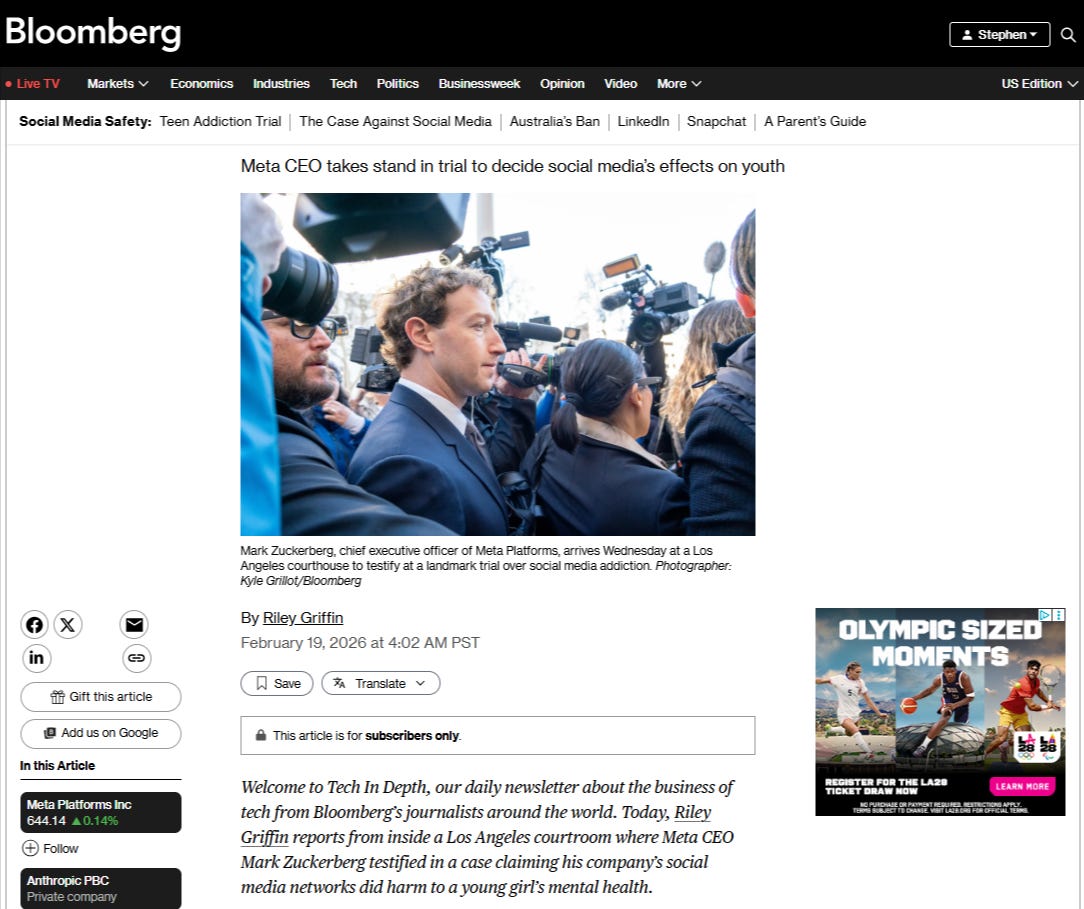
That podcast opened with an ad for Instagram’s “Teen Accounts” feature, promising safeguards for kids and peace of mind for parents. The irony wasn’t lost on me: I was getting ready to head to Los Angeles Superior Court, where Mark Zuckerberg, chief executive officer of Instagram’s parent company, Meta, was set to testify in a landmark trial over whether social media is addictive and harmful to young users.
I first posted on Instagram at 16. Though I’m not quite the social media native that my Gen Z peers are, I’ve been a longtime user of the photo-sharing app and have wrestled with that question. Now, it was central to a high-stakes legal battle that could result in billions of dollars in potential damages. And I would be among the few in the room to watch Zuckerberg take the stand and answer how Instagram was designed, how it captured and retained users, and whether it caused them harm, with a particular focus on teenage girls.
This was a years-in-the-making moment. Lawyers have long been building their case against Meta, as well as Alphabet’s YouTube, Snap and TikTok — though the latter two are no longer participating after reaching confidential settlements before the trial began. The case centered on a woman named Kaley, who was on Instagram as early as 9 years old, and on claims that the app fueled years of her mental health struggles.
Inside the courtroom, the air was tense and quiet, sprinkled with grieving family members who say they lost children to the harms of social media, and reporters. In the first row was Kaley, who had so far been absent from the trial. Now 20, she sat directly in the line of sight where Zuckerberg would soon testify.
When the CEO and fifth-richest man in the world arrived, many in the room failed to notice. Dressed in a dark blue suit and gray tie, Zuckerberg looked somber, subdued. As he approached the stand, nerves broke through. He fidgeted with a water bottle and took a deep breath.
This was the calm before the storm.
For six hours, Zuckerberg faced a barrage of questions about his company’s effort, or lack thereof, to protect young users on Instagram and Facebook. He was pressed on internal communications in which employees pleaded to shore up safety measures, and lamented the toll social media took on children. He was questioned about Meta’s focus on increasing the amount of time users spent on its platforms, and the company’s knowledge that a broad swath of pre-teens were on the apps despite stated restrictions for those younger than 13. He was made to look at a banner depicting an unfathomable number of selfies Kaley had posted throughout her youth. And pressed on choices he made about beauty filters.
Though Zuckerberg has faced challenging inquiries from Congress and federal lawyers before, this was the first time he testified about social media’s impact on mental health before a jury. His responses were slow, often quiet, acknowledging past practices, while promising many had changed. He spoke of balancing guardrails with his north star of free expression. He noted that teens currently account for just 1% of the company’s revenue, given their lack of disposable income, but suggested he still wants to deliver them “value,” which he claimed was necessary to keep them on the platforms for the long term.
The day was an exhausting back-and-forth, where Zuckerberg was dealt some blows and scored some wins. By the end, he appeared tired: checking his watch, flickering his eyes, and responding in a muted tone unlike the one I’ve heard at company conferences, on earnings calls, or across his own social feed.
Zuckerberg’s testimony didn’t settle the question of whether social media is addictive, for Kaley or any of its users. But it did thrust into the spotlight the different choices that could have been made. Meta could have done more to enforce its age requirements, for example, or realized earlier on that optimizing its product for “time spent” was a bad idea. Zuckerberg said the company has evolved on both fronts, but I wonder if that evolution happened too late.
Those questions will continue to loom over the trial as it moves forward into next month. And it could prove a critical test not only for Meta, but for the thousands of similar cases winding through courts across the country; cases that could shape the future of Instagram itself, the app so many of us still reach for before we’re fully awake.
Populist nationalism always lives locally; so it has a situationally specific context.
The common factors. The populist nationalists in both Europe and America share the common feature of being “left behinds” in a state of deep resentment against the cosmopolitan elites that dominate much of their respective societies. Resentment is always the rocket fuel to populist angst.
Most of the resentment is economic and further fueled by the social distinction that goes with higher economic circumstances originating from superior education and/or being born into more privileged circumstances.
Another base of resentment is race and identity grounded in fear of ethnic displacement–the cathedral or church steeple is about to be replaced by the mosque. Underneath religion are the dark dragons of racial resentment; in American reactionary elites have used racial rivalry between left-out whites and excluded African-Americans for centuries. Recent Moslem immigration into Europe shows that culturally distinct foreign immigrants assimilate unevenly and that inclusion must be a concerted public and open process. Education and skills have to be shared so that the vistas of opportunity are perceived as available to all — people care about their children’s prospects.
The Trumpista MAGA group is currently mixing traditional American racism against African Americans and Asians with new anxieties about immigration of non-European-like groups from everywhere with any skin complexion at all (Indians are the new source of anxiety) into one discriminatory stew. One senses the Trumpistas are really overplaying their hand in modern America which is indeed a multicultural society (the Bad Bunny brouhaha just emphasized this). The Republicans are increasingly making Representatives Ilan Omar and Alexandria Ocasio-Cortez into latter day American Joans of Arc, attractive faces of tomorrow’s better America.
A big international factor. For about a half a millennium, a major threat to a pluralistic Europe of many nationalities has been a monolithic, despotic and expanding Russian empire. If one dislikes reigning European elites, simple one-stop shopping will send the disaffected to St. Petersburg or Moscow. No one consistently challenges European reigning elites like a despot in the Kremlin; that has been a constant for centuries except for a brief holiday in the 1990s between the last Communist and the rise of Putin. No one impinges and subverts European governance and with such consistency and intensity as Putin and his regime; that is what they have organized themselves to do. The Ukraine war has always been about more than just Ukraine; it is about Europe and its freedom from predation from the east.
The recent articles in the FT and elsewhere discussing fertility rates way below replacement highlight the emerging hardest of realities — Europe becomes more inclusive or Europe disappears like a declining statistics. Europe has to start making European things work.
But Europe has everything in place to be a growing and more successful Europe. It just has to choose through voting to be a more and better Europe; Victor Orban and the AfD do not offer that pathway at all. Atavistic Russian revanchism is hardly a credible alternative for Europe.
Orban has simply been for sale; he and his clique have just been playing a political arbitrage game using Russia opportunistically to sustain an authoritarian “illiberal” regime inside an institutionally democratic Europe. He and his clique have always been in it for the wealth extraction possibilities intrinsic to state capture. This is a very old game.




 StephenKMackSD's Blog