Recent Comments
Archives
- September 2026
- August 2026
- July 2026
- June 2026
- May 2026
- April 2026
- March 2026
- February 2026
- January 2026
- December 2025
- November 2025
- October 2025
- September 2025
- August 2025
- July 2025
- June 2025
- May 2025
- April 2025
- March 2025
- February 2025
- January 2025
- December 2024
- November 2024
- October 2024
- September 2024
- August 2024
- July 2024
- June 2024
- May 2024
- April 2024
- March 2024
- February 2024
- January 2024
- December 2023
- November 2023
- October 2023
- September 2023
- August 2023
- July 2023
- June 2023
- May 2023
- April 2023
- March 2023
- February 2023
- January 2023
- December 2022
- April 2022
- March 2022
- February 2022
- January 2022
- November 2021
- October 2021
- September 2021
- August 2021
- July 2021
- June 2021
- May 2021
- April 2021
- March 2021
- February 2021
- January 2021
- December 2020
- November 2020
- October 2020
- September 2020
- August 2020
- July 2020
- June 2020
- May 2020
- April 2020
- March 2020
- February 2020
- January 2020
- December 2019
- November 2019
- October 2019
- September 2019
- August 2019
- July 2019
- June 2019
- May 2019
- April 2019
- March 2019
- February 2019
- January 2019
- December 2018
- November 2018
- October 2018
- September 2018
- August 2018
- July 2018
- June 2018
- May 2018
- April 2018
- March 2018
- February 2018
- January 2018
- December 2017
- November 2017
- October 2017
- September 2017
- August 2017
- July 2017
- June 2017
- May 2017
- April 2017
- March 2017
- February 2017
- January 2017
- December 2016
- November 2016
- October 2016
- September 2016
- August 2016
- July 2016
- June 2016
- May 2016
- April 2016
- March 2016
- February 2016
- January 2016
- December 2015
- November 2015
- October 2015
- September 2015
- August 2015
- July 2015
- June 2015
- May 2015
- April 2015
- March 2015
- February 2015
- January 2015
- December 2014
- November 2014
- October 2014
- August 2014
- July 2014
- June 2014
- May 2014
- April 2014
- March 2014
- February 2014
- January 2014
- December 2013
- November 2013
- October 2013
- September 2013
- August 2013
- July 2013
- June 2013
- May 2013
- April 2013
- March 2013
- January 2013
- December 2012
- November 2012
- October 2012
- September 2012
- August 2012
- July 2012
- June 2012
- May 2012
- April 2012
- March 2012
- February 2012
- January 2012
- December 2011
- November 2011
- October 2011
- September 2011
- August 2011
- July 2011
- June 2011
- May 2011
- April 2011
- March 2011
- February 2011
- January 2011
- December 2010
Categories
Meta
At The Financial Times: The New Cold War is still with us, 2 ‘News Reports’& An Editorial, a comment by Political Realist
Posted in Uncategorized
Leave a comment
Vulcan Zakheim attacks Dove Bacevich, some thoughts by Political Reporter
Kudos to Mr. Bacevich. He has managed to evoke from one of The Vulcans a shrill defensive polemic, which at times recovers itself to make some trenchant but short lived observations, in which this policy maker defends not just the catastrophically failed War on Terror but the whole of American Foreign Policy, post World War II. Not to speak of his defense of his fellow Vulcans, like Paul Wolfowitz, while not forgetting his disrespectful treatment of ‘Douglas J. Feith, merely the eighth-ranking civilian official in the Pentagon’.
In these two quoted paragraphs from Bacevich’s book, this soldier/historian make clear beyond doubt his value as that rarest of civic actors/thinkers. Mr. Zakheim continually makes the mistake of quoting Bacevich at his most revelatory:
“the vacuum left by . . . [the British]; intractable economic backwardness and political illegitimacy; divisions within Islam compounded by the rise of Arab nationalism; the founding of Israel; and the advent of the Iranian Revolution.” …
“Schwarzkopf [the field commander who led the operation against Saddam] . . . shared MacArthur’s penchant for theatrics. As with Patton, maintaining his emotional balance required a constant struggle. Like Eisenhower, Schwarzkopf had a volcanic temper. . . . And like the thin-skinned Bradley, he was quick to take offense at any perceived slight. Generalship in wartime requires foresight, equanimity, and a supple intelligence.”
The latter of these quotations evokes this observation:
Apparently, these were qualities that MacArthur, Patton, Eisenhower and Bradley—those failed commanders of yesteryear—all did not possess.
Amidst the dross of political defensiveness Mr. Zakheim provides an answer to a reader’s search for a plausible reason for his polemic, for it’s bluntness is again instructive:
Bacevich considers the Clinton administration’s response to Al Qaeda’s bombing of both the World Trade Center in 1993 and the USS Cole in 2000 to have been laughable. But he reserves most of his spleen for the Bush administration’s wars in Afghanistan and Iraq. Of the team of veteran policymakers that Bush brought with him into office, Bacevich writes, “They arrived knowing everything they needed to know. They just didn’t know enough to avert a horrific attack on the World Trade Center.” Certainly counterterrorism czar Dick Clarke, in particular, tried to warn of an impending Al Qaeda attack on an American target, but Bacevich goes too far in conveying the impression that Bush and his national-security team somehow could have both forecast the exact nature of 9/11 and prevented it and that, therefore, someone should have “lost his or her job . . . [been] reprimanded or demoted.” As the 9/11 Commission made clear, the failure was systemic, not individual.
Mr. Zakheim and his fellow Vulcans were part of a ‘systemic failure’, this destructive myopia about 9/11, then takes on a rhetorical life as a sub rosa ‘reason’ for the crimes of Afghanistan and Iraq?
And what is always de rigueur, for the Vulcan menage, a pseudo-defense of the IDF.
Bacevich claims that once initial combat operations had ended, and the American military confronted a growing insurrection and civil war, it adopted the “get tough” posture of the Israeli Defense Forces. Bacevich argues that the IDF’s tactics “reflected an Israeli determination to maintain a permanent grip on the West Bank,” while the similar practices of American forces “raised the specter of the United States maintaining permanent control of Iraq.” He is wrong on both counts. The IDF has never taken a political position on retention of the West Bank, no doubt because much, if not most, of its officer corps supports a two-state solution. IDF tactics, while harsh, and perhaps too harsh, have always been intended to deter future acts of terrorism; on balance, Israel does a much better job in this regard than, for example, Western European forces. In any event, just as the IDF’s operations have no impact on Israeli political decisions regarding the future of the occupied territories, so American counterinsurgency operations in Iraq were in no way a signal of American long-term intentions. Indeed, as Bacevich himself points out, it was George W. Bush who signed an agreement for the withdrawal of American combat troops from that country.
The next two paragraphs Zakheim alludes to his argued stance of a demonstrable political paranoia manifested by Mr. Bacevich: about the breadth and depth of Vulcan political machination, as if The Project for a New American Century’s manifesto was not easily accessible to even the most incurious of readers.
One claim in particular goes to the heart of Bacevich’s argument. Buttressed by no source higher than Douglas J. Feith, merely the eighth-ranking civilian official in the Pentagon, Bacevich alleges that Iraq was only a prelude to greater things—the remaking of the Middle East via the overthrow of the likes of Qaddafi and Syria’s Bashar al-Assad. Beyond the fact that Feith did not necessarily speak for his Defense Department superiors—and certainly did not speak for the White House—his list of targets did not include Egypt’s Mubarak, the Gulf kingdoms and emirates, and the kings of Jordan and Morocco, for the simple reason that these countries and their rulers were all allied to Washington and, in the case of Egypt and Jordan, had peace treaties with Israel.
Bacevich does quote “one Bush Administration official,” who says, “The road to the entire Middle East goes through Baghdad.” But who was that official? And how senior was he or she? We don’t know, and Bacevich doesn’t tell. In a similar vein, his criticism of the Iraq War, as with many of his assertions throughout the book, relies far too heavily on pundits and columnists. He cites journalists as sources for what policymakers thought (Bob Woodward, whose own books have no notes, is a particular favorite) and employs them as putative spokesmen for a government in which they never served. In this regard, Max Boot in particular is a frequent Bacevich foil. Unfortunately, Bacevich’s passionate opposition to the war simply overwhelms what might otherwise have been a reasonable critique of an operation that most analysts now agree was woefully misdirected from its very inception.
Then we as readers reach the long awaited denouement of Mr. Zakheim polemic, which doesn’t even surprise, as part of the Vulcan rhetorical set piece of Munich, always Munich:
He blames Obama for not ending the “War for the Greater Middle East,” and for expanding and perpetuating it by surging troops to Afghanistan, a place that he describes as, in words that echo Neville Chamberlain’s shameful characterization of Czechoslovakia, “a distant country about which most Americans knew little and cared even less.”
Then this rather surprising argument by Mr. Zakheim about the vexed question of the ‘judgement’ of Obama, Petraeus and McChrystal, made by a policy technocrat with no military experience- it is astounding in its rhetorical assurance of some self-proclaimed insight base in an imagined empiricism? Not to speak of the revelations of Petraeus’ undeniable incompetence!
He assails David Petraeus, “arguably the most overtly political senior military officer . . . since MacArthur” for launching a “veiled challenge to the authority of the commander in chief” by publicly supporting Gen. Stanley McChrystal’s case for a counterinsurgency strategy in Afghanistan. Bacevich goes on to say that Petraeus and McChrystal successfully pressured “the green-as-grass commander in chief without personal military experience” to surge more troops into Afghanistan. Yet the green-as-grass Obama did not hesitate to sack McChrystal over an interview with Rolling Stone magazine, pressure or no. That Obama not only did not fire Petraeus, but appointed him to head the CIA, clearly demonstrates how Bacevich has misunderstood the president’s relationship with his generals.
The next four paragraphs in Mr. Zakheim’s polemic is devoted to Bacevich’s criticism of Obama’s Foreign Policy: this paragraph offer some valuable insights that almost emancipates itself from the polemical dross:
Bacevich rightly criticizes Obama’s posture, or more accurately, the absence thereof, vis-à-vis the Syrian Civil War. As he puts it, “Libya represented a model of thoughtful planning and competent execution in comparison with Obama’s one other foray into regime change [namely, Syria].” Once again, he offers no new insights, much less alternatives to Obama’s policies. Moreover, his argument that the administration’s use of drones and special-operations forces against Islamic terrorists in Yemen, Somalia and elsewhere is a sign of the administration’s “confusion” seems itself confused. What might intervention in Syria have to do with fighting terrorists elsewhere? The former, if fully implemented, could have resulted in regime change; the latter actually is in support of regimes seeking to govern their unruly nations.
Yet this rhetorical mood is dispelled by a return to polemic:
In any event, Obama’s worst sin appears to have been a willingness to reinsert American forces into Iraq. After having asserted, inaccurately, that “the last non-U.S. foreign troop contingents pull[ed] out of Iraq during the summer of 2009” (the British stayed on until mid-2011), Bacevich asks, “Why did Washington choose to reengage militarily in Iraq?” He answers, “Because it couldn’t think of anything better to do.” It is as if the emergence of ISIS as a new terrorist state, with an expanding geographical base and recruits from the world over, including the United States, should not have merited an American response. Once again, Bacevich offers no new real insights, other than to criticize whatever Obama and his team have done.
The last sentence of this quoted paragraph takes a stance against the very reason and practice of criticism: ‘Once again, Bacevich offers no new real insights, other than to criticize whatever Obama and his team have done.’ The purpose of Mr. Zakheim’s self-apologetical propaganda is take the onus off his failed policies, to call those policies calamitous is not to engage in hyperbole, but to engage and put that onus on an irresponsible critic, not vested in the self-evident Vulcan Tribalism. Revile and cast out the nonconformist. Look to the concluding paragraphs of Mr. Zakheim’s essay, for the proof of that defamation of Mr. Bacevich: His anger is still there; his insights are unoriginal; and his policy prescriptions are as superficial as they ever were. Shades of Donald Trump.
A RESPECTED military historian recently remarked to me that Bacevich constantly rewrites the same book. He has a point. In recent years Bacevich has written The Limits of Power: The End of American Exceptionalism (2009); Washington Rules: America’s Path to Permanent War (2011); The New American Militarism: How Americans Are Seduced by War (2013); and Breach of Trust: How Americans Failed Their Soldiers and Their Country (2014). Bacevich’s latest volume is simply a rehashing and updating of these other books.
There is considerable merit to the argument that the United States needs to be more discriminating in its involvement in overseas conflicts, particularly civil wars that pose no clear threat to America’s vital national interests. Over the past several decades, the United States has been far too prone to intervene in the internal affairs of other countries, often to remove and replace their leaders. On the other hand, the very fact that Americans have grown tired of overseas conflicts, and that Obama for all his faults—and there are many—at least prefers not to enmesh the country in new foreign adventures, belies the assertion that America is addicted to armed intervention in the Islamic world. But Bacevich suffers from his own addiction: he cannot bring himself to modify the case against America and its “establishment” that he has been making year after year. His anger is still there; his insights are unoriginal; and his policy prescriptions are as superficial as they ever were. Shades of Donald Trump.
Political Reporter
https://www.patreon.com/StephenKMackSD
Posted in Uncategorized
Leave a comment
At The Financial Times: Christopher Caldwell on Trump & Trumpism, a comment by Political Reporter
It has been some time since we have read Mr. Caldwell in the pages of The Financial Times. As background to reading Caldwell on the American Trump phenomenon, and to further the readers knowledge of his idiosyncratic Neo-Conservative world view, in The Age of Terror, one could not find a better critic than Marxist Historian Perry Anderson. Here is a excerpt of Anderson’s reviews of Caldwell’s book ‘ Reflections on the Revolution in Europe: Immigration, Islam and the West’, the last three paragraphs of that review are instructive:
In nevertheless suggesting that Europe is confronted with an all but revolutionary danger to its traditional being, Caldwell not only overstates the problems that Muslim minorities – which still amount to no more than about five per cent of the population of Western Europe – present to the EU, but unusually for such a cogent writer, falls into contradiction with himself. On the one hand, he declares that “the conditions unifying Europe culturally have not been better for decades, and Islam is part of the reason why. Renewed acquaintance with Islam has given Europeans a stronger idea of what Europe is, because it has given them a stronger idea of what Europe is not”. On the other hand, he pronounces Europe to be “a civilization in decline”, in which many Europeans already feel themselves exiles in their own homelands, as the number of immigrants rises around them, and an alien creed looms ever larger.
His final word is that “Europe finds itself in a contest with Islam for the allegiance of its newcomers. For now, Islam is the stronger party in that contest, in an obvious demographic way and in a less obvious philosophical way. In such circumstances, words like ‘majority’ and ‘minority’: mean little. When an insecure, malleable, relativistic culture meets a culture that is anchored, confident and strengthed by common doctrines, it is generally the former that changes to suit the latter”.
Both judgements cannot be right. But they can be, and are, equally mistaken. Europe is neither being galvanized into a new sense of unity by the reemergence of Islam as its historic adversary, nor demoralized by the superior faith of its Muslim immigrants. If it has cause for disarray, that lies elsewhere, in the combination of servility and resentment it regularly displays in its role as camp-follower of the American hegemon. So far as its relations with the world of Islam are concerned, the best thing that could happen to Europe would be for it to be evicted, bag and baggage, from the Middle East, along with its overlord. That would be a revolution worthy of the name.
http://www.thenational.ae/arts-culture/books/portents-of-eurabia#full
‘The bogeyman of Islamism’ is no stranger to Mr. Caldwell!
Political Reporter
http://www.ft.com/cms/s/0/eaf0fdb2-3f8d-11e6-8716-a4a71e8140b0.html#axzz4DHFZtDuW
Posted in Uncategorized
Leave a comment
At The New York Times: Monsignor Douthat on ‘The Myth of Cosmopolitanism’, a comment by American Writer
Monsignor Douthat’s remit as Opus Dei operative in American Life is to patrol the wombs of American women, to prattle on about ‘out of wedlock births’ the Mortal Sin of abortion and the general Moral Decline, as some of the obsessions of ‘Conservative Thought’. But don’t forget the Opus Dei specialty of, that dovetails with the American Puritan Tradition, the search for the heretics within the body of believers. The Salem Witch Trials and the Spanish Civil War are stark object lessons in that commonality, no matter how starkly antithetical that relationship may appear- one a seeming project to eradicate evil agents of the devil from a religious body,based solely on ‘Spectral Evidence’, and the other to eradicate the souless political agents of Communism from the political body, to engage in reductivism. Monsignor Douthat now continues that tradition of the search for and the eradication of the heretical, on an intellectual plane, with his ‘The Myth of Cosmopolitanism’. He opens his essay with this paragraph:
Now that populist rebellions are taking Britain out of the European Union and the Republican Party out of contention for the presidency, perhaps we should speak no more of left and right, liberals and conservatives. From now on the great political battles will be fought between nationalists and internationalists, nativists and globalists. From now on the loyalties that matter will be narrowly tribal — Make America Great Again, this blessed plot, this earth, this realm, this England — or multicultural and cosmopolitan.
Followed by this telling self-description of his status as a member, in good standing, of a elite free of the taint of the cosmopolitan contagion
Well, maybe. But describing the division this way has one great flaw. It gives the elite side of the debate (the side that does most of the describing) too much credit for being truly cosmopolitan.
He thereby establishes his credibility, as an objective commentator on the heresy of that cosmopolitanism. Followed by a lengthy and utterly self-referential not to speak of self-serving definition of what that cosmopolitanism is, beginning here :
Genuine cosmopolitanism is a rare thing. It requires comfort with real difference, with forms of life that are truly exotic relative to one’s own. It takes its cue from a Roman playwright’s line that “nothing human is alien to me,” and goes outward ready to be transformed by what it finds…
Monsignor Douthat continues his scattershot attack on his chosen targets of the heresy of Cosmopolitanism, in it’s various iterations, garnished with jejune personal references, a list of marginal Literary authors , the high political melodrama of the Brexit, yet the absence of even a mention of the name Kant demonstrates/secures the Monsignor’s status as incurious American Provincial.
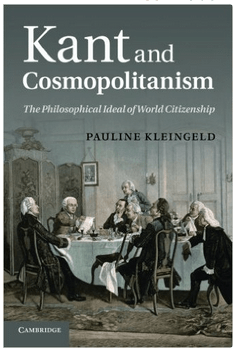
I can think of at least one current book on Kant and Cosmopolitanism: Pauline Kleingeld’s Kant and Cosmopolitanism, The Philosophical Ideal Of World Citizenship as a most valuable commentary/evaluation and compact source, of the latest scholarly explorations of Kant’s idea of cosmopolitanism:
American Writer
Posted in Uncategorized
Leave a comment
Andrew Sullivan:Democracies end when they are too democratic, a comment by Political Observer
Here is where Mr. Sullivan’s essay actually begins, in his natural habitat, the cocktail party of movers and shakers in Washington D.C.
‘And so, as I chitchatted over cocktails at a Washington office Christmas party in December, and saw,…’ One can only wonder at what office party? He is one of America’s elite pundits.
The admixture of quotations from Plato and his self-serving interpolations of the Master, reeks of ‘Straussian scholarship’, that opens his essay, mere window dressing to his staged political hysterics about Mr. Trump as the end of ‘Democracy’. Mr. Sullivan sounds the warning, while carefully eliding from the essay his stark complicity in the rise of the American Caudillo. Amply demonstrated by this quote:
‘And as I watched frenzied Trump rallies on C-SPAN in the spring, and saw him lay waste to far more qualified political peers in the debates by simply calling them names, the nausea turned to dread.’
Mr. Sullivan has watched too many movies, or more likely too much television. But this partial quotation raises the question of Mr. Sullivan’s judgement, if it exists:
…and saw him lay waste to far more qualified political peers in the debates…
In the end the opponents of Mr. Trump were reduced to the utter dregs of American Politics, Rubio and Cruz: so much for Mr. Sullivan’s judgement if any doubt remained of his status as myopic prattler, or by another name as Neo-Conservative redux. But then more of Plato:
Plato had planted a gnawing worry in my mind a few decades ago about the intrinsic danger of late-democratic life. It was increasingly hard not to see in Plato’s vision a murky reflection of our own hyperdemocratic times and in Trump a demagogic, tyrannical character plucked directly out of one of the first books about politics ever written.
Mr. Sullivan’s selective reading of The Master leaves out the most salient, and perhaps the most important point about Plato, he was no democrat, but an advocate of The Philosopher Kings, as the only way to protect against the mortal political danger of too much democracy. Mr. Sullivan in his maladroit way presents himself as a contemporary iteration of that model of political leadership, in his role of conscious stricken pseudo-technocrat, bemoaning the rise of Trump and Trumpism. But he cannot be brief about his dismissal, his exercise of contempt for The Rebellion Against The Elites, as so aptly named by the Financial Times, as part of their propaganda campaign against Left Wing backbencher Jeremy Corbyn, Le Pen and other continental iterations against a catastrophic Neo-Liberalism- Mr. Sullivan lacks curiosity and the intellectual range to make that kind of connection. Trump and his epigones happened for the reason that the Neo-Liberal economic policies advocated by Sullivan, and other members of that Elite, collapsed in 2008 and prosperity has yet to return, except to the 1%.
Eric Hoffer makes an appearance in the essay, The True Believer , who was a willing, and the most able apologist for the Vietnam War, that Lyndon Johnson could scare up from America’s intellectual class. Some of us are old enough to recall his White House appearances. Sinclair Lewis’ ‘It Can’t Happen Here’ makes its obligatory appearance , but not Phillip Roth’s engaging ‘The Plot Against America’, perhaps too laden with nostalgia and self-celebration of Roth as child-hero, not to speak of the political inconvenience of Charles Lindbergh in the dual role of an actual American Hero and as an American Fascist. Trump is a bully and a coward and the Circus Ringmaster on The Apprentice. A role that cemented in the public mind his status as Leader.
I have tried to be as brief as possible in my comment, and realize that I can’t answer every part of Mr. Sullivan’s rambling essay, brevity and succinctness are literary strangers to our author.
Political Observer
http://nymag.com/daily/intelligencer/2016/04/america-tyranny-donald-trump.html
https://www.patreon.com/StephenKMackSD
Posted in Uncategorized
Leave a comment
At Rolling Stone: Matt Taibbi on The Brexit vote and The Elites, a comment by Political Reporter
Sam Rye posted a link to Mr. Taibbi’s compelling essay at the very stogy, not to speak of Corporatist Financial Times:
http://on.ft.com/292vrCK
Mr . Rye makes the soundest kind of argument that Mr. Taibbi makes a case of more cogency -not beholden to the current apologetics for the Cold War relic of the EU, nor its being mired in Neo-Liberalism and the Myth of Germanic Virtue.
Read Gideon Rachman’s essay:
‘I do not believe that Brexit will happen, There will be howls of rage, but why should extremists on both sides dictate how the story ends?
More of the same of Elite contempt for the democratic process.
For valuable insights on Rogoff see this essay from the now suspended publication of The New York Times Examiner, the site is still up and a valuable resource:
https://www.nytexaminer.com/2013/04/reinhart-and-rogoff-are-not-being-straight/
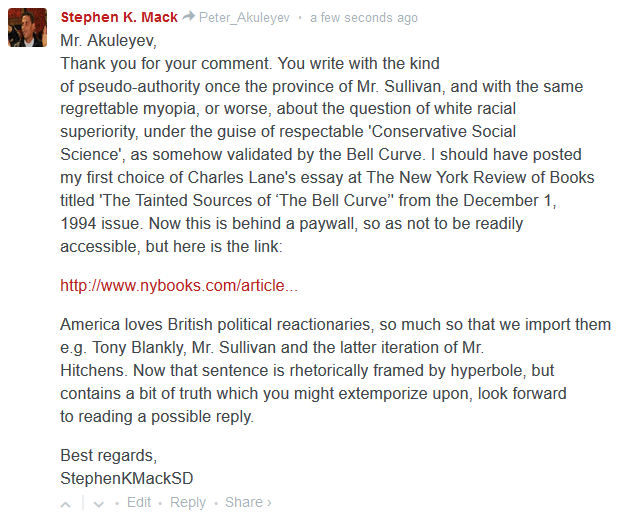
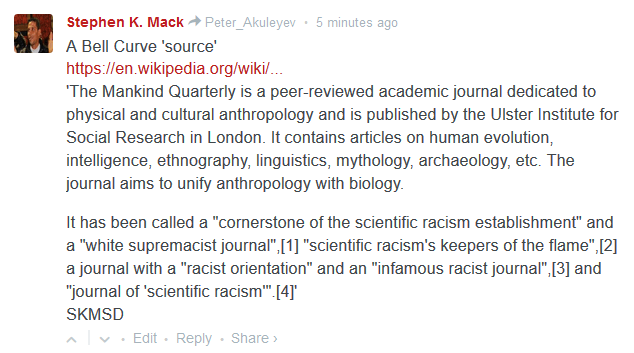
And as for Mr. Sullivan as some kind of pundit, see this on his unseemly, not to speak of ugly, defense of the Bell Curve ( I know old business, but a revealing insight into Sullivan’s self-serving myopia) :
In both the Rogoff and Sullivan consideration as reliable sources of opinion, they both have a verifiable records of bad judgement , not to speak of lack of honesty and worse.
What Mr. Taibbi describes here as the political arrogance of the Elites, via Platonic chatterers and apologists, for that Elite as knowing better than the Electorate: look to the Constitutional Exceptionalism of Carl Schmitt, as documented in ‘The Enemy, An Intellectual Portrait of Carl Schmitt’ by Gopal Balakrishnan In Chapter Eight titled ‘The Crisis of Political Reason’.
Political Reporter
https://www.patreon.com/StephenKMackSD
My replies to
Posted in Uncategorized
Leave a comment
At The Financial Times: Gideon Rachman on Brexit Vote, some observations by Almost Marx
Headline: I do not believe that Brexit will happen
Sub-Headline : There will be howls of rage, but why should extremists on both sides dictate how the story ends?
Gideon Rachman is in high dungeon at the Brexit vote and as ever he voices the rage and anguish of the plutocrats and oligarchs, that their ideological hobbyhorse, the EU, has been dealt a crippling blow: from ‘extremists from both sides’: Mr. Rachman needs a refresher course in what defines the Democratic State:
But there is no reason to let the extremists on both sides of the debate dictate how this story has to end. There is a moderate middle in both Britain and Europe that should be capable of finding a deal that keeps the UK inside the EU.
http://www.ft.com/cms/s/2/8f2aca88-3c51-11e6-9f2c-36b487ebd80a.html#axzz4Csgx5yw1
Perhaps one might view the vote as the integrating third term in the dialectic of The Rebellion Against the Elites/ The Failure of the Elites to place it within Hegelian parlance. Those ‘extremists of both sides’ and others made up a majority! The political facts are more than clear, yet that can’t interfere with the Capitalist Utopianism, that is the political/intellectual mooring of Mr. Rachman’s faith in what? Certainly not in the democratic process!
Enter this movie melodrama, as per Mr. Rachman’s rhetorical frame, Rupert Harrison with something that resembles political sense, rationality and perhaps, by accident?, something like a regard for the democratic process: all framed in an enlightened economic policy advocacy.
Headline: We now need a proper roadmap to quell corrosive uncertainty
Sub-headline: Control and sovereignty, not immigration, were main drivers of Leave vote, writes Rupert Harrison
The nature of that map should reflect the reality — the UK is to leave the EU — but it should also reflect the narrow nature of the vote. It is significant that the polling evidence since the vote suggests that control and sovereignty, not immigration, were the main drivers of the Leave vote. The right aim, therefore, should be some kind of “European Economic Area minus” deal.
Perhaps my enthusiasm was a bit premature, although for The Financial Times, Mr. Harrison’s political/economic rationalism is a refreshing change from the relentless Brexit Hysterics. But Mr. Harrison offers the hope, that rationality will prevail, in the midst of the current manufactured climate of crisis, and at its headquarters at The Financial Times.
The final challenge is political. The Conservative party must now conduct a leadership contest, decided by party members, in which the contenders will be asked to set out their stall for the UK’s future relationship with Europe. That is not the ideal environment for cool, rational planning in the national interest. To avoid unrealistic promises, the leadership candidates could each be given access to official support from the civil service to help develop their policy platform. The Tory-Liberal Democrat coalition government of 2010-15 provides a possible precedent.
The people have spoken, now we need to figure out exactly what they have said and find a way to make it happen without causing too much damage.
http://www.ft.com/cms/s/0/61687770-3c7a-11e6-8716-a4a71e8140b0.html#axzz4Csgx5yw1
Should my faith in Mr. Harrison’ economic/political rationality be modulated,informed even nullified by this revelation?
‘The writer, a former chief of staff to George Osborne, is chief macro strategist for multi-asset strategies at BlackRock.’
Almost Marx
https://www.patreon.com/StephenKMackSD
My comment @Voice

Posted in Uncategorized
Leave a comment
My reply to Chris C. at Prospect
| Chris C. |
| Thank you for your comment. As Yanis Varoufakis pointed out the EU began life as a cartel, although eventually garnished with the trappings of Democracy, and from my point of view needs to be reformed, from the ground up. The Greek Crisis is left unmentioned in the current postmortems on the Brexit, the harshest kind of object lesson as to the character of the EU, led by 4 time defaulter Germany, Merkel and the European Central Bank, as the Virtuous Norther Tier enactors of the strong medicine of Austerity, on the profligate Southern Tier, or so the apologists for the contemporary political orthodoxy proclaimed loudly. The purest kind of hypocrisy and not lost on the voters of the referendum, although the xenophobia, political paranoia led from the Right was rightly called out in the press. The Rebellion Against the Elites, as posited by The Financial Times, happened and is happening for a very compelling reason: the collapse of codified Neo-Liberal policies in 2008 and the current economic doldrums. The lack of a return to something like prosperity allied to the glaring rise in inequality in the West, as Piketty’s book rightly and compellingly argued, to the consternation of a press in thrall to Neo-Liberalism as revelation. |
| Mr. Greenwald focuses in his essay on an Elite that has been consistently, persistently wrong on economic, political, foreign policy and are now looking for someone on which to place blame, for that eclipse: Farage, The Brexiteers, Trump, Le Pen are the perfect culprits in a game of deflection of blame. Read the Financial Times, the Economist or Mr. Grayling to chart the evolving Party Line, as it is shaped by the self-exculpatory chatter of the technocrats and their political/economic allies.
StephenKMackSD http://www.prospectmagazine.co.uk/politics/referendum-result-leave-23rd-june-brexit#comment-39556 |
Posted in Uncategorized
Leave a comment
At The Economist: Bagehot on the Brexiteers, A Pseudo-Psycho History, a comment by Philosophical Apprentice
I’ve been expecting Bagehot’s comment on the Brexit, but I wonder where he has been, and what he has not been reading? The Rebellion Against The Elites has been the Party Line at The Financial Times, the once sister publication to The Economist, since the improbable rise of Jeremy Corbyn, the incarnation of the evil of Old Labour i.e. The Party before Neo-Thatcherite Blair. What the writers and editors, at The Financial Times, elided from that ‘Rebellion’ thesis was to mention it’s political/rhetorical twin The Failure of The Elites, and their hobbyhorse of Neo-Liberalism: it’s collapse and the eight years of economic decline that have followed. Cameron was still in Austerity mode after his victory: a way to cement his trustworthiness with the electorate? Add to the conversation the idea that while the Utopianism of Soviet State Capital was in near total collapse, the West began it’s infatuation with Free Market Utopianism.
Also elided from the political polemic that Bagehot constructs is the stark object lesson of the Greek Crisis: Merkel, the European Central Bank, and other EU political actors rode roughshod over the Greeks. And trumpeted themselves a part of The Virtuous Northern Tier. Note that Germany defaulted four time in the 20th Century, reported by Gillian Tett at The Financial Times:
To some, Germany faces a moral duty to help Greece, given the aid that it has previously enjoyed
As the crucial election looms in Greece later this month, newspapers have been full of pictures of demonstrations (or riots) in Athens. But there is another image hovering in my mind: an elegant dining hall on the shores of Lake Lucerne in Switzerland.
Last summer I found myself in that spot for a conference, having dinner with a collection of central bank governors. It was a gracious, majestic affair, peppered with high-minded conversation. And as coffee was served, in bone-china crockery (of course), Benjamin Friedman, the esteemed economic historian, stood up to give an after-dinner address.
The mandarins settled comfortably into their chairs, expecting a soothing intellectual discourse on esoteric monetary policy. But Friedman lobbed a grenade.
“We meet at an unsettled time in the economic and political trajectory of many parts of the world, Europe certainly included,” he began in a strikingly flat monotone (I quote from the version of his speech that is now posted online, since I wasn’t allowed to take notes then.) Carefully, he explained that he intended to read his speech from a script, verbatim, to ensure that he got every single word correct. Uneasily, the audience sat up.
For a couple of minutes Friedman then offered a brief review of western financial history, highlighting the unprecedented nature of Europe’s single currency experiment, and offering a description of sovereign and local government defaults in the 20th century. Then, with an edge to his voice, Friedman pointed out that one of the great beneficiaries of debt forgiveness throughout the last century was Germany: on multiple occasions (1924, 1929, 1932 and 1953), the western allies had restructured German debt.
http://www.ft.com/cms/s/0/927efd1e-9c32-11e4-b9f8-00144feabdc0.html
Bagehot’s search for an apt historical analogy proves fruitless, or perhaps the better descriptor is labored, yet the garnish of certain historical points of interest are apposite,while not being wholly convincing, if my own thought process doesn’t confuse the issue. Bagehot writes the crudest kind of psychoanalysis of the Brexiteer voter, a kind of Pop Psychohistory , reinforced by British stereotypes, as an alternative to the etiolated Freudian vocabulary : the momentary mania of ‘For now Brexiteers will congratulate themselves for unleashing the inner anarchist’ and the hope of one of the elites’ apologist that ‘worldly scepticism—must and will reassert itself.’
Philosophical Apprentice
https://www.patreon.com/StephenKMackSD
Posted in Uncategorized
Leave a comment
At The Financial Times: Tony Barber as Cassandra, a comment by Political Reporter
Headline: ‘Brexit deals a grievous blow to the international order’
Sub-headline: ‘The repercussions in Europe will be incalculable, writes Tony Barber’
To what international order does Mr. Barber refer ? The Neo-Liberal order collapsed with a deafening crash in 2008. It’s taken eight years for the news to reach the Elites at The Financial Times, by way of Mr. Cameron’s bad political bet? Not to gloat, but what a gross political miscalculation, even maladroitly career ending for Cameron. The perpetually repeated Party Line of this newspaper of The Rebellion Against The Elites, indulged in with abandon by the editors: was the writing on the wall, to those willing to read the message, no matter how obscurely spelled out, in the rise of the dreaded ‘Populists’ of both ‘Left’ and ‘Right’? Should we note the rise of Jeremy Corbyn as indicative of that political discontent? Or the treatment of the Greeks by Germany, a four time defaulter, headed by Merkel and her political confederate the European Central Bank? This, the starkest kind of object lessons, about the judgement of ‘The Virtuous Norther Tier’, as the real arbiters of the ruthless cartel called the EU, the precursor of the projected European Super State? But Mr. Barber in his opening paragraph strikes a Cassandra like pose: hysterical melodrama is never amiss:
Make no mistake about it. Britain’s vote to leave the EU is the most damaging blow ever inflicted on the liberal democratic international order that was created under US auspices after 1945. Pandora’s box is well and truly open.
Or the second paragraph mentioning ‘Moscow, Pyongyang and the hiding places of assorted terrorists.’ The friends/allies of Britain and the current political monsters are invoked :
All Britain’s allies and friends, from Australia, Canada, India, Japan and the US to London’s 27 EU partners, urged British voters to vote Remain. It is hard to think of anyone beyond Britain’s borders who will rejoice at the referendum result outside Moscow, Pyongyang and the hiding places of assorted terrorists.
Mr. Barber, in the remainder of his essay, continues his role as Cassandra, yet in this incarnation of the role, Mr. Barber conceives himself as Prophet, whose readers eagerly await his pronouncements of doom.
A modest proposal: might the EU, in light of Brexit, call for a European Constitutional Convention, in which all member states, Britain being an invited guest/participant, engage in a full scale debate about the ‘reform’ of the union into an actual democracy. Or, at the least, begin a dialogue about such institutional reform, as a beginning to realize the actuality of union based upon functioning democratic principles, backed by the force of law. The stunning lack of political imagination, nor a persistent ideological myopia, of both The Financial Times and Mr. Barber could not be more starkly demonstrated!
Political Reporter
http://www.ft.com/cms/s/0/bbd593ee-39d4-11e6-9a05-82a9b15a8ee7.html#axzz4CLxahHXN
Posted in Uncategorized
Leave a comment


