At The Financial Times: Mr. Jon Cruddas on the danger of Jeremy Corbyn, Spartacist, a comment by Political Observer

Headline: The mortal threat to Labour

Sub-headline: The party’s future is uncertain as it loses touch with the working class, writes Jon Cruddas

The framing of the headline and the sub-headline are familiar, yet Jon Cruddas shows himself to be one of the most able Anti-Corbyn propagandists yet to appear in the pages of The Financial Times: he casts a long shadow over, even the coterie of  professional journalists, whose reportorial appetite for apostate hunting has reached a creative cul-de-sac. Three highlights of this essay provide a clue to the talent Mr. Cruddas brings to this endeavor. Don’t make the mistake of thinking that he is not New Labour to his core, his slight dig at Blair acts as mere rhetorical gesture. Like an experienced politician, he recognizes the power of both rhetoric and gesture to winning, if not the argument, then at the least the loyalty of his readers/auditors.

1) Demonstrates the power of historical analogy: The ‘realism’ of Lansbury as opposed to the the ‘lack of realism’ of Corbyn.

Supporters of Jeremy Corbyn, the leader of the Labour party, often compare him to the great radical interwar Labour leader George Lansbury. But this comparison does not help him today. When, on a collision course with his parliamentary party over intervention in Abyssinia, on a number of separate occasions Lansbury offered his resignation. Yet so loved was he by his parliamentary colleagues that they refused to let him go before eventually conceding to the inevitable. Unlike Mr Corbyn, Lansbury knew his pacifist beliefs would in the end prove irreconcilable with the task of leading the party and the need for support of Westminster representatives in a parliamentary democracy.

2) A quotation from a beloved political figure from a different national political context relevant to one of the political quandaries of the present:

The former leader of the UK Independence party, Nigel Farage, knew this better than most. His extraordinary political project caught alight in January 2014 when he started to talk about there being “some things that matter more than money”. This echoed Robert F Kennedy’s line about how emphasis on GDP measures everything apart from what is important in life.

3) An apt quotation from an American political philosopher, who advocates a civic patriotism as key to a renewal of the ‘mainstream left’, which is argumentatively equal to the election of Owen Jones, or someone like him, as antidote to the ‘radical’ Corbyn.

The US political philosopher Michael Sandel argued that for the mainstream left to survive it has to return to its foundations and offer a renewed civic patriotism rooted in a moral critique of the excesses of capitalism. Nowhere, he argues, is this happening. Both the Labour left and right tend toward the abstract, global and remote while the British people seek renewed national solutions. We have failed to build a philosophy of the common good expressed in an optimistic and generous national story. Maybe Mr Smith will rise to that challenge. Someone had better.

Earlier in the essay Mr. Cruddas makes another historical analogy, in which Corbyn is rhetorically cast in the role of a Spartacist Radical: a signal that the political crisis is of the greatest historical moment. Is the action contemplated by Mr. Cruddas anything like Carl Schmitt’s  political exceptionalism?

The closest historical parallel with this situation lies not in Westminster but in Berlin in 1918. Friedrich Ebert led the Social Democratic party (SPD) and the national government in the Reichstag, claiming legitimacy from the democratic vote of the people, whereas the Spartacists, including Rosa Luxemburg and Karl Kautsky, claimed theirs from the workers’ movement, the factory committees and works councils. Ebert ultimately unleashed the Freikorps against the leaders of the insurrection leading to the establishment of the German Communist party and a wider political polarisation across German society and the eventual victory of fascism.

Let me offer my reorganization of the material as just an alternative reading.

Political Observer

http://www.ft.com/cms/s/0/cbbd860c-4a98-11e6-8d68-72e9211e86ab.html#axzz4FLEooUPm


Posted in Uncategorized | Leave a comment

At The Financial Times: Martin Wolf on the Failure of The Elites x 3, a comment by Almost Marx

Let us look at Mr. Wolf on the Elites:

January 14,2014

Headline: Failing elites threaten our future

Sub-headline : Leaders richly rewarded for mediocrity cannot be relied upon when things go wrong

Mr. Wolf describes the three visible failures of the Elites:

Here are three visible failures.

First, the economic, financial, intellectual and political elites mostly misunderstood the consequences of headlong financial liberalisation. Lulled by fantasies of self-stabilising financial markets, they not only permitted but encouraged a huge and, for the financial sector, profitable bet on the expansion of debt. The policy making elite failed to appreciate the incentives at work and, above all, the risks of a systemic breakdown. When it came, the fruits of that breakdown were disastrous on several dimensions: economies collapsed; unemployment jumped; and public debt exploded. The policy making elite was discredited by its failure to prevent disaster. The financial elite was discredited by needing to be rescued. The political elite was discredited by willingness to finance the rescue. The intellectual elite – the economists – was discredited by its failure to anticipate a crisis or agree on what to do after it had struck. The rescue was necessary. But the belief that the powerful sacrificed taxpayers to the interests of the guilty is correct.

Second, in the past three decades we have seen the emergence of a globalised economic and financial elite. Its members have become ever more detached from the countries that produced them. In the process, the glue that binds any democracy – the notion of citizenship – has weakened. The narrow distribution of the gains of economic growth greatly enhances this development. This, then, is ever more a plutocracy. A degree of plutocracy is inevitable in democracies built, as they must be, on market economies. But it is always a matter of degree. If the mass of the people view their economic elite as richly rewarded for mediocre performance and interested only in themselves, yet expecting rescue when things go badly, the bonds snap. We may be just at the beginning of this long-term decay.

Third, in creating the euro, the Europeans took their project beyond the practical into something far more important to people: the fate of their money. Nothing was more likely than frictions among Europeans over how their money was being managed or mismanaged. The probably inevitable financial crisis has now spawned a host of still unresolved difficulties. The economic difficulties of crisis-hit economies are evident: huge recessions, extraordinarily high unemployment, mass emigration and heavy debt overhangs. This is all well known. Yet it is the constitutional disorder of the eurozone that is least emphasised. Within the eurozone, power is now concentrated in the hands of the governments of the creditor countries, principally Germany, and a trio of unelected bureaucracies – the European Commission, the European Central Bank and the International Monetary Fund. The peoples of adversely affected countries have no influence upon them. The politicians who are accountable to them are powerless. This divorce between accountability and power strikes at the heart of any notion of democratic governance. The eurozone crisis is not just economic. It is also constitutional.

http://www.ft.com/cms/s/0/cfc1eb1c-76d8-11e3-807e-00144feabdc0.html#axzz4EaXdjrIB

May 17,2016

Headline: Failing elites are to blame for unleashing Donald Trump

Sub-headline: A healthy republic requires a degree of mutual sympathy rather than equality

My interpolation: ‘mutual sympathy’ is not a substitute for equality. The ‘benign  paternalism’ of both Burke and Disraeli: an unsurprising conservative gambit.

Mr. Wolf quickly reaches full scale Trump hysterics:

Donald Trump will be the Republican candidate for president. He might even become president of the US. It is hard to exaggerate the significance and danger of this development. The US was the bastion of democracy and freedom in the 20th century. If it elected Mr Trump, a man with fascistic attitudes to people and power, the world would be transformed.

Mr Trump is a misogynist, a racist and a xenophobe. He glories in his own ignorance and inconsistency. Truth is whatever he finds convenient. His policy ideas are ludicrous, where they are not horrifying. Yet his attitudes and ideas are less disturbing than his character: he is a narcissist, bully and spreader of conspiracy theories. It is frightening to consider how such a man would use the powers at the disposal of the president.

http://www.ft.com/cms/s/0/f27340fc-1848-11e6-b197-a4af20d5575e.html#axzz4EaXdjrIB

Mr. Wolf goes badly off course when he quotes notorious political poser, if not charlatan, Andrew Sullivan, who then quotes Plato as some sort of expert on Democracy, rather than his actual status as a staunch defender of an Oligarchy: The Philosopher Kings. And unmentioned is Plato’s cowardice in the face of Socrates’ death sentence! A reading from Plato must always be selective. Mr. Wolf’s last paragraph is a marvel of Neo-Liberal self congratulation: ‘Some of what has happened was right and so should not have been avoided.’ and the public scolding of an Elite, in which Mr. Wolf enjoys emeritus status.

Mr Trump has called forth new political possibilities. But it is not mainly an excess of democracy that has brought the US to this pass. It is far more the failings of short-sighted elites. Some of what has happened was right and so should not have been avoided. But much of it could have been. Elites, particularly Republican elites, stoked this fire. It will be hard to put out the blaze.

July 19,2016

Headline: Global elites must heed the warning of populist rage

Sub-headline: Real income stagnation over a longer period than any since the war is a fundamental political fact

Is one of the measure of political desperation a quotation or paraphrase from that old American reactionary H.L. Mencken?

For every complex problem, there is an answer that is clear, simple and wrong.” H.L.a report by a  Mencken could have been thinking of today’s politics. The western world undoubtedly confronts complex problems, notably, the dissatisfaction of so many citizens. Equally, aspirants to power, such as Donald Trump in the US and Marine Le Pen in France, offer clear, simple and wrong solutions — notably, nationalism, nativism and protectionism.

The remedies they offer are bogus. But the illnesses are real. If governing elites continue to fail to offer convincing cures, they might soon be swept away and, with them, the effort to marry democratic self-government with an open and co-operative world order.

http://www.ft.com/cms/s/0/54f0f5c6-4d05-11e6-88c5-db83e98a590a.html#axzz4Eyha4ERL

Mr. Wolf uses as his starting point of this essay a report titled  Poorer than their Parents? by a subsidiary of McKinsey & Company called McKinsey Global Institute: On the parent company:

McKinsey & Company is a worldwide management consulting firm. It conducts qualitative and quantitative analysis in order to evaluate management decisions across the public and private sectors. Widely considered the most prestigious management consultancy,[4] McKinsey’s clientele includes 80% of the world’s largest corporations, and an extensive list of governments and non-profit organisations. More current and former Fortune 500 C.E.O.s are alumni of McKinsey than of any other company, a list including Google C.E.O. Sundar Pichai, Facebook C.O.O. Sheryl Sandberg, Morgan Stanley C.E.O. James P. Gorman, and many more. McKinsey publishes the McKinsey Quarterly, funds the McKinsey Global Institute research organization, publishes reports on management topics, and has authored many influential books on management. Its practices of confidentiality, influence on business practices, and corporate culture have experienced a polarizing reception.

https://en.wikipedia.org/wiki/McKinsey_%26_Company

Mr. Wolf is, as always, a good corporate citizen. Nothing too outside the mainstream.Mr. Wolf again touches on the sore subject of inequality:

Thus people preferred becoming better off, even if they were not catching up with contemporaries better off still. Stagnant incomes bother people more than rising inequality.

Piketty is again the absent protagonist in the Wolf Melodrama! All this followed by advocacy for  Global Governance for essential global public goods allied with Capitalist Reform, international co-operation, taxation reform, acceleration of economic growth, but of most importance ‘fight the quacks’!

The last paragraph is where Mr. Wolf hits his rhetorical stride :

Above all, recognise the challenge. Prolonged stagnation, cultural upheavals and policy failures are combining to shake the balance between democratic legitimacy and global order. The candidacy of Mr Trump is a result. Those who reject the chauvinist response must come forward with imaginative and ambitious ideas aimed at re-establishing that balance. It is not going to be easy. But failure must not be accepted. Our civilisation itself is at stake.

Given the above is Hillary cast, in this melodrama, as an American Savior?

Almost Marx

Posted in Uncategorized | Leave a comment

On the idea of ‘Fast Radicalization’, a comment by Almost Marx

The newest propaganda unleashed by National Security State political actors and their journalist allies, in the West, is the notion of ‘Fast Radicalization’ of perpetrators of mass murder, who fit into the loosest of all categories of criminals ‘The Lone Wolfe’: this is most times, but not always, confined to people of Muslim faith or those with a close proximity to it, even if not directly traceable by empirical evidence, in fact, this category is the last resort of tangential, or even absent evidence, of any contact with ‘radicalizing persons or institutions’.

‘Fast Radicalization’ has the stench of Madison Avenue Advertising sloganeering: a blight that has afflicted American/European life for almost one hundred years. One need only look to Edward Bernays, whose book Propaganda was published in 1928. Some valuable insights are offered in this extensive excerpt from his Wikipedia entry as to his influence, and his connection to very influential persons like the American sage Walter Lippmann, among others.

‘Bernays, working for the administration of Woodrow Wilson during World War I with the Committee on Public Information, was influential in promoting the idea that America’s war efforts were primarily aimed at “bringing democracy to all of Europe”.[citation needed] Following the war, he was invited by Woodrow Wilson to attend the Paris Peace Conference in 1919.[citation needed]

Stunned by the degree to which the democracy slogan had swayed the public both at home and abroad, he wondered whether this propaganda model could be employed during peacetime.[citation needed] Due to negative implications surrounding the word propaganda because of its use by the Germans in World War I, he promoted the term public relations.[citation needed] According to the BBC interview with Bernays’ daughter Anne, Bernays believed that the public’s democratic judgment was “not to be relied upon” and feared that the American public “could very easily vote for the wrong man or want the wrong thing, so that they had to be guided from above.” Anne interpreted “guidance” to mean that her father believed in a sort of “enlightened despotism“.[7]

This thinking was heavily shared and influenced by Walter Lippmann, one of the most prominent American political columnists at the time.[citation needed] Bernays and Lippmann served together on the U.S. Committee on Public Information, and Bernays quotes Lippmann extensively in his book, Propaganda.Bernays, Edward (1928). Propaganda. New York: Horace Liveright. Retrieved February 24, 2016.[pages needed]

Bernays also drew on the ideas of the French writer Gustave LeBon, the originator of crowd psychology, and of Wilfred Trotter, who promoted similar ideas in the anglophone world in his book Instincts of the Herd in Peace and War.[citation needed] Bernays refers to these two names in his writings.[citation needed] Trotter, who was a head and neck surgeon at University College Hospital, London, read Freud’s works, and it was he who introduced Wilfred Bion, whom he lived and worked with, to Freud’s ideas.[citation needed] When Freud fled Vienna for London after the Anschluss, Trotter became his personal physician.[citation needed] Trotter, Wilfred Bion, and Ernest Jones became key members of the Freudian psychoanalysis movement in England.[citation needed] They would develop the field of group dynamics, largely associated with the Tavistock Institute, where many of Freud’s followers worked.[citation needed] Thus ideas of group psychology and psychoanalysis came together in London around World War II.[citation needed]

Bernays’ public relations efforts helped to popularize Freud’s theories in the United States.[citation needed] Bernays also pioneered the public relations industry’s use of psychology and other social sciences to design its public persuasion campaigns: “If we understand the mechanism and motives of the group mind, is it not possible to control and regiment the masses according to our will without their knowing about it? The recent practice of propaganda has proved that it is possible, at least up to a certain point and within certain limits.”[8] He called this scientific technique of opinion-molding the engineering of consent.[9]

https://en.wikipedia.org/wiki/Edward_Bernays

The idea of ‘Fast Radicalization’ is part of a campaign in public persuasion, of manufacturing consent, to effect an end to democratic institutional protections: the crisis will make way for the political exception, Nazi Jurist Carl Schmitt provides the intellectual cover for the end of republican ideas and practices in the name of ‘Security’.

Almost Marx


Posted in Uncategorized | Leave a comment

At The Financial Times: At the creation of the new myth of ‘Fast Radicalization’, a comment by Political Observer

The invention of the idea of ‘Fast Radicalization’ is a propaganda tool that places everyone in the Muslim minority in France under suspicion, that is it’s reason d’etre ! It discards the practice, even the idea of evidentiary based investigation, in favor of a new kind of political Spectral Evidence, a notorious tool of Cotton Mather in the Salem Witch Trials. All quotes from this essay,I won’t call it a ‘news story’, in italics.

‘French police arrested a man and a woman on Sunday as new details suggested the truck driver who killed 84 people in Nice and who was described by Islamist militant group Isis as one of its “soldiers” may have radicalised shortly before committing his attack.’…

‘In an interview with newspaper Le Journal du Dimanche, Manuel Valls, French prime minister, said: “The investigation will establish the facts, but we know now that the killer was radicalised very quickly.

The claim on Saturday morning by Islamic State and the fast radicalisation of the killer confirms the Islamist nature of this attack.” ‘

‘Bernard Cazeneuve, interior minister, said on Saturday that people interrogated by police had indicated that he had undergone a rapid transformation from someone with for a long time no apparent interest in religion and who had never been flagged by intelligence services as a potential security threat.

“It shows the extreme difficulty of the anti-terrorist fight because we are dealing with individuals who are receptive to Daesh’s message and engage in extremely violent acts without necessarily having participated in [military] combats or getting trained,” Mr Cazeneuve added, using an alternative name for Isis.’

Anonymous sources quoted:

‘A person close to the investigation said that contacts in the phone found in the truck that Bouhlel used to plough into the crowd celebrating Bastille Day on Thursday evening were local jihadis.’

Then the briefest sketch of the perpetrator of this crime, Bouhlel, emerges out of the dross of hysteria, speculation and unconfirmed reports:

Tunisia-born Bouhlel had a conviction for affray but had not been to jail, unlike some other jihadis who were radicalised in prison.

A father of three, he lived in Nice with a French visa, had separated from his wife several years ago and worked as a delivery driver. He had rented the 19-tonne truck he drove to commit his massacre three days before the attack.

RTL, the French radio station, reported that his father in the town of Msaken, Tunisia, produced a 2004 psychiatric order for his son.

Closing the essay is a statement by presidential aspirant Alain Juppé :

Alain Juppé, the former prime minister who is seeking the centre-right presidential nomination, on Sunday criticised the Hollande government for its “fatalism.”

“It’s clear today that we need to switch gears in this fight that is a permanent and extremely serious threat,” he told Le Parisien.

http://www.ft.com/cms/s/0/cf12a30e-4c01-11e6-8172-e39ecd3b86fc.html#axzz4EfcjTlyF

I thought Mr. Juppé’s comments echoed a  recent essay at the Financial Times by policy/security expert François Heisbourg, the reader can judge for herself if my comment is valid:

http://www.ft.com/cms/s/0/b25fe8cc-4a6a-11e6-8d68-72e9211e86ab.html#axzz4EaXdjrIB

Political Observer


Posted in Uncategorized | Leave a comment

At The Financial Times: my reply to KissMeHardy

KissMeHardy,

Thank you for your comment. ‘Perhaps Stephen you can regale us with your expert view, after all you website proclaims you are an ‘intellectual’. I think I have already expressed my opinion on Mr. Heisbourg’s combination of self-advertisement and scaremongering propaganda: where he shamefully trolls for customers, as an Expert in Security matters. Yet the age of the Technocrat, the Expert, once celebrated by Walter Lippmann, has come to what? After so many failures: Neo-Liberalism, The Economy, Western Foreign Policy and it’s endless wars, and the rise of the Populists both Left and Right without forgetting ISIS as the watersheds of Afghanistan and Iraq, not to speak of the EU as perhaps coming apart? Mr. Heisbourg folds into this chaotic/hysteric realm unrelated Mass Murderers, without any evidence to connect them to Terrorists: by an act of personal fiat? Dangerous and preposterous, but as I said the motto here is never let a crisis go to waste. Some example of The Failure of The Elites follow:

Date: January 14,2014

Headline: Failing elites threaten our future

Sub-headline: Leaders richly rewarded for mediocrity cannot be relied upon when things go wrong

By Martin Wolf

In 2014, Europeans commemorate the 100th anniversary of the start of the first world war. This calamity launched three decades of savagery and stupidity, destroying most of what was good in the European civilisation of the beginning of the 20th century. In the end, as Churchill foretold in June 1940, “the New World, with all its power and might”, had to step “forth to the rescue and the liberation of the old”.

The failures of Europe’s political, economic and intellectual elites created the disaster that befell their peoples between 1914 and 1945. It was their ignorance and prejudices that allowed catastrophe: false ideas and bad values were at work. These included the atavistic belief, not just that empires were magnificent and profitable, but that war was glorious and controllable. It was as if a will to collective suicide seized the leaders of great nations.

Complex societies rely on their elites to get things, if not right, at least not grotesquely wrong. When elites fail, the political order is likely to collapse, as happened to the defeated powers after first world war. The Russian, German and Austrian empires vanished, bequeathing weak successors succeeded by despotism. The first world war also destroyed the foundations of the 19th century economy: free trade and the gold standard. Attempts to restore it produced more elite failures, this time of Americans as much as Europeans. The Great Depression did much to create the political conditions for the second world war. The cold war, a conflict of democracies with a dictatorship sired by the first world war, followed.

The dire results of elite failures are not surprising. An implicit deal exists between elites and the people: the former obtain the privileges and perquisites of power and property; the latter, in return, obtain security and, in modern times, a measure of prosperity. If elites fail, they risk being replaced. The replacement of failed economic, bureaucratic and intellectual elites is always fraught. But, in a democracy, replacement of political elites at least is swift and clean. In a despotism, it will usually be slow and almost always bloody.

This is not just history. It remains true today. If one looks for direct lessons from the first world war for our world, we see them not in contemporary Europe but in the Middle East, on the borders of India and Pakistan and in the vexed relationships between a rising China and its neighbours. The possibilities of lethal miscalculation exist in all these cases, though the ideologies of militarism and imperialism are, happily, far less prevalent than a century ago. Today, powerful states accept the idea that peace is more conducive to prosperity than the illusory spoils of war. Yet this does not, alas, mean the west is immune to elite failures. On the contrary, it is living with them. But its failures are of mismanaged peace, not war.

For the remainder of the essay go to:

http://www.ft.com/cms/s/0/cfc1eb1c-76d8-11e3-807e-00144feabdc0.html#axzz4EaXdjrIB

Date: May 17, 2016

Headline: Failing elites are to blame for unleashing Donald Trump

Sub-headline: A healthy republic requires a degree of mutual sympathy rather than equality

By Martin Wolf

Donald Trump will be the Republican candidate for president. He might even become president of the US. It is hard to exaggerate the significance and danger of this development. The US was the bastion of democracy and freedom in the 20th century. If it elected Mr Trump, a man with fascistic attitudes to people and power, the world would be transformed.

Mr Trump is a misogynist, a racist and a xenophobe. He glories in his own ignorance and inconsistency. Truth is whatever he finds convenient. His policy ideas are ludicrous, where they are not horrifying. Yet his attitudes and ideas are less disturbing than his character: he is a narcissist, bully and spreader of conspiracy theories. It is frightening to consider how such a man would use the powers at the disposal of the president.

Andrew Sullivan, the conservative commentator, recently wrote: “In terms of our liberal democracy and constitutional order, Trump is an extinction-level event.” He is right.

It might prove surprisingly easy for President Trump to find people willing to execute tyrannical orders or to compel the unwilling to do so. By exaggerating crises or creating them, a would-be despot can pervert judicial and political systems. The presidents of Russia and Turkey are skilful exemplars. The US has an entrenched constitutional order. But even this might buckle, particularly if the president enjoyed impeachment-proof support in Congress.

For the remainder of the essay go here:

http://www.ft.com/cms/s/0/f27340fc-1848-11e6-b197-a4af20d5575e.html#axzz4EaXdjrIB

Date: July 16,2016

Headline : Elite Impunity and the Chilcot Report – Will Tony Blair Ever Go to Jail?

By Dr. Arshad M. Khan

What stands out in the British Iraq Inquiry (Chilcot) report is the sidestepping of the war crime issue. But then it was carefully placed outside its scope. This omission aside, the indictments remain, damning and morally appalling. Thus it confirms the war was launched on a false pretext. Major General Michael Laurie made plain in his testimony that Tony Blair’s notorious “dossier” was designed to persuade Members of Parliament to vote for the war: “We knew at the time that the purpose of the dossier was precisely to make a case for war rather than setting out the available evidence.” In this, he echoes CIA Director George Tenet’s notorious “slam dunk case.” So it was, a war based on hyped up intelligence instead of objective assessment; a fact clearly not overlooked by the inquiry when it concluded in its damming assessment (judgment?), that the invasion was not a “last resort” because peaceful options had not been exhausted.

Remainder of the essay:

http://www.globalresearch.ca/elite-impunity-and-the-chilcot-report-will-tony-blair-ever-go-to-jail/5536054

Date: June 25,2016

Headline: Brexit Is Only the Latest Proof of the Insularity and Failure of Western Establishment Institutions

By Glenn Greenwald

The decision by U.K. voters to leave the EU is such a glaring repudiation of the wisdom and relevance of elite political and media institutions that — for once — their failures have become a prominent part of the storyline. Media reaction to the Brexit vote falls into two general categories: (1) earnest, candid attempts to understand what motivated voters to make this choice, even if that means indicting their own establishment circles, and (2) petulant, self-serving, simple-minded attacks on disobedient pro-Leave voters for being primitive, xenophobic bigots (and stupid to boot), all to evade any reckoning with their own responsibility. Virtually every reaction that falls into the former category emphasizes the profound failures of Western establishment factions; these institutions have spawned pervasive misery and inequality, only to spew condescending scorn at their victims when they object.

Remainder of the essay here:

https://theintercept.com/2016/06/25/brexit-is-only-the-latest-proof-of-the-insularity-and-failure-of-western-establishment-institutions/

Regards,

StephenKMackSD

http://www.ft.com/cms/s/0/b25fe8cc-4a6a-11e6-8d68-72e9211e86ab.html?hubRefSrc=email&utm_source=lfemail&utm_medium=email&utm_campaign=lfnotification#ft-article-comments

Posted in Uncategorized | Leave a comment

At The Financial Times: François Heisbourg’s fear mongering about Nice, a comment by Almost Marx

François Heisbourg is an employee of a Think Tank that specializes in ‘Security’ issues, I don’t read French but just a look at their web site can lead to only one conclusion: he has a product to sell, his vaunted expertise. Yet his thesis that the attack in Nice and Breivik’s mass murder are somehow part of organized Terrorism, although not quite connected by the ascertainable facts of each case, is part of more self-serving fear mongering, by a profiteer presenting himself as possessing answers. To not just Terrorism by ISIS and other groups, but by ‘The Lone Wolves’ in our midst. An advanced case of paranoia in the service to the profit motive? And a tribute to the utter mendacity of The Financial Times as a reliable journalistic enterprise, or just an exercise in reckless political conformity of the moment? Never let a crisis go to waste is the motto of both Mr. Heisbourg and The Financial Times.

But wait, Mr. Heisbourg’s crime against truth, allied to a reification of his status as expert, ends with this bit of pandering merde :

‘But the real losers are the people who were killed or maimed in Nice, their families and with them all those who share the universal values for which France stands.’

Almost Marx

http://www.ft.com/cms/s/0/b25fe8cc-4a6a-11e6-8d68-72e9211e86ab.html#axzz4EaXdjrIB

Posted in Uncategorized | Leave a comment

w.davies (@gold.ac.uk)

Mr. Davies makes more interesting and creative use of some of the available statistical data than did Jürgen Habermas in an interview reprinted at The Social Europe web site.
https://www.socialeurope.eu/2016/07/core-europe-to-the-rescue/
Habermas presents his statistical data as some how a form of argument, without an attempt to place it within a political/historical context.Perhaps the reader was supposed to intuit the existence of that context?
While Mr. Davies demonstrates a more informed and intelligent analysis of the Brexit vote, he still manages to sound the notes of Liberal paternalism, opining on the lower orders. With the really inexcusable mention of psychoanalysis, as somehow representative of a viable tool, in the search for the meaning as to the motives, the psyche of the Brexit voter. The scholarship is clear from Freud, Biologist of the Mind: Beyond the Psychoanalytic Legend to Freud’s Paranoid Quest,Psychoanalysis and Modern Suspicion: that Freud was huckster, a gifted  practitioner of self-aggrandizement. And then a discussion of ‘fact’.

What did eminent historian J.G.A. Pocock have to say about the Brexit?

J.G.A. Pocock

Profoundly anti-democratic and anti-constitutional, the EU obliges you to leave by the only act it recognises: the referendum, which can be ignored as a snap decision you didn’t really mean. If you are to go ahead, it must be by your own constitutional machinery: crown, parliament and people; election, debate and statute. This will take time and deliberation, which is the way decisions of any magnitude should be taken.

The Scots will come along, or not, deciding to live in their own history, which is not what the global market wants us to do. Avoid further referendums and act for yourselves as you know how to act and be.

http://www.lrb.co.uk/v38/n14/on-brexit/where-are-we-now

What effect did the Greek Crisis have on the Brexit voter. 4 time defaulter Germany led by Merkel treated the Greeks with utter contempt, as if they were really the leader of The Virtuous Norther Tier,  yet this object lesson does not merit inclusion in Mr Davies commentary. Just a confirmation of our writer’s own case of political myopia?

Brexit and the Facts

Almost Marx


Posted in Uncategorized | Leave a comment

@GustavAHorn @SocialEurope @hmeyer78 @andreasbotsch @boeckler_de

In this ‘interview’ conducted by fellow traveler Thomas Assheuer,  Habermas proves himself to be a Neo-Liberal, not a democrat, mitigated by Mr. Habermas’ penchant for    self-congratulatory intellectual garnish e.g….– in what Hegel would have called a valet’s perspective –…  Hegel was, after all, an Egalitarian and a Democrat. The EU was and is a cartel with the trappings of democracy i.e. Neo-Liberalism avant la lettre. What is utterly absent from this ‘interview’, for obvious political/strategic reasons, is the starkest object lesson, of how the 4 time defaulter Germany, led by Merkel and her economic truncheon the European Central Bank, treated the Greeks, this glaringly obvious point was not lost on British voters in the Referendum. Read Gillian Tett’s ‘A Debt to History’ published in, of all places, The Financial Times on Benjamin Friedman’s after dinner address :

For a couple of minutes Friedman then offered a brief review of western financial history, highlighting the unprecedented nature of Europe’s single currency experiment, and offering a description of sovereign and local government defaults in the 20th century. Then, with an edge to his voice, Friedman pointed out that one of the great beneficiaries of debt forgiveness throughout the last century was Germany: on multiple occasions (1924, 1929, 1932 and 1953), the western allies had restructured German debt.

So why couldn’t Germany do the same for others? “There is ample precedent within Europe for both debt relief and debt restructuring . . . There is no economic ground for Germany to be the only European country in modern times to be granted official debt relief on a massive scale and certainly no moral ground either.

“The supposed ability of today’s most heavily indebted European countries to reduce their obligations over time, even in relation to the scale of their economies, is likely yet another fiction,” he continued, warning of political unrest if this situation continued.
http://www.ft.com/cms/s/0/927efd1e-9c32-11e4-b9f8-00144feabdc0.html

The Myth of The Virtuous Northern Tier and Germany as it’s leader shattered by an inconvenient bit of history? Mr. Habermas was a vocal defender of the ‘German Position’ against the profligate Southern Tier, recall the propaganda of the moment before the arch enemy of Populism became the specter haunting the West?

Mr. Habermas can’t resist the temptation to scold the British for their half-hardheartedness in regards to the EU, not to speak of their crime of self-interest:

The British had a decidedly liberal view of the EU as a free trade area and this was expressed in a policy of enlarging the EU without any simultaneous deepening of co-operation. No Schengen, no euro. The exclusively instrumental attitude of the political elite towards the EU was reflected in the campaign of the Remain camp. The half-hearted defenders of staying in the EU kept strictly to a project fear campaign armed with economic arguments. How could a pro-European attitude win over the broader population if political leaders behaved for decades as if a ruthlessly strategic pursuit of national interests was enough to keep you inside a supranational community of states. Seen from afar, this failure of the elites is embodied, very different and full of nuances as they are, in the two self-absorbed types of player known as Cameron and Johnson.

Here is Mr. Habermas in a mode of humility, that appears as intellectual self-deprecation in a nearly comic vein:

But my perspective is that of an engaged newspaper reader and I wonder if Merkel’s blanket policy of dulling everyone to sleep could have swept the country without a certain complicity on the part of the Press.

The pose of ‘an engaged newspaper reader’ is  politically self-serving and comic in the truest sense of the word.

In regards to European/German Journalism and it’s relation to the American Hegemon, Dr. Uno Ulfkotte offer some insights on this question, although Habermas might just view this as outside the province of respectable bourgeois opinion:

JournalistsforHireJuly82016

http://www.globalresearch.ca/editor-of-major-german-newspaper-says-he-planted-stories-for-the-cia/5429324

The reader has to sift through the chatter about the failed Referendum, to find key pieces of the evidence of the why of the defeat, and it’s demographic components, when in fact that is all there is in Habermas’ analysis: demographics. His ideological myopia.

To ‘solve’ the current crisis of the EU Mr. Habermas presents an undemocratic plan that gives priority to ‘Core Europe’ defined as what? Germany as one of that ‘core’ is unquestionable! Instead of a European Constitutional Convention that involves  ‘cacophonous circle of the 27 members of the European Council.’ Democracy is difficult and unmanageable and the natural antagonist of ‘Core Europe’. One might address Habermas with the imperative of ‘reform or die’!

The summoning of a convention that would lead to big treaty changes and referenda would only come to pass if the EU had made perceptible and convincing attempts to tackle its most urgent problems. The still-unresolved euro crisis, the long-term refugee problem and current security issues are now called urgent problems. But the mere descriptions of those facts are not even a consensus in the cacophonous circle of the 27 members of the European Council. Compromises can only be reached if the partners are ready to compromise and that means their interests shouldn’t be too divergent. This modicum of convergence of interests is what one can at best expect from members of the Eurozone. The crisis story of the common currency, whose origins have been thoroughly analysed by experts, closely ties these countries together for several years – albeit in an asymmetrical manner. Therefore, the Eurozone would delimit the natural size of a future core Europe. If these countries had the political will, then the basic principle of “closer cooperation” foreseen in the treaties would allow the first steps towards separating out such a core – and, with it, the long-overdue formation of a counterpart to the ministerial eurogroup inside the European Parliament.

There is almost a momentary breakthrough where the ideologue almost makes way for the philosopher, but we only catch a faint glimpse of his shadow, how refreshing is that glimpse and how utterly disappointing.

 How must a Spaniard, Portuguese or Greek feel if he has lost his job as a result of the policy of spending cuts decided by the European Council? He cannot arraign the German cabinet ministers who got their way with this policy in Brussels: he cannot vote them in or out of office. Instead of which, he could read during the Greek crisis that these very politicians angrily denied any responsibility for the socially disastrous consequences that they had casually taken on board with such programmes of cuts. As long as this undemocratic and faulty structure is not got rid of you can hardly be surprised at anti-European smear campaigns. The only way to get democracy in Europe is through a deepening of European co-operation.

If I read Mr. Habermas correctly, his anti-democratic vision of the EU : ‘Core Europe’ is the benighted future he imagines:

Therefore, the opposite side recommends the alternative of a deepened and binding co-operation within a smaller circle of states willing to cooperate. Such a Euro-Union has no need to seek out problems just to prove its own capacity to act. And, on the way thereto, the citizens will realize that such a core Europe will deal with those social and economic problems that lie behind the insecurity, the fear of societal decline and the feeling of losing control. Welfare state and democracy together form an inner nexus that in a currency union can no longer be secured by the individual nation state alone.

Compare Mr. Habermas’s comments on the Brexit from his German/European perspective, with that of  J.G.A. Pocock’s published in The London Review of Books:

JGAPococOnBrexitLondonReviewJuly102016

http://www.lrb.co.uk/v38/n14/on-brexit/where-are-we-now

Philosophical Apprentice

https://www.socialeurope.eu/2016/07/core-europe-to-the-rescue/


Posted in Uncategorized | Leave a comment

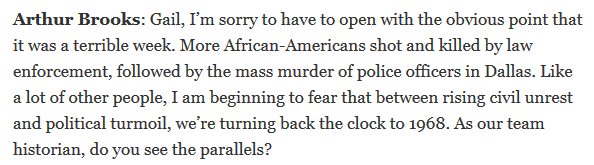
At The New York Times: Tweedledum and Tweedledee or Arthur C. Brooks & Gail Collins on 1968 Redux

Arthur C. Brooks has just awoken from a very long Neo-Liberal slumber to find the USA about to burst into political flame,1968 style. Although Mr. Brooks was born in 1964, this reader was there and witnessed it first hand! Mr. Brooks is also the author of the Conservative Heart, an unconvincing work of political fiction, which attempts to put a human face upon greed. Ayn Rand would have held his pandering to ‘altruism’ in utter contempt. He is a an inept propagandist. Here is opening statement, the as if being that somehow he ‘cares’ about African-American lives. The ‘Bottom Line’ for Neo-Liberals is profit before people e.g. Hayek, Mises, Friedman and their epigones at AEI.

ABrookson1968HystericsJuly122016

Mr. Brooks and his fellow Conservative Technocrats, at the American Enterprise Institute, are in fact hostile to the idea of Civil Rights, as the very notion puts the Market in last place, to the idea and practice of the primacy of civic republican virtue. Mr. Brooks assignment is the production of self-exculpatory propaganda. But here he soft pedals it in his  conversation with Gail Collins, ‘our team historian’. An homage to bourgeois political respectability is the New York Times reason d’etre. Ms. Collins never fails to be an unimaginative political bore as she prattles on.

Gail: Maybe it’s because I’m now on the other side of the generation gap, but despite the terrible moments in 1968, the situation in 1968 seemed more hopeful — the country was turning against the war in Vietnam, the civil rights movement had come of age and the women’s movement was blooming.

Now it feels as if we’re almost post-hope. I suppose it’s totally futile to mention guns. I’m sure you read the story in our paper about the 20 to 30 marchers in Dallas who were openly carrying assault-style rifles during the demonstration that ended with the shooting. Which is legal in Texas.

Populism now becomes Mr. Brooks focus:

Arthur: There was also a huge amount of distrust of public officials and a rise in political populism, both of which also look familiar these days. I want to get to that in a minute, but before we do, tell me — based on what we learned from 1968 — what our country and leaders need to do right now.

Mr. Brooks follows the political lead of The Economist and The Financial Times, and points the accusing finger at the dread Populism,of both Left and Right, as a political creature out of nowhere, rather that the product of the complete failure of a Neo-Liberalism, that Mr. Brooks and his army of political technocrats defend to this day.

Never fear, Mr. Brooks places himself in the same category as Thomas Friedman,dull witted apologist for a failed Utopianism: recall his infamous ‘suck on this’ comment uttered without shame, or even without challenge from the equally addled Charlie Rose?

Arthur: I definitely count Sanders as a populist, just a very left-wing one. Populism comes in many flavors, sort of like Ben & Jerry’s. Some people like Socialist Swirl. Others prefer Chocolate Chip Autarky.

No big shock that Trump is trolling for Sanders supporters because that takes strength directly from Clinton. And no shock Sanders is endorsing Clinton; she’s closer to his policy views and he can pull her closer to his. Although I imagine Sanders will enjoy stumping for Clinton about as much as he’d enjoy two scoops of asparagus ice cream.

Almost Marx


Posted in Uncategorized | Leave a comment

At The London Review of Books: Where are we now? Responses to the Referendum, some comments by Political Observer

The first to comment in this collection of small essays  on the Brexit Vote is David Runciman.It is a myopic political analysis filled with data and a special pleading for Proportional  Representation, that functions argumentatively as some kind of answer to the vexing question of these kinds of Referendums, if I am reading it with comprehension. It seems not quite relevant, except for the policy technocrat or even as just rhetorical ballast?

What seems to have  escaped the attention of Mr. Runciman is the starkest kind of object lesson, not lost on the British voter, of the treatment by Merkel and The European Central Bank of Greece. Now the fact that Germany was a four time defaulter in the 20th Century was the subject of a Financial Times essay by Gillian Tett:

Headline: A debt to history?

Sub-headline: To some, Germany faces a moral duty to help Greece, given the aid that it has previously enjoyed

http://www.ft.com/cms/s/0/927efd1e-9c32-11e4-b9f8-00144feabdc0.html

That the story of Greece remains outside Mr. Runciman’s  narrative is unsurprising. For those patient enough to read through this essay, here Mr. Runciman shows himself to be New Labour, without doubt:

What about Corbyn? I don’t believe that a different leader, fighting a more full-throated campaign, would have made much difference to the final outcome: most Labour voters went for Remain anyway and many of those who didn’t were sufficiently alienated to be resistant to all persuasion. Nevertheless, if Labour had had a different leader there’s a good chance we wouldn’t be in this mess. Yvette Cooper might have been no better at convincing people in Labour’s heartlands to turn out in support of an unloved and distant institution – she might well have been worse – but she would have been far better at convincing the Tory government to think a bit harder about the risks it was running in holding the referendum, including the risk of defeat at a subsequent general election…

Or this rather obtuse jab at Corbyn :’ It forced the entire Labour movement to line up behind a leader who was not competent to lead them.’

For an antidote to Mr. Runciman’s dry post-mortem read  Neal Ascherson’s essay, next in line, for a more historically informed and adroit, not to speak of tart, dismissal of both the Remain and the Leave camps, framed by this wonderfully vivid opening paragraph :

This is the third time the island has given notice to Europe. The first brief and bloody, the second powerful and long-lasting, the third stupid and calamitous. A Dutch marine officer in the Roman forces called M. Mausaeus Carausius tried it in 286. He proclaimed himself emperor, beat off imperial expeditions crossing the Channel and struck a great many silver and copper coins with his bearded face on them. Like the Leave campaigners, he told the Brits that together they would ‘take their country back’ (‘Restitutor Britanniae’). He had ‘Genius Britanniae’ stamped on his coins, along with quotes from Virgil. Carausius, seen by some romantic Victorians as the pioneer of British independence, didn’t last long. He was murdered by his chancellor of the exchequer, a certain Allectus, in 293. Soon afterwards, Britain was back in Roman Europe.

T.J. Clark

I voted Leave, without enthusiasm, mainly because I had promised to do so in Greece last July. What Dijsselbloem and Schäuble did to Greece back then seemed an indication of what the EU was truly for. It remains our best clue to how ‘Europe’ would act if a left government, of a nation less hopelessly enfeebled than post-Pasok Greece or post-Blair-and-Brown Britain, dared, say, to resist TTIP’s final promulgation of the neoliberal rule of law. Certainly the relevant point of comparison for the 17 million Leave votes is the No to ‘austerity’ registered by the Greeks, again in the face of all respectable opinion, a year ago. And everything will now be done, as then, to make sure the scandal of democratic refusal doesn’t get in the way of business. I have no doubt that already, behind the smokescreen of Article 50, Dijsselbloem and Schäuble’s intermediaries are sitting down with Carney and Osborne to settle the outlines of the no-but-on-the-other-hand-not-really.

Global capitalism, in other words, is inconvenienced by the verdict from the UK zones of sacrifice, and naively disdainful of it, but well equipped to cope with the casualties’ ingratitude. It will soldier on. The intelligentsia can be depended on to froth in its favour. Facebook, an American friend tells me, ‘has become an unbearable liberal wailing wall’. Conversations with young Southern European immigrants in London – one recently with a Bulgarian woman sticks in the mind – are a welcome reality check. They know all too well what the ‘free movement of labour’ means for people like them, and how much the discipline of the euro is responsible for driving them north. No lessons in the mechanics of wage suppression or Deutsche Bundesbank’s anti-Keynesianism are needed.

Political Observer

http://www.lrb.co.uk/v38/n14/on-brexit/where-are-we-now

https://www.patreon.com/StephenKMackSD


Posted in Uncategorized | Leave a comment