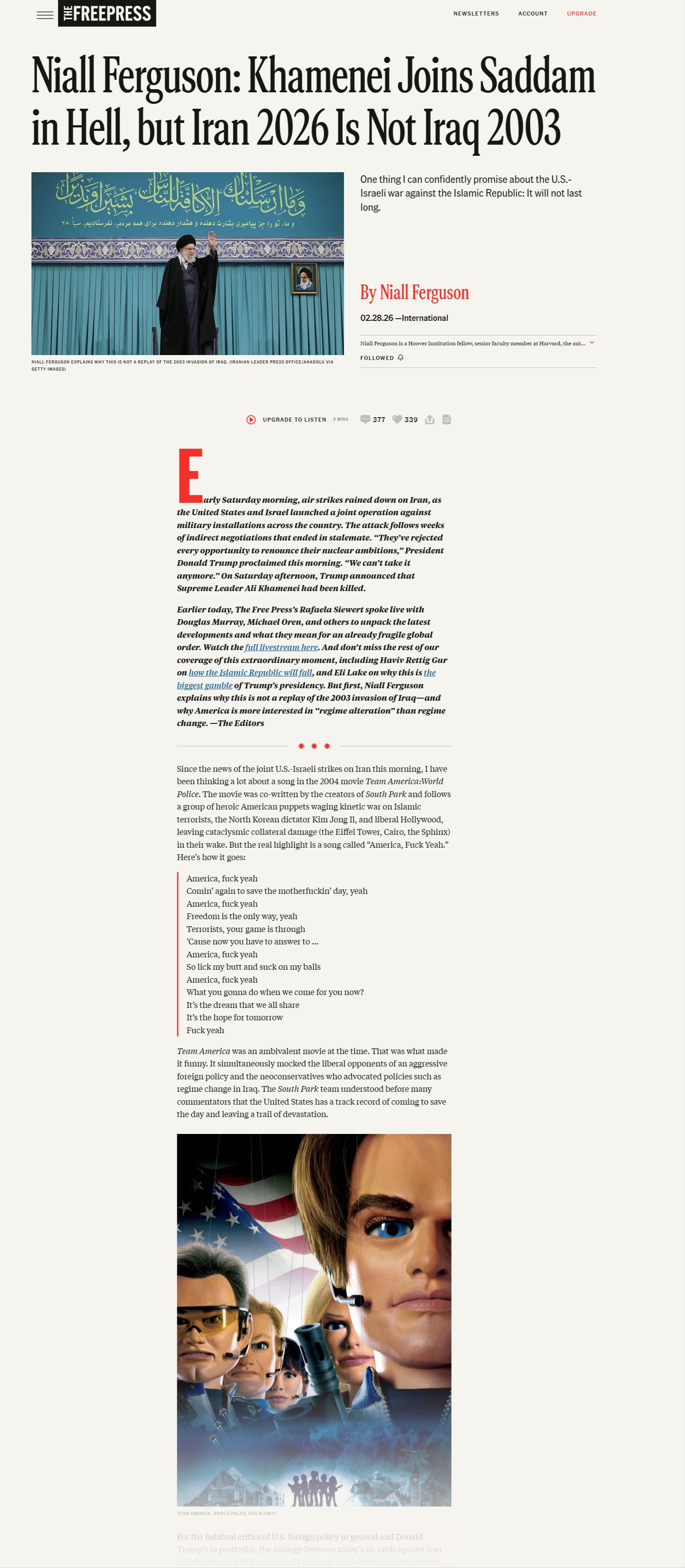
Editor: Mr. Fergusons latest fore into Pop Culture: compare and contrast with this collection of Fergusons commetaries that follow this The Free Press chatter! ‘South Park’ is the measure of an utterly re-imagined Ferguson? A collection of those highbrow commetaries will follow!
Newspaper Reader: A case of bad judgement or someting else? stephenkmacksd.com/ Mar 16, 2025 The historian Niall Ferguson has denied being an “gay-basher”, claiming that his friendship with the prominent homosexual blogger Andrew Sullivan showed that he could not be … Continue reading →
Political Observer comments. The regular reader of Mr. Niall Ferguson’s cumbersome , bloated historical panoramas, the word count in this instance is 2596 -The Straussian method is to drown the reader in verbiage, ideas, actors, as a strategy to make … Continue reading →
Political Observer comments. This discussion begins at the 01:20 point and ends before the 21:18 point. Katy Balls asks questions of her two guests Ferguson and Grey act the parts of Political Technocrats, relying on ‘Polling Data’ as a reliable source- … Continue reading →
In the May 7, 2021 edition of the the TLS, Charles King’s reviews Niall Ferguson’s new book ‘Doom: The politics of catastrophe’. Some revelatory excerpts: … At its best, Doom is a vade mecum to misery. Whatever readers are facing … Continue reading →
I woke up at 4:30 AM PST, this morning, and checked twitter for the latest Election News, not knowing what to expect, other than bad news. Now at the breakfast table, I’ve read first the Editorial Board of The Financial … Continue reading →
The reader can only wonder at Mr. Ferguson’s – what reads like nostalgia for George Deukmejian and Pete Wilson, of Prop 87? Oh! sorry he is just a late arrival to California, 2016, in its advanced state of ‘Decadence/Decay’ the … Continue reading →
I came here from The Financial Times. Just looking at Gideon Rachman’s latest essay, made me a bit queasy: Headline: India picks a side in the new cold war Sub-headline: It is folly for China to drive its rival into … Continue reading →
Perhaps this is one of the reasons that Mr. Ferguson left the august Times ? ‘He is the founder and managing director of Greenmantle LLC, a New York-based advisory firm.’ Mr. Ferguson is another peddler, with his vaunted ‘expertise’ like … Continue reading →
In his column of Sunday March 8, 2020, Niall Ferguson: Headline: Sleepy Joe Biden has given Donald Trump a wake-up call Sub-headline: Despite his senior moments, the comeback codger has a real shot I know Joe Biden. Not well, but … Continue reading →
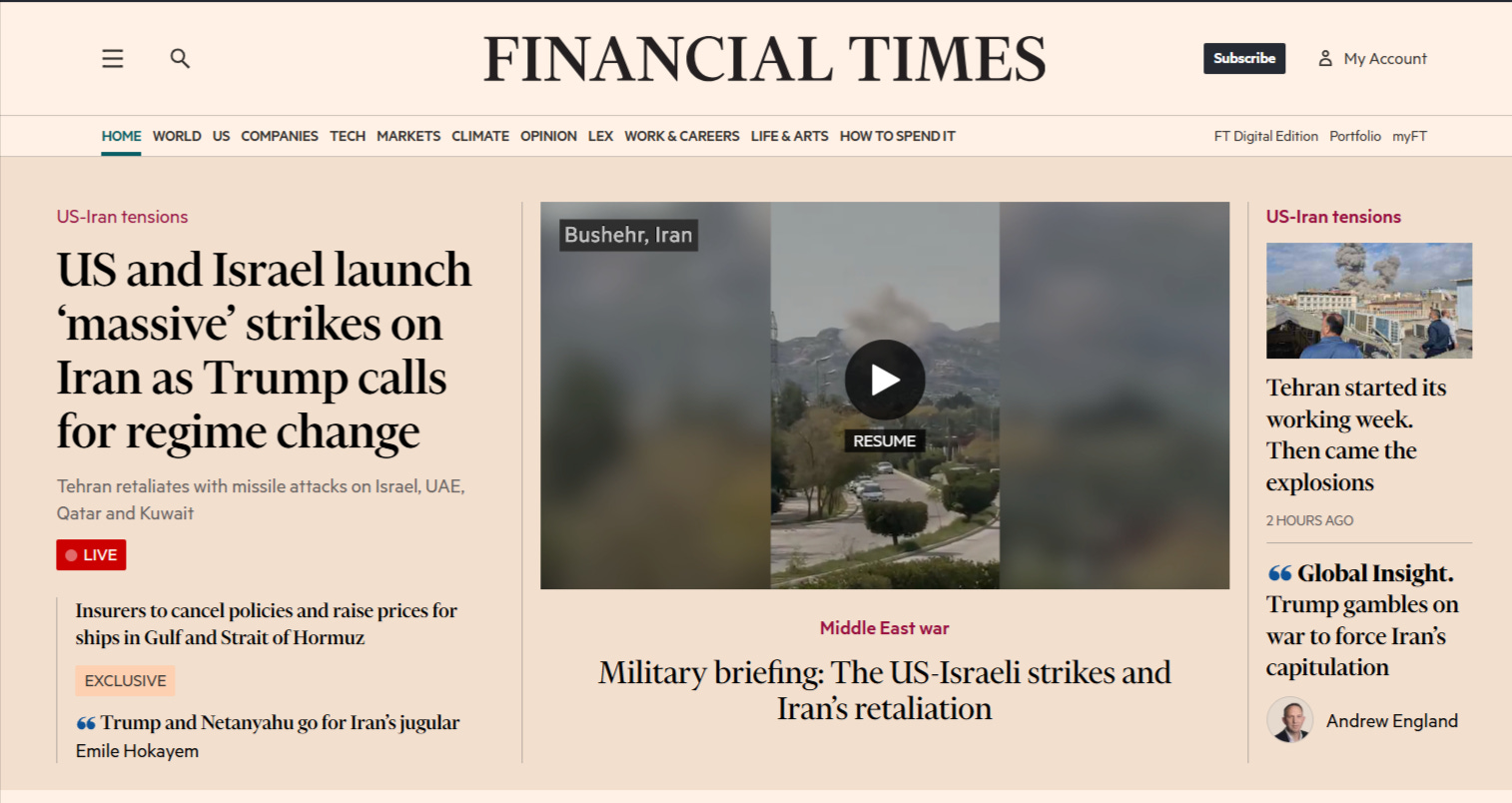
No wonder protests in Iran have resumed, this time among university students who are bravely undaunted by the terrifying risk. Their protests seem connected to the 40-day memorials for the victims of last month’s massacres. But it’s not a stretch to assume those protests are also a signal to Trump that his promise last month to Iranians that “help is on its way” hasn’t been forgotten, and that ordinary Iranians are prepared to join the fight for their own liberation.
If so, then there is at least a reasonable chance that a sustained military operation that not only further degrades the regime’s nuclear, missile and military capabilities — a desirable outcome in its own right — but also targets its apparatus of domestic repression could embolden the type of sustained mass protests that could finally bring the regime down. Even more so if the leaders who give the orders, including the supreme leader and his circle, are not immune from attack.
For all of its willfulness and the evil it has wreaked over 47 years, the regime does not stand 10 feet tall. It nearly fell during the 2009 Green Movement against that year’s fraudulent elections. It nearly fell again in 2022 during the Women, Life, Freedom protests.
The difference on those occasions was the absence of external military support. Donald Trump now has a unique opportunity to provide it. Despite the risk that military strikes entail, the bigger risk, in the judgment of history, would be to fail to take it.
Editor: Bret Stephens is a Zionist Loyalist, his time from 2002 to 2004, as editor-in-chief of The Jerusalem Post demostrates his political loyelties? Or can that be construed as an instance of ‘Anti-Semitism’ the fallback position of a political opportunist ? Yet with no experience of war, but an utter penchent for sending others to fight his chosen battles: The Neo-Consevative calling card is strewn with the blood of others!
The New Your Times of March 1, 2026, 6:00 a.m. ET:
A Tyrant Falls. Dangerous Uncertainty Begins.
Editor : The New York Times like it’s hireling Stephens relpay the Old Cold War platitudes that are replayed again and again: Vietnam, The Iraq War, The War in Afghanistan.
Ayatollah Ali Khamenei governed Iran with the vigilance and brutality of an autocrat convinced that his own people and the world’s superpower sought to unseat him — and in the end, they did. With President Trump’s announcement that Ayatollah Khamenei, the 86-year-old supreme leader, was killed in joint American and Israeli airstrikes on Saturday, his reign has come to a close, cementing a lost half-century for his nation. As the Middle East confronts an unpredictable void, let us be clear: No one should mourn the death of a dictator who spent decades inflicting misery and bloodshed.
Ascending to power in 1989, Ayatollah Khamenei organized his existence around an obsession with the West. As a ruler, he squelched dissent, labeling demands for reforms as Western “sedition,” and expanded the intelligence apparatus of the Islamic Revolutionary Guards Corps to repress his own people. He impoverished his citizens to bankroll foreign interventions and a nuclear program that brought Iran only isolation. When faced with citizens’ protests, he answered with force, including the slaughter of thousands earlier this year. Abroad, his legacy is one of destabilization, having constructed a so-called axis of resistance across Gaza, Iraq, Lebanon, Syria and Yemen.
Editor: The first paragraps of the NYT Opinion The Editorial Board
…
Editor: The final paragraps of this ‘Editorial’ again repeats the perenial tropes of American Hegemony/Imperiaism!
The president still has not offered an explanation for why this campaign will end any better than the 21st-century regime change efforts in Iraq and Afghanistan did. Those wars also toppled governments. Yet their disappointing, bloody legacies left Americans understandably skeptical of open-ended military operations.
Amid the chaos this strike will cause in Iran, Americans should brace for the possibility of retaliation. True, Iran has failed to exact almost any meaningful damage on the United States in recent years, and its military has been degraded. But it maintains an arsenal of missiles capable of overwhelming defense systems, and this weekend it hit a U.S. Navy base in Bahrain, among other targets in the region. Iran may also be capable of launching cyberattacks and proxy strikes against American forces and allies.
The bigger risks may lie in the future. The president of the United States has just helped assassinate a foreign leader without the approval of Congress, the support of most allies or a plan for the future. History suggests that unilateral American involvement along these lines often has consequences that are not immediately apparent. When American officials helped orchestrate the 1953 coup, they surely did not imagine that they were planting the seeds for the Middle East’s most radical anti-American government.
Managing the future in Iran will require thoughtfulness, attention and international cooperation. We urge Mr. Trump to work with Congress, but at this point we have little expectation that he will. Given this reality, Congress should play a leadership role; lawmakers from both parties are right to demand briefings and force a debate on war powers to ensure the president is constrained and held accountable.
Finally, the United States cannot navigate the uncertainty alone. The Trump administration, which has frequently treated our allies with scorn, should bring international partners into the fold, too. Confronting a post-Khamenei Iran requires strategic clarity and a global coalition, not isolated decision-making.
For decades, the Iranian people have sacrificed greatly for the prospect of a more open society. After enduring years of autocracy and international isolation, they deserve the opportunity to chart a freer, more stable future.
Editor: The reader must wonder at the inabilitiy of the these self-presented ‘experts’ who across time have caused more human suffering : Vietnam, The Iraq War, The War in Afghanistan. Yet wisdom wedded to self-congatulation is the vocabulary of political bankruptcy!
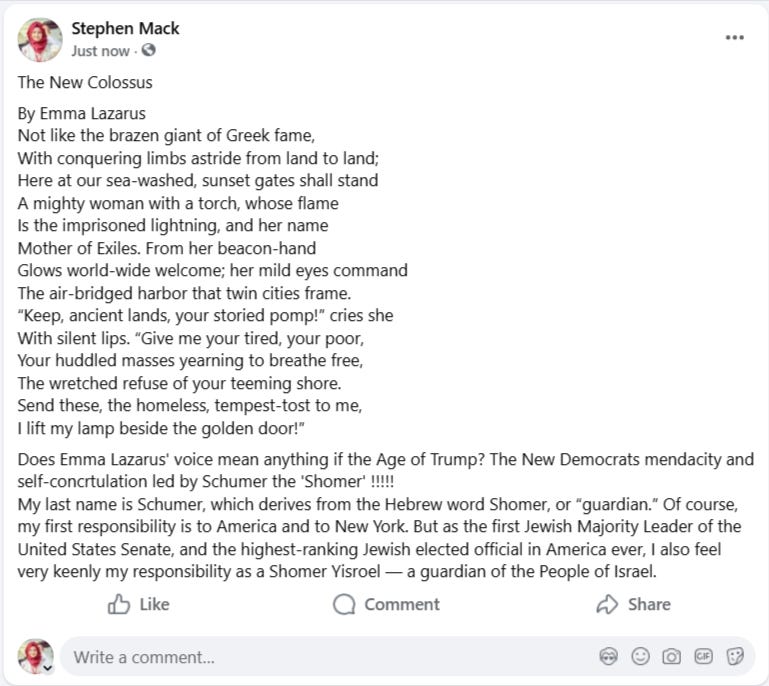
Does Emma Lazarus’ voice mean anything if the Age of Trump? The New Democrats mendacity and self-concratulation led by Schumer the ‘Shomer’ !
My last name is Schumer, which derives from the Hebrew word Shomer, or “guardian.” Of course, my first responsibility is to America and to New York. But as the first Jewish Majority Leader of the United States Senate, and the highest-ranking Jewish elected official in America ever, I also feel very keenly my responsibility as a Shomer Yisroel — a guardian of the People of Israel.
Hillary Clinton delivered a withering rebuke to a congressional committee investigating her supposed links to Jeffrey Epstein on Thursday, accusing its Republican members of embarking on a “fishing expedition” intended to cover up and deflect attention from the actions of Donald Trump.
In a furious opening statement, the former secretary of state suggested the event was “partisan political theatre” and “an insult to the American people” while repeating her insistence that she had never met Epstein, the disgraced financier and convicted sex trafficker who died in 2019.
“You have compelled me to testify, fully aware that I have no knowledge that would assist your investigation, in order to distract attention from President Trump’s actions and to cover them up despite legitimate calls for answers,” she said, according to remarks she shared during the closed-door testimony.
Clinton’s onslaught came on the first day of a session that will also include a deposition on Friday by her husband, Bill Clinton, the former US president. The hearing is being staged at an arts center near the couple’s home in Chappaqua in upstate New York.
The Clintons reluctantly agreed to appear in response to a subpoena from the committee’s Republican chair, James Comer, after being threatened with contempt of Congress charges.
In her opening statement, Clinton excoriated the proceedings as “designed to protect one political party and one public official, rather than to seek truth and justice for the victims and survivors”.
Referencing her own career campaigning against sex trafficking, she added: “If this committee is serious about learning the truth about Epstein’s trafficking crimes, it would not rely on press gaggles to get answers from our current president on his involvement; it would ask him directly under oath about the tens of thousands of times he shows up in the Epstein files.
“If the majority was serious, it would not waste time on fishing expeditions. There is too much that needs to be done. What is being held back? Who is being protected? And why the cover-up?”
The hearing was temporarily suspended at the request of Clinton’s legal team after a photo of her giving testimony was shared on social media. It was later reported that the picture, posted by the Maga influencer Benny Johnson, had been taken by Lauren Boebert, one of the committee’s Republican members. It is against the rules for witnesses or lawmakers to take pictures during closed-door congressional hearings. Democrats condemned the breach as “unacceptable”.
Clinton resumed her testimony to the House of Representatives’ oversight committee shortly afterwards.
Robert Garcia, the committee’s ranking Democrat, said that during the interruption, Clinton had called for the hearing to be opened to the media.
The Clintons have previously complained they are being singled out unfairly to distract public attention from Trump, who had a long friendship with Epstein before breaking with him. They wanted the testimony to be given in public, rather than released in later in video and accompanying transcripts, as is planned.
Speaking during an afternoon break in proceedings, Garcia said Hillary Clinton had answered every question and called for transcripts of her deposition to be released within 24 hours. “The American people have a right to know exactly what she said, what questions were asked of her and how she responded,” he said.
Bill Clinton is scheduled to give testimony under identical circumstances on Friday, as representatives investigate links with Epstein that he has acknowledged and which are confirmed in files released by the justice department under congressional mandate.
Committee members have travelled to Chappaqua for the proceedings after it was agreed that the Clintons would not have to testify on Capitol Hill. Written transcripts and video footage from the depositions are expected to be released in the coming days.
Addressing journalists outside the Chappaqua Performing Arts Center, where the Clinton hearings are being staged, Republicans and Democrats vied for control of the narrative surrounding the files.
Comer, the committee chair, accused the Clintons of trying to avoid a subpoena when other public figures – including Bill Barr and Alex Acosta, members of the first Trump administration – had responded willingly.
“The Clintons haven’t answered very many, if any, questions about their knowledge or involvement with Epstein and [Ghislaine] Maxwell,” Comer said. “Again, no one is accusing at this moment the Clintons of any wrongdoing. They’re going to have due process. But we have a lot of questions, and the purpose of the whole investigation is to try to understand many things about Epstein.”
Garcia told reporters that he supported Bill Clinton being asked to address the committee but said Democrats would now demand that Trump testify following disclosures that files relating to a woman alleging he had sexually assaulted her when she was a minor had been excluded from the documents released.
He said: “Let’s get President Trump in front of our committee to answer the questions that are being asked across this country, from survivors, from those have been brutally attacked and raped, sometimes as children.”
Hillary Clinton’s summons has prompted accusations that the depositions are a partisan exercise intended to deflect scrutiny of Trump’s long association with Epstein.
James Walkinshaw, a Virginia Democrat on the committee, said: “There is no indication – zero, zip, zilch, nada – that Secretary Clinton had any knowledge of Epstein’s crimes. My fear is we’re here today as part of a political exercise, part of a long running fever dream where Republicans want to lock up Secretary Clinton.”
Hillary Clinton has denied having met Epstein, although she has acknowledged meeting Maxwell several times.
Sidney Blumenthal, a longtime confidant of the Clintons and Guardian columnist, said: “The big tell in the partisan intent behind this event is that they have subpoenaed and threatened with criminal contempt Hillary Clinton, who has nothing to offer, who has never met Jeffrey Epstein or communicated with him.
“She knows absolutely nothing. So the fact that you would do that to her and bind her into this shows exactly what their motive is.”
Hillary Clinton testified for nine hours in 2015 to a House select committee investigating a deadly terrorist attack on a US diplomatic mission in Libya that killed the US ambassador and three other Americans while she was secretary of state. Her appearance was widely deemed to have neutralized Republican attacks and boosted her campaign for the Democratic presidential nomination.
“Hillary faced Trey Gowdy [a former Republican representative and the select committee chair] who, at the end of the day, looked ridiculous,” he said. “Trey Gowdy is an intellectual giant compared to James Comer.”
Bill Clinton provided two sworn testimonies in 1998 resulting from a Republican-driven independent counsel investigation.
One related to sexual harassment allegations brought by Paula Jones, a former Arkansas state employee. He also gave grand jury testimony over allegations that his testimony in the previous hearing about his relationship with Monica Lewinsky, a White House intern, amounted to perjury and obstruction of justice.
Bill Clinton has denied any wrongdoing and has called for all files relating to Epstein to be released. About 3m documents are believed to be still in the justice department’s possession, in violation of the terms of the Epstein Files Transparency Act.
Clinton acknowledges flying four times on Epstein’s private plan, nicknamed “the Lolita Express”, and appears in several photographs in the files, including one showing him and Epstein in a hot tub with a woman whose identity is redacted.
He says he cuts ties with Epstein in 2006 as the financier’s sexual crimes became known.
The Langs’ troubling friendship with Jeffrey Epstein
Former French culture minister Jack Lang and his daughter Caroline Lang appear thousands of times in the most recently released documents. All evidence suggests that she had a much closer relationship with the sex offender than she now admits.
On June 20, 1990, before dawn, Jack Lang arranged to meet his guestsat Le Bourget airport, just north of Paris. President François Mitterrand’s minister of culture had big plans to export the annual national music celebration he had created to the Soviet Union. His round trip to Moscow involved celebrities (Eddy Mitchell, Charlélie Couture, Alain Delon), a filmmaker tasked with capturing the event, and around 15 journalists. Out on the tarmac, the delegation discovered their aircraft: a private Boeing 727, fully fitted out with a lounge, bedroom and bathroom. The plane had been lent by a “friend,” answered Monique Lang, the minister’s wife, when asked about the mysterious owner’s identity. That “friend,” French diplomats whispered to the stunned guests, was Robert Maxwell.
The British media mogul and Lang had already known each other for several years. In 1987, the Socialist culture minister and the businessman, a former Labour MP in the House of Commons in London, even formed an alliance. At the height of the battle over the privatization of TF1 television station, undeterred by any mixing of business and politics, it was with Lang’s support that Maxwell and Francis Bouygues, head of the world’s largest construction group, managed to convince Mitterrand to choose them to buy France’s first television channel.
Maxwell also became a valuable patron for Lang. On July 18, 1989, they were side by side at the inauguration of the Grande Arche de la Défense, the giant monument aligned with the Arc de Triomphe. It was one of those celebrations that characterized the Lang years, complete with champagne and saxophonists dressed as astronauts. The British businessman had saved his friend’s colossal project by contributing 150 million francs (€42 million today).
The businessman also demonstrated his generosity by contributing 500,000 francs to fund events and commemorations related to the bicentennial of the French Revolution, notably for the digitization of period documents, affording himself the pleasure of attending all the Parisian ceremonies. Maxwell was, in fact, so close to Lang, who was also the mayor of Blois, in central France, that he owned a printworks in that city. In October 1989, he attended the Estates General of European Culture there at Lang’s invitation. Without even visiting his own printworks.
At the time, one of the minister’s two daughters, Caroline Lang, was 28 years old. After appearing in the films L’Argent (Money, 1983) by Robert Bresson and Chronicle of a Death Foretold (1986) by Francesco Rosi, she studied to obtain a doctorate in public law. And, for her first foray into professional life, she was hired by none other than Maxwell Communications in London. As always with the Lang family, blurring the lines was the rule, with private interests and public service, family and ministry all intertwined. At Jack Lang’s own office, Monique, in everyone’s eyes, acted as the head of communications, welcoming all the important artists on behalf of her husband.
…
In Epstein’s “little black book” – his address book, which the FBI seized as early as 2009 while investigating his embezzlement and sexual abuse of minors in Florida – Caroline Lang’s name is already there: three phone numbers and a New York address, apartment 9C at 400 East 52nd Street, in the heart of Manhattan. Had the daughter of the former Socialist minister already been noticed, as early as the 2000s or even before, by this businessman determined to spin his web around the world? Very few French nationals appeared in this directory that contained some 1,700 names. When contacted by Le Monde, Caroline Lang declined to comment.
Wildly close-knit clan
Since January 30 and the publication of the Epstein files, the documents have cast a raw light on the connection binding the Lang family, particularly Caroline, to Epstein. Their extensive correspondence, which lasted seven years, from 2012 until the sex offender’s arrest in 2019, reveals an intimate and troubling relationship.
Records show that on March 24, 2012, the American hosted a dinner in Paris attended by Caroline Lang, along with filmmaker Woody Allen and his spouse, Soon-Yi Previn, and US Ambassador Charles Rivkin and his wife. Epstein, who had been convicted four years earlier of soliciting prostitution of a minor, took care to keep paparazzi at bay, even as he returned to Parisian high society and rebuilt his extraordinary network. The following day, Jack Lang’s daughter thankedhim by email for inviting her to his table. On March 26, she visited his luxurious Paris apartment at 22 Avenue Foch in the 16th arrondissement. Welcomed by the butler, she spent some time with the American, discussing Japanese literature and Vladimir Nabokov, the writer whose most famous novel, Lolita (1955), is also the confession of a sexual predator about the relationship he had with a 12-year-old girl.
This apparent nonchalance of the Lang family, pampered by their American friend, never seemed to be shaken. But it did not reflect Epstein’s true situation. For several months, the FBI had been on his trail. On November 28, 2018, the Miami Herald published an in-depth investigation titled “How a future Trump Cabinet member gave a serial sex abuser the deal of a lifetime.” The “serial sex abuser” in question was Epstein. The Trump administration official mentioned by the Florida daily was Alexander Acosta, the very man who, 10 years earlier, had accepted a secret deal with the millionaire to reduce his sentence to 18 months in prison in exchange for his guilty plea to soliciting prostitution from a minor, at a time when the FBI had identified 33 victims. This time, the journalist behind the investigation found around 80 women claiming to have been sexually assaulted and raped by the businessman between 2001 and 2006, when they were between 13 and 16 years old.
Did Caroline Lang hear about this article published on the other side of the Atlantic? In any case, she knew that her friend was accused of “international sex trafficking” and of “sex orgies” with a very large number of young women, some of whom were minors at the time. On March 4, 2019, Epstein himself sent her the letter to the editor his own lawyers had just published in The New York Times, in response to the Miami Herald investigation and the inquiries now being conducted by the largest American daily newspaper. Caroline Lang replied to thank him.
Fifteen days later, however, she invited him, as usual, to a family lunch on Place des Vosges. “Perfect, as usual, I will be on time,” Epstein replied with delight. She also invited him to a contemporary interpretation of Swan Lake at the Théâtre National de Chaillot with her parents on March 30, 2019.
The next day, Epstein told her in an email that Jack Lang had a “proposal” for him. Through Caroline, a meeting was arranged between the two men at the café Ma Bourgogne, Place des Vosges, to discuss it. It is not known what idea Jack Lang had for his American friend. However, his daughter Caroline would be among the last French people to see Epstein, who was arrested by the FBI on July 6, 2019, as he returned from Paris aboard his private jet. On August 8, 48 hours before he was found dead in his prison cell, the convicted sex offender included her in his will, leaving her $5 million (€4.2 million).
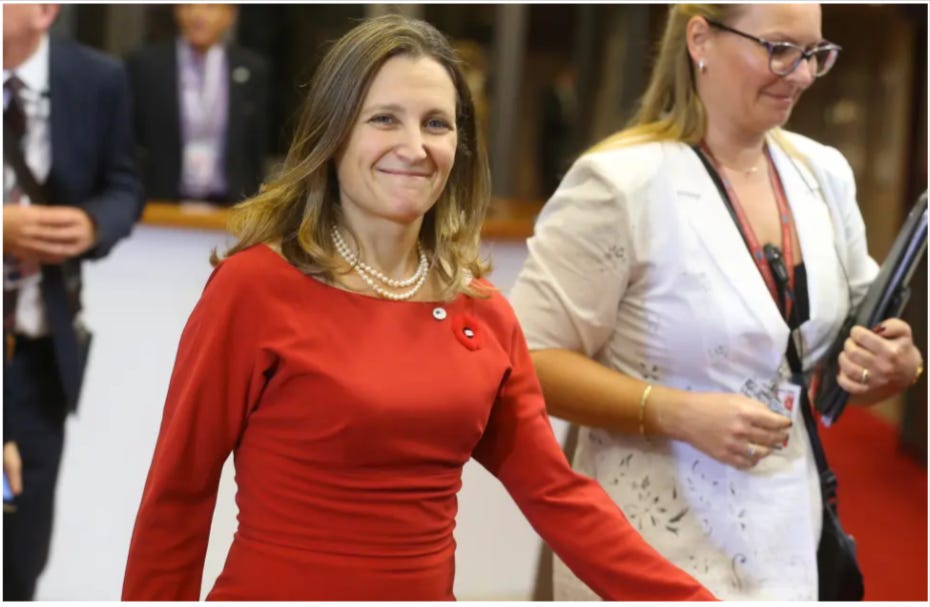
Chrystia Freeland, the newly appointed Foreign Minister of Canada. Nicolas Maeterlinck/AFP/Getty Images
When asked at a press conference on March 6 about the allegations that her maternal grandfather was a Nazi collaborator, Chrystia Freeland, newly appointed Foreign Minister of Canada, former journalist and a writer, a master of words, found only clumsy sentences to deliver what would have earned no more than a ‘C’ in a high school debate class.
“It’s no secret that Russians do not like you and banned you from the country,” began the question. “Recently, there has been a series of articles in pro-Russian websites about you and your maternal grandparents, making accusations that [your grandfather] was a Nazi collaborator. I’d like to get your view—is this a disinformation campaign by the Russians to try to smear you and discredit you, which they have a tendency to do?”
With a poorly-camouflaged expression of pain on her face, Freeland replied:
“It’s public knowledge that there have been efforts—as U.S. intelligence sources have said—by Russia to destabilize the U.S. political system. I think that Canadians and indeed other Western countries should be prepared for similar efforts to be directed at us. I am confident in our country’s democracy and I am confident that we can stand up to and see through those efforts.”
“I don’t think it’s a secret,” she continued, “American officials have publicly said—and even [German Chancellor] Angela Merkel has publicly said—that there were efforts on the Russian side to destabilize Western democracies, and I think it shouldn’t come as a surprise if these same efforts were used against Canada. I think that Canadians and indeed other Western countries should be prepared for similar efforts to be directed at them.”
What? Angela Merkel? Was her grandfather a Nazi collaborator or wasn’t he? Freeland dodged the question.
As The Globe and Mail reported, when asked to refute the allegation, her office responded: “People should be questioning where this information comes from, and the motivations behind it.”
While the story created a storm of Canadian press, apart from The Washington Post and Bloomberg, U.S. media shied away.
Freeland, a former Canadian journalist of Ukrainian descent, has authored two books on corrupt Russian oligarchs—surely, her books on the Ukrainian oligarchs who flushed her beloved Ukraine down the toilet are on the way. She speaks Russian fluently, and understands Russian culture—including Russian politics. So, she certainly could have mustered a better answer to shrug off the uncomfortable questions about rumors of her grandfather’s collaboration with the Nazi regime in WWII Poland.
This meme, shorter and better seasoned than her actual response, would have worked: “You are Sourkovskaya propaganda!”
The term, overwhelmingly popular in Russian political newspeak, has origins in the name of Mr. Vladislav Sourkov, Vladimir Putin’s personal advisor and at one point a major Kremlin ideologist. It means “Sourkov’s propaganda,” of course, and first surfaced in 2011, when journalists from a pro-Kremlin television network tried to break into the office of opposition NGOs, demanding an interview from its representative.
Fighting off the aggressive guests armed with microphones and cameras, the opposition employee gave only one explanation for his refusal to be interviewed.
“You are Sourkovskaya propaganda!” he said more than 80 times in a five-minutes span.
“You are Sourkovskaya propaganda” is the pathetic last line of defense for righteous politicians against the evil reality of stubborn questions that will not evaporate.
But first: Is it such big news that politicians of the Canadian Foreign Minister’s level have relatives that collaborated with Nazis during WWII?
Recent history is replete with examples of world leaders with similar skeletons from their relatives’ Nazi or Soviet past.
Former Estonian Foreign Minister Marina Kaljurand, despite strong electoral support, dropped out of last year’s presidential race when it was revealed that her father, during the WWII, fought on the side of Nazis in the 19th Latvian SS Division. He had a rank of SS Untersturmfuhrer and received two Iron Crosses from Nazi military authorities.
Kaljurand said she never knew her father—and never said she was proud of him.
Russian media revealed that the father of Olexandr Turchynov—former Prime Minister of Ukraine, former Acting President of Ukraine and current head of the Council of National Security of Ukraine—was a member of the Nazi punitive auxiliary police battalion, responsible for annihilating a number of villages in Russia. After the war, Turchinov’s father was sentenced to 25 years of hard labor in Siberia, but in 1955, just five years later, was released during Khrushchev’s thaw.
Ukraine ignored the news and Turchynov never responded to this example of Sourkovskaya propaganda.
Lithuanian President Dalia Grybauskaitė had insisted her father, Polikarpas Grybauskaitė, was a firefighter after the war when, in fact, he served Stalin’s dreaded NKVD—which is nothing to be proud about in Lithuania.
In 2014, when a book on Grybauskaitė’s past came out—sealing her nickname Red Dalia—her subordinates called it an “informational attack against Lithuania by the people connected to Kremlin.”
The revelation of Grybauskaitė’s father’s work for NKVD, Stalin’s dreaded secret service, didn’t lead to impeachment because the notion of Sourkovskaya propaganda had been introduced by that time.
Parents and grandparents—not children—should be responsible for these crimes. But, more often than not, they get away with them.
Kurt Waldheim, oberleutnant of the Nazi Wehrmaht, bearer of the Iron Cross, became President of Austria and the fourth General Secretary of the UN. All of his life he lied about his role in WWII, later admitting he “made mistakes” and asking for forgiveness in his posthumous latter.
At 79, after hiding his secret for all of his life, German novelist and Nobel Prize Laureate Gunter Grass admitted that at the age of 17 he joined Waffen SS and was a member of the Nazi party during the war. This fact “oppressed” him, he said, the “disgrace” later became “a burden.” The revelation ended “Grass’s moral authority” in Germany and around the world.
Pope Benedict Xvi had to resign—the first Pope to do so since 1415! A lot of people in his flock could not forget that, in his youth, Joseph Aloisius Ratzinger was a member of Hitler Jugend and wore a Wehrmaht uniform during the war.
Lech Wałęsa, ex-President of Poland and leader of the Solidarity movement—another Nobel Prize Laureate—vehemently denies he was a KGB agent with the operative nickname ‘Bolek,’ though recently-discovered documents state otherwise.
The list goes on.
Michael Chomiak, grandfather of Canadian Foreign Minister Chrystia Freeland, was no a Gunter Grass—though he had a direct relation to publishing.
Born Mykhailo Chomiak, he fled his Polish hometown of Lviv for another Polish town, Cracow, in 1939—right before Stalin’s annexation of this part of the country. His granddaughter claims he was smart enough to foresee what Stalin’s regime would do in his motherland Ukraine.
To make a long story short, Chomiak preferred Hitler’s regime to Stalin’s.
But does that make him a Nazi collaborator, or is this all a bunch of Sourkovskaya propaganda?
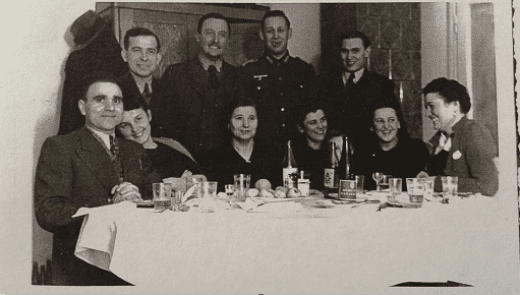
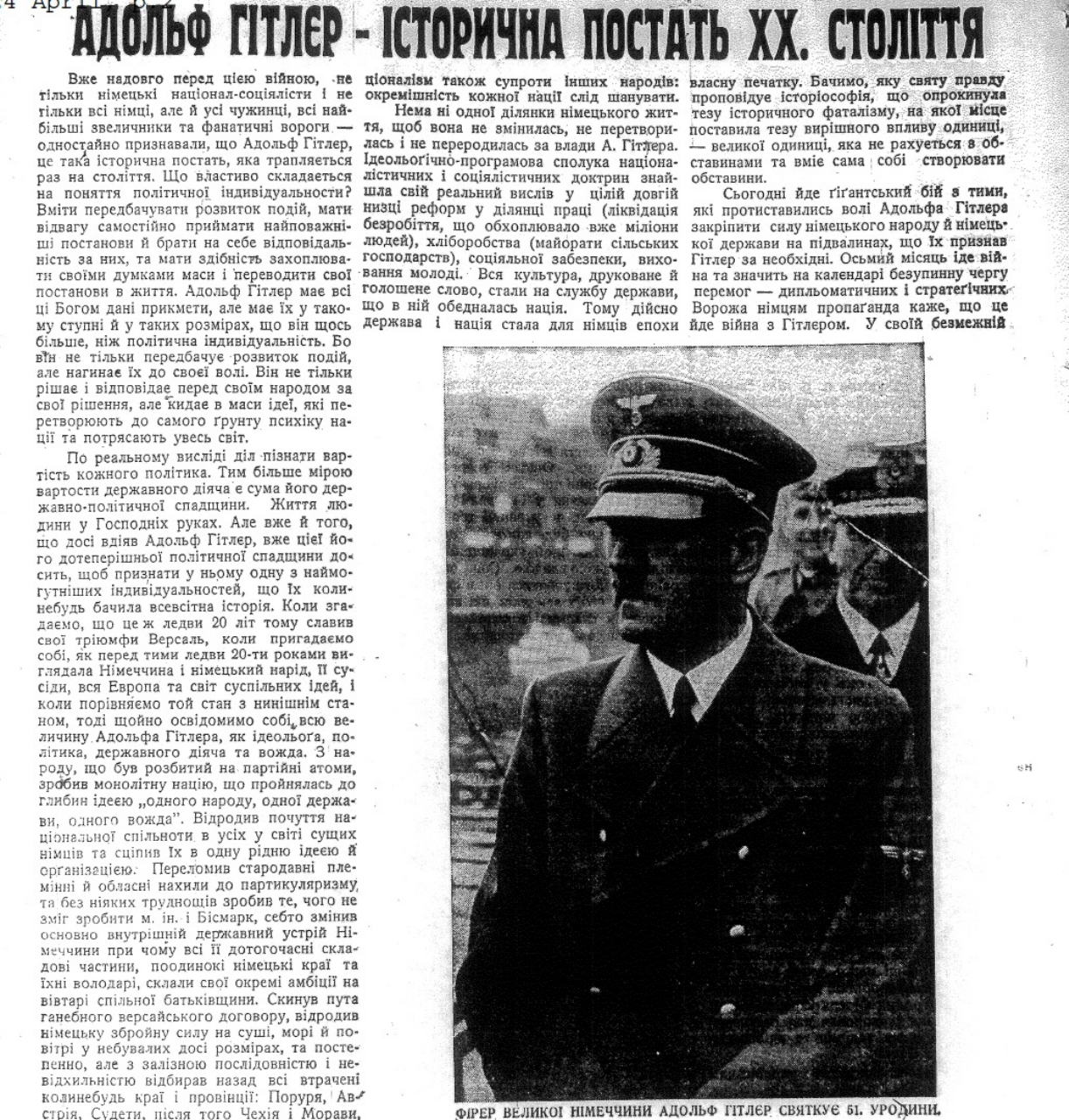
Here’s a fact: after Hitler ‘reunited’ Poland in the beginning of WWII, Chomiak chose not to return to his beloved Lviv which he missed so much, but to remain in Cracow. There, from 1940 to 1944, he served as editor-in-chief of the Ukrainian Nazi newspaper, under the command of Hans Frank (Governor-General of Poland, Nazi lawyer, executed at the Nuremberg Trials). Chomiak’s direct supervisor was none other than Emil Gassner, head of the press department in Nazi-occupied Poland.
During WWII, in occupied Poland, the Nazis entrusted Chomiak with this position, editing Krakivski Visti (Cracow News). His office and printing presses had been taken from the Jewish owners of the Nowy Dziennik newspaper, who were sent to the extermination camps.
It was a lot of work for Chomiak, but he didn’t have to start from scratch—thanks to the confiscated (Jewish) resources. In the beginning of 1940, the newspaper printed just two issues a week, increasing later to three, and then, after much organizational effort on Chomiak’s part, became a daily.
His Nazi bosses settled Chomiak comfortably in an apartment in Crakow that had been “freed” from its previous Jewish owners.
Krakivski Visti spread Nazi propaganda for five years, praising Adolf Hitler and Governor-General Hans Frank on behalf of the “Ukrainian people,” and spitting venom against Jews, Poles and Russians.
“With the great joy, the Ukrainian population welcomes the establishment of just German order, the representative of which they have found in you, dear Mr. General Governor,” wrote Krakivski Visti on November 1, 1940. “This happiness has been expressed by Ukrainian people not only with flowers that German soldiers that entered our region were covered with, but also with the sacrifices with blood that the fight against Polish usurpers demands.” Ukrainians were ready for a “happy cooperation” with the Nazis, the newspaper claimed—happy to help with the “establishment of plans of the new order in Europe,” Mykhailo Chomiak’s newspaper printed.
In 1943 and 1944, Krakivski Visti hailed the formation of the 14th Waffen SS Division Halychyna, composed of Ukrainian volunteers, fighting against partisans and annihilating civilians.
Krakivski Visti welcomed the “German bombs falling on London that created a lot of heavy house fires.” The “bombing of industrial plants in Birmingham, Coventry, the port of Liverpool was good,” it reported with enthusiasm.
Editor-in-chief Chomiak undoubtably approved of the Nazi’s campaign to exterminate the Jews. According to The Globe and Mail, Prof. Himka, a relative of Freeland, “acknowledged that Mr. Chomiak was a Nazi collaborator,” although he pointed out that “the Germans made the editorial decisions to run anti-Semitic articles and other Nazi propaganda.”
After a mass shooting of Jews in Kiev at Babi Yar, Krakivski Vesti wrote that the city was better without the Jews. “There is not a single one left in Kiev today, while there were 350,000 under the Bolsheviks,” the newspaper reported with satisfaction. The Jews “got their comeuppance.” Without Jews, Kiev became “beautiful, glorious.”
Editorials described Poland as “infected by the Jews.” All in, about 25 percent of the newspaper’s content was devoted to Nazi propaganda—anti-Semitic, but also anti-Polish and anti-Russian.
In Canadian newspapers, some supporters of Freeland and her grandfather—especially those of Ukrainian descent—paid attention to the fact that Mykhailo Chomiak never personally signed any story published by the Krakivski Visti. But if he was smart enough to foresee the consequences of Stalin’s occupation of Lviv when he ran to Nazi-occupied Cracow, he was smart enough not to sign any story in his paper. Foreseeing his next possible run—out of Cracow—Chomiak wouldn’t have wanted to risk, one day, being held accountable for them.
There is no doubt Chomiak was very good at what he did for the Nazis in Krakivski Visti—otherwise, why would he be taken to Vienna, together with his family, in 1944 with the retreating Nazi army? German recourses were scarce—and they spent them on Chomiak.
He did not stay in Cracow to join Polish resistance.
In Vienna, he continued to publish the newspaper.
From Vienna, with the help of his retreating Nazi bosses, he resettled in Bavaria.
For the third time, he chose Hitler over Stalin.
And, by that point, wasn’t Stalin an ally of the United States?
It was in Bavaria that Chomiak surrendered to Americans and, three years later, immigrated to Canada to reunite with his sister. The “quiet Canadian” never told his relatives about his work for Nazis. The truth came out only after his death in 1984, when his private papers were found in the attic of his house.
“Foreign Affairs Minister Chrystia Freeland knew for more than two decades that her maternal Ukrainian grandfather was the chief editor of a Nazi newspaper in occupied Poland that vilified Jews during the Second World War,” The Globe and Mailreported.
Some say Chomiak’s past has nothing to do with Freeland and the whole thing was blood libel orchestrated by Russians.
But, having known for more than 20 years about her grandfather’s past, why has Freeland been portraying him as a victim of both Stalin and Hitler?
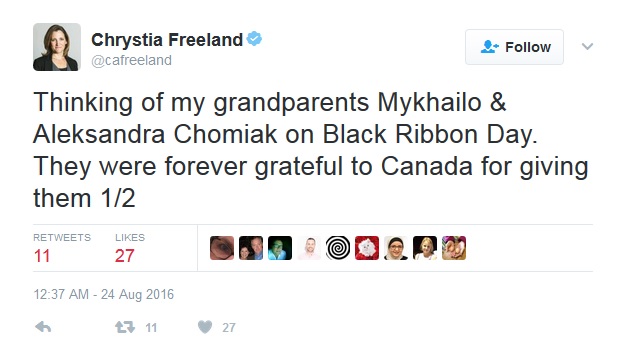
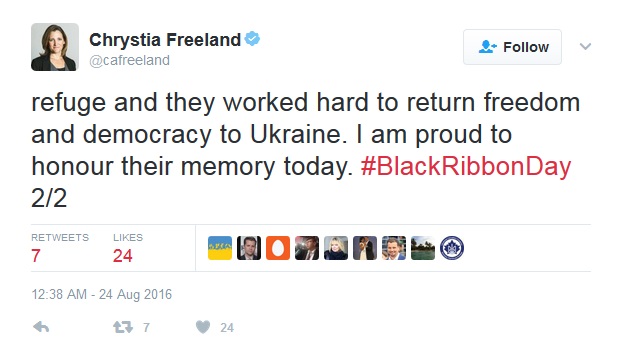
On 24 of August, 2016, a day after Black Ribbon Day, commemorating victims of both Stalinism and Nazism, Freeland Tweeted the following: “Thinking of my grandparents Mykhailo & Aleksandra Chomiak on Black Ribbon Day. They were forever grateful to Canada for giving them refuge and they worked hard to return freedom and democracy to Ukraine. I am proud to honour their memory today.”
Unlike Gunter Grass, Mykhailo Chomiak never apologized for his collaboration with the Nazis.
And his granddaughter, the Canadian Foreign Minister, should not be doing it for him. Rather, she must make two things clear: On what grounds does she consider him to be a victim of Nazis and Stalin? And what part of his past is she so proud to honor?
As far as Kremlin Sourkovskaya propaganda is concerned, yes—a number of Russian media outlets republished The Washington Post story following Freeland’s ill-fated press-conference. Otherwise, there has been deafening silence…
This is most likely because Russians are now busy digging into their NKVD-KGB archives, hoping to find a dusty Nazi party card inscribed with the name Mykhailo Chomiak.



 StephenKMackSD's Blog