The opening of Edward Carr essay relies on History
N JUNE 10TH 2026 the fighting between Russia and Ukraine will have lasted longer than the first world war. That conflict, too, was supposed to have been over in a few weeks. As in Ukraine, fighting became bogged down and the high command squandered men’s lives in one doomed assault after another. In August 1918 the allies used new tactics to break the German lines. Today, by contrast, Ukraine will not surrender and Russia does not know how to win.
Even in a dictatorship, a leader who has no theory of victory is storing up trouble. As Tsar Nicholas II learnt to his cost in the first world war, sooner or later there will be a reckoning.
Editor : Should I check my copy of August 1914 THE RED WHEEL 1? Though I am moored on page 573 ‘66’ ? I’ll quote Mr.Carr’s paragraph on the Russian casualties without acompaning data about the five Russian soldiers are dying for every Ukrainian.
The numbers tell this terrible story. In the year to mid-October, Russian casualties grew by almost 60%, to somewhere between 984,000 and 1,438,000. The dead now number between 190,000 and 480,000. Perhaps five Russian soldiers are dying for every Ukrainian. And yet over the summer Mr Putin’s armies failed to take a single large city. Russia is advancing, but to occupy the four oblasts it claims as its own would require five more years. If the killing continues at 2025’s rate, total Russian casualties will reach almost 4m.
Editor: Mr. Carr is a Neo-Conservative like Zanny Menton Beddoes, his editor:
…
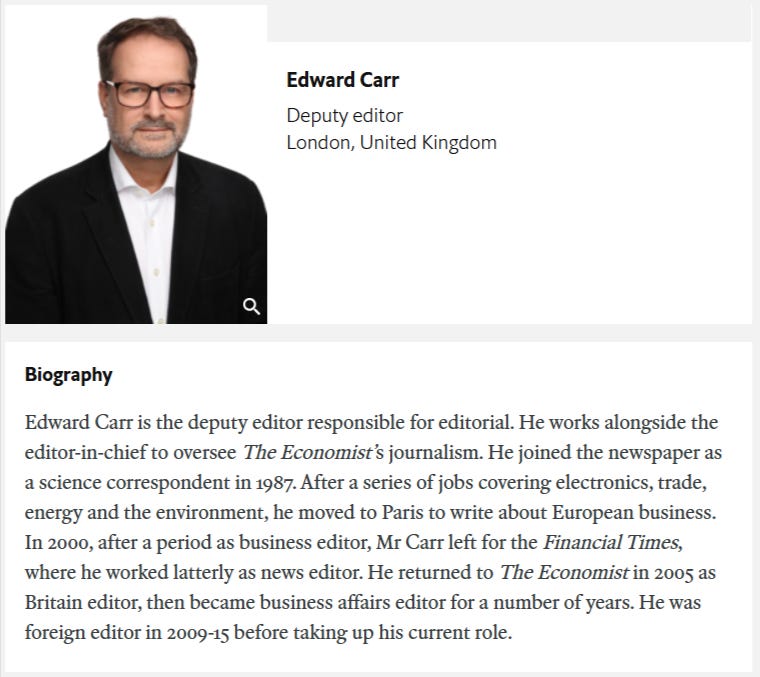
Edward Carr is a highly-respected writer and commentator on global strategic affairs and business and is based in London with the leading weekly international newspaper, The Economist. He currently provides the editorial leadership for The Economist on international affairs, and is uniquely placed to relate these topics to reflect the implications for international business – he has the wealth of experience of previously being Foreign Editor, Business Affairs Editor (covering science, technology, industry and finance and various other portfolios. He was also previously the Editorial Director with oversight of the quarterly magazine Intelligent Life, published by The Economist Group.
Edward speaks and moderates on a wide range of issues including international strategic affairs, business, industry and trade as well as energy, climate change and the environment.
He has carried out numerous live and recorded radio and television appearances over the years and is occasionally invited to co-host CNBC’s Squawk Box, once hosting with guests Jack Welch and Charles Elson featuring a discussion about executive pay. He regularly chairs seminars and debates for Economist Conferences and other top level events.
He also engages in client events, where he presents or moderates at customer forums – e.g. McKinsey Global Leadership Conference, or for organisations’ internal strategy sessions.
As Deputy Editor of The Economist, has editorial responsibility across the entire print side of the newspaper. During his journalist career, which saw him first join The Economist as science correspondent in 1987 and then go to Paris to write on European business, he briefly left The Economist in 2000 to write for the Financial Times where he worked as foreign news editor, and then as the news editor overseeing the front page and the newspaper’s news operation.
Edward studied Science at Cambridge University, winning The Bronowski Prize for his work on 18th Century French Chemistry.
…
Mr Putin also had hopes that America’s president, Donald Trump, would tip the balance in his favour. By withdrawing vital American support—in particular, on intelligence and for air-defence—Mr Trump could indeed impose a bad peace on Ukraine. Early in 2025, he briefly tried to do so.
Yet those tactics no longer look likely. The peacemaker in the White House continues to blow hot and cold with Ukraine’s president, Volodymyr Zelensky, whom he dislikes. But Europe is now paying Ukraine’s bills, neutralising MAGA’s main gripe that America was being exploited. And Mr Trump seems to have concluded that throwing Ukraine to the bears would ruin his aspiration to become a Nobel prize-winning statesman. In October he even imposed sanctions on Lukoil and Rosneft, two Russian oil companies.
Lastly, Mr Putin may hope European resolve will crumble. The money Ukraine needs to keep on fighting will run out in February. The prospect of populist governments that are less hostile to the Kremlin already hangs over the continent. A divided and dysfunctional Europe will struggle to give Ukraine the long-term backing it needs to thrive once the fighting stops.
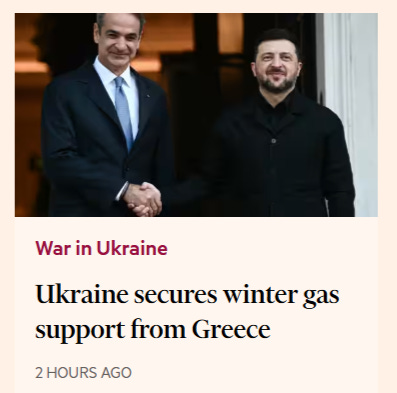
But that is not the same as abandoning Ukraine in the heat of battle. The case that Ukraine is the key to European security is iron-clad. If Kyiv falls, Mr Putin will have control over Europe’s biggest army and a formidable arms industry. Work is afoot to set up a credible multi-year financing mechanism that goes beyond seizing Russian assets. If it succeeds, Mr Putin will know that Ukraine’s economy can outlast Russia’s.
Some people think the Russian president must believe time is on his side, or he would have already sued for peace. Yet the lesson of Vietnam, Afghanistan and Iraq is that leaders cling on in the hope that something—anything—will turn up. So the chances are that Mr Putin will continue to fight in 2026, waiting for his generals to find a new way of waging war, for Ukraine to run out of men, for Mr Zelensky’s government to collapse, or for Mr Trump or Europe to lose patience.
But if none of these things happen, Mr Putin will be storing up a terrible reckoning. Russia has mortgaged its economy, harried Finland and Sweden into joining NATO, subordinated itself to China and scythed through a generation of young men. And for what? The moment this question forms on Russian lips, the world will face a new danger. Mr Putin could accept defeat abroad and impose terror at home. Or he could escalate.
…
Editor: The reader has to wonder at this Call To Arms in The Economist?
Why funding Ukraine is a giant opportunity for Europe
The bill will be huge. It is also a historic bargain
Political Observer marvels at the ever bumptious Neo-Con Zanny Menton Beddoes, who has never fought in a War. Ernst Jünger’s Storm of Steel (1920) provides a fractured but usable model?
…
Editor: Beddoes and her minions have refined the call to battle, as a necessay imperative for Europe. The very thought of an Oxbridger, or its equiveilent, serving in any Army, offers a certain puerile potential? ‘Europe’ seems to have reached an Age of Fracture: Macrons wayward politics is the paradigm?
Question: What will Macron, Merz, Starmer and Ursula von der Leyen do in the face of the coming defeat? Not to speak of the Billions spent on proping up Zelenskyy, and the political toxin of the Azov Battalion and Azov International?
In 1984, homelessness became a presidential campaign issue. In a televised interview aired in January of that year, a reporter asked President Reagan about criticism that his policies favored the rich. He responded by referring to “the people who are sleeping on the grates, the homeless who are homeless, you might say, by choice.”10(italics added) Meanwhile, mayors and governors reported that homelessness was surging around the country even as economic indicators pointed to a strong recovery from the 1981 recession.88(pA3) This situation provided an opportunity for the Democrats to strike the president at a vulnerable spot. In January 1984, the Democratic-led House Committee on Government Operations began a series of hearings on the federal response to homelessness, some of which were held at Washington, DC, homeless shelters. Many Democrats seized the opportunity to highlight the administration’s inattention to the issue.14
In reaction to these moves, the Reagan administration publicly questioned the need for any federal response to homelessness, even the one that had already been launched. In October 1983, HHS had established the Federal Interagency Task Force on Food and Shelter for the Homeless to coordinate its efforts in this area with those of 14 other agencies. The Federal Emergency Management Agency (FEMA), which had been assigned to coordinate the emergency food and shelter program with the United Way and other voluntary groups, along with the Department of Defense, ADAMHA, and other agencies, participated actively in the project.14(pp1-2)Although the HHS task force programs used existing budgetary resources and relied on private organizations to distribute surplus government material, John A. Svahn, the commissioner of Social Security who had earlier defended the administration’s inaction on homelessness in his reply to a constituent, reportedly expressed concern that HHS was “hyping” the homelessness issue in organizing the task force.89 In a February 23 memo echoing Svahn’s concerns, presidential aide Donald Clarey underlined the administration’s view that homelessness was the fault of negligent states and individuals:
The whole question of the homeless, in my opinion, should be addressed from a different angle, namely, that well over 50 percent of these people are released mental patients and victims of terrible neglect by states (New York is by far the worst). Most of the others are alcoholics and drug abusers. Very few are there as a result of unemployment alone. These states have found it expedient to let them roam the streets with no supervision or support mechanisms because it is cheaper to put them on SSI (federal disability benefits). Most of the people who sleep on grates are eligible for SSI but probably don’t want to participate.90,91
This memo, along with President Reagan’s comment about homelessness “by choice,” reflected the long-standing tendency to blame individuals for homelessness that had permeated social science and popular opinion from the days of tramps and hobos through the era of urban renewal. This deep-rooted belief, together with the assumption that closing the state hospitals had caused contemporary homelessness among people with mental illness, served to justify the administration’s inaction on the issue.
In April 1984, President Reagan seemed to depart from this stance by holding a meeting with an administration official to discuss homelessness.92,93(p23),94(pA23) In this meeting, with HHS Secretary Margaret Heckler, he requested that she prepare a report for him on the subject.92 In mid-August, Heckler delivered the report, which suggested addressing homelessness through public and private partnerships and better coordination among existing agencies.95 But presidential aides explicitly ordered that her report not be transmitted to Congress.96Perhaps this was because it indicated that “the Federal government can do more to make sure the homeless receive the benefits to which they are entitled and to provide technical and other assistance to local groups which provide direct services.”92(italics added)
HHS officials, however, either did not receive or simply did not obey the directive from the president’s aides to keep the report away from Congress, suggesting a possible split within the administration on the issue. When Ted Weiss, the liberal New York City congressman leading the House hearings, requested the report in September, the assistant HHS secretary for legislation sent it to him.97 Weiss’s committee quickly released it to the public on October 3.14(p19) The HHS officials subsequently backpedaled, sending the committee a second document, which committee reports described as “a quickly written analysis which refutes and rebuts every major recommendation contained in the document.” When HHS official Harvey Vieth, who chaired the task force that drafted the original HHS report to the president recommending more action on homelessness, later testified during the hearings, he denied ever having read it.14(p17)
During the hearings, Democratic congressmen lambasted HHS for this mixed message and for failing to direct sufficient resources toward homelessness. But they reserved their worst criticism for HUD.14(p22) The agency, which had sharply curtailed its budget requests for and expenditures on low-income housing during the first years of the Reagan administration, had not explicitly addressed homelessness until releasing its first report on the issue in May 1984.98(pG1),99 This report estimated the homeless population of the United States at between 250,000 and 350,000. After its release, the acting assistant housing secretary, Benjamin F. Bobo, was publicly quoted as saying that the report indicated homelessness “is not as widespread a problem as previously had been thought.”100(pC6) These comments and the report’s findings sparked outraged responses by Mitch Snyder’s CCNV and other activist groups.101(p12) The CCNV’s leaders, who were not trained researchers, had conducted a telephone survey of homeless shelter providers in 1980 and estimated based on this survey that the United States had a homeless population of 2.2 million to 3 million.13 Snyder repeatedly cited this figure in interviews with the news media, and after HUD released its report, he filed a lawsuit against the agency demanding a retraction of the report.100(pC6)Meanwhile, congressional Democrats held a hearing at which they alleged that the HUD report represented the Reagan administration’s attempt to evade responsibility for addressing homelessness.102(pA15) News reporters meanwhile continued to report CCNV rather than HUD estimates or reported both estimates as the upper and lower boundaries of the US homeless population.45(p107)
A Changed Climate
After President Reagan’s 1984 landslide reelection victory, partisan battles over homelessness cooled somewhat. Some Republicans began to publicly acknowledge that homelessness, especially among people with severe mental illness, was a national problem.103(pC6)But after the 1986 midterm elections, the Reagan administration was seriously weakened: Democrats now controlled the House and Senate, and an embarrassing scandal surfaced over the administration’s secret arms dealings with Iran and payments to the Nicaraguan Contra rebels (Iran-Contra), thereby undermining the administration’s credibility even with some Republicans.104(pA9) In this changed climate, a comprehensive bipartisan proposal to address homelessness began to take shape, despite the administration’s lack of support for it.105,106(pA6) The substance abuse treatment and prevention sector also worked to secure funding in the bill for new NIAAA- and NIDA-sponsored research on substance abuse among homeless populations (interview with Lubran). The NIMH found allies from both parties to support the expansion of its research on homelessness and mental illness. Republican Senator Pete Domenici of New Mexico, whose daughter had been diagnosed with schizophrenia at age 17, and Senator Al Gore’s wife, Tipper, who was becoming an outspoken advocate on homelessness and for the humane treatment of mental illness, became key allies of the NIMH program.107,108(pA10) Levine met with Domenici’s wife, Nancy, at teas hosted by Mrs. Gore in downtown Washington, and they began collaborating with an active network of congressional wives to ensure that the seedling programs Mrs. Domenici had nurtured could receive enough funding to grow into larger research efforts (interview with Levine; interview with Loretta Haggard, November 23, 2010).
Others involved in early efforts to develop health care programs for homeless populations also strongly influenced this legislation. The Health Care for the Homeless Program (HCHP), funded with $25 million by the Robert Wood Johnson Foundation and the Pew Charitable Trusts, had begun establishing clinics in 1984 as demonstration programs in 19 cities.69 Run by Philip Brickner, a New York City community physician who had been serving SRO and shelter populations since the late 1960s, the HCHP was collecting data on 100,000 people who attended the program’s clinics.109 Even though the program evaluation and data collection were not complete in 1987, HCHP advocates were able to convince congressional leaders to include in the legislation a federally funded expansion of the program.110(p173)
In July 1987, a lame-duck President Reagan reluctantly signed the Stewart B. McKinney Homeless Assistance Act (McKinney Act), the first landmark piece of federal homelessness legislation. Although pushed through by a Democratic Congress, it was named for its chief Republican sponsor, Representative Stewart B. McKinney of Connecticut, who had died of AIDS that May.111,112(pB4),113 This legislation included more than $1 billion in funds to dramatically expand an emergency shelter grant program administered by HUD; to create housing demonstration programs; and to fund health care, education, and job training for people experiencing homelessness.114(pA1) The HCHP, administered by the Health Resources and Services Administration (HRSA), was awarded $44.5 million for 109 projects in 43 states to fund mental health, substance abuse, and physical health care services, and served more than 230,000 people in 1988 alone.115 The NIMH, NIAAA, and NIDA also were awarded funds for research demonstration projects on programs addressing mental illness, alcoholism, and drug abuse among homeless populations (interviews with Levine and Lubran). Subsequently, the NIAAA and NIDA demonstration projects implemented and evaluated alcohol and drug treatment programs for these populations.116(p1) The NIMH demonstration programs included 9 local efforts to administer mental health services to adults experiencing homelessness and 3 to serve the needs of homeless children with “emotional disturbance.”67(p45) The McKinney Act also tasked NIMH with administering block grants to states for homeless mentally ill populations. For this legislation, the total funding for NIMH, NIAAA, and NIDA programs related to homelessness grew to $74 million by 1990.117(p39)
Today and yesterday saw the homeless, in fact I see them most days! I gave my dollars to a young man by the Bank, yesterday, and another young man today by Vons’ market, feeding his cat! Today it is raining in California! What happend to the Party of FDR? The utterly Bankrupt New Democrats and the Republican Party of Trump all owned by AIPAC!
Between 1939 and 1945, Nazi genocide claimed the lives of nearly three hundred thousand people diagnosed with psychiatric illness or cognitive deficiencies. Not until the 1980s would these murders, as well as the coercive sterilizations of some four hundred thousand others classified as “feeble-minded,” be officially acknowledged as crimes at all. The Question of Unworthy Life charts this history from its origins in prewar debates about the value of disabled lives to our continuing efforts to unlearn eugenic thinking today.
Drawing on a wealth of rare archival evidence, Dagmar Herzog sheds light on how Germany became the only modern state to implement a plan to eradicate cognitive impairment from the entire body politic. She traces how eugenics emerged from the flawed premise that intellectual deficiency was biologically hereditary, and how this crude explanatory framework diverted attention from the actual economic and clinical causes of disability. Herzog describes how the vilification of the disabled was dressed up as the latest science and reveals how Christian leaders and prominent educators were complicit in amplifying and legitimizing Nazi policies.
Exposing the driving forces behind the Third Reich’s first genocide and its persistent legacy today, The Question of Unworthy Life recovers the stories of the unsung advocates for disability rights who challenged the aggressive victimization of the disabled and developed alternative approaches to cognitive impairment based on ideals of equality, mutuality, and human possibility.
The Question of Unworthy Life: Eugenics and Germany’s 20th Century by Dagmar Herzog. Princeton, 312 pp., £30, November 2024, 978 0 691 26170 6
At ten past ten on the morning of 2 June 1948, Karl Brandt climbed on the black gallows in the courtyard of Landsberg Prison in Bavaria. An American military tribunal had sentenced him to death for crimes including ‘planning and performing the mass murder of prisoners of war and civilians of occupied countries, stigmatised as aged, insane, incurably ill, deformed and so on, by gas, lethal injections and diverse other means in nursing homes, hospitals and asylums during the Euthanasia Programme and participating in the mass murder of concentration camp inmates’.
As the executioner and his assistants completed their preparations, Brandt delivered an impassioned speech to the handful of journalists and officials standing in the courtyard. He had done nothing wrong, he declared. He had only done his best to help humanity – above all, German humanity. His death was an act of political murder. The Americans had no right to condemn him, least of all after they had killed nearly a quarter of a million people by dropping atom bombs on Hiroshima and Nagasaki. As he ranted on, the executioner, who had warned Brandt to keep his remarks short, lost patience, placed a hood over his head, took a step back and pulled the trapdoor lever, sending him plunging to his death.
Tall, good-looking and married to a glamorous swimming champion, Brandt had been appointed Hitler’s escort physician in 1934 after he had used the surgical skills honed on victims of mining accidents in the Ruhr to treat a Nazi official injured while driving in the Führer’s motorcade. A member of Hitler’s inner circle from then on, Brandt was in 1939 ordered by him to investigate a petition by the parents of a severely disabled child asking for the infant to be killed. Brandt approved the murder and supervised it himself. This led to his being appointed to run what was termed a ‘euthanasia’ programme, Aktion T4, carried out with Hitler’s authorisation under the cloak of the war. On Brandt’s advice, first children, then adults were rounded up from their homes and from institutions, taken to killing centres in mental hospitals and gassed with carbon monoxide.
In the summer of 1941, after Clemens von Galen, a Catholic bishop, condemned the murders in a series of public sermons, copies of which he distributed across the country, the gassing teams were transferred to new sites in Eastern Europe, where they set up the gas chambers in which millions of Jews were killed. But the ‘euthanasia’ programme continued in secret, by means of lethal injection, starvation and the denial of medical treatment. Up to three hundred thousand victims, most though not all of them German, had been killed by the end of the war.
The ‘euthanasia’ programme was preceded by an even more widespread programme of compulsory sterilisation. After attaining power Hitler lost no time in issuing a Law for the Prevention of Hereditarily Diseased Offspring: it came into effect on 1 January 1934. Four hundred thousand people were subjected to forcible sterilisation – a practice common in countries from Sweden to the US, and used in some places well after the end of the Second World War, but nowhere so widely as in Germany. Behind the programme lay a belief that the quality of the German race had been badly affected by the First World War, in which more than two million soldiers, thought to be the best and bravest of their generation, had lost their lives. It was urgently necessary to replenish and rebalance the race, a goal that for the Nazis involved not only encouraging the ‘fit’ and healthy to have more children but also preventing the ‘unfit’ and unhealthy from reproducing. In Hitler’s mind, this was part of Germany’s long-term preparation for victory in the struggle between races. The effects of Nazi eugenic policies would not be immediate, but no matter: he was planning the ‘thousand-year Reich’. Medical opinion in Germany was overwhelmingly in support of what doctors deemed to be a scientifically informed policy aimed at improving the quality of the population.
Editor: The final paragraphs of self-congratlatory dreck!
…
I got to meet Halik this week at a conference sponsored by the Faith Angle Forum, which brings theologians together with journalists. I attended because I’m looking for a form of Christianity that is more attractive and compelling than Christian nationalism and which we can use to pry people away from that nationalism.
Led by these wise people like Halik and Williams, I now see glimmers of a better way to be faithful in the world. St. Augustine advised us to follow what seems delightful, and in this pilgrim’s way of living I see the delight of pluralism. The world is too complicated to have all its truth encompassed by any single tradition — by Christianity, Judaism, Islam or Enlightenment. You can plant yourself in one and learn from them all.
I see the delight of self-forgetting. As so many sages have told us, if you dive down to the deepest realms of yourself, you find there a desire for self-transcendence that leads you to a highway straight out of self — toward loved ones and friends, toward God. You’re no longer trapped in your small, insecure, self-absorbed self; you’re outward facing, maybe not thinking about yourself much at all.
I see delight in humility. I love Rowan Williams’s definition of humility as a “capacity to be a place where others find rest.” Williams adds that the people Jesus calls blessed “are those who live in welcoming stillness yet are at the same time on fire with longing for the well-being of the neighbor and the healing of the world’s hurts.”
I see, finally, a glimpse of the America I thought I knew. For centuries we have been a hopeful people, a people on the move, defined more by our future than our pasts. Sometimes this relentless passion for growth has led toward gaudy materialism and even exploitation. But American history has been at its best when the passion for spiritual and moral growth has been just as strong. When people have said: I want my heart constantly enlarged, my nation constantly moving toward fairness.
Somehow MAGA has swept in and made us a frightened nation, stagnant, callous and backward. I don’t think this alien cultural implant can last forever. Eventually Americans, restless as any people on earth, will want to replace threat with hope and resume our national pilgrimage. When that cultural and spiritual shift occurs, a lot will change in our religious and political life.
Editor: David Brooks’s political evolution from War Monger, to an ersatz theological fellow traveler of Tomas Halik, offers the reader an opportunity to view an evolution, of a kind, built on the erasure of a toxic past! Because April 28, 2003 is about self-forgeting, wedded to political opportuism?
Politcal Observer: His Cast Charasters is like, in its own way, those dreadful Cecil B. DeMille Biblical Epics, we watched as children at the Arden Theater, and also as re-runs on * The Fabulous 52 !
Editor: As usual Mr. Stephens ignores the myriad crimes of the Zionist State! He was the editor of the Jerusalem Post, the propganda arm of the Zionist State! Stephens is not just a Fellow Traveler, he is an integral part of the internal propaganda aparatus within the American State:
Larry Ellison: Co-founder of Oracle Corporation and consistently ranked among the world’s wealthiest individuals.
Larry Page and Sergey Brin: Co-founders of Google (Alphabet Inc.).
Mark Zuckerberg: Co-founder and CEO of Meta Platforms (Facebook).
Steve Ballmer: Former CEO of Microsoft and current owner of the Los Angeles Clippers basketball team.
Michael Dell: Founder and CEO of Dell Technologies.
Michael Bloomberg: Co-founder of Bloomberg L.P., former Mayor of New York City, and a major philanthropist.
Miriam Adelson: Physician and publisher, who, with her late husband Sheldon Adelson, built a casino empire (Las Vegas Sands Corporation) and became a significant political and philanthropic donor.
Leonard Blavatnik: A Ukrainian-born, British-American investor and the founder of Access Industries, with significant stakes in chemicals and media companies like Warner Music Group.
George Soros: Investor, business magnate, and founder of Soros Fund Management and the Open Society Foundations.
Jan Koum: Ukrainian-born American co-founder of WhatsApp.
Marc Benioff: Co-founder of the software giant Salesforce.
Jim Simons: Renowned hedge fund manager and founder of Renaissance Technologies.
Bill Ackman : founder and chief executive of Pershing Square Capital Management, an investment management company.
Editor: I have foreshortened Stephens Cast of Characters:
Tucker Carlson, Nick Fuentes, Senator Ted Cruz, The Wall Street Journal, Heritage Foundation, William F. Buckley, American Mercury, National Review, Pat Buchanan, Leo Strauss, Christianity, Declaration of Independence and the U.S. Constitution, “Reflections on the Revolution in France” and “The Road to Serfdom.”, Now it’s the New Testament,Charlie Kirk, MAGA, Kishinev-born grandfather, Who actually killed Christ, brought on the bubonic plague?, Or got America embroiled in unnecessary wars in the Middle East?, replaces American workers with cheap immigrant labor?,
Editor: Mr. Stephens a full hysterical screech!
Jews don’t have the luxury of being indifferent to either threat. The tsunami of progressive antisemitism that hit after Oct. 7 is being followed by another wave, just as tall.
Political Observer.
* Film students and movie buffs everywhere are searching for the lost music and history compositions of The Fabulous 52.
The Fabulous 52 aired each Saturday night (11:30) on KNXT’s Channel 2 ( late 1950s/Los Angeles) showing its big, bold title superimposed upon the well-lit, KNXT/CBS studio. Who can forget the spot-aerial lights that stretched out into the starry night skies? A beautiful orchestra flaired ” The High and the Mighty” an unforgettable, classical, opening.
For the past few years, I have had to ask myself a question I never asked before in my life: What should we call the era we’re living in today?
I was born into the “Cold War” era, and most of my career as a columnist was in the “Post-Cold War.” The latter era — those decades since 1989 characterized by American unipolar dominance — ended in the 2020s with the chaotic U.S. withdrawal from Afghanistan, followed by Russia’s full-scale invasion of Ukraine, which exploded Europe’s Cold War and post-Cold War security architecture, followed by China’s emergence as a true peer economic and military rival to the U.S.
My initial thought was that we should call this new epoch the “Post-Post-Cold War,” but that made no sense. No, we have arrived at a moment that is much more than the aftermath of a largely bipolar superpower rivalry born in the mid- to late 1940s. It’s the birth of something novel and highly complex to which we all must adapt, and quickly — but what to call it?
Many climate scientists call our current epoch the “Anthropocene” — the first human-driven climate era. Many technologists call it the “Information Age” or now the “Artificial Intelligence Age.” Some strategists prefer to call it “the Return of Geopolitics” or, as the historian Robert Kagan put it, “the Jungle Grows Back.”
But none of these labels capture the full fusion taking place between accelerating climate change and rapid transformations in technology, biology, cognition, connectivity, material science, geopolitics and geoeconomics. They have set off an explosion of all sorts of things combining with all sorts of other things — so much so that everywhere you turn these days binary systems seem be giving way to poly ones. Artificial intelligence is hurtling toward “polymathic artificial general intelligence,” climate change is cascading into “poly-crisis,” geopolitics is evolving into “polycentric” and “polyamorous” alignments, once-binary trade is dispersing into “poly-economic” supply webs, and our societies are diversifying into ever more “polymorphic” mosaics.
As a foreign affairs columnist, I now have to track the impact and interactions of not only superpowers, but also super-intelligent machines, super-empowered individuals taking advantage of technology to extend their reach and super-global corporations,as well as super-storms and super-failing states, like Libya and Sudan.
I was musing about all this one day with Craig Mundie, the former head of research and strategy at Microsoft. I told him that in nearly every domain I was writing about lately, the old binary left-right systems were giving way to multiple interconnected ones, and, in the process, shattering the coherence of both the Cold War and post-Cold War paradigms.
At one point Mundie said to me, “I know what you should call this new era: the Polycene.”
It was a neologism — a word he just made up on the spot and not in the dictionary. Admittedly wonky, it is derived from the Greek “poly,” meaning “many.” But it immediately struck me as the right name for this new epoch, where — thanks to smartphones, computers and ubiquitous connectivity — every person and every machine increasingly has a voice to be heard and a lever to impact one another, and the planet, at a previously unimaginable speed and scale.
So, welcome to the Polycene. It’s been an interesting ride getting here.
Better Than Any Human
My journey through the phase changes that led me to Polycene began in the summer of 2024, two years after ChatGPT was first released, when I sat down with Mundie for a series of tutorials on artificial intelligence. I have been very fortunate over the years to have developed a network of experts on different subjects, whom I call tutors. They have become both cherished teachers and friends, and Mundie, originally a supercomputer designer, has been my go-to person on computing since 2004.
One of the first things he explained to me was that the holy grail of the A.I. revolution was creating a machine capable of “polymathic artificial general intelligence.” This would be a machine that was able to master physics, chemistry, biology, computer science, philosophy, Mozart, Shakespeare and baseball better than any human could, and then reason across all of those disciplines at a high dimensional level, higher than a human ever could, to produce breakthrough insights that no human ever could.
While some skeptics believe that we will never be able to build a machine with truly polymathic A.G.I., many others, including Mundie, believe it is a matter of when, not if.
This is a remarkable phase change in cognition that we are going through: We are moving from programmable computing — where a computer could only ever reflect the insight and intelligence of the human who programmed it — toward polymathic A.G.I. That is where you basically describe the outcome you want, and the A.I. melds insight, creativity and broad knowledge to figure out the rest. We are shifting the boundary of cognition, Mundie argues, from what humans can imagine and program to what computers can discover, imagine and design on their own. It is the mother of all computing phase changes — and a species-level turning point.
The Microchip Evolution
All of this was made possible by microchips evolving from binary to poly. In the binary era, chips processed data serially — toggling between 0s and 1s to execute one instruction after another. In the poly era, chips can compute in parallel — with thousands of smaller tasks processed at once, each aware of and interacting with the others.
The big advance in parallel processing in the early 2000s is what made today’s A.I. possible. It enabled computers to ingest huge amounts of data into their “brains” — their neural networks — and train themselves using billions of tiny settings, called parameters. As an A.I. system learns, it keeps adjusting these settings — like turning little dials — so it can recognize patterns, weigh alternatives and iteratively get smarter over time.
I have been tracking this change in computing for years from one of my favorite vantage points. When I want to understand how power is shifting in the world, my first call is rarely to the Pentagon or the State Department. Instead, I visit Applied Materials in Silicon Valley. Applied makes the precision machines and materials that allow companies like Nvidia, T.S.M.C., Intel and Samsung to manufacture the latest generations of microchips. So very often Applied can see before anyone else which companies and countries are pushing the technological frontier and which are lagging.
My most recent tutors there have been the chief executive, Gary Dickerson, and the chief of staff, Tristan Holtam, who for years have been showing me how our ability to generate polymathic A.I. has been enhanced by the creation of more polymorphic chips.
“We’ve gone from monolithic designs to disaggregated ones — breaking up the chip into ‘chiplets,’ each with its own specialized role and then recombining them into one integrated system,” explained Holtam. This, he added, “allows a single ‘system in a package’ to contain many different functions — logic, memory, communications, graphics — coexisting and cooptimizing together,” resulting in much more computing capability with less energy consumption.
And when designers ran out of room to add more features in two dimensions, they moved into three. Chips are now built vertically, stacking up many layers of circuitry — tiny parking ramps of transistors and memory cells stitched together by miles of microscopic or even nanoscopic wiring. Each new layer sharply increases the chip’s capacity for learning, predicting and decision-making.
Put it all together and you have the silicon foundation for the Polycene — multiple intelligences, seamlessly networked, co-improving and co-evolving in real time.
From Climate Change to Polycrisis
About a week after the A.I. tutorial in 2024 with Mundie, I got an email from my favorite environmental tutor, Johan Rockström, director of the Potsdam Institute for Climate Impact Research and one of the world’s premier earth system scientists. Rockström said that he and his colleague Thomas Homer-Dixon, the executive director of the Cascade Institute at Royal Roads University in British Columbia, were convening a seminar in New York for climate week and could I help moderate?
I told him, “I’d be happy to — but what’s it about?”
“It’s about polycrisis,” Rockström said.
I thought: “That’s interesting. My A.I. tutor is talking about ‘polymathic artificial general intelligence,’ my microchip tutors have been talking about poly chips — and now my environmental tutor is talking about ‘polycrisis.’ What’s up with all the polys?”
The term “polycrisis” has been around for decades but has been recently popularized by the Columbia University historian Adam Tooze to highlight how one crisis, like Covid or the Ukraine war, can increasingly trigger multiple crises across the globe.
Rockström and Homer-Dixon have been mining the same concept, but with a particular focus on how cascading environmental crises were breaching what Rockström calls our “planetary boundaries.” These are interconnected life-support systems — like the stability of our climate and the health of our oceans, forests and soils — whose integrity we need to maintain to keep humanity safe and the natural world resilient.
For decades, when we spoke about climate change, the narrative was simple and rather binary: more warming bad, less warming good.
The thinking about climate change, though, has undergone a phase change of its own. In Rockström’s view, climate change becomes the spark that ignites cascades of interlocking crises. Together, they put the whole earth in a state of polycrisis — where self-reinforcing events like the melting of the polar ice caps and the destruction of the Amazon, two giant regulators of the earth’s temperature, propel us toward higher and higher temperatures, even without human fossil-fuel burning. This triggers more droughts, floods, wildfires, crop failures and sea-level rise, which in turn unleash economic shocks, mass migration, the collapse of fragile states and the breakdown of trust worldwide.
Two factors are propelling us in this direction, Rockström and Homer-Dixon wrote in a Nov. 13, 2022, opinion essay in this newspaper: “First, the magnitude of humanity’s resource consumption and pollution output is weakening the resilience of natural systems, worsening the risks of climate heating, biodiversity decline and zoonotic viral outbreaks,” and second, “vastly greater connectivity among our economic and social systems” means that what happens in one country or community can quickly tip into others, with no regard for borders.
I reported on the mini-version of this dynamic firsthand from Syria in the years just before its civil war erupted in 2011. A once-in-a-century drought — made more intense by shifting climate patterns — wiped out crops, drove hundreds of thousands of rural Syrians off their farms and forced them into the outskirts of cities like Aleppo and Damascus. There, they collided with soaring food prices, joblessness and longstanding ethnic and sectarian grievances. Then Syrians got on their cellphones and watched the uprisings in Egypt and Tunisia, prompted in part by rising food prices. And then they blew the lid off Syria.
A Geopolitical Transformation
Needless to say, this combination of fracturing states and fracturing Cold War alliances is combining to make geopolitics in general more polyamorous.
In 2011, the historian Walter Russell Mead observed that after the 1990s revolution that triggered the collapse of the Soviet Union, Russians had a saying that today would apply to more than a few other countries: “It’s easier to turn an aquarium into fish soup than to turn fish soup into an aquarium.”
From Europe to the Middle East to Africa to Latin America, a lot of aquariums are being turned into fish soup full of sectarian, tribal or networked, super-empowered militias. It is no accident that it took President Trump so much time and energy — and arm-twisting — to herd all the different states, armies and militias into a simple cease-fire in Gaza. It could take him the rest of his time in office to herd them into peace — maybe.
At the same time, when I started in journalism in 1978, the world was largely defined by a set of binaries — East-West, Communist-Capitalist, North-South. Most countries at the time fit into one of those clubs. Today, it has become a free-for-all square dance of shifting partners. Iran is aligned with Russia against Ukraine. China is supplying technology for drones to both Russia and Ukraine. Israel is aligned with Muslim Azerbaijan versus Christian Armenia.
“The diffusion of power is not only about the U.S., Europe, China or Russia,” the national security experts Robert Muggah and Mark Medish wrote on the geopolitical risk site SecDev. “Middle powers — Brazil, India, Türkiye, the Gulf states, South Africa — are practicing what diplomats now call ‘multialignment.’ They seek advantage issue by issue rather than binding themselves to one camp. India buys discounted Russian oil while courting Western investment and tech transfers. Brazil expands trade with China while floating mediation ideas with Beijing and talking climate finance with Washington and Brussels.”
Warfare today is also much less binary — your front line against mine — with much more “hybrid” attacks coming from everywhere. Because the front line has become poly.
Vladimir Putin is fighting Ukraine on the attack surface of Ukrainian territory, and at the same time, he’s fighting Western Europe using the attack surface of cyberspace, where everyone is connected but no one is in charge. On that front, Putin’s shadow warriors are believed to be behind numerous disinformation campaigns in E.U. elections, unattributed drone incursions into Western European airspace and even, in August, jamming the GPS system of the plane carrying the European Commission president, Ursula von der Leyen, while flying over Bulgaria, forcing the pilot to dig out paper maps to land safely.
From Binary to Polymorphic Communities
When I was growing up in Minnesota in the 1950s, the social landscape was extremely binary. Generally speaking, you were either white or Black, a man or a woman, straight or gay, a Christian or a Jew. You were either at work or at home or at home or in school. My congressmen were mostly liberal white Republican men in a Democratic district — not unusual in Minnesota back then. The categories were pretty rigid, and the boundaries policed by culture, law, prejudice, income and habit. Diversity certainly existed, but it was limited and rarely celebrated.
Not anymore!
Today, my hometown, St. Louis Park, once the beating heart of Minnesota Jewish culture, synagogues and delicatessens, has a 29-year-old Somali Muslim woman as mayor, Nadia Mohamed, who graduated from my high school and is part of the influx of Somalis to frigid Minnesota.
If I still lived in my old neighborhood, my representative in Congress would be Ilhan Omar, one of the first two Muslim women to serve in Congress. I am told that more than 30 languages are spoken in the elementary school near my old house — roughly 29 more than when I grew up there.
Last week, St. Paul elected a Laotian Hmong immigrant, Kaohly Her, as its first Hmong American and female mayor — after she defeated the incumbent, Melvin Carter, the city’s first Black mayor.
It’s no wonder: Global migration has roughly doubled in number since 1990. It has become so multidirectional — workers moving from South Asia to the Persian Gulf, students from Africa to China, Sudanese and Eritrean refugees to Israel, Polish workers to Britain and refugees from Syria, Venezuela and Ukraine to everywhere — that communities once defined by a single ethnicity or faith are now polyglot, polychromatic and polyreligious.
The news about those communities has also moved from binary — largely top-down news generated by mainstream newspapers, magazines and television networks — to poly: news generated side-to-side on social media and bottom up by bloggers and podcasters.
When the Trump administration recently tried to shield from view as much as possible its destruction of the White House East Wing, noted CNN’s Brian Stelter, “One of the most striking views of the demolition came from a passenger on a plane flying out of National Airport yesterday. It was reshared on X and other sites millions of times.”
Poly-Economic Networks
When Adam Smith laid out the foundational principles of trade in the 18th century, he imagined a relatively simple world of binary relationships: I make cheese, you make wine, and by specializing in what each of us does best, we both end up better off. That insight was revolutionary and still underpins our view (except for President Trump) that trade can be a win-win proposition.
But if Smith were alive now, watching how iPhones, mRNA vaccines, electric vehicles or advanced microchips get made, he wouldn’t just update his theories — he would have to write a new book.
What’s changed? In a word: complexity. Today’s economy is no longer primarily built on bilateral trade of discrete goods between countries with clear borders and self-contained industries. Instead, Eric Beinhocker, executive director of the Institute for New Economic Thinking at the Oxford Martin School, another of my tutors, points out that we now operate more and more inside global ecosystems, what he calls dynamic, “interdependent webs” of knowledge, skills, technology and trust.
That explains why most trade today involves more than two countries. In summarizing a report it released in June, the Organization for Economic Cooperation and Development said global supply chains now “account for about 70 percent of international trade, as services, raw materials, parts and components cross borders — often multiple times.” That weaves a complex web, where products are designed in one country, sourced with components from multiple others, manufactured in still a different place, assembled in yet another country and tested in one more.
Smith famously identified the division of labor as a huge productivity booster — you can make more pins with fewer workers if you divide up the labor correctly. “That was great,” Beinhocker remarked to me in a column in February. But today, in the Polycene, “the more powerful engine is the division of knowledge.”
When knowledge and capabilities are pooled, we are able to make complex things that solve complex problems cheaper and faster than any country could do alone.
Think about the chip in your smartphone. It was imagined in California, designed using software from the U.S. and Europe, manufactured in Taiwan using Dutch lithography machines and materials science innovations from Japan and Silicon Valley, all assembled in China and delivered by a global logistics network.
I always chuckle when I recall what Don Rosenberg, a former general counsel for Qualcomm, once told me about Qualcomm’s relationship with the Chinese tech behemoth Huawei — because it perfectly sums up today’s poly-economic world: “Huawei is our customer, our licensee, our competitor, our shared standards setter, and we are suing each other!”
The world, at its best, no longer runs on the equation “my finished product for yours.” It runs on 21st-century networks of collaboration built on trust, not bullying.
How to Govern in the Polycene
This kind of explosion of diverse new players is hardly without precedent in the history of our planet. While we often think of evolution as slow and incremental, the fact is that world history has been punctuated by massive bursts of new species and new designs — but this is not true only in nature, Beinhocker said to me.
Human civilization has also followed a similar pattern of big bangs, he explained, “each dramatically amplifying the complexity of human life” by expanding the number of empowered actors, connections, interactions and feedback loops in human society.
Think, Beinhocker said, “of how the shift from hunter-gatherers to settled civilizations” — with farmers and peasants and artisans and kings — “complexified life.” Think of how the printing revolution broke the monopoly on information held by religious and royal elites, and how the Industrial Revolution amplified human and machine power, enabling much more global trade and connectivity. Now we have artificially intelligent machines and robots joining the play, adding exponentially more nodes, networks and combinations of actors.
Many industrial democracies eventually concluded that the best way to govern in the industrial age was with some form of welfare state and two-party political systems based on a fixed left-right grid. I just don’t see how that works much longer in a world where most of the problems we face do not have “either/or” answers: they have “both/and” answers. Key actors must be able to occupy multiple states, and hold competing ideas in tension, at the same time.
I am a both/and person by nature. On immigration, I am for a very high wall, with a very big gate — secure borders and a welcome to both high-energy and highly skilled legal immigrants. On policing, I am for more police and better police. On economics, I am for growing the pie and redividing the pie. On education, I am for well-funded public schools but also for charters and independent schools; competition makes everyone better.
On foreign policy, I am for diplomacy but always backed by a strong military. On trade, I am for free trade with transparent rules — but also reciprocal treatment: Whatever China imposes on us, we should impose on it. On energy, I am for natural gas with carbon/methane capture, wind, solar, nuclear, geothermal, fission, fusion — any solution that can provide energy that is reliable, affordable and will diminish the odds we enter into a climate polycrisis. During the Covid pandemic, I was for balancing saving lives and saving livelihoods.
It’s not because I can’t make up my mind. It’s because I have made up my mind — that in the Polycene, the best answers live in the synthesis, not on the edges.
But because so many traditional left-right parties have hardened into political silos — incapable of operating in multiple modes at once — they are either fracturing under the stress of reality or devolving into identity tribes bound together by shared grievances, ethnicities and economic fantasies, and therefore increasingly irrelevant to real-world problem-solving. That’s not sustainable.
The most adaptive, resilient and productive communities in the Polycene will be those that can assemble dynamic coalitions across issues — what I call complex adaptive coalitions. These bring together business, labor, government, social entrepreneurs, philanthropists, innovators, regulators and educators to solve problems through synthesis rather than by postponing them with binary mutual vetoes. That is the only way to move fast andmake things.
“Our old basis of shared association does not work anymore,” observed Dov Seidman, the business philosopher and founder of the HOW Institute for Society. “But the imperatives to live together, work together, cooperate with one another in ecosystems and belong together — not turn on each other — have only intensified.”
“Interdependence is no longer our choice,” he added. “It is our condition. We will either build healthy interdependencies and rise together or suffer through unhealthy interdependencies and fall together.”
Whichever way we go, though, we’re going there together.
That’s the inescapable truth of the Polycene, even if many leaders in Washington, Beijing and Moscow still haven’t grasped it. It will be the first era in which humanity must govern, innovate, collaborate and coexist at a planetary scale in order to thrive. Only by doing so can we capture the best and cushion the worst of everything from A.I. to nuclear power to climate change. It will take everyone, everywhere, rowing together.
“The decisive test of our age,” Beinhocker remarked to me, “is whether we will recognize this in time.”
I left scool at 16 and drifted, and watched too much television! But that became part of my education! I watched The Today show with Hugh Downs that featured Aline Saarinen as Arcitecture Critic, Judith Crist as Movie Critic, and Cleveland Amory in his ‘Who Killed Society?’ phase. He even scooped Truman Capote, and his adoration/ degradation of his ‘Swans’ in his La Côte Basque !
I watched Mort Sahl and on KTTV television in Los Angeles, and his revelaitions the Kennedy Assassination, with Mark Lane, and Roger Hilsman book ‘To Move a Nation, The Politics of Foreign Policy in the Administration of John F. Kennedy’
In a trip to visit one of my brothers, who now were in trouble for ditching school, the crime of truency of the time. I saw a copy Gourmet Magazine of Christman 1960. Lucius Beebe and Henri Soulé’ Le Pavillon opened up to me, but of more importance was Edna Lewis writing about Free Town:
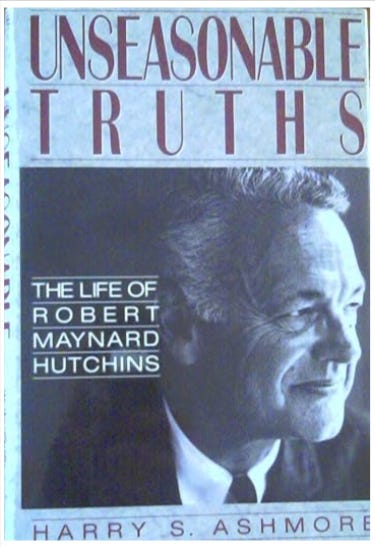
Robert M. Hutchins played a major part in my political explorations.
Center for the Study of Democratic Institutions, nonprofit educational institution established at Santa Barbara, Calif., in 1959 and based in Los Angeles from 1988. The educator Robert M. Hutchins (q.v.) organized the centre and headed it and its parent corporation, the Fund for the Republic (chartered in New York in 1952), for 25 years. The purpose of the centre—to clarify the basic issues confronting a democratic society—was served through discussion and criticism, publications, and public meetings. Scholars, public officials, and leaders of thought and action from many countries often met with a small resident staff to discuss and to try to understand the causes of contemporary problems. Topics included, among others, modern technology, ecological imperatives, responsibilities and control of the mass media, minority and constitutional rights, and world peace.
The centre had experienced financial difficulties off and on during its history, and in 1979 it was reorganized under a new parent organization—the University of California Santa Barbara Foundation—and became a “center of independent thought and criticism” on the university campus. In 1988 the centre was again reorganized when it moved to Los Angeles, where it absorbed the Institute for National Strategy and took over the publishing of New Perspectives Quarterly.
Mort Sahl also recomemded The New York Review of Books, which really began my political/intellectual/moral awakening! Yet when Robert Silvers provided space for Neo-Conservative Timothy Snyder, that was the end of my respect for this publication and its once …
Reader note who Snyder now associates with Neo-Con Bill Kristol !
Anne Applebaum through her publications in the Atlantic and most recently in her book, Twilight of Democracy: The Seductive Lure of Authoritarianism, has articulated a perplexed disappointment with Republican politicians and colleagues endorsing Trumpism. She poses a series of questions in her recent Atlantic article History Will Judge the Complicit: why have Republicans abandoned their principle in support of a dangerous and immoral president. How could “Each violation of our Constitution and our civic peace gets absorbed, rationalized, and accepted by people who once upon a time knew better”? How can the fear of a Twitter tirade silence members of once honorable elite, men like John Bolton and Paul Ryan, from intervention against the slide to totalitarianism. Her Atlantic article, Laura Ingraham’s Descent into Despair, begins with puzzlement of how a deeply idealistic iconoclast could evolve into an end-of-days Trumpist, stoked by fatalism over American decline, by liberal deracination, and from Catholic unlapsing. How indeed?
Applebaum begins her article on the transformation of Laura Ingraham, the Fox News professional racist and COVID-19 denier, by describing a celebratory Georgetown cocktail party of the neo-conservative elite in 1995. There the recognition of American exceptionalism and its appropriate distillation throughout the world was seamlessly enunciated. In attendance were David Brock (in his Clinton tormentor phase), David Frum, Danielle Crittendon, David Brooks, John Podhoretz, Roger Kimball, William Kristol, Dinesh D’Souza, and James Atlas, and Laura Ingraham. The reader can best decide whether this group is more aptly characterized as a self-congratulatory rogues gallery or post-Reaganite translators of the language of anti-totalitarianism, personal liberty and property rights, and American exceptionalism. In Anne Applebaum’s astigmatic eyes, focused by Eastern European analogies, the assumptions and simplistic confidences of the American liberal left about labor rights and wealth distribution may have seemed, unserious if not contemptible. The neo-conservative world view was curious. A modest level of irony, if not humility, might have led to pondering how a self-appointed elite became the intellectual center of the modern Republican Party. Here was a new conservative generation of columnists and editorial writers who overnight became public intellectuals and political theoreticians without ever having produced disciplined work on policy, or having achieved formal academic accomplishment or even having had extensive experience with legislation. And yet, William Kristol et al., could later credit themselves with the identification of and selection of Sarah Palin as a potential president. The totalistic adoption of an ideology and its self-appointed spokespersons might have recalled for Applebaum the permutated trans-slavism of the Comminform, given her affinity for analogies to sovietized Eastern Europe. It did not.
Reader consider that my commetarry can never quite match the unbrideled toxic egotism of Norman Podhoretz ‘Making It’! And his moment of trumph of self-reporting, by telling Jacqueline Kennedy ….





 StephenKMackSD's Blog