When President Javier Milei first met Donald Trump, he was starstruck.
“President!” he cried, grabbing both the Republican magnate’s arms and staring straight into his eyes, grinning broadly. “Thank you for your work for me,” Milei said. “I’m very happy.” In the background, the Village People anthem, YMCA, was pumping.
As soon as Milei finished speaking, Trump quickly scanned the room for a camera, looked into one, and said: “MAGA — Make Argentina Great Again.” Only then did Milei let him go.
It was February 2024 in Maryland, US. Both leaders were attending the Conservative Political Action Conference (CPAC), an annual right-wing gathering first held in 1974. Trump had not yet been elected for a second term.
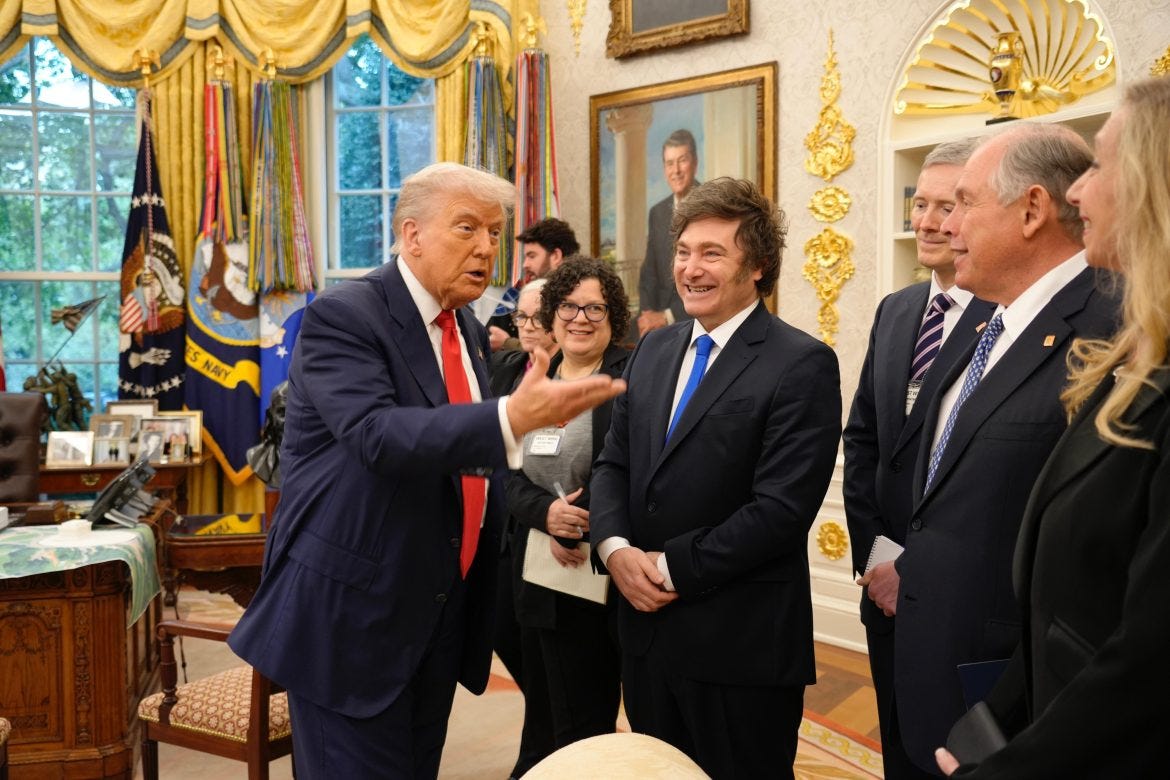
Trump and Milei have met several times since, and the Argentine was the first world leader to meet with Trump after his electoral victory last November. But of all their encounters, none was as crucial for the relationship as a lunch at the Oval Office of the White House, where they discussed details of a U.S. lifeline to Argentina that could total over US$40 billion.
During the one-hour televised meeting, Milei spoke for just three minutes. “I feel very honored, especially at this moment in which, under your great leadership, President Trump, you have accomplished peace in the Middle East,” the Argentine president said in Spanish, his back to the camera. Only after he had finished speaking did Trump ask if an interpreter was present to explain Milei’s “important, profound statement” to the room — but none was forthcoming, and he moved on. None of the questions from the crowd of journalists present were directed at the Argentine leader.
The optics of that lunch and previous public appearances suggest that, while both men are world leaders, Trump does not see this as a relationship between equals.
An ideological alliance
“It is a relationship that surpasses any other instance or experience of alignment or acquiescence that Argentina has had throughout its history in its bilateral relationship with the United States,” Anabella Busso, director of the School of International Relations at the University of Rosario and a specialist in Argentina-U.S. relations, told the Herald.
Busso said that the alliance between the two far-right leaders is “ideological”. Both leaders have accused the international community and world leaders of adopting so-called “Marxist” attitudes towards the “environment, gender, multilateralism, and social policies,” Busso added.
Earlier this year, for instance, Milei followed Trump’s example and announced that Argentina would also leave the World Health Organization (although this has not happened at the time of writing). He also mimicked some of the Republican’s stunts (Milei’s catchphrase “We don’t hate journalists enough” is derived from Trump’s “You don’t hate the media enough”). The Trump administration has also copied some of Milei’s wildest ideas — for example, his “chainsaw” campaign was embraced by Elon Musk during his brief stint at the U.S. government’s Department of Government Efficiency.
Both Trump and Milei are part of a far-right movement that frequents places like the CPAC.
This is no small matter — channels associated with CPAC were crucial in striking the deal with the U.S.’s financial support package for Argentina. U.S. consultant Barry Bennett, a former Trump advisor, was hired by the Argentine government to create a “backchannel” between Washington and Buenos Aires. Negotiations were held through both official channels — through Economy Minister Luis Caputo — and so-called “parallel diplomacy” led by Tactic Global, a consulting firm where Bennett works. Soledad Cedro, the CEO of CPAC Argentina, is one of its partners.
Bennett has also met with members of Argentina’s so-called moderate opposition (opposition parties who at least partially support Milei) to tell them the U.S. government’s views on Argentina, according to two people present in those meetings. They spoke on condition of anonymity to discuss the sensitive negotiations. The magazine Noticias went so far as to call him “Viceroy Bennett,” implying that he was acting as a representative of the U.S. government in Argentina within a colonial relationship.
Congressman Cristian Ritondo of the right-wing party PRO, an ally of Milei, met with Bennett and dismissed criticism of U.S. involvement in Argentina as “populist.”
“Some prefer a Chinese swap, and some prefer an American swap,” he told the Herald, in reference to a US$18 billion currency swap between Argentina and China.
“We prefer to follow the democracy of the world, the most capitalist country. Populism will never like the most capitalist country in the world,” he added. Ritondo claimed that the bailout came with no strings attached. However, many analysts have said it could enable the U.S. to toughen its negotiating strategy over key Argentine raw materials — for instance, by asking that they be put up as collateral.
A test case for the dispute between China and the US
While negotiating the deal, US Treasury Secretary Scott Bessent said Milei was “committed to getting China out of Argentina.” The Asian country is Argentina’s second-largest trading partner, and his comments prompted a riposte from the Chinese Embassy in Argentina, accusing U.S. government officials of having a “Cold War mindset.”
A source familiar with the backchannel negotiations between Washington and Buenos Aires said the U.S. is eyeing Argentina’s lithium and uranium reserves and wants the government to phase out Chinese technology, even urging ministries to stop using products from the telecoms giant Huawei, an old obsession of Trump (citing cybersecurity reasons, he imposed fines on US companies using products from that Chinese company).
According to Busso, Argentina is “becoming a test case for the dispute between China and the United States, with the United States demanding that we consolidate its power on the continent, which is its major geopolitical objective.”
The proposal of a free trade deal with the U.S., which competes with Argentina as a supplier of key products including soybeans, as well as an executive order allowing 30 US naval officers to come to the country for joint exercises, have also been criticized.
“Milei has demonstrated, especially in the last month, that he has not even the slightest trace of the Argentine Republic’s history of autonomy — his vocation is clearly a neocolonial one, not to call it colonial outright,” Busso added.
Despite Milei’s apparently unconditional support for Trump, the U.S. leader’s support is not unconditional. During the pair’s meeting in the White House, he told onlookers that the U.S. “would not be generous with Argentina” unless Milei performed well during the elections.
Geopolitics aside, perhaps the person who best explains Trump’s total endorsement of Milei is the U.S. president himself. Last year, during a campaign speech in Richmond, Virginia, he said that Argentina “went MAGA.”
“He’s a big Trump guy. He loves Trump, I love him, because he loves Trump,” he said.
Not once in the speech did he refer to Milei by name.
Editor: This is the companion piece, to the Manhattan Institute’s latest Anti-Mamdani hysteria mongering. This reader awaits the charge that Mamdani is the reincarnation of Robespierre!
Editor: In the above paragraphs The Economist writers, because this news magazine is carefully edited, by many hands, answers their own questions: as to the why of Mr Mamdani ! The Myth of Oxbridger superiority does not just a stumble, it a pratfall !
Newspaper Reader & Political Observer.
Good morning:
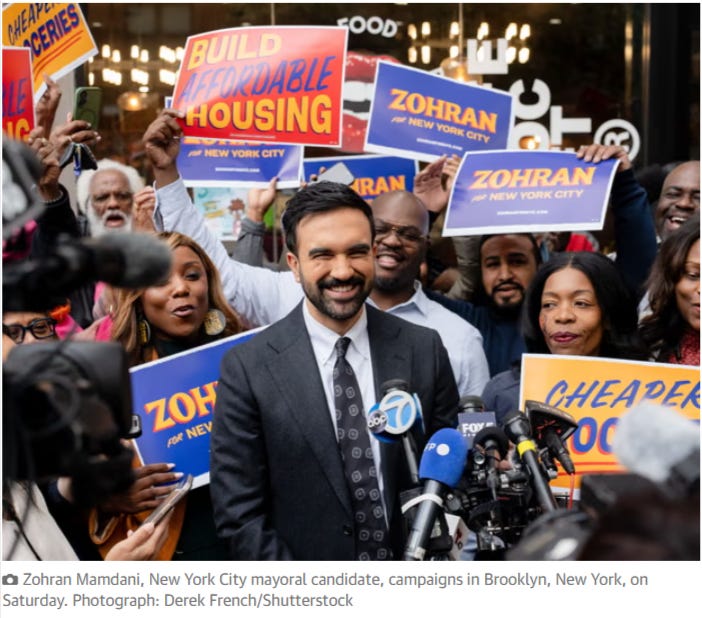
New Yorkers are days away from Tuesday’s mayoral contest and a new Manhattan Institute poll finds that there is a striking difference between frontrunner Zohran Mamdani’s electoral strength and support for his policy agenda.
The survey, conducted October 22–26, included 600 likely voters in the 2025 New York City mayoral election and 300 registered voters across New York State. As vice president of external affairs Jesse Arm writes in his analysis of the results, Assemblyman Mamdani leads the field and bests former governor Andrew Cuomo in a head-to-head matchup. At the same time, the majority of respondents oppose multiple progressive policy ideas: 58% of NYC voters oppose eliminating bus fares; 64% of state voters favor expanding gifted and talented education programs rather than scaling them back; and 55% favor repealing the city’s permissive bail reform laws.
Perhaps NYC is a blue city in a state that may tip purple? That would explain why the MI poll finds Republican Congresswoman Elise Stefanik ties with Democratic incumbent Governor Kathy Hochul in a potential 2026 gubernatorial contest.
Staying with the NYC mayoral race, director of cities John Ketcham looks at the strength of the Muslim vote among New Yorkers and how appealing to that coalition has played a role in the race, in UnHerd.
In City Journal, senior fellow Nicole Gelinas argues that New York’s wealthiest denizens will be better positioned than middle-class New Yorkers to “bear the brunt” of policy ideas like rent freezes, free bus fares, and swaps to police resources in favor of civilian outreach workers. These bold experiments in government are largely untested but will certainly have a captive audience.
NYC’s next mayor will also need to be prepared for another kind of audience—the 1.2 million visiting fútbol fanatics expected in July for the 2026 FIFA World Cup. Cities policy analyst Santiago Vidal Calvo writes in City Journal that the city’s largest sporting event in its history will stress infrastructure, such as hotels, and city services, such as transportation and public safety. Managing the event preparations will be a mammoth task for any mayor, and a considerable test of his managerial skills.
In other news, senior fellow Allison Schrager evaluates the current phenomenon of low credit spreads, which usually suggests a low-risk economic environment. Yet “low risk,” Shrager writes in Bloomberg, “describes precisely nothing about this market.”
Finally, in a new paper released this week, adjunct fellow Jennifer Weber argues that mayoral control of education systems, leads to more successful long-term reform. Using mayoral control in NYC as a case study, Weber finds that the city closed achievement gaps with state and national averages on standardized tests while maintaining greater administrative efficiency than board-governed districts. The paper recommends NYC preserve mayoral control and suggests that other struggling districts adopt a similar governance structure.
I can still vividly remember my first visit to New York. It was 1988. I was a student spending the summer in America. Like so many others, I found the city intoxicating, like stepping into a movie. Fast forward to today and I still love New York’s energy. But I can’t help being struck by how 20th-century and, dare I say it, dilapidated it seems. The potholes, the creaking subway, locked shelves at drug stores, the pervasive smell of marijuana. America’s pre-eminent city sometimes feels more like a relic of yesterday than top of the heap. That’s why this week, on the eve of a pivotal mayoral election, we are asking: is New York in trouble?
Who can forget Zanny Minton Beddoes guest shot, on The Daily Show with Jon Stewart? An aging Neo-Con in black leather pants, and former assistant to Jeffrey Sachs
Dr. Jeffrey Sachs, Shock Therapist
By Peter Passell
June 27, 1993
…
General Pinochet was a tyrant, Sachs says, but he did represent the interests of the Chilean middle class and was thus a strong supporter of market reforms. In Russia, by contrast, an authoritarian government would undoubtedly serve as a front for the military-industrial complex, which Sachs believes is the primary obstacle to a capitalist rebirth.
…
The first goal for reformers, says Sachs, is to get across the message that democracy and capitalism are inextricable. Sachs, as a matter of principle, refuses to advise unelected governments: When approached by Poland’s Communist junta to help renegotiate the country’s foreign debts, he turned them down flat. Sachs’s unbending stand, one must assume, has more than a little to do with the experience of his wife, Sonia Ehrlich, a pediatrician in Cambridge, Mass., who fled Communist Czechoslovakia with her family at age 12.
The Russian researchers accept Sachs’s interpretation of Chile and China without complaint, though it is difficult to know whether they are convinced or simply unaccustomed to challenging authority. At lunch over borscht, pork cutlets and cheese pastries, all the talk is about who is winning and who is losing at which ministries.
…
Editor-in-Chief of The Economist, Zanny Minton Beddoes, joins Jon Stewart to discuss President Joe Biden’s 2nd term potential, the global spread of national conservatism, what former President Donald Trump doesn’t understand about the NATO alliance, and the Republican divide over support for Ukraine.
Editor : Beddoes present mission is to raise the political tempertures of her readers, who are New York voters, that Mr Mamdani is a clear and present danger! Yet the present Mayor Eric Adams was corrupt:
I can still vividly remember my first visit to New York. It was 1988. I was a student spending the summer in America. Like so many others, I found the city intoxicating, like stepping into a movie. Fast forward to today and I still love New York’s energy. But I can’t help being struck by how 20th-century and, dare I say it, dilapidated it seems. The potholes, the creaking subway, locked shelves at drug stores, the pervasive smell of marijuana. America’s pre-eminent city sometimes feels more like a relic of yesterday than top of the heap. That’s why this week, on the eve of a pivotal mayoral election, we are asking: is New York in trouble?
In the year that New York marks its 400th birthday, the city’s operating model—a booming financial industry supporting generous welfare benefits for its citizens—seems to be breaking down. Financial firms are moving jobs elsewhere, pushed away by high rates of corporate income tax, and the ultra-rich are also decamping to cheaper states. America’s biggest bank, JPMorgan Chase, now employs more people in Texas than in New York City. Pair the loss of these jobs and the tax revenue that they generate with New York’s extraordinary cost of living and the world’s financial capital starts to look shaky.
If you’re not a New Yorker, does all this matter? It’s a good question and one posed by several of our editors during Monday’s editorial debate. The city’s sheer heft (it anchors a metropolitan area that has a larger economy than Canada), cultural clout and the unique position that it occupies in the public imagination are important. But today it is most interesting to me as a battleground for two different approaches to government, advanced by two captivating New Yorkers: Donald Trump and Zohran Mamdani. Next week Mr Mamdani, a 34-year-old Democratic Socialist, is almost certain to be elected as the city’s next mayor. A peerless campaigner, he vows to make New York more affordable via rent freezes, housing investment, free child care and free buses.
In tomorrow’s show we’ll examine the style and substance of Mr Mamdani’s campaign. I’ll be joined by Edward Carr, deputy editor, Charlotte Howard, our New York bureau chief, and John Prideaux, our US editor. We’ll ask how many of his commitments Mr Mamdani can actually deliver and, crucially, what the potential combination of Mayor Mamdani and President Trump would mean for the future of New York—and America. We also want to hear your thoughts on New York and how it compares to other cities across the world. Cast your vote in our poll.
Editor: Beddoes intervention, is to say the least, a bit late in the political game!
Headline: A political drama for the ages, opening soon in New York City
Sub-headline : Zohran Mamdani v Donald Trump. What could go wrong?
Meeting sceptics with smiles is a luxury Mr Mamdani appears able to afford. Polls and betting markets suggest he will very likely be elected mayor of New York City on November 4th. His nearest challenger, Andrew Cuomo, a former governor running as an independent, would have to defy a persistent double-digit polling deficit. If it is Mr Mamdani, voters will deliver one of the most stunning results in the city’s history. A 34-year-old Democratic Socialist with an eye-catching (and eye-wateringly expensive) progressive agenda, but no executive experience, would take charge of America’s largest city, with a workforce of about 300,000 and a budget of $116bn.
How did New York get here? To call Mr Mamdani “charismatic” understates the appeal he exerts on his supporters, many of them young and ethnically diverse. Mr Mamdani’s gifts as a made-for-TikTok video auteur are well-known, but his campaign’s message discipline has been as impressive. He has made his affordability platform—rent freezes, housing investment, free child care, free buses—the main story of the election, while avoiding culture-war traps and shouting matches with Donald Trump, who calls him a communist. “What his campaign did so well was to celebrate the city,” says Eli Northrup, an ally who is running for the state legislature next year. “It’s joyful. It’s positive.”
…
Editor: In the above paragraphs The Economist writers, because this news magazine is carefully edited, by many hands, answers their own questions: as to the why of Mr Mamdani ! The Myth of Oxbridger superiority does not just stumble, it a pratfall !
Border Patrol chief leading Trump immigration crackdown in Chicago ordered to report daily to federal judge
In a tense hearing, Gregory Bovino faced scrutiny for alleged violations of court orders limiting use of force.
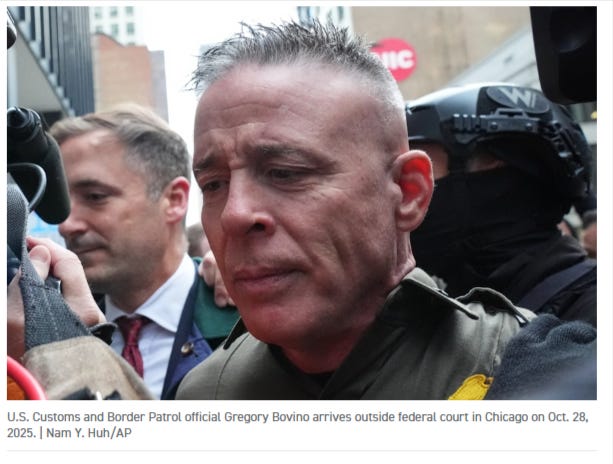
U.S. Customs and Border Patrol official Gregory Bovino arrives outside federal court in Chicago on Oct. 28, 2025. | Nam Y. Huh/AP
CHICAGO — U.S. Border Patrol chief Gregory Bovino, the face of “Operation Midway Blitz” cracking down on illegal immigration, must report daily to a federal judge after reports of combative enforcement, including using tear gas.
Bovino appeared Tuesday for a tense hearing before U.S. District Judge Sara Ellis at the Dirksen Federal Courthouse in downtown Chicago. She questioned him about reports of aggressive immigration enforcement and the federal agents’ treatment of protesters, journalists and even children during the ongoing “immigration blitz.”
The hearing was part of an ongoing lawsuit brought by local media organizations alleging that federal agents have violated prior court orders restricting their use of force. Those orders forbid agents from using tear gas or “riot control” weapons without giving two warnings and from deploying them against people who pose no immediate threat.
“They don’t have to like what you’re doing. And that’s OK. That’s what democracy is,” Ellis said during the hearing, referring to protesters or others who might be voicing opposition to federal agents on the ground. “They can say they don’t like what you’re doing, that they don’t like how you’re enforcing the laws, that they wish you would leave Chicago and take the agents with you. They can say that, and that’s fine. But they can’t get teargassed for it.”
While Bovino’s immigration enforcement efforts came under scrutiny Tuesday, President Donald Trump threatened to send “more than the National Guard” to combat crime in blue cities like Chicago. Some National Guard members have already been sent to Illinois, though they have yet to be deployed to the streets. The president has also sent the National Guard into Washington and is seeking to send troops to Portland, Oregon.
In Chicago, the judge, an Obama appointee, imposed a new requirement: Bovino must meet with her every weekday to update her on the immigration enforcement efforts. “Mr. Bovino’s going to be here every day at 6 to tell me what happened,” she said.
From the outset of the hourlong hearing, Ellis made clear her expectations. “My role is not to tell you that you can or cannot enforce validly passed laws by Congress,” she said. “My role is simply to see that any enforcement of those laws is done in a manner that is consistent with your obligations under the law.”
The judge reminded Bovino of rules that state he must “leave journalists alone. If they’re doing their job, they need to be left alone to do their job.”
Bovino agreed. “We’re on the same page,” he said.
Bovino listened intently while on the stand, and at least once took time to gaze across the courtroom, which was crowded with reporters and a few onlookers.
Outside the courthouse, a few protesters waved signs reading “Stop ICE Brutality” and “Judge Sara Ellis is a Boss.”
Inside, the tone was serious as Ellis read anecdotes aloud from reports that federal agents had used tear gas in Chicago neighborhoods during Halloween festivities. “Kids were tear gassed on their way to celebrate Halloween,” the judge said, referring to an incident in the Old Irving Park neighborhood on Chicago’s North Side. “Those kids were dressed up in their Halloween costumes. You can imagine, their sense of safety was shattered.”
Halloween was on the judge’s mind as she told government attorneys: “I do not want to get violation reports from the plaintiffs that show that agents are out and about on Halloween where kids are present and tear gas is being deployed.”
For his part, Bovino responded throughout the informational hearing with “yes ma’am,” and challenged only when asked about tear gas being used. “Your honor, I believe that each situation is dependent on the situation. I’d like to know more about what happened.”
Attorneys for the plaintiffs moved to ban tear gas altogether, but Ellis said for now she would not decide. “If [federal agents] are using tear gas, they better be able to back it up,” she said. “And if they can’t, then they will lose that as something they can use.”
Ellis raised concerns from the public that federal agents haven’t identified themselves. “I instructed all agents under my command to place an identifier conspicuously somewhere on their uniform,” Bovino replied. Ellis suggested IDs appear “in a conspicuous location” in at least two places, and Bovino agreed.
Ellis demanded that Bovino deliver use-of-force reports and body-worn camera footage compiled since Sept. 2.
And she ordered him to wear a camera himself. “The camera is your friend,” the judge said.
Bovino had acknowledged that he hadn’t been wearing one. “How about by Friday you get one for yourself?” Ellis asked. Bovino agreed, saying, “We can get that.”
Editor: the first two paragraphs of Arnaud Leparmentier reportage are instructive:
A tunnel beneath the Bering Strait linking Siberia and Alaska – that’s the latest idea put forward by Kirill Dmitriev, head of the Russian sovereign wealth fund, who wants to entrust the construction to Elon Musk and his tunnel company, The Boring Company. Dmitriev, an adviser to President Vladimir Putin, believes the entrepreneur’s ingenuity could reduce the cost from $65 billion (€56 billion) to $8 billion.
The world’s richest man may have emerged battered from his stint in politics in June, after his time leading the Department of Government Efficiency (DOGE) under US President Donald Trump, but he continues to fascinate. Especially with his wildest projects: colonizing Mars, controlling the brain via Neuralink or, in this case, this absurd tunnel. The proposed infrastructure would come out near Nome, a gold rush town in Alaska that remains completely isolated, some 850 kilometers from Anchorage, and would ultimately serve only to move military troops – arguably the best argument not to build it.
Editor: Though nothing quite prepares the reader for what is to follow! Does it model itself on ‘Lost Illusions’ of Balzac and its protagonist Lucien de Rubempré? To this American Tin-Ear, much of what I read at this newspaper, is touched by what my English can only know as a literary/poetic atmospheric, though this is a vulgarization!
Keeping a relatively low profile, Musk has been working on restoring his psychological well-being. He needs to be loved, as shown by the messages he highlights on his social network X. One is from his brother, Kimbal, who helps him cope with the pressure: “It’s not that I’m the voice of reason, it’s more like I’m helping Elon find his voice of reason.” There is the one from his mother, Maye Musk, who is still modeling for magazines at 77: “When Elon told me he is going to launch satellites, he said it was to save lives. This is another example. How did he know? He sees the future. Proud mom.” Added to these is the statement from investor Cathie Wood, who has never given up on Tesla and defends the astronomical compensation of its boss, which could reach $1 trillion: “I think he’s a very good person.”
There is also the video, posted on October 10, of a meeting with Jensen Huang, head of Nvidia and a key figure in the artificial intelligence revolution thanks to his ultrahigh-performance chips: “Elon Musk is just an extraordinary engineer, and I love working with him.”
Editor: Arnaud Leparmentier embelishes on his theme:
Musk is tired of being hated, even though he insists that his companies work for the good of humanity. “Tesla is accelerating sustainable energy; this is a love of philanthropy. SpaceX is trying to ensure the long-term survival of humanity with multiple planet species; this is love for humanity. You know, Neuralink is to help solve brain injuries and existential risk with AI; love of humanity. Boring Company is trying to solve traffic, which will help most people, and that also is love of humanity,” Musk explained in a video posted on October 11 on X.
Keeping a relatively low profile, Musk has been working on restoring his psychological well-being. He needs to be loved, as shown by the messages he highlights on his social network X. One is from his brother, Kimbal, who helps him cope with the pressure: “It’s not that I’m the voice of reason, it’s more like I’m helping Elon find his voice of reason.” There is the one from his mother, Maye Musk, who is still modeling for magazines at 77: “When Elon told me he is going to launch satellites, he said it was to save lives. This is another example. How did he know? He sees the future. Proud mom.” Added to these is the statement from investor Cathie Wood, who has never given up on Tesla and defends the astronomical compensation of its boss, which could reach $1 trillion: “I think he’s a very good person.”
There is also the video, posted on October 10, of a meeting with Jensen Huang, head of Nvidia and a key figure in the artificial intelligence revolution thanks to his ultrahigh-performance chips: “Elon Musk is just an extraordinary engineer, and I love working with him.”
Chapter 1
Combative CEO
Word Count: 478
Chapter 2
SpaceX lagging behind
Word Count : 443
Chapter 3
Messianism and entrepreneurship
Word Count: Word Count: 438
Chapter 4
Army of robot workers
Word Count : 282
Reader I will attach a copy of each of the 4 Chapters of Arnaud Leparmentier commetary:
Combative CEO
Of course, still navigating on the fringes of the far right, he continues to post hateful content targeting Democrats, undocumented migrants and British Labour supporters. Still, he is much more withdrawn, and at any rate, less noticed.
Musk has stopped attacking Donald Trump and no longer talks about creating his own party. While he did not attend the dinner for top tech executives at the White House in early September, he greeted the president in Arizona during the tribute to Charlie Kirk, the MAGA influencer who was killed in Utah on September 10. For now, though, he appears to have left behind his period of extreme politicization. Musk has not returned to Washington since May, and tracking of his private jet shows him shuttling between Texas; the San Francisco Bay Area; and occasionally Vancouver, Canada, where Neuralink is being tested. He has returned to focusing on his industrial ventures: SpaceX, Tesla and xAI.
Investors have breathed a sigh of relief, as exemplified by Dan Ives, a prominent American tech analyst at the financial group Wedbush. “You’re seeing a much different Musk than from the dark days during the Trump administration, when a lot of that brand damage [to Tesla] happened, and he took his eye off the ball. I think Musk is back to wartime CEO, laser-focused on bringing Tesla into the AI revolution chapter,” Ives said.
Investors have believed it. The share price has doubled since its April lows, and Tesla is now worth $1.43 trillion, about five times more than Toyota or 120 times more than Renault. “I think the stock has reflected that the biggest asset for Tesla is Musk,” said Ives. Third-quarter results published on Wednesday, October 22, confirmed that the company is in recovery, with a performance much better than the disastrous first half of the year, but still mixed: Year-on-year, sales jumped by 12%, boosted in the United States by the scheduled end of tax credits for electric vehicles. But net income fell by 37%, notably due to lower prices and the costs of transitioning to robotics and AI. On the New York Stock Exchange, Tesla’s share price was down 3.3% in after-hours trading on Wednesday.
His other private companies are also worth fortunes. SpaceX, which in 2024 carried out half of all space launches, sending 84% of the world’s satellites into orbit worldwide, was valued at $400 billion this summer, according to Bloomberg (for comparison, LVMH is worth around $360 billion).
Finally, xAI, formed from the merger of X and Musk’s AI start-up, was valued at $200 billion. The days when Musk was crushed by debt after buying Twitter for $44 billion in 2022 are long gone. As a result, he is by far the richest person in the world, with a fortune estimated by Bloomberg at nearly $460 billion, after briefly surpassing $500 billion.
Word Count: 478
………………………………………………………………………………………………………………
SpaceX lagging behind
But isn’t Musk deceiving investors, making impossible promises all over again, like conquering Mars, building self-driving cars and making robots? In reality, to properly analyze the entrepreneur, it’s necessary to invert the Chinese proverb, “When the wise man points at the moon, the fool looks at the finger.” It’s not the moon that matters, but the finger. While Musk claimed he would conquer Mars, he was actually colonizing low Earth orbit with his Starlink satellite system and crushing Europe’s Ariane program.
While he was extolling the virtues of the self-driving car, he was reinventing the Ford Model T, with a handful of electric models selling more than seven million units, manufactured in four giant factories. And while he was championing Twitter’s so-called freedom of speech, he was amassing data for his AI robot, Grok, within xAI. These achievements led investor Wood to say, “I think he’s the Thomas Edison of our age.”
Except that those achievements are now in the past, and the era of monopolies is over. Other satellite constellations, such as Eutelsat, are set to compete with Starlink; Tesla’s share of the electric vehicle market has dropped below 40% in the US, after peaking at nearly 80% in 2020, as competitors caught up, while the brand has suffered a serious decline in Europe. Now, attention must once again turn to the Moon. And there, unsurprisingly, things are much more difficult.
SpaceX is something of an exception. The company, which revolutionized the space industry with its reusable launchers and low-cost launches, claims it will conquer Mars. Still, NASA has concerns about whether it can even reach the Moon. On October 20, its interim administrator, Sean Duffy – who also serves as Trump’s transportation secretary – announced that he was considering turning to Blue Origin, Jeff Bezos’s company.
He explained that Musk’s rocket, which is intended to land astronauts on the Moon and serve as a launch base for Mars missions, is highly complex, with unprecedented challenges such as in-orbit refueling and transporting 100 metric tons of cargo. “I love SpaceX. It’s an amazing company. The problem is, they’re behind. They’ve pushed their timelines out, and we’re in a race against China,” said Sean Duffy on CNBC on Monday.
Musk’s retort to Duffy, a champion tree climber, stung on X (formerly Twitter) on Tuesday: “Should someone whose biggest claim to fame is climbing trees be running America’s space program?” Still, the challenges ahead are immense. “The number of technical hurdles SpaceX has thus far overcome pales in number and complexity to those that lay ahead,” wrote three former senior NASA officials, Douglas Loverro, Doug Cooke and Daniel Dumbacher, in the journalSpaceNews in early September.
Word Count : 443
…………………………………………………………………………………………………………
Messianism and entrepreneurship
For Tesla and xAI, Musk has one obsession: the AI revolution. The South African-born entrepreneur is driven by his unquenchable hatred of Sam Altman, with whom he co-founded OpenAI – the creator of ChatGPT – at the end of 2015, before leaving the organization. Musk has accused Altman of turning OpenAI into a profitable company even though it was originally a nonprofit organization.
According to aNew York Times investigation published at the end of September, Musk has dedicated most of his time in recent months to xAI, completely overhauling his teams and preparing for battle to create an AI that is not “woke,” as he accuses ChatGPT of being. Once again, Musk displayed a blend of messianism and entrepreneurship. “We are the only company where the mission is truth. If you force the AI to lie or believe things that are not true, you’re at great risk of creating a dystopian future,” he told xAI employees in a speech.
This ideological battle has led to notorious glitches: In July, after a program update, his chatbot Grok made antisemitic remarks, praising Adolf Hitler and suggesting that people with Jewish last names were more likely to spread hate online. As for Musk, he mainly seems stuck in the 1980s, the era of his adolescence, in a world of science fiction and eroticism. He keeps posting several of Grok’s creations: science fiction imagery and many depictions of women – sensual, curvaceous, provocative – intended for so-called “virtual romances.”
This development relies on energy-intensive supercomputers, located in Memphis, Tennessee. “Just as we will be the first to bring a Gigawatt of coherent training compute online, we will also be the first to 10GW, 100GW, 1TW…” he posted on X on September 23. However, many experts believe Musk is lagging behind. “Musk is someone I wouldn’t bet against,” cautioned Ives. “[OpenAI] has the scale and scope to play catch-up to Antropic. OpenAI clearly is going to be the leader. There’s trillions that are going to be spent in this AI revolution, and Musk wants to make sure that he’s at the front of the table.”
Tesla’s future also depends on AI, which, in the eyes of its most fervent enthusiasts, can justify the company being valued at 260 times its current profits. The company plans to offer its shareholders the chance to take a stake in OpenAI, and Ives does not rule out that Musk could eventually bring his various companies together under a single holding company. Pessimists point out that fully autonomous cars are constantly announced and repeatedly delayed, while the fall 2024 demonstration of the Optimus robots was staged, with their speech remotely controlled.
Word Count: 438
………………………………………………………………………………………………………………
Army of robot workers
Nevertheless, the success of his competitor Waymo (Google), a specialist in driverless taxis, highlights how far Musk has fallen behind, but also confirms that this path will soon open. In addition, Musk believes in building an army of robot workers and wants to produce one million per year within five years. “Humanoid robots are going to be a major factor in Tesla’s growth story. Optimus is going to play a huge role in factories, as well as for everyday consumers in their lives,” added Ives.
For all these projects, money is needed – and a lot of it. On that point, Musk has repeatedly claimed that becoming wealthy is not his goal – he is not known to own a yacht, an art collection or luxurious properties, nor does he have extravagant passions, apart from a McLaren he bought for $1 million in 1999. This allowed him to bond with Larry Ellison, founder of Oracle, also a fan of British supercars.
Yet he fought tooth and nail to secure his $1 trillion compensation at Tesla. Officially, it was to have free rein by controlling a quarter of the company’s capital. “I don’t want to find I have so little control I can be easily ousted by activist shareholders,” he said in July while admitting that he shouldn’t have so much control over Tesla that the board can’t fire him if he goes “crazy.” At the end of April, his board, according to The Wall Street Journal, had threatened to start a search to replace him. “It was not sustainable for Musk to stay in the Trump administration and also be CEO of Tesla,” said Ives. “He had to choose, and gladly he chose Tesla.”
Headline: A Rising Democrat Leans Into the Campus Fight Over Antisemitism
Sub-headline:Gov. Josh Shapiro of Pennsylvania, the proudly Jewish leader of a battleground state, has dived headfirst into subjects that have wrenched apart his party.
A few hours after Columbia University canceled its main commencement ceremony following weeks of pro-Palestinian student protests, Gov. Josh Shapiro of Pennsylvania was in his office in Harrisburg, taking stock of the ways he sees universities letting students down.
“Our colleges, in many cases, are failing young people,” he said in an interview this week. “Failing to teach information that is necessary to form thoughtful perspectives. They are willing to let certain forms of hate pass by and condemn others more strongly.”
Mr. Shapiro — the leader of a pre-eminent battleground state, a rising Democrat and a proudly observant Jew — has also emerged as one of his party’s most visible figures denouncing the rise in documented antisemitism after the Hamas-led Oct. 7 attack on Israel.
And at a moment of growing Democratic anger and unease over how Israel is conducting its devastating military response, Mr. Shapiro, 50 — who has no obligation to talk about foreign policy — has not shied away from expressing support for the country while criticizing its right-wing government.
Plunging into a subject that has inflamed and divided many Americans carries risk for an ambitious Democrat from a politically important state. The politics around both the Gaza war and the protest movement are exceptionally fraught within the Democratic Party, and many of its voters and elected officials have become increasingly critical of Israel.
But Mr. Shapiro has been direct.
Asked if he considered himself a Zionist, he said that he did. When Iran attacked Israel last month, he wrote on social media that Pennsylvania “stands with Israel.”
When the University of Pennsylvania’s president struggled before Congress to directly answer whether calling for the genocide of Jews violated the school’s rules, Mr. Shapiro said she had failed to show “moral clarity.” (She later resigned.) When opponents of the Gaza war picketed an Israeli-style restaurant in Philadelphia known for its falafel and tahini shakes, Mr. Shapiro called the demonstration antisemitic and showed up for lunch.
And as university officials have struggled to define where free speech ends and hate speech begins, a tension upending the final weeks of the school year, Mr. Shapiro has issued stern warnings about their responsibility to protect students from discrimination. The issue hits close to home: On Friday, police cleared an encampment of pro-Palestinian demonstrators off the campus of the University of Pennsylvania. Mr. Shapiro had said it was “past time” for Penn to do so.
Editor: This selection from this 1609 word political feature story by Katie Glueck.
He added, “It’s certainly not helpful when it comes to our top political priority, which is to re-elect President Biden.”
The Mideast war, which has killed more than 34,000 people in Gaza, according to local health authorities, has fueled a broad and significant protest movement.
But on college campuses, there are sharp debates over when demonstrations against Israel and its treatment of Palestinians veer into antisemitic targeting of Jewish students and institutions.
Editor: In the sentence below Mr. Shapiro is not just patently dishonest, but maligns the very notion of what a political/moral actor is and does! To segregate ‘Israeli policies’ from the political/moral actors who have committed the Genocide is about political/moral vacuity!
To Mr. Shapiro, the distinction is clear: Criticism of Israeli policies is fair game. “Affixing to every Jew the policies of Israel,” he said, is not.
Mr. Shapiro said he felt a “unique responsibility” to speak out both because he leads a state founded on a vision of religious tolerance, and because he is a “proud American Jew.”
Indeed, his Jewish identity is intertwined with his public persona to a degree rarely seen in American politicians.
Two US House Republicans are pushing the federal justice department to investigate the path to citizenship of Zohran Mamdani, the Democratic candidate favored to win the 4 November election for New York City mayor.
Congressman Randy Fine of Florida and Andy Ogles of Tennessee – both staunch proponents of Donald Trump’s presidential administration – have been leading the push, which has been condemned by Democratic officials and Muslim civil rights groups as “racist and anti-Muslim”.
Fine told the New York Post: “I just think we need to take a hard look at how these folks became citizens, and if there is any fraud or any violation of the rules we need to denaturalize and deport.”
He continued: “I know that there’s a lot of us that are very, very concerned about the enemy within – people who have come to this country to become citizens, to destroy it.”
Meanwhile, since June, Ogles has pushed for a justice department investigation of Mamdani, with calls to deport him over claims that the Democratic Socialists of America (DSA) to which Mamdani belongs are a communist organization that he didn’t disclose in his naturalization process.
A dual citizen of the US and Uganda, Mamdani has criticized the rhetoric aimed at him by Fine, Ogles and other Republicans by invoking the federal government shutdown which began on 1 October as well as his decisive victory in June’s New York City Democratic mayoral primary.
“In a moment where Americans across the country are deeply fearful of whether they can afford the basic dignities of life, be it healthcare, be it groceries, be it their rent, the focus of the Republican party is to try and denaturalize the Muslim guy that won the New York City Democratic primary with the most votes in our city’s history?” Mamdani told MSNBC’s The Weekend: Primetime on Saturday. “It just speaks to the fact that for the Republican party, the only agenda they really have on offer is that of cruelty and punishment.”
Mamdani also criticized his main mayoral opponent, Andrew Cuomo, the former governor of New York who resigned while facing an impeachment investigation over sexual harassment allegations in 2021. Cuomo, who is the preferred candidate of New York City native Trump, suggested on a radio talk show recently that Mamdani would cheer a terrorist attack like the ones that killed thousands on 11 September 2001.
“God forbid another 9/11,” Cuomo said. “Can you imagine Mamdani in the seat?”
The host, Sid Rosenberg replied, “He’d be cheering.”
Cuomo paused, laughed, and added, “That’s another problem.”
Cuomo tried to distance himself from the interview, claiming, “I can see where if you took it seriously, it was offensive.” Cuomo’s campaign has also received criticism for posting, then deleting, a racist AI generated video depicting “criminals for Zohran Mamdani”.
“I think Islamophobia is something that is endemic to politics across this country,” Mamdani added in the interview with MSNBC. “And we have seen it normalized. We have seen it accepted. And it has come to a point where to speak up about it is seen as if you are making it into an issue, whereas in fact you are naming that which already exists. And so much of this is driven from an unwillingness to recognize that Muslims belong here in the city.”
Editor: My apologies to my readers, for the inordinate length of my collection of my various comments, on the question of Argentine Politics. I was happy that my recall and memory are somewhat reliable when pressed to the limit! I will make revivions!
Never before have midterm elections in Argentina grabbed so much global attention. The Trump administration has thrown the financial might of the United States behind both President Javier Milei and the Argentine peso, turning the vote on October 26th into a political football in Washington and front-page news in the rest of the world. Bond markets scrutinise every poll. Yet one crucial group seems uninterested: the Argentines.
In Buenos Aires, the capital, billboards are rare, rallies are modest and apathy is widespread, even at campaign events. “I’m obliged to be here,” says Emiliano, who is walking in a small march for Peronism downtown. The distant Peronist-run municipality that he works for as a street cleaner brought him there. Who will he vote for? “I don’t know.” Every major political leader, including Mr Milei, is viewed negatively by a majority of Argentines. “In New York there is much more interest in the election than here,” says Gala Díaz Langou of CIPPEC, an Argentine think-tank, who recently visited Wall Street.
Reader note that the Economist frames it’s News Story: looks first to the anonymous Emiliano that works for as a street cleaner, as opposed to Gala Díaz Langou of CIPPEC, an Argentine think-tank. Oxbridgers are steeped in Class Bias, this cannot surprise the regular reader !
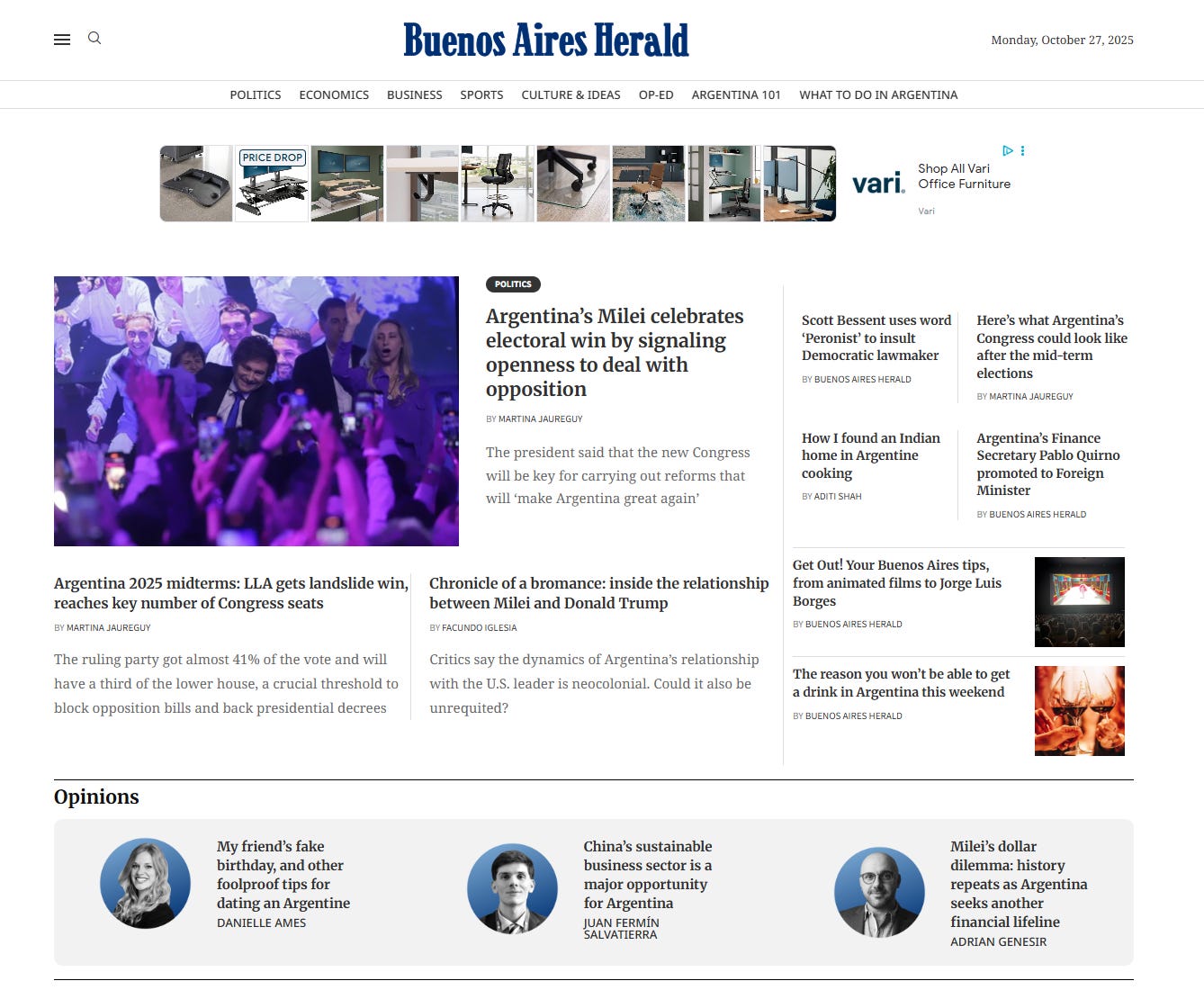
Editor: Look to the Buenosaires Herald as a more reliable source of information about Argentine political life?
Headline: Milei’s dollar dilemma: history repeats as Argentina seeks another financial lifeline
Sub-headline: As Argentina receives US backing amid political turmoil, echoes of past failed rescue attempts raise questions about the libertarian president’s future.
Argentina once again finds itself at a familiar crossroads. Past week, President Javier Milei’s government announced a potential $20 billion currency swap lifeline from the United States, just as financial pressures and electoral setbacks mount. The deal, confirmed by US Treasury Secretary Scott Bessent, adds another chapter to Argentina’s century-long cycle of crisis and foreign bailouts – a cycle that rarely delivers lasting stability.
The timing could not be more critical. On September 7, Milei’s La Libertad Avanza suffered a crushing 13-point defeat to Peronist forces in Buenos Aires Province, securing just 34% of the vote compared to the opposition’s 47%. Markets panicked: the peso fell to its exchange rate ceiling, while country risk spiked above 1,100 basis points.
The parallels with the past are striking. Fernando de la Rúa’s “blindaje” (shield) in 2000 and “megacanje” in 2001 initially calmed markets but failed to prevent collapse. Mauricio Macri’s record $57 billion IMF package in 2018 financed capital flight without restoring growth, setting the stage for his 2019 defeat. Milei, like them, has tied his legitimacy to exchange-rate stability while imposing painful fiscal cuts. The Central Bank has already spent over $1 billion defending the peso, recalling the reserve depletion that preceded the 2001 meltdown.
The irony is hard to miss. Milei, who campaigned on eliminating the Central Bank, now depends on it as his main tool – a point his critics, like Buenos Aires Governor Axel Kicillof, emphasize. The libertarian who promised to free dollar markets now bends policy to control them.
Recent export tax maneuvers highlight this contradiction. On September 22, weeks before the October 26 elections, the government suspended grain export taxes until October 31 or until $7 billion in sales were declared. The rush was immediate: quotas were filled in three days, with over 11 million tonnes exported on September 24 alone. Yet the policy was reversed within 72 hours, leaving farmers frustrated and reinforcing perceptions of opportunism.
At the ballot box, Milei faces another structural problem: his ceiling of support. He won the presidency in 2023 with only 30% in the first round, and that number has barely budged through 2024’s local elections. Even his Buenos Aires City legislature victories were won with about 30%. The recent 34% in Buenos Aires Province suggests his base is loyal but capped.
The October midterms may shift the equation. Of 257 lower house seats, 127 are up for renewal, and Milei’s coalition is defending just 7. In the Senate, all 24 seats at stake belong to opposition parties. Structurally, this favors Milei, giving him a chance to expand his footprint without risking much.
Yet gains would likely come at the expense of Mauricio Macri’s PRO rather than Peronism. LLA has already overrun PRO’s Buenos Aires City strongholds. While the two coordinate campaigns, tensions over post-election seat distribution loom. Congress has already exposed the alliance’s weakness, with PRO legislators sometimes siding with opposition overrides despite theoretical support for Milei.
If the alliance fractures, PRO may hold traditional enclaves, while Milei dominates anti-establishment districts. The result could leave both weakened against a unified opposition. Meanwhile, Milei’s reliance on young voters, who lack memory of past crises and evaluate leadership through immediate conditions and social media, makes him vulnerable to rapid shifts. Allegations involving his sister Karina spread quickly online, damaging his credibility.
History offers a sobering warning. Technical fixes – whether swaps, shields, or bailouts – cannot substitute for political legitimacy. The $20 billion from Washington may buy time, but without coherence between promises and practice, Milei risks repeating his predecessors’ fate. Each failed attempt deepens public mistrust of market reforms, narrowing the path for future leaders.
Whether Milei breaks the cycle depends less on foreign lifelines than on domestic politics: uniting his fragile coalition, managing the alliance with PRO, and broadening his appeal beyond a fixed base. If he fails, Argentina’s story may rhyme once again with its past – another rescue that saved time, but not the project.
Editor: Reader make note of The Economists waning political romance with Javier Milei. Zanny Menton Beddoes and her fellow Neo-Liberals are no doubt anguisged by the reality of the Fall of Milei ? Though one short mournful paragraph seems …
Mr Milei won office in 2023 by exciting voters with radical plans and furious condemnation of “la casta”, the political class. Since then, huge cuts to spending have pulled monthly inflation down from 13% to about 2%. Poverty has fallen to its lowest level since 2018. Mr Milei has slashed red tape, improving everything from internet access to airlines. At the start of the year it looked as if he had a good shot at a thumping win in the midterms, where half the seats in the lower chamber and a third of those in the Senate are up for grabs. Now, Mr Milei’s project is at risk of unravelling.
…
Editor: Here is my comment of March 30, 2017 on Macri’s Austerity, yet the result of the resort to the IMF defines what is the Argentine political leitmotif !
Macri’s Austerity and Macron Neo-Liberalism with a Human Face: a comment by Old Socialist
I haven’t read anything in the American Press about the political unrest in Argentina. America’s political narcissism is primary, and the outliers in South America hold no purchase on the crisis ridden Age of Trump.
Yet Macri’s exhumation of Neo-Liberalism and his bribing of Vulture Capitalist Paul Singer, as entree back into the World Economic family, seems to be in actual political trouble. The best the Financial Times can do, in the realm of an Argentine political ‘experts’, are Fernando Iglesias and Maria Victoria Murillo, an Argentine political scientist at Columbia University. Neither one a Peronist! And the perfect choices to give credence to the Financial Times’ Anti-Populist Party Line. The question arises what was the actual legacy of the 12 years of Kirchner government, provided here by teleSUR :
‘For Argentines, just as the 1980s are referred to as the “lost decade,” the 12 years of Kirchner government (four by the late Nestor Kirchner and eight by Cristina Fernandez de Kirchner) is now often called the “won decade.”
The Kirchner governments found success in systematically improving the everyday lives of Argentines. Social policies, such as subsidies, pension raises and unemployment benefits, went hand in hand with the improved economy, as well as the necessary and popular overhaul of Argentina’s judicial system after the murky history of human rights abuses committed with impunity.
Nestor Kirchner was also a key figure in the regional integration of Latin America. He was the leader who managed to restructure 93 percent of the country’s massive debt, Fernandez took the baton and heroically battled the remaining 7 percent demanding repayment, known as the vulture funds.’
Fernando Iglesias extemporizes on the theme of Peronist rabble rousing, indeed on the tradition of ‘coup-mongering’ in Argentina:
‘Even so, Fernando Iglesias, a writer and former congressman who supports the government, argues that this is Mr Macri’s “most difficult moment” so far.
“People still don’t have money in their pockets, and of course the Peronist opposition is taking advantage of this with strikes, demonstrations and roadblocks . . . There is a long history of coup-mongering in Argentina,” warns Mr Iglesias, pointing to the failure of all non-Peronist governments to complete their electoral mandates since the return of democracy in 1983.
… “The Peronists know that if the country recovers they will never return to power. The stakes couldn’t be higher, so they are going all in,” adds Mr Iglesias. Indeed, many senior figures from the previous government face corruption charges, including Ms Fernández herself, who is due to stand trial soon for the first of various cases against her.’
What the reader gets near the end of this extended apologetic on behalf of the Neo-Liberalism of Macri, is this collection of data, that should have mollified even the most ardent Populist? This notion is in the realm of the chatter of the technocrat.
‘Officials complain that the timing of the general strike makes no sense. Despite a 2.3 per cent decline in gross domestic product overall in 2016, in the third and fourth quarters the economy grew by 0.1 per cent and 0.5 per cent respectively compared to the previous quarters. Since October, around 25,000 jobs are being created each month, say officials.’
What is more than compelling in terms of argument is Maria Victoria Murillo’s comment that at first attempts to trivialize the strikes as:
‘…argues that the general strike is “not a big deal” and is “nothing new.” She explains that the leaders of Argentina’s fragmented trade unions need to flex their muscles from time to time to maintain support among the grass roots.’
And then she asserts that:
“It may have an impact on the margins, but ultimately the election will be decided by the economy,” says Ms Murillo. “Unless they can solve that, they are toast — the rest is decoration.”
Mr. Macri’s success is dependent on an electorate that is, to say the least, unhappy with his expression of Austerity, that is one of the central tenets of the Neo-Liberal Dispensation, dubbed ‘Reform’ by its acolytes. It would have been the wiser course, to have offered to Argentina what Macron is offering to the French electorate: Neo-Liberalism with a Human Face, e.g.:
‘The candidate’s recently announced programme is thus a careful balancing act between progressive ideals of social solidarity and conservative aspirations to entrepreneurship and order: it includes a raft of liberal economic proposals, such as cutting public expenditure, reducing the number of civil servants, unifying the pension system, and introducing greater flexibility in the labour market. But it also contains socially progressive measures, such as increasing the number of teachers, offering additional resources to schools in disadvantaged areas, promoting greater equality between the sexes, protecting those on short-term employment contracts, abolishing the residence tax for 80 per cent of the population, and offering a “Culture Pass” of €500 to all eighteen-year-olds – a concrete affirmation of Macron’s republican belief that education and learning are “the apprenticeship of freedom”.
The metaphor is revealing, for at the heart of Macron’s vision lies the promise of an “enterprising and ambitious France”. His conception of the good life is that of an optimistic, cosmopolitan and socially conscious modernizer: committed to the transformation of the French economy, and releasing business from the burdens of high taxation and over-regulation, but also aware (not least as a child of the provinces) that the market alone cannot produce equal opportunities for all citizens, and that state intervention is often indispensable.’
What might a reader take from this review of The Panama Papers by Edward N. Luttwak, published by The TLS of August 17,2016 titled ‘Hidden assets, hidden costs’? A long quotation from the essay is not just revelatory about the corruption of Cristina Fernández de Kirchner, but that of Neo-Liberal White Knight Mauricio Macri, who was also customer of Mossack Fonseca. Note that Vulture Capitalist Paul Singer rates a mention as rabid pursuer of assets, that even eluded his greed:
‘The Panama Papers opens with an engaging first-person account by Bastian Obermayer, a well-known investigative journalist for the Süddeutsche Zeitung, of how the whole story started: an unsolicited email from a John Doe offering “data”. As soon as Obermayer accepted the twin conditions of total anonymity and encrypted communications, he received “a big bunch of documents”.
These mostly concerned the alleged smuggling of $65 million out of Argentina on behalf of its President, Cristina Fernández de Kirchner – hardly startling news if true, given the country and the person but the documents also included what really mattered: full corporate information on the 123 name-plate-only (“shell”) companies that were used to zig-zag the money surreptitiously around the world, all of them formed by a Panamanian law firm called Mossack Fonseca.
If anyone tried to work back from company number 123 to the original money-sending company by way of the 122 companies in between, a lifetime of investigations might not do it, especially because those 122 companies could be registered anywhere in the world, not restricted to the places where Mossack Fonseca had and still have offices, to wit: Anguilla, the Bahamas, Belize, the British Virgin Islands, Costa Rica, Cyprus, Hong Kong, Malta, the Netherlands, Panama, Samoa, the Seychelles, the United Kingdom and two US states: Nevada and Wyoming. Those companies, moreover, could be legally incorporated yet have no identifiable owners at all, because their equity might all be vested in nameless “bearer” shares. Not even the ultra-formidable billionaire Paul Singer, who had bought up heavily discounted Argentine debt, had refused “haircut” payouts and was employing lawyers and investigators everywhere to track down anything of value that he could impound (he did succeed with an Argentine naval vessel), could do anything about the $65 million sitting tantalizingly close to him in Nevada – but now all the data was revealed (too late for Singer because Argentina’s new President, Mauricio Macri, also a Mossack Fonseca client as it happens, had already decided to settle and pay him off, along with all the other hold-out claimants).
It was a stunning reversal for the 59-year-old former businessman who came to power in December 2015 vowing to make Argentina a “normal country”, after 12 years of leftist rule by Mr Kirchner and his wife Cristina Fernández.
Not ‘normal country’ ! Macri paid a ransom to Vulture Capitalist Paul Singer, as the admission price to the utterly dysfunctional Family of Neo-Liberal Nations!
Two days ago, in this newspaper, there were at least three ‘news stories’ about the present Argentine Crisis that I read, two of those ‘reports’ had disabled comments sections. There is nothing this newspaper fears more than The Rebellion Against The Elites, except the open contempt of its readership! Those ‘news stories’ brimmed with the symptoms of the ‘run on the currency’. But the pseudo-technocrats at The Financial Times demonstrate that the Dismal Science is in fact Political Economy, in the vulgar ill-fitting party dress of Statistical Data!
Austerity has never worked even in its ‘gradualist’ iteration of Macri. Wunderkind Alfonso Prat-Gay was Macri’s Minister of Finance for a short time but look at his record of achievements in ending ‘the clamp’ and the part of his record that is equally dubious :
A decade later, as Minister of the Economy of Mauricio Macri, he lifted 4-year-old government controls on the Argentine currency (“the clamp”), a mere 4 days after taking office.[4]
…
Prat-Gay was appointed minister of financed in 2015, by president Mauricio Macri. In that capacity, he successfully ended the currency controls established by Cristina Kirchner and the sovereign default declared in 2001. He also helped to restore international relations, and the update of the figures of the wealth tax, which had not been updated in previous years in line with inflation. He had conflicting views of the economy with Federico Sturzenegger, president of the Central Bank of Argentina. By demand of president Macri, he resigned on December 26, 2016,[15] and was succeeded by Nicolás Dujovne.[16]
…
Prat-Gay was appointed minister of financed in 2015, by president Mauricio Macri. In that capacity, he successfully ended the currency controls established by Cristina Kirchner and the sovereign default declared in 2001. He also helped to restore international relations, and the update of the figures of the wealth tax, which had not been updated in previous years in line with inflation. He had conflicting views of the economy with Federico Sturzenegger, president of the Central Bank of Argentina. By demand of president Macri, he resigned on December 26, 2016,[15] and was succeeded by Nicolás Dujovne.[16]
From the early days of The Economist’s Political Romance with Mauricio Macri.
From January 2, 2016
Headline: A fast start
Sub-headline: Mauricio Macri’s early decisions are bringing benefits and making waves
‘MAURICIO MACRI, who took office as Argentina’s president in December, has wasted little time in undoing the populist policies of his predecessor. On December 14th he scrapped export taxes on agricultural products such as wheat, beef and corn and reduced them on soyabeans, the biggest export. Two days later Alfonso Prat-Gay, the new finance minister, lifted currency controls, allowing the peso to float freely. A team from the new government then met the mediator in a dispute with foreign bondholders in an attempt to end Argentina’s isolation from the international credit markets.
This flurry of decisions is the first step towards normalising an economy that had been skewed by the interventionist policies of ex-president Cristina Fernández de Kirchner and her late husband, Néstor Kirchner, who governed before her. They carry an immediate cost, which Mr Macri will seek to pin on the Kirchners. Some of the new president’s other early initiatives are proving more controversial.’ … ‘Touring northern Argentina, where 20,000 people have been displaced from their homes by floods, Mr Macri blamed the former president, saying she had failed to invest in flood defences (see article). For now, Argentines are likely to believe their new president. However, if the economic slowdown is prolonged, the honeymoon will not be.
Sub-headline: A battle over utility bills is Mauricio Macri’s first big crisis
THE most populous parts of Argentina are stifling in summer and bone-chilling in winter. The Kirchner family, which ruled for a dozen years until 2015, kept the cost of comfort low. An earlier government had fixed the price of electricity and natural gas in 2002 to help the economy out of a slump; the Kirchners barely raised it. As a result, Argentines pay a fraction of what their neighbours do for energy (see chart).
But they have paid in other ways. Energy subsidies jumped from 1.5% of government spending in 2005 to 12.3% in 2014. Partly because of such largesse, the budget deficit was a worrying 5.4% of GDP last year. Because energy is cheap, consumers use it with abandon; utilities lack cash for investment. Summer blackouts can last for hours. Mauricio Macri, who succeeded Cristina Fernández de Kirchner as president in December, said the energy crisis was the most complex of the “many bombs” she had left for him. Defusing it is proving to be perilous.
…
Mr Macri has little choice but to hope that the supreme court rules in his favour, persist with price rises and pay the political cost. “To find tariffs both attractive enough for investment and acceptable to society—without impacting inflation—is impossible in the short term,” says Carlos Marcelo Belloni of IAE Business School in Buenos Aires. Like chilly consumers, Mr Macri is waiting for balmier weather.
Headline: How Mauricio Macri is trying to rehabilitate Argentina’s economy
Sub-headline: The president faces a vast task
FOR most of 2015 few gave Mauricio Macri much chance of becoming Argentina’s president. The pro-business mayor of Buenos Aires lagged in the polls behind Daniel Scioli, the candidate favoured by Argentina’s outgoing president, Cristina Fernández de Kirchner. Pundits pointed out that no non-Peronist president had completed a full term in office since 1928. But in the end it was Mr Macri’s outsider status that clinched his victory. After scraping 51% of the vote in a run-off on November 22nd, his supporters at home and abroad looked forward to swapping political populism for economic prosperity. But, more than nine months after his inauguration, Argentina is still plagued by high inflation, unemployment and weak consumer demand. What has gone wrong?
The scale of the task confronting Mr Macri was formidable. Argentina had been a financial pariah for more than 14 years, cut adrift from international capital markets thanks to a long-running dispute with holders of its defaulted debt. Official government statistics were widely discredited, prompting the International Monetary Fund to issue a formal censure in 2013. A standoff with the agricultural sector meant that farmers preferred to stockpile grain and soyabeans rather than export them. Currency controls left the peso overvalued and foreign exchange reserves at a nine-year low. Years of chronic underinvestment in infrastructure had pushed the country’s energy network to the brink of collapse.
…
The new president favoured bold action. During his first weeks in office Mr Macri eased currency controls, reduced export tariffs on agricultural goods and oversaw an overhaul of the national statistics institute. In April he concluded a $9.3 billion deal with holders of Argentina’s defaulted debt, restoring the country’s access to credit markets. But the remedies, although necessary, have proved painful. The peso’s devaluation pushed up the already-high inflation Mr Macri had inherited to around 40%, the highest rate in Latin America outside Venezuela. The reduction of unaffordable energy subsidies and an accompanying rise in utility bills inflicted more pain on hard-pressed consumers. With unemployment at 9.3% and the economy in recession, union-organised protests brought tens of thousands of demonstrators onto the streets of Buenos Aires on September 2nd.
Mr Macri is desperate for good news. With legislative elections due in October 2017, his political fortunes will hinge on whether or not Argentines begin to feel tangible improvements in the economy. Inflation is finally slowing: in August prices rose by just 0.2%. But the flood of foreign investment Mr Macri promised would arrive following Argentina’s return to the markets has so far failed to materialise. For now at least, experts remain optimistic. Although the IMF believes the economy will shrink by 1.5% of GDP this year, it forecasts growth of 2.8% for 2017. Argentines also appear willing to give Mr Macri the benefit of the doubt. After months in decline the president’s approval ratings have stabilised at 56% over the past two months, according to Poliarquía, a pollster. As spring arrives in Buenos Aires, Mr Macri must be hoping that his fortunes have finally turned.
Editor: I have attemped to condence the Economist political melodrama to its essientials?
The slide began in February, when he promoted a dodgy cryptocurrency which soon collapsed in value.
…
Mr Milei also relied heavily on a strong peso to pull down inflation, even after floating it within bands in April as part of an IMF bail-out. He assumed that low inflation would win the election.
…
All this came to a head on September 7th with legislative elections in Buenos Aires province, home to 40% of the population. Mr Milei’s party, Liberty Advances (LLA), lost to the incumbent Peronists by 14 percentage points. Markets panicked and ditched pesos.
…
It stumped up in extraordinary fashion: a $20bn swap line, almost $1bn in peso purchases and an effort to corral another $20bn from private banks. Yet, as The Economist went to press, the peso was still under heavy strain.
…
Mr Milei is also more popular in the interior of the country than in the province of Buenos Aires. Many voters will still reward him for reducing inflation.
….
“I don’t know the candidates really, I’m voting for Milei,” says Ezequiel Salazar, a young interior designer. LLA will need lots of voters to focus similarly on Mr Milei rather than his candidates.
…
Mr Milei’s outsider, anti-corruption brand may have been broken by these repeated scandals, says a well-connected political consultant.
…
The perceived assault on Argentine sovereignty may fire up the Peronist base. “We don’t have a president, we have a guy receiving orders,” fumes Óscar Rubén from La Matanza, a Peronist bastion in the outskirts of the capital.
…
The biggest issue is the weight of Argentines’ wallets. “What good are falling prices if people haven’t got work,” says Mr Rubén.
…
People are focused on keeping their heads above water, says María Jimena López, a leading Peronist candidate in the province of Buenos Aires. “They see that every day the water keeps rising.”
This leaves an unusually wide range of possible outcomes. Markets will tumble if, together with his allies, Mr Milei fails to marshall the third of the seats in the lower chamber that he needs to prevent his vetoes being overturned. If his party polls below 30%, then chaos will ensue, especially because Mr Trump hints that he may walk away if Mr Milei loses.
…
“Whatever the outcome, the instability disappears,” says Federico Sturzenegger, the minister for deregulation. Yet even with more seats, if Mr Milei’s approval rating is low he will struggle to control Congress.
…
Even a narrow win that forces Mr Milei to rely on somewhat friendly parties to defend his veto may suffice to prevent initial market panic. Pollsters suggest that is the most likely result (see chart), though they were badly over-optimistic about his chances in the Buenos Aires provincial election.
…
The most obvious ally will remain the PRO, the right-wing party of a former president, Mauricio Macri. But it will not roll over. “The conditions will be onerous,” says Fernando de Andreis, who was Mr Macri’s chief of staff, “even more than those of the last year and a half.” A fiendishly difficult two years beckons.
Headline: Trump Has a Religion. What Do Democrats Have?
Sub-headline: Mamdani might be working in Democrats’ favor. But what about “No Kings”?
Oct. 23, 2025, 5:05 a.m. ET
Editor: Here is the ‘meat’ of one of the Brooks segments of this stilted and carefully edited conversation between three NYT political hacks. In this portion of Brooks self-congatulation that meshes with the protestors as utterly like himself : in sum ‘center right’ ?
…
Brooks:What I liked about No Kings rallies was just what E.J. mentioned: that people like me, who are kind of center right, would feel completely at home there.
If it starts looking like Occupy Wall Street, then I think: Good for you people, but it’s not for me. I’m hanging around Occupy and my hair starts falling out. But around No Kings, I just feel it’s pro-American. It’s basically in line with the cultural DNA of this country. So I’m very impressed by it.
I think a couple of reservations I have — not criticisms, but things that are not yet there — if you look back at social movements that have succeeded, they’re decentralized. They happen all over, but there are always central collaborating committees. You look at the civil rights movement and they had the N.A.A.C.P., all these acronyms of all these organizations who were leading.
Second, I do think you need leaders, and I think sometimes, like Occupy, people are averse to having one person at the top. But without that, you can’t control your message. You can’t really conduct a strategy.
The civil rights movement conducted a soap opera every day. They told the story every day about segregation, and through that repeated storytelling, you really built the movement. You gave the segregators an unwinnable proposition. When you control the streets, either they cede the streets to you or they crack down on you and look like monsters. And that’s a way to achieve civic power.
The final thing that I think No Kings is so far not making is a vision. Donald Trump has a vision. Trump is a culture. He has a core story: The elites have betrayed you. But he doesn’t only have that story. He has a culture of MAGA, a culture of what a man looks like, what a woman looks like. He has a religion, basically, if you looked at the Charlie Kirk memorial service. He gives you identity. He gives you belonging.
It takes a counterculture to best the culture that Donald Trump is leading. And so far, the Democrats don’t have that; they have a bunch of tax credits. And so far, the No Kings movement doesn’t have that.
…
Editor : Reader note that in the above italicised quote Brooks plays a game of one-upmanship, with his intelletual inferiours! Reader recall Brooks of ‘The Collapse of the Dream Palaces’ ? Brooks inserts Charlie Kirk into his political chatter, as a kind of moral/politicasl arbitor. Yet Kirk’s disillusionment with his Zionism, is well reported by his friend and confidant Candace Owens!




 StephenKMackSD's Blog