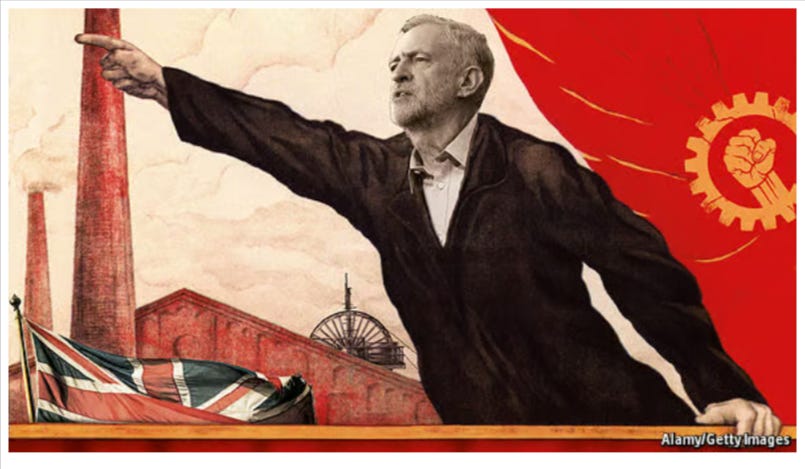
In Abigail Green’s review of Mark Mazower’s ‘On Antisemitism A word in history’ of November 28, 2025 not one mention of The Gaza Genocide, should not surprise the reagular reader of the ‘Times Newspaper’ in its various iterations: Reader recall the attacks on Jeremy Corbyn, andThe Economiststhat engaged in in like-mimded pictorial defamation:
Jeremy Corbyn is leading Britain’s left into a political timewarp. Some old ideological battles must be re-fought
Sep 19th 2015|5 min read
Editor: Reader note the use of the IHRA as the cudgel of choice, while the Genocide In Gaza continues unabated!
…
Inevitably, Mazower’s account of this situation is not neutral. It was, he writes, increasingly clear to him “that the constant invocation of antisemitism [against those protesting for Palestinian rights] needed to be understood as a refusal to acknowledge other things … that is to say, the existence of a suffering Palestinian people and their desire for freedom”. I want to let that stand; it may well be true, just as it may be true that those concerned with the “weaponization” of antisemitism refuse to acknowledge the ways in which the Palestinian movement is acting as a conduit for antisemitism into “our” society, however just its core aspirations. After all, the IHRA and the Jerusalem Declaration both agree that anti-Zionism is sometimes a form of antisemitism.
To publish such a book at this particular juncture is inevitably to intervene in a highly charged political debate. On Antisemitism is, the back cover tells us, “a vitally important attempt to draw a line that must be drawn”. Unlike Mark Mazower, whose scholarship I admire, I have not chosen to intervene in that debate, preferring instead to review his book as a work of history, which is what it purports to be. Nevertheless, I want to conclude by querying the implicit “we” that runs through its entire enterprise. “What do we mean when we talk about antisemitism?”, it asks. To answer that question in today’s global world, “we” need to consider a broad range of agents and publics. The narrative provided here does centre Jewish voices, but it consistently privileges European, American and (in Israel) Ashkenazi players and perspectives over those of others.
Obviously, we all know it’s a conspiracy theory that Jeffrey Epstein was a Mossad agent running a honeypot to blackmail our politicians, but weirdly, it turns out Epstein was behaving exactly like a Mossad agent. Personally, I can’t work out why that might be…
We now know that Epstein brokered deals for Israeli intelligence, such as “security agreements” with Côte d’Ivoire and Mongolia to turn them into mass surveillance states. The goal was to build a “cyber weapons empire” for Israel with the help of the Rothschild Group.
You would hope that similar could not possibly happen in the UK, but consider how the government is attacking civil liberties to protect Israel, how peaceful protesters are treated as terrorists, how we are losing the right to trial by jury, how we need ID to access websites, and how digital ID is coming, thanks to a push from Zionists such as Larry Ellison.
Obviously, Epstein is not behind any of this (unless he’s still alive somewhere), but that doesn’t mean the same dark forces are not at play. The intelligence agency behind a paedophile ring is still pulling the strings…
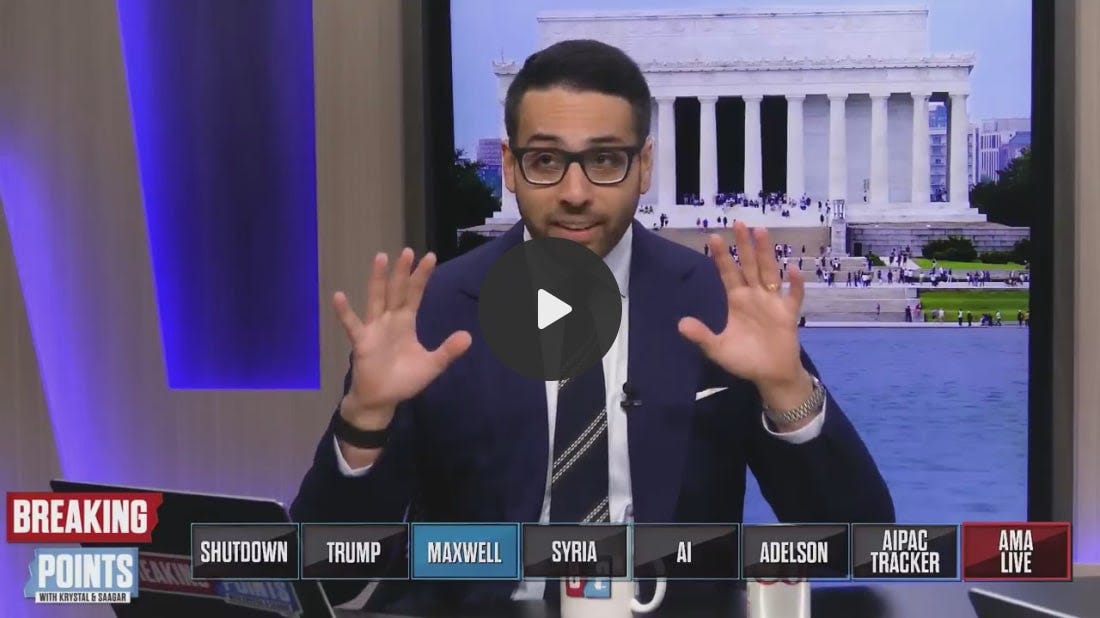
It seems not a day goes by when we are not learning more about Epstein’s connections to Israel. For example, the outstanding Drop Site News has revealed that Epstein worked with lawyer Alan Dershowitz back in the 2000s to attack academics John Mearsheimer and Stephen Walt. The pair had co-authored a paper that was published by Harvard Kennedy School that was titled: “The Israel Lobby and U.S. Foreign Policy.”
As you all know, we are supposed to pretend the Israel lobby doesn’t exist, even while AIPAC hosts events, bragging about how it shapes US policy. However, Mearsheimer and Walt somehow got an academic paper published that breaks down exactly how the Israel lobby influences US policy towards the Middle East. Honestly, I’m surprised they weren’t jailed or suicided for this.
Drop Site News describes the paper as follows:
The paper, which ran in the London Review of Books and became the basis for a book published the following year, was an unflinching analysis of the impact of pro-Israel advocacy and lobbying groups on the U.S. political system, and the role of organizations like the American Israel Public Affairs Committee (AIPAC) in shaping U.S. foreign policy towards the Middle East.
While the paper was entirely factual, the details were largely ignored by the media, and Mearsheimer and Walt were smeared as antisemites for writing it. The Atlantic commissioned the piece then paid Mearsheimer and Walt a $10,000 “kill fee” when the publication backed out due to “sensitivity concerns”. Note how it’s always insensitive to tell the truth about Israel…
The Anti-Defamation League called the paper an “anti-Jewish screed”, which is interesting because when evidence emerges of other countries, such as Russia or China, meddling in western politics, no one is accused of racism. It’s almost like we have a massive double-standard…
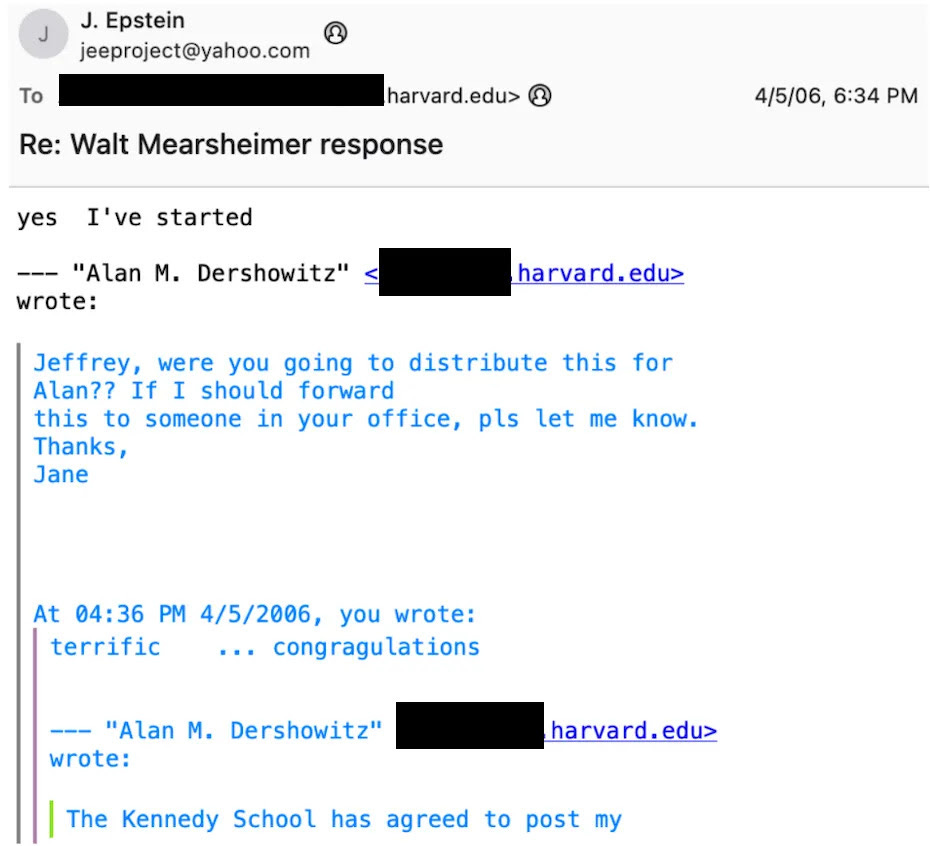
The evidence has revealed that Epstein used his extensive social networks to push talking points, smearing Mearsheimer and Walt. That evidence comes in the form of a trove of emails obtained by Distributed Denial of Secrets. The email cache has been authenticated by Bloomberg via cryptographic verification.
The emails show that Epstein was the recipient of drafts of an attack piece written by Harvard law professor Alan Dershowitz, titled: “Debunking the Newest – and Oldest – Jewish Conspiracy.” The email chain confirms that Epstein distributed the piece for Dershowitz. Yes, it looks like the Israel lobby conspired to… debunk the conspiracy theory of the Israel lobby. What do you even say?
Dershowitz’s ties to Epstein run much deeper than the attack piece, as he represented Epstein as a lawyer. In 2005, a 14-year-old girl reported to police that she had been sexually assaulted at Epstein’s mansion. Epstein hired a private investigator to look into the girl and sent information to Dershowitz to undermine her testimony.
In the correspondence, Epstein accused the girl of being sexually active and using drugs, and he attacked the character of her family members. Epstein later pleaded guilty to watered down charges and served 13 months in prison where he was bizarrely allowed out for 12 hours per day, six days per week.
Consider that a man, who later became a convicted sex offender, was conspiring to ruin the careers of two academics for being critical of Israel. In doing so, he inadvertently proved the claims of Mearsheimer and Walt to be correct.
Now consider how the powerful people, who line up to discredit figures like Mearsheimer and Walt, have been so determined to protect Epstein’s clients. Seems strange that they would choose that hill to die on, doesn’t it?
If you’ve ever wondered what Epstein was up to, I’m gonna use my psychic powers to suggest that his contacts in the media and political circles were so willing to push Zionist propaganda, precisely because most of them visited his rape mansions.
Of course, Epstein’s influence also came from his considerable wealth so let’s not discount the possibility of bribery. For example, Epstein was considered an influential figure at Harvard, despite holding no official role, because he donated $9 million over a ten-year period. Why should anyone have influence over a university, simply because they have deep pockets? Can you see how western governments and institutions can be so easily captured by foreign state actors?
Epstein had strong ties to Israeli politicians such as former prime minister Ehud Barak, which was proven through hacked emails released by Palestinian group Handela. Epstein met with CIA Director William Burns and Barack Obama’s top lawyer Kathryn Ruemmler dozens of times. An Israeli spy lived for weeks in one of his mansions in Manhattan.
Editor: Mr. Stephens is given to playing many roles, and all of them not just self-serving, but execises in a reliable moral/political mendacity, and in this case heavely garnished with historical/political kitsch!
…
That’s the genius of the holiday. Nobody — except your uncle — likes to talk about politics at the Thanksgiving table. Nobody should need to, either, because the occasion itself is inherently political. It’s an opportunity for families and friends and, by extension, communities, states and the country itself, to have a national reset. It’s when we remember that we can still be capable of setting everyday arguments aside, of recalling common bonds, of indulging a soft patriotism that’s also potent because it’s so unobjectionable. Thanksgiving, far more than the star-spangled Fourth of July, is what makes us Americans all over again.
That was also the spirit of the Gettysburg Address, another purported act of remembrance of the dead that is, in fact, an opportunity for rededication by the living — a “new birth of freedom.” The question for successive generations of Americans is: What kind of freedom should it be?
For Lincoln, the new birth meant saving government of, by, and for the people, and a nation where all are equal. For Hale, it meant extending the boundaries of opportunity for women. For Thomas Edison, it was about advancing the reach of science: In 1877, just 14 years after the first national Thanksgiving and while Hale was still alive, he read “Mary Had a Little Lamb” for the first-ever phonograph recording.
Down the generations, what we can most give thanks for isn’t just abundance. It’s the abundance of freedom, created by people for whom possibility and renewal, even in a world of bitterness, was theirs — and ours — to seize.
Editor: What actual writer/thinker would resort to the notion that the Devil is an active presence in the life of Americans or ‘Others’ ? The title of Haidt book is laced with respectable Academic Chatter and features The Devil and ChatGPT, as reliable source of viable information about the possible Future of American Youth? Some of us might conger up the Orson Wells movie classic of ‘Black Magic’as a kind of enterainment that hides what Haidt embraces?
I approach spirituality as a social scientist who believes that whether or not God exists, spirituality is a deep part of human nature, shaped by natural selection and cultural evolution, and central to human flourishing and self-transcendence. Our “better angels” call us upward and out of our daily concerns.
Editor: In the rest of this essay, I reprint Chat’s seven-step plan, in italics, followed by my own commentary.
1. Erode Attention and Presence
2. Confuse Identity and Purpose
3. Flood Them with Information, Starve Them of Wisdom
4. Replace Real Relationships with Simulacra
5. Normalize Hedonism, Pathologize Discipline
6. Undermine Trust Across Generations
7. Make Everything a Marketplace
Editor: Mr. Haidt missed the toxic assent of Neo-Liberalism inagurated by Mrs. Thatcher and Ronald Reagan and their epigones across The West!
Conclusion: Learning from the Red Team
Editor: The final paragraphs of Haights essaycrowned with‘We can save future generations from spiritual devastation’ reeks of a Billy Graham crusade!
When enacted together, these four norms roll back the phone-based childhood and give children time and opportunities to play, develop friendships, read books, grow a stable identity, and learn to pay sustained attention.
We can save future generations from spiritual devastation. We can bring down those high rates of agreement that “life often feels meaningless.” We can—and must—defeat the Devil and reclaim childhood in the real world.
Editor: Robert Silvers, of the New York Review of Books, provided space for Timothy Snyder’s hysteria mongering about Putin’s War against Ukraine that is reaching it’s toxic end stage: Silvers and Snyder were/are the not quite vestages of a ‘Cold War’ that was rekindled by Bush The Younger’s ‘War Against Terror’? Not quite proximate enough? Snyder opening paragarphs are revelatory of his ‘History Made To Measure’!
The history of diplomacy is full of strangeness. Touch the surface of the dusty books and peculiar characters spring forth to demand that their tales be heard. And yet the American diplomacy of the past few days, I believe, will stand out as something peculiarly gruesome — not simply incompetent, but openly courting national and global catastrophe.
A document suddenly appeared a few days ago under the inapplicable (and too-often repeated) heading of “peace plan” regarding the Russo-Ukrainian war. It would be more accurately described as a plan to intensify the war to the profit of a few Russians and Americans. It seems to have produced entirely or mostly by Russians, and then leaked by a Russian negotiator to an American outlet. It was then claimed by a fraction within the White House, endorsed (sight unseen) by the president of the United States, who insisted (at least at first) that Ukraine had to accept it.
Since then there have been many denials, denials of denials, and obfuscations. The scandal will perhaps clarify problems of process in Washington. It is not that we — America — are trying to sell out Ukraine. American public opinion is favorable to Ukraine. Republican voters support Ukraine. A majority in Congress supports Ukraine. It is rather that a few Russians and a few Americans have the ability to define as a “peace plan” what is essentially the furtherance of personal economic interests combined with a strengthening of Russia’s capacity for warfighting and a weakening of Ukraine’s. Along the way, it contradicts every major principle of international law and furthers a world dominated by China and its Russian ally.
This suggests the absence of American statecraft.
It looks a lot like (details below) that Russians are seeking to bribe Americans to allow Russia to win a war it would otherwise lose. Having allowed Russians in this instance to design our policy, we then rely on our European and Ukrainian allies to serve as a check on us. We (or rather some powerful Americans) scold them for doing what they have to do, not only in their own interests but in ours and in the interest of avoiding general disaster. A
So much for procedure.
This document that begins in a Russian unreality. Rather than summarizing what has actually happened, a Russian invasion of Ukraine, the authors work instead to communicate the implicit premises that the war was caused by the West, and that Ukraine is not in fact a real country. Its total silence on the basic facts of the Russian invasion leads to the conclusion that Russia should be celebrated and rewarded — as should specific American individuals.
…
Editor: In a mere 28 paragraphs Snyder exhausts the readers patience! Reader here is a reminder of the Bad Actors in the beginning of the Ukraine Coup melodrama of 2014!
Ukraine crisis: Transcript of leaked Nuland-Pyatt call
An apparently bugged phone conversation in which a senior US diplomat disparages the EU over the Ukraine crisis has been posted online. The alleged conversation between Assistant Secretary of State Victoria Nuland and the US Ambassador to Ukraine, Geoffrey Pyatt, appeared on YouTube, external on Thursday. It is not clearly when the alleged conversation took place.
Here is a transcript, with analysis by BBC diplomatic correspondent Jonathan Marcus:
Warning: This transcript contains swearing.
Voice thought to be Nuland’s: What do you think?
Jonathan Marcus: At the outset it should be clear that this is a fragment of what may well be a larger phone conversation. But the US has not denied its veracity and has been quick to point a finger at the Russian authorities for being behind its interception and leak.
Voice thought to be Pyatt’s: I think we’re in play. The Klitschko [Vitaly Klitschko, one of three main opposition leaders] piece is obviously the complicated electron here. Especially the announcement of him as deputy prime minister and you’ve seen some of my notes on the troubles in the marriage right now so we’re trying to get a read really fast on where he is on this stuff. But I think your argument to him, which you’ll need to make, I think that’s the next phone call you want to set up, is exactly the one you made to Yats [Arseniy Yatseniuk, another opposition leader]. And I’m glad you sort of put him on the spot on where he fits in this scenario. And I’m very glad that he said what he said in response.
Jonathan Marcus: The US says that it is working with all sides in the crisis to reach a peaceful solution, noting that “ultimately it is up to the Ukrainian people to decide their future”. However this transcript suggests that the US has very clear ideas about what the outcome should be and is striving to achieve these goals. Russian spokesmen have insisted that the US is meddling in Ukraine’s affairs – no more than Moscow, the cynic might say – but Washington clearly has its own game-plan. The clear purpose in leaking this conversation is to embarrass Washington and for audiences susceptible to Moscow’s message to portray the US as interfering in Ukraine’s domestic affairs.
Nuland: Good. I don’t think Klitsch should go into the government. I don’t think it’s necessary, I don’t think it’s a good idea.
Pyatt: Yeah. I guess… in terms of him not going into the government, just let him stay out and do his political homework and stuff. I’m just thinking in terms of sort of the process moving ahead we want to keep the moderate democrats together. The problem is going to be Tyahnybok [Oleh Tyahnybok, the other opposition leader] and his guys and I’m sure that’s part of what [President Viktor] Yanukovych is calculating on all this.
Nuland: [Breaks in] I think Yats is the guy who’s got the economic experience, the governing experience. He’s the… what he needs is Klitsch and Tyahnybok on the outside. He needs to be talking to them four times a week, you know. I just think Klitsch going in… he’s going to be at that level working for Yatseniuk, it’s just not going to work.
Pyatt: Yeah, no, I think that’s right. OK. Good. Do you want us to set up a call with him as the next step?
Nuland: My understanding from that call – but you tell me – was that the big three were going into their own meeting and that Yats was going to offer in that context a… three-plus-one conversation or three-plus-two with you. Is that not how you understood it?
Pyatt: No. I think… I mean that’s what he proposed but I think, just knowing the dynamic that’s been with them where Klitschko has been the top dog, he’s going to take a while to show up for whatever meeting they’ve got and he’s probably talking to his guys at this point, so I think you reaching out directly to him helps with the personality management among the three and it gives you also a chance to move fast on all this stuff and put us behind it before they all sit down and he explains why he doesn’t like it.
Nuland: OK, good. I’m happy. Why don’t you reach out to him and see if he wants to talk before or after.
Pyatt: OK, will do. Thanks.
Nuland: OK… one more wrinkle for you Geoff. [A click can be heard] I can’t remember if I told you this, or if I only told Washington this, that when I talked to Jeff Feltman [United Nations Under-Secretary-General for Political Affairs] this morning, he had a new name for the UN guy Robert Serry did I write you that this morning?
Jonathan Marcus: An intriguing insight into the foreign policy process with work going on at a number of levels: Various officials attempting to marshal the Ukrainian opposition; efforts to get the UN to play an active role in bolstering a deal; and (as you can see below) the big guns waiting in the wings – US Vice-President Joe Biden clearly being lined up to give private words of encouragement at the appropriate moment.
Pyatt: Yeah I saw that.
Nuland: OK. He’s now gotten both Serry and [UN Secretary General] Ban Ki-moon to agree that Serry could come in Monday or Tuesday. So that would be great, I think, to help glue this thing and to have the UN help glue it and, you know, Fuck the EU.
Jonathan Marcus: Not for the first time in an international crisis, the US expresses frustration at the EU’s efforts. Washington and Brussels have not been completely in step during the Ukraine crisis. The EU is divided and to some extent hesitant about picking a fight with Moscow. It certainly cannot win a short-term battle for Ukraine’s affections with Moscow – it just does not have the cash inducements available. The EU has sought to play a longer game; banking on its attraction over time. But the US clearly is determined to take a much more activist role.
Pyatt: No, exactly. And I think we’ve got to do something to make it stick together because you can be pretty sure that if it does start to gain altitude, that the Russians will be working behind the scenes to try to torpedo it. And again the fact that this is out there right now, I’m still trying to figure out in my mind why Yanukovych (garbled) that. In the meantime there’s a Party of Regions faction meeting going on right now and I’m sure there’s a lively argument going on in that group at this point. But anyway we could land jelly side up on this one if we move fast. So let me work on Klitschko and if you can just keep… we want to try to get somebody with an international personality to come out here and help to midwife this thing. The other issue is some kind of outreach to Yanukovych but we probably regroup on that tomorrow as we see how things start to fall into place.
Nuland: So on that piece Geoff, when I wrote the note [US vice-president’s national security adviser Jake] Sullivan’s come back to me VFR [direct to me], saying you need [US Vice-President Joe] Biden and I said probably tomorrow for an atta-boy and to get the deets [details] to stick. So Biden’s willing.
Pyatt: OK. Great. Thanks.
Jonathan Marcus: Overall this is a damaging episode between Washington and Moscow. Nobody really emerges with any credit. The US is clearly much more involved in trying to broker a deal in Ukraine than it publicly lets on. There is some embarrassment too for the Americans given the ease with which their communications were hacked. But is the interception and leaking of communications really the way Russia wants to conduct its foreign policy ? Goodness – after Wikileaks, Edward Snowden and the like could the Russian government be joining the radical apostles of open government? I doubt it. Though given some of the comments from Vladimir Putin’s adviser on Ukraine Sergei Glazyev – for example his interview with the Kommersant-Ukraine newspaper the other day – you don’t need your own listening station to be clear about Russia’s intentions. Russia he said “must interfere in Ukraine” and the authorities there should use force against the demonstrators.
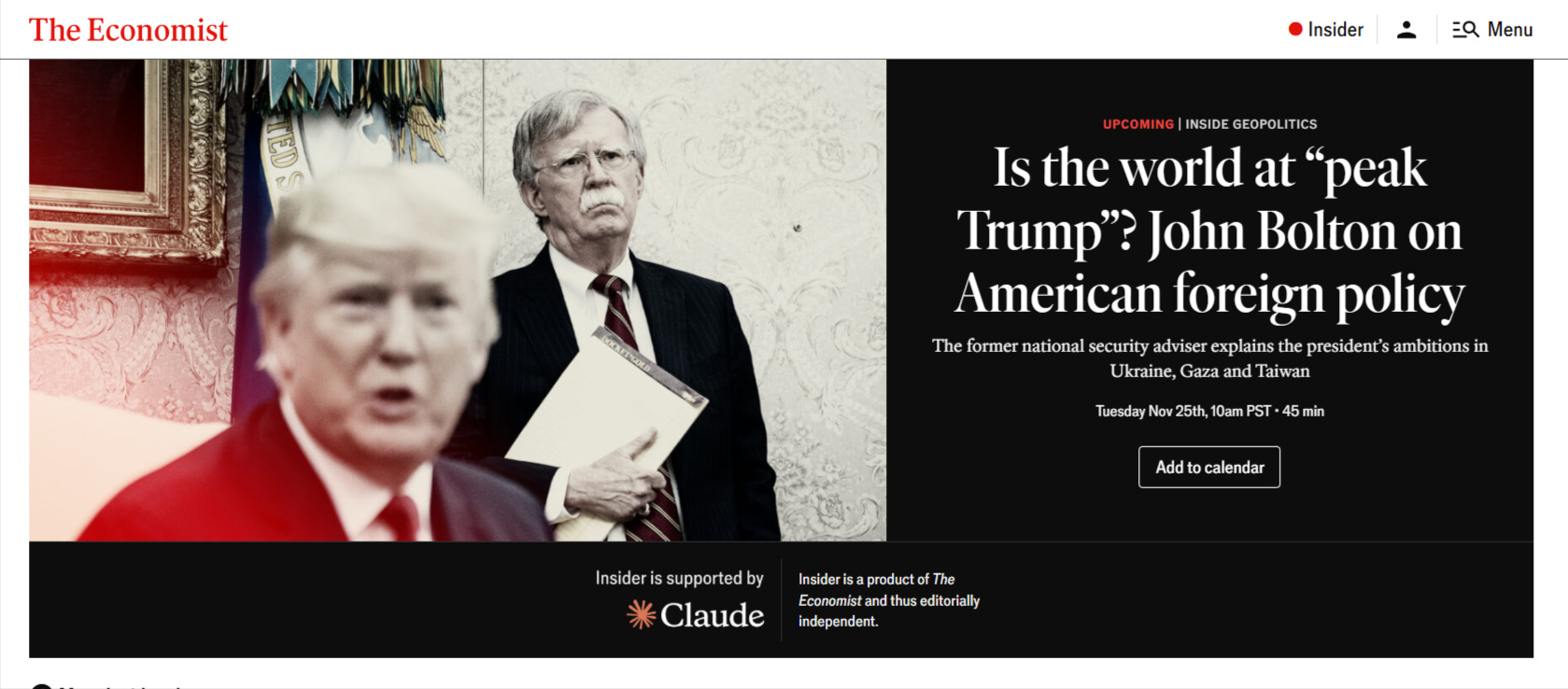
Editor: The ‘Thucydides’s trap’ first appeared as an esssay and then a book. In 2015 as an article, and again in 2017 in book form. But Lydia Polgreen in her political desperation to impress The New York Times reader: her first paragraphs almost sing?
In Washington, a decade of rancorous polarization just gave us the longest ever government shutdown. But one belief has endured on both sides of the aisle: that the world order, built and led by the United States, is under threat from China, which aims to usurp America’s rightful place atop it.
There’s a phrase that encapsulates the theory: the Thucydides trap, referring to the violent clash that comes when a rising power challenges the ruling hegemon. In Thucydides’ time, it was Athens that successfully challenged the pre-eminence of Sparta. But it is a pattern that has played out repeatedly through history, with the ambition and aggression of the challenger almost always ending in bloodshed.
…
In a startling reversal, it is America, not China, that seems determined to spring Thucydides’ trap. At the world’s summit, America is overthrowing America.
Editor: In mere moments Lydia Polgreen will be near full gallopp?
Editor: Here Graham Allisonwrites for The Financial Times of August 21,2012
Headline: Thucydides’s trap has been sprung in the Pacific
Sub-headline: China and America are the Athens and Sparta of today, says Graham Allison
China’s increasingly aggressive posture towards the South China Sea and the Senkaku Islands in the East China Sea is less important in itself than as a sign of things to come. For six decades after the second world war, an American “Pax Pacifica” has provided the security and economic framework within which Asian countries have produced the most rapid economic growth in history. However, having emerged as a great power that will overtake the US in the next decade to become the largest economy in the world, it is not surprising that China will demand revisions to the rules established by others.
The defining question about global order in the decades ahead will be: can China and the US escape Thucydides’s trap? The historian’s metaphor reminds us of the dangers two parties face when a rising power rivals a ruling power – as Athens did in 5th century BC and Germany did at the end of the 19th century. Most such challenges have ended in war. Peaceful cases required huge adjustments in the attitudes and actions of the governments and the societies of both countries involved.
Classical Athens was the centre of civilisation. Philosophy, history, drama, architecture, democracy – all beyond anything previously imagined. This dramatic rise shocked Sparta, the established land power on the Peloponnese. Fear compelled its leaders to respond. Threat and counter-threat produced competition, then confrontation and finally conflict. At the end of 30 years of war, both states had been destroyed.
Thucydides wrote of these events: “It was the rise of Athens and the fear that this inspired in Sparta that made war inevitable.” Note the two crucial variables: rise and fear.
The rapid emergence of any new power disturbs the status quo. In the 21st century, as Harvard University’s Commission on American National Interests has observed about China, “a diva of such proportions cannot enter the stage without effect”.
Never has a nation moved so far, so fast, up the international rankings on all dimensions of power. In a generation, a state whose gross domestic product was smaller than Spain’s has become the second-largest economy in the world.
If we were betting on the basis of history, the answer to the question about Thucydides’s trap appears obvious. In 11 of 15 cases since 1500 where a rising power emerged to challenge a ruling power, war occurred. Think about Germany after unification as it overtook Britain as Europe’s largest economy. In 1914 and in 1939, its aggression and the UK’s response produced world wars.
…
To recognise powerful structural factors is not to argue that leaders are prisoners of the iron laws of history. It is rather to help us appreciate the magnitude of the challenge. If leaders in China and the US perform no better than their predecessors in classical Greece, or Europe at the beginning of the 20th century, historians of the 21st century will cite Thucydides in explaining the catastrophe that follows. The fact that war would be devastating for both nations is relevant but not decisive. Recall the first world war, in which all the combatants lost what they treasured most.
In light of the risks of such an outcome, leaders in both China and the US must begin talking to each other much more candidly about likely confrontations and flash points. Even more difficult and painful, both must begin making substantial adjustments to accommodate the irreducible requirements of the other.
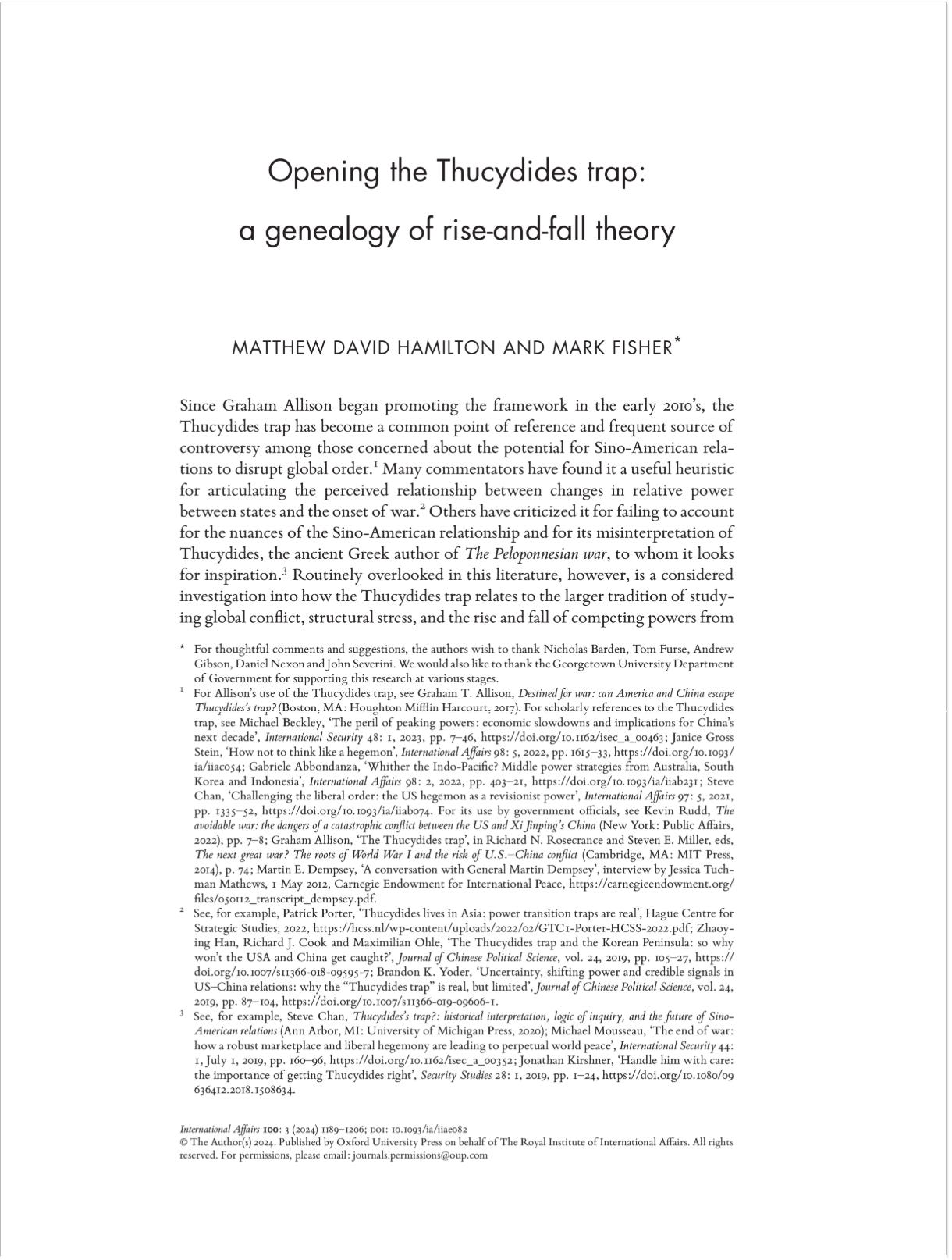
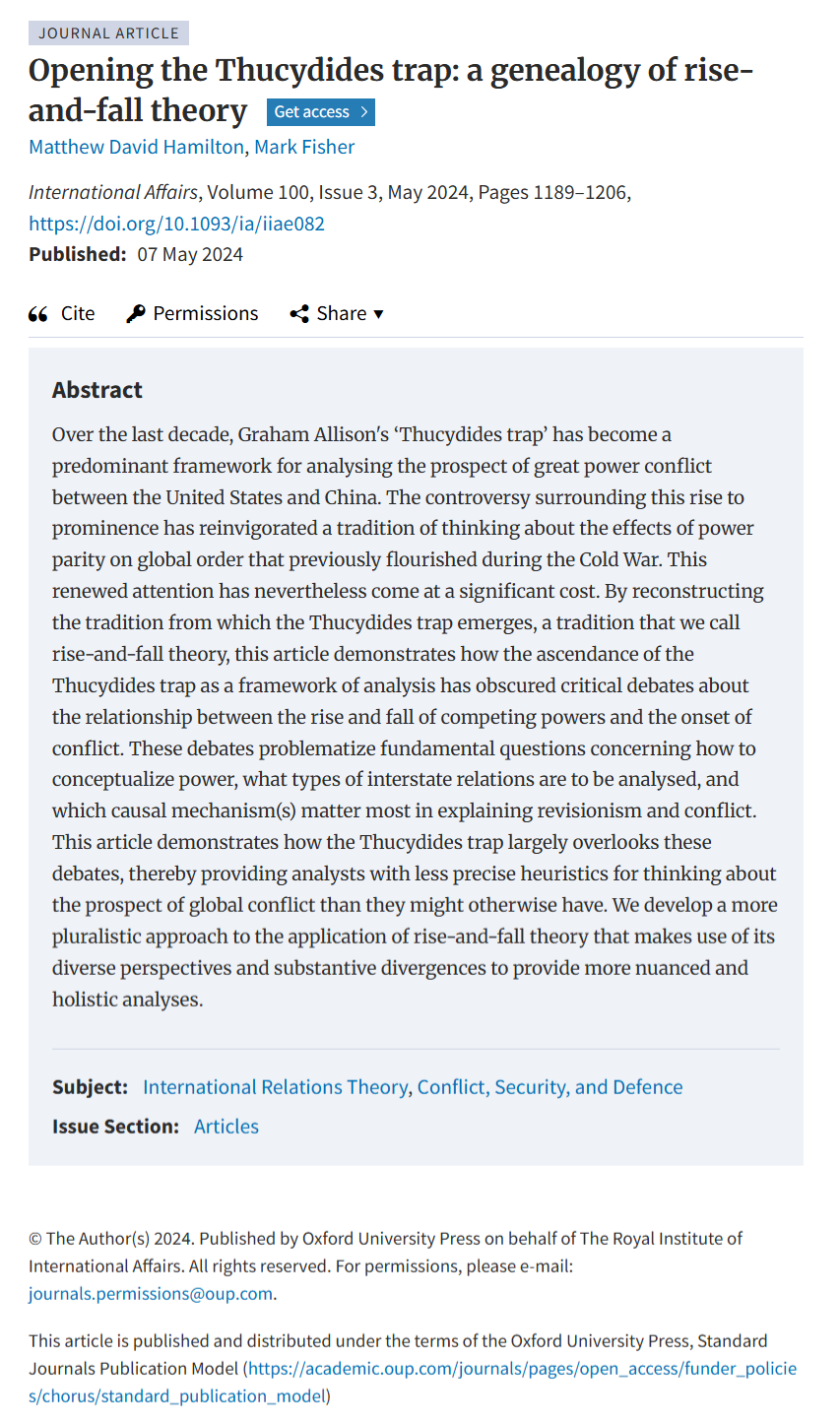
Editor: Reader consider this from Matthew David Hamilton, Mark Fisher:
Editor: A collection of telling quotes from Lydia Polgreen’ near political monstrosity!
Trump or no, the military adventurism of the past two decades has become an unmistakable sign of decline. “If we’re having to maintain primacy by invading this country that’s not posing a threat to us and launching a global campaign of antiterror, clearly, we’re on the decline,” Van Jackson, a progressive foreign policy scholar and an author of “The Rivalry Peril,” told me. “It has always been the case in these cycles of history that when the dominant power starts investing and playing this military role globally, you have rising powers who are stepping up, playing a more important economic role globally.”
History is littered with examples of the dangers of aggression for declining powers — Spain’s crusading military folly in the 16th century, the late Ottoman Empire’s embrace of ethnic nationalism, Britain’s vain attempt to cling to its unsustainable imperial position between the world wars. Each ended the same way: an astonishingly rapid loss of power and prestige on the global stage.
…
This leads to an irresistible irony. Far from beating back China, America under Trump may come to resemble it. The country is on its way: obsessed with regime stability and willing to use almost any means to keep its people under control; jealously guarding its near periphery while remaining largely uninterested in leading the world; and building a cult of personality around its autocratic leader in an atmosphere of ethnonationalist triumphalism.
Trump, despite his vituperative campaign rhetoric, has never really been a China hawk, even if some around him have led the charge for more aggressive policies to blunt China’s might. Indeed, he has often lavished praise on Xi Jinping, a man who has the kind of virtually limitless power Trump clearly craves. “President Xi is a great leader of a great country,” Trump cooed at their meeting in South Korea last month.
…
China is playing a much longer and more sophisticated game. Premier Li Qiang, Xi’s top emissary, will be in Johannesburg, accompanied by a vast retinue of officials, ready to talk with the world’s major economies about the problems and possibilities of the emerging multipolar order.
As its primacy fades, the United States now faces a choice: meet rising nations as respected partners in building a new, more equitable multipolar world or seek the costly, brittle power that comes from domination. Trump has chosen the latter; China, it seems, seeks the former. History tells us which path leads to peace and prosperity, and which is the road to ruin.



 StephenKMackSD's Blog