On the desperation of The New Republic, in featuring John Yoo of the toxic lie of ‘The Unitary Executive’!

Newspaper Reader on the utterly bankruptcy of Michael Tomasky, apologist for the failure of the New Democrats, since the Neo-Liberalism of Bill & Hillery to the political present!

stephenkmacksd.com/

Dec 11, 2025

Even George W. Bush’s Torture Guy Thinks Trump Is Crossing the Line

John Yoo says the Trump’s “drug boat” strikes are clearly illegal.

John Yoo

Melissa Golden/Getty Images

Even the Justice Department lawyer who defended the George W. Bush administration’s decisions to waterboard, bind, and sleep-deprive prisoners in the infamous 9/11 “Torture Memos” of 2002 thinks the Trump administration’s drug boat strikes are going too far.

“I don’t think there’s an armed attack” against the United States by the drug cartels, law professor John Yoo, the former Bush DOJ deputy assistant attorney general, told Politico in a Thursday article.


Unitary Executive Theory (UET)

The unitary executive theory (UET) is a constitutional law theory holding that the President of the United States possesses sole authority over the executive branch. Supporters trace the theory’s origins to debates at the Constitutional Convention of 1787, particularly the Virginia Plan, which emphasized a single executive.

The most controversial aspect of the theory concerns the President’s removal power. Under the UET, the President may remove appointed executive branch officials without approval from Congress or the courts. The Supreme Court has addressed the scope of this power in a series of cases. In Myers v. United States, 272 U.S. 52 (1926), the Court held that the President has exclusive authority to remove executive officers. Later decisions, such as Humphrey’s Executor v. United States, 295 U.S. 602 (1935), and Morrison v. Olson, 487 U.S. 654 (1988), placed limits on removal where Congress created independent agencies or officers with quasi-legislative or quasi-judicial functions. More recently, the Court has shifted back toward the UET view, striking down removal protections for certain executive officials. In Seila Law LLC v. Consumer Financial Protection Bureau, 591 U.S. 197 (2020), the Court held that Congress could not insulate the Consumer Finance Protection Bureau’s single director from at-will removal. In Collins v. Yellen, 594 U.S. 220 (2021), the Court similarly held that the structure of the Federal Housing Finance Agency violated the separation of powers because its single director was not removable at will by the President. The case Slaughter v. Trump, 606 U.S. ___ (2025) raises removal power issues anew: the Supreme Court considered the President’s removal of an FTC commissioner without cause, revisiting the scope of congressional authority to insulate executive officers from at-will removal.

[Last reviewed in September of 2025 by the Wex Definitions Team]

https://www.law.cornell.edu/wex/unitary_executive_theory_%28uet%29

Newspaper Reader.

Posted in Uncategorized | Leave a comment

The Political Hysteria of Zionist shill Bret Stephens, in The New York Times, isn’t just about shoddy note keeping?

Newspaper Reader.

stephenkmacksd.com/

Dec 10, 2025

Editor: The paragraphs below set the scene for the patient reader, who can just about see through Stephen’s particular expression of Doom and Gloom! About a West that will experience the end of the Ukraine War, in mere Historical Moments, while willfully forgeting 2014, and the myard crimes of E.U. and America that attented to ressurect a version of The Cold War with more current toxic political actors! Mr. Stephens has carefully tinctured his New Cold War chatter that reminds this reader of lowbrough Oswald Spengler!

If Germany were invaded, just 38 percent of its citizens would be willing to fight for their country, according to a recent poll. Fifty-nine percent would not. In Italy, another poll found that only 16 percent of those of fighting age would take up arms. In France, Gen. Fabien Mandon, the army’s chief of staff, told a conference of mayors last month that the nation would be “at risk” if it “wavers because we are not ready to accept losing our children.” This statement of the obvious set off a political furor.

It’s in this context that the Trump administration’s latest National Security Strategy, released last week, landed in Europe with a thud.

It’s not hard to see why. America’s chief foreign-policy priorities, according to the document, are now focused on the Western Hemisphere and Asia. The European Union stands accused of suppressing political freedom, subverting national sovereignty, obstructing economic dynamism, promoting migration policies that could lead to “civilizational erasure,” and obstructing a peaceful resolution to the war in Ukraine.

“It is far from obvious,” the document warns, “whether certain European countries will have economies and militaries strong enough to remain reliable allies.”

Editor: Reader the final paragraphs of Stephens attempt at diatribe, that is a dizzing collection of -should I call them ‘actors’‘characters’, or just the intelectual detritus of a writer relying on ‘clippings’ , that act the part of ideas, actors, or just irredeemable chatter? Note that the final reference is to the perpetually Murderious Henry Kissinger!

European politics in this century have been largely fixated on growth-killing clichés (“sustainable development”); feckless foreign-policy gestures (recognition of a nonexistent Palestinian state); self-destructive environmental policies (Germany’s decision to close its nuclear-power stations); and a virtue-signaling attitude toward mass migration (Angela Merkel’s “We can manage this”) that is the central reason fascistic parties like Alternative for Germany are surging. All this needs to end.

What should take its place? It’s a cold view of what Europe must do to protect itself in a world where it no longer has protectors. Rearmament on a massive scale. An end to dependency-producing, cost-exacerbating green energy projects. Immigration policy on the Danish model — tougher about who gets to come, who has to leave, and what immigrants must do to integrate. A return to the European Union’s original and noble purpose of opening markets and fostering competition, not being a factory for rules.

Above all, a civic revolution to persuade younger Europeans that their heritage, culture and way of life — a fundamentally Christian civilization leavened and improved but not erased by the values of the Enlightenment — are worth defending. That’s not my civilization, and even to write that line feels transgressive.

But it should also be self-evident. If Europe isn’t that, what, then, is it? If it isn’t that, why would anyone go to war for its sake? If it isn’t that, what’s to keep it from just becoming an extension of someone else’s civilization, whether that’s America’s, Russia’s or Islam’s?

Henry Kissinger once said of Donald Trump that he “may be one of those figures in history who appears from time to time to mark the end of an era and to force it to give up its old pretenses.” There are good reasons to regret this, not least in Europe. There are no good reasons to pretend it isn’t happening, or to fail to adapt.

Newspaper Reader.

Posted in Uncategorized | Leave a comment

@FT 12/9/2025

Is @FT the @NYT with bigger fangs?

stephenkmacksd.com/

Dec 09, 2025

https://www.ft.com/

Posted in Uncategorized | Leave a comment

Justice Ketanji Brown Jackson continues to upset the Supreme Court, and Jonathan Turley!?

Poltical Observer wonders at the versitility, even the indefatigability of Ketanji Brown Jackson’s thought! That it peakes Turley’ ire is …

stephenkmacksd.com/

Dec 09, 2025

Humphrey’s Estate and Jackson’s Experts: Justice Offers Surprising View of the Separation of Powers


Editor: The first paragraphs of Turley’s commentary on Ketanji Brown Jackson’s technocracy!

As is increasingly becoming the case, Justice Ketanji Brown Jackson stole the show with some of her comments on her view of the underlying constitutional issues. She suggested that “experts” in the Executive Branch generally should not be subject to termination by a president. It is a virtual invitation for a technocracy rather than a democracy.

Jackson continued her signature role in oral arguments by effectively arguing the case of one side. At points, Jackson interrupted counsel to instruct him on his “best arguments” and spoke at length to counter the questions of her conservative colleagues.

What was most striking was Jackson’s dismissal of the executive power claims in such agencies. As with Justice Elena Kagan, Jackson raised “real-world” concerns rather than articulate a clear constitutional theory supporting the creation of these hybrid bodies — part legislative and part executive — resting in the executive branch.

In confronting U.S. Solicitor General D. John Sauer (who did another masterful job) in a difficult oral argument, Jackson said she did “not understand” why “agencies aren’t answering to Congress.” Jackson simply brushed aside the fact that the president is given authority to execute the laws and that the executive branch is established under the Constitution.

The argument was maddeningly circular: since Congress created the commission, it must necessarily be Congress’s right to dictate how commissioners can serve or be fired. It was conclusory and shallow in its analysis.

Jackson expressed frustration: ‘I really don’t understand why the agencies aren’t answering to Congress. Congress established them and can eliminate them. Congress funds them, and can stop. So, to the extent that we’re concerned that there’s some sort of entity that is out of control and has no control, I guess I don’t understand that argument.”

She then added her support for a virtual technocracy:

I guess I have a very different view of the dangers, and real-world consequences of your position than what you explored with Justice Kavanaugh. My understanding was that independent agencies exist because Congress has decided that some issues, some matters, some areas should be handled in this way by non-partisan experts, that Congress is saying that expertise matters — with respect to aspects of the economy, and transportation, and the various independent agencies that we have. So, having a president come in and fire all the scientists, and the doctors, and the economists, and the PhDs, and replacing them with loyalists and people who don’t know anything, is actually not in the best interest of the citizens of the United States. These issues should not be in presidential control. So, can you speak to me about the danger of allowing, in these various areas, the president to actually control the Transportation Board and potentially the Federal Reserve, and all these other independent agencies. In these particular areas, we would like to have independence, we don’t want the president controlling. I guess what I don’t understand from your overarching argument is why that determination of Congress — which makes perfect sense given its duty to protect the people of the United States, why that is subjugated to a concern about the president not being able to control everything.

In Turley’s opinion technocracy trumps the opinions of the Court itself! Turley sees the approach of another way of viewing or approaching the law, that perhaps puts Lawyering, and the primacy of The Court, in another kind of light? Or should I call it an unwanted refraction of a kind?

Poltical Observer.

Posted in Uncategorized | Leave a comment

Does Jonathan Freedland as Public Moralist ring true?

Old Socialist wonders at political opportunism, in its various and toxic itertions?

stephenkmacksd.com/

Dec 07, 2025

Headline: The Trump administration sinks to a new low – opening fire on drowning men

Sub-headline: These deadly US boat strikes are the latest example of a president corrupting both the law and morality

https://www.theguardian.com/commentisfree/2025/dec/05/trump-administration-opening-fire-drowning-men

Editor: To say that Friedman’s political opportunism is wedded to an exercise in public shaming of Trump, and his appoitees deserves condemnation is an exercise in what? Is self-aggrandisement too strong a concept? From a man, a writer who defamed Corbyn, with a kind of gusto that Trumps minions excell at in another context? JD Vance is perhaps the example that comes to mind! Or should a writer concetrate on the misdeeds of the Historical Moment, rather than look at another revelatory Historical Moment, of the past as a kind of revelatory frame for the political present?

The Trump administration looks ever more like a criminal enterprise – and now it seems to have added war crimes to its repertoire. Though even that may be too generous a description.

On Thursday, word came that the US military had launched yet another deadly strike on a small boat moving through international waters. This time the attack killed four people, bringing to at least 87 the number of people the US has killed in a series of 22 such strikes on what it says are drug boats – vessels carrying illicit narcotics in the Caribbean or eastern Pacific.

This has been happening for months, but the issue has only just drawn political heat thanks to a Washington Post investigation of the first such attack on 2 September. The paper reported that US forces hit the targeted boat once, then hit it again – the second strike killing two survivors clinging to the wreckage. According to the Post, the defence secretary, Pete Hegseth, had issued a verbal command to “kill them all”.

Editor: With a mere 1173 words left in Freedland’s exercise in ‘High dudgeon’ left to explore, what might the reader contemplate as a possible future for the American Republic? Might that reader contemplate a senario via Fletcher Knebel & Charles W. Bailey II Seven Days in May?

Old Socialist

Posted in Uncategorized | Leave a comment

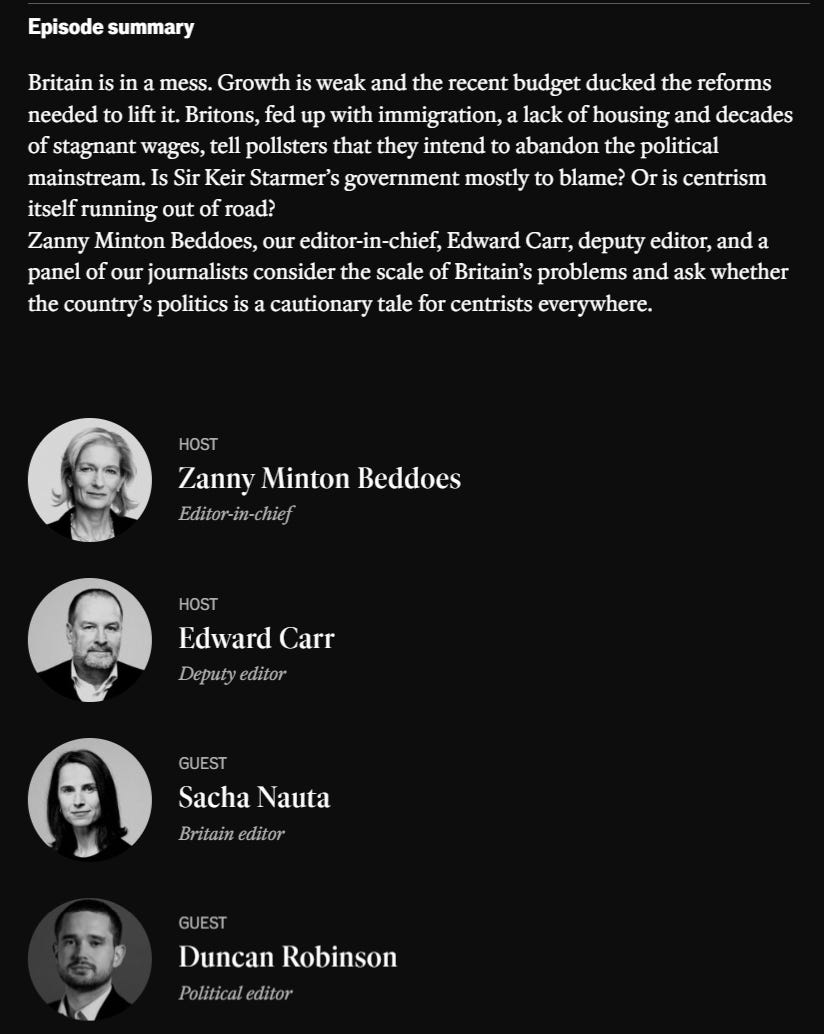
Zanny Menton Beddoes and her cadre: Edward Carr, Sacha Nauta & Duncan Robinson

Political Observer : The Reader must demand a the transcript! Even John Micklethwait and Adrian Wooldridge used the The Economist as ‘the rehersal space’ for all those BestSellers!

stephenkmacksd.com/

Dec 07, 2025

Editor: Reader take note that The Economist once had a vibrant comments section, that was discarded ! I once received two phone calls from the same represetative of The Economist as to the ‘why’ of my cancelation of my long time subscription. I was blunt! That comments section always was worthy of my time and attention, such was the quality of the comments section and its regular commentors!


Micklethwait & Wooldridge Best-Sellers:

The Company: A Short History of a Revolutionary Idea: 2005

The Fourth Revolution: The Global Race to Reinvent the State: 2014

God Is Back: How the Global Revival of Faith Is Changing the World: 2009

The Witch Doctors: Making Sense of the Management Gurus: 1996

A Future Perfect: The Challenge and Hidden Promise of Globalization: 2000

The Wake-Up Call: Why the pandemic has exposed the weakness of the West – and how to fix it: 2020

The Right Nation: Conservative Power in America : 2004


Editor: By reading Micklethwait & Wooldridge in The Economist the reader was, in essence, reading the the ‘dress rehersals’ of those Best-Sellers !

Political Observer.

Posted in Uncategorized | Leave a comment

My comment from January 22, 2012 : ‘Sol Stern on Arendt the Apostate’ by Political Cynic’.

stephenkmacksd.com/

Dec 06, 2025

Is this essay Sol Stern seeks the root of the current revival of ‘antisemitism’ to it’s origin: the great Jewish thinker and Heidegger apologist Hannah Arendt. Here we have the latest installment of the current war on the policies and practices of the Zionist state’s critics, in the guise of an intellectual history of a prominent ‘self-hating Jew’ (a term that has lost it appeal because it no longer retains its ability to shock and confound) published by The Manhattan Institute’s City Journal. Here is an informative paragraph that appears early in the essay,I quote it in full:

Since the publication of Eichmann in Jerusalem, serious scholars have debunked the most inflammatory of Arendt’s charges. Nevertheless, for today’s defamers of Israel, Arendt is a patron saint, a courageous Jewish intellectual who saw Israel’s moral catastrophe coming. These leftist intellectuals don’t merely believe, as Arendt did, that she was the victim of “excommunication” for the sin of criticizing Israel. Their homage to Arendt runs deeper. In fact, their campaign to delegitimize the state of Israel and exile it from the family of nations—another kind of excommunication, if you will—derives several of its themes from Arendt’s writings on Zionism and the Holocaust. Those writings, though deeply marred by political naivety and personal rancor, have now metastasized into a destructive legacy that undermines Israel’s ability to survive as a lonely democracy, surrounded by hostile Islamic societies.”

Mr. Stern has mapped the territory of his polemic, so the rest is simply elaboration on his chosen theme. What we do know from Young-Bruehl’s biography of Arendt is that she had an agreement with her professors, that she would leave her classes if the antisemitic remarks by her fellow students became too much. So her consciousness of her Jewishness was a phenomenon that probably came earlier that Mr. Stern indicates in his essay. Although that piece of key evidence might just subvert the political intention of his piece, even if it’s impact be minimal to his argument. That Arendt and many young intellectuals including, Karl Löwith, Hans Jonas, Herbert Marcus were spellbound by the lectures of Heidegger, he taught a generation of German students. Consult :The Young Heidegger,Rumor of the Hidden King by John van Buren and Heidegger’s Children by Richard Wolin.

In this long essay Mr. Stern merely sketches the political missteps, bad faith and political naivete of Arendt on the Zionist question that serves his narrative thrust, that she was an apostate to the followers of the evolving party line of mainstream Zionism: she was radically independent, she went her own way, a dissenter. That is the problem with Arendt, she thought independently and expressed herself forcefully;her intellectual heirs share her problem. The party line is not served by dissenters, by apostates. (Let me conjecture here that Arendt was in all likelihood one of the few women involved in any capacity with the formation of the state of Israel, at least in its intellectual dimension: she was a lone female voice in a field dominated by men habituated to their patriarchal privilege.) That is the central argument is this piece of backhanded propaganda, masquerading as intellectual history,updated to serve the needs of present day apologists for the self-destructive nihilism of Israeli politics.

But let me quote the prescient Arendt on the future of Israel, that seems to elude Mr. Stern’s intellectual and argumentative grasp.

degenerate into one of those small warrior tribes about whose possibilities and importance history has amply informed us since the days of Sparta. Their relations with world Jewry would become problematical, since their defense interests might clash at any moment with those of other countries where large numbers of Jews lived. Palestine Jewry would eventually separate itself from the larger body of world Jewry and in its isolation develop into an entirely new people. Thus it becomes plain that at this moment and under present circumstances a Jewish state can only be erected at the price of the Jewish homeland.”

This could be a description of the fortress state of contemporary Israel, although Mr. Stern misses it’s currency. Another quote from near the end of this seemingly interminable indictment:

Making the charges all the more outrageous is that we now know that she herself, at the time of the trial, was voluntarily engaged in a collaboration of sorts with Heidegger, who never repented for his Nazi allegiance. According to the historian Richard Wolin, Arendt served “as Heidegger’s de facto American literary agent, diligently overseeing contracts and translations of his books.”

Arendt always spoke to the fact that her work owed its genesis to the philosophical project of Heidegger, and that she maintained a deep intellectual connection and affection for him. Was he worth her loyalty and affection? Perhaps we should ask the same question of Marcuse, Jaspers, Gadamer, Löwith, and a host of his other students. I have chosen to comment on certain sections of Mr. Stern’s long polemic against Arendt, as apostate, but let me quote from the end of most telling paragraph:

Those writings, though deeply marred by political naivety and personal rancor, have now metastasized into a destructive legacy that undermines Israel’s ability to survive as a lonely democracy, surrounded by hostile Islamic societies.”

Israel has the best equipped and trained military out side of the USA, that is America’s 147 billion dollars military investment, our unmanageable protectorate. It has between 100 and 400 atomic weapons and the capability and the means to deliver them. Israel is neither beleaguered nor threatened, except in the collective mind of certain political factions, whose reason to be is to stir up war fever against Iran: the only ‘Middle East Democracy’ flourishes on an unending flow of American dollars.

Political Cynic

Posted in Uncategorized | Leave a comment

How Hannah Arendt Helps Us Understand Our World Fifty years after her death in New York, Hannah Arendt has become the most popular philosopher of our time. For good reason: Her views are just as timel

https://derspiegel.substack.com/p/how-hannah-arendt-helps-us-understand

stephenkmacksd.com/

Dec 06, 2025

By Tobias Rapp

It must be so nice to play Hannah Arendt. No fewer than five actresses are on stage this evening at the Deutsches Theater Berlin to portray the philosopher. The piece is an adaptation of the graphic novel by American illustrator Ken Krimstein about the philosopher’s life, called “The Three Escapes of Hannah Arendt,” combined with scenes from the famous interview that journalist Günter Gaus conducted with Arendt in 1964 for German public broadcaster ZDF.

Five actresses, then. They play Arendt and a few of her contemporaries, the philosopher Martin Heidegger, the writer Walter Benjamin, her husband Heinrich Blücher. There is a great deal of speech in the play, especially from Arendt herself. The places of her life are ticked off, her childhood in Königsberg, her student years in Marburg and the affair with Heidegger. Life in Berlin in the early 1930s and her flight from Germany when the Nazis came to power. Exile in Paris and arrival in New York, where she then became known as a political theorist in the early 1950s.

It is clever, sometimes also funny, and when the five actresses stand on stage at the end and receive the audience’s applause while standing next to a small table piled with Arendt’s books, the whole thing is a bit reminiscent of “I’m Not There,” that film in which five actors (and one Cate Blanchett) play Bob Dylan.

Bob Dylan though? Is that the category we’re speaking about when we talk about Hannah Arendt?

She passed away 50 years ago. She suffered a heart attack on December 4, 1975. As a result, she was unable to complete her last book, which was supposed to be called “The Life of the Mind.” She was well-known at the time, but far from famous.

Half a century later, she is everywhere. The Thalia Theater in Hamburg just premiered a play in which Corinna Harfouch plays the philosopher; and an Arendt play is also running in Stuttgart. Two new biographies have just been published, even though one came out just two years ago. There are now at least a dozen of them. A film about Arendt also hit the silver screen in late summer. Every politician who has ever held a book in their hand has dropped a few sentences about Arendt in an interview. Angela Merkel, Robert Habeck, Frank-Walter Steinmeier. The governor of Baden-Württemberg, Winfried Kretschmann, has even written a book about her, published a few weeks ago.

Everyone wants a piece of her. The liberals, because freedom was the concept around which her thinking revolved. The leftists, because she always stood up to power. The conservatives, because she could find nothing appealing in socialism. The feminists, because she was a self-confident woman who refused to be intimidated in the male-dominated world of great thinkers. The conspiracy theorists, because Arendt believed that politics must not allow science to take away the primacy of decision-making. The critics of Israel, who believe they can align themselves with her criticism of the state of Israel. The friends of Israel, who recall her Zionist activism.

And the influencers, because she was cool and not only wrote thick books but also left behind sentences that look good on any Instagram post. Some really are direct quotes – while others are only almost verbatim. “No one has the right to obey.” “The meaning of politics is freedom.” “Unthinking men are like sleepwalkers.” “The problem was not what our enemies did, but what our friends did.” “Thinking is dangerous.” The list goes on and on. And we still haven’t mentioned the “banality of evil,” the kind of signature sentence reserved only for the likes of Theodor Adorno (”There is no right life in the wrong one”) or René Descartes (”I think, therefore I am”).

Is that, though, all people want from Arendt? A good saying, a bit of confirmation and a pat on the back? Is Hannah Arendt helpful in dark times because she makes one feel good?

Present-day upheavals would undoubtedly have felt familiar to Arendt. Authoritarian rulers, anti-Semitism, post-factual politics, mass migration, conspiracy theories, democracy on a shaky foundation. She experienced all of this herself. Fascism, communism, liberalism. World War I, Weimar, World War II, Cold War. She defended herself against the challenges of her era in ever new ways – by trying to understand them. One must “be completely present,” Arendt believed. That is an extremely compelling attitude in a confusing world like today’s.

DER SPIEGEL – The German View

How Hannah Arendt Helps Us Understand Our World

By Tobias Rapp…

Read more

3 days ago · 20 likes · DER SPIEGEL


Martin Heidegger at Eighty

Hannah Arendt, translated from the German by Albert Hofstadter

October 21, 1971 issue

Editor: Hannah Arendt and Heidegger …

Posted in Uncategorized | Leave a comment

My comment from January 22, 2012 : ‘Sol Stern on Arendt the Apostate’ by Political Cynic’.

stephenkmacksd.com/

Dec 06, 2025

Is this essay Sol Stern seeks the root of the current revival of ‘antisemitism’ to it’s origin: the great Jewish thinker and Heidegger apologist Hannah Arendt. Here we have the latest installment of the current war on the policies and practices of the Zionist state’s critics, in the guise of an intellectual history of a prominent ‘self-hating Jew’ (a term that has lost it appeal because it no longer retains its ability to shock and confound) published by The Manhattan Institute’s City Journal. Here is an informative paragraph that appears early in the essay,I quote it in full:

Since the publication of Eichmann in Jerusalem, serious scholars have debunked the most inflammatory of Arendt’s charges. Nevertheless, for today’s defamers of Israel, Arendt is a patron saint, a courageous Jewish intellectual who saw Israel’s moral catastrophe coming. These leftist intellectuals don’t merely believe, as Arendt did, that she was the victim of “excommunication” for the sin of criticizing Israel. Their homage to Arendt runs deeper. In fact, their campaign to delegitimize the state of Israel and exile it from the family of nations—another kind of excommunication, if you will—derives several of its themes from Arendt’s writings on Zionism and the Holocaust. Those writings, though deeply marred by political naivety and personal rancor, have now metastasized into a destructive legacy that undermines Israel’s ability to survive as a lonely democracy, surrounded by hostile Islamic societies.”

Mr. Stern has mapped the territory of his polemic, so the rest is simply elaboration on his chosen theme. What we do know from Young-Bruehl’s biography of Arendt is that she had an agreement with her professors, that she would leave her classes if the antisemitic remarks by her fellow students became too much. So her consciousness of her Jewishness was a phenomenon that probably came earlier that Mr. Stern indicates in his essay. Although that piece of key evidence might just subvert the political intention of his piece, even if it’s impact be minimal to his argument. That Arendt and many young intellectuals including, Karl Löwith, Hans Jonas, Herbert Marcus were spellbound by the lectures of Heidegger, he taught a generation of German students. Consult :The Young Heidegger,Rumor of the Hidden King by John van Buren and Heidegger’s Children by Richard Wolin.

In this long essay Mr. Stern merely sketches the political missteps, bad faith and political naivete of Arendt on the Zionist question that serves his narrative thrust, that she was an apostate to the followers of the evolving party line of mainstream Zionism: she was radically independent, she went her own way, a dissenter. That is the problem with Arendt, she thought independently and expressed herself forcefully;her intellectual heirs share her problem. The party line is not served by dissenters, by apostates. (Let me conjecture here that Arendt was in all likelihood one of the few women involved in any capacity with the formation of the state of Israel, at least in its intellectual dimension: she was a lone female voice in a field dominated by men habituated to their patriarchal privilege.) That is the central argument is this piece of backhanded propaganda, masquerading as intellectual history,updated to serve the needs of present day apologists for the self-destructive nihilism of Israeli politics.

But let me quote the prescient Arendt on the future of Israel, that seems to elude Mr. Stern’s intellectual and argumentative grasp.

degenerate into one of those small warrior tribes about whose possibilities and importance history has amply informed us since the days of Sparta. Their relations with world Jewry would become problematical, since their defense interests might clash at any moment with those of other countries where large numbers of Jews lived. Palestine Jewry would eventually separate itself from the larger body of world Jewry and in its isolation develop into an entirely new people. Thus it becomes plain that at this moment and under present circumstances a Jewish state can only be erected at the price of the Jewish homeland.”

This could be a description of the fortress state of contemporary Israel, although Mr. Stern misses it’s currency. Another quote from near the end of this seemingly interminable indictment:

Making the charges all the more outrageous is that we now know that she herself, at the time of the trial, was voluntarily engaged in a collaboration of sorts with Heidegger, who never repented for his Nazi allegiance. According to the historian Richard Wolin, Arendt served “as Heidegger’s de facto American literary agent, diligently overseeing contracts and translations of his books.”

Arendt always spoke to the fact that her work owed its genesis to the philosophical project of Heidegger, and that she maintained a deep intellectual connection and affection for him. Was he worth her loyalty and affection? Perhaps we should ask the same question of Marcuse, Jaspers, Gadamer, Löwith, and a host of his other students. I have chosen to comment on certain sections of Mr. Stern’s long polemic against Arendt, as apostate, but let me quote from the end of most telling paragraph:

Those writings, though deeply marred by political naivety and personal rancor, have now metastasized into a destructive legacy that undermines Israel’s ability to survive as a lonely democracy, surrounded by hostile Islamic societies.”

Israel has the best equipped and trained military out side of the USA, that is America’s 147 billion dollars military investment, our unmanageable protectorate. It has between 100 and 400 atomic weapons and the capability and the means to deliver them. Israel is neither beleaguered nor threatened, except in the collective mind of certain political factions, whose reason to be is to stir up war fever against Iran: the only ‘Middle East Democracy’ flourishes on an unending flow of American dollars.

Political Cynic

Posted in Uncategorized | Leave a comment

Reader’s I missed this yesterday!

Former Reader of The Financial Times.

stephenkmacksd.com/

Dec 05, 2025

Posted in Uncategorized | Leave a comment