Reading Robert Colvile Sunday Times essay titled ‘In case no one has told you yet, debt’s piling up and there’s only one way out — growth’ of November 22, 2020 demonstrates the Thaterism isn’t quite dead yet.
As Mr. Colvile ‘runs’ , his own words, the Centre for Policy Studies, which declares itself ‘Center Right‘. Its ‘as if ‘ the Economic Collapse of the Neo-Liberal Swindle of 2008 had not occured, nor a devastating Pandemic and the near total closing of Capitalist enterprises, and its newest iteration chronicled by Capitalism without Capital: The Rise of the Intangible Economy by Jonathan Haskel, Stian Westlake. Here part of an interview with co-author Westlake by James Pethokoukis of AEI :
“The right should be unashamed of the fact that it wants to make Britain boom again — to create good jobs, to enrich people in the places they live, and to give them the freedom and opportunity to lead better lives. Informed by the principles we’ve identified – the importance of productivity growth, agglomeration effects, intangible capital, and Britain’s persistently low levels of investment – the policies we set out below are a plan for creating prosperity in the UK.”
Mr. Colvile’s unalloyed enthusiasm for ‘growth’ in the Age of Global Warming, and its various expressions, like melting glaciers, rising seas, out of control wild fires and other phenomenon. Is about the fact that Thatcherism, and its epigones, are a destructive political anachronism, still mired in the Economic Romanticism of Hayek, and his ‘Road to Serfdom’! This coterie has been eclipsed by the cumulative effects of that Free Market toxicity, since 1976: the immiseration of the working and middle classes. A quote from Westlake is instructive about that ‘Capitalism’:
Westlake: This big change that’s been going on in the economies of the rich world is about the nature of capital. The nature of what businesses invest in.
Once upon a time, what businesses invested in was mostly physical things — machines, factory buildings, vehicles, computer hardware — things that, if you hit it with your foot, you’d stub your toe. That’s been gradually changing for at least 40 years, and each year, businesses gradually invest less in that physical stuff and more in what we would call “intangible assets.”
These are things that, like physical capital, have a long term value. But they’re immaterial. Things like research and development, designs, organizational capability, and even brands, marketing, and artistic originals.
The reader need only look to the Financial Times of November 18, 2020, by Jonathan Wheatley, for a panoramic perspective on the effect of The Pandemic on debt levels
Headline: Pandemic fuels global ‘debt tsunami’
Sub-headline: Governments and companies took on $15tn more borrowing in first nine months of 2020, says IIF
…
The rise in emerging market debt was driven by a surge in non-financial corporate debt in China, bringing total emerging market indebtedness to $76tn. Excluding China, the US dollar value of debts in other emerging markets declined this year, reflecting the falling value of local currencies against the dollar.
Mr Tiftik said financial institutions had tried to “build buffers against the Covid shock”. “A significant proportion of their new debts has been directed to clients, which has been very useful in absorbing the initial shock of the crisis,” he said.
Debts in advanced economies rose by more than 50 percentage points this year to hit 432 per cent of GDP by the end of September. The US accounted for nearly half of this; its debts are set to reach $80tn this year, from $71tn at the end of 2019.
Mr. Colvile is just another Political Technocrat, and newspaper pundit, in either case, with a product to sell. Though the vexing, many layered political/economic crisis, renders his notion of ‘growth’ into a convenient reductivism. That is in fact propaganda, with Boris Johnson acting as it’s spendthrift villain. The reader can only wonder what Mr. Colvile would write, had Corbyn been elected?
Should any reader be surprised that Beddoes is an Oxbridger? It’s an Economist Tradition. Note this from the Economist:
Ms. Minton Beddoes joined The Economist in 1994 after spending two years as an economist at the International Monetary Fund (IMF), where she worked on macroeconomic adjustment programmes in Africa and the transition economies of Eastern Europe. Before joining the IMF, she worked as an adviser to the Minister of Finance in Poland, as part of a small group headed by Professor Jeffrey Sachs of Harvard University.
Wikipedia supplies more detailed information on Beddoes IMF responsibilities:
Beddoes is member, in very good standing, of the Economic Elite, that is only reinforced by her service with the IMF. She worked with the ‘Shock Therapy’ obsessed Prof. Sachs, who now denies his toxic prescriptions, for implementing those destructive policies across Eastern Europe. See ‘Europe Since 1989: A History’ by Philipp Ther for a telling history of Sach’s destructive ideological fixsation.
Chapter 4: Getting on the Neoliberal Bandwagon
Chapter 5: Second-Wave Neoliberalism
Beddoes being the first women to be the Editor of the Economist. She is a long time employee of the newspaper since 1994. Her ideological conformity is a proven political quantity. Reading the opening paragraph of her essay demonstrates that fact.
Some years loom large in history. Usually it is the end of a war or the onset of a revolution that punctuates the shift from one chapter to another. 2020 will be an exception. The defeat of Donald Trump marked the end of one of the most divisive and damaging presidencies in American history. A once-in-a-century pandemic has created the opportunity for an economic and social reset as dramatic as that of the Progressive era. The big question for 2021 is whether politicians are bold enough to grasp it.
Call this restrained political melodrama. She has been schooled, by that Economist team of Micklethwait & Wooldridge, that team of Economist Writers, who have proven to be the best re-write men in Journalism. Taking their shorter Economist articles and fleshing them out, into those best selling 400 page paperbacks.
Next:
Covid-19 has not just pummelled the global economy. It has changed the trajectory of the three big forces that are shaping the modern world. Globalisation has been truncated. The digital revolution has been radically accelerated. And the geopolitical rivalry between America and China has intensified.
Then comes this astounding sentence, ever uttered by any editor of this reactionary newspaper:
At the same time, the pandemic has worsened one of today’s great scourges: inequality.
One of the most enlightening aspects of reading ‘Liberalism at Large: The World According to the Economist’ by Alexander Zevin is that a self-serving political/moral hypocrisy is the very sine qua non of this newspaper. So Beddoes mention of inequality brings to mind:
From May 5th 2014
By R.A.
Headline: Thomas Piketty’s “Capital”, summarised in four paragraphs
Sub-headline: A very brief summary of “Capital in the Twenty-First Century”
It is the economics book that took the world by storm. Capital in the Twenty-First Century, written by the French economist Thomas Piketty, was published in French in 2013 and in English in March 2014. The English version quickly became an unlikely bestseller, and it prompted a broad and energetic debate on the book’s subject: the outlook for global inequality. Some reckon it heralds or may itself cause a pronounced shift in the focus of economic policy, toward distributional questions. The Economist hailed Professor Piketty as “the modern Marx” (Karl, that is). But what is his book all about?
Sub-headline: Thomas Piketty’s blockbuster book is a great piece of scholarship, but a poor guide to policy
WHEN the first volume of Karl Marx’s “Das Kapital” was published in 1867, it took five years to sell 1,000 copies in its original German. It was not translated into English for two decades, and this newspaper did not see fit to mention it until 1907. By comparison, Thomas Piketty’s “Capital in the Twenty-First Century” is an overnight sensation. Originally published in French (when we first reviewed it), Mr Piketty’s vast tome on income-and-wealth distribution has become a bestseller since the English translation appeared in March. In America it is the top-selling book on Amazon, fiction included.
The book’s success has a lot to do with being about the right subject at the right time. Inequality has suddenly become a fevered topic, especially in America. Having for years dismissed the gaps between the haves and have-nots as a European obsession, Americans, stung by the excesses of Wall Street, are suddenly talking about the rich and redistribution. Hence the attraction of a book which argues that growing wealth concentration is inherent to capitalism and recommends a global tax on wealth as the progressive solution.
To be fair R.A. published a revelatory set of essays on Piketty’s book. The first essay in this valuable set of commentaries on ‘Capital’.
LAST year Thomas Piketty, an economist at the Paris School of Economics and a renowned expert on global inequality, published a book titled “Capital in the Twenty-first Century”—in French. It will be released in English on March 10th. We reviewed the book earlier this year, but it is detailed and important enough, in our opinion, to deserve additional discussion. We will therefore be publishing a series of posts over the next few weeks—live-blogging the book, as it were—to draw out its arguments at slightly greater length. Starting today, with the book’s introduction.
Capital, as I will refer to Mr Piketty’s book from here on out, is an incredibly ambitious book. The author has self-consciously put the book forward as a companion to, and perhaps the intellectual equal of, Karl Marx’s Capital. Like Marx, Mr Piketty aims to provide a political economy theory of everything. More specifically, he attempts to re-establish distribution as the central issue in economics, and in doing so to reorient our perceptions of the trajectory of growth in the modern economic era. Mr Piketty’s great advantage in attempting all this, relative to past peers, is a wealth of data and analysis, compiled by himself and others over the last 15 or so years.
This newspaper has never had any interest in ‘inequality’. Look at this depiction of Jeremy Corbyn, the foremost political reformer in British politics. Who attacked the very ‘inequality’ of both New Labour and the Tories, that Beddoes finds so compelling. This is pure political pose!
A selection of quotations from the Beddoes essay is instructive, of the level of political posturing, wedded to an unslakable hypocrisy-the very life-blood of this newspaper! As Beddoes moves from imperative to imperative, as she describes it, I will try to be brief and make some choices that will incite criticism:
On Globalization:
…
Although globalisation will still be about goods and capital crossing borders, people will travel less. The Asian countries that controlled the virus most effectively were also those that shut their borders most strictly. Their experience will shape others’ policies. Border restrictions and quarantines will stay in place long after covid-19 caseloads fall. And even after tourism restarts, migration will remain much harder. That will dent the prospects of poor countries that rely on flows of remittances from their migrant workers abroad, reinforcing the damage done by the pandemic itself. Some 150m people are likely to fall into extreme poverty by the end of 2021.
Global commerce will be conducted against an inauspicious geopolitical backdrop. Mr Trump’s mercurial mercantilism will be gone, but America’s suspicion of China will not end with the departure of “Tariff Man”, as the president was proud to be known. Tariffs, now levied on two-thirds of imports from China, will remain, as will restrictions on its technology companies. The splintering of the digital world and its supply chain into two parts, one Chinese-dominated and the other American-led, will continue. Sino-American rivalry will not be the only fissiparous influence on globalisation. Chastened by their reliance on imported medical supplies and other critical goods (often from China), governments from Europe to India will redefine the scope of “strategic industries” that must be protected. State aid to support this new industrial policy has become and will remain ubiquitous.
With the West battered and China crowing, plenty of pundits (including in this publication) will declare the pandemic to be the death knell for a Western-led world order. That will prove premature. For all its “vaccine diplomacy”, China inspires fear and suspicion more than admiration. And for all his determination to bring China centre-stage, its president, Xi Jinping, shows little appetite for genuine global leadership. Although Mr Trump’s contempt for allies and forays into transactional diplomacy have shaken trust in the American-led global order, they have not destroyed it.
…
On Biden, as the political antidote to a ‘dangerous Leftism’ = Left-Wing Social Democrats. Medicare for all is not an integral part of ‘Bidenomics’ (Call this neologism what it is a dull-witted placeholder for actual argument)
…
But he could be just the right person. Mr Biden’s policy platform is ambitious enough. Behind the slogan of “build back better” is a bold, but not radical, attempt to marry short-term stimulus with hefty investment in green infrastructure, research and technology to dramatically accelerate America’s energy transformation. From expanding health-care access to improving social insurance, the social contract proposed by Bidenomics is a 21st-century version of the Progressive era: bold reform without dangerous leftism.
…
This selective quotation, from the final paragraph of Beddoes’ essay is less that enthusiastic about Biden, that descends into demotic moralizing.
… Mr Biden himself is too focused on repairing yesterday’s world rather than building tomorrow’s, and too keen to protect existing jobs and prop up ossified multilateral institutions to push for the kind of change that is needed. The biggest danger is not the leftist lurch that many Republicans fear—it is of inaction, timidity and stasis. For America and the world, that would be a terrible shame.
Beddoes is like so many self-appointed political technocrats ,obsessed with ‘policy’, rather than what effect those policies have on human lives. Its ‘as if’ these technos are in a laboratory, rather than the unpredictable, and utterly ungovernable human world. This was called ‘Social Engineering’, in the days of the Soviets, but not a subject that the once ascendet Neo-Liberals, and their fellow travelers, would dare to broach about their own Utopianism, now in a state of ungovernable collapse.
Mr. Edsall’s opening sentence: ‘The Democratic Party is struggling with internal contradictions, as its mixed performance on Election Day makes clear.’
It doesn’t dawn on this writer, that the ‘internal contradictions’ facing the Democrats is about a conflict between the New Democrats, Neo-Liberals, and a resurgent New Deal Democrats, following the 2008 Financial Collapse. Not to mention the rise and destruction of ‘Occupy Wall Street’ by Bloomberg and Obama. Or the rise of Piketty, as, perhaps, its intellectual contemporary ? The next sentence should not surprise:
Analysts and insiders are already talking — sometimes in apocalyptic terms — about how hard it will be for Joe Biden to hold together the coalition that elected him as the 46th president.
Mr. Edsall frames his comments via the opinions of these ‘anaysists and insiders’. And quite impressive they are! Call these political actors, what they are ‘Technocrats’ as is Mr. Edsall. But his cast of players is epic, like Cecil B. De Mille’s cinematic hyperbole.
With all the rhetorical ballast, not to speak of a rampant appeal to authority, Edsall ends with well worn political cliches, in these two paragraphs:
It is the very determination of each of these blocs to place a priority on its own agenda that casts doubt on the ability of the Democratic Party to unite in support of the kind of economic platform Rodrik describes, a step that would require the subordination of narrower interests in favor of the party’s collective interest. Unfortunately, this demand for a willingness to sacrifice or compromise factional interests comes at a time when there has been a steady erosion of a national commitment to collective responsibility.
In a way, this is yet another tragic legacy of the Trump administration. Liberal advocacy groups have become more in-your-face, more intense, partly in reaction to the intransigence of the Trump regime, a development that is in turn irrevocably linked to the intensity of the conflicts across the country and within the Democratic Party itself.
The fact that Neo-Liberalism, in America, from Ronald Reagan to the political present is ignored. The ‘as if’ here is that the economic collapse of 2008 was, somehow, not about the very failure of that Economic/Political Mirage of the Free Market. That was to be the beginning of a New Age of prosperity, much like the post-war boom, and its twin the Cold War, and a Defense Industry that fueled that prosperity.
It was the Clintons and Joe Biden, the New Democrats, whose: ‘The Personal Responsibility and Work Opportunity Reconciliation Act of 1996’ , the 1994 ‘Violent Crime Control and Law Enforcement Act’ and Gramm–Leach–Bliley Act (GLBA), the Financial Services Modernization Act of 1999. These laws Reagan could not enact , but the Clintons and their ally Joe Biden did, with catestprohic effect.
Mr. Edsall wan attempt to diagnose the state of the Democratic Party’s ‘internal contradictions’, fails to confront the betrayal that the Clintons and Joe Biden are to that New Deal Tradition!
“Remember another thing: the Arab people gained a large slice of the planet. Not thanks to its skills or its great virtues, but because it conquered and murdered and forced those it conquered to convert during many generations. But in the end the Arabs have 22 states. The Jewish people did not have even one state. There was no reason in the world why it should not have one state. Therefore, from my point of view, the need to establish this state in this place overcame the injustice that was done to the Palestinians by uprooting them.”
And morally speaking, you have no problem with that deed?
“That is correct. Even the great American democracy could not have been created without the annihilation of the Indians. There are cases in which the overall, final good justifies harsh and cruel acts that are committed in the course of history.”
And in our case it effectively justifies a population transfer.
“That’s what emerges.”
And you take that in stride? War crimes? Massacres? The burning fields and the devastated villages of the Nakba?
“You have to put things in proportion. These are small war crimes. All told, if we take all the massacres and all the executions of 1948, we come to about 800 who were killed. In comparison to the massacres that were perpetrated in Bosnia, that’s peanuts. In comparison to the massacres the Russians perpetrated against the Germans at Stalingrad, that’s chicken feed. When you take into account that there was a bloody civil war here and that we lost an entire 1 percent of the population, you find that we behaved very well.”
I have removed my essay of March 3, 2018 because of my own inexcusable lack of attention, to the responsibilities, that being a writer means. The title was:
‘Peter Van Buren vs Andrew Sullivan on ‘Russiagate’ and its ersatz hero Robert Mueller. Political Cynic comments (Revised)’
My apologies to Mr. Sullivan, Mr. Van Buren, and to my readers: mea culpa!!
As an publication that takes its name from The Dismal Science, adopted by The Economist, to represent a semblance of bourgeois political respectability. While engaging in a politics representing itself as the height of British rationality and probity. The publication of ‘Liberalism at Large” The World According to the Economist‘ by Alexander Zevin demonstrated that this was a self-serving pose, of political/moral/economic virtue. Here, a selection from this essay:
Under the rubric of ThePragmatist
Headline: Joe Biden would not remake America’s economy
Sub-headline: He would improve its fortunes, though
Some leaders , when they come into office, have a powerful economic vision for transforming how their country creates wealth and distributes it. Others approach power as pragmatists whose goal is to subtly shape the political and economic forces they inherit. Joe Biden is firmly in the second camp. He is a lifelong centrist whose most enduring economic belief is his admiration for hard-working Americans and who has shifted with the centre of gravity in his party. But Mr Biden’s ability to go with the flow means that, at the moment, both the left and the right are anxious about the prospect of Bidenomics.
…
At the same time Mr Biden will head up a party that has indeed shifted more to the left and that has a more radical wing that, while not dominant, is influential and thinks America’s economic model is broken and that the answer is a vastly bigger state. Combined with this, the public is bitterly divided and many people are wary of globalisation. Under President Donald Trump, America’s standing in the world has slumped.
Because of this chaotic backdrop and Mr Biden’s own lack of a fixed economic doctrine, the range of outcomes attributed to a Biden presidency is bewildering and not always benign.
…
Mr Biden’s long career does not exactly suggest much enthusiasm for economics.
…
The Diamond State is home to the headquarters of some icons of 20th-century industry, including DuPont, some of whose workers lived in the suburb Mr Biden spent his teens in. His exposure to such folk may help explain his fondness for manufacturing and a more paternalistic capitalism.
This wan endorsement of Biden- the question arises where is Adrian Wooldridge? who might have written a more readable, succinct and stylistically sophisticated essay. Instead of this realization that the Dismal Science, married to an equally dismal Politics, that produces a rhetorical product that hews to the Market Ideology, but nothing beyond that!
Woven into this Economist essay is the predictable Anti-Left hysteria, no matter how benign that ‘Left’ may appear. That ‘Left’ being Left-Wing Social Democrats, that has become an integral part of another of the political monsters, conjured by this ‘newspaper’ , called ‘Populists’. A selection:
…
As he grapples with this topsy-turvy economy, Mr Biden will have to deal with a second force in the form of the left wing of his party. Over a third of voters in the Democratic primaries supported Bernie Sanders or Elizabeth Warren, whose plans involved a giant expansion in annual government spending. Since then Mr Biden has skillfully flattered the more radical left while ignoring their more ambitious proposals, such as nationalised health care and the “Green New Deal”, a package promoted by Alexandria Ocasio-Cortez, a congresswomen, among others, which includes a guaranteed job for all. In July a joint Biden-Sanders task force agreed on watered-down policy recommendations. Some of these Mr Biden then further diluted into his own proposals. Even so, the left will still demand jobs in any administration. And the centre of the party remains to the left of public opinion. Opinion polls suggest the typical American is more worried about climate change and China than they used to be, and more relaxed about government borrowing (see chart 2). But 87% of them still believe in free enterprise.
…
Biden looks like a ‘Leftist’? The Income Tax of the Eisenhower era was 90%!
…
Mr Biden would raise the headline rate on corporate income from 21% to up to 28%, levy minimum taxes on foreign earnings and remove tax perks for real-estate and private-equity firms. Individuals earning more than $400,000 would see the top band of income tax rise to up to 39.6%, and those earning more than $1m might have to pay a capital-gains rate that is nearer the one they pay on their income.
…
The New York Times offers a list of contenders for ‘key’ positions in the Biden Administration. The reader can compare this list with The Economist predictions.
A second way Mr Biden could influence the economy, and give licence to his party’s more radical impulses, is through job appointments. Yet it seems unlikely that he will appoint Ms Warren as treasury secretary, or even attorney-general. That would send an alarming signal to the business community when the economy is fragile. It would also trigger a special election to fill her Senate seat in Massachusetts. Instead the front-runners to become treasury secretary are centrists. They include Lael Brainard, a centre-left member of the Federal Reserve Board; Jeff Zients, a co-head of Mr Biden’s transition team; Sylvia Mathews Burwell, a former Obama official and Sarah Bloom Raskin, a former Fed governor and treasury official. If a business figure is needed then Ruth Porat, the finance chief of Alphabet, a tech giant, is also thought to be a contender.
…
A return to a random selection of the Anti-Left Hysterics, and other telling comments of The Economist, is instructive of this ‘newspaper’s’ sometimes befuddled reactionary politics.
…
At the same time Mr Biden will head up a party that has indeed shifted more to the left and that has a more radical wing that, while not dominant, is influential and thinks America’s economic model is broken and that the answer is a vastly bigger state
…
To some Republicans on Wall Street and in boardrooms he would enable a hostile takeover by the radical left. “The country is running the risk of structural changes under the guise of social justice which would take the us into a place where it won’t know how to function,” claims one.
…
Then there is this seemingly political nosequiter:
…
By instinct he is an admirer of the middle-class more than the country’s glittering plutocratic elite or its downtrodden.
…
On the possible danger of Kamala Harris. The fact that this essay’s writer misses is that Harris is just another New Democrat, in sum, a Neo-Liberal, a Biden fellow traveler. Though possessed of an ambition, that led to her merciless attack against Biden on the debate stage.
…
Based on Mr Biden’s own experience as vice-president, in which he acted as a key counsellor to Mr Obama, Ms Harris would have an important voice in his administration. She sits to the left of him on tax and spending, although she is within the mainstream. And having rejected its signature policies and outmanoeuvred its star figures, Mr Biden might try to placate the left of his party by giving it lots of jobs in the regulatory apparatus where they would emit a cacophony of left-sounding signals.
…
For a second view of Biden, see Michael Wolff’s review of ‘Joe Biden : American Dreamer’ by Evan Osnos, at the Times Literary Supplement of November 13, 2020. Recall Mr Wolff as the author of two Trump Sagas , Fire and Fury, 2018, and Siege, 2019 and his biography of Murdoch. Mr. Wolff doesn’t seem quite the type, that the TLS used to favor. The Academic reviewing, the books of other Academics, or writers, literati and pretenders on the make. Having listened to an hour long radio interview, of Mr. Wolff, on the publication of the Murdoch biography, he seemed to be suffering from an oversized ego, with the arrogance to go with that. The only thing that stuck me, beside the former impression, was his use of the catch-phrase ‘Great Television’. He seemed enamored of it as some how a telling comment, perhaps he thought of it as Delphic?
Two examples of Mr. Wolff’s canny self-promotion, on the Murdoch biography demonstrates that knows the value of a particular kind of Media Saturation:
Some sample of Wolff’s observations, that he might think of as revelatory apercus, or at the least as something close?
Joe Biden isn’t just a dramatic alternative to Donald Trump but to Barack Obama as well. The cool, charismatic Obama promised to be a transformational figure in politics and culture, possibly the greatest ever leap forwards in American public life. It was the failure of that promise, and its over-hyped nature, that helped to pave the way for the loutish – and in his own way charismatic – Trump, whose margin of victory in 2016 was largely provided by Obama voters who converted to him.
…
Joe Biden: American dreamer by Evan Osnos, an early-out-of-the-gate primer on the new president, is in itself quite a throwback.
…
Osnos’s account of Biden’s life and political education is written in a news magazine style (Time and Newsweek, in their day, were the leading exponents of the obliging political biography). Here we see the journalist in sync with the aspirations and craft of the politician, admiring, often in awe of, his subject’s driving ambition to rise in the political structure, and his skills in accomplishing this.
…
Biden is an affecting character in the system’s last stand because he is a lover of the system, not a technocrat who strains to make the levers work but an artisan, even an artist. This most unlikely figure, without modern skills and guile, believing what, practically speaking, nobody believes – that the system is good, and that if you trust it enough it will work – has been sent to save us. That’s a fantastic story, any way it turns out.
The reader need only look at both these essays, one steeped in an Economics of a particular brand, and the other one steeped in what can’t exactly be named ‘Entertainment Value’ but is something that is too close to that ‘value’!
I will begin my considerations of Mr. Continetti’s essay with this telling sentence:
It was Kristol’s role as a political entrepreneur, as an activist and organizer as well as a commentator, which provided most of the fodder for magazine profiles.
The idea , concept of ‘political entrepreneur’ is one of the touchstones of Neo-Liberalism’s Market Deification, that reduces the moral/civic actor into part of the machinery of Capital. Label it an anti-human perspective!
If writers did not focus on his career, they focused on his personality: his wit, detachment, realism, modesty, ironic sensibility, equanimity, directness, consistency, and cheerfulness. Charles Krauthammer has called him the right’s “Cool Hand Luke.” Conservatives, …
The un-mourned Mr. Krauthammer reduces Mr. Kristol to a character in a Hollywood movie! One would think that Mr. Krauthammer would have been averse to using anything Hollywood produced?
The recent launch of the Foundation for Constitutional Government’s IrvingKristol.org and the forthcoming publication by Mosaic Books of the posthumous essay collection On Jews and Judaism present us with such an opportunity. Reading these materials, along with Kristol’s five previous collections, it soon becomes clear that it is not quite true to write, as Esquire did so many decades ago, that Irving Kristol achieved notoriety mainly for his role in “advancing other people’s ideas.”
Mr. Kristol was, in fact, a popularizer for the ideas and politics of Leo Strauss. If the reader continues to explore Mr. Continetti’s essay that is readily apparent, yet this sentence seems to be a bit out of order,that would make it more effectictive: ‘These ideas reveal Kristol to be a sort of theologian—a writer whose deep interest in religious matters informed his cultural and political criticism’
Indeed, sifting through the materials, one is struck by the similarities between the political climate of the 1970s and the political climate of today. We, too, are experiencing a lack of economic growth, a preoccupation with income inequality, an apocalyptic environmentalism, an intellectually exhausted left, and an intellectually confused right. As we think through the multiplying challenges confronting America and begin to formulate responses — and perhaps even tentative solutions — to them, it is worth recalling the teachings of Irving Kristol.
In above paragraph Mr. Continetti appears to be not just a ‘reader ‘ of the ’70’s’, but of the Age of The the Pandemic, and of the slow-motion collapse of what is left of Neo-Liberalism! ‘The teaching of Irvin Kristol’ : as if he were a Prophet,’ with Continetti acting as …
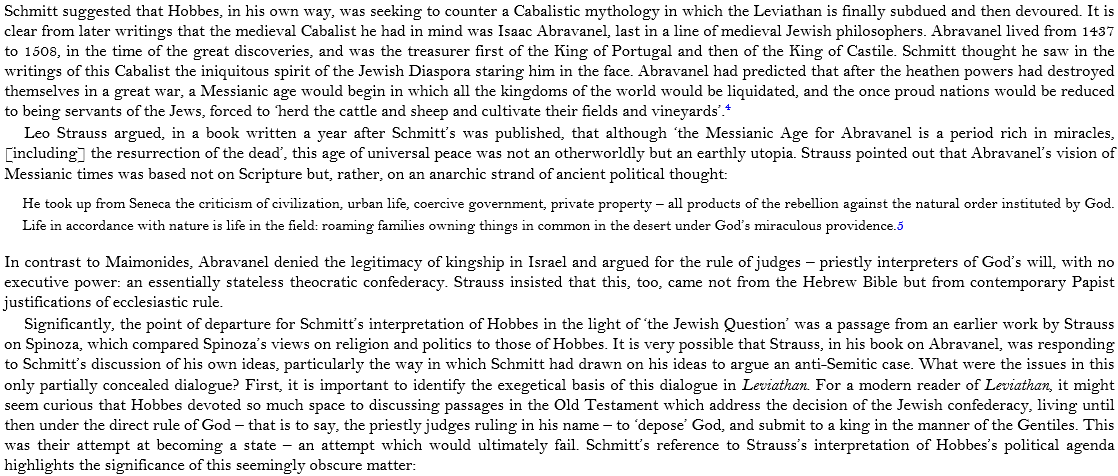
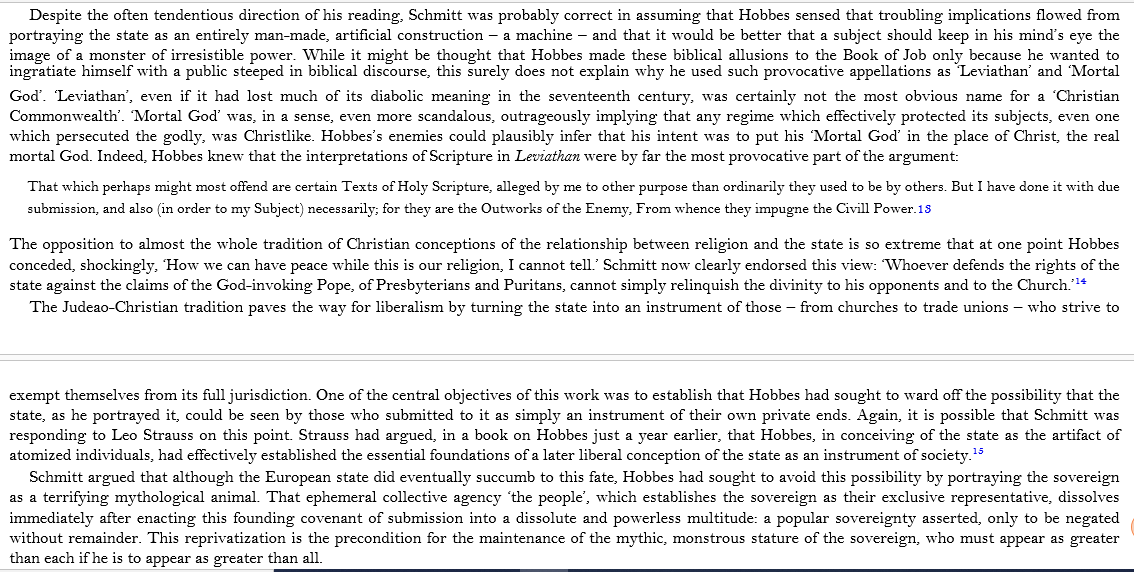
The reader has reached the point at which Continetti now comments on the importance of religion in Kristol’s World View. The heading for this next section is ‘Christianity, Judaism, and Gnosticism‘. For an exposition and clarification, the reader need only look to The Enemy: An Intellectual Portrait of Carl Schmitt by Gopal Balakrishnan Chapter 16 ‘The Leviathan Myth’ for the particulars of the ‘debate’ between Schmitt and Strauss about the importance of Hobbes’ ‘Leviathan’ and the central question of the place of religion in political thought.
These two screen shots, just small samples of this chapter. These two may be out of order, but are, none the less, instructive. That can lead the reader to see that Kristol was a ‘student’ of Strauss. Read also ‘The Neoconservative Revolution: Jewish Intellectuals and the Shaping of Public Policy’ by Murry Friedman pages 40 – 41 for more on the power of Strauss’ writing/thinking on Kristol”s intellectual/political development.
Mr. Continetty begins by describing a key part of Kristol’s development:
The traditional understanding of Judeo-Christian religion plays a leading role in what a post-modernist might call the Kristol meta-narrative: the intellectual history of capitalism and its degeneration that is the basis for his interpretation of politics. It was in 1979, at a conference of theologians organized by Michael Novak at the American Enterprise Institute, that Kristol described most plainly the religious lens through which he viewed modernity. His talk was later condensed into an essay, “Christianity,Judaism, and Socialism.” The full text of the discussion, including a partial transcript of the question-and-answer period, was published later that year in Novak’s Capitalism and Socialism. It, too, begins with a version of the epigraph from Péguy, translated, more bluntly, as “Politics begins in mysticism, and mysticism always ends in politics.”
Mr. Continetti on Kristol’s binary of Orthodox/Gnostic.
Kristol began with an anecdote. He said that a recent conversation with a friend, a prominent rabbi, had reminded him of the distinction between the “prophetic” tradition in Judaism and the “rabbinic” one. The former are the rebels against the law, the critics of society’s failure to live to the highest and strictest ethical standards; the latter are the followers of the law. The two tendencies, Kristol went on, are present in all of the world’s major religions. “I assume the tension between the prophetic and the rabbinic—or the orthodox and the gnostic—to be eternal.” To a gnostic, the world is a very bad place. Horrible things happen to innocent creatures. There is no satisfactory explanation for the problem of evil. Society is unequal. It does not live up to our high expectations. Laws are unjust or ignored; institutions are archaic and corrupt. Human beings fail to realize their potential. These unsatisfactory conditions of life provoke a revolt. “The gnostic . . .tends to say that the proper and truly authentic human response to a world of multiplicity, division, conflict, suffering, and death is some kind of indignant metaphysical rebellion, a rebellion that will liberate us from the prison of this world.”
The two tendencies, Kristol went on, are present in all of the world’s major religions. “I assume the tension between the prophetic and the rabbinic—or the orthodox and the gnostic—to be eternal.” This is representative of Kristol as theologen. The reader will see, that the ‘orthodox’ and the ‘gonstic rebels’ ,will reappear in the political realm, as political actors and antagonists.
…
“These gnostic movements tend to be antinomian—that is, they tend to be hostile to all existing laws, and to all existing institutions,” Kristol said. “They tend to engender a millenarian temper—that is, to insist that this hell in which we live, this ‘unfair’ world, can be radically corrected.”
…
Should this transmogrification, from Theology made to measure, to his politics surprise? The reader can make the connection, from a self-serving version of ‘theology’ to Kristol’s politics! Kristol self-presentation is that of the representative, of the steady hand of ‘orthodoxy’, while those on the definable political/moral outside, are the ‘gnostic rebels’.
Continetti continues his narration of Kristol’s Theology/History made to measure. this is conformation of the screen-shots I posted from The Enemy: An Intellectual Portrait of Carl Schmitt by Gopal Balakrishnan Chapter 16 ‘The Leviathan Myth’ for the particulars of the ‘debate’ between Schmitt and Strauss about the importance of Hobbes’ ‘Leviathan’ and the central question of the place of religion in political thought.
Christianity, Kristol said, emerged out of a gnostic rebellion against Judaism. Christians rejected the Mosaic law and embraced Jesus as the messiah. But for Christianity to become successful, for it to last, for it to spread beyond the Eastern Mediterranean, the Church fathers had to manage the transition from gnostic movement to orthodox faith. “They had to convert it into a doctrine for the daily living of people, into something by which an institution could spiritually govern the people.” This they were able to do, in part, Kristol noted, by appropriating the Hebrew Bible as the “Old Testament.” The Church fathers, he said,needed the Old Testament for certain key statements that are not found in the New Testament, or at least are not found there in an emphatic way, such as that when God created the world, he saw that “it was good.” That is an Old Testament doctrine. It became a Christian doctrine, and it is crucial to any orthodoxy, since gnosticism says that no one knows who created the world—a demiurge or whatever—but that the world is certainly bad.
Judeo-Christian orthodoxy, in Kristol’s telling, held for centuries until the beginning of modernity. Like most scholars, he identified those beginnings in the Renaissance rediscovery of the ancients, and in the Reformation discovery of the individual conscience. As it developed, Kristol said, the early modern civilization of the West was “shot through with gnostic elements.” The concept of original sin vanished from elite and then popular discourse. Science and technology became endowed with extraordinary capabilities: Tasked with the mastery of nature for the relief of man’s estate, the reputation of natural science expanded until it subsumed theology and philosophy and threatened the stature of religion itself. The individual human life seemed to lack cosmic direction. Human beings became confused as to their ultimate purpose.
A telling quotation from the remainder of this section of Continetti’s Kristol apologetic :
Meanwhile, there arose a class of social scientists that believed the individual and society could be manipulated with the ease and skill with which natural scientists reshaped the physical world. The social scientists sought to perfect humanity in the same way that engineers perfected bridges and roads and aqueducts. “What, specifically, were (and are) the teachings of this new philosophical-spiritual impulse?” Kristol asked in a 1991 essay, “The Future of American Jewry.” His answer:
They can be summed up in one phrase: “Man makes himself.” That is to say, the universe is bereft of transcendental meaning, it has no inherent teleology, and it is within the power of humanity to comprehend natural phenomena and to control and manipulate them so as to improve the human estate.
These are gnostic ideas; these are utopian ideas. “[T]he modern world, in its modes of thinking, has become so utopian that we do not even know when we are utopian or to what degree we are utopian,” Kristol told the theologians back in 1979.
The Weakness Of Capitalis the next section of Mr. Cotinetti’s apologetic, in which Kristol engages in a wan evaluation/critique of Capitalism. And its ally, the concomitant evolution of ‘bourgeois values’ . some evocative quotations:
Capitalism was vulnerable to the attack. As a social system, it made only two promises: the gradual improvement of the material conditions of life through economic growth, and the maximum feasible amount of individual liberty. These were not lofty goals
…
The contours of all prior civilizations—their virtues, their values, and their codes of behavior—had been shaped by political or religious or cultural elites. All of these civilizations permitted some level of business, some degree of commerce, but not to the point where free enterprise became an independent center of power and the driving force behind public and private life
…
Under the capitalist dispensation, religious orthodoxy tempered the pursuit of individual self-interest and regulated the satisfaction of material appetites. Biblical faith had the same relation to capitalism as the Hebrew Bible had to the New Testament: It was the moral ground that anchored gnostic impulses to reality. The so-called “bourgeois values,” Kristol said, maintained the balance between capitalist prosperity and religious tradition. They told human beings how to live.
…
But such an inner emigration included only a portion of the anti-capitalist rebels. Escapism could not satisfy the do-gooders, the world-improvers, the lifter-uppers, and the power-hungry. “Rebellion was an alternative route, as the emergence of various socialist philosophies and movements early in the 19th century demonstrated.” The socialist rebellion against bourgeois capitalism lasted until the collapse of the Soviet Union in 1991. It was, in some sense, a two-front war. What the theoreticians of capitalism had not anticipated, Kristol said, was that the free market would slowly erode the very foundation of orthodoxy on which it rested. The new capitalist testament began to consume the old religious one.
…
…Kristol said in a 1989 talk. “But, of course, values are not created; values are inherited.” He continued:
‘There is no such thing as a rationalist religion that gives you an authoritative moral code. If there were, you would have heard of it. There are no rationalist ten commandments. Morality is derived from certain fundamental dogmatic truths, and I emphasize that word dogmatic. It is the function of a religion, in a society such as ours, to provide the dogmatic basis for those truths.’
But the old dogmas were vanishing from the world. Men and women began to be more concerned with the here and now, with what could be gained and lost in this life, not in the next.
…
The purpose of politics becomes the maximum gratification of desires and appetites, and the successful politician is one who panders most skillfully to this “revolution of rising expectations,” a revolution which affluent capitalism itself generates and before which the politics of bourgeois democracy prostrates itself.
…
The quest for the immediate gratification of the population’s desires results in a more intrusive state, for it is assumed that collective action and bureaucratic coercion can accomplish the goals that mere individuals cannot. The question is: Will the state succeed?
It will not, of course; unreasonable demands are by definition insatiable. But it is true that the nondemocratic state will have the power to curb and repress these demands, where it cannot satisfy them, whereas the bourgeois-democratic state can rely only on the selfdiscipline of the individual, which affluent capitalism itself subverts.
…
Human beings chose either to create the perfect community here on Earth—through anarchic protests, small experiments in communal living, or totalitarian states—or to escape into self-examination, introspection, self-absorption, and a search for authenticity. Neither of these options proved satisfactory. Communes collapsed, fascism and communism imploded, and the exploration of self was self-defeating because, as Kristol wrote in “The Adversary Culture of the Intellectuals” (also in 1979), “[t]he deeper one explores into the self, without any transcendental frame of reference, the clearer it becomes that nothing is there.” So, injured and beleaguered, capitalism has soldiered on, because of the wealth it produces but also because of the heritage—waning, yet lingering—of Biblical religion.
The above quotation marks the end of ‘The Weakness of Capitalism’ and introduces ‘Socialism,Egalitarianism,Nihilism’. Capitalist Apologetics/Rationalizations/Cheerleading as the reader might expect from AEI propagandists :
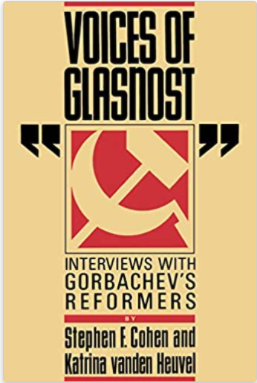
This “The Adversary Culture of the Intellectuals” , of Kristol’s invention in 1979. The ‘prescient’ Kristol missed by a decade the Reform Movement named ‘Glasnost’ ,’Perestroika’ in the Soviet Union. Chronicled by:
…
The death of the socialist idea, and later the collapse of communism, did not make life any easier for the defenders of orthodox religion, the bourgeois ethos, and capitalism. “[I]f the death of socialism is not simply to mean a general disintegration into political pseudo-socialist forms whose only common element is a repudiation, in the name of ‘equality,’ of individual liberty as a prime political value,” Kristol wrote in his 1976 essay “Socialism: An Obituary for an Idea,” then proponents of liberal capitalism would have to combat egalitarianism, deal prudentially with the rise of corporations, and somehow deal with the decline in traditional religion. A glance at today’s headlines is enough to confirm that these challenges remain.
Kristol was immune to egalitarian impulses, voiced then and now in calls to address rising income inequality. “I do not like equality,” he told the theologians at AEI in 1979.
…
Under the banner of equality, the professional and political classes use the state to manage a greater portion of national income, distributing the resources—spreading the wealth—as they see fit. It is no accident, Kristol might say, that the loudest calls for addressing income inequality come from members of those professions—public-sector unions, academic economists, liberal journalists, attorneys—that would benefit most in status, power, and wealth from an America where government controls a larger portion of GDP. As he put it in 1976:
…
One of the means by which egalitarians rally support for the furtherance of their class prerogatives is demonization of large corporations. Corporate capitalism, for Kristol, presented a danger not because of economic inequality or environmental pollution but because of the possibility that “the large corporation will be thoroughly integrated into the public sector, and lose its private character altogether.” By criticizing the “externalities” of corporate capitalism—“air pollution, water pollution, noise pollution, traffic pollution, health pollution, or what have you”—liberals are able to transfer more power and decision-making from the private sector to the public one. “The transformation of American capitalism that this would represent—a radical departure from the quasi-bourgeois ‘mixed economy’ to a system that could be fairly described as kind of ‘state capitalism’—does constitute a huge potential threat to the individual liberties Americans have traditionally enjoyed.” Returning to his theme of the religious conflict between orthodoxy and Gnosticism that underlies political argument, Kristol suggested that the deeper impulses animating the liberal or progressive left are not ultimately political. The roots of egalitarianism, he taught, went back to the religious thinness of capitalist civilization:
…
“Unappeasable indignation”—the phrase captures well the personality of the activist left. It was Kristol’s insight that this indignation was a response to the failure of secular liberal society to provide to its members a comprehensive and compelling theory of distributive justice. “I think it is becoming clear that religion, and a moral philosophy associated with religion, is far more important politically than the philosophy of liberal individualism admits,” Kristol wrote in his 1973 essay “Capitalism, Socialism, and Nihilism.”
In this last quotation, from Continetti’s essay, the reader again confronts the sine qua non of Kristol’s Political Theology. Touching again the importance of the Schmitt/Strauss/Hobbes religious/political marriage of moral imperative.
…
Into the spiritual vacuum created by advanced liberal capitalism step the forces of the left, seeking to reassert control over the market and prevent it from determining society’s shape. Society is to be shaped instead by the left. The egalitarians seek redistribution to effect social justice. The environmentalists seek control over business and natural resources in their quest to stop climate change. Public-health bureaucrats tell us what to eat, what not to smoke, which drugs we can and cannot take. The censors have returned, policing speech and attitudes in the same way authorities once policed entertainment and pornography.
…
The above paragraph is crowded with the ‘Gnostic Rebels’, in political form. Named ominously ‘the forces of the left’ . The reader is in very familiar territory of political hysteria. This opportunity cannot be wasted by Continetti. Where does Kristol begin and where might Continetti begin, a vexing question. Yet the ends of propaganda must be served. The cast of ‘Gnostic Rebels’, dubbed ‘clerisy ‘ is almost as crowded as a Cecil B. De Mille biblical epic, to frame it in a complementary hyperbole.
…
The trial lawyers, journalists, Silicon Valley executives, Wall Street bankers, foundation officers, social workers, bureaucrats, Hollywood types, university administrators, public employees, and college professors ascendant in the 1970s and today constitute more than a “New Class.” They are a new clerisy.
Growth,Virtue, and the Welfare State
…
If what Kristol called the “problematics” of liberal capitalist democracies remain the same today as in the 1970s—increasing secularization, a rise in the number of Americans with no religious affiliation, family fragmentation, a popular culture that is hostile to the bourgeois ethos, rampant consumerism and materialism, an empowered and triumphalist class of liberal aristocrats, minuscule economic growth, a weak and inadequately defended capitalism—then the response to these problematics may also be the same. It is impossible, of course, to know precisely what Irving Kristol might think of the presidency of Barack Obama, the economics of Paul Krugman and Thomas Piketty, the culture of Lady Gaga and Miley Cyrus. But his writings offer some guidance about how to approach today’s problems in American politics, economics, and culture. And the solutions to which they point are as likely to unsettle the libertarian right as the progressive left.
…
Name this a Crowd Scene from some ‘Pathe Newsreel’ from the 30’s : except for its contemporary Politicians, Economists and Pop Stars. Subject to the jejune conjectures of Continetti.
…
Growth acts as a balm for democratic politics. It legitimizes capitalist exchange. “It was only the prospect of economic growth in which everyone prospered, if not equally or simultaneously,” Kristol wrote in his 2003 essay “The Neoconservative Persuasion,” “that gave modern democracies their legitimacy and durability.” A pro-growth agenda shares elements of a social agenda that protects and promotes bourgeois values. “The reason cultural nihilism will not prevail,” Kristol said in 1992, “is that a bourgeois, property-owning democracy tends to breed its own antibodies. These antibodies immunize it, in large degree, against the lunacies of its intellectuals and artists.”
…
Manfred Max-Neef and his ‘Development Model’ ,that replaces the untenable ‘Growth Model’ ,that Continetti and his employers embrace as ineluctable, has in the face of the Environmental crisis, in the present, defines how we live today, has rendered that ‘Growth Model’ to be toxic, to all biological life on the planet Earth! Yet this quote from Kristol leaves little doubt about … ‘These antibodies immunize it, in large degree, against the lunacies of its intellectuals and artists.”. The Gnostic Rebels make their return!
…
Kristol’s vehicle for measures to promote bourgeois flourishing was what he called the “conservative welfare state.” Not only did he say it was fruitless to believe that the welfare state could be overturned; he also said that a welfare state was, in principle, compatible with conservative politics. How? “The demand for a ‘welfare state’ is, on the part of the majority of the people, a demand for a greater minimum of political community, for more ‘social justice’ (i.e., distributive justice) than capitalism, in its pristine, individualistic form, can provide,” he wrote in 1976. “It is not at all a demand for ‘socialism’ or anything like it.” He went on: ‘Nor is it really a demand for intrusive government by a powerful and ubiquitous bureaucracy—though that is how socialists and neo-socialists prefer to interpret it. Practically all of the truly popular and widespread support for a “welfare state” would be satisfied by a mixture of voluntary and compulsory insurance schemes—old-age insurance, disability insurance, unemployment insurance, medical insurance—that are reasonably (if not perfectly) compatible with a liberal capitalist society.’ It is the idea of a conservative welfare state that most discomfits the right, for the idea suggests that there really is no turning back the political clock. The theoretical principles of the founding fathers can be recovered, laws can be passed and interpreted according to the original text of the Constitution, but it is folly, the advocates of a conservative welfare state say, to believe that the government of the United States of America can or should be reduced to the size it was 50 or 100 or 200 years ago.
…
The above almost takes the reader’s breath away : The Conservative Welfare State! yet reserved for the Middle Class? In the World View of Continetti’s version of Kristol, the Working Class and the Poor do not exist?
…
Above all, a conservative welfare state would be future oriented. “It must be committed to shaping the future with at least as much energy as to preserving a traditional attachment to the past.” It would build on human motivations, rather than try to change them “through the practical exercise of our unadulterated compassion, our universal benevolence, our gentle paternalistic authority.” And it would not be hostile to religion. “The plain truth is that if we are ever going to cope with the deficit, and the social programs that inflate it,” Kristol wrote in a 1993 column, “we are going to have to begin with a very different view of human nature and human responsibility in relation to such issues as criminality, sexuality, welfare dependency, even medical insurance.” We are going to have to begin, in other words, with a religious view.
…
Kristol advocates, in the above quoted paragraph, for a Welfare State based on ‘a religious view’ . What to name it but Theocracy!
The Limits of Politics:
…
Kristol’s metaphor for wishful political thinking, it is interesting to note, was a religious one: ‘Too many conservatives today, like the Catholic church of the 16th Century, view the difficulties of the reformation we are living through as an opportunity to restore the status quo ante. They are wrong, as the Catholic Church was wrong. There is no more chance today of returning to a society of “free enterprise” and enfeebled government than there was, in the 16th Century, of returning to a Rome-centered Christendom. The world and the people in it have changed. One may regret this fact—nostalgia is always permissible. But the politics of nostalgia is always self-destructive.’ With the temptation of nostalgia on the one hand and the danger of utopianism on the other, students of Kristol’s work today must nonetheless participate vigorously in the ongoing clash between orthodoxy and Gnosticism, between the bourgeoisie and the liberal aristocracy. It is an uphill fight, but not necessarily hopeless. As new entrants join the battle, they can draw not only on the professional history and the personality of Irving Kristol. They can draw also on his words, on his theological and political ideas.
I will end my comments here, except to say that it is readily apparent to write that Kristol was a political romantic, in thrall of his own particular expression of Utopianism, that advocates for a Theocratic Welfare State, reserved for a Middle Class in need of rescue, from the predations of an amorphous army of ‘Gnostic Rebels’. In sum, Left-Wing zealots, expressed by Kristol as ‘the lunacies of its intellectuals and artists.”
What is absent from Continetti’s long apologetical essay, on Irving Kristol, is the political/moral nihilism of Neo-Conservatism , expressed as unsalkable bellicosity that produced 37 million Refugees:
The reason d’etre of ‘European Bank for Reconstruction and Development’ is to build ‘Market Economies’: the institutionalizing of the utterly failed Mises/Hayek/Friedman romance with an abstraction, in service to profit alone, owing nothing to the once prized civic obligation, that citizens owe to one another!
The defining feature of what? Not Democracy nor Republicanism, but the rapacious Free Market, that brought the ‘West’ into an ever spiraling economic/political crises! Are ‘we’ suffering from economic/political amnesia?
In the face of The Pandemic, the imperative of Democratic States is to rebuild indigenous manufacturing, to replace ‘supply chains’ that do not recognize public health and welfare as imperatives! If ‘we’ are survive, indeed if ‘we’ are to prosper, from bottom to top of our societies, the reinvigoration of the idea and practice of that Civic Ideal is the sine qua non, that must define both our politics and economics!
What is most interesting or compelling about Sam Tanenhaus’ essay at Prospect is not that it adheres to the standard bourgeois political chatter, even his talent as writer/storyteller can’t rescue this essay from being just standard. But here the reader encounters an almost nonsequiteur, but its length leaves the reader just non-plused as to what it might be or represent. Except perhaps a maladroit attempt to recycle part of another essay?
For Biden to win alone was not enough. A Democratic victory, to be meaningful, had to be complete—a presidential landslide, with the sort of truly crushing popular vote lead that translated into the capture of several Republican citadels and a rout in the electoral college plus, and of far greater practical importance, a regained majority in the Senate. Only then might they draw up in bold outline and vivid colour the programmes they envisioned and excitedly whispered about: universal health care, a much higher minimum wage, reduced or even free college tuition, racial justice (including, possibly, some form of reparations for African Americans), science-driven climate policy. This was the “new” New Deal that Biden was said to be ready to enact, drawing on the most innovative ideas circulating on his party’s progressive wing. Biden would be the “old guy” bipartisan compromiser in a restored world of “who cares who gets the credit” concord—the inverse of the transactional deal-making huckster Trump—while the youthful advance guard, including Congressional stars like Alexandria Ocasio-Cortez, would sweep the country onto a bold new path.
And there was more—the dream of making America a bigger and more genuine democracy through structural changes: admitting Puerto Rico and Washington, DC to the Union as full states with Senate seats; eliminating the notorious Senate filibuster (to end Republican obstructionism); and doing away with the electoral college and its over-representation of sparsely populated hinterland states. All this was not likely to happen under Biden, but could under his anointed successor. Vice President Kamala Harris is 56, and with her degree from Howard, the crown of America’s “historically black” universities, and her wardrobe of Spandex leggings and Converse sneakers, is the charismatic new face and voice of a party whose future lies in commanding the loyalty of Millennials and Generation Z.
The November result ended that dream. *
…
This labored hypothetical, at its end, presents the Kamala Harris of the jailing the parents of truant children, of the de facto pardon of Steve Mnuchin, AIPAC groveler, and the well deserved pillaging of the sclerotic Biden, as something other that another New Democrat on the make. Although this reader must congratulate that Harris, who fed the shit to Senile Old Joe!
Mr. Tanenhaus would have been wise to close his essay with this bit of political kitsch, rather than more of The Ring-Master Trump hyperbole, as if it were needed.
America has had beloved presidents. Grown men wept when the caskets of slain Abraham Lincoln and John F Kennedy rolled past, felt a hole in their lives when Franklin Roosevelt and Ronald Reagan died. There are those for whom the brightest moment in the past year was the return of Barack Obama, with his piercing wit and flashes of humor, his manner that mingles the wisdom of the college professor with the joy of the pulpit orator.
Political Observer
*
Krystal and Saagar: Biden Team Weighs BAN On Bernie, Warren As They Consider Republicans For Cabine
Just a selection from Mr. Ganesh’s latest essay, on American Political life and Foreign Policy and its World-Historical repercussions. In sum a collection catchphrases-sometimes expressed as sentences. In sum, the rhetorical architectonic is based upon fragmentary thought, held together with stylistic embellishment, one of his writerly gifts.
…
No one is better placed to restore the US to planetary leadership.
…
Whatever the empire’s faults, caprice was not among them.
…
When the cold war ended, so did America’s steadfastness. The pattern since has been one of abrupt swings not just in policy but in underlying worldview from president to president.
…
When US fickleness recurs in trade, global health and other realms, you can see how countries might come to make their own arrangements or, in time, to throw in their lot with a more predictable superpower.
….
Mr Biden could run a masterly foreign policy, then, and still fail to recreate the kind of US influence that he knew from childhood through to middle age.
…
Aware of its relative youth as a civilisation, the west often assumes that Asia sees history as a vast Hegelian rhythm, measured out in centuries.
…
The Chinese pitch to wavering countries almost writes itself: better a heavy-handed superpower than a whimsical one.



 StephenKMackSD's Blog