gideon.rachman@ft.com on ‘Biden’s retreat’, Art History, Pulp, Comic Books & The New Cold War. Political Skeptic tries to explain/interpret this?

In America two genres of popular culture are, and have been, in the ascendent , since the 1930’s and 1940’s , Pulp and the Comic Book. Why start here? James Ferguson provides the cartoon reductionism of the argued conflict between Russia, as the ferocious bear and China just present, but its intention unseen. And a majestic America eagle soars above, in this tableau. Art in the service of propaganda? The interpretation of symbols, in paintings of past ages, is an integral part of Art History.

Biden’s ‘retreat’ ,from the natural role of America as World Hegemon will lead to dire consequences. The second and third paragraphs of his essay Mr. Rachman that features the ignominy of America’s defeat in Vietnam, of course not framed so close to the truth, fealty to bourgeois political respectability must be observed.

The watching world will wonder if a gap is emerging between White House rhetoric about re-engagement with the world, and a reality of continuing retreat. Biden insists that this is not the case. He argues that America has achieved its counter-terrorism aims in Afghanistan and now intends to “fight the battles for the next 20 years, not the last 20”.

But perception matters. The danger is that the pullout from Afghanistan will be seen outside America as a Vietnam-like failure that could eventually lead to the fall of Kabul to the Taliban, a replay of the fall of Saigon to North Vietnam in 1975.

https://www.ft.com/content/0116d3ab-9c97-45d8-97ef-8ba86254c4dc

Biden’s ‘weakness’ will have dire consequences. The Enemies are poised to breach the Pax Americana. The reader accompanies Mr. Rachman as he describes , in the vocabulary of Stan Lee, in his Futurology Episodes of The New Cold War to come, while riffing on Dickens. The whole of literary/political inheritance is subject to the demands of fear mongering, about the dire possibilities.

What follows in Mr. Rachman’s polemic is a History Made To Measure, a speciality of Financial Times writers. What Mr. Rachman fails to even mention is that Biden has surrounded himself with Neo-Con ghoul Victoria Nuland, R2P zealot Samantha Power, and Antony Blinken : In sum the Neo-Cons and fellow travelers are in power. What is politics as practised but the exercise of ‘pragmatism’: in sum ‘reappraisal’ is its manifestation.

Political Skeptic

Posted in Uncategorized | Leave a comment

The Economist & The Financial Times agree on the ill fated Biden Afghanistan withdrawal. Political Observer comments

What might History teach about the failed interventions of the British and the Soviet Union and their wars in Afghanistan? Not to speak of America’s support for the Mujahideen and  Osama bin Laden?  

The two most conservative/reactionary Western newspapers, are taking the role of an utterly failed foreign policy technocracy, that helped to produce the failed ‘War On Terror’. The human costs of this war are not worthy of mention in these two newspaper. Though never at a loss for politically exploitable moralizing.   

Headline: At Least 37 Million People Have Been Displaced by America’s War on Terror

Sub-headline: A new report calculates the number of people who fled because of wars fought by the United States since Sept. 11, 2001.


The War in  Afghanistan began on 2001, how much longer for the occupier to win ‘hearts and minds’ ? The Neo-Cons, champions of The American Empire, are well represented in the Biden Coterie: Victoria Nuland and R2P Zealot Samantha Power. So a possible ‘reappraisal’ of the withdrawal is more than possible, based in Biden’s ‘pragmatism’.   


April 17 , 2021 :

Headline: Joe Biden is wrong to withdraw American troops from Afghanistan

Sub-headline: But America can still try to minimise the damage

If Mr Biden insists on pulling out American troops, he should at least take steps to reduce the likelihood of total disaster. The Soviet-backed state did not collapse immediately when Russian soldiers withdrew; it fell when the money ran out. So America should promise to subsidise Kabul for longer. The Taliban’s leaders now have plush offices in Qatar and travel freely internationally. They are, at least nominally, negotiating with Kabul. They must be made to realise that if they take over by force, they will be international pariahs once again, and the money will stop. Even in Taliban-held districts teachers and doctors are paid by foreign donors. Ashraf Ghani, Afghanistan’s president, must also now realise that more American troops are not coming to his rescue, and try seriously to negotiate—or cede his position to someone who will.

The omens are not good. The Taliban believe they have defeated America; they do not seem inclined towards concessions. Even if they negotiate rather than shoot their way back into government, the Afghan constitution of 2004, with its legal protections for women and other freedoms, is unlikely to last. The Taliban show little sign of giving up their links with al-Qaeda. Mr Biden may be pulling troops out of the country now. A future president may have to send them back in.


https://www.economist.com/leaders/2021/04/15/joe-biden-is-wrong-to-withdraw-american-troops-from-afghanistan


************************


April 18, 2021:

Headline: Biden’s risky Afghanistan withdrawal

Sub-headline: The Taliban gets something for nothing in its war on Kabul

The choice is understandable. As the cliché goes, there are no good options in any of these situations. But America should be aware of what could come undone. Millions of Afghan girls now going to school who would be sent back home under the Taliban. Women in the urban work force would also be in jeopardy. It is easy to dismiss America’s history in Afghanistan as a tragic waste. But these are powerful counterpoints.

Following Biden’s announcement, America’s Nato allies, which account for another 7,000 troops, said they would also pull out. This will leave Kabul even more starkly exposed. Given the Taliban’s territorial gains in the last two years, Biden’s advisers were concerned that the Pentagon would press for another surge.

When the choice boils down to all or nothing, the least bad is probably the latter. But there is a third option — to retain America’s modest presence on the ground and in the air. Last year ten US troops were killed in combat in Afghanistan. Each loss is tragic. But the result of America’s departure risks being far more tragic for Afghanistan and the world. 


https://www.ft.com/content/afdf0907-cf92-4327-b85a-e38a722db37a


The reader confronts the expertise of both the Economist and the Financial Times , but the reader need only look to Iraq,  to what ‘withdrawal’ actually means. Here is information on the size of America’s Embassy in Bagdad, Iraq, that is in reality the fortress of an occupier:

That was the process that has led, now, to this—the construction of an extravagant new fortress into which a thousand American officials and their many camp followers are fleeing. The compound, which will be completed by late fall, is the largest and most expensive embassy in the world, a walled expanse the size of Vatican City, containing 21 reinforced buildings on a 104-acre site along the Tigris River, enclosed within an extension of the Green Zone which stretches toward the airport road. The new embassy cost $600 million to build, and is expected to cost another $1.2 billion a year to run—a high price even by the profligate standards of the war in Iraq. The design is the work of an architectural firm in Kansas City named Berger Devine Yaeger, which angered the State Department last May by posting its plans and drawings on the Internet, and then responding to criticism with the suggestion that Google Earth offers better views. Google Earth offers precise distance measurements and geographic coordinates too.

https://www.vanityfair.com/news/2007/11/langewiesche200711

Political Observer

Posted in Uncategorized | Leave a comment

Larry Summers in almost three keys. Old Socialist comments.

From January 21, 2021 in The Economist:

Under the rubric of ‘Fire without fury’

Headline: Will Joe Biden’s fiscal stimulus overheat the American economy?

Sub-headline: If it does, higher inflation could be the consequence

On january 20th Joe Biden entered the White House during an economic crisis for the second time. On January 14th he unveiled his plan for dealing with the downturn wrought by the pandemic. Viewed from the bottom up, it combines vital spending on vaccines and health care, needed economic relief and other, more debatable handouts. Seen from the top down, it is a huge debt-funded stimulus. Mr Biden’s plan is worth about 9% of pre-crisis gdp, nearly twice the size of President Barack Obama’s spending package in 2009. And it is big, too, relative to the shortfall in demand that America might suffer once it puts the winter wave of covid-19 behind it, given the stimulus already in place.

https://www.economist.com/finance-and-economics/2021/01/19/will-joe-bidens-fiscal-stimulus-overheat-the-american-economy?itm_source=parsely-api

Vintage Economist’s Austerity grumbling about the undeserving lesser beings, that inhabit the once Republic: ‘and other, more debatable handouts.’ and this declaration, ‘nearly twice the size of President Barack Obama’s spending package in 2009’ which proved to be not enough. Adam Tooze offers this in the April 22, 2021 issue of the London Review of Books:

Once the crisis was properly recognised it was clear what had to be done – and Obama appeared to have the people in place to do it. His economic policy team were as thoroughbred a group of New Keynesians as you could wish for. What was needed was a huge fiscal stimulus to ensure that the US didn’t slide from a crippling financial crisis into a Japan-style, low-growth liquidity trap. It was the very obviousness of that diagnosis that made what happened next all the more upsetting to Krugman. In 2009 Obama and the Democratic Congress passed a stimulus, but it was hopelessly undersized – half what was required. And 2010 began with the president announcing not that more was necessary, but that it was time for belt-tightening.

In so far as Obama was involved, Krugman wasn’t surprised – he had never been a fan. Obama’s insistence on bipartisanship ran squarely against Krugman’s darker vision of the roots of America’s political divisions in racialised class inequality. The dogged opposition of the GOP, for its part, was only to be expected. What shocked Krugman was the failure of his own kind, the economists, to rally in a time of national emergency. Predictably, the Chicago School joined the GOP opposition, but what horrified Krugman was the undeniable evidence that Obama’s own economic experts were self-sabotaging, and that Larry Summers – once the teenage star of MIT and Harvard – was in the thick of it. It was he who led the push to cap the stimulus at well below a trillion dollars. ‘The overall narrative,’ Krugman wrote, was ‘tragic. A policy initiative that was good but not good enough ended up being seen as a failure, and set the stage for an immensely destructive wrong turn.’ ‘We used to pity our grandfathers, who lacked both the knowledge and the compassion to fight the Great Depression effectively; now we see ourselves repeating all the old mistakes.’

https://www.lrb.co.uk/the-paper/v43/n08/adam-tooze/the-gatekeeper

The Economist writer present the arguments, recognizing the role of Larry Summers as self-appointed watchdog on the possibility of this ‘overheating’. Let me refresh your memory : Gramm-Leach-Bliley and Simpson-Bowles !

There are three main reasons to suspect overheating might be on the cards: emerging evidence that the downturn may prove temporary; generous stimulus; and the Federal Reserve’s monetary-policy strategy. Take first the evidence that today’s downturn might be more temporary hiatus than prolonged slump. The number of non-farm jobs remains around 10m, or 6.3%, below its pre-pandemic peak—similar to the shortfall seen in 2010. Yet after the first wave of infections last year, unemployment fell much more rapidly than forecasters expected. If job creation were to return to the average pace achieved between June and November 2020, the pre-pandemic peak in employment would be reconquered in less than a year. It was not until midway through Mr Biden’s second vice-presidential term that such a milestone was reached last time.

Next for consideration is the ‘cash pile’ comprised of ‘excess savings’ that Americans have accumulated since the lockdown. Such is the myopia of this person, with the lives of we ordinary Americans!

According to Fannie Mae, a government-backed housing-finance firm, by mid-December Americans had accumulated about $1.6trn in excess savings. It is hard to know what might happen to this cash pile; economists typically assume that households are much less likely to spend wealth windfalls (such as the gains from a rise in the stockmarket) than income. But if people instead regard these excess savings as delayed income, then the cash hoard represents stimulus that has not yet gone to work, to be unleashed when the economy fully reopens.

The writer ends the essay here, with the fact that the Economy is not like a watch that can be repaired byTechnocrats.

Those who are zealously committed to breaking the world economy out of the low-rate, low-inflation trap of the 2010s might welcome the even larger burst of inflation that the current fiscal and monetary policy mix could enable. The Fed, however, is not in that camp. Were overheating to provoke it into earlier rate rises than markets expect, the assumption of cheap money that underpins today’s sky-high asset prices and the sustainability of rocketing public debt might begin to unravel.

Such a scenario remains a tail risk. The most likely outcome is that Congress agrees on a smaller stimulus than Mr Biden has proposed, and that overheating, if it occurs, proves temporary. Beyond that, nobody really knows how fast the economy can grow without setting off inflation. Should economic policy stay in uncharted territory, though, its speed limits may be tested more frequently. 

___________________________________________________

From The Financial Times of April 11, 2021. Larry Summers is interviewed by Martin Wolf

Headline: Larry Summers: ‘I’m concerned that what is being done is substantially excessive’

Sub-headline: Former treasury secretary criticises the scale of Biden’s fiscal policy and warns it could lead to overheating and wasted resources

Now, however, Summers — a Democrat with his party back in power — is criticising both the scale and direction of the administration’s fiscal policies. Instead of applauding its boldness, he fears they will lead to significant overheating and waste of resources.

In discussion with Martin Wolf, the FT’s chief economics commentator, Summers explains why the new approach might go disastrously wrong. He agrees there is a strong case for a more aggressive approach to fiscal policy. But policy still needs to be grounded in economic realities and priorities — and these ones, he insists, are not.

If Summers is wrong, it will matter little. If he is right, the hopes for a transformative presidency are likely to end in catastrophic economic and political disappointment. It is an immensely important argument.

https://www.ft.com/content/380ea811-e927-4fe1-aa5b-d213816e9073

Martin Wolf: Let’s start with the current macroeconomic situation and, particularly, the legacy of Covid-19 and the arrival of Biden. His administration has already passed an enormous new fiscal stimulus of $1.9tn and is talking about a longer-term investment package of $3tn. Together, this is close to a quarter of gross domestic product.

You have been critical of these policies. Could you explain your criticisms? And how does this fit with your views on secular stagnation?

Larry Summers: I’m going to focus on the American policy path and not talk about where responsibility lies for that path. I think, in important respects, it lies with the Republicans and with those on the more extreme left of the Democratic party.

If you look at the economy at the beginning of this year, prevailing forecasts were that Covid would reduce wages and salaries to American households by $20bn-$30bn a month, with that figure declining over the year.

So, that would be a $250bn-$300bn hole in wages and salaries over the course of the year. So, I look at this hole and then I see $900bn of stimulus in the December package, $1.9tn of stimulus in the recently passed package and $2tn in the savings overhang, which is also likely to be spent. I see the Fed with its foot on the accelerator as hard as any Fed has ever done.

I see serious discussion of trillions of dollars more in fiscal stimulus, along with the explanation that this latest package is not temporary Covid relief, but a harbinger of a major transformation in social policy, which suggests that at least some of it will be continued indefinitely.

So, I look at that dwindling hole. Then I look at expenditures that aren’t hard to add into the multiple trillions, and I see substantial risk that the amount of water being poured in vastly exceeds the size of the bathtub.

The Technocrat, who was the an advocate for the ill fated Gramm-Leach-Bliley,that was the end of Glass-Steagall, that ended in a World Historical Crisis! Who can claim that kind of power? But note that Mr. Summers strategically hedges his bets with Biden:  I’m going to focus on the American policy path and not talk about where responsibility lies for that path. Just in case the Biden economic overreach goes wrong, Mr. Summers will be there to assist with an Austerity made to measure.

Here is Robert Kuttner’s revelatory essay on Summers of July 13 , 2020

Headline: Falling Upward: The Surprising Survival of Larry Summers

Sub-headline: The surprising survival of a rebranded Larry Summers, who once again is counseling a Democratic presidential candidate

Larry Summers’s public career has been marked by a carnival of policy debacles, punctuated by his brief, accident-prone tenure as president of Harvard. Yet, at 65, he is once again a senior economic adviser to another prospective Democratic president—one who has gingerly embraced transformative policies that Summers has long opposed.

Joe Biden and his handlers are aware that Summers is radioactive to much of the Democratic coalition. His campaign has downplayed Summers’s role. In fact, Summers is not only part of Biden’s senior economics policy team, but he is able to end-run other advisers and have one-on-one conversations directly with the former vice president.

Though much has been written about Summers, it’s worth reviewing the dynamics of his influence, serial repositioning, and uncanny survival. The more mistakes Summers makes, the more he is treated as a seer. This is a complex man, with a brilliant mind and nimble political skills. He has powerful patrons and protégés. Perhaps most importantly, his views are very congenial to powerful financial elites, who have a great deal to lose should Joe Biden turn out to be another Franklin Roosevelt.

https://prospect.org/economy/falling-upward-larry-summers/

In American History there have been many harbingers (perhaps not a strong enough term?) of catastrophe: Johnson, McNamara Nixon, Kissenger, Bush The Younger, Cheney,Rumsfeld, Obama, Hillary Clinton, John Kerry, Samantha Power, Victoria Nuland, and The Economic Sage Greenspan! The political/economic niche that Mr. Summers has created for himself, places him comfortably with the aforementioned.

Old Socialist
Posted in Uncategorized | Leave a comment

Adrian Wooldridge , writing as ‘Bagehot’, on ‘Prince Philip and the dynasty factor’. Almost Marx comments.

The first paragraph reads like a weak but modulated defense of the Royals, in a History Made To Measure of their victimhood, at the hands of democratising forces: malign political actors, catastrophic events, all cobbled together to impress the reader of the writer’s mastery of sources?  

The modern world was built on the graves of royal dynasties. The grave-diggers started their work with the American and French revolutions in the second half of the 18th century, paused for a while in the 19th, as Europe recoiled from the excesses of Madame Guillotine and the Emperor Napoleon, and then resumed with gusto in the 20th. The first world war and its aftermath saw the destruction of such great names as Russia’s Romanovs, Germany’s Hohenzollerns and Austria-Hungary’s Habsburgs. Today there are just 26 monarchies left. 

The following paragraph builds on the first:

Yet the reaction to Prince Philip’s death on April 9th demonstrated that the dynastic principle continues to flourish in one of the world’s most advanced countries. The bbc suspended its programming to focus on the news. Newspapers produced special editions framed in black. A vast army of royal experts competed to tell the most heart-warming anecdotes about the crusty royal. Old newsreels of the queen’s coronation were rolled out to remind the world that, while most surviving monarchies seem almost embarrassed about their role—witness the bicycling kings and queens of the Nordic world—the Windsors believe that monarchy is worth doing only with pomp and circumstance.

More of Bagehot’s ‘history’ that evolves into a telling question:

Why do the British continue to cherish the dynastic principle at the very heart of the state? There has been no shortage of answers to this question over the past days. One is that the royals are tireless public servants: the prince carried out more than 22,000 solo engagements and countless more as an appendage to his wife, always walking two steps behind her. A second is that they are judicious modernisers: the prince melded clever innovations (such as the Duke of Edinburgh award scheme for youngsters) with ancient rituals. A third is that the monarchy is a source of unity in a country that is often at war with itself.

Bagehot expands on the question, in the next two paragraphs, yet does he stand apart from his fellow citizens?

The first two answers are weak. The theatre of monarchy is not primarily a theatre of works performed and duties fulfilled. It is a theatre of majesty. The only way to fully modernise the monarchy is to abolish it: the point of the institution is to act as a counterbalance to the everyday world of value for money and performance targets. Monarchy is romance or it is nothing.

The third answer is closer to the truth. Regular politics is inevitably about differences: rival parties bellow at each other from opposing benches and then vote in something called a division. These disagreements are unusually sharp at the moment: furious arguments about Brexit are now giving way to equally furious arguments about devolution. Questions of identity underlie these issues: what does it mean to be “British” in a multi-ethnic society? And what prevents us from spinning out of control in an age of such hectic change? The reaction to the duke’s death was a symptom of a desire to find unity at a time of discord and continuity at a time of flux.

After more conjecture ,the reader comes to this surprising comment on Prince Philip, and the royal apostate, Meghan Markle. The Melodrama of the Royals evokes political kitsch, from a writer, who adopts the guise of a revered 19th Century editor*, that at its end is cynical. Perhaps the Free Market ideologue fails to see the value of the Royals as exemplars of duty, service, and tradition?

Prince Philip’s blunt style exacerbated some of the divisions at the heart of the country’s culture wars. And recent rows about Meghan Markle—a victim of royal racism to her defenders and an entitled woke princess to her critics—suggest that the monarchy fosters division as well as healing it.

The most keenly watched royal events are marriages (and their breakdown) and births. The Duke of Edinburgh’s death provided a chance to observe on the public stage something that usually takes place only in private. It also allowed people to do at a national level what they usually do within their families: contemplate the way things have changed over the decades. These great royal events are unifying because they are “brilliant editions of universal facts”, to borrow a phrase from Walter Bagehot, the great Victorian editor of The Economist. They are also consoling, for they remind people that even those with great wealth and status share the troubles from which lesser mortals suffer—unsatisfactory partners, wayward children and, eventually, decay and death.

It is extraordinary that the dynastic principle has survived. That it has done so by taking the most atypical people on the planet—blue bloods living in gilded cages—and turning them into exemplars of our common humanity is quite bizarre.

https://www.economist.com/britain/2021/04/15/prince-philip-and-the-dynasty-factor?utm_campaign=editorial-social&utm_medium=social-organic&utm_source=twitter

Almost Marx

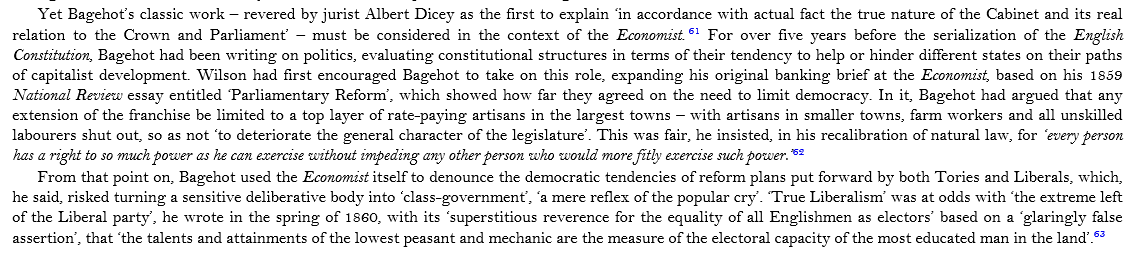
*From page 88, of ‘Liberalism at Large: The World According to the Economist’ by Alexander Zevin, that describes Bagehot’s opinion on extending the franchise:

Footnote to the above:

Posted in Uncategorized | Leave a comment

Jordan Peterson and Warren Farrell on The Boy Crisis and Gender Politics. Queer Atheist comments.

The viewer/reader is confronted with Catch Phrases masquerading as descriptive of Thought. E.g., ‘The Closing of the American Mind’, ‘The Clash of Civilizations’ , ‘The End of History and the Last Man’, ‘Tenured Radicals’, ‘Illiberal Education’ , ‘The Right Nation’, ‘The Thucydides Trap’ , ‘The Coddling of the American Mind’ , ’12 Rules for Life’ ‘The Boy Crisis’ the latest expression, in this genre, that looks at boys in an increasing ‘Feminized World’? Too many would be Technocrats,of the Human Endeavor, diagnosing what is wrong with us! The descriptive wedded to the prescriptive, that seeks to emancipate us from our ‘condition’ ! Its as if Kant’s imperative of self-emancipation from tutelage, was never thought, nor written down, as a reference point : ‘”Out of the crooked timber of humanity no straight thing was ever made” (Aus so krummem Holze, als woraus der Mensch gemacht ist, kann nichts ganz Gerades gezimmert werden)!

Queer Atheist

Peterson is always a defender of The Patriarchy, in all of its incarnations. So the ‘Boy Crises’ and ‘Gender Politics’ are an integral to the Conservative World View, that marries politics/culture/gender into a seamless garment. The only problem is his penchant for Jungian Archetypes, as his binding agent, it resembles 19th Century phrenology. Freud and Jung represent both opportunism and ambition. The Age of Depth Psychology in all its iterations is no more!

Q.A.

Posted in Uncategorized | Leave a comment

janan.ganesh@ft.com, not one day later ? Political Skeptic comments.

In his his essay of April 13, 2021, Mr. Ganesh proclaimes ‘A raucously free society is hard to mobilise against a rival in a lasting way’ ! He riffs on ‘rugged individualism’ ,in his surprising lack of mastery of American self-congratulatory sloganeering ! Note, that not one day later, in his newspaper, reports this :

Headline: Biden imposes tough new sanctions against Moscow

Sub-headline: Measures include restrictions on Russia’s sovereign debt market and expulsion of diplomats

https://www.ft.com/content/b2bf1be3-a10c-4963-9deb-8a6b319e9363

Biden and his advisors Blinken, Nuland (Neo-Con) , Power (R2P Zealot), etc. , etc . are waging The New Cold with the ferocity of Neo-Cons! Having no experience with waging actual war, combat ,has made this alliance between Neo-Liberals, Neo-Cons, and an R2P Zealot, a threat to Humanity!!!

Political Skeptic

https://www.ft.com/content/d3e971e0-4497-4368-a726-a68be6c0f6ba

Posted in Uncategorized | Leave a comment

janan.ganesh@ft.com on the impossibility of a ‘New Cold War’. Political Skeptic comments.

Even framed by Mr. Ganesh’s potted history of America’s Old Cold War, and the mention of Kennan, but not his ‘The Long Telegram’ nor his ‘Mr. X article’, this reader finds his whole article lacks anything like a viable case that The New Cold War is not at full cry,  even in his own newspaper. This headline speaks volumes as to an argued political sophistication, of American citizens: The US is too changed since the cold war to repeat it’ Here are a set of ‘reviews and assessments’ of Kennan’s career, and the evolution of his thought’s on his ‘Containment Theory’     

The Journal of Cold War Studies Volume 15,Number 4 of the Fall of 2013 offers this:

FORUM: George F. Kennan and the Cold War: Perspectives on John Gaddis’s Biography

https://direct.mit.edu/jcws/issue/15/4

Gone is the use of the telling aphorisms, and other Ganesh rhetorical signatures. It reads like low political comedy, that demands, deserves more focused application of serious thought!    

Political Skeptic 

https://www.ft.com/content/d3e971e0-4497-4368-a726-a68be6c0f6ba

My reply to  Making it right :

Thank you for your thoughtful comment. Yet this, ‘The author penned an observation. This was not an essay or thesis.’ , doesn’t quite match the evidence of the essays’ intent, which was to declare that a New Cold War can’t exist , argued ,absent Mr. Ganesh’s usual curlicues, to borrow from Auden, …


Yet the fact of Biden’s comment on Putin, goaded by Stephanopoulos: Note that Biden attacks Putin, framed theologically, utterly preposterous, almost comic if …

GEORGE STEPHANOPOULOS: Director of National Intelligence came out with a report today saying that Vladimir Putin authorized operations during the election to under — denigrate you, support President Trump, undermine our elections, divide our society. What price must he pay?

PRESIDENT JOE BIDEN: He will pay a price. I, we had a long talk, he and I, when we — I know him relatively well. And I– the conversation started off, I said, “I know you and you know me. If I establish this occurred, then be prepared.”

GEORGE STEPHANOPOULOS: You said you know he doesn’t have a soul.

PRESIDENT JOE BIDEN: I did say that to him, yes. And — and his response was, “We understand one another.” It was– I wasn’t being a wise guy. I was alone with him in his office. And that — that’s how it came about. It was when President Bush had said, “I looked in his eyes and saw his soul.”

I said, “Looked in your eyes and I don’t think you have a soul.” And looked back and he said, “We understand each other.” Look, most important thing dealing with foreign leaders in my experience, and I’ve dealt with an awful lot of ’em over my career, is just know the other guy. Don’t expect somethin’ that you’re– that — don’t expect him to– or her to– voluntarily appear in the second editions of Profiles in Courage.

GEORGE STEPHANOPOULOS: So you know Vladimir Putin. You think he’s a killer?

PRESIDENT JOE BIDEN: Uh-huh. I do.

GEORGE STEPHANOPOULOS: So what price must he pay?

PRESIDENT JOE BIDEN: The price he’s gonna pay we’ll– you’ll see shortly. I’m not gonna– there’s– by the way, we oughta be able that ol’ — that trite expression “walk and chew gum at the same time,” there’re places where it’s in our mutual interest to work together.

https://abcnews.go.com/Politics/transcript-abc-news-george-stephanopoulos-interviews-president-joe/story?id=76509669

 And Blinken’s comments on China:


We will push back, if necessary, when China uses coercion and aggression to get its way,” Blinken said.’


https://www.reuters.com/article/us-usa-asia-blinken-japan/blinken-warns-china-against-coercion-and-aggression-on-first-asia-trip-idUSKBN2B71C9  

Biden and Blinken are still operating on the notion that Trump was the political creature of Putin. In sum ‘soft on Putin’. as the in order too of an utterly misbegotten the Biden/Blinken strategy of ‘getting tough’ on both China and Russia. This a demonstration that the fictional ‘Russia Interference’ in the 2016 election still lives and breathes as political subtext!

Even considering Mr. Ganesh’s rhetorical gifts, he like Jonathan Freedland, writes political fiction, in service to a respectable bourgeoise politics!

Regards,

StephenKMackSD

Posted in Uncategorized | Leave a comment

gideon.rachman@ft.com on the EU’s stability. Political Skeptic comments.

The E.U.’s stability is built on adherence to its laws ?

*******************************

Opinion: How France gets away with breaking EU rules on its …

http://www.marketwatch.com › story › how-france-gets-away

Oct 25, 2019 · France is already overshooting the treaty limit in 2019. The budget deficit at 3.1% of GDP is because of the extra spending ordered by Macron a year ago to help him tackle the “yellow jackets”…

********************************************

Oops, France did it again! EU allows Paris near-traditional …

http://www.rt.com › business › 447520-france-eu-budget

Dec 27, 2018 · Paris had to admit last week that its budget deficit next year is set to stand at around 3.2 percent, which is 0.4 percent more than initially expected and higher than the three percent that the European Union deficit rules allow. The forecast comes following weeks of nationwide anti-fuel tax hikes and anti-Macron protests, that forced the French leader to announce wage increases for the poorest workers and a tax cut for most pensioners

********************************

France’s Deficit Tests the Flexibility of the EU’s Fiscal Rules

http://www.piie.com › blogs › realtime-economic-issues

Dec 18, 2018 · These measures will push the fiscal deficit for 2019 from a forecast 2.8 percent to almost 3.5 percent of GDP. The European Commission must now prepare a report under Article 126(3) of the 20-year-old Treaty on the Functioning of the European Union to assess the case for launching an EDP against France.

**************************************************************

EU Commission to assess French budget in spring 2019 | Reuters

http://www.reuters.com › article › us-eu-france-budget

In the November document, the EU executive said the French budgetary plan was “at risk of non-compliance” with EU rules because instead of improving the structural deficit by 0.6 percent of …

****************************************************

France 2019 budget is also a concern for Brussels

http://www.cnbc.com › 2018/10/24 › france-2019-budget-is

Oct 24, 2018 · In the case of France, the 2019 budget plan sees its structural deficit (the difference between spending and revenues, excluding one-off items) falling 0.1 percent this year and 0.3 percent in..

Author: Silvia Amaro

****************************************************************

How Countries Keep Testing the EU’s Fiscal Rules

http://www.bloomberg.com › news › articles

Jan 20, 2019 · Rome lowered its deficit target for 2019 to 2.04% from a previous 2.4%, which the EU had rejected as an “unprecedented” breach of the bloc’s rules, and Brussels held off on a disciplinary …

**********************************************************

Mr Rachman offers this opinion on a Coal and Steel Cartel that evolved into the E.U. Technocrat Supreme Jean Monnet’s vision, and a check on the Soviets!

Scepticism about the EU’s long-term future is persistent, nonetheless. It may stem partly from the organisation’s unique nature. It is an international organisation with many of the characteristics of a state, including a currency, a parliament, a supreme court and a central bank. This hybrid nature of the EU invites outsiders, used to dealing with nation-states, to regard the EU as unnatural, or even deformed and therefore an obvious candidate for an early death, like a human born with its organs in the wrong place.

… 

Perhaps Mr. Rachman should consult Bernard Connolly’s ‘The Rotten Heart of Europe’ revised 2012 edition, for an insider’s view of the E.U.

The Collection of Villains:

Marine Le Pen, Matteo Salvini, Viktor Orban, Poland ( Andrzej Duda doesn’t rate a mention? He’s part of a team that makes their own rules? See the first party of my essay. ) , China and Russia (The New Cold War)

A sign of hope? ‘Opinion polls show that young people are more pro-EU than older voters.’

The reader didn’t get a potent political drama in the hands of a Sidney Lumet, but the melodramatic kitsch of a Douglas Sirk!

Political Skeptic

Posted in Uncategorized | Leave a comment

janan.ganesh@ft.com & edward.luce@ft.com on Joe Biden’s almost political revolution? Political Cynic comments

The regular reader of The Financial Times might look at the April 6, 2021 essay of Janan Ganesh:

Headline: Biden shows that only moderates can govern from the left

Sub-headline: The US president’s reassuring blandness frees him to do big things

https://www.ft.com/content/0e6d1438-afde-4cc6-bdec-164d813daeaa

And then look to Edward Luce’s column of April 8, 2021, as reflections of each other?

Headline: Biden’s big fiscal gamble on America’s future

Sub-headline: Many obstacles stand in the way of the president’s infrastructure bill

https://www.ft.com/content/fbba9770-ce1c-46d6-9ec0-c51063b6f96e

Ganesh makes the argument that only Joe Biden, rather that Bernie Sanders, ‘can govern from the left’. Its ‘as if’ the Keynesianism of Bush The Younger has escaped Ganesh’s a-historical attention?

Mr. Luce opines about the ‘obstacles’ that stand in the way of the president’s infrastructure bill. These paragraphs, of his essay, features his former employer Larry Summers.

Nobody can be sure whether Biden’s roughly $5tn in new spending will lead to runaway inflation. Lawrence Summers, the former US Treasury secretary, puts the risk of inflation at about a third. He gives the same odds to the prospect that America will continue to enjoy non-inflationary growth. For what it is worth, the US bond market’s inflation expectations have leapt in the past few weeks. But neither the bond markets nor most economists foresaw the era of inflation that began in the late 1960s or the “great moderation” that replaced it in the 1980s.

Which leads to the odd situation where both the centrist Summers and the socialist Bernie Sanders are saying almost the same thing. Sanders believes Biden’s infrastructure bill is far too small. Summers believes the stimulus was far too big. Both may be right at the same time. It is worth stressing that investment spending is less inflationary than stimulus as, in principle, it boosts long-term productivity growth.

How much loyalty, to a former employer does a former employee owe? Larry Summers is not a ‘Centrist’, but an unapologetic Neo-Liberal, who was an enthusiastic proponent of the catastrophic Gramm-Leach-Bliley. The debt to former employers has to be paid? Not to forget Mr. Summers comments on women in Science. Here is a report on his weaseling self-apologetic:

https://www.insidehighered.com/news/2005/02/18/what-larry-summers-said

And on the question of Cornell West:

Cornel West Talks About Feud With Former Harvard President

Summers on checks:

SUMMERS: We should put money into the economy. The question is how much. If your bathtub isn’t full, you should turn the faucet on, but that doesn’t mean you should turn it on as hard as you can and as long as you can. And so the question isn’t whether we need big stimulus. The question is, do we need the biggest stimulus in American history? It’s the overall scale of the stimulus and it’s whether we’re using any of it to build a stronger economy or just to give money to people.

https://www.npr.org/2021/02/06/964764257/larry-summers-says-latest-coronavirus-stimulus-needs-restraint

Mr. Summers has demonstrated his utter incompetence, in matters Economic, and his impolitic opinions, on matters outside the sphere of his vaunted ‘expertise’. A vexing question occurs to this writer: when will Ganesh, Luce and Summers call for the imposition of Austerity, as the necessary intervention, to maintain an ‘Economic homeostasis’? Its only a matter of time!

Political Cynic

Posted in Uncategorized | Leave a comment

Watching Dan Crenshaw on Joe Rogan: Queer Atheist comments.

Mr. Crenshaw manages the shot-gun wedding of the year: the Neo-Liberal Trinity of Hayek/Mises/Friedman to the self-hating, hysterical American Divine Johnathan Edwards’ ‘Sinner in the Hands of an Angry God’! Neo-Liberalism marries Christianity with Mr. Crenshaw officiating. The Estate of ‘Man’ : suffering/redemption, with Government standing watch, declaring its neutrality, in this dull-witted Social Darwinist Melodrama. (Pamphleteer Ayn Rand waits off-stage)

Queer Atheist

Queer Atheist

Posted in Uncategorized | Leave a comment