Economist Reader almost longs for Micklethwait & Wooldridge…….
Dec 24, 2025
Headline : Adam Smith is misinterpreted and his influence overstated
Sub-headline: The most famous book in economics is less revolutionary than you think
The reader must grant that this Economist writer and her/his storied cast of characters is compelling?
Karl Marx, Darwin, Javier Milei,Margaret Thatcher, yet this paragraph might trouble that reader?
People will sagely nod at the mention of the anniversary; they will claim to have read it. Yet its reputation exceeds its contents. The book contains fewer genuinely novel ideas than many assume, and more weaknesses than its modern admirers acknowledge.
The Ecomomist writer offers this sketch of Smith’s life, in self-serving reductive terms, Smith seems to have led this writer to a dislike of a man of anothern time and place?
Kirkcaldy, a small town on Scotland’s east coast, is a nice place. But aside from a small alleyway, Adam Smith Close, the town has largely forgotten that Adam Smith lived there. The Adam Smith Heritage Centre is rarely open. The house in which he wrote the “Wealth of Nations” no longer exists.
Kirkcaldy’s lack of boastfulness about Smith is in keeping with the man’s character. Smith was shy, though he enjoyed drinking claret with friends. He never married. He had little time for pomp, quitting a scholarship at Oxford in 1746 because he thought the teaching was poor. He was also fantastically absent-minded. Lost in thought, he once wandered out of town in his dressing gown. He brewed a beverage of bread and butter and pronounced it the worst tea he had ever tasted.
He was nonetheless brilliant. By his early thirties he was the professor of moral philosophy at Glasgow University. Before long he decided that becoming an independent scholar would allow him to make a bigger impact. Following his great work’s publication in 1776, the reading public wanted more. But Smith never felt that he had completed a worthy successor. On his deathbed in 1790, he ordered his papers to be burned.
…
John Ruskin, a Victorian art critic, called him a “half-bred and half-witted Scotchman” who advised his readers to “hate the Lord thy God, damn His laws, and covet thy neighbour’s goods
…
How else to understand Smith’s second-most famous quotation?
“It is not from the benevolence of the butcher, the brewer, or the baker, that we expect our dinner, but from their regard to their own interest.”
…
This is an idea that Mr Milei, Ronald Reagan and Thatcher came to espouse. According to Smith’s most famous quotation:
“He intends only his own gain, and he is in this, as in many other cases, led by an invisible hand to promote an end which was no part of his intention.”
…
A cottage industry of academics, led by Amartya Sen, a Nobel prizewinning economist, has encouraged people to read Smith’s work more closely, however. Do so, and the caricature melts away. His first big work, the “Theory of Moral Sentiments” (1759), opened with a clear statement opposing greed-is-good:
“How selfish soever man may be supposed, there are evidently some principles in his nature, which interest him in the fortune of others…though he derives nothing from it except the pleasure of seeing it.”
…
Reader on the question of ‘The Impartial Spectator’ see D.D. Raphael’s book:
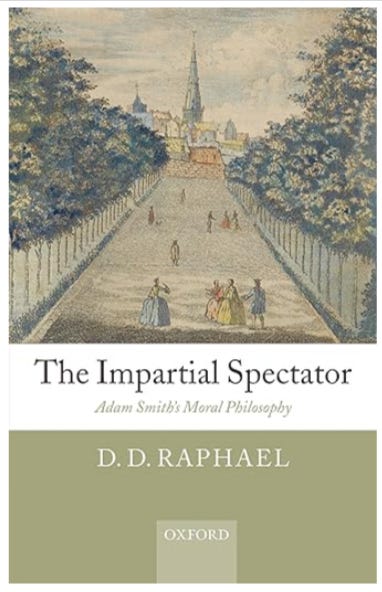
Oxford University Press
August 28, 2009
…
Raphael’s discussion of the way Smith develops the idea of an impartial spectator to explain how we morally judge ourselves is as elegant as it is economical. His discussion spans several chapters, which include a critical appraisal of Smith’s theory of conscience and an examination of Smith’s account of moral rules and the virtues; but his chapter, “The Impartial Spectator,” is the central one. Here Raphael is especially careful to detail Smith’s revisions.
Raphael prefaces this discussion with a brief chapter on the role of the ‘spectator’ in Hutcheson’s and Hume’s moral theories. On his reading, Smith follows his predecessors in grounding moral judgments in the feelings of a spectator, attempting, as they did, to capture the disinterestedness of the moral sentiments of approval and disapproval. According to Raphael, Hutcheson’s and Hume’s idea of a spectator is that of a stranger — someone who is “indifferent in the sense of not being an interested party.” (34) All three philosophers aim to provide an empirical account of the moral sentiments.
Hutcheson was the first to insist that our approval of someone else’s actions can be disinterested, “uninfluenced by any thought of benefit to oneself.” (28) He claims that we possess a special moral sense, in addition to our other senses, that disposes us to feel approval or disapproval when we survey people’s character traits and actions. Hume’s contribution is that he saw the need to explain our capacity to approve and disapprove. He traces it to sympathy: we sympathize with the person herself and everyone with whom she interacts. We judge her character traits and actions expressive of them to be virtuous or vicious in terms of whether they are good or bad for everyone affected. Raphael thinks that the idea of an impartial spectator is present in Hume, although not the term.
On Raphael’s reading of Smith, he only needs the simpler idea of a spectator as “not being an interested party” to explain moral judgments we make about others. His originality and lasting contribution lie in his account of how we come to judge ourselves: how we acquire conscience, how it operates, and how it becomes authoritative.
There are two central features of Smith’s explanation of conscience, both of which were present at all stages in the development of his theory. One is that conscience is a social product, a “mirror of social feeling.” The other is that an agent is able to judge herself only by imagining what an impartial spectator would approve or disapprove of in her conduct.
Smith first stresses the impartiality of the reactions of spectators in his discussion of the virtue of self-command: when an agent tries to moderate his passions to the point where a spectator can sympathize. The virtue of self-command is essential to our being able to see ourselves as others do. Conscience originally springs from our “social experience” of being judged by others and being spectators who judge others. We have a natural desire to be loved and we dread blame. Because we love praise and hate blame, we learn to see our conduct through the eyes of others. We come to approve or disapprove of ourselves by imagining how spectators would judge us.
Raphael argues that Smith increasingly came to trust “imagination more and society less.” (38) One reason is that he was bothered by an objection that Sir Gilbert Elliott raised after TMS first appeared: if conscience is merely a reflection of actual spectators’ social attitudes, how would judgments of conscience differ from those of actual spectators?
However, even in the first edition, Smith’s spectator isn’t an actual bystander, but one we imagine. In the 2nd and 6th editions, Smith stresses even more that the spectator is a creation of imagination. Self-examination requires an ability to divide ourselves:
Whenever I endeavor to examine my own conduct … I divide myself as it were into two persons: and that I, the examiner and judge, represent a different character from that other I, the person whose conduct is examined into and judged of. The first is the spectator… The second is the agent… (TMS III. 1.6)
I become a judge of my own conduct by imagining what I would feel if I were a spectator of my own behavior. I then compare these feelings with the feelings that I as an agent actually have.
This leads to Smith’s famous idea of an internal, impartial spectator — “the man within.” Although conscience is initially a product of the approval and disapproval of others, Smith retains the traditional idea that “the voice of conscience represents the voice of God.” As a superior tribunal, it may conflict with the judgments of actual spectators. How does conscience gain its independence and become a higher authority?
Once we are capable of judging ourselves, we make a new distinction between being praised and being praiseworthy, being blamed and being blameworthy. We want not only praise, but to be praiseworthy; we dread not only blame, but to be blameworthy. Actual spectators may be partial and ill informed, but we are able to view ourselves without partiality or misunderstanding. I may gain the approval of others, for example, by pretending to be virtuous. But since I am able to judge what others would think of me, if they knew everything and were impartial, I realize that I do not merit praise. Not only may the judgments of the internal, impartial spectator differ from those of actual spectators, conscience comes to represent a higher tribunal. Smith eventually saw that being “flattered by the praise of society,” while ignoring the superior verdicts of conscience, is a sign of vanity.
At one point, Raphael remarks that a spectator theory is able to explain more easily third-person judgments, and also second-person judgments, but is “apt to be in difficulties with judgments made in the first person (about ‘me’ or ‘us’).” (31) But, on his view, what is original and enduring in Smith’s thought is his explanation of our capacity to judge ourselves from the point of view of an impartial spectator. He also notes that a spectator theory is “more comfortable with passing verdicts on what has been done in the past than with considering and deciding what should be done in the future.” (31) Does Raphael think that Smith is able to explain how we go from being a spectator of our own conduct to being a moral agent who tries to live up to her own ideals of conduct? In the moment of action, we may not be able to view ourselves impartially. But doesn’t the importance of the internal, impartial spectator lie in the fact that the spectator is the person to whom we, as agents, try to conform our conduct, thereby becoming worthy of love and praise? Raphael says that, according to Smith, an agent who attains a high degree of self-command can “identify himself with the imagined spectator to the extent of obliterating the natural feelings of self-regard.” (41)
Raphael maintains that Smith’s psychological and sociological explanation of conscience also shows that judgments of conscience possess a kind of authority or normativity. Does he think that Smith is able to show that they are authentically normative — answering a justificatory question about why we ought to approve as an impartial and well-informed conscience would? Or does he think that Smith is answering a question in “moral anthropology” — explaining why we are inclined to think that the judgments of conscience are normative?
Interestingly, Hume sketches a process that is similar in some ways to Smith’s account of conscience. According to Hume, sympathy ensures that we will catch the moral feelings other people have about us. Since we care deeply about what others think about us, our internalization of the praise and blame of others has the effect of making us see ourselves as others see us, valuing ourselves as others value us. Sympathy thus pressures us to survey ourselves as we appear to others. Hume says that sympathy may even go so far as to make us disapprove of our own vices, even though they benefit us.
Anyone interested in Adam Smith’s moral philosophy or in 17thand 18thcentury British moral philosophy will find Raphael’s The Impartial Spectator a stimulating book.
These paragraphs end this attack on Smith of the ‘The Theory of Moral Sentiments’ and its advocates like Amartya Sen and D.D. Raphael ! And almost adoration for ‘The Wealth of Nations’ framed with this wan cliche : ‘But there is no need for the best bottle in your cellar’ !
Second, Smith sometimes got economics wrong—not just in his support for the Navigation Acts. In the “Wealth of Nations” he argued for the “labour theory of value” (the idea that the amount of work that goes into a product determines its price, rather than how useful that product is). This theory distracted economists for decades and laid the groundwork for Marxism. Exploitation, in Marx’s view, arose from the difference between how much workers had laboured to create a good and what they were paid for producing it. Without Smith, there could have been no Marx.
Third, Smith introduced fewer core ideas of economics than you might think. He did not invent GDP (William Petty, in the 1660s, probably gets that accolade). He was not the first to recommend free trade. François Quesnay, a French economist, got there earlier. Nor was Smith the first to recognise the benefits of the division of labour. Plato beat him by 2,000 years.
Some argue that what makes the “Wealth of Nations” revolutionary is not individual ideas, but its method. Often using his favourite claret as an example, Smith treats the “economy” as a system with regularities. He did not use the term “equilibrium”, yet he clearly understood the interaction of supply and demand. When governments meddle, they distort the process. All interesting; yet these ideas were common in late 18th-century Europe.
Finally, what of his intellectual honesty? The rules about plagiarism were vague in Smith’s day. People often cited others obliquely, or assumed that the reader would already know who originated an idea. Smith, as it happens, was fiercely jealous of his insights, calling out rivals who he believed had stolen them, including Adam Ferguson, another Scottish philosopher, in 1767.
Which makes it funny, then, that the “Wealth of Nations” contains what Salim Rashid of the University of Illinois, Urbana-Champaign, delicately calls “unacknowledged borrowings”. Smith does not mention Ferguson’s analysis of the alienation of the worker under the division of labour. Or consider the pin factory. Did Smith personally observe it? Perhaps—he travelled a fair bit. Yet there is circumstantial evidence, including from the details of how the pins were made, that he “borrowed” the idea from the “Encyclopaedia”, a French work. Discussing the charge of plagiarism, John Maynard Keynes shrugged: “It seems unlikely that the question can ever be answered for certain.” So in 2026 raise a glass to the “Wealth of Nations”. But there is no need for the best bottle in your cellar. ■
Economist Reader.
The final paragraphs of this Economist Rewrite of Adam Smith
When the “Wealth of Nations” came out, everyone agreed it was a Very Important Book. But does it warrant calling Smith the “father of economics”? That may be going too far, for three reasons. Smith was a flowery writer; he made strange errors; and he is credited for ideas that were not his.
Take the book itself first. Full of long, winding sentences, it is not nearly as readable as Milton Friedman’s “Free to Choose” or Marx’s “Communist Manifesto”. Even in the 1770s people found it hard to digest, with a contemporary review noting that the work “may be sometimes thought diffuse”. Small wonder that even Smith scholars admit that they have not read the whole thing in one go.
Second, Smith sometimes got economics wrong—not just in his support for the Navigation Acts. In the “Wealth of Nations” he argued for the “labour theory of value” (the idea that the amount of work that goes into a product determines its price, rather than how useful that product is). This theory distracted economists for decades and laid the groundwork for Marxism. Exploitation, in Marx’s view, arose from the difference between how much workers had laboured to create a good and what they were paid for producing it. Without Smith, there could have been no Marx.
Third, Smith introduced fewer core ideas of economics than you might think. He did not invent GDP (William Petty, in the 1660s, probably gets that accolade). He was not the first to recommend free trade. François Quesnay, a French economist, got there earlier. Nor was Smith the first to recognise the benefits of the division of labour. Plato beat him by 2,000 years.
Some argue that what makes the “Wealth of Nations” revolutionary is not individual ideas, but its method. Often using his favourite claret as an example, Smith treats the “economy” as a system with regularities. He did not use the term “equilibrium”, yet he clearly understood the interaction of supply and demand. When governments meddle, they distort the process. All interesting; yet these ideas were common in late 18th-century Europe.
Finally, what of his intellectual honesty? The rules about plagiarism were vague in Smith’s day. People often cited others obliquely, or assumed that the reader would already know who originated an idea. Smith, as it happens, was fiercely jealous of his insights, calling out rivals who he believed had stolen them, including Adam Ferguson, another Scottish philosopher, in 1767.
Which makes it funny, then, that the “Wealth of Nations” contains what Salim Rashid of the University of Illinois, Urbana-Champaign, delicately calls “unacknowledged borrowings”. Smith does not mention Ferguson’s analysis of the alienation of the worker under the division of labour. Or consider the pin factory. Did Smith personally observe it? Perhaps—he travelled a fair bit. Yet there is circumstantial evidence, including from the details of how the pins were made, that he “borrowed” the idea from the “Encyclopaedia”, a French work. Discussing the charge of plagiarism, John Maynard Keynes shrugged: “It seems unlikely that the question can ever be answered for certain.” So in 2026 raise a glass to the “Wealth of Nations”. But there is no need for the best bottle in your cellar.
Economist Reader.


 StephenKMackSD's Blog