Newspaper Reader on the utterly bankruptcy of Michael Tomasky, apologist for the failure of the New Democrats, since the Neo-Liberalism of Bill & Hillery to the political present!
Dec 11, 2025
Even George W. Bush’s Torture Guy Thinks Trump Is Crossing the Line
John Yoo says the Trump’s “drug boat” strikes are clearly illegal.
Melissa Golden/Getty Images
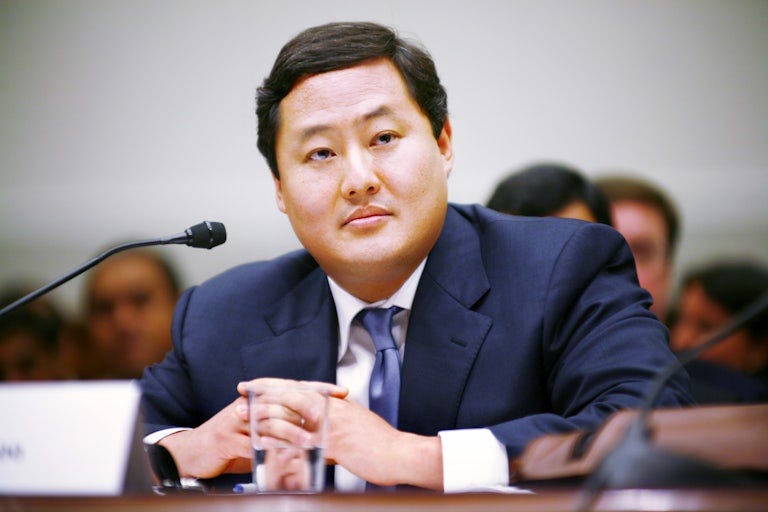
Even the Justice Department lawyer who defended the George W. Bush administration’s decisions to waterboard, bind, and sleep-deprive prisoners in the infamous 9/11 “Torture Memos” of 2002 thinks the Trump administration’s drug boat strikes are going too far.
“I don’t think there’s an armed attack” against the United States by the drug cartels, law professor John Yoo, the former Bush DOJ deputy assistant attorney general, told Politico in a Thursday article.
Unitary Executive Theory (UET)
The unitary executive theory (UET) is a constitutional law theory holding that the President of the United States possesses sole authority over the executive branch. Supporters trace the theory’s origins to debates at the Constitutional Convention of 1787, particularly the Virginia Plan, which emphasized a single executive.
The most controversial aspect of the theory concerns the President’s removal power. Under the UET, the President may remove appointed executive branch officials without approval from Congress or the courts. The Supreme Court has addressed the scope of this power in a series of cases. In Myers v. United States, 272 U.S. 52 (1926), the Court held that the President has exclusive authority to remove executive officers. Later decisions, such as Humphrey’s Executor v. United States, 295 U.S. 602 (1935), and Morrison v. Olson, 487 U.S. 654 (1988), placed limits on removal where Congress created independent agencies or officers with quasi-legislative or quasi-judicial functions. More recently, the Court has shifted back toward the UET view, striking down removal protections for certain executive officials. In Seila Law LLC v. Consumer Financial Protection Bureau, 591 U.S. 197 (2020), the Court held that Congress could not insulate the Consumer Finance Protection Bureau’s single director from at-will removal. In Collins v. Yellen, 594 U.S. 220 (2021), the Court similarly held that the structure of the Federal Housing Finance Agency violated the separation of powers because its single director was not removable at will by the President. The case Slaughter v. Trump, 606 U.S. ___ (2025) raises removal power issues anew: the Supreme Court considered the President’s removal of an FTC commissioner without cause, revisiting the scope of congressional authority to insulate executive officers from at-will removal.
[Last reviewed in September of 2025 by the Wex Definitions Team]
https://www.law.cornell.edu/wex/unitary_executive_theory_%28uet%29
Newspaper Reader.


 StephenKMackSD's Blog