The Economist and its present hirelings, have willfully forgotten their propganda predecessors of John Micklethwait & Adrian Wooldridge?
Dec 01, 2025
Reader recall this from Nov 21, 2025?
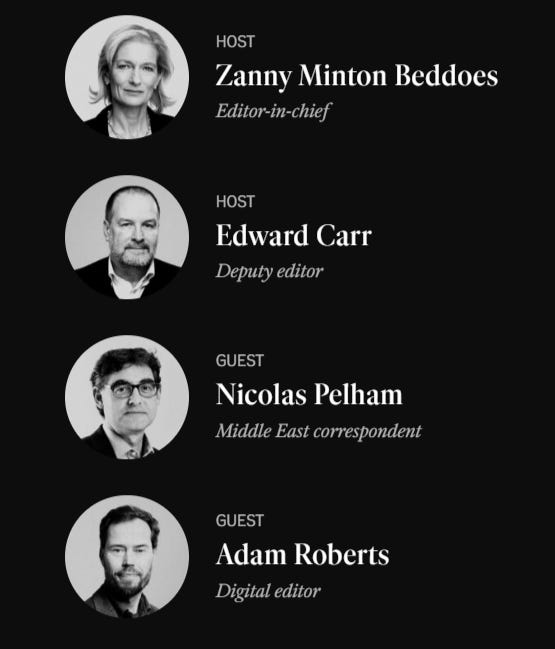
Zanny Minton Beddoes, Edward Carr, Nicolas Pelham & Adam Roberts discuss: ‘Dispatch from Tehran: how dangerous is the Iranian regime today?’
Editor: What is not supplied to the reader is an actual redable transcript of this conversation, that might lead the reader to look upon this conversation, as an exercise in political propaganda!
Nov 21, 2025
Dispatch from Tehran: how dangerous is the Iranian regime today?
Neo-Con Zanny Minton Beddoes and her cadre of men explore such questions: ‘After 46 years of theocracy and a brief but bruising war, where does power now lie? What are the regime’s nuclear ambitions? And with the prospects of a succession crisis, has Iran been permanently weakened—or is it storing up trouble?’
This Reader observes that there is no actual trascript, with which to follow the arguments as each of Beddoes employees, as they make their argumanments/ contrbutions?
Episode summary
Nicolas Pelham, our Middle East correspondent, and Adam Roberts, our digital editor, are just back from a rare reporting trip to Tehran. They join our top editors in the studio to discuss what they learnt from an interview with Iran’s foreign minister and consider the future of the Islamic Republic. After 46 years of theocracy and a brief but bruising war, where does power now lie? What are the regime’s nuclear ambitions? And with the prospects of a succession crisis, has Iran been permanently weakened—or is it storing up trouble?
StephenKMackSD.
Just to establish my credentials a long time reader of The Economist, I hold in my hand a Book Review of A.W. Alschuler’s ‘Law Without Values: The Life ,Work, And Legacy Of Justice Holmes’ from page 86 dated Febuary 24, 2001.
StephenKMackSD
Added 11/22/2025 !
Editor: Hear is one of Beddoes’ Oxbridgers, Adam Roberts, chattering about Ukraine, like a reliable employee and Fellow Traveler !
Hello from London,
How vulnerable is Volodymyr Zelensky? It’s not only winter that is closing in. The closest aide to Ukraine’s president was compelled to resign on Friday, as anti-corruption investigators continue to expose a scandal in the energy sector said to involve kickbacks worth $100m or more. The loss of Andriy Yermak as chief of staff is undoubtedly a painful blow. Mr Yermak had been in charge of handling diplomatic pressure from America and Russia—countries trying to impose a grim-sounding peace deal on weary Ukraine. Read our story on the fall of Mr Yermak.
Add fears that Russia, bit by bit, is gaining the upper hand on the battlefield. In a war of attrition Russia’s economic and manpower advantages are starting to tell. Its more recent advantage in drone firepower looks worrying, too. None of that means any sort of decisive military breakthrough is likely. It’s still not clear to me even whether all of Pokrovsk, a symbolically important town in the Donbas that Russia has been on the cusp of seizing for 14 months, has actually fallen, for example. But it adds to a sense of gloom.
Some Ukrainians would like to see Mr Zelensky go. It’s widely assumed that Valery Zaluzhny, who was sacked as commander of Ukraine’s armed forces early in 2024, is eager to become president himself. I assume that Donald Trump would like Mr Zelensky gone if that would make it easier for him to declare the war over (whatever the consequences for Ukrainians and for Europe as a whole). Undoubtedly, Vladimir Putin hopes to see his foe gone. Mr Zelensky has played a big part in humiliating the Russian autocrat. Mr Putin’s supposed three-day invasion of Ukraine, back in 2022, has become a bloodbath that has now lasted more than 1,370 days and cost over 1m Russian dead and injured.
Editor: Adam Roberts whistling in the dark!
Despite the recent pressure on Mr Zelensky I don’t see him as powerless. Europeans, who actually provide Ukraine with weapons (bought from America) and economic aid, are sticking by him, as they should. They know that it’s crucial both to fend off American efforts to impose a dreadful sort of peace deal on Ukraine, and to make sure that Mr Zelensky’s forces can inflict military and other pain on Russia. Maritime drone attacks on shadowy oil tankers in the Black Sea over the weekend suggest a new effort to block Russian exports. The regular signs of Russian threats in other parts of Europe—such as drones over Moldova this weekend—are reminders that Mr Putin’s real goal is to make Europe much weaker. Every effort to help Ukraine continue to resist, in other words, is entirely in Europe’s own interest.
I recently asked for your views on Ukraine and the consequences if Russia seizes Pokrovsk. Rui Manuel Marques Rodrigues suggests it would not lead to any ceasefire, but only to more Russian aggression. Margaretha Jud has the same view, and she is sure that none of the proposals for a ceasefire deal would lessen Mr Putin’s appetite to take over Ukraine. Richard W. Murphy, meanwhile, emphasises the “miracle” of the long Ukrainian defence of Pokrovsk, at huge cost to the Russian attackers. I entirely agree. Finally, many of you also wrote in with observations about Iran, after my recent visit there with a colleague. I’d still welcome your thoughts on that country, and on whether any change is possible there. Please write to me at economisttoday@economist.com.
Editor: Alan Wolfe provides a canny evaluation of John Micklethwait and Adrian Wooldridge!
What Gave Us the Right
By Alan Wolfe
Nov. 28, 2004
THE RIGHT NATION Conservative Power in America. By John Micklethwait and Adrian Wooldridge. 450 pp. The Penguin Press. $25.95.
LEO STRAUSS AND THE POLITICS OF AMERICAN EMPIRE By Anne Norton. 235 pp. Yale University Press. $25.
Is George W. Bush not only the most conservative president we’ve ever had, but an entirely new kind of conservative whose ideas will dominate American politics for the foreseeable future? Or is he — along with the neoconservative “Straussians” who advised him to go to war in Iraq+- not really a conservative at all, but a daring crusader who’d make a real conservative like Leo Strauss turn over in his grave? Oddly, the better-written and more politically astute of two recent books, “The Right Nation,” by John Micklethwait and Adrian Wooldridge, offers the wrong answer to these questions, while the often incoherent one, Anne Norton’s “Leo Strauss and the Politics of American Empire,” gets them right.
Micklethwait, the United States editor for The Economist, and Wooldridge, its Washington correspondent, are the authors of a wonderful book on business advice manuals, “The Witch Doctors: Making Sense of the Management Gurus.” In “The Right Nation,” they show how the conservative movement that brought Bush to power is not recognizable as conservative from a European perspective. Ours is not a Tory conservatism respectful of the landed gentry, deferential to the privileges of an established church, fearful of class division — and, at least in modern times, incompetent in politics.
Rather, the authors argue, American conservatism is exceptional because America is. Fueled by free-market enthusiasts, gun-toting libertarians, Bible-believing Christians and welfare-hating exurbanites, the conservatism of a Grover Norquist or Tom DeLay knows what it stands for, has the confidence that gloomy liberals lack and best represents the places in America that are growing most rapidly, like Colorado Springs, Texas, the South. So powerful is its appeal that liberals must alter their ideas to counter it (one reason John Kerry posed with a shotgun during the campaign). Americans love business, freedom and the military, and on these key issues, the liberal disadvantage is palpable. “The stage is set,” Micklethwait and Wooldridge believe, “for a possible realignment of American politics, to make the Republicans the natural party of government in the same way that the Democrats once were.” Their analysis, presented well before the 2004 election, now seems more prescient than talk of an emerging Democratic majority — or, if a mea culpa is permissible, of one nation, after all.
…
Micklethwait and Wooldridge are not cheerleaders for the right; they keep their politics to themselves and balance their respect for conservatism’s success with numerous examples of its limits and failures. Ideological tilt is not the flaw of their otherwise engaging book; superficial analysis is. The most obvious defect in their treatment is that Bush has not run as a hard-right conservative. In 2000, he displayed his compassion for all to see. In 2004, he attacked Kerry as a liberal and didn’t endorse the hard-right position on gay rights or abortion. His victory was as strategically brilliant as it was ideologically imprecise. Micklethwait and Wooldridge know he is a conservative, and Bush himself knows he is a conservative, but there are not a few voters out there, including many who voted for him, who have not been let in on the secret.
…
Micklethwait and Wooldridge fail to appreciate the conservative appropriation of liberal ideas because their book pays little attention to ideas of any sort. Conservatism, they write, is new and different, but they never say whether it makes sense. Yes, conservatives thought out of the box in denouncing Europe and pursuing a unilateralist policy in Iraq, but if the ideas behind their foreign policy are disastrous, as they evidently are, perhaps one should be more guarded about conservatism’s triumph. The same could, and should, be said about the right’s domestic policies. It is adventurous to spend money the government does not have. But if the result is as unwise as it is irresponsible, those who promote such a program will pay a significant political price in the future.
…
Editor: My comment from May 16, 2024 : Adrian Wooldridge and John Micklethwait were mere bit players, but they did provide ballist to Seabright’s essay.
Posted on May 16, 2024 by stephenkmacksd
Political Cynic takes the measure of Mises/Hayek/Friedman’s successor?
I’ve been a reader of The Economist from the early 1990’s and on and off since then. The stogey old white men, represented by those once stalwarts Adrian Wooldridge and John Micklethwait, Oxbridgers both, and their best sellers like The Right Nation: Conservative Power in America compendiums of their various essay subjected to studious re-writes. When the comments section was closed, that was marked my canceling of my subscription, though I later returned. Beddoes was not a member of that club, so that high-flown rhetoric must patiently wait for paragraphs like these? In this essay Amazon is the arbiter of Popular Taste, with Mr Seabright’s off and on appearances, aided by some ‘Big Names’. This is propaganda!
God gets mixed reviews on Amazon. This is perhaps surprising. His marketing campaign (now in its third millennium) has been strong. His slogans (“God is Great!”) are positive. And indeed many shoppers effuse. “Wonderful!” reads one five-star review beneath His best-known work, the Bible. “Beautiful,” says another. “Amen,” adds another satisfied customer.
Other reviewers are critical. One, after giving the Bible just a single star, observes bluntly, if rather blasphemously, that it is a “boring read”. Another review complains: “the plot is not cohesive”. A third disgruntled reader argues that there are “Too many characters” and that the main protagonist is a bit full of himself.
The patient reader need just wait as Mr Seabright describes himself:
…
My research lies in the areas of microeonomic theory, industrial and competition policy, intellectual property and the digital society, development economics, economics and human evolution, the economics of gender, the economics of religion. A common theme to these apparently chaotically diverse topics is the foundations of human cooperation and social trust: I examine the way in which our prehistorically evolved psychology interacts with modern institutions to make social cooperation possible.
…
My new book The Divine Economy: How Religions Compete for Wealth, Power and People, published by Princeton University Press in May 2024, brings together my interests in industrial economics (specifically the economics of platforms) and my fascination for behavioural and evolutionary economics. Two earlier books published by PUP, The Company of Strangers: A Natural History of Economic Life (2010) and The War of the Sexes: How Conflict and Cooperation Have Shaped Men and Women from Prehistory to the Present (2012) also explored the confrontation of a psychology shaped by evolution with modern social and economic institutions.
…
The Reader might just wonder, indeed ponder the reach of ‘Economic Science’, in the thought of Mr Seabright! He seems to bypass the Neo-Liberal Chatter of that Toxic Trio of Mises/Hayek/Friedman!
The Reader might wonder at what Economist might offer the The Believer, The Atheist , and or the completely disinterested?
If it feels surprising that God is reviewed on Amazon, it should not. God may have made heaven and earth, but he also makes an awful lot of money, as Paul Seabright, a British economist and professor at the University of Toulouse in France, points out in a new book.
The utter boredom of God Talk: The Economist.
…
Secularists may smirk at religion as silly, but it deserves proper analysis. “The Divine Economy” looks at how religions attract followers, money and power and argues that they are businesses—and should be analysed as such. Professor Seabright calls religions “platforms”, businesses that “facilitate relationships”. (Other economists refer to religions as “clubs” or “glue”.) He then takes a quick canter through the history, sociology and economics of religions to illustrate this. The best parts of this book deal with economics, which the general reader will find enlightening.
Economists were slow to study religion. Some 250 years ago Adam Smith observed in “The Wealth of Nations” that the wealth of churches was considerable. He used secular language to describe how such wealth arose, observing that churches’ “revenue” (donations) flowed in and benefited priests, who he argued were sometimes animated less by love of God than by “the powerful motive of self-interest”. He also argued that if there were a better functioning market in religious providers, this would lead to increased religious harmony. According to Laurence Iannaccone, a professor of economics at Chapman University in California, Smith’s analysis was “brilliant”—and for a long time largely ignored.
…
The Religious Hucksters, what ever their guise, trade in Sacred Texts like the Bible, the Koran, The Talmud. Mr. Sebright uses Economics as the ‘Key’ . It’s like the etiolated Neo-Liberal Trinity of Hayek/Mises/Friedman in a new key! Economics is the central driver in human existence: The Wisdom of the Market is the singular imperative of human striving?
Some selective quotation: The Economist: Two descriptors apply: ‘Potted History’ or ‘History Made To Measure’!
Divinity departments are staffed by theologians rather than economists; the idea of mixing the dismal science with the divine strikes many people at the very least “as odd and at worst strikes them as blasphemous”, says Mr Iannaccone. People associate God with angels, not with Excel.
Yet religions lend themselves to economic analysis nicely. They offer a product (such as salvation); have networks of providers (priests, imams and so on) and benefit from good distribution networks. It is not just trade that travels on trade routes: ideas, diseases and religions do, too. Roman roads allowed the plague of Justinian to spread across Europe with a rapidity never seen before. They also allowed Christianity to.
Starting in the 1970s, some economists have been approaching religion with more academic devotion, analysing, for example, the economics of extremism and obtaining a place in the afterlife. This mode of thinking can help to clarify complicated religious history. When historians talk about the Reformation they tend to do so using thorny theological terms such as “transubstantiation”. Economists would describe it more simply as the moment when a monopoly provider (the Catholic church) was broken up, leading to an increase in consumer choice (Protestantism) and the price of services declining (indulgences were out).
A greater variety of suppliers started to offer road-maps to heaven. Henry VIII swapped his old service provider, Catholicism, for the new one—which was not only cheaper, but also allowed him to divorce a troublesome wife. There were, admittedly, some bumps: the pope was not pleased, and the habit of burning picky customers at the stake dented consumer confidence. But overall, the Reformation enabled people and their rulers to “get a better bargain”, says Davide Cantoni, a professor at Ludwig Maximilian University of Munich.
Seabright returns briefly, then some Brand Names, Nations, then it becomes a muddle of Economist chatter!
(Christianity and Islam), Walmart, Lidl and Tesco, the Catholic church, like McDonald’s, Vatican or Venezuela, Baal , the Bible, Tom Lehrer, Catholics, The Vatican Rag, “The Divine Economy”, ‘ a rational Bayesian framework, God, as Friedrich Nietzsche stated, Jordan Peterson, a Canadian academic.
The final salvo: The Economist
God might wish he were dead when He hears such things. He is not.
( Call this the profession of Faith of ‘The Economist’?)
Political Cynic


 StephenKMackSD's Blog