Newspaper Reader attempts to unravel …
Nov 17, 2025
Headline: Vladimir Putin has no plan for winning in Ukraine
Sub-headline: Fighting will continue, but a reckoning is coming
The opening of Edward Carr essay relies on History
N JUNE 10TH 2026 the fighting between Russia and Ukraine will have lasted longer than the first world war. That conflict, too, was supposed to have been over in a few weeks. As in Ukraine, fighting became bogged down and the high command squandered men’s lives in one doomed assault after another. In August 1918 the allies used new tactics to break the German lines. Today, by contrast, Ukraine will not surrender and Russia does not know how to win.
Even in a dictatorship, a leader who has no theory of victory is storing up trouble. As Tsar Nicholas II learnt to his cost in the first world war, sooner or later there will be a reckoning.
Editor : Should I check my copy of August 1914 THE RED WHEEL 1? Though I am moored on page 573 ‘66’ ? I’ll quote Mr.Carr’s paragraph on the Russian casualties without acompaning data about the five Russian soldiers are dying for every Ukrainian.
The numbers tell this terrible story. In the year to mid-October, Russian casualties grew by almost 60%, to somewhere between 984,000 and 1,438,000. The dead now number between 190,000 and 480,000. Perhaps five Russian soldiers are dying for every Ukrainian. And yet over the summer Mr Putin’s armies failed to take a single large city. Russia is advancing, but to occupy the four oblasts it claims as its own would require five more years. If the killing continues at 2025’s rate, total Russian casualties will reach almost 4m.
Editor: Mr. Carr is a Neo-Conservative like Zanny Menton Beddoes, his editor:
…
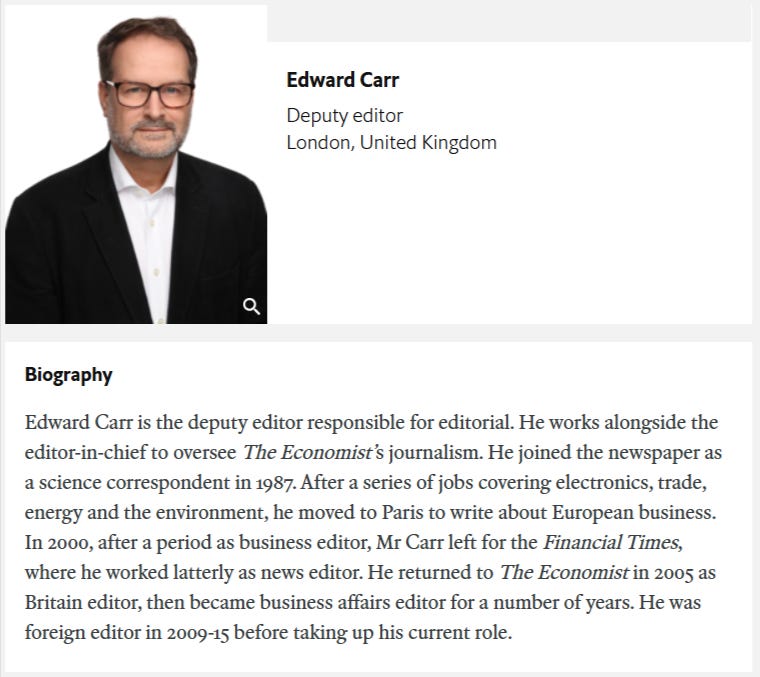
Edward Carr is a highly-respected writer and commentator on global strategic affairs and business and is based in London with the leading weekly international newspaper, The Economist. He currently provides the editorial leadership for The Economist on international affairs, and is uniquely placed to relate these topics to reflect the implications for international business – he has the wealth of experience of previously being Foreign Editor, Business Affairs Editor (covering science, technology, industry and finance and various other portfolios. He was also previously the Editorial Director with oversight of the quarterly magazine Intelligent Life, published by The Economist Group.
Edward speaks and moderates on a wide range of issues including international strategic affairs, business, industry and trade as well as energy, climate change and the environment.
He has carried out numerous live and recorded radio and television appearances over the years and is occasionally invited to co-host CNBC’s Squawk Box, once hosting with guests Jack Welch and Charles Elson featuring a discussion about executive pay. He regularly chairs seminars and debates for Economist Conferences and other top level events.
He also engages in client events, where he presents or moderates at customer forums – e.g. McKinsey Global Leadership Conference, or for organisations’ internal strategy sessions.
As Deputy Editor of The Economist, has editorial responsibility across the entire print side of the newspaper. During his journalist career, which saw him first join The Economist as science correspondent in 1987 and then go to Paris to write on European business, he briefly left The Economist in 2000 to write for the Financial Times where he worked as foreign news editor, and then as the news editor overseeing the front page and the newspaper’s news operation.
Edward studied Science at Cambridge University, winning The Bronowski Prize for his work on 18th Century French Chemistry.
…
Mr Putin also had hopes that America’s president, Donald Trump, would tip the balance in his favour. By withdrawing vital American support—in particular, on intelligence and for air-defence—Mr Trump could indeed impose a bad peace on Ukraine. Early in 2025, he briefly tried to do so.
Yet those tactics no longer look likely. The peacemaker in the White House continues to blow hot and cold with Ukraine’s president, Volodymyr Zelensky, whom he dislikes. But Europe is now paying Ukraine’s bills, neutralising MAGA’s main gripe that America was being exploited. And Mr Trump seems to have concluded that throwing Ukraine to the bears would ruin his aspiration to become a Nobel prize-winning statesman. In October he even imposed sanctions on Lukoil and Rosneft, two Russian oil companies.
Lastly, Mr Putin may hope European resolve will crumble. The money Ukraine needs to keep on fighting will run out in February. The prospect of populist governments that are less hostile to the Kremlin already hangs over the continent. A divided and dysfunctional Europe will struggle to give Ukraine the long-term backing it needs to thrive once the fighting stops.
But that is not the same as abandoning Ukraine in the heat of battle. The case that Ukraine is the key to European security is iron-clad. If Kyiv falls, Mr Putin will have control over Europe’s biggest army and a formidable arms industry. Work is afoot to set up a credible multi-year financing mechanism that goes beyond seizing Russian assets. If it succeeds, Mr Putin will know that Ukraine’s economy can outlast Russia’s.
Some people think the Russian president must believe time is on his side, or he would have already sued for peace. Yet the lesson of Vietnam, Afghanistan and Iraq is that leaders cling on in the hope that something—anything—will turn up. So the chances are that Mr Putin will continue to fight in 2026, waiting for his generals to find a new way of waging war, for Ukraine to run out of men, for Mr Zelensky’s government to collapse, or for Mr Trump or Europe to lose patience.
But if none of these things happen, Mr Putin will be storing up a terrible reckoning. Russia has mortgaged its economy, harried Finland and Sweden into joining NATO, subordinated itself to China and scythed through a generation of young men. And for what? The moment this question forms on Russian lips, the world will face a new danger. Mr Putin could accept defeat abroad and impose terror at home. Or he could escalate.
…
Editor: The reader has to wonder at this Call To Arms in The Economist?
Why funding Ukraine is a giant opportunity for Europe
The bill will be huge. It is also a historic bargain
https://www.economist.com/leaders/2025/10/30/why-funding-ukraine-is-a-giant-opportunity-for-europe
Political Observer marvels at the ever bumptious Neo-Con Zanny Menton Beddoes, who has never fought in a War. Ernst Jünger’s Storm of Steel (1920) provides a fractured but usable model?
…
Editor: Beddoes and her minions have refined the call to battle, as a necessay imperative for Europe. The very thought of an Oxbridger, or its equiveilent, serving in any Army, offers a certain puerile potential? ‘Europe’ seems to have reached an Age of Fracture: Macrons wayward politics is the paradigm?
Newspaper Reader.


 StephenKMackSD's Blog