Political Cynic compares Stephens wan confession, to that of Francis Fukuyama’s declaring himself a ‘Liberal’ ?
Aug 20, 2025
Editor: Bret Stephens World is just like David Brooks World? Though David somtimes forgets he’s JEW, but Stephens was trained by being the editor in chief of The Jerusalem Post, the political arm of The Zionist Faschist State! In the following paragraphs Stephens applies weak white-wash to Neo-Conservatism! Prerfectly attuned to the New York Times readers prejudices!
Although the term “neoconservative” has fallen into disuse — except as an occasional slur used by the MAGA right, the progressive left and social-media antisemites who really mean to say “Jew” — I’ve never been shy about describing myself as one. In Donald Trump’s whipsawing performances with Vladimir Putin in Alaska on Friday and Volodymyr Zelensky and his European allies in Washington on Monday, I’m reminded of why.
Neoconservatism emerged in the early 1970s as a loosely coherent movement of disenchanted liberals who were critical of the welfare state and turned off by the anti-Americanism of parts of the antiwar left. But the movement also took a dim view of the Nixon administration, particularly in its pursuit of arms control with the Soviet Union, its relative indifference to human rights issues behind the Iron Curtain, and its realpolitik approach to foreign policy in general.
I learned this the hard way 14 years ago, when Henry Kissinger nearly kicked me out of his Park Avenue office for having the ill grace to ask him about China’s brutal treatment of Liu Xiaobo, the imprisoned dissident. The former secretary of state, then 88, was still too concerned with currying influence in Beijing to say anything nice about his fellow Nobel Peace laureate.
Little wonder, then, that many of Trump’s most ardent conservative opponents in recent years are, or were, old-school neocons. Like President Richard Nixon’s, Trump’s politics are a mix of statist economic impulses, populist grievances, the conceit of being above the law and a transactional approach to foreign policy that discounts the moral force of American ideals. What Trump lacks in his predecessor’s intellectual sophistication, he makes up for with his gifts for crude showmanship.
Editor: Mr. Stephens can’t quite match Barry Gewen’s essay of 2010 in The New York Times,
Leave No War Behind
By Barry Gewen
June 11, 2010
…
This definitional question, and in particular neoconservatism’s extraordinary transformation, is the principal subject of “Neoconservatism: The Biography of a Movement,” by Justin Vaïsse, a French expert on American foreign policy who is currently a senior fellow at the Brookings Institution. It is essential reading for anyone wishing to understand the contours of our recent political past. Vaïsse is a historian of ideas. “Neoconservatism” demonstrates, among other things, that ideas really do make a difference in our lives.
Vaïsse defines neoconservatism by disassembling it. He sees three “ages” to the movement. The first began in the mid-1960s with intellectuals like Irving Kristol, Daniel Bell, Daniel Patrick Moynihan and Nathan Glazer gathering around Kristol and Bell’s new magazine, The Public Interest, and also around Commentary, under its editor Norman Podhoretz. At the time, all of these writers were sympathetic in principle to an activist government, especially when it came to the economy, but questioned the expectations of Great Society planners of antipoverty and related social programs — or, in Saul Bellow’s phrase, the Good Intentions Paving Company. Challenging what they saw as liberal overreaching and wishful thinking with hard, often crushing, empirical facts, these early neoconservatives were, in a sense, the skeptical conscience of liberalism.
But skepticism about the effectiveness of particular programs soon mutated into broader disenchantment with almost every kind of government intervention and into the conviction that the free market alone offered acceptable solutions to social problems. As neoconservative pragmatism calcified into laissez-faire dogma, some of its godfathers defected. Daniel Bell, a self-described “right-wing social democrat,” for one; Moynihan, who, Vaïsse writes, “contended that he was the modern incarnation of a Wilsonian Progressive,” for another. By the time President Ronald Reagan proclaimed “government is not the solution to our problem; government is the problem,” neoconservatism was a spent force in domestic policy, hardly distinguishable from the libertarianism of the American Enterprise Institute.
In the second and third ages, as Vaïsse describes them, neoconservatives turned their attention to foreign policy. This wasn’t surprising. The original neoconservatives were devout anti-Communists for whom opposition to Stalinism and the Soviet Union was as much a left-wing as a right-wing position. This is why the neoconservatives of the second age reacted against what Vaïsse calls “the conquest of the Democratic Party by the forces of the New Left,” begun in 1968 and completed in 1972, when George McGovern won the presidential nomination. The McGovernites, strenuously opposed to the Vietnam War and distrustful of American power, struck more hawkish Democrats as naïve about Communism, even isolationist. The neocons rallied behind Henry Jackson, known as Scoop, a Democratic senator from Washington who, though a supporter of the Great Society’s domestic programs, was the most unrepentant of cold warriors. He nurtured the careers of many young men later known as the toughest of the tough-minded — Richard Perle, Paul Wolfowitz, Elliott Abrams and Douglas Feith.
…
Editor: Stephens presents his arguments:
What would a traditional neocon say about Trump’s latest diplomatic efforts between Russia and Ukraine? A few points.
.
First, we’d note that dictators who are contemptuous of the rights of their own people tend to be equally contemptuous of the rights of other countries.
.
Second, dictators who do not abide by the rule of law at home will not honor international agreements, either.
.
Third, Putin does not see Trump’s chummy manner, his effort to forge personal ties, as an invitation to be reasonable.
.
Fourth, neocons subscribe to a “broken windows” theory of international order: If disorder goes unchecked, or if aggression is rewarded, in one part of the world, it will encourage disorder and aggression in other parts.
.
Fifth, neocons believe that American ideals do not undermine American power; rather, they march hand in hand. When the United States lent destroyers to the United Kingdom in 1940, we created the conditions that allowed us to prevail in World War II.
.
Sixth, international guarantees are mostly worthless unless backed by credible and overwhelming power.
.
Seventh, the only way to guarantee an end to this conflict is steadfast opposition to Putin through sanctions, ostracism and military and economic support for Ukraine and every other country Russia threatens.
.
Neocons may have long ago fallen out of fashion. To watch Trump in recent days is to be reminded that some old fashions deserve to be made new again.
Editor: Reader see ‘Carl Schmitt and Leo Strauss The Hidden Dialogue’ by Heinrich Meier Translated by J. Harvey Lomax, to guage the political mendacity of Mr. Stephens New York Times chatter!
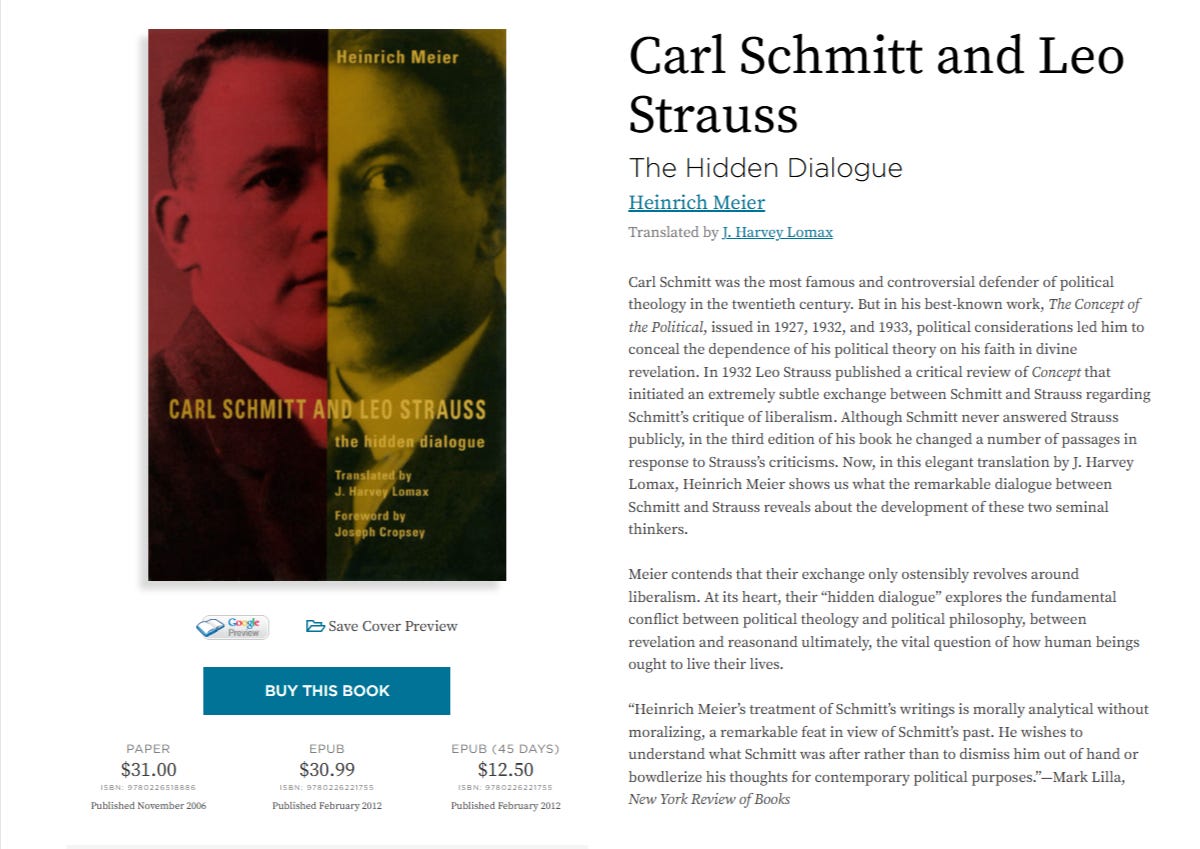
https://press.uchicago.edu/ucp/books/book/chicago/C/bo3637206.html
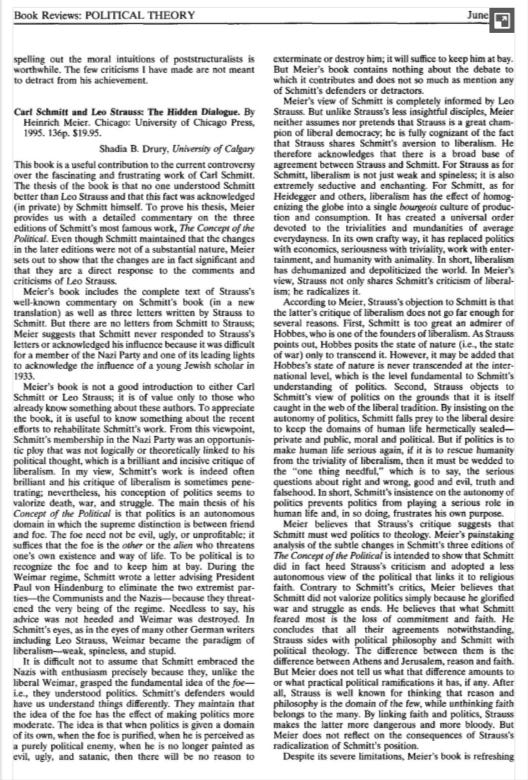
Shadia Drury offers the above!
Political Cynic.


 StephenKMackSD's Blog