Political Observer on The Gaza Genocide and Hiroshima and Nagasaki?
Aug 12, 2025
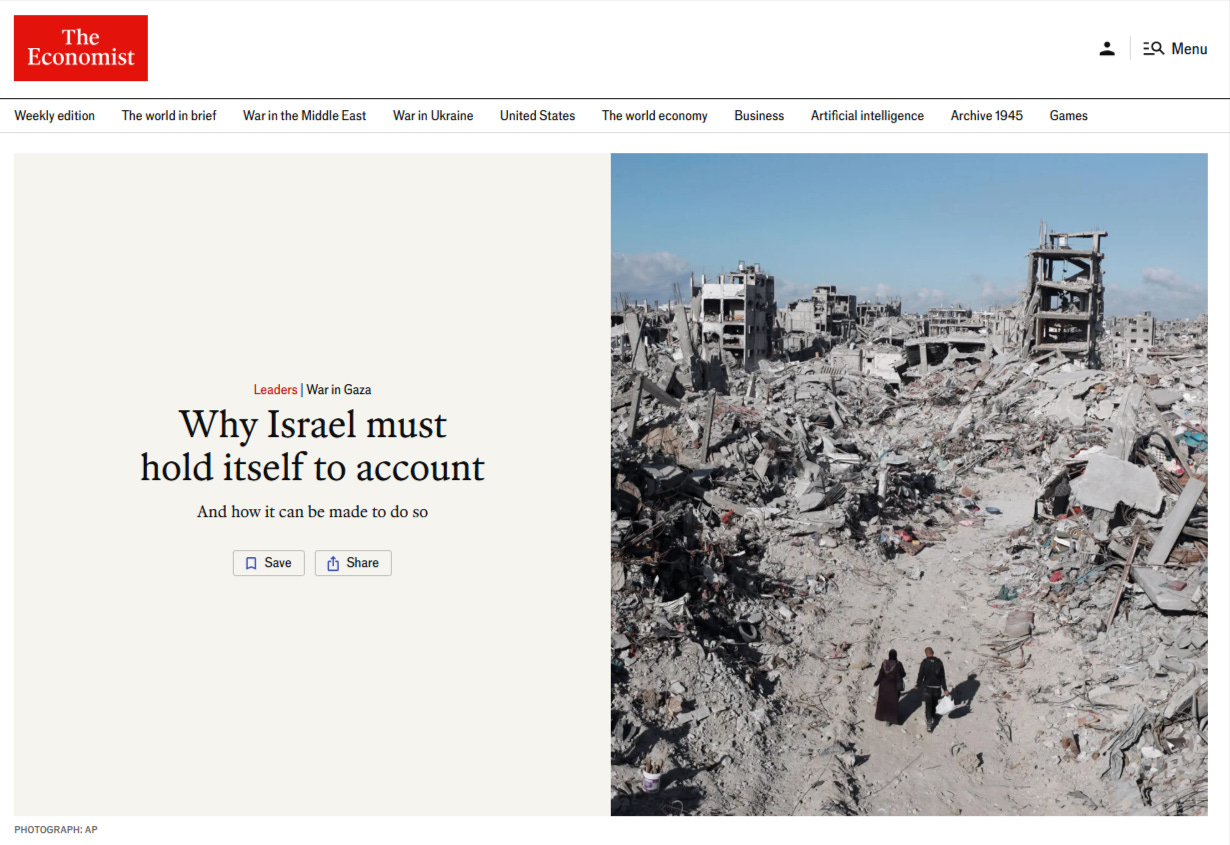
Editor: Here is the bedinning of ‘call to account’ offered by this news magaine : featuring the Soviet Union as the untimate, indeed the toxic political actor of the 20th Century. How fleeting is the political memory of this newspaper and it’s minions, about the Crime’s perpitated by America in the bombing of Hiroshima and Nagasaki!
…
Other estimates made in the immediate postwar, for which the methodology is not available, include the following, which were cited in some of the aforementioned reports:
- Hiroshima Red Cross Hospital estimated 70,000 dead, and another 50,000-60,000 dead within the next two months, for a total of around 125,000 dead;
- The British estimated, based on their own population estimates, that some 70,000-90,000 people died at Hiroshima, and an additional 100,000 were injured; at Nagasaki, they initially estimated 39,500 killed, but later reduced this to 34,000; they also estimated that at least 60,000 were injured at Nagasaki;
- The Navy technical mission to Japan estimated 80,000 dead at Hiroshima and 45,000 at Nagasaki;
- The United States Strategic Bombing Survey’s Civilian Defense Division estimated that 25,761 had died in Nagasaki, with 30,460 injured and 1,927 missing;
- The Supreme Commander for the Allied Powers headquarters put the dead at Hiroshima at 78,000 in early 1946;
- In July 1946, Lt. Col. George V. LeRoy, a physician assigned to the Joint Commission and a member of the Manhattan Project’s health physics division at the University of Rochester, gave an address that claimed that at Hiroshima 80,000 had died and 40,000 had been injured, and at Nagasaki 40,000 had died and 25,000 had been injured.
Again, the fact that most of these numbers hover around similar orders of magnitude (66,000-90,000 dead at Hiroshima, 25,000-45,000 at Nagasaki) should probably be understood as being essentially based on the same types of data for the populations of the cities, and they may not be totally independent estimates.
Various Japanese estimates were also made during this time. As we have seen, the American forces viewed Japanese accounts with some skepticism, rightly or wrongly. At the end of August 1945, officials in both Hiroshima and Nagasaki prefectures estimated that there were 63,614 dead and missing at Hiroshima, and 25,672 dead and missing at Nagasaki. The Joint Commission concluded that an investigation into the data behind these estimates “reveals several errors in calculation and judgment.”
The police at Hiroshima prefecture estimated that there were 92,133 dead and missing from the city at the end of November 1945. In March 1946, the city of Hiroshima put the same number at 64,610. In August 1946, the city put the number of dead and missing at one year after the bombing at 122,338. In 1949, a Nagasaki City committee estimated that 73,884 people had died. Both of these latter estimates are obviously considerably higher (nearly double) the other estimates, and it is not clear what the methodologies used to compile them were. (They are cited in Table 10.11 on page 364 of Hiroshima and Nagasaki: The Physical, Medical, and Social Effects of the Atomic Bombings.)
Recommended Reading
The physical and medical effects of the Hiroshima and Nagasaki bombs
A team of scientists appraises Japanese studies of the after-effects of the bombings of Hiroshima and Nagasaki in 1945.
Most of the deaths occurred on the first days of the attacks, and most of those that did not happen immediately happened within several months.
The only other estimate of note that I have come across from the 1940s is from Shinzo Hamai, the mayor of Hiroshima in 1949, who asserted that 210,000-240,000 had died from the bombing. He claimed to base this on his own personal experience in working with the rice rationing cards, and also on his belief that the military dead were removed from the official statistics. (The United States Strategic Bombing Survey had previously estimated that only 6,789 soldiers, out of 24,158 in Hiroshima, were killed or missing because of the bombing.) The only reportage I have on this estimate is from American newspaper sources (and so may be inadequately communicated or poorly translated), but it is of interest not only because of its significant variance with the other numbers given, but also because it was reported on quite widely in 1949 specifically because of that variance.
Almost all of these estimates are the dead within several months of the bombing. The question of time is an important one: Are we talking about how many people died on the day of the bombing, within a month, within several months, until the present? The estimates on this are, of course, as sketchy as they are for anything else. An American doctor, Verne R. Mason, from 1947 reported that the last of those who died of acute radiation exposure at Hiroshima had expired by late September 1945; a Japanese study of mortality rates from 1951 found that about 70% of those who had died by November 1945 had died on August 6. (See Table 7.8 on page 112 of Hiroshima and Nagasaki: The Physical, Medical, and Social Effects of the Atomic Bombings.) The Joint Commission had itself estimated that around 40,000-50,000 (about 70% of their 64,000 total) died at Hiroshima on the first day. They similarly estimated that maybe 10,000 had died immediately at Nagasaki, as well.
These kinds of estimates are even looser than the estimates of total dead. But the basic conclusion is an important one, because it is perhaps surprising to people approaching this topic for the first time that most of the deaths occurred on the first days of the attacks, and that most of those that did not happen immediately happened within several months. The question of long-term radiation-related deaths (e.g., from cancer) will be discussed in a moment.
…
Editor: The opening paragraphs of this ‘History Made to Measure’ and The Soviet Union, that appeals to The Economist’s reactinary readership! Not to speak of this maudlin pastiche: From the beginning, the world has struggled to live up to the high ideals of 1948.
ON MAY 14TH 1948, in its Declaration of Independence, Israel embraced universal human rights “irrespective of religion, race or sex”. This belief in individual human dignity is also enshrined in the Geneva Conventions, submitted to governments that same month. Today the founding vision of Israel and the laws of war are under attack in Gaza. In its bombed and barren landscape the fate of both lies in the balance.
From the beginning, the world has struggled to live up to the high ideals of 1948. Israel was born in violence and ever since it has wrestled with the tension between upholding universal rights and being the home of a people in a contested land. The cold war was a stand-off between two systems that too often treated humanitarian law as inconvenient. Even so, the decades after the fall of the Soviet Union gave rise to aspirations that law-breaking leaders could be held to account.
Editor: The toxic, indeed murderious action of the Zionist Faschist State has been continious since 1948! This political fact eludes the Economist’s ladder of political checks and balances, that ends in its final political product !
Gaza shows how this vision is failing. The laws of war are being broken and the system for upholding them is not working. However, that failure does not exonerate Israel from having to answer for its actions in Gaza, including war crimes and crimes against humanity. Indeed, its foundations as a liberal democracy demand that it must.
Something has gone very wrong in Gaza. Israel’s just war against the terrorists who massacred its people on October 7th 2023 has turned into death and destruction on a biblical scale. Most of Gaza lies in ruins, millions of civilians are displaced and tens of thousands have been killed. And still, Israel’s prime minister, Binyamin Netanyahu, cannot stop himself. This week it emerged that he wants to occupy all of Gaza. But Hamas is no longer a military threat, so the war no longer has a strategy and fighting on is no longer just.
Worse, Israel’s government, despite its duties as an occupying power, has used the distribution of food to civilians as a weapon against Hamas. It continued even when, as predicted, that led to starvation and the death of desperate people queuing for survival rations. By corralling civilians in pockets as it systematically bulldozes their homes, Israel is also practising ethnic cleansing.
Editor: The above pagraphs are followed by this collection of Bad Political Actors that widens the scope, and offers a brief respite, of a self-serving kind, in sum a self-serving apologetic of a kind?
Gaza is not alone. Civilians are being slaughtered and driven from their homes in the Democratic Republic of Congo, Myanmar, Sudan, Ukraine and pretty much every other warzone today. Hamas, don’t forget, started the current Gaza conflict 22 months ago with an orgy of hostage-taking and crimes against humanity. Instead of seeking peace, it has gorged on the misery of its own people. It recently described the recognition of a Palestinian state promised by Britain, Canada and France as the “fruits” of October 7th.
Editor: This political indictment, of a kind?, rambles on and and on! Reader here are the final paragraphs of this Economist Chatter, that in it’s meadering way, seeks the the ‘Redemption’ of The Zionist Faschist State!
Those officials understand that Israel has an interest in the law, too. Some Israelis calculate that they can do what they like now and patch up relations with the West later. But views of Israel are bleak in Europe and are changing in America among Democrats and the MAGA right. If Israel becomes an ethno-nationalist state that annexes the West Bank and crushes its people, the violence will not cease.
You might argue that, after suffering the worst attack in its history, Israel will have no appetite for prosecuting its own leaders. However, the penetrating insight which emerges from the Geneva Conventions is that countries which break the laws of war without shame or recourse do not just harm their victims: they also harm themselves.
Israel has an existential interest in seeing justice done. If instead it glorifies those who orchestrate famine and ethnic cleansing in Gaza, its politics and society will lurch towards demagoguery and authoritarianism. The young, idealistic country that was born in May 1948 will have been eclipsed. ■
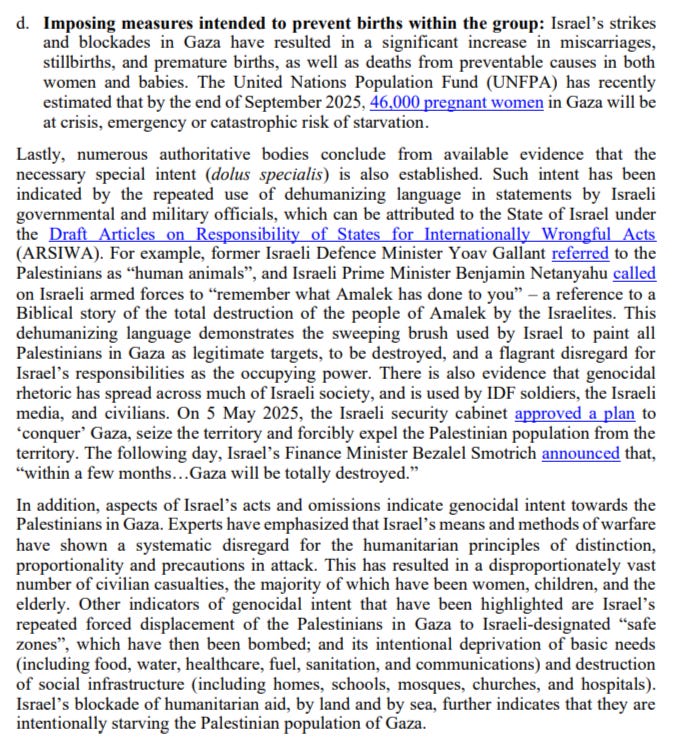
Political Observer.


 StephenKMackSD's Blog