An apt analogy of Mr. Phillips book: a Studio Head, in the Golden Age of Hollywood, calling in The Wise Hack to do a re-write on a property. Such is Mr. Phillips’ role as the intellectually mendacious redeemer of the Legend of Freud. Call this intervention by its name propaganda!
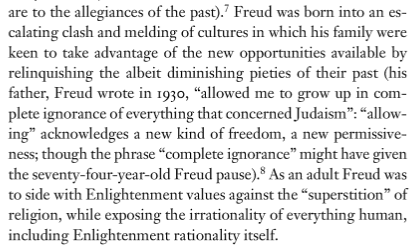
Freud always presented Psychoanalysis as a Science, not a tool for Jewish Emancipation, from European oppression in all its iterations, but as a methodology for liberation from the interaction between the Id, Ego and Super-Ego and the malign Unconscious. Freud constructs a Melodrama taking place inside the person. But this quote should put the readers mind at rest as to Freud’s commitment to Jews and Judaism:
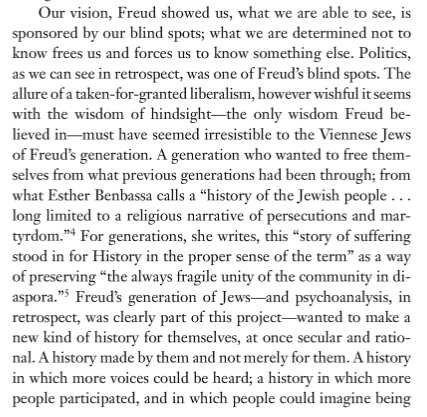
How can a person raised in ‘complete ignorance of of everything that concerned Judaism’, a defender of Enlightenment rationality, the author of a ‘Science’ called Psychoanalysis be allied in the project of Jewish Emancipation as Mr. Phillips presents it?
That Phillips somehow thinks that part of his readership might not be former analysands, and or readers/explorers of Freud and his critics strikes this reader as the myopia of the propagandist: the evidence that leads this reader to that conclusion is the Phillips engages in the denaturing of the language of Freud, his arcane jargon, to borrow Adorno’s more that fitting description of Heidegger’s rhetorical practice, is disappeared, in favor of a set of easily understood concepts. All of this is made more palatable by Phillips’ fluid writing style, that serves him well.
To put it bluntly Phillips writes in a time in which the Freud Legend is at its nadir. The reason being, that the critical evaluation of Freud has been the undoing of his ‘Science’ and the rise of Freud as Metaphysician, Jewish Liberator or Jewish Story Teller. In Phillips re-write of Freud: he is what you desire him to be!
Mr. Phillips ‘Becoming Freud’ is the perfect candidate for an Audio Books, since the footnotes are merely superfluous scholarly garnish, to his version of Freud. Or to be blunt its like Velveeta Cheese, its ‘processed cheese food’ an ersatz version of the real thing. It is destined to end up casually placed on coffee tables, or night stands, to give the impression that its possessor is well read! I found my copy on the remainder table for $4.00
Here is a link to my essay, that contains a long list of writers who approached Freud in a critical way. I can recommend the work of Frederic Crews and John C. Ferrell :
‘Eli Zaretsky on Political Freud, a comment by Philosophical Apprentice’
…
For the surprising literary antecedent to Freud’s ‘psychoanalytic project’, Cervantes’ Quixote, see ‘Freud’s Paranoid Quest,Psychoanalysis and Modern Suspicion by John C. Farrell, Chapter 6 ‘Freud as Quixote’:
Daniel Goleman reports on psychology for The Times. Excerpts from Freud’s letters are from ”The Complete Letters of Sigmund Freud to Wilhelm Fliess, 1887-1904,” translated and edited by Jeffrey Moussaieff Masson; Cambridge, Mass., and London, England: The Belknap Press of Harvard University Press, c 1985 Sigmund Freud Copyrights Ltd. and J. M. Masson; to be published in April 1985.
WHEN SIGMUND FREUD learned in 1936 that his letters to Wilhelm Fliess, the German doctor who had been his closest friend at the turn of the century, had been purchased from a bookseller by his student, Princess Marie Bonaparte, he was aghast. Freud, by then world famous as the father of modern psychotherapy, wrote her immediately, saying: ”Our correspondence was the most intimate you can imagine. It would have been highly embarrassing to have it fall into the hands of strangers . . . I do not want any of them to become known to so-called posterity.” He later asked her to destroy them.
Almost a half-century later, the full text of that correspondence is being published. The letters have appeared, in part, before; the new edition, however, to be published next month, is the first complete and unexpurgated version. In it, passages never seen before, or quoted only in part or out of context, can be read in full, their meanings and implications presented for all to see.
Freud’s mania for controlling the narrative on his self-conception as an hero figure, is simply confirmed in the first paragraphs of this long report on the Fliess/Freud correspondence by Daniel Goleman. Freud writes to Princess Marie Bonaparte:
”Our correspondence was the most intimate you can imagine. It would have been highly embarrassing to have it fall into the hands of strangers . . . I do not want any of them to become known to so-called posterity.” He later asked her to destroy them.
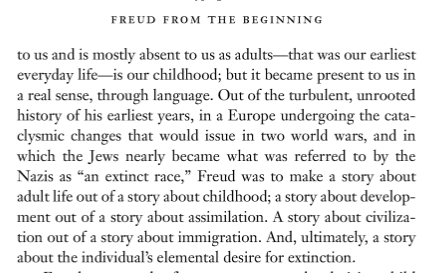
Here is more of Phillips’ breathtaking historical/personal phantasmagoria:
Begin at ‘Out of the turbulent ,uprooted history…’ . The reader can call this by its rightful name, a Freudian Melodrama aided by Lacan’s borrowings from Saussure. And ending in ‘…the individual’s desire for extinction.’ Don’t call this pessimism, but the expression of Freudian nihilism, pronounced by a revisionist’s failed attempt at his project.
Its taken some time to come to this realization: what I’ve offered as an explanation for Phillips’ style of argument, as ‘historical/personal phantasmagoria’ is that he engages in the most important tools of Psychoanalysis ‘free association’, in a biographical/historical/personal key. That appears, at first reading, as that phantasmagoria but is simply an adaptation of Freud’s methodology, to discover what the patient does not want to ‘share’ with her/his analyst.
That ‘Free Association’ reads as a meandering, evocative rhetorical style, that mimics, in a way, the aphoristic style of the seer or mystic, or even the Greek Heraclitus.
Rootless cosmopolitan,down at heels intellectual;would be writer.
'Polemic is a discourse of conflict, whose effect depends on a delicate balance between the requirements of truth and the enticements of anger, the duty to argue and the zest to inflame. Its rhetoric allows, even enforces, a certain figurative licence. Like epitaphs in Johnson’s adage, it is not under oath.'
https://www.lrb.co.uk/v15/n20/perry-anderson/diary



 StephenKMackSD's Blog