Philospical Apprentice.
Jun 26, 2025
https://www.lrb.co.uk/the-paper/v34/n08/katrina-forrester/tocqueville-anticipated-me
Editor: The opening paragraph of this essay via George Soros, offers the reader insight into both political/philosopical actors!
In October 2011, the European Court of Human Rights ruled that George Soros had violated insider trading laws more than two decades ago in dealings with the French bank Société Générale. Soros has given billions of his personal wealth to fund liberal political organisations, notably his own Open Society Foundations, which operate on a global scale and have supported anti-totalitarian movements from Poland’s Solidarity to Zimbabwe’s Movement for Democratic Change, as well as countless other organisations that promote human rights. He has promised to give $100 million to Human Rights Watch over the next ten years. The decision of the European Court, however, brings Soros to book for the nastier things he does when he’s not being a philanthropist. His teacher and mentor, Karl Popper, might have seen this as an example of the paradox of unintended consequences. Soros’s actions also illustrate one of the central puzzles of Popper’s liberalism. Like Soros, Popper wanted to have it both ways: he wanted to unify the humanitarian left while celebrating the openness of the free market, with all its imbalances. Did he succeed?
Editor: The final paragraphs of this essay, while recognising the value of this whole essay, and its explorations of Popper, and his evolving philosopical imperatives and his self-infatuation, a clear and present danger to all who put pen to paper!
…
One of the most interesting exchanges from this period is a series of letters between Popper and the philosopher Rudolf Carnap. (It’s clear that Popper, too, thought they were interesting, since he sent Hayek a copy of his responses to Carnap’s questions.) In 1946, after reading an attack by Popper on Marx and historicism, Carnap wrote to ask ‘whether or to what extent you still regard yourself as a socialist’. Popper replied that he rejected the term ‘socialism’, but claimed that he shared much with the socialists: a belief in the ‘greater equalisation of incomes’, in ‘experimentation in the political and economical sphere’, and even in the partial ‘socialisation of means of production’. The public ownership of industries and services could work well, he suggested, and it was certainly important that the state have the power to break up monopolies. But he attached two provisos, which, he thought, brought out the differences between the socialist position and his own. He argued that socialisation would be possible only if ‘the considerable and serious dangers raised by such experiments are frankly faced, and means are adopted to meet these dangers’, and if ‘the mystical and naive belief is given up that socialisation is a kind of cure-all’. Freedom could not be ‘saved’ without ‘improving distributive justice, i.e. without increasing economic equality’. More important, it could be achieved only if its defenders were willing to use trial and error, to accept that socialisation sometimes would promote freedom, and sometimes would not. Popper believed that income disparities might be even greater in a socialised, centralised economy. It was also more likely, he believed, that in such an economy powerful people would have too much control over individuals’ thoughts and actions. As Carnap pointed out in response, Popper differed from socialists in other ways, too – notably in his lack of concern for issues of economic power and exploitation, and in his emphasis on distribution rather than production.
When did Popper leave all this behind? In a 1956 letter to the American journalist Henry Hazlitt, a neoliberal and one of the founding members of the Mont Pélerin Society, Popper retracted the ideas he’d outlined in The Open Society that now seemed to him too statist and too Keynesian, in particular the concern with full employment. He still thought it important to reduce poverty and support public education, but no longer had the goal of increasing equality. From this point on, he starts to look more like a Cold Warrior. His attacks on totalitarianism in general became attacks on communism in particular, and what he perceived as the choice between the open and the closed society became ever starker. Where once he had tried to unify the individualist left, he now became a critic of it. By the early 1970s he had declared himself in ‘diametrical opposition’ not only to Marxists, but also to the New Left. Radical students saw him as a representative of the conservative establishment; he saw them as representing the decline of Western civilisation. He objected to what he called the ‘conspiracy theory of society’ – namely, the idea that the capitalist system is evil or morally base. Yes, the open society was in ‘urgent need of reform’, but it was still the case that people had never had it so good. During the postwar decades, he withdrew from public life, spent less time at the LSE and became more and more intellectually isolated. Though he never described it in quite these terms, he came to see the biggest problem in the capitalist West as that of moral decline. Indeed, it sometimes seems that, for Popper, all that was morally objectionable in society could be blamed on individual failures of moral and intellectual responsibility. When he listed what was wrong with the world, alcohol, drugs and crime were high on the list. These were not just symptoms, he believed, but were themselves the problems. In democracies, it was not the structures of society that were at fault, but the citizens: when things go wrong, they have only themselves to blame. By 1981, Popper was so angry at outright opponents of capitalism that he claimed he didn’t care about social inequality any more. What did it matter if the rich got richer?
Despite Popper’s continual assertions that he remained a critic of modern politics, the West appeared to get off scot-free. All he cared about was whether or not a government could be removed without bloodshed. If it could, it was a democracy. Many political theorists of Popper’s generation had been sceptical about idealistic visions according to which democracy expresses the ‘general will’. They argued that such visions obscured the reality that democracies are competitive systems in which voters elect leaders – so-called ‘elite democracies’. Popper certainly shared this view. But whereas his fellow Austrian Joseph Schumpeter had argued that real-life competitive democracies tended to be less competitive – and less open – than free markets, Popper didn’t spill much ink on the flaws in his model of the open society. He may have wanted it to be open to critical discussion, but he was surprisingly uninterested in the question of how to ensure that such discussion would be open to everyone and conducted on equal terms. Though he advocated a continual ‘fight against bureaucracy’, he didn’t see the need for an equivalent fight against private corporate interests.
While it isn’t so surprising that Popper gave up on equality (it was always an instrumental good for him, a necessary step on the path to liberty), it is striking that he gave up on – or at least toyed with giving up on – aspects of individual freedom. In his later writings, population growth is a constant concern. In 1972, after the publication of The Limits to Growth thesis, with its Malthusian predictions of economic and social collapse, he wrote that in order to preserve life on earth, we must find ways to address the problem, and to do so without coercion. How? Education, he argued, was the only way out, the only way to slow population growth without constraining freedom. How to avoid giving up on freedom in the face of this danger is a recurrent theme in After ‘The Open Society’. He is less obviously troubled by threats to freedom of speech. In 1989, he declined an invitation to sign the Society of Authors’ letter declaring support for Salman Rushdie after the fatwa was declared. By this time he seems to have become open to arguments for censorship. The last essay in this volume argued that the power of television must be controlled and violent images restricted. Only then could a democratic society remain ‘civilised’. Popper’s suggestion here was that the primary function of ‘civilisation’ was to reduce violence – censorship was the cost of keeping a society open.
This picture of Popper in old age is not a flattering one, but a picture of the younger Popper might not be very flattering either. Though he listed modesty and a readiness for critical debate as the highest intellectual virtues, he was famously dogmatic – and the dogmatism shines through in these writings. For a man who declared (in a technical context, it’s true) that there is ‘no such thing as justification’, he seems to have spent a lot of time justifying himself. Many of the early essays are directed at the (many) critics of The Open Society who saw it as polemical, emotional, even hysterical. His defence – that although it aimed at peace, it was also his ‘war effort’ – was reasonable, but his tone was sometimes less so. He wrote letters to friends that included third-person defences of his work so they could pass them off as their own. And he could appear remarkably self-important: in a lecture on Tocqueville, he noted how impressive it was that in some of his views on the paradoxes of freedom and equality, ‘Tocqueville anticipated me.’
These quirky and revealing writings show that Popper was not as consistent as he would have liked to think. But the editors sometimes seem too close to him to notice. Jeremy Shearmur was Popper’s assistant for many years, and gives the impression that he wants the reader to feel as he did on first reading some of these essays – when one unpublished fragment tails off, he tells us that ‘alas no more material follows.’ Popper’s own inconsistencies – particularly his celebration of individual freedom and unwillingness to face up to its consequences – are reflected in the editors’ decisions. And terminology that reminds us of Popper’s historical context has been removed, thanks to a somewhat squeamish political correctness: as the editors make clear in the introduction, they have ‘changed the use of Mohammedans for the followers of Islam, as it is now recognised as offensive’. But the updating – or whitewashing, take your pick – of Popper’s terminology doesn’t extend to eliminating the term ‘Negro’, which he apparently continued to use as late as 1988. By then, he was out of touch. The idea of The Open Society may have had a long and illustrious afterlife, but as the title of this volume inadvertently suggests, the political writings that followed are perhaps best understood as a long and not so illustrious footnote to the ‘war effort’ of Popper’s middle years.
Editor: Also read the reply of Jeremy Shearmur.
Letters
Vol. 34 No. 11 · 7 June 2012
Katrina Forrester reads Popper as if he was a proponent of market liberalism, or ‘neoliberalism’ (LRB, 26 April). But this isn’t the case. Popper certainly valued liberty and markets; but within the broad commitments of the ‘open society’ he was willing to accept considerably more government involvement than neoliberals – or any conservative, for that matter – would. Any account of Popper’s views is complicated by the fact that he found admirers on the left as well as on the right. But today there is no reason to think that support for liberty and (well-regulated) markets alone entails any particular position on the liberal spectrum. Part of the interest of After ‘The Open Society’, the collection of Popper’s writings that Forrester reviews, which I co-edited, is that it shows the extent to which Popper never fully joined with Hayek and other neoliberals. For example, late in his career he proposed that the state take a 51 per cent share in all public companies (but not an active role in management). His attention to the problem of overpopulation and his (curmudgeonly) worry about the effects of mass market television, also tell against a neoliberal interpretation of his views, especially when a more consistent social democratic interpretation is available. Popper was explicitly critical of ‘free market ideology’. But the main contribution of his political philosophy was towards the defence of the widely shared liberal commitments of the ‘open society’, within which more specific policy prescriptions may be worked out through trial and error.
Jeremy Shearmur
Australian National University
Editor: See Chapter 9 Plato, Socrates, Classical Athens , and the West in Haim Hacohen’s Karl Popper: The Formative Years 1902-1945 for insights into Popper’s view of Plato!
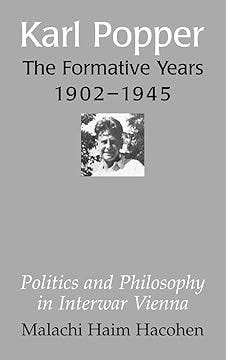
Cambridge University Press
Publication date : October 23, 2000
Philospical Apprentice.


 StephenKMackSD's Blog