Political Observer on ‘Mathias Döpfner is chair and CEO of Axel Springer, POLITICO’s parent company’: Think of Mathias Döpfner as the In House Anne Applebaum, or Jeffrey Goldberg of Politico !
Jun 16, 2025

Editor: Britannica provides a vauable history of the paid apologists for hire, in an American context, and the pioneering work of Walter Lippman, and the evolution of his Experts/Technocrats as the a check on Too Much Democratcy!
…
The number of American newspaper titles more than doubled between 1880 and 1900, from 850 to nearly 2,000. In addition to the weekly newspaper serving the smaller community, every major city had its own daily newspaper, and the metropolis had become the site of circulation battles between several titles. In New York City the newspaper business was shaken up by the arrival of Joseph Pulitzer, who is often credited with changing the course of American journalism. An immigrant from Hungary, Pulitzer had proved his ability in St. Louis, Missouri, where he had bought and merged two local papers, the Post and the Dispatch. In New York City Pulitzer bought the failing New York World and in three years raised its circulation from 15,000 to 250,000, at that time the highest figure achieved by any newspaper in the world. With a series of stunts and campaigns, Pulitzer revitalized the established formulas of sensationalism and idealism, taking one step further the qualities of editorial independence and exciting journalism that had been introduced to an earlier generation of New Yorkers by Bennett’s Herald and Greeley’s Tribune (see above).
Whereas Pulitzer was never afraid to unearth public wrongdoing and to crusade against it, the next press baron to influence New York City newspapers, William Randolph Hearst, was prepared to go to much further extremes in creating a headline story. Like Pulitzer, Hearst had learned about newspaper proprietorship in the brash, tough frontier West. His San Francisco Examiner (from 1880) had gained a reputation for exposing and cleaning up political corruption. By the time he came to New York City in 1895, however, Hearst was interested in circulation-building sensation at any price, even if it meant dressing up complete fabrications as news. This approach was revealed all too clearly in 1898, when Hearst’s Morning Journal was challenging Pulitzer’s World in the New York circulation battle. The Journal published exaggerated stories and editorials about the political tensions between the United States and Spain that stirred the country to a pitch of hysteria. Eventually, war—over Cuba—was triggered by the sinking of the U.S. battleship Maine in Havana harbour, but Hearst nevertheless claimed credit for the war in a banner headline: “How Do You Like the Journal’s War?” Hearst is reported to have cabled his illustrator in Cuba, demanding pictures of atrocities for the Journal. The illustrator found no atrocities to illustrate and informed Hearst, who replied, “You furnish the pictures and I’ll furnish the war.” Alarmist headlines and attention-grabbing campaigns were only one of the tactics introduced by Hearst. Equally important in the sensationalist yellow journalism of the era were vivid pictorial designs—photographs, cartoons, graphic illustrations—and the new Sunday supplements, which focused on human-interest stories and comic strips.
It was inevitable that some newspapers, and especially those that refrained from irresponsible tactics, would suffer circulation losses. One of these was The New York Times, which only recovered after it was acquired in 1896 by newspaper investor Adolph S. Ochs, who promoted responsible journalism and reestablished The New York Times as the city’s leading serious journal. The paper’s slogans, “All the news that’s fit to print” and “It will not soil the breakfast cloth,” indicated Ochs’s commitment to fair-minded news reporting.
By 1900 there were half a dozen well-known newspaper barons in the United States. Hearst, whose collections at one time ran to 42 papers, was the most acquisitive of the early owners. Another early chain-builder was Edward Scripps, who began purchasing newspapers in 1878. Scripps bought small, financially insecure newspapers and set them on their feet by installing capable young editors, who were given a share of the profits as an incentive to improve circulation. The editors were always urged “to serve that class of people and only that class of people from whom you cannot even hope to derive any other income than the one cent a day that they pay for your newspaper.” Scripps wanted his papers to be of genuine service to the public, and though he succeeded in making money from them his motive was never exclusively profit. But the commercial advantage of owning newspaper chains soon became obvious, as it allowed newsprint to be bought on favourable terms and syndicated articles to be used to the fullest. Scripps’s methods were adopted by his rivals and by newspaper proprietors in other countries as the idea of chain ownership spread. Inevitably, the profitable newspapers attracted outside investors whose motives were commercial, not journalistic. This new type of proprietor was exemplified by Frank A. Munsey, who bought and merged many newspapers between 1916 and 1924, including the Sun and the Herald in New York City. In describing Munsey and others like him, the American author and editor William Allen White wrote that he possessed “the talent of a meat packer, the morals of a money changer, and the manners of an undertaker.”
Commercial consolidation into larger publishing groups continued immediately after World War I, when the struggle for circulation intensified. First published in 1919, the New York Daily News was written to a ruthless recipe of sex and sensationalism by Joseph Medill Patterson, and it sparked off a war with Hearst’s Daily Mirror and Bernarr Macfadden’s Daily Graphic, both launched in 1924. The Graphic closed in 1932, and the Mirror ceased publication in 1963, selling many of its feature columns and comics to the Daily News, which underwent several ownership changes before being bought by Mortimer B. Zuckerman in 1993. Takeovers often led to title mergers or the complete disappearance of titles. In 1931 the New York Morning, Evening, and Sunday World titles were bought by the Scripps-Howard chain; the morning and Sunday editions were dropped, and the Evening World was merged with the New York Evening Telegram, an action that suited Americans’ preference for afternoon papers at that time. Newspapers with extensive circulations could command the attention of the larger advertisers, and this reinforced the disappearance of smaller titles in favour of a few high-circulation papers.
One outcome of the new ownership pattern was the gradual disappearance of the old press baron, who, as editor-proprietor, had tended to combine the roles of professional editor and management executive. Even the editor was to suffer a loss of personal impact as fame was increasingly won by columnists—men and women who were given regular columns to express forceful points of view or divulge society secrets. Among the most important political columnists of the 1920s were David Lawrence of the United States News, Frank Kent of the Baltimore Sun, Mark Sullivan of the New York Herald-Tribune, and Walter Lippmann of the New York World. Such writers could gain considerable national followings when their columns or articles were syndicated by major chains.
Political Observer
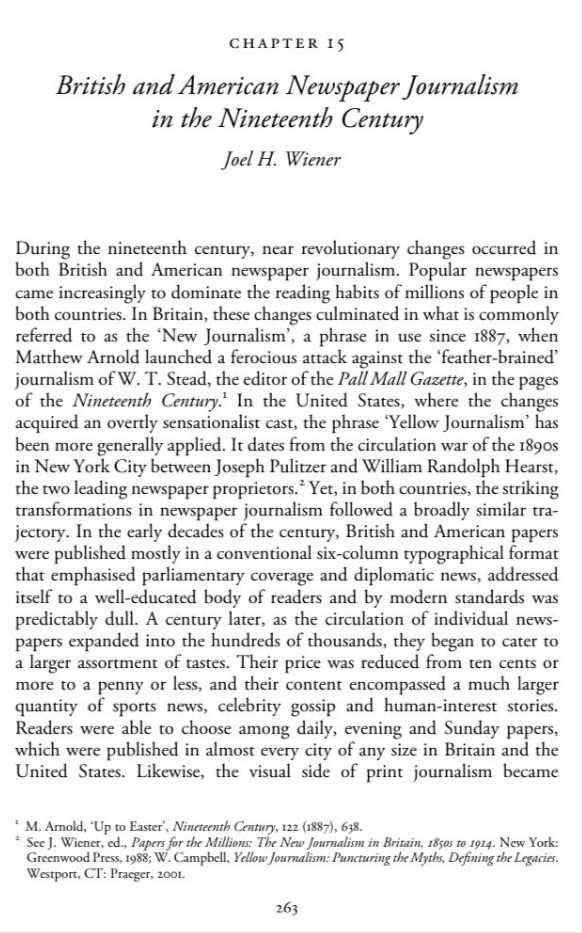
Chapter 15 – British and American Newspaper Journalism in the Nineteenth Century
from Part III – The ‘Globalisation’ of the Nineteenth-Century Press
Published online by Cambridge University Press: 24 March 2017


 StephenKMackSD's Blog