Editor : Mr. Brooks has become a more adroit propagandist since the ‘The Collapse’ but not by much!
I had forgotten how exhausting it is to live in Donald Trump’s world. He’s not only a political figure. He creates a psychological and social atmosphere that suffuses the whole culture — the airwaves, our conversations, our moods.
If there is one word to define Trump’s atmosphere, it is “pagan.” The pagan values of ancient Rome celebrated power, manliness, conquest, ego, fame, competitiveness and prowess, and it is those values that have always been at the core of Trump’s being — from his real estate grandiosity to his love of pro wrestling to his king-of-the-jungle version of American greatness.
The pagan ethos has always appealed to grandiose male narcissists because it gives them permission to grab whatever they want. This ethos encourages egotists to puff themselves up and boast in a way they find urgently satisfying; self-love is the only form of love they know.
The pagan culture is seductive because it lures you with images of heroism, might and glory. Think of Achilles slaughtering his enemies before the walls of Troy. For a certain sort of perpetual boy, what could be cooler than that? But there is little compassion in this worldview, no concept that humility might be a virtue. There is a callous tolerance of cruelty.
…
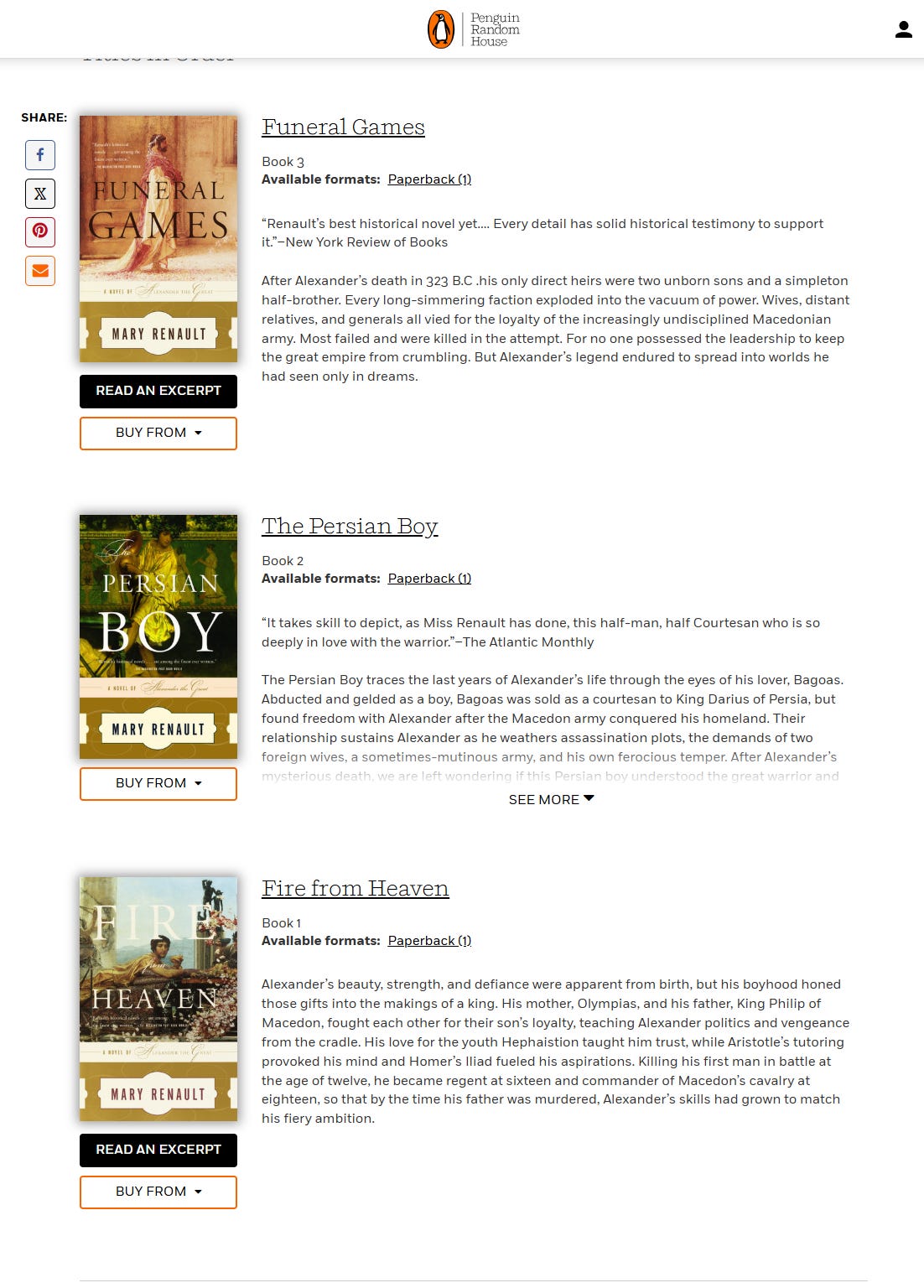
Editor : If the discussion of ‘paganism’is just to be‘imagined’ by Brooks in the most self-serving way: what can a series of novels offer, to the reader, who might consider Mary Renault’s Trilogy?
Editor: Mr. Brooks offers his reader:
Tom Holland is a historian who wrote several fine books of classical history, like “Persian Fire.” Gradually he became more and more appalled by many of those ancient pagans — those Caesars who could slaughter innocent human beings by the hundreds of thousands while everyone thought this was totally fine.
“This is a really terrifyingly alien world, and the more you look at it, the more you realize that it is built on systematic exploitation,” Holland told the writer Justin Brierley. “In almost every way, this is a world that is unspeakably cruel to our way of thinking. And this worried me more and more.”
….
The callous tolerance of cruelty is a river that runs through human history. It was dammed up, somewhat, only by millenniums of hard civilizational work. The pagan ethos — ancient or modern — always threatens to unleash brutality once again. The pagan ethos does not believe that every human was made in the image of God, does not believe in human equality, is not concerned about preserving the dignity of the poor. It does not care much about the universal feelings of benevolence, empathy and faithfulness toward one another, which, it turns out, are absolutely required for a democracy to function.
…
If paganism is a grand but dehumanizing value system, I’ve found it necessary, in this increasingly pagan age, to root myself in anything that feels rehumanizing, whether it’s art or literature or learning. I’ve found it incredibly replenishing to be spending time around selfless, humble people who are still doing the work of serving the homeless, mentoring a lost kid who’s joined a gang. These days I need these moral antidotes to feel healthy, resilient and inspired.
…
If paganism is a grand but dehumanizing value system, I’ve found it necessary, in this increasingly pagan age, to root myself in anything that feels rehumanizing, whether it’s art or literature or learning. I’ve found it incredibly replenishing to be spending time around selfless, humble people who are still doing the work of serving the homeless, mentoring a lost kid who’s joined a gang. These days I need these moral antidotes to feel healthy, resilient and inspired.
…
Judaism and Christianity confront paganism with rival visions of the good. The contrast could not be starker. Paganism says: Make yourself the center of the universe. Serve yourself and force others to serve you. The biblical metaphysic says: Serve others, and you will find joy. Serve God, and you will delight in his love.
Editor: Where might The Reader look to explaine/rationalize the Genocide in Gaza, perpitrated by Israel, with munitions supplied by its allies in The West? That Brooks so malidriotely elides, from his self-serving politcal moralizing = New York Times merde!
Rootless cosmopolitan,down at heels intellectual;would be writer.
'Polemic is a discourse of conflict, whose effect depends on a delicate balance between the requirements of truth and the enticements of anger, the duty to argue and the zest to inflame. Its rhetoric allows, even enforces, a certain figurative licence. Like epitaphs in Johnson’s adage, it is not under oath.'
https://www.lrb.co.uk/v15/n20/perry-anderson/diary



 StephenKMackSD's Blog