Newspaper Reader confronts Gideon Rachman as NATO propagandist!

Jan 08, 2025
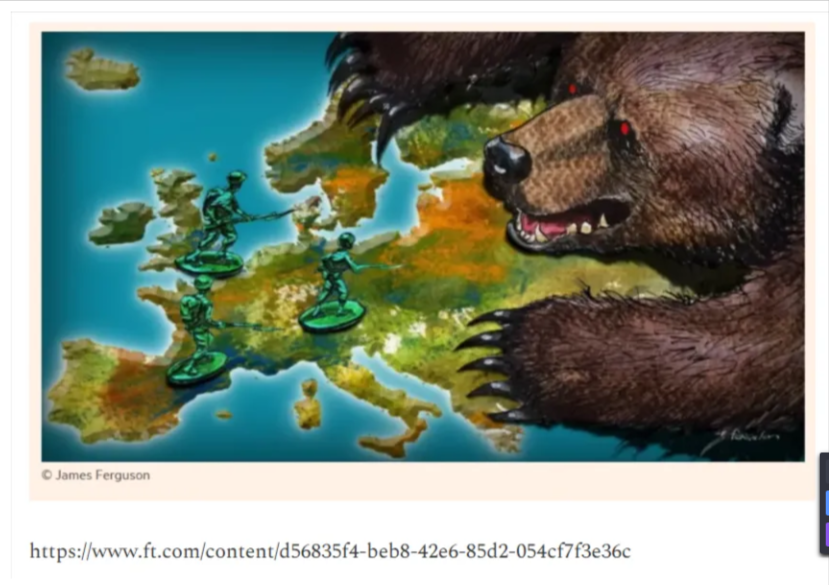
The rapacious Russian Bear is the nightmare of ‘Europe’ : the hallowed remaines of the ghost of Jean Monnet’s Coal and Steel Cartel, of The Cold War years. As that is by now the ricketry remains of a dream of ‘Europe’, incapable of its own realization, but hanging on a notion of its viability, via Technocratic chatter at high volume. From Newspapers like The Financial Times, and its cadre of Experts like Gideon Rachman. NATO is the linchpin that now holds together this unrealised fraturing Super State! Not to speak of a Cold War relic rehabilitated as need be!
Editor: Some telling quotataions from this NATO propaganda refracted through Gideon Rachman as its enuciator
…
Mark Rutte, Nato’s recently appointed secretary-general, warned last month that: “Russia’s economy is on a war footing . . . Danger is moving towards us at full speed.” He urged Nato to rapidly increase defence production and “shift to a wartime mindset”.
…
Last April, General Christopher Cavoli, Nato’s supreme commander in Europe, cautioned that: “Russia shows no sign of stopping. Nor does Russia intend to stop with Ukraine.” Western analysts argue that Russia is already engaged in a hybrid war with Europe — involving regular acts of sabotage that risk mass casualties.
…
Editor: ‘European defence analysts worry’. Rachman as Diagnostician:
Elbridge Colby, who has just been nominated as under secretary of defence for policy, wrote in the FT last year that China is a much higher priority for the US than Russia and argued that the “US must withhold forces from Europe that are needed for Asia, even in the event of Russia attacking first”.
European defence analysts worry that a US military pullback from Europe would encourage Russian aggression. In a recent book, Keir Giles of Chatham House argues: “The withdrawal of America’s military backing for Nato is the surest possible way of turning the possibility of Russia attacking beyond Ukraine into a probability.
Editor: Vladimir Putin acts as goad to a hapless Europe? Rachman sounds the alarm!
But the extent of the casualties Vladimir Putin is willing to absorb should also be a warning. The Russian army is now larger than it was at the beginning of the war in 2022. And, as Rutte recently pointed out, the country is producing “huge numbers of tanks, armoured vehicles and ammunition”.
European countries lack the manpower and equipment to engage in a war of attrition of the kind Russia is fighting in Ukraine. At the beginning of last year, the British army had 73,520 — the fewest since 1792. The German army has 64,000.
Editor: Mr. Rachman on Poland, Germany, France, Britains as to who is best able to confront the menace of Putin in Economic terms.
The closer you get to the Russian border, the more seriously the Russian threat is taken. Poland is on course to increase its defence spending to 4.7 per cent of GDP in 2025. But in the bigger western European economies, it’s a different story. Germany and France barely hit 2 per cent last year; Britain was at 2.3 per cent.
France has a budget deficit of 6 per cent of GDP and public debt of well over 100 per cent. The British government is also highly indebted and struggling to raise revenue.
But Germany — with a debt-to-GDP ratio of just over 60 per cent — has the fiscal space to spend a lot more on defence. It also still has a considerable industrial and engineering base.
Editor Mr. Rachman demonstrate a kind of surity , in sum he places his wager on Germany.
Friedrich Merz of the Christian Democrats, who will probably emerge as German chancellor after elections this year, takes the threat from Russia seriously. He could preside over a historic shift. If Germany relaxed its constitutional provisions against deficit financing — and accepted the need for common EU debt to finance European defence — it could transform the continent’s security landscape.
Even 80 years after the end of the second world war, some of Germany’s neighbours — particularly Poland and France — will feel queasy about German rearmament. But, in the interests of their own security, they need to get over it.
Editor: Mr. Rachman’s well oiled political machinery failes to factor in the rise of Alternative for Germany!
4.2 NATO as a Defensive Alliance
Membership of NATO corresponds to Germany‘s interests with regard to foreign and security policy, as long as NATO’s role remains that of a defensive alliance. We are in favour of a substantial strengthening of the European component of the North Atlantic Alliance. To achieve this objective, it is necessary to restore the military capabilities of the German Armed Forces, and to align these with strategic and operative requirements. The AfD thus calls for a restoration of Germany’s defensive capabilities, not only for the purpose of ensuring national defence as the main task of the German Armed Forces, but also to meet Alliance requirements, and perform crisis prevention measures. Membership of NATO corresponds to Germany‘s interests with regard to foreign and security policy, as long as NATO’s role remains that of a defensive alliance. The AfD believes that predictability in meeting commitments towards NATO allies is an important goal of German foreign and security policy, so that Germany can develop more political weight to shape policies, and gain influence. We advocate that any engagement of NATO must be aligned to German interests, and has to correspond to a clearly defined strategy. NATO has to be reformed, and the armed forces of the European partner states have to be restructured in such a way that they can ensure security in Europe and at its periphery. Wherever German Armed Forces, as part of NATO operations, are involved beyond the borders of its Alliance partners’ territory, shall, in principle, only be carried out under a UN mandate, and only if German security interests are taken into account. The Allies and Germany work together on equal terms and with mutual respect. They co-operate in questions of major international importance. Against this background, and 70 years after the end of World War II, and 25 years after the end of a divided Europe, the renegotiation of the status of Allied troops in Germany should be put up for discussion. The status of Allied troops needs to be adapted to Germany’s regained sovereignty. The AfD is committed to the withdrawal of all Allied troops stationed on German soil, and in particular of their nuclear weapons.
4.4.1 No European Army
The AfD rejects the idea of a combined European military force, and subscribes to well-equipped and trained German Armed Forces as the pillar of German sovereignty. This does not preclude the continuous co-operation of the German Armed Forces with its Allies. Germany needs military forces whose leadership, strength and equipment are adapted to the requirements of future conflicts, and which comply with the highest international standards. It needs troops which are trained according to the requirements of modern combat, as well as an administration which is oriented towards the welfare of the troops, combined with considerably reduced bureaucracy
Another indispensable factor is the existence of national defence capabilities, which are necessary to remain independent in key technologies, to keep pace with the latest developments in armaments technology, and to preserve jobs in the domestic defence industry. The military budget has to be increased to a level which is adequate for preserving the security and freedom of Germany and its Allies. The size and equipment of the armed forces need to be adapted to both the tasks at hand, and to foreign and security policy requirements. Furthermore, the intelligence services should be restructured and reformed. They are an important instrument in detecting threats at home and abroad. The AfD rejects the current practice of funding intelligence services according to budgetary constraints
Newspaper Reader.


 StephenKMackSD's Blog