Newspaper Reader comments.

Nov 16, 2024
What has happened to the once ascendent Oxbridgers at The Economist? The first paragraph of these book recomendations/reviews read as if it were in The Telegraph!
Editor: The opening parqagraphs of this essay:
They may not have the cachet of the Pulitzer or the Booker, but the Sidewise Awards for Alternate History deserve respect. The what-if genre of fiction is growing fast, with work of startling quality and originality. Take the last Sidewise long-form winner, “Cahokia Jazz” by Francis Spufford. A noir thriller that takes place in the 1920s, it imagines an America in which the native population had not been nearly wiped out by smallpox. Other winners of the 29-year-old prize include Laurent Binet’s “Civilizations”, which imagines that the Incas invaded Europe in 1531, 39 years after Christopher Columbus did not discover the Americas. Tweaking history is surely as much fun as a novelist can have: losers become winners, and not quite everything changes. What if General Lee had won at Gettysburg? What if Napoleon had seen off Wellington and Blücher at Waterloo? The Nazis are overrepresented on alternate-history bookshelves as they are in other sections of most libraries.
Perhaps the inspiration for this review/essay and the Sidewise Awards had their beginnings with Niall Ferguson’s book, of 1997?
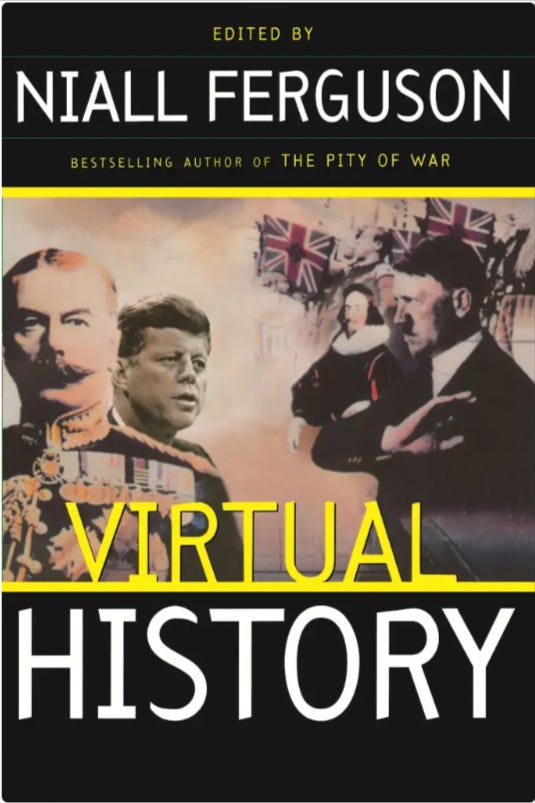
Editor: The carefully re- written ‘Plot’ by televisions writers David Simon and Ed Burns, captures the Oxbridger attention for ‘a moment’!
The Plot Against America” by Philip Roth, for example, places Charles Lindbergh, a suspected Nazi sympathiser, in the White House. Not far behind is John F. Kennedy, who skipped that visit to Dallas, or perhaps fell victim to the mafia/Cubans/Russians/Lyndon Johnson. As this selection of the best alternate-history novels demonstrates, the world of imagined pasts is rich and potentially endless.
Editor: Roth’s ‘Plot’ is awash in political hysteria, wedded to Roth’s idealised younger self: narcissism rules! : That evetually became a 2020 Television Melodrama, by David Simon and Ed Burns. They collaboreated with Roth and engaged in a re-write for television!
…
Robert Harris’s “Fatherland”, set in 1964 in Nazi Berlin, would have been another entry.
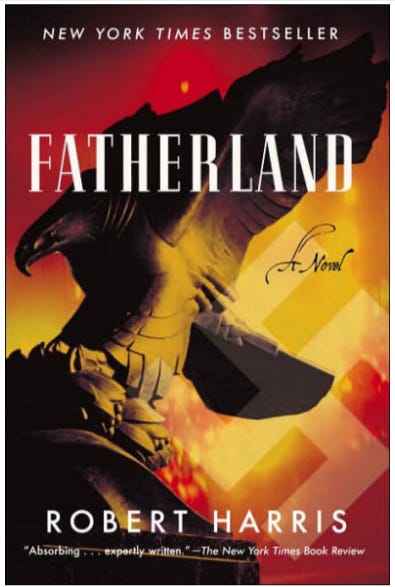
Editor: I read ‘Fatherland’ and found it compelling reading from start to finish. Harris’s literary debut was auspicious. This novel transcendes the territory of Ferguson’s book, it is the work of a novelist that posses a vital, powerful Historical Imagination!
…
Rodham
Curtis Sittenfeld imagines what might have happened to Hillary Rodham Clinton (pictured), and to American politics, if Hillary and Bill Clinton had broken up in 1975. Hillary becomes a politician and Bill leaves politics and becomes a rich tech entrepreneur. Their paths cross again in startling fashion in 2016, when Donald Trump also makes an appearance. Ms Sittenfeld finds a way to include the Clintons’ famous “60 Minutes” interview in 1992, in which Hillary declared herself to be no Tammy Wynette “standing by my man”. The glamour, the rough and tumble and the sheer grind of American politics are well captured. Above all, Ms Sittenfeld convincingly transports us into Hillary’s inner world. The book’s surprising denouement seems entirely plausible.
Reader here is a link: BOOKS
Curtis Sittenfeld interview: what would Hillary have achieved without Bill Clinton?
The author of American Wife returns with an explosive imagined autobiography of the former first lady, says Bryan Appleyard
On the fictional valorization of Hillary Clinton, just in time ? American Writer comments
Posted on May 10, 2020 by stephenkmacksd
How opportune! As Senile Old Joe marinates in his cognitive decline , sequestered from public view. His campaign, such as it is, carefully managed ‘interviews’ with friendly media, and short videos. Curtis Sittenfeld’s ‘Counter Factual Biography’ of Hillary Clinton, to be published under the title ‘Rodham’ adds what to the American political conversation? Here is her picture provided by The Sunday Times:
Here is a quote from Bryan Appleyard about the ‘why’ of the book:
Sittenfeld writes women better than anybody else, and women read her in huge numbers with the joy of recognition. If anybody can turn Hillary into a fictional heroine, she can.
And she really is the heroine. This book is a counterfactual — a “what if?” way of studying the past. The big “what if” here is what if Hillary hadn’t married Bill? Her answer, thanks to the deft way she combines fact and fiction, is wholly convincing. This is clearly how she wanted Hillary to be. And, crucially, about how much she wanted her to become president.
The book, and the timing of its publication are suspicious, to say the least, so it is important that Sittenfeld establish her distance from Hillary Clinton:
She has not met Hillary, although was once “in the same space with her” at Stanford University. But she springs to utterly convincing life in these pages.
“I do feel it’s important for me to emphasise that I’ve never spoken to her. It’s not as if I have any inside scoop. Any research I did was publicly available. I never interviewed someone behind the scenes. But there is a lot of information that’s out there.”
Appleyard probes a bit :
If she did meet her, what would she want to ask? She emails her question: “If you hadn’t become a lawyer and politician, what do you think you’d have done instead?” My question would have been: do you think marrying Bill Clinton held you back? That’s the one that looms behind the book. However, I can tell Sittenfeld doesn’t like that. She’s a detail person, and if that is the looming question, it’s up to the reader to ask it, not her.
Should the reader of this interview come to the conclusion that Sittenfeld has written counter factual fan fiction?
Did she like Hillary more than when she started this book more than three years ago? “Yes, more, more! You know, for a lot of the last three years I’ve put on a pant suit and blond wig, metaphorically. I would never write a book from the point of view of a character I was unable to sympathise with. I feel very emotional about her. There’s this reflexively negative way of talking about her. Yet she’s such a hero and role model to so many people, especially many women, which doesn’t get acknowledged as much as it should.”
She says she ended up loving her. But she had also fallen for Bill during her research. She had read his big, swaggering autobiography, My Life.
“I mean, this is the thing; while reading it, I felt like I fell in love with him. And it was very surprising to me. But I think a writer needs to be able to feel the emotions her characters feel.”
This is voice of the true believer, or to be pointed, an apologist/propagandist that has produced an ‘imagined’ Hillary Clinton, rendered more palatable by Sittenfeld’s adolescent ‘crush’.
Even Appleyard provides a bit of gush about ‘Bill’ , and Sittenfeld confirms :
I tell Sittenfeld about meeting the real Bill at a party. He charmed me in about three seconds, and there was some weird visual effect that made everybody else blur into insignificance.
“Exactly, I’ve heard he has this very particular kind of magnetism that most mortals do not have.”
Not interested in the remainder of the interview focused on Sittenfeld life and literary career. One final comment, neither Appleyard nor Sittenfeld have any relation to the tradition of Graham Greene or even Eric Ambler !
American Writer
Editor: The final comment from The Economist: steeped in prescience and self-congratulation! Being an Oxbridger is a moral/political responsibility, that weighs on the whole cadre!
In 2017 we warned that the what-if-the-Nazis-had-won genre may distract from more credible threats to democracy. Our series “The World If” has speculated about the future and invented history
Newspaper Reader.


 StephenKMackSD's Blog