Newspaper Reader: French Political Centrism meets a collapsed American Neo-Liberalism?

Nov 10, 2024
Headline: In Harris’s defeat, French radical left sees proof supporting its strategy
Sub-headline: Members of France’s radical left see Donald Trump’s victory as a failure due to the Democratic candidate’s moderate stance. And they’re trying to draw lessons for the French political scene.
Published on November 8, 2024, at 10:18 am (Paris)
Donald Trump’s victory and Kamala Harris’s defeat in the US presidential election have resurfaced divisions within France’s political left over international but also domestic issues. Clearly keen to keep control of the narrative, France’s radical left La France Insoumise (LFI) was the first to react, on Wednesday, November 6. LFI lawmaker Antoine Léaument saw in the failure of the Democratic candidate’s moderate positioning a validation of LFI’s “radical” stance against a “soft” left.
In a statement, LFI argued that the Republican candidate’s return to the White House is implacable proof that “only a radical and popular left” could prevail against the far right. “You can’t mobilize people on a neoliberal platform and without social and geopolitical breaks” with the status quo, Manuel Bompard, LFI’s top official, wrote on X. in reference to Harris, the center-left candidate who was called a “communist” and a “total Marxist” by Trump, two disqualifying terms on the other side of the Atlantic.
Editor : Philippe Marlière offers this. Yet as American’s know, the Clinton Political Machinery doomed the Bernie Sanders campaign, via Party Regulars. Wedded to Sanders own will to political conformity!
“An American election can’t be won further to the left: In fact, that was Bernie Sanders’ limit,” explained political scientist Philippe Marlière, referring to this figure of the American far left, who unsuccessfully sought the Democratic presidential nomination in 2016 against Hillary Clinton.
Editor: The Reader now enters the real political territory of Le Monde’s Anti-Leftist exercise in self-serving diatribery:
Driven by visceral anti-Atlanticism, LFI leader Jean-Luc Mélenchon wielded “confusionism,” believes Marlière, by equating the Democrat and the Republican. “The USA couldn’t choose the left: there wasn’t one,” reacted Mélenchon, a three-time presidential candidate, after Trump’s victory on Wednesday morning. Two days earlier, he said that the two contenders for the White House were “similar but not identical,” referring to their stances on the Israeli-Palestinian conflict and support of “capitalism.” “The lesser evil is always evil,” he concluded, while conceding that he would have voted for Harris if he had lived in a swing state.
Editor: Jean-Luc Mélenchon manages in his own political meander, to identify the very convoluted nature of the Trump/Harris campaigns. What dominates both candidate’s politics, is a very real flimsiness! Add to this that Polling Data provided by the Technocrats, was utterly and completely wrong! The argued ‘Dead Heat’ or ‘Political Parity’ between Trump and Harris, were a fiction that ensured that these ‘Technocrats’ could continue to profit, against the Myth of a Political Knowlege that has never been realized!
Editor: some selective quotation from the remainder of the essay:
…
On these two issues, the party risks swimming against the tide. “It could be very complicated for Mélenchon,” said political scientist Rémi Lefebvre. Eurosceptic, LFI has always wavered on the war with Russia, advocating “peace” and calling for a “conference on borders,” a way of calling into question those of Ukraine.
…
On the question of strengthening Europe, which LFI does not mention in its press release, the party would prefer France to “develop a non-aligned international policy,” in contrast to the Socialists and the Greens, both pro-European.
Editor: ‘a non-aligned international policy’ reads like the intellectual orphan of the Cold War?
…
Editor: The Myth of ‘Europe’ will never die! Jean Monnet is the pioneer of the European Myth of a Common Political Destiny
Jean Monnet and the European Coal and Steel Community: A Preliminary Appraisal | SpringerLink
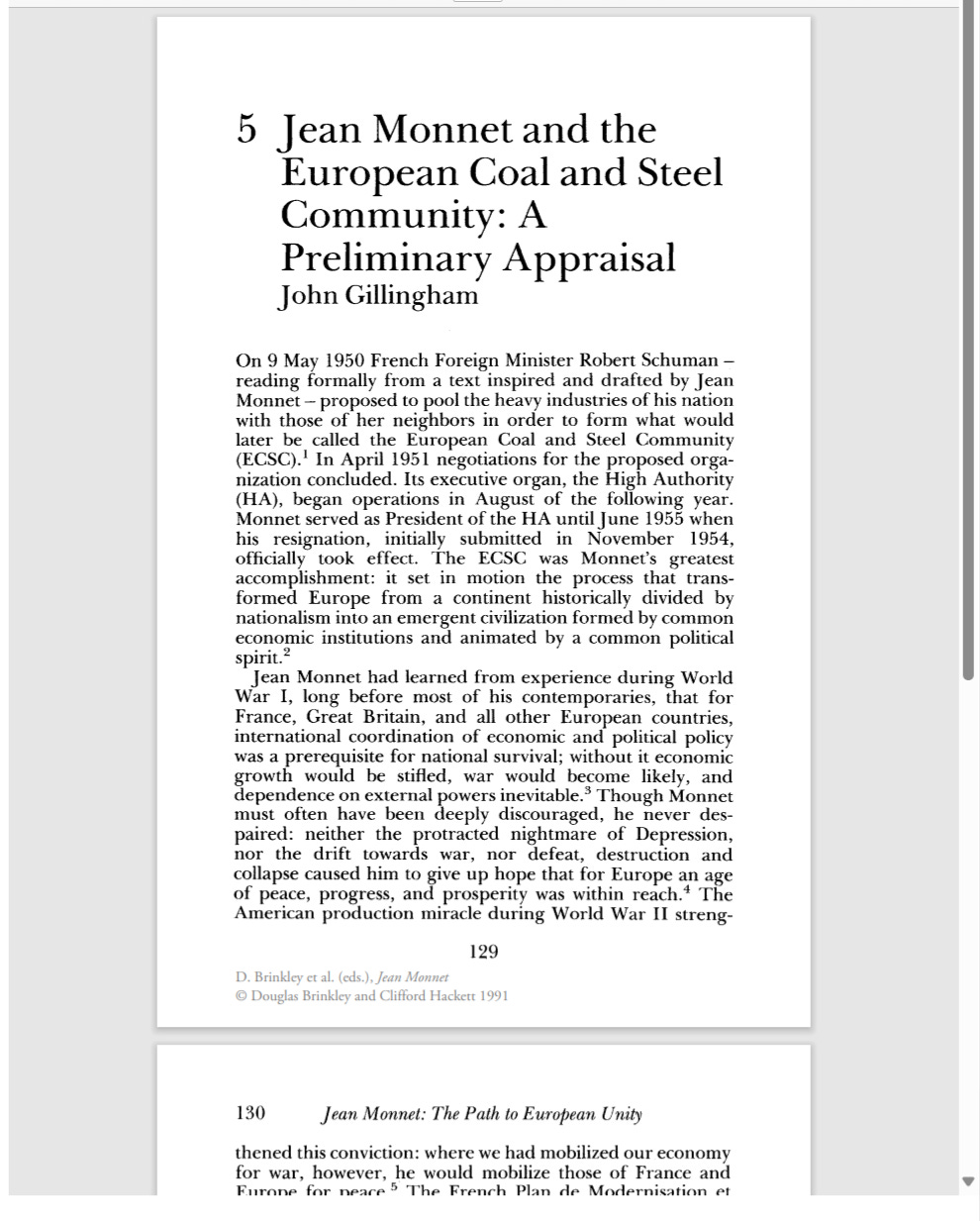
Jean Monnet and the European Coal and Steel Community: A Preliminary Appraisal | Springer Link;
On 9 May 1950 French Foreign Minister Robert Schuman — reading formally from a text inspired and drafted by Jean Monnet — proposed to pool the heavy industries of his nation with those of her neighbors in order to form what would later be called the European Coal and Steel Community (ECSC).1 In April 1951 negotiations for the proposed organization concluded. Its executive organ, the High Authority (HA), began operations in August of the following year. Monnet served as President of the HA until June 1955 when his resignation, initially submitted in November 1954, officially took effect. The ECSC was Monnet’s greatest accomplishment: it set in motion the process that transformed Europe from a continent historically divided by nationalism into an emergent civilization formed by common economic institutions and animated by a common political spirit.2
Jean Monnet and the European Coal and Steel Community: A Preliminary Appraisal | SpringerLink (Retrieved November 10, 2024)
…
Glucksmann posted on X that “Trump’s election is one of those tipping points that shape history. We are now, in Europe, alone to face our destiny.” This provoked an impassioned reaction from Antoine Léaument. “How can you be so out of touch that you can’t see that it’s the political position you hold in Europe and France that has led to defeat at the hands of Trump?” he challenged.
Editor: Glucksmann vs. Antoine Léaument!
…
Appalling! Pathetic!” reacted Green Senator Yannick Jadot, anticipating a return of tensions amongst the left.
Newspaper Reader.


 StephenKMackSD's Blog