Newspaper Reader comments.
Headline: Academics can no longer speak freely
Sub-headline: Solving this crisis in higher education should transcend the division between the right and the left.
https://www.newstatesman.com/comment/2024/02/academic-free-speech
For many years, left-wing opinion-makers have told us that there is no crisis of free speech in British universities, that the whole idea is a fiction put about by right-wing bigots upset that they can no longer sound off with impunity, or by politicians and journalists intent on stirring up a culture war. To quote Nesrine Malik, writing in the Guardian in 2019, “the purpose of the free-speech-crisis myth is…to blackmail good people into ceding space to bad ideas”.
Anyone who works in a university knows that this is balderdash. The crisis in academia is of course a godsend to the right, but that doesn’t mean that it isn’t also real and serious. Indeed, it is much more serious than most people realise. High-profile cancellations are what make the headlines, but they are merely the occasional effect of something deeper: the capture of entire sections of the academic bureaucracy by ideological lobbies, which insist on imposing their beliefs on all and sundry. We have seen this sort of thing before.
“Books, newspapers, official communications and forms issued by administrative departments – all swam in the same brown sauce,” wrote the German philologist Victor Klemperer, referring to the monotony of thought and language in Hitler’s Reich. The sauce is no longer brown, but apart from that, Klemperer could be describing a modern British university.
The Reader might look to this essay by Mr. Skidelsky at ‘The Critic’ from 2021:
Headline: The Specter of Totalitarianism
The worst offenders in the new climate of intolerance are our universities.
https://thecritic.co.uk/issues/march-2021/the-spectre-of-totalitarianism
…
The new intolerance is often seen as a specifically left-wing phenomenon — an intensification of the “political correctness” which emerged on US campuses in the 1980s. But that is a one-sided view of the matter. It was US Zionists who pioneered the tactic of putting pressure on organisations to disinvite unfavoured speakers; far-right nationalists are among the keenest cyberbullies; and religious zealots of all stripes are prodigal of death threats.
Generalising, one might say that left-wing groups, being more publicly respectable in our part of the world, prefer to pursue their objectives through institutions and the law, whereas right-wing groups seek out the anonymity of the internet. But the goal on each side is the same: it is to intimidate, suppress, silence. In any case, the distinction between “left” and “right” is becoming increasingly muddled, as lines shift and alliances regroup. All one can safely say is that the various forms of contemporary extremism imitate and incite each other. What has given way is the civilised middle ground.
For this reason, I prefer to speak not of “fascism” or “political correctness” but of “totalitarianism”, a label designed to pick out what is common to fanaticisms of left and right. Totalitarianism is often thought of as a type of regime, which may make my use of the term seem hyperbolic; after all, we still live in a democracy. But it can also be understood in a broad sense, as a frame of mind and a style of political action. Totalitarianism in this broad sense existed in Russia and Germany before the establishment in either country of a totalitarian regime, and it remained a force in West European politics even after the war, if only on the radical fringe. It is totalitarianism in this sense whose recent rise to prominence alarms me. A public inured to totalitarian habits of thought and action is unlikely to offer much resistance to a totalitarian takeover of the state.
…
Call Mr. Skidelsky a political opportunist, who writes a ‘History Made To Measure’: its like reading The Financial Times Opinion Section.
In the context of these two essays, The Reader might gain from reading Skidelsky’s essay of 1999 on Perry Anderson?
Headline: The New Statesman Profile – Perry Anderson
Sub-headline: He is one of Britain’s great Marxist intellectuals, yet now he seems a strangely conservative figure
https://www.newstatesman.com/politics/welfare/1999/03/the-new-statesman-profile-perry-anderson
Some revelatory quotation:
On Anderson’s critique of Fukuyama, as presented by Skidelsky:
…
A good example of this is his essay on Francis Fukayama’s The End of History. Fukayama’s grand narrative of historical progress – even though it culminates in the triumph of bourgeois liberal democracy – is of precisely the kind to win Anderson’s admiration. Anderson defends it against its detractors, claiming, on impeccably Marxist grounds, that their various refutations of Fukayama’s hypothesis amount to nothing more than local difficulties, and do not constitute a genuine contradiction. But then – as if suddenly realising what he has admitted – he amasses a whole set of difficulties of his own, ranging from environmental problems to feminism. But these are no more a fundamental contradiction than the difficulties he has previously dismissed. All are manageable within the confines of the present world-system. Fukayama has beaten Anderson at his own game.
…
Editor: Nothing impressed the intellectual bumkins across continents as much as Fukuyama’s Hegelian inflected chatter. Charlatan !
Editor: added 2/28/2024:
Then there is this dubious commentary about how Anderson must comport himself as a Public Intellectual. Not to speak of Anderson’s romance with ‘Latin American terrorism’.
Anderson is notoriously elusive. No interviews, no broadcasts – and even the London School of Economics, where he is a visiting lecturer, did not have a photograph to contribute to the illustration of this profile. Yet for all his elusiveness, his influence on British intellectual life has been enormous. The conduit of this influence was the New Left Review, the socialist bi-monthly which he edited from 1962 to 1982. Anderson’s goal was the introduction into Britain of a new kind of socialist culture, alternative to both the official Marxism of the Communist Party and the stolid reformism of the Labour Party. His followers saw themselves as a revolutionary vanguard. Inspired by Gramsci, they aimed to establish a socialist hegemony in the realm of ideas from which, they hoped, a revolutionary movement would follow. The leading lights of Continental Marxism – Lucacs, Gramsci, Benjamin, Adorno, Marcuse and Althusser – were published and discussed, often for the first time in Britain. Non-Marxist structuralists such as Lacan and Levi-Strauss were also introduced. High theory was interspersed with the other amour of the era: Latin American terrorism.
Just having re-read The Origins of Post-Modernity, a work of impeccable scholarship, historical insight, not offered by any writer/thinker, other than Fredric Jameson! The reader will note that the claim made by Skidelsky, is the same claim made by the critics of that Post-Modernism, Derrida being the target of choice.
…
Defeated on the political plane, Anderson has at last succumbed to the “siren voices of idealism”. His latest essay, The Origins of Postmodernity, is a work of cultural criticism in the classic tradition of Benjamin and Adorno. It is essentially a defence and an elaboration of Frederic Jameson’s thesis that postmodernism constitutes “the cultural logic of late capitalism”.
Postmodernism is a natural target of attack for a Marxist. What it signifies is the final disappearance of any critical perspective on the capitalist order. The Soviet Union, for all its imperfections, provided such a perspective, and its existence sustained the avant-garde throughout Europe and America. Now there is nothing but capitalism. Any revolt is immediately assimilated and commodified. Art, realising this, has abandoned its haughty intransigence and entered into alliance with the market. The tone of the essay is one of sorrowful resignation. Anderson can diagnose the malady, but he has no cure.
…
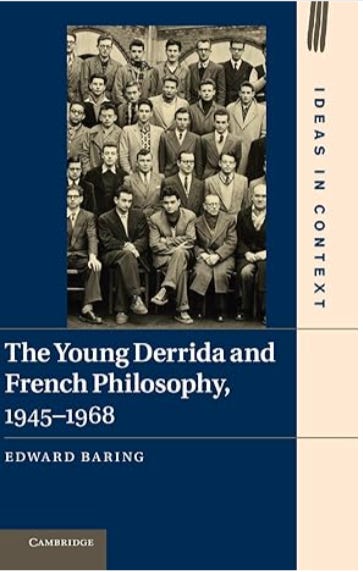
The Young Derrida and French Philosophy. 1945-1968
Edward Baring, Cambridge University Press, 2011, 326pp., $95.00 (hbk), ISBN 9781107009677.
Reviewed by Samir Haddad, Fordham University
2012.08.28
https://ndpr.nd.edu/reviews/the-young-derrida-and-french-philosophy
Newspaper Reader


 StephenKMackSD's Blog