As a Reader of a certain age, nearing 80, I have to wonder about David Brook’s status as a New York Times Public Intellectual, born in 1961! By the 1970’s I was reading Russian Thinkers, Against the Current, Age of Enlightenment: The 18th Century Philosophers [The Mentor Philosophers Series] And all these essay published in The New York Review of Books.
Isaiah Berlin
Isaiah Berlin (1909–1997) was a philosopher and historian of ideas who held the Chichele Professorship of Social and Political Theory at Oxford. The final volume of his correspondence, Affirming: Letters 1975–1997, was published in December 2015.
I will quote the relevant paragraphs of Brook’s essay dealing with Berlin:
…
That idea is known as value pluralism. It’s most associated with the British philosopher Isaiah Berlin and is based on the premise that the world doesn’t fit neatly together. We all want to pursue a variety of goods, but unfortunately, these goods can be in tension with one another. For example, we may want to use government to make society more equal, but if we do, we’ll have to expand state power so much that it will impinge on some people’s freedom, which is a good we also believe in.
As Damon Linker, who teaches a course on Berlin and others at the University of Pennsylvania, noted recently, these kinds of tensions are common in our political lives: loyalty to a particular community versus universal solidarity with all humankind; respect for authority versus individual autonomy; social progress versus social stability. I’d add that these kinds of tensions are rife within individuals as well: the desire to be enmeshed in community versus the desire to have the personal space to do what you want; the desire to stand out versus the desire to fit in; the cry for justice versus the cry for mercy.
…
Berlin had a word for people who think there is one right solution to our problems and that therefore we must do whatever is necessary in order to impose it: monists. Berlin was born in pre-revolutionary Russia and came of age in the 1930s, when two monist philosophies were on the march, Marxism and fascism. They claimed to be all-explaining ideologies that promised an ultimate end to political problems.
…
We pluralists resist that kind of Manichaean moralism.
…
We pluralists believe that conflict is an eternal part of public life — we’re always going to be struggling over how to balance competing goods — but it is conflict of a limited sort, a debate among patriots, not a death match between the children of light and the children of darkness.
…
Pluralism is a creed that induces humility (even among us pundits, who are resistant to the virtue). A pluralist never believes that he is in possession of the truth, and that all others live in error. The pluralist is slow to assert certainty, knowing that even those people who strenuously denounce him are probably partially right. “I am bored by reading people who are allies,” Berlin once confessed.
…
He was more interesting when writing about specific people — like Machiavelli or Churchill — than when writing about abstract ideas.
…
Berlin argued that if there were a final set of solutions, “a final pattern in which society could be arranged,” then “liberty would become a sin.”
…
I’ve left this paragraph, out of the order of its presentation, this self serving political chatter…
In the 1980s, I thought the chief worry was economic sclerosis and that Reagan/Thatcher policies, including tax cuts, were the right response. Now I think the chief worry is inequality and social fragmentation, and I think the Biden policies, including tax increases, are the right response.
Those ‘right responses’ to the 1980’s , in sum the Neo-Liberal Swindle that produced the Economic catastrophe of 2007-2008, and the ruination of both the Working Class and The Middle Class – Brooks lacks the integrity to face his culpability, while proclaiming his Pluralism.
Reader, consider this essay in The London Review of Books:
Many years later, reviewing Personal Impressions for the New Statesman, I mentioned the old story of Berlin acting as an academic gatekeeper, and barring the appointment of Isaac Deutscher to a chair at Sussex University. This denial had the sad effect of forcing Deutscher – who had once given Berlin a highly scornful review in the Observer – to churn out Kremlinology for a living: as a result of which he never finished his triad or troika of Stalin, Trotsky and Lenin biographies. In the next post came a letter from Berlin, stating with some anguish that while he didn’t much approve of Deutscher, his opinion had not been the deciding one. I telephoned Tamara Deutscher and others, asking if they had definite proof that Berlin had administered the bare bodkin, and was told, well, no, not definite proof. So I published a retraction. Then came a postcard from Berlin, thanking me handsomely, saying that the allegation had always worried and upset him, and asking if he wasn’t correct in thinking that he had once succeeded more in attracting me to Marxism than in repelling me from it. I was – I admit it – impressed. And now I read, in Ignatieff’s book, that it was an annihilatingly hostile letter from Berlin to the Vice-Chancellor of Sussex University which ‘put paid to Deutscher’s chances’. The fox is crafty, we know, and the hedgehog is a spiky customer, and Ignatieff proposes that the foxy Berlin always harboured the wish to metamorphose into a hedgehog. All I know is that I was once told – even assured of – one small thing.
Isaac and Isaiah: The Covert Punishment of a Cold War Heretic by David Caute – review
Tariq Ali on a renowned scholar’s vendetta against a fellow refugee
…
Berlin was a liberal fanatic, a staunch empire loyalist, gliding effortlessly from Britain to the US when the time came. He was at his happiest when close to power, an instinctive courtier, unless insulted or ignored. During the 1970s he was invited to Iran, then under the Shah, when dissidents were being hanged naked or toasted on racks by the hated secret police. He accepted. His fee was never disclosed, but the subject of his talk, “On the Rise of Cultural Pluralism”, irritated the empress Farah Pahlavi. He was barely halfway through when the empress signalled a factotum to bring her torture to an end and stop the lecture. Berlin later confided to a friend that it was as if he had been “stung by several wasps”. But why had he gone in the first place?
Both of these essays explore the fact that Isaiah Berlin was not above defaming Isaac Deutscher! Pluralism matters how in Berlin’s treatment of Isaac Deutscher ?
Reader don’t miss to opportunity offered ‘Sir Isaiah Berlin Interview 1995 Michael Ignatieff’ although at times listening to Berlin, is muddled or simply beyond understanding? While Ignatieff is nearly ecstatic in his proximity to the Master.
The excerpts from a letter of 17, October 1989 demonstrates that Berlin was, at the least a political/moral conformist. His concerted campaign against Isaac Deutscher, proves that Berlin was just another Academic Politiker, who betrayed his ‘values’ when convenient!
Kaiser had good things to say, too, telling an anecdote about Alsop beguiling children in a small Vietnamese town—“Joe at his best.” But he found himself unable to place Alsop in his “mental closet.” “Certainly he was almost unique here as a genuine intellectual who knew his own mind, and also just knew a lot. He also played a very important role in the (now ended) era of punditry, but I fear the high point of his career was in intimidating JFK to make a commitment in Vietnam, a tragic error.” Moreover, Alsop “was a tormented soul, confused about his own sexuality, addicted to booze and tobacco, often just sad.” Kaiser asked Berlin: “What does all this add up to? How did you understand the man?” Following is Berlin’s reply, drawn from the fourth and final volume of his correspondence, Affirming: Letters 1975–1997, edited by Henry Hardy and Mark Pottle, to be published in the US later this year.
—Henry Hardy
…
With all this, he was bad-tempered, bibulous (as you say), could be a bully—but only towards people whom he suspected of opportunism, running with the tide, above all of holding views, whether in a weak and flexible way or in an obstinate and unyielding way, which he regarded as against the interests of the United States. Hence his dislike for Walter Lippmann (whom I knew well and who was indeed a twig that bent in the wind, honest, intelligent but of no character really, undone by his appalling embarrassment about his Jewish origins, which rattled like a skeleton in a half-opened cupboard); ditto my hero Stevenson, whom he regarded as a weakling, over-high-minded; Scotty Reston, for whom he had no moral or intellectual respect; but equally right-wingers like Arthur Krock, whom he despised as one of the vicious defenders of the extreme, slightly Fascist right. He was a deeply neurotic character, lonely, liable to periods of gloom and depression—hence, for the most part, the drink—and certainly to some extent undone by his crypto-homosexuality, which he sought to conceal all his life, but which became more and more widely known, although he never knew the extent to which it was known….
…
He could not resist charm and intelligence. Naturally, he began by violently denouncing Bob Silvers. When they met, they became fast friends. He was a great friend of my friend Stuart Hampshire, who is a lifelong socialist and whose views coincided with Joe Alsop’s at very few points. He became a friend of a man called Burdon-Muller, of whom I do not expect you to have heard (he was a rich, eccentric pro-Soviet who lived in Cambridge and Boston) as well as Franklin Roosevelt; and Ben Cohen, whom one cannot accuse of illiberal views—Joe thought him a saint and almost invariably right, though politically, of course, there were disagreements. He was friends, to my great indignation, with the horrible Lillian Hellman, who had praised his stance on civil liberties. But, of course, as time went on he became more and more reactionary, even though one could tease him about that and to some degree he laughed at himself for his lonely, rock-like attempt to stem the irresistible tide of vulgarity, decline in intellectual rigour, betrayal of the old civilisation, etc. which he perceived at Harvard, Washington and wherever.
…
He was a total original: the cruel bullying of which you speak did no doubt occur, and so did the drunkenness—if I had been there, even shivering in a corner, and said “Now, Joe, stop this, don’t go on like this,” I think he would have stopped. He prized friendship above almost everything—not above his patriotism, perhaps, but certainly everything else. Arthur Schlesinger’s obituary of him was fundamentally just and generous : he basically did not care for Arthur, unlike everyone else—he seemed too far to the left (!)—but adored his second wife, who is the daughter of a lady he once paid court to. So they remained on terms. Given this, Arthur’s piece about him is very creditable indeed. But they were not friends personally in the way that Chip Bohlen, Philip Graham (who once told me that he had once meditated joining the Soviet Army as a volunteer against the Finns), Fritchey, Evangeline Bruce or Aline and I were friends. In the end, it was his private person, his warm heart, his honesty, courage and integrity, which no political combination or personal advantage, of whatever kind, ever affected in the smallest degree, that drew one to him. In the end, one simply likes people for what they are, not for this or that reason—I think Montaigne said that.The way people look, speak, the expressions on their faces, what one experiences when they enter a room—this is what determines one’s fundamental feelings. He was a man on his own: his marriage was a disaster. He remained incurably solitary; his politics were more often than not deplorable—in personal conversation it became a joke—but you are right, in the kind of situations you describe he must have been often unspeakable.
I have done my best. I don’t know if that explains anything, I only hope it does. Please give my love to both your parents.
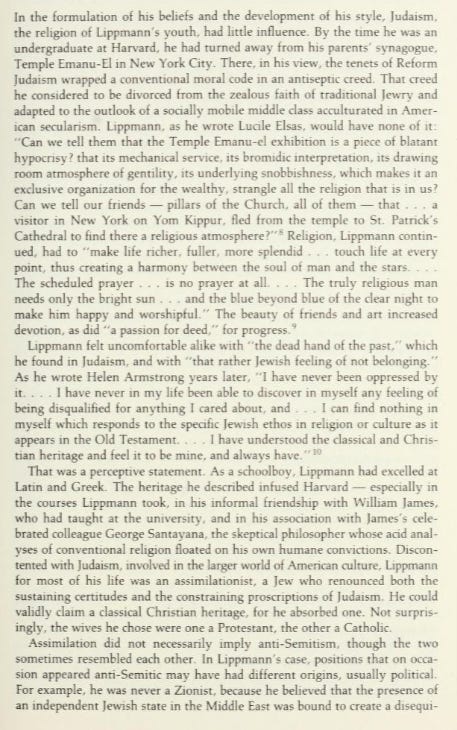
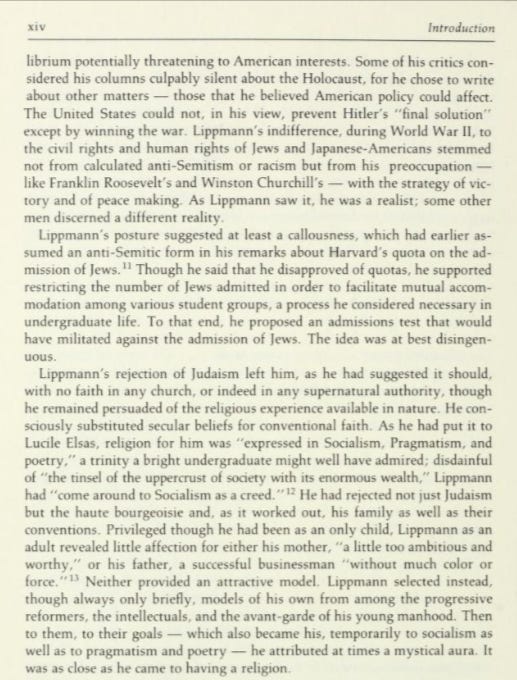
In John Morton Blum’s book Public Philosopher : The Selected Letters of Walter Lippmann presents Lippmann development on the question of Judaism, in his life and thought, sans the accusatory and shaming rhetoric of Berlin! Pages xiii to xiv
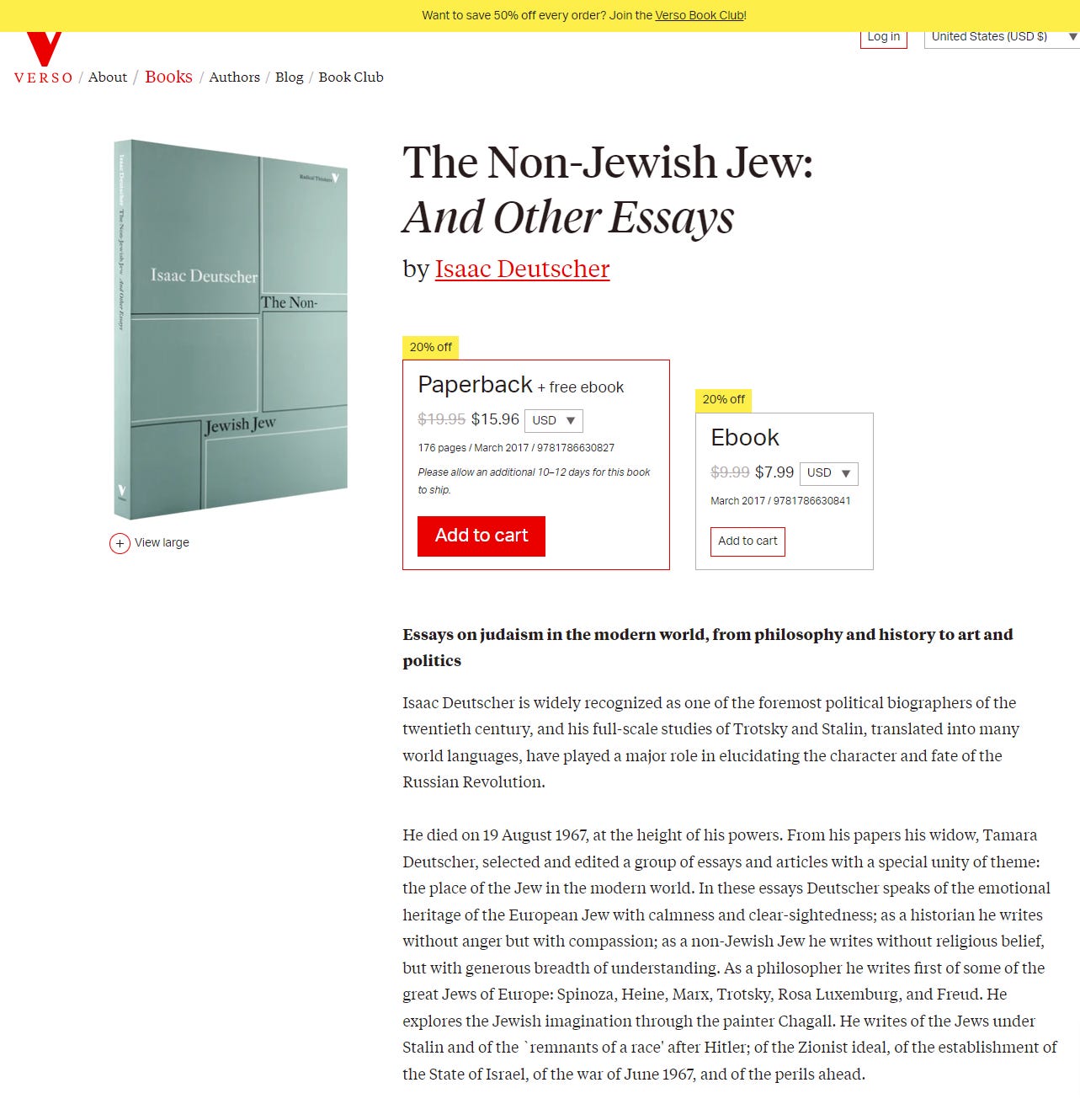
Here is a book of interest that should provide some insights into Isaac Deutscher as writer/thinker/Non-Jew:
Rootless cosmopolitan,down at heels intellectual;would be writer.
'Polemic is a discourse of conflict, whose effect depends on a delicate balance between the requirements of truth and the enticements of anger, the duty to argue and the zest to inflame. Its rhetoric allows, even enforces, a certain figurative licence. Like epitaphs in Johnson’s adage, it is not under oath.'
https://www.lrb.co.uk/v15/n20/perry-anderson/diary


 StephenKMackSD's Blog