Old Socialist comments.
Mr. Stephens first paragraph is instructive as to his self-serving ‘analysis’ of a snapshot of the bad actors in his melodrama. I will highlight these in bold font.
When historians look back on the early days of 2024, they probably won’t recall what, precisely, an elderly Democratic president couldn’t quite remember about the names or countries of other world leaders. They will note what 26 Senate Republicans chose to forget about world leadership.
…
On paper, the 70-to-29 vote looks like a bipartisan embrace of embattled democratic allies.
…
Republicans reverted to the isolationism of the original America First Committee of pre-World War II infamy.
…
…Oklahoma’s James Lankford. The cynicism would be breathtaking if it weren’t so predictable coming from the Trumpified right.
…
…Arkansas’s Cotton, there’s the argument that support for Israel’s efforts to defeat Hamas is incompatible with any civilian assistance for Gazans.
…
…Ron Johnson, we have the claim that although Vladimir Putin is “an evil war criminal,” Russia is certain to win the war,…
…
…J.D. Vance, this: “The supplemental represents an attempt by the foreign policy blob/deep state to stop President Trump from pursuing his desired policy.”
Mr Stephens inserts his diagnosis of the political opportunists:
What a mix of cruelty, defeatism, conspiracy-mongering and political servility.
Karen Sullivan offer a relevant study of the authoritarian personality that places Mr. Stephens in a larger historical and moralizing context :
The Inner Lives of Medieval Inquisitors
There have been numerous studies in recent decades of the medieval inquisitions, most emphasizing larger social and political circumstances and neglecting the role of the inquisitors themselves. In this volume, Karen Sullivan sheds much-needed light on these individuals and reveals that they had choices—both the choice of whether to play a part in the orthodox repression of heresy and, more frequently, the choice of whether to approach heretics with zeal or with charity.
In successive chapters on key figures in the Middle Ages—Bernard of Clairvaux, Dominic Guzmán, Conrad of Marburg, Peter of Verona, Bernard Gui, Bernard Délicieux, and Nicholas Eymerich—Sullivan shows that it is possible to discern each inquisitor making personal, moral choices as to what course of action he would take. All medieval clerics recognized that the church should first attempt to correct heretics through repeated admonitions and that, if these admonitions failed, it should then move toward excluding them from society. Yet more charitable clerics preferred to wait for conversion, while zealous clerics preferred not to delay too long before sending heretics to the stake. By considering not the external prosecution of heretics during the Middles Ages, but the internal motivations of the preachers and inquisitors who pursued them, as represented in their writings and in those of their peers, The Inner Lives of Medieval Inquisitors explores how it is that the most idealistic of purposes can lead to the justification of such dark ends.
https://press.uchicago.edu/ucp/books/book/chicago/I/bo10715485.html
Mr. Stephens self-presentation in this paragraph, is predictably self-congratulatory, yet The Reader confronts the political history of a Zionist without apology. Stephens engages in self-apologetics, it is his métier.
…
I’m surely among the most pro-Israel commentators around, but I can think of no moral or strategic argument in which hunger and disease among Gaza’s civilians serve anyone’s interests, least of all Israel’s.
…
It also echoes the prewar defeatism of figures like Robert Taft and Joseph Kennedy, who argued against helping Britain during the Blitz because Hitler was destined to win.
…
Today’s G.O.P. isolationists now have more in common with George McGovern’s “Come home, America” slogan than with anything Ronald Reagan or Dwight Eisenhower stood for.
…
…the Republican riposte to these failures reminds me of something the theoretical physicist Wolfgang Pauli reportedly said about a young physicist’s work: “It is not even wrong” —…
…
any more than a patient should put off getting a skin cancer removed until he loses 50 pounds. It is an idiotic linkage guaranteed to do harm.
…
In January 1945, Arthur H. Vandenberg, a Michigan Republican, gave a landmark Senate speech now remembered as the moment when his party finally began to put its reflexive isolationism behind it.
…
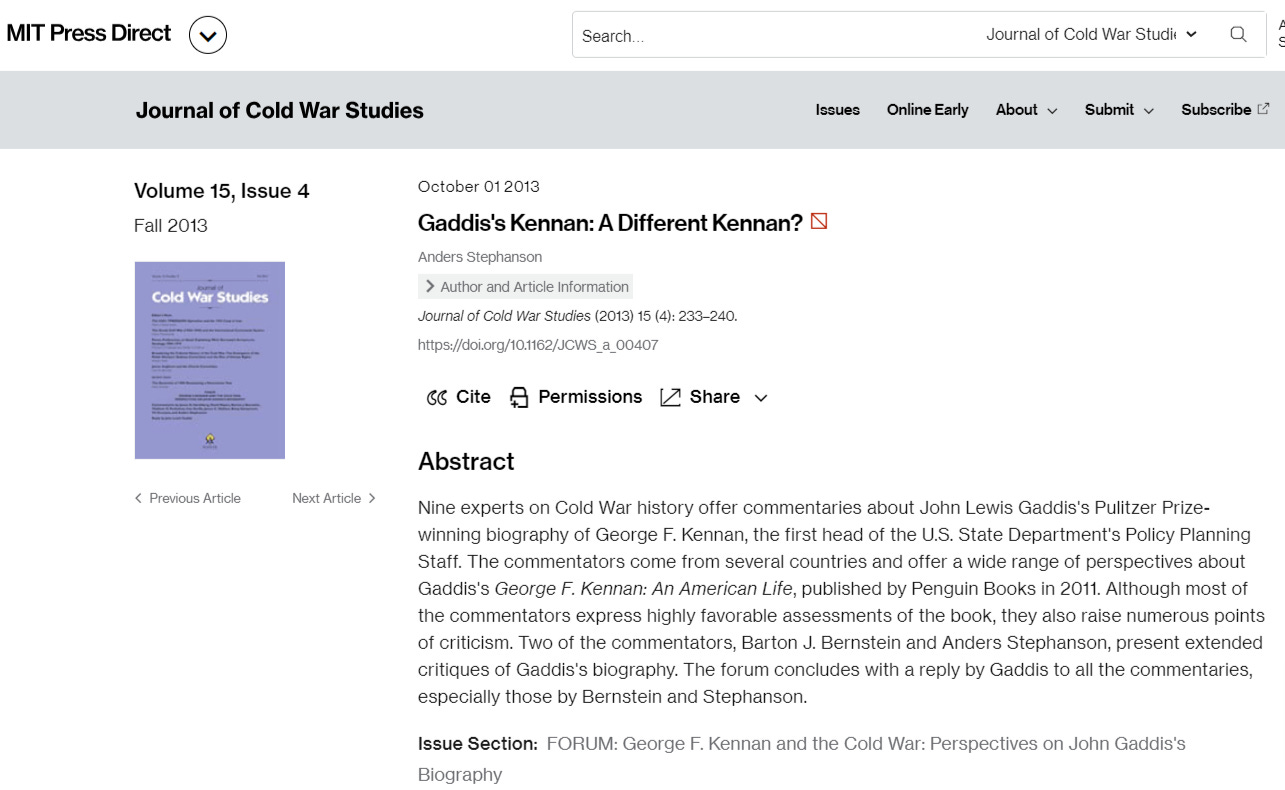
Mr. Stephens ransacks ‘History’ its ‘Bad Actors’ while Vandenberg and his arrival at an Enlightened position, while willfully forgetting George Kennan of The Long Telegram… Read the Fall 2013 of the Journal of Cold War Studies for a collection critical commentary on ‘Gaddis’s George F. Kennan: An American Life .
The eternally bumptious Stephens scolding of George McGovern, is just another reminder of his political posturing as a reliable New York Times Public Intellectual!
Old Socialist


 StephenKMackSD's Blog