Mr. Stephens in his latest contribution to @NYT . Under the pretentious rubric:
Opinion
The Point
Conversations and insights about the moment.
Updated
Feb. 2, 2024, 9:24 p.m.
Mr. Stephens is a bellicose Neo-Con, without any kind of military experience. Yet he places his faith, based upon a complete ignorance of what war might be, or its imperatives, based on a Military model of 1988. As a Neo-Con he, perhaps, draws on the expertise of his fellow Neo-Cons, in the area of effective Military Strategy? Yet the lessons of Afghanistan, Iraq and Ukraine prove that the Neo-Conservative cadre has produced murder, chaos and political instability on a World Historical Scale!
B.A. with honors from the University of Chicago, and an M.Sc. from the London School of Economics: The Master of Science (M.Sc.) is an academic degree for post-graduate candidates or researchers, it usually takes from 4 to 7 years after passing the Bachelor … confers ‘expertise’ upon its graduates?
The last four paragraphs of Mr. Stephens essay are revelatory of his posturing!
The Biden administration has responded to some of these previous attacks with precision strikes — attempting to send a message to Tehran while hoping to avoid escalation. It hasn’t worked. To adapt an adage attributed to Leon Trotsky, we may not be interested in making war on Iran, but Iran is interested in making war on us.
What could get Tehran to stand down, at least for a time? Not attacking their proxies, which are now surely dispersing their forces in anticipation of U.S. strikes. A better model was 1988’s Operation Praying Mantis, a military operation launched in retaliation for an Iranian mine that nearly sank an American frigate during a period when Tehran was constantly attacking oil shipping in the Persian Gulf.
In that daylong engagement, the U.S. Navy sank six Iranian ships and destroyed two Iranian intelligence facilities on old oil platforms. Tehran got the point. Praying Mantis helped end Iran’s attacks on international shipping, and it was one of the factors that finally persuaded Iran’s leaders to agree to an end to the Iran-Iraq war.
Iran has used its proxies to start fires across the Middle East. They won’t be put out until the arsonist is taken down.
This will acquaint The Reader of Mr. Stephens with Edwin M. Yoder’s book about Joe Alsop, a political commentator who did not serve in WWII, but was in the Asian Theater of that War, and covered the war in Korea.
See this review of Mr. Yoder’s book in the Times of April 2, 1995, Section 7, Page 9:
JOE ALSOP’S COLD WARA Study of Journalistic Influence and Intrigue. By Edwin M. Yoder Jr.220 pp. Chapel Hill: University of North Carolina Press. $24.95.
NEWSPAPER columnists once wielded more power over Washington than television anchors do today. Walter Lippmann, James Reston and the Alsops, Joe and his younger brother Stewart, to name some of the most notable, pounded home, three or four times weekly, inside stories of palace intrigues, mythologically potent notions of “missile gaps” and “domino theories” and galleries of dragon slayers and dragons. Politicians and policy makers listened. They had to.
The columnists, with their five-star social and professional connections, knew more about what was going on in Byzantium-on-the-Potomac than Presidents and Speakers of the House. Everyone talked to them privately, and everyone knew that everyone talked to them privately. Not least, they could wound foes and protect friends. And they did, with much the same sting that William Safire, perhaps alone, possesses today.
“Walter Lippmann and the American Century,” Ronald Steel’s life of Lippmann, set a magisterial standard for understanding those days. Edwin M. Yoder Jr., himself a respected columnist for The Washington Post Writers Group and a former editorial page editor at The Washington Star, did not aim so high in “Joe Alsop’s Cold War.” Rightly so, as editorial writers are wont to put it, for Joseph Alsop could not rival Walter Lippmann’s mind or James Reston’s reportorial skills.
But Joe Alsop was a clever journalistic intriguer and influencemonger, as Mr. Yoder signals in his subtitle, a man decidedly of a class and type, yet unique — and important. As a member of the Winthrop and Chubb clans, Alsop had the ultimate WASP pedigree, manners and restraint, yet the same zest for public brawls as his cousins Theodore and Franklin Roosevelt. He wrote hatchetlike columns and a book on Chinese art. He also was a columnist who would brutalize the challengers of his outsized estimate of the Soviet threat, yet valiantly defend victims of redbaiting like the State Department adviser John Paton Davies and the physicist J. Robert Oppenheimer.
…
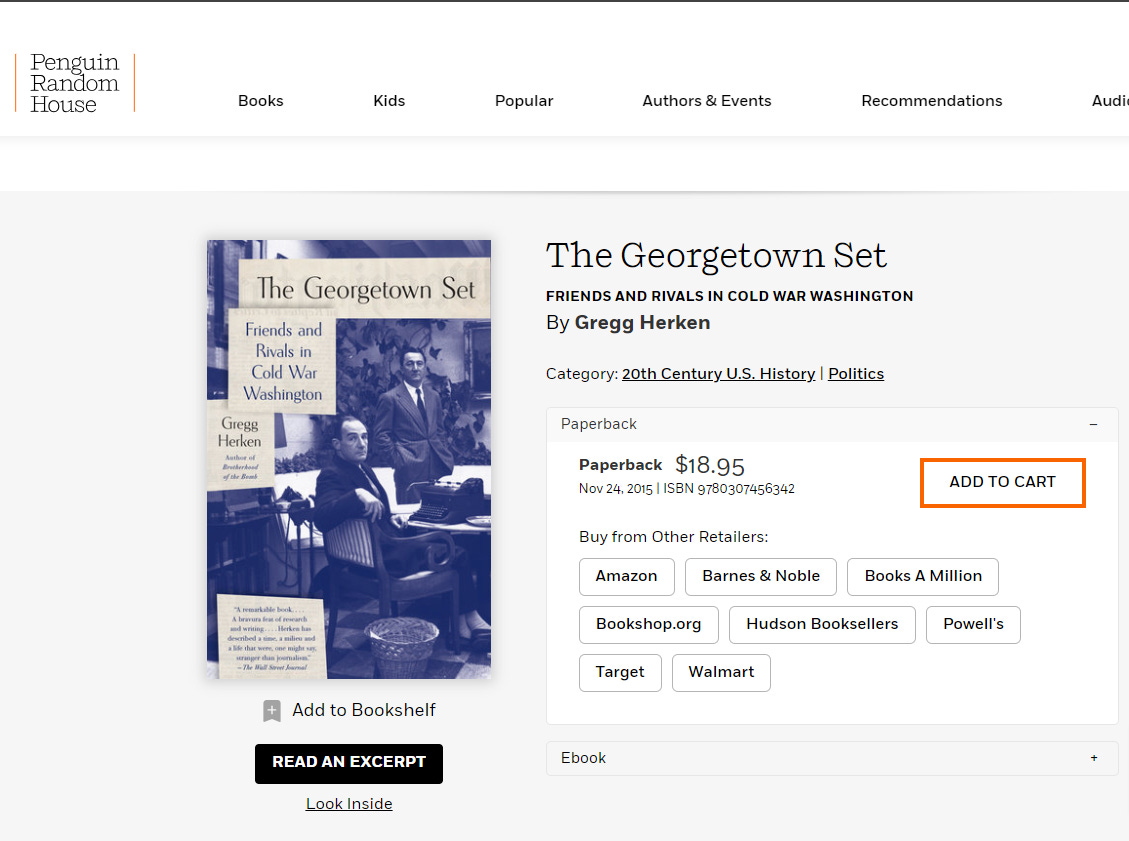
Mr. Stephens is a Zionist apologist/partisan and political propagandist, the Alsop Brothers were political operators and propagandists, with reach and influence for a reason! They were part of a long gone American Patrician Class, as explored in Mr. Yoder’s book, and Gregg Herken’s insightful book, that sometimes lapses into bestseller territory ‘The Georgetown Set’.
Like the Alsop brothers, who attended the Groton School for Boys, in Groton, Massachusetts, under the tutelage of the storied Endicott Peabody, Stephens attended an exclusive boys school Middlesex School in Concord, Massachusetts: so a sense of entitlement, attached to the pretense of expertise, is a natural attitude for Stephens to manifest?
Rootless cosmopolitan,down at heels intellectual;would be writer.
'Polemic is a discourse of conflict, whose effect depends on a delicate balance between the requirements of truth and the enticements of anger, the duty to argue and the zest to inflame. Its rhetoric allows, even enforces, a certain figurative licence. Like epitaphs in Johnson’s adage, it is not under oath.'
https://www.lrb.co.uk/v15/n20/perry-anderson/diary


 StephenKMackSD's Blog