Political Observer comments.
A personal note:
As a long time subscriber of The Economist: I still have a page torn out of the February 24 , 2001 edition , a review of ‘Law Without Values: The Life, The Work , and The Legacy Of Justice Holmes’. I cancelled my subscription after The Economist discontinued the ‘comments section’. To my surprise, I received two telephone calls, from representatives of the magazine, asking me the ‘why’ of my cancellation? I told both of these men, that if The Economist wasn’t interested in my comments, I was no longer interested in reading this News Magazine. Time has past and I could not resist commenting upon a publication that was still moored in 1843.
I recommend Alexander Zevin book, a revelatory history, as a starting point:
When the New York Times lost its way
American media should do more to equip readers to think for themselves
https://www.economist.com/1843/2023/12/14/when-the-new-york-times-lost-its-way
At a mere , yet dizzying 17, 568 words, here are some revelatory paragraphs:
…
Whether or not American democracy endures, a central question historians are sure to ask about this era is why America came to elect Donald Trump, promoting him from a symptom of the country’s institutional, political and social degradation to its agent-in-chief. There are many reasons for Trump’s ascent, but changes in the American news media played a critical role. Trump’s manipulation and every one of his political lies became more powerful because journalists had forfeited what had always been most valuable about their work: their credibility as arbiters of truth and brokers of ideas, which for more than a century, despite all of journalism’s flaws and failures, had been a bulwark of how Americans govern themselves.
I hope those historians will also be able to tell the story of how journalism found its footing again – how editors, reporters and readers, too, came to recognise that journalism needed to change to fulfil its potential in restoring the health of American politics. As Trump’s nomination and possible re-election loom, that work could not be more urgent.
I think Sulzberger shares this analysis. In interviews and his own writings, including an essay earlier this year for the Columbia Journalism Review, he has defended “independent journalism”, or, as I understand him, fair-minded, truth-seeking journalism that aspires to be open and objective. It’s good to hear the publisher speak up in defence of such values, some of which have fallen out of fashion not just with journalists at the Times and other mainstream publications but at some of the most prestigious schools of journalism. Until that miserable Saturday morning I thought I was standing shoulder-to-shoulder with him in a struggle to revive them. I thought, and still think, that no American institution could have a better chance than the Times, by virtue of its principles, its history, its people and its hold on the attention of influential Americans, to lead the resistance to the corruption of political and intellectual life, to overcome the encroaching dogmatism and intolerance.
…
https://www.economist.com/1843/2023/12/14/when-the-new-york-times-lost-its-way
Where might the Critical Reader place this Economist Political Moralizing, directed at The New York Times, the American National Security State’s Pravda, when compared to The Economist campaign of lies and defamation against Jeremy Corbyn?
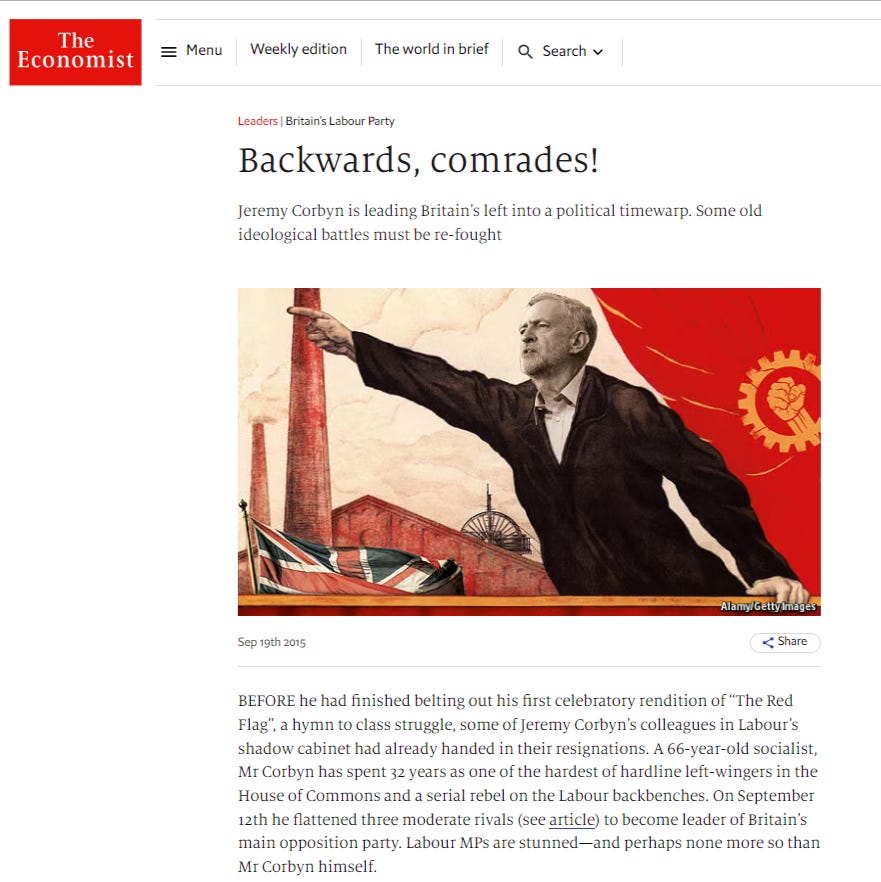
https://www.economist.com/leaders/2015/09/19/backwards-comrades
Or this :
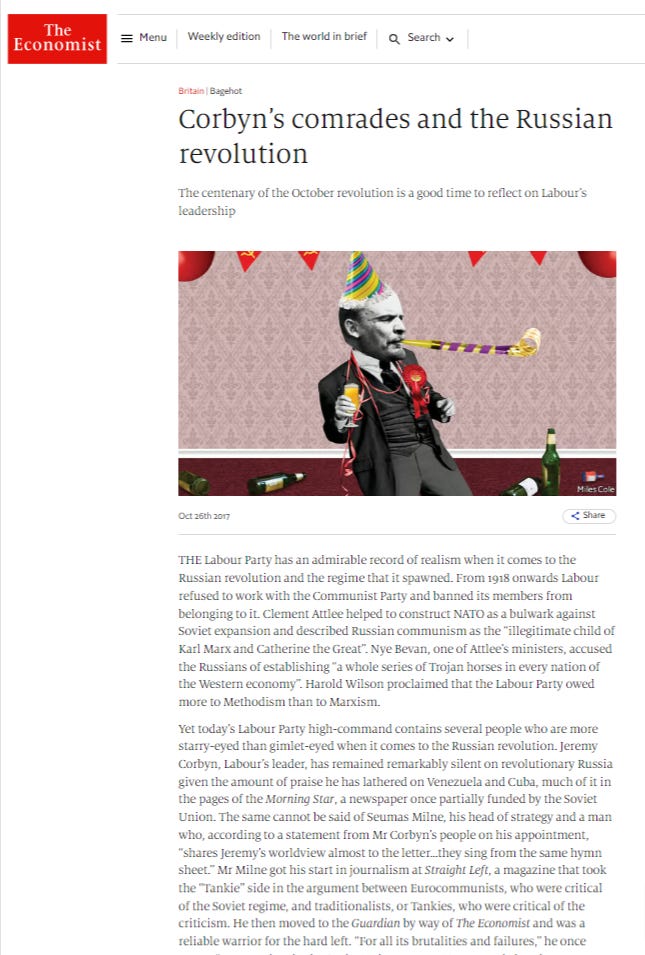
https://www.economist.com/britain/2017/10/26/corbyns-comrades-and-the- russian-revolution
Perhaps this adaptation applies? Let publications without a clear record of lies and defamation should not cast aspersions?
Political Observer


 StephenKMackSD's Blog