Political Observer looks at The Economist’s Past, to predict its…
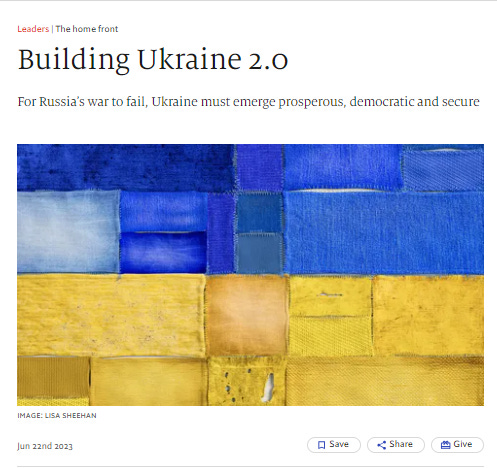
The Reader of The Economist confronts the not so underlying tone of political moralizing.
Ukraine’s war is raging on two fronts. On the 1,000km battlefront its armies are attacking the Russians’ deep defences. At the same time, on the home front Ukraine is defining what sort of country it will be when the fighting stops. Both matter, and both will pose a severe test for Ukraine and its backers.
…
The home front is less dramatic, but everything depends on it.
…
Ukraine’s nation-builders face formidable obstacles. The greatest is that, while Mr Putin is in power, this war is unlikely to end with a solid peace treaty.
…
The other obstacles are almost as formidable, though at least it is in the power of Ukraine and its allies to overcome them.
…
The World Bank has estimated that repairing the damage from the first year of war will cost more than $400bn—and that was before the collapse of the dam at Nova Kakhovka, most likely because of Russian sabotage.
…
To succeed, Ukraine must work on many dimensions at the same time. To attract workers and private capital, it needs to rebuild itself. To unleash the creativity and enterprise of its citizens, it must live by the rule of law.
…
Progress will help lock in Western support, which may ebb—especially if Donald Trump is elected in 2024. It will also signal to Mr Putin and his cronies that their war is futile.
…
The effort starts with money for rebuilding on a vast scale. Ukraine’s economy has stabilised at about two-thirds of its former size. Ultimately, its future rests on private investment, but government money will be needed first.
…
Many countries have a vital interest in Ukraine succeeding and Russian aggression being seen to have failed, but these are straitened times.
…
Instead they should find a legal process that allows them to treat the $330bn or so of Russian state money they have frozen as a fund for paying out compensation to Ukraine.
…
Next comes good government. The war has shunted aside many of the oligarchs who held Ukraine back. Their place has been taken by a cohort of entrepreneurs and activists, many of them with a background in technology.
…
However, Western officials warn that, for all his strengths, Mr Zelensky is bored by the detail that dogged reform entails. When Ukraine finally holds elections it risks lapsing back into the old, corrupt politics.
…
Eventually, Ukraine needs to join nato. That would offer permanent security at the lowest cost, because nato’s Article 5 guarantee would signal to Mr Putin and his successors that an attack on Ukraine was an attack on the entire alliance—a battle Russia could not win.
…
However, Ukraine gains little from joining while battle rages—because that would require suspending Article 5 and any doubt about when it applies would weaken nato. Instead Ukraine needs bilateral security guarantees and an accelerated path to nato membership.
…
This is a fearsome agenda. If Ukraine struggles on the battlefront, a greater burden will fall on the home front and the higher will be the obstacles to success. All the more reason for Ukraine and its allies to press ahead.
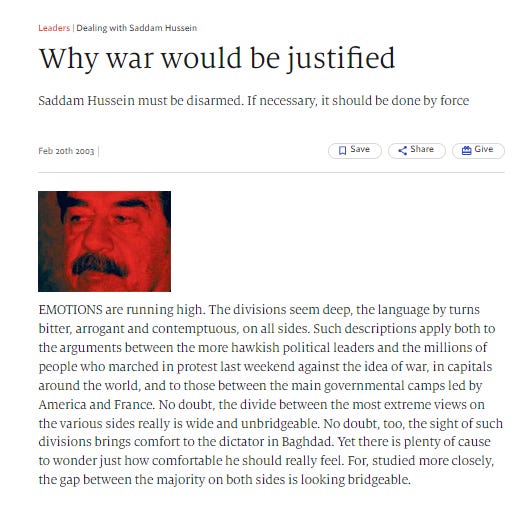
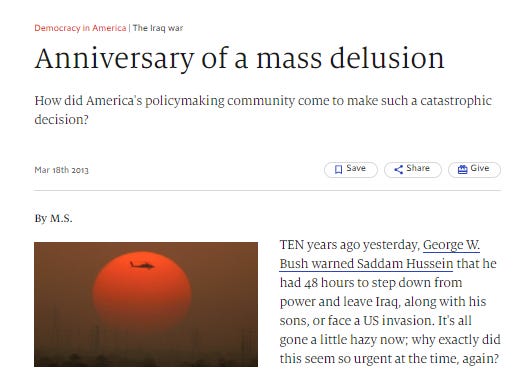
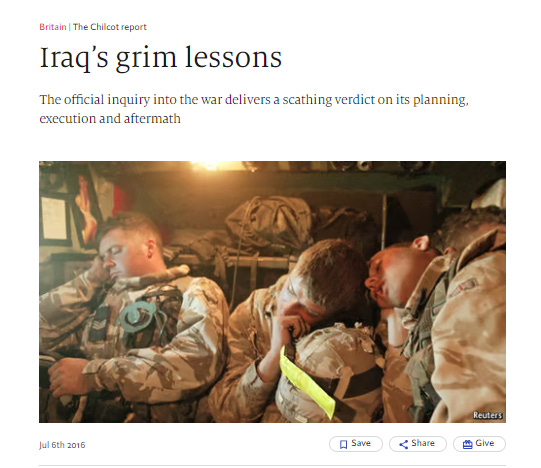
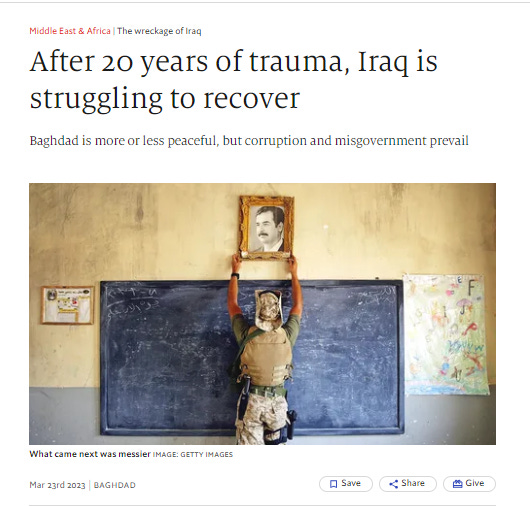
The Reader need only look at the ‘evolution’ of The Economist’s position on the Iraq War, as predictive of the how and why of Joe Biden’s Proxy War in Ukraine!
Political Observer


 StephenKMackSD's Blog